Introduction
As has been previously reported by Tanner (Reference Tanner1962), psychological stress can modify the process of development. On the basis of results of the research carried out in orphanages by Widdowson (Reference Widdowson1951), Tanner concluded that psychological factors can inhibit the process of growth to some extent by the mechanism of hormonal response of an organism to stress. Previous studies on cases of psychosocial dwarfism (Saenger et al., Reference Saenger, Levine, Wiedemann, Schwartz, Korth-Schutz and Pareira1977), the influence of emotional conditions on child development (Montgomery et al., Reference Montgomery, Bartely and Wilkinson1997; Hulanicka et al., Reference Hulanicka, Gronkiewicz and Koniarek2001) and the effects of dramatic events experienced in childhood (Magner et al., Reference Magner, Rogol and Gorden1984) have confirmed the influence of psychological factors on the process of growth. On the other hand, some studies have shown growth retardation to be an important risk factor for brain development (Walker et al., Reference Walker, Wachs, Grantham-McGregor, Black, Nelson and Huffman2011). Early childhood stunting affects the hypothalamic–pituitary–adrenocortical system, which results in elevated levels of salivary cortisol concentration and enhanced cardiovascular responsivity to a physical stressor. Growth retardation is also related to increased risk of depression, higher levels of anxiety and lower self-esteem in later life (Walker et al., Reference Walker, Chang, Powell, Simonoff and Grantham-McGregor2007).
Much is known about the hormonal response of an organism to stress. Children and adolescents who experienced adverse life events have dysregulation of the hypothalamic–pituitary–adrenal axis (HPA), which results in an increased and flattened daily cortisol profile (Van den Bergh et al., Reference Van den Bergh, Van Calster, Pinna Puissant and Van Huffel2008; Vythilingam et al., Reference Vythilingam, Gill, Luckenbaugh, Gold, Collin and Bonne2010). Over-activity of the HPA axis persists for many months after the stressor effect (Vila et al., Reference Vila, Porche and Mouren-Simeoni1999b; Pervanidou et al., Reference Pervanidou, Kolaitis, Charitaki, Lazaropoulou, Papassotiriou and Hindmarsh2007). A high level of glucocorticoids during chronic stress contributes to a decrease in the level of growth hormone (Magiakou et al., Reference Magiakou, Mastorakos, Gomez, Rose and Chrousos1984; Pinto et al., Reference Pinto, Finamor and Lengyel1999), and in addition somatomedin release is inhibited and an organism's sensitivity to that hormone is decreased (Thakore & Dinan, Reference Thakore and Dinan1994). The hormonal responses may be a link between psychological factors and slower development, which has been assumed by Tanner.
Answering the question of the influence of less dramatic events and the role of an individual child's predisposition to respond with stress to potential stress-inducing stimuli seems to be more difficult. For instance, a child suffering from separation anxiety (F93.0 diagnostic category in the International Statistical Classification of Disease and Health Related Problems – ICD10: WHO, 1993) will respond with great anxiety and stress in a situation of separation from a parent, while for other children the situation will be neutral or positive. Therefore in that case the biological response to the stimulus will not depend on the objective nature of the situation but on its individual interpretation. Such reasoning is in accordance with the transactional theory of stress (Lazarus & Folkman, Reference Lazarus and Folkman1987): stress is the outcome of the person–environment relationship and depends on cognitive appraisal of an objective stressor. Hence a hypothesis may be formed that children with an established tendency to negative appraisal of events, and therefore a tendency to respond with anxiety in many situations, will often experience biological stress. The results of earlier studies on the influence of stress on development (Widdowson, Reference Widdowson1951; Saenger et al., Reference Saenger, Levine, Wiedemann, Schwartz, Korth-Schutz and Pareira1977; Montgomery et al., Reference Montgomery, Bartely and Wilkinson1997; Hulanicka et al., Reference Hulanicka, Gronkiewicz and Koniarek2001) suggest that such children may grow more slowly than their peers.
The aim of the present research was to assess the relationship between adverse life events, the tendency to respond with a high level of anxiety and growth and adiposity of children and adolescents.
Methods
Sample
The research was carried out over the 18 months from September 2010 to January 2012. It included students aged 10–15 from primary and secondary schools in the Wielkopolska region of Poland. The region of Wielkopolska covers an area of 29,826 km2, accounting for 9.5% of the total area of Poland, making it the second largest province after Mazovia. Wielkopolska is located within the boundaries of the Central Polish Lowlands and the South Baltic District Area (Kondracki, Reference Kondracki1998). The province has a population of 3,408,300 (8.95% of total population of Poland). The average monthly gross remuneration is 2976 PLN (average for Poland is 3315 PLN) (Central Statistical Office, 2009).
The aims and methodology of the research and principles of maintaining confidentiality of the information given by parents and pupils were presented in detail during meetings with parents. The initial criterion for a child's participation in the study was consent of both the parents and the pupil.
The minimum sample size was calculated using the formula:
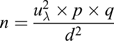 $$n={u^2_\lambda \times p \times q \over d^2}$$
where n is the minimum sample size, u is the normal distribution percentile (for λ=0.05 u=1.96), p is the frequency of high level of anxiety and q=p−1.
It was assumed that: (1) the adequate power of planned statistical tests should be 90%, (2) the difference will be considered significant at the level of p=0.05, and (3) the incidence of high levels of anxiety (raw score >34) is 30% of the population. The minimum sample size was calculated at 323 people. Assuming that on each of the three phases of the study the sample size can be reduced by 30%, it was calculated that an initial sample size of 1200 people would be sufficient.
Study design
The research was cross-sectional and included anthropometric measurements and a questionnaire survey of children and parents. In the first stage the parents who had consented to their child's participation in the survey filled in the questionnaires prepared for them. For this purpose special meetings were arranged in the schools their children attended. In the second stage of the examination, the questionnaires were filled in by children. The survey took place in schools. The children filled in the questionnaires in the presence of their teacher and a researcher. The same oral and written instruction was given to all students. In the third stage, children for whom a full complement of questionnaires was obtained participated in anthropometric measurements. The measurements were carried out in the school nurse's office. Each stage of the research was conducted during separate visits of the researchers to the schools. The time interval between stages was no longer than 1 month for each student.
Indicators related to stress
Children responded to the questions on the questionnaire about highly stressful, unpleasant or disturbing events in the 6-month period before the examination. The presented examples of such events included parent's death, divorce or separation of parents, being bullied by peers, severe disease of a family member, involvement in a car accident and ‘any other event that scared me very much’. The respondents answered generally ‘no’ or ‘yes’ without providing information on the type of event.
The level of anxiety was measured with the use of the State-Trait Anxiety Inventory for Children (STAIC). The questionnaire analyses two aspects of anxiety: anxiety as a state of a child during examination and anxiety as a personality characteristic. Only the anxiety trait (AT) scale was used in the study, being the most suitable for measurement of the generalized individual tendency to respond with a high level of anxiety (Vila et al., Reference Vila, Mollet-Clémençon, De Blic, Falissard, Mouren-Simeoni and Scheinmann1999a).
The Polish version of the STAIC, originally developed by Spielberger et al. (Reference Spielberger, Gorsuch, Lushene, Vagg and Jacobs1983), has well-documented psychometric properties. Cronbach's alpha for the AT scale ranged from 0.86 to 0.89, depending on age and sex (Jaworska, Reference Jaworska2005). Items are answered ‘hardly ever’, ‘sometimes’ or ‘often’ and are given a score of 1 to 3. The scale measures a durable form of anxiety and includes 20 item, such as: ‘I notice my heart beats fast’, ‘I get funny feeling in my stomach’, ‘I get upset at home’, ‘I am scared’, ‘I feel troubled’ describing somatic, emotional and cognitive symptoms of anxiety.
The raw result is a sum of the points obtained for providing an answer on a three-grade scale. The minimum result is 20 points and the maximum is 60 points. Then the results can be converted into a standard percentile scale. Similar to studies by other authors (Isnard et al., Reference Isnard, Michel, Frelut, Vila, Falissard, Naja, Navarro and Mouren-Simeoni2003), a raw result of 34 points was taken as the criterion for a high level of anxiety trait (in the Polish standardization sample the result on average corresponds to the 70th percentile).
Anthropometric measurements
Measurements of body height and weight were carried out by trained physical anthropologists. Body height was measured according to the standard technique (Onis et al., Reference Onis, Onyango, Broeck, Chumlea and Martorell2004; Chumlea & Guo, Reference Chumlea, Guo and Cameron2006) with the use of an anthropometer with measurement accuracy of ±1 mm. A medical weight machine with measurement accuracy of ±100 g was used for body weight measurements. The children wore underwear during the examination. The measurements were carried out between 8.00 am and 2.00 pm. In order to minimize measurement errors, each child was measured three times (at the same opportunity), and arithmetic means of the three measurements were treated as the actual values of body height and weight. Technical error of height and weight measurement (TEM) was assessed using the method recommended by WHO (WHO Multicentre Growth Reference Study Group, 2006).
Body mass index (BMI) was calculated and used in the study as an indicator of adiposity. Body height and BMI were later calculated as z-scores on the basis of World Health Organization growth charts (WHO, 2006).
Controlled variables
Other variables that may have an influence on the level of AT and/or height and body weight were assessed in the study. Questions regarding these factors were included in the questionnaire for a parent. Variables associated with socioeconomic status (SES) were assessed, such as place of residence, number of rooms in a flat, number of persons inhabiting a common household, parents' education and satisfaction with income level. Also the number of meals consumed per day by a child, chronic diseases (e.g. diabetes, allergies, asthma, endocrinal dysfunctions), sex and age of subjects were recorded.
Age of subjects was categorized for the purpose of analyses as: children aged 9.50–11.49 were included in the 10–11 year category; those aged 11.50–13.49 were included in the 12–13 year category; and those aged 13.50–15.49 were included in the 14–15 year category.
Statistical analysis
The methods of statistical analysis were selected taking into account three aspects of the research: (1) appraisal of the relationship between events, controlled variables and the level of AT; (2) analysis of the relationship between stressful events, AT, controlled variables and body height and BMI; (3) analysis of the interactions between selected variables, AT and body height and BMI.
Analyses (1) and (2) employed one-way analysis of variance (ANOVA) and Tukey's post-hoc test for unequal group sizes. Two-way analysis of variance was used for assessment of interactions. Four models, in which the influence of AT was adjusted for sex, age, occurrence of chronic diseases and adverse life events, were used for each dependent variable, i.e. body height and BMI. The results were considered statistically significant when p<0.05.
Statistica-10 software was used for statistical calculations. WHO AnthroPlus software was applied in order to calculate the results of body height measurements and BMI values as z-scores.
Results
A total of 1200 parents of children aged 10–15 were asked to consent to the research. Of these, 839 consented to participate but, due to the lack of consent of 67 children, research was carried out on 772 parent–child pairs. A full complement of completed questionnaires without missing data was obtained from 621 subjects. Due to the absence of some children from school (n=46) during anthropometric measurements, the final number of persons included in the research amounted to 575. The final study sample comprised 309 girls and 266 boys, mean age 12.73 years (range 9.94–15.23; SD 1.35). Age categories were 10–11 (n=171), 12–13 (n=279) and 14–15 (n=125).
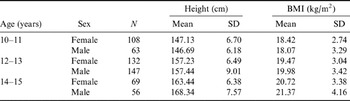
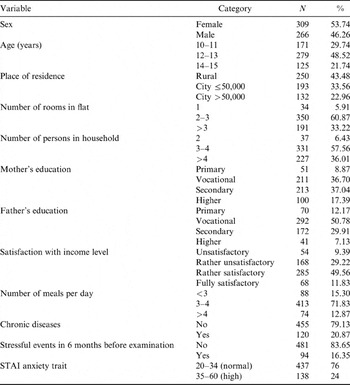
Tables 1 and 2 show the characteristics of the sample students. Most subjects came from rural areas (43%) and inhabited 2–3 room flats (61%). The flats were mostly inhabited by 3–4 persons (58%). Mothers generally had secondary (37%) or vocational education (37%), while fathers mainly had vocational education (51%). Most parents declared a ‘rather satisfactory’ income level (50%). The children most often had 3–4 meals per day (72%) and were not chronically ill (79%). The following disorders were reported: asthma in 2.61% (n=15) of children and allergies in 18.26% (n=105). No other chronic diseases were noted. Table 1 describes the mean height and BMI separately for age and sex categories. The technical error of measurement equalled 8 g and 0.26 cm for weight and height respectively.
Mean height and BMI of sample students by age and sex, Poland, 2010–12

Characteristics of sample students, Poland, 2010–12

The occurrence of a highly stressful event in the 6 months before the examination was declared by 16% of children. Mean AT in the sample amounted to 29.83 (SD 7.14; minimum, 20; maximum, 60). A high level of AT was found in 24% of children.
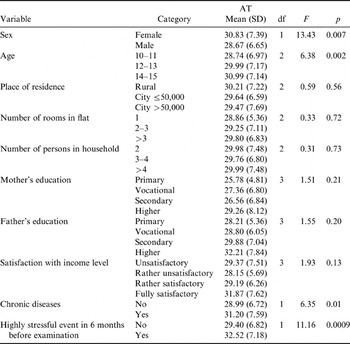
In order to determine which variables are associated with a high level of anxiety in the sample, one-way ANOVA was applied (Table 3). Girls had a significantly greater level of AT than boys (30.83 vs 28.67, F=13.43, p=0.007). The level of AT also differed depending on age (F=6.38, p=0.002). Tukey's test showed a statistically significant difference between the subjects at the ages of 10–11 and 14–15 (28.74 vs 30.99, p=0.03). Children suffering from chronic diseases had a higher AT than healthy children (31.20 vs 28.99, F=6.35, p=0.01). The occurrence of adverse life events affected the level of AT (F=11.16, p<0.001). Subjects who reported a highly stressful event during the 6 months before the examination had a higher AT (32.52 vs 29.40).
Assessment of the influence of social and psychological variables on the level of anxiety trait (AT) in sample students, Poland, 2010–12

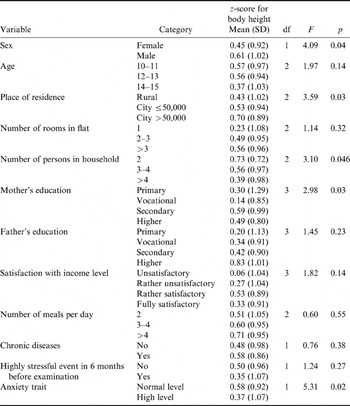
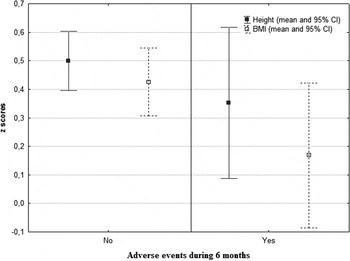
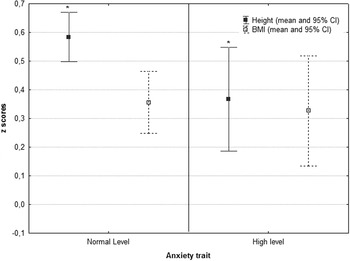
Adverse life events did not statistically significantly affect body height in the sample, although the subjects with a history of stressful events were slightly shorter than the subjects who did not experience such events in the last 6 months (z=0.50 vs z=0.35) (Table 4). However, statistically significant results were noted for AT. Subjects with a high result for AT were shorter than those with a normal level of AT (z=0.37 vs z=0.58, p=0.02) (Figs 1 and 2).
The influence of social and psychological variables on body height of sample students, Poland, 2010–12

The differences in z-scores for height and BMI between students with and without a history of adverse events during last 6 months.

The differences in z-scores for height and BMI between students with normal and high levels of anxiety.

Boys had higher z-scores for height than girls (z=0.61 vs z=0.45, F=4.09, p=0.04). Among the variables determining socioeconomic status, three were statistically significantly associated with body height: place of residence (F=3.59, p=0.03), number of persons inhabiting a common household (F=3.10, p=0.046) and mother's education (F=2.98, p=0.03). Tukey's post-hoc test showed differences between children from rural areas and cities with over 50,000 inhabitants (z=0.43 vs z=0.70, p=0.045), children from small (number of family members <3) and large families (number of family members >4) (z=0.73 vs z=0.39, p=0.047) and children of mothers with vocational and secondary education (z=0.14 vs z=0.59, p=0.042).
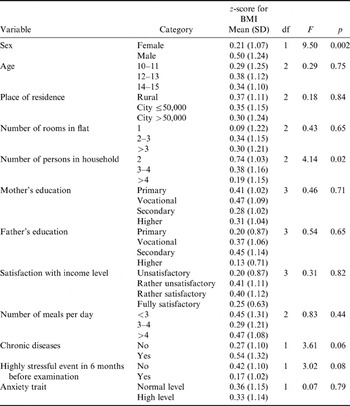
The occurrence of stressful events was associated with lower values of BMI (z=0.17 vs z=0.42) (Table 5). However, this result was not statistically significant (p=0.08). Anxiety trait did not affect BMI in the examined sample. Two controlled variables had a significant influence on BMI: sex (F=9.50, p=0.002) and number of persons in a common household (F=4.14, p=0.02), and higher z-scores were found for boys and children living with only one carer (in comparison with children from families consisting of five or more persons: p=0.04 in Tukey's test in both the performed tests).
The influence of social and psychological variables on BMI of students, Poland, 2010–12

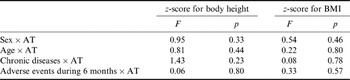
Two-way ANOVA was used for assessment of interactions between AT and some controlled variables (Table 6). The models used for body height and BMI showed no significant interactions between sex, age, chronic diseases, adverse events and AT. The relationship between AT and body height was independent of the variables for which the models were adjusted.
Analysis of the influence of interactions between anxiety trait (AT) and selected variables on body height and BMI of students, two-way ANOVA, Poland, 2010–12

Discussion
This research aimed to assess the influence of stressful events, and the generalized tendency to respond with anxiety, on body height and BMI. The effects of sex, age, socioeconomic variables, chronic diseases and eating habits as factors potentially associated with anxiety trait, height and BMI were also analysed.
The cross-sectional research did not demonstrate any influence of adverse life events on body height or level of adiposity as assessed with BMI. Despite the occurrence of the expected tendency, i.e. lower results for body height and BMI in the group with a history of stressful events, the differences were not statistically significant. Nevertheless, the study did demonstrate a relationship between anxiety trait, considered in the study as a psychological factor of susceptibility to stress, and body height.
Earlier papers have demonstrated the importance of adverse events for development in childhood and adolescence. Clinical examinations have demonstrated long-term inhibition of growth and delayed adolescence due to dramatic and stressful life events (Magner et al., Reference Magner, Rogol and Gorden1984). Long-persisting inhibition of growth resulting from stress has also been suggested by a study on Croatian children aged from 2.5 to 4 during the 1991–1992 war. Suboptimal growth was maintained until their 12th year (Jovanović et al., Reference Jovanović, Prebeg, Stanić and Vuletić2003). Also, research carried out in the People's Republic of China has demonstrated a relationship between the death of one or both parents and shorter age- and sex-adjusted seated height (Schooling et al., Reference Schooling, Jiang, Lam, Zhang, Cheng and Leung2011). A study by Montgomery et al. (Reference Montgomery, Bartely and Wilkinson1997) showed the influence of less dramatic events on development. The authors demonstrated the relationship between a family conflict and lower height of a child. Hulanicka (Reference Hulanicka, Gronkiewicz and Koniarek2001) compared the growth and adolescence of girls experiencing long-term stress caused by death of one or both parents, their separation or divorce, persistent disease of a family member, alcoholism or criminal history of one parent with girls who had not experienced such events. The girls who were under family stress matured earlier: they had earlier menarche and faster development of breasts and pubic hair, but they were slightly shorter than the girls with no history of stressful life events. The influence of emotional conditions on the growth process has also been shown well in a study by Saenger et al. (Reference Saenger, Levine, Wiedemann, Schwartz, Korth-Schutz and Pareira1977). They described the case of a boy with psychosocial dwarfism admitted to hospital at the age of 7. His growth rate increased very distinctly during the 100 days of hospitalization and then decreased during separation from the boy's favourite nurse.
The present study did not show a statistically significant influence of stressful life events on body height. One possible reason for this variance of results is methodological differences: in the study we assessed occurrence of highly stressful events during the last 6 months, while the other mentioned papers assessed the long-term influence of adverse events occurring during the whole life time. Hence earlier (occurring before the 6 months) stressful events might have blurred the differences between the compared groups.
However, a statistically significant relationship between intensity of anxiety trait and body height was observed. Subjects with a high level of anxiety trait were shorter than those with a normal level by 0.21 z-scores. This in accordance with our assumptions and suggests that the tendency to interpret many situations as threatening, and therefore to respond with stress, may be a reason for growth disturbances.
There is only scant evidence dealing with the relationship between adverse events and anxiety experienced in childhood and body stature in later stages of life. In the long-term studies of Pine et al. (Reference Pine, Cohen and Brook1996) anxiety disorders that occurred during childhood prospectively predicted relatively short stature in early adulthood among females. However, these associations were not found among males. Girls seemed to be more sensitive to adverse life events than boys, as was found in a study conducted by Li et al. (Reference Li, Manor and Power2004).
In the examined sample, anxiety trait depended on sex, age, chronic diseases and adverse life events. It was suspected that the variables are the actual reason for differences in body height and the anxiety trait effect is only an artifact. However, the relationship of anxiety trait and body height remained significant when possible interactions between the variables were analysed. This suggests the significant role of individual psychological characteristics that may decide the initiation and maintaining of the biological mechanism of stress and the intensity of neurohormonal response to a potential stressor.
The relationship between stress, anxiety and hormonal dysregulation has been demonstrated in previous studies. Van den Bergh et al. (Reference Van den Bergh, Van Calster, Pinna Puissant and Van Huffel2008) showed that a high level of anxiety trait is highly associated with an increased level of evening cortisol and a highly flattened diurnal cortisol profile. These physiological changes occur in persons under chronic stress (McEwen, Reference McEwen2002). Dysregulation of the hypothalamic–pituitary–adrenal axis has been well documented in cases of patients with post-traumatic stress disorder (PTSD) (Vythilingam et al., Reference Vythilingam, Gill, Luckenbaugh, Gold, Collin and Bonne2010). A typical characteristic of these persons is an increased anxiety persisting for a long time after a single dramatic event (Vila et al., Reference Vila, Porche and Mouren-Simeoni1999b). Also, hormonal changes caused by stress are long-lasting. In a study by Pervanidou et al. (Reference Pervanidou, Kolaitis, Charitaki, Lazaropoulou, Papassotiriou and Hindmarsh2007), an increased level of evening cortisol normalized in children who had experienced a car accident 6 months after the event. In addition, studies on animal models have shown a long-term increase in the level of corticosteroids in response to a stress stimulus (Barha et al., Reference Barha, Brummelte, Lieblich and Galea2011). The above studies prove the co-existence of a high level of anxiety and hormonal changes characteristic of the biological response to stress, which could explain the relationship between anxiety trait and body height demonstrated in the present study.
Some earlier studies have shown the relationship between stress (Widdowson, Reference Widdowson1951; Saenger et al., Reference Saenger, Levine, Wiedemann, Schwartz, Korth-Schutz and Pareira1977), anxiety (Crisp & McGuiness, Reference Crisp and McGuiness1976) and a decrease in body weight or slower weight gain. Similar results have been obtained in research on animal models (Barha et al., Reference Barha, Brummelte, Lieblich and Galea2011). Other studies have shown the opposite tendency, with a high level of anxiety being associated with obesity (Becker et al., Reference Becker, Margraf, Turker, Soeder and Neumer2001; Jorm et al., Reference Jorm, Korten, Christensen, Jacomb, Rodgers and Parslow2003). In a study by Perkonigg et al. (Reference Perkonigg, Owashi, Stein, Kirshbaum and Wittchen2009), PTSD occurring in adolescents was a predictor of obesity in young adults. The results of research by Incledon et al. (Reference Incledon, Wake and Hay2011) show that a negative emotional state, symptoms of depression and low self-esteem predispose adolescents to adiposity. Similar results were obtained by Anderson et al. (Reference Anderson, Cohen, Naumova and Must2006), who analysed the relationship between a high level of anxiety and depression in girls with higher BMI values. These disorders did not affect the body weight of boys. Isnard et al. (Reference Isnard, Michel, Frelut, Vila, Falissard, Naja, Navarro and Mouren-Simeoni2003) revealed that a high level of anxiety, depression and low self-esteem are associated with binge eating, which is a risk factor for obesity. In the present research, irrespective of sex, anxiety trait was not significantly associated with BMI, which proves a lack of a one-way relationship between negative emotional state and level of adiposity.
In this study, controlled variables affecting z-scores for BMI included sex and number of persons inhabiting a common household. The z-score for body height was also affected by such indicators of socioeconomic status as place of residence and mother's education. The results are in accordance with predictions: a higher degree of urbanization, better parental education and a smaller family are usually associated with higher socioeconomic status. The influence of financial reserves on body height and weight has been reported in many previous studies (Bogin & MacVean, Reference Bogin and MacVean1978; Tanner, Reference Tanner and Komlos1994; Eiben & Mascie-Taylor, Reference Eiben and Mascie-Taylor2004; Johnston Reference Johnston and Cameron2006).
Study limitations
The research has several limitations. One is its cross-sectional nature, which does not allow for analysis of the influence of stressful events and the tendency to respond with anxiety on growth rate. The study's hypothesis was that the tendency to respond with stress, as assessed by the level of anxiety trait, can modify growth. Due to the cross-sectional nature of the research, it was not possible to make an objective conclusion about the correlation between high level of anxiety and body height, or exclude that the direction of the relationship is opposite to the assumed one, i.e. short boys may have a greater tendency to respond with anxiety. This has been shown by the research of Walker et al. (Reference Walker, Chang, Powell, Simonoff and Grantham-McGregor2007, Reference Walker, Wachs, Grantham-McGregor, Black, Nelson and Huffman2011), which revealed that early childhood stunting affects both mental development (makes people more vulnerable to anxiety and depression) and later growth. Since retrospective data on height and weight from earlier stages of life were not available, it cannot definitely be excluded that the observed relation between high level of anxiety and lower height might be the consequence of earlier growth retardation. Future longitudinal research including both retrospective data and follow-up would investigate the issue.
This study did not demonstrate a significant influence of adverse life events on growth. It should be remembered that the procedure was very little invasive on the assumption: children responded to the question if they had experienced any stressful event during the last 6 months. It was not known what exactly had happened to a child, how harmful the event had been, or if it had been a one-off matter or a situation lasting for some time. Thus many variables associated with stress remained beyond control and could have resulted in the lack of statistically significant results. In this research the questionnaire was the basic tool for assessment of independent variables. The most important factors included occurrence of adverse events and level of anxiety trait. It was assumed that they were related to the stress response at the organism level. However, direct physiological stress indicators, such as blood cortisol level, were not available. Nevertheless, application of such procedure was well-founded. The research was planned to be as least invasive as possible and not arouse anxiety to prevent children with a high level of anxiety trait, whom we were most keen to examine, from being excluded from the sample. Additionally, as mentioned above, the relationship between dysregulation of the HPA axis and anxiety and stress has been well-documented in previous studies (McEwen, Reference McEwen2002; Van den Bergh et al., Reference Van den Bergh, Van Calster, Pinna Puissant and Van Huffel2008; Vythilingam et al., Reference Vythilingam, Gill, Luckenbaugh, Gold, Collin and Bonne2010). For this reason the use of indirect stress indicators was considered as adequate for the purpose of this study.
Conclusions
The research showed a significant relationship between a high level of anxiety trait and lower body height of adolescents aged 10–15. It suggests that psychological characteristics related to the cognitive tendency to interpret events as threatening and, consequently, to respond with stress, may be involved in variability of biological traits. However, making conclusions on the basis of the obtained results is limited due to the cross-sectional nature of the study and the hypothesis needs to be confirmed in longitudinal research.
Acknowledgments
The authors thank the students Agata Ratajczak and Anna Ida for their contribution to the research.