

Introduction
The Australian educational landscape is currently undergoing rapid change. This change was initially promoted by the laying down of Australian policy in the form of National Goals for Schooling in the 21st century (Ministerial Council for Education, Early Childhood Development and Youth Affairs [MCEECDYA], 2010). Goals of curriculum and related systems of assessment, accreditation, and credentialing were aimed to promote quality of education. To achieve these goals, a number of initiatives were put in place, and the most profound of these involve the development of the national assessment program NAPLAN and, more recently, a national curriculum (Australian Curriculum Assessment and Reporting Authority [ACARA], 2011a). While these goals and their related initiatives are laudable and desirable, there is considerable concern about the way in which these initiatives are being put in place. Dempsey and Conway (Reference Dempsey and Conway2004) identified that educational reform relied on accurate reporting through ‘inclusive processes in the measurement of educational outcomes and accountability systems’ (p. 12). They raised concerns about students with disabilities most likely to be excluded from large-scale assessment and reporting as a critical component of the Australian educational accountability system. It would seem that students with disabilities and additional needs are not being given ‘a fair go’ in accessing NAPLAN, despite the fact that surveys regularly confirm that almost all Australians place the right to a fair go at the top of their list of values (Gough, Reference Gough2006). The relevant goals and testing initiatives will now be outlined.
National Goals for Schooling: Espoused Policy
The 2002 Adelaide Declaration on National Goals for Schooling (MCEECDYA, 2010) provided broad directions to guide schools and education authorities, and specifically identified a commitment to the reporting of comparable educational outcomes for all students, including students with a disability (MCEECDYA, 2010). In particular there was common and agreed commitment to
• continuing to develop curriculum and related systems of assessment, accreditation and credentialing that promote quality and are nationally recognised and valued; and to
• increasing public confidence in school education through explicit and defensible standards that guide improvement in students’ levels of educational achievement and through which the effectiveness, efficiency and equity of schooling can be measured and evaluated (MCEECDYA, 2010).
The Melbourne Declaration on Educational Goals for Young Australians (Ministerial Council for Education, Employment, Training and Youth Affairs [MCEETYA], 2008a) superseded the Adelaide Declaration to set the direction for Australian schooling for the next 10 years. One of the goals related specifically to students with a disability and called for schooling to be socially just, so that students’ schooling outcomes were free from the effects of negative forms of discrimination based on sex, language, culture and ethnicity, religion, or disability. This declaration was the precursor to the plan for the introduction of national reporting of educational outcomes in numeracy and literacy (NAPLAN), and other curriculum areas.
The MCEETYA Four-Year Plan (2009–2012) then outlined the key strategies and initiatives Australian governments would undertake to support the achievement of the educational goals for all young Australians. Two initiatives of interest to this paper are the promotion of world-class curriculum and assessment, and strengthening accountability and transparency.
Promoting World-class Curriculum and Assessment
For this initiative, the development of a National Curriculum was identified as a key strategy, along with the promise that ‘assessment of student progress would be rigorous and comprehensive’ (MCEETYA, 2009, p. 14). The plan also identified the need for government to work with all school sectors to develop and enhance national and school level assessment that focused on assessment for learning, which enabled teachers to use information about student progress to inform their teaching, assessment as learning, which enabled students to reflect on and monitor their own progress to inform their future learning goals, and also assessment of learning, which assisted teachers to use evidence of student learning to assess student achievement against goals and standards.
The Australian Curriculum Assessment and Reporting Authority (ACARA) was established to deliver key national reforms including the development of plans to improve the capacity of schools to assess student performance, to link assessment to the national curriculum, and to manage the National Assessment Program. It also aimed to develop high quality diagnostic and formative assessment tools and strategies, to support teachers’ skills and understanding in the use of assessment as a tool for student learning and classroom planning, and in adapting instructional practice in classrooms to focus on specific student needs.
Strengthening Accountability and Transparency
The plan recognised the need for students, teachers, and schools to have good quality data on student performance to improve student outcomes. Parents and families also required information about performance at various levels — about their son or daughter at school, of the school he or she attended, and of the system — to help them make informed choices. In response to this plan, ACARA was to publish relevant, nationally comparable information on all schools to support greater accountability, school evaluation, collaborative policy development, and resource allocation. The My School website that has recently been upgraded with My School Version 2.0 is one result of this initiative (ACARA, 2011b).
The National Assessment Program
NAPLAN is the most comprehensive national assessment process that Australia has ever put in place. Commencing in 2008, the program aim was to assess all Australian students in Years 3, 5, 7, and 9 using common national tests in reading, writing, language conventions (spelling, grammar, and punctuation) and numeracy. Involvement in the program was essentially mandatory since Commonwealth legislation required testing of all students in identified grades in every Australian school each year, and federal school funding was contingent upon involvement in the program.
Test administration authorities in each state and territory are responsible for printing the NAPLAN tests each year, for test administration, data capture, marking, and the delivery of reports to the central Commonwealth body, MCEETYA. Principals and teachers are offered information on protocols by the relevant authority through a range of mediums including information sessions, written information, and web-based materials. Students are then tested in their own schools by their own schoolteachers in mid May of each school year, with tests comparable to previous years.
National de-identified data collected by the relevant test administration authority are submitted to an independent national data contractor for analysis. National achievement scales, national means, and achievement of the middle 60%, for each domain of reading, writing, spelling, grammar and punctuation, and numeracy are determined across Years 3, 5, 7, and 9. The skills and understandings assessed in each domain from Year 3 to Year 9 are mapped onto achievement scales with scaled scores that range from 0 to 1000 (MCEETYA, 2008b). Comparative data on the performance of students from each grade across each state and territory are also compiled, with the means and standard deviations for each state and territory compared to national means and standard deviations for each domain published in the full report that is publicly available on the web (see MCEECDYA, 2009; MCEETYA, 2008; National Assessment Program, 2010). Schools receive information about how their year level compares against national minimum standards, and percentages of children reaching national minimum standards. These data are ultimately published on the My School website. Schools also receive statements of performance of individual students and year levels as a whole. Results for individual students can be compared against the national minimum standards and decisions regarding intervention vary across states and territories, regions, and schools. For students achieving below the national minimum standard, anecdotal evidence suggests that intervention is more likely. Schools provide individual students (and their parents/carers) with statements of performance in relation to the national minimum standards. Now that most students from 2008 (except for those in Year 9) have completed their second NAPLAN in 2010, measures of growth in achievement are being analysed.
Access to the National Assessment Program
Involvement of all students in NAPLAN is critical for the achievement of educational goals for young Australians, particularly in line with the espoused policy initiatives of promoting world-class curriculum and assessment and strengthening accountability and transparency. While it is mandatory that all students be assessed under the NAPLAN program, anecdotal evidence suggests that many students with disabilities and additional needs are not included, despite Australian legislation that aims to protect this right. The gap between legislation, policy goals, and practices has failed to receive adequate attention in the literature. This paper aims to raise awareness of this gap and to promote change in practices so that all students with a disability are included in the national assessment and reporting regime.
This paper will first of all identify the Australian legislation that pertains to students with a disability and their rights to access and participation in education. Policies and practices that relate to access to participation in NAPLAN for students with a disability are then outlined, along with the available data on exemptions and withdrawal of students, and the application of special provisions and considerations for those that are assessed. The paper will then recommend a number of protocols and initiatives that will improve accessibility to NAPLAN for all students, based on lessons from the United States.
Australian Legislation Relevant to Students With a Disability
Partly because of variation in the definition of disability across the states and territories, data on the number of students with a disability in Australian schools and the nature of enrolment of those students are limited (Davies & Dempsey, Reference Cumming2011). The evidence that is available suggests that over 3.5% of Australian school students have a disability. As a percentage of the total school population there has recently been an increase in the proportion of students placed in segregated settings but, more importantly, an increasing number of students with a disability are attending regular schools (Australian Government Productivity Commission, 2004; Davies & Dempsey, Reference Cumming2011; Dempsey, Reference Dempsey2004, Reference Dempsey2007).
Australian legislation has been developed to provide protection for students with a disability against all forms of discrimination. Specific components of this legislation need to be considered in relation to the National Goals of Schooling and the National Assessment Program.
Disability Discrimination Act
The Disability Discrimination Act 1992 (DDA; Australasian Legal Information Institute, 2009) was designed to address discrimination against people with a disability across a number of areas including education. Under this act it is unlawful for an educational authority to discriminate against a student on the grounds of the student's disability by denying or limiting the student's access to any benefit or curricular provided by the educational authority that will either exclude the person from participation, or subject the person to any other detriment. The DDA was extended by the development of the Disability Standards for Education 2005.
Disability Standards for Education 2005
Education standards were legislated (Australian Government Attorney-General's Department, 2005) to address enrolment, participation, curriculum, student support services, and elimination of harassment and victimisation (Australian Human Rights Commission, 2009a) in educational settings. The education standards that relate to participation are of particular interest to this paper.
The Standards for Participation state that the education provider must take reasonable steps to ensure that the student is able to participate in the learning experiences (including assessment) of the courses or programs provided by the educational institution on the same basis as a student without a disability. Assessment requirements of the course or program need to be appropriate to the needs of the student and accessible to him or her; and the assessment procedures and methodologies for the course or program are to be adapted to enable the student to demonstrate the knowledge, skills, or competencies being assessed. The provider must consult the student, or an associate of the student, about whether the disability affects the student's ability to participate (including assessment) in the courses or programs for which the student is enrolled and, in the light of the consultation, decide whether a ‘reasonable’ adjustment is necessary to ensure that the student is able to participate in the courses or programs provided by the educational institution on the same basis as a student without a disability. If an adjustment is necessary and a reasonable adjustment can be identified in relation to that aim, then a reasonable adjustment should be made for the student (DDA Education Standards, 2009).
The participation standards therefore specifically outline that students with a disability are entitled to participate on the same basis as students without a disability, and without discrimination. School courses and activities are required to be flexible enough to meet the student's needs. The school must consult with the student and/or his or her advocate to determine those needs and, as an outcome, the participation of the student with a disability should be comparable to the participation of a student without a disability. The opportunity to participate in school or a course should be the same as for other students, as should be the opportunity to participate in assessments, including national assessment tests (Davies & Dempsey, Reference Cumming2011).
Educational providers and authorities are still coming to terms with the education standards and their impact on educational services and approaches. In addition to ensuring that schools embrace a wider definition of disability, schools are now legally obliged to provide a minimum level of educational support to students with a disability (Nelson, Reference Nelson2003). Just how schools respond to this obligation is open to interpretation and perhaps subject to future legal challenges. To this point in time there have been no federal or high court decisions that relate to the participation of students with a disability in educational assessment. Usually such matters are addressed through policy and administrative procedures and do not typically reach courts or tribunals (Cumming, Reference Cumming, Wyatt-Smith and Cumming2009a). Complaints from a number of students with different disabilities at various schools in relation to not being given sufficient adjustments by their respective schools to allow them to participate in exams has resulted in conciliated settlements (Australian Human Rights Commission, 2009b). If conciliation cannot be reached, then the matter is heard by the Federal Court of Australia. By 2010 there had been 81 conciliated outcomes and 14 court decisions. Participation in national assessments such as NAPLAN is yet to be tested.
Policies and Practices Related to Student Participation in NAPLAN
The policies and practices related to student participation are provided in more detail by the educational authorities responsible for each state and territory. While based on the same policy, each authority represents them slightly differently. One Australian state, Queensland, provided a Test Preparation Handbook that states that the tests are ‘structured to be inclusive of all students, within budgetary and administrative limitations . . . and all eligible students must sit for the tests, unless they are exempt or withdrawn by parents/carers’ (Queensland Studies Authority [QSA], 2009, section 4.0). Further, eligible students include those students involved in a special education facility or program that were of equivalent chronological age to ‘typical’ Year 3, 5, 7, or 9 students. While students with disabilities in these settings appear to be eligible, unverified reports suggest that many are exempt or withdrawn. For those students with a disability that do complete NAPLAN tests, no data on this group are gathered. In stark contrast, other students from low socioeconomic backgrounds, including Indigenous youth and other disadvantaged young Australians, are identified as an important cohort to measure and report on. The NAPLAN process fails to define and identify students with disabilities, except to suggest that they might be exempted or withdrawn.
Students Who Are Exempt or Withdrawn
The standard NAPLAN policy across all educational authorities is that students may qualify for exemption from one or more of the tests because of their ‘lack of proficiency in the English language, or because of significant intellectual and/or functional disability’. Additionally, students with disabilities should ‘be given the opportunity to participate in testing if their parent/carer prefers that they do so’ (QSA, 2009, section 4.2). Principals are required to consult with parents/carers on all matters of exemption, and then use ‘professional judgment’ when making decisions about a student's participation in the tests. The level of consultation would seem to vary widely from case to case. Principals, however, must obtain signed forms from parents/carers to allow students who meet the criteria to be exempted. In Australia, exempt students are judged to have achieved in each exempted test at the level ‘below national minimum standard’ and are reported within this subgroup of the population of students who had participated in the tests.
Students can be withdrawn from the testing program by their parents/carers in consultation with the school. While withdrawals are intended to be the result of philosophical and religious based objections to testing, withdrawal on the basis of disability has been identified by information provided to parents in some states and territories. For example, the information guide for the state of New South Wales stated that ‘students with confirmed disabilities or difficulties in learning are expected to participate in the testing. However, parents do have the right to withdraw their children from testing. This is classified as a parent withdrawal and not as an exemption’ (NSW Department of Education and Training, 2007, p. 2, cited in Davies & Dempsey, Reference Cumming2011). It is significant that students who are withdrawn are not counted as part of the population. In terms of reporting, they are grouped with those students who were absent or suspended and who, despite the principals’ facilitation, were unable to complete the test(s) in the days immediately following the standard national testing day. Regrettably, authorities and schools who seek to diminish the perceived negative impact of students with disabilities on the percentage of their students not achieving national minimum standards might encourage parents to withdraw these students rather than consulting towards exemption, or allowing them to unsuccessfully complete the NAPLAN tests.
While the characteristics of students who are exempt or withdrawn are not reported, the numbers and percentages of students across each of the five domains are reported within participation statistics in the NAPLAN annual report. To provide a summary, the average percentages of students in each grade who were exempted, absent, or withdrawn across the five domains for NAPLAN from 2008, 2009, and 2010 across Australia, drawn from the available published reports, is provided in Table 1.
Percentages of Australian Student Exemptions, Absences/Withdrawals, and Assessed Across Year Levels for 2008, 2009, and 2010 NAPLAN

Note. The number of students in each year level across the last three years varies between 250,000 to 270,000.
Similar participation levels between the 2009 and 2008 cohort were identified in the 2009 NAPLAN report (ACARA, 2009). The available data from the 2010 summary suggests similar levels of participation and percentages of exemption and absent or withdrawn students. There would seem to be a slight increase in levels of participation by Year 3, 5, and 7 students.
When details regarding the reasons for exemptions or absences and withdrawals were sought from state educational authorities, testing authorities, and independent school systems, all authorities advised that the written parent applications for exemptions or withdrawals, and subsequently approved by principals, were kept at the school level and were not centrally recorded at the national, state, or systemic level. The number of exempted students with identified disabilities, with learning disabilities, or language difficulties is therefore unknown. Similarly, the reasons for students being withdrawn or absent (or suspended) and the basis of parental philosophical objections for withdrawal are unknown. Finally, the number of students with learning or other disabilities who were absent or withdrawn is also unknown.
Issues Arising from Exemptions/Absences/Withdrawals
The agreement of the Council of Australian Governments (COAG) to a new performance reporting framework and to the publication of relevant, nationally comparable information on all schools to support accountability and school evaluation has the indirect potential to threaten those students who are poor performers. Personnel involved with education, from teachers and school principals, to education officers in education authorities, and governments have all experienced the negative consequences if performances at their level of responsibility in the system fall below expectation and/or the National Standards. To avoid such negative outcomes, strategies at each level of the system are being put into place, often as a priority. School principals in some states and territories are being offered financial and other incentives to increase the performance of their school. School funding and teacher performance pay will potentially be linked to performance on national tests in future (Cumming, Reference Cumming, Wyatt-Smith and Cumming2009a), and there is some evidence in some states and territories of “accelerated progression up the (pay) scale based on classroom performance evidence” (Ingvarson, Kleinhenz, & Wilkinson, 2008, p. 10). At the teacher level, more time is being spent on training children in their classes on NAPLAN type tasks from very early in the school year, implicitly indicating the priority of NAPLAN over other learning and teaching concerns. At the student level, teachers and principals are discouraging the participation of many poor performing students and they are being encouraged to withdraw. There is also some evidence that parents are being encouraged to withdraw their children who are low achievers ‘on philosophical grounds’. These evasions are mirrored by concerns expressed by many in the print media regarding an increase in NAPLAN absenteeism in some schools in some states and territories (Patty, Reference Patty2009). In this article from the Sydney Morning Herald, a politician suggested that, because of the publication of school performance data, there is ‘a fear that the school's average and reputation will be damaged by individual poor results’ (para. 4).
The figures provided in Table 1 indicate that approximately 5% of students are not participating in national achievement testing. This estimate suggests that 50,000 students are not being benchmarked by NAPLAN each year. While it is unknown how many of these students who are exempted and withdrawn have disabilities, it is most likely a significant proportion of them were exempted or withdrawn because of a perceived inability to be able to adequately complete the tests. Their non-participation in the NAPLAN process distorts the whole assessment system and flies in the face of the legislation (DDA, Education Standards) and policies (National Schooling for the 21st Century, Adelaide and Melbourne Declarations, MCEETYA Four-Year Plan) that espouse and promote assessment for all.
When students are exempted from national testing or are withdrawn or are absent because the tests are deemed not to be appropriate for them, the national assessment program is failing those students (Davies & Dempsey, Reference Cumming2011). Their lack of inclusion potentially places them and their parents in a position of marginality. From the students’ point of view, socially they are being excluded from a mainstream experience, and potentially significant educational outcomes are also at risk. They miss out on having their capacity measured against a standard national benchmark that might help to form educational goals for the students for the coming year. Parents do not receive meaningful performance information about their children in terms of National Standards unlike all other parents. As a result, parents have no standard benchmark and without these data their capacity to make judgments about the effectiveness of the teacher and the school is reduced. While non-participation raises the potential for negative educational outcomes for students with disabilities, it needs to be also recognised that many schools and teachers still maintain a positive approach to these students and continue to identify strategies to help these students to benefit from the curriculum and ultimately perform well on other assessment tasks.
From a systems perspective, students with disabilities and their performance levels become less important to schools. In terms of the school performance data, many of these students could be ‘written off’ as not having the potential to achieve the current minimum National Standards, and so, when resources are allocated to improve performance, the learning needs of these students may be considered as less important, compared to other students who might have the potential to achieve these standards (Davies & Dempsey, Reference Cumming2011). Conversely, from the systems’ point of view it could be argued that measuring achievement of students with additional needs should be an even higher priority than for other students, since this group requires higher levels of resourcing, and measuring change in achievement outcomes would be an important evaluative measure.
In terms of assessment of schools, the lack of inclusion of students with arguably the greatest learning needs is a systems failure, and may even invalidate the measurement of school effectiveness. Similar concerns were raised in the United States more than 10 years ago in the report from the Committee on Goals 2000 and the Inclusion of Students with Disabilities for the National Research Council (McDonnell, McLaughlin, & Morison, 1997). When data on achievement levels of students with disabilities are absent, then ‘judgments about the effectiveness of educational policies and programs at local, state and national levels’ (p. 6) are neither valid nor fair.
Special Provisions/Considerations/Adjustments
To comply with the legislative requirements of the Disability Standards for Education 2005, special provisions are to be made available for some students so they could complete the NAPLAN testing, when deemed necessary. In general, special provisions, now termed adjustments in the latest National Protocols for Test Administration (ACARA, 2012), are permitted for students with disability (as defined by the DDA) to support their access to the tests and facilitate maximum participation.
In previous years, students with disabilities or special needs were to be provided with a range of supports and resources comparable to the type of support the student regularly accessed in the classroom, or was afforded to the student to complete existing state-based tests. Special provisions could be accessed by a student for all or part of a test, with multiple provisions available in any one test. Schools were encouraged to consider the principles of equity and inclusivity in meeting the needs of all students by recognising that many students without disabilities might also require special provisions/consideration. While this extension of potential support is noteworthy, the notion of ‘reasonable adjustment’ provides schools with the opportunity to avoid offering accommodations. After a process of consideration as to whether or not an adjustment was necessary, a reasonable adjustment was then able to be put into place. Schools were allowed to provide the following accommodations or reasonable adjustments, if necessary (QSA Test Preparation Handbook, 2009, section 5.10, as cited in Davies & Dempsey, Reference Cumming2011):
• Reading support
• Use of a scribe
• Extra time (up to 50%) including rest breaks
• Braille and large print test materials
• Separate supervision or special test environment
• PCs/laptops (no spellcheck or speech-to-text software)
• Assistive listening devices
• Specialised equipment or alternative communication devices
• ‘Signed’ instructions.
A number of accommodations were not permitted. However, many of these disallowed accommodations may be judged by many to be quite ‘reasonable’ in assisting students with disabilities to understand what a test required and to then be able to complete assessment tasks.
In terms of reading, it was not permitted to:
• read numbers or symbols in numeracy tests
• interpret diagrams or rephrase questions
• read questions, multiple-choice distractors or stimulus material in the reading or language conventions tests
• paraphrase, interpret or give hints about questions or texts
• read or sign literacy questions to students with moderate/severe to profound hearing impairment.
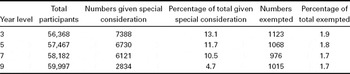
Consistent with the lack of reported information about students with disabilities, the NAPLAN report does not provide the numbers and percentages of students who were afforded special consideration or adjustments, and the types of accommodations with which they were provided. Some testing authorities have gathered the numbers who were given special consideration on at least one test booklet. For instance, the Queensland Studies Authority (QSA, 2009) provided the details for Table 2 to be constructed. Data from the 2010 NAPLAN are not yet available.
Queensland Students Afforded Special Consideration and Exemptions, Across Year Levels for 2009 NAPLAN

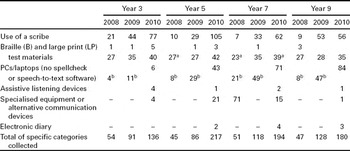
No details were publicly available as to the types of special consideration afforded to students, and the types of disability of these students. As above, written parent applications for special consideration and subsequently approved by principals were kept at the school level and only some details were provided to the state authority on their request. Table 3 displays the data on types of special consideration provided by QSA.
Numbers of Students Granted Special Considerations and Special Provisions in Queensland, 2008, 2009, and 2010

Note. Use of a dash (–) indicates that data were not obtained or not reported. QSA also did not collect data on the allowable special provisions of reading support, separate supervision or special test environment, ‘signed’ instructions, and extra time (up to 50%) including rest breaks.
aIn 2008 Braille (B) and large print (LP) materials were combined. bPC/laptops and assistive listening devices were combined for the 2008 and 2009 data.
The adjustments that are available for students with disability have been extended and have become more specified in the 2012 National Protocols for Test Administration (ACARA, 2012).
Issues Arising from Special Provisions/Considerations
An inspection of the bottom line in Table 3 indicates that special provisions and accommodations are being increasingly applied to support students with additional needs across the 3 years of NAPLAN for each Year level. While the range of sanctioned accommodations provide some support, many accommodations are not permitted. Moreover, validity issues have been raised in relation to the limited application of accommodations and adaptations to NAPLAN among other assessment approaches (Cumming, Reference Cumming, Wyatt-Smith and Cumming2009a). From a cultural perspective, while students with disabilities have diverse ways of knowing, accommodations are still framed from particular constructions of ways of knowing, ‘expected patterns of “normal” development, and how the demonstration of knowledge should occur’ (Cumming, Reference Cumming, Wyatt-Smith and Cumming2009a, p. 5). While legislation and policy calls for appropriate accommodations for all students with disabilities, alternative assessment forms to allow students to demonstrate their knowledge in other ways are not provided by the NAPLAN system. Cumming also raises concerns about the form of some NAPLAN assessment items dominating the task and precluding the demonstration of important knowledge. Such assessment formats are not uncommon in large-scale testing, but they preclude students with disabilities from demonstrating their skills and knowledge.
There is a need to develop alternative assessments for students with additional needs to more accurately measure competencies at a less complex level. A recent Senate report on the administration and reporting of NAPLAN testing recognised the need to more accurately diagnose lower (and higher) achieving students. Senate Recommendation 5 (2.75) states that “the committee majority recommends that ACARA investigate and report to MCEECDYA on enhancing NAPLAN to support the diagnostic needs of higher and lower student achievers” (Parliament of Australia, 2010, p. 20).
Whether or not this Senate recommendation will extend beyond diagnosis to adapting achievement test options to more effectively assess higher and lower achieving students is yet to be determined. As reported by Kettler, Elliott, Davies, and Griffin (2012), there is current research being undertaken in Australia that focuses on the assessment of developmental levels of children with additional needs. Research by Griffin and colleagues (Coles-Janess & Griffin, 2009; Roberts & Griffin, 2009; Woods & Griffin, 2008) focuses on the developmental continua that describe levels of increasing competence in each of the areas of communication, literacy, and social and emotional development. One outcome of the work is an assessment protocol based on a functional (not aged-based or norm-referenced) profile that identified the progression of qualitative shifts or transitions in students with additional needs in these areas. The ultimate goal of this approach to screening is to link instructional strategies and resources to progress in learning. Despite the development of these assessment strategies to potentially improve options of assessment under a large-scale assessment regime, much more needs to be done to ensure a fair go for all.
Improving Access to NAPLAN for All Students: Lessons From Abroad
This paper strongly advocates that all students should have access to high-stakes tests such as NAPLAN, but future progress can be assisted by taking on board a number of lessons from abroad. First of all, many in the Australian educational community may be critical of large-scale, high-stakes testing, especially for students with additional needs. The United States has for more than a decade been foremost in championing the need for including all students in accountability testing, even those with the most significant cognitive disabilities (Hager & Slocum, 2011). The No Child Left Behind Act of 2001 (NCLB) mandated that all students participate in statewide accountability assessments, including all students with disabilities. High-stakes testing was selected as one means for assessing student outcomes, and measuring school improvement. However potential negative consequences for all stakeholders (i.e., students, parents, and schools) have been reported, and ‘the participation of students with disabilities in these assessments has been controversial’ (Katsiyannis, Zhang, Ryan, & Jones, 2007, p. 160). Dempsey and Conway (Reference Dempsey and Conway2005) also identified concerns about high-stakes testing, suggesting that ‘despite good intentions, the movement for increased educational accountability has been accompanied by a number of unintended consequences’ (p. 153). Albrecht and Joles (Reference Albrecht and Joles2003) examined undesirable ramifications associated with the use of a single high-stakes test to assess academic proficiencies of students with disabilities. They determined that this (mis)use was discriminatory and unfair for these students, and that alternative forms of tests could provide educational progress measures and satisfy the requirement of accountability and ensure equal access. Negative by-products of test failure included stigma of failure, lowered self-esteem, anxiety, increase in school dropouts, and loss of educational advancement and vocational options. However, Ysseldyke et al. (Reference Ysseldyke, Nelson, Christenson, Johnson, Dennison, Triezenberg and Hawes2004) indicated that there was little empirical evidence on the consequences of high-stakes testing for individual students, especially those with disabilities. Albrecht and Joles (Reference Albrecht and Joles2003) also reported that prior to the legislative amendments requiring inclusion of all students, the school system engaged in negative test strategies that included the encouragement of students with disabilities to drop out of tests to ensure that post performance data were as positive as possible, teaching to the test, increased homework, and reduction in time for art and music curricular. In support of these concerns, McNeil (Reference McNeil2000) suggested adverse effects of the Texas accountability system on teaching and learning, the stifling of democratic discourse, and the perpetuation of inequities for minority students, but once again, with limited data on participation and performance, these statements require validation (Ysseldyke et al., Reference Ysseldyke, Nelson, Christenson, Johnson, Dennison, Triezenberg and Hawes2004).
While these concerns have been raised, more recent reviews of high-stakes testing and increased emphasis of accountability indicate many positive outcomes (Katsiyannis et al., Reference Katsiyannis, Zhang, Ryan and Jones2007). Hager and Slocum (Reference Hager and Slocum2011) have indicated that carefully designed alternate assessment systems have the potential to provide meaningful information about the progress of all students, including those with significant cognitive disabilities, that can guide decision-making at the classroom and district level. Under this testing and accountability regime they report an increase in participation of students with special needs, and Katsiyannis et al. (Reference Katsiyannis, Zhang, Ryan and Jones2007) report that students with disabilities made impressive gains in improving academic performance and other related outcomes. More importantly, mandating participation in the United States has ensured inclusivity. Prior to this legislation, one policymaker in Arizona had commented that lack of involvement of special education students in the accountability track resulted in their removal from the curriculum track (Koehler, 1992, cited in Weigert, Reference Weigert, Elliott, Kettler, Beddow and Kurz2011). Historic underachievement of students with disabilities was linked to low expectations for learning and scant access to the general education curriculum (Koenig & Bachman, 2004). McDonnell et al. (Reference McDonnell, McLaughlin and Morison1997) considered the inclusion of students with disabilities in statewide assessment systems as essential, while Thurlow, Lazarus, Thompson, and Morse (2005) indicated that such inclusion was essential to improving educational opportunities for these students, and in gathering meaningful and valuable student performance information for schools and others. McDonnell et al. (Reference McDonnell, McLaughlin and Morison1997) had earlier cautioned that when achievement data on students with disabilities is missing then ‘judgments about the effectiveness of policies and programs at local and state and national levels’ (p. 6) are neither valid nor fair. Zigmond, Kloo, and Lemons (2011) indicated that mandating participation of students with disabilities in high-stakes accountability assessment promoted quality assurance for special education. It was assumed that participation raises the stakes, that these yield higher expectations, and these expectations lead to increased participation in general education, leading to better instruction, which ultimately results in improved academic outcome for students with disabilities (Defur, Reference Defur2002). The special education community accepted these assumptions in the formation of the assessment and accountability regulations in the No Child Left Behind Act of 2001 (NCLB; Zigmond et al., 2011).
If all Australian students are to be included, as legislation requires, in a national assessment program such as NAPLAN, then a number of protocols and initiatives used in the United States to progress large-scale inclusive assessment need to be put in place. When the No Child Left Behind Act (NCLB) required all students to participate, the challenge was to design an assessment system that signalled high expectation of performance but still provided useful data about the progress of students at the lower end (McDonnell et al., Reference McDonnell, McLaughlin and Morison1997).
The first condition was to ensure that students had an opportunity to learn the material that they were to be assessed on. Failure to do so would undermine educational equity, fairness in testing, and reduce the validity of test scores and their uses and interpretations. Second, students with disabilities needed to have appropriate testing accommodations that were individualised depending on the students’ access needs. For some students the testing accommodation entailed nonstandard forms of test presentation, administration, and response modes. The outcome of such implementation is to increase the validity of inferences that are made from the test scores. Third, a smaller student cohort required testing modifications to accurately measure performance of students at the low end of the scale. The U.S. Department of Education developed guidelines for states that permitted alternate and flexible assessments for special education students (Cortiella, Reference Cortiella2007) that were determined, justified, and documented by the individualised education plan (IEP) team or the teaching team. States were able to modify standards, design a totally different assessment, or adapt the existing regular assessments in such a way that minimised construct-irrelevant test features (Elliott, Davies, & Kettler, 2012). Some states adapted the regular assessment by reducing the number of test questions, others simplified the language of test items, reducing the number of multiple-choice options, using pictures to aid understanding, and providing more white space on the test booklet (Davies & Dempsey, Reference Cumming2011).
In essence, assessment needs to acknowledge and value the knowledge that can be demonstrated when not bound by the constraints of comparisons with other children, or a curriculum that does not reflect different ways of knowing (Cumming, 2009a). If these measures are to effectively meet the needs of all children, educators and assessors need to strive to better understand children and their ways of knowing and then take account of them in the design of assessments.
Conclusion
This paper has identified that while Australian legislation and policies (e.g., Education Standards) require equity of opportunity for students in all school activities, it is apparent that many students with a disability are not provided with the opportunity to properly access the national testing regime NAPLAN. Many students are not assessed and are either exempted or withdrawn from national testing, with only basic attention being given to the overall numbers of exemptions or withdrawals, and with data on the reasons for these exemptions or withdrawals not being collected. This lack of benchmarking of achievement levels has consequences for the student, parents, the teacher, the school profile, resourcing, and the efficacy of the teaching program. No data are obtained on the achievement of students with disabilities under the NAPLAN testing regime and, as a result, from any level of systemic profiling, these students do not exist. One of the lessons from the US experience is that public reporting of assessment results for students with disabilities, along with those who participate in different or modified assessments, is ‘key to ensuring fair and equitable comparisons among schools, districts, and states; in addition, all students should be accounted for in the public reporting of results.’ (McDonnell et al., Reference McDonnell, McLaughlin and Morison1997, p. 7). Australia has not yet learnt this lesson.
Those that are currently assessed under NAPLAN may well be assessed on material that they had not had the opportunity to learn. Many others who are assessed are afforded only basic testing accommodations that for many place them at risk in any comparison with their peers without disability. The complete set of adjustments and accommodations taken up by students are not centrally recorded or monitored for review or quality assurance in the states and territories that have been reviewed. Much more can be done to extend the application of testing accommodations so that authentic assessment is more likely to occur. Under the current NAPLAN program, no testing modifications are possible, and no alternative assessments under the umbrella of NAPLAN have been developed. One of the recommendations in the newly released Senate report (Parliament of Australia, 2010) promoted the development of diagnostic tools for lower and higher achieving students. Authentic assessment of the achievement of students with disabilities, however, requires the modification of existing tests (and items) and the design of new achievement tests if access barriers are to be overcome. So while there would seem to be a national agenda of assessment of achievement for all students, the practical application of these policies falls well short of the mark. If alternative modes of assessment are not developed, court challenges about the adequacy of current provisions to assess student achievement are likely (Cumming, Reference Cumming, Wyatt-Smith and Cumming2009b).
Because national testing is only slowly evolving within complex political and educational contexts, significant change is required. Exemptions and withdrawals need to be minimised, existing assessment protocols need to be adjusted, and test items reviewed and modified to accommodate students with disabilities. Alternative assessment tools also need to be designed to accommodate students’ diverse needs. Students with disabilities must be authentically assessed if the NAPLAN program and benchmarking reports are to be considered valid, comprehensive, and inclusive. Struggling already, students with disabilities need to be guaranteed a fair go.