1. Seed markets, transaction costs and agriculture
General concerns about the impact of economic growth on biodiversity have been raised in the last two decades. In particular, there is a common belief that the process of economic growth and development, which expands market access, might lead towards greater depletion of genetic material. This premise has been corroborated by a growing number of studies that prove the adverse effect of economic growth and development on biodiversity (Naidoo and Adamowicz, Reference Naidoo and Adamowicz2001; Asafu-Adjaye, Reference Asafu-Adjaye2003; Mills and Waite, Reference Mills and Waite2009). Moreover, there is an overlap between poorer countries and biodiversity hotspots, indicating that poorer, less developed areas hold higher levels of biodiversity (Fisher and Christopher, Reference Fisher and Christopher2007). Therefore, policies that aim to address rural poverty through improving market access might result in global biodiversity loss. In this paper, we will specifically focus on analyzing agricultural biodiversity.
As mentioned, economic development is linked to market access which in turn is largely governed by the transaction costs associated with participating in those markets. Transaction costs can be defined as the set of outlays incurred when conducting a market transaction and involves costs beyond the price paid by the commodity, such as the ones associated with search, negotiation and bargaining, supervision, etc. (Coase, Reference Coase1960). The significance of transaction costs in agriculture depends on their influence on agricultural decision making at different stages of the agricultural cycle, including whether the costs are associated with input-market-to-farm, on-farm or farm-to-final-market transaction costs. A number of studies have sought to test the hypothesis that transactions costs, which limit market access, influence specialization and, therefore, the level of genetic material used on farms (Aguirre et al., Reference Aguirre, Bellon and Smale1998; Gebremedhin et al., Reference Gebremedhin, Smale, Pender and Smale2004; Vadez et al., Reference Vadez, Reyes-Garcia, Godoy, Apaza, Byron, Huanca, Leonard, Perez and Wilkie2004; Wale and Mburu, Reference Wale, Mburu and Smale2004). However, there are a number of limitations to these studies. First, most of the analyses focus on the effect of farm-to-final-market transaction costs or on-farm transaction costs rather than input-market-to-farm transaction costs, and particularly costs associated with getting seeds which embody genetic material. Second, most of the studies use proxies or indirect measures of transaction costs, such as distance to markets, rather than direct measures of the costs. Third, the studies presented do not account for the possibility that farmers who participate in the market are substantially different from farmers who do not participate in these markets. Fourth, the studies do not explore how input-market-to-farm transaction costs influence yields through the choice of biodiversity.
To address these limitations, this study attempts to provide a better understanding of the influence of transaction costs on agricultural decisions by carefully considering the role of these costs in seed and thus variety choice, and by using a direct measure of input-market-to-farm transaction costs. This pre-harvest outcome is also linked to potato production by using the appropriate econometric techniques and accounting for the possibility that farmers who participate in the market could be substantially different from those who do not participate. Specifically, we focus on evaluating the effect of transaction costs in the seed market on agricultural biodiversity and total agricultural production. In addition, the analysis of the household's decision process of whether or not to participate in the market provides a more complete framework of the relationship between diversity, markets and farmer welfare. In general, it is expected that poorer farmers with limited access to markets and who therefore face higher transaction costs hold greater agricultural diversity in order to reduce risk and assure food security.
These hypotheses will be tested using data collected on Bolivian potato producers. Bolivia is one of the centers of potato biodiversity in the world and therefore provides a suitable case of study for conducting this analysis. The study site was purposefully selected by the authors to analyze seed markets and diversity. The study included a mix of quantitative and qualitative approaches to understanding markets and diversity and, while this paper focuses on the quantitative analysis of the collected data, it is informed by the qualitative analysis. The households included in the study have different levels of market accessibility and face different degrees of transaction costs.
The remainder of the paper is structured as follows. Section 2 illustrates the conceptual link between transaction costs, pre-harvest decisions and yields. This is followed by a description of the Bolivian context and the data in section 3. Section 4 presents the methodological framework for the empirical estimations. Section 5 shows the results of the empirical assessment of biodiversity and yields. Also, an analysis of the determinants of the households' decision to participate in the seed market is included. Finally, section 6 reports the conclusions and the implications of the analysis.
2. Pre-harvest decision making: conceptual framework
Transaction costs can influence farmer decision making with respect to market participation through a variety of channels; here we focus on transaction costs in the seed market and therefore how they influence pre-harvest decisions. Prior to considering this particular issue, the role of transaction costs in farmer decision making in general is analyzed, as well as how this research fits in with previous studies along similar lines. This is followed by a discussion of the seed market and its relationship to biodiversity in order to understand how costs in the input-market-to farm transactions can ultimately influence biodiversity.
2.1. Transaction costs and market access
As noted, transaction costs can be defined as the set of outlays incurred when conducting a market transaction and involve costs beyond the price paid by the commodity (Coase, Reference Coase1960). These costs can be proportional, when depending on the quantity of goods bought in the market, or fixed when these are constant (Key et al., Reference Key, Sadoulet and De Janvry2000). Transaction costs in agriculture can be primarily analyzed from three different perspectives: farm-to-final-market, on-farm and input-market-to-farm transaction costs.
The farm-to-final-market transaction costs are associated with the exchange of output that takes place after harvesting the product. Decisions, such as whether or not to participate in the output market, the market choice, the price at which the output is sold and the amount of output to be sold, take place once production has finished and harvest has occurred. The on-farm transaction costs are those interlinked to transactions and exchanges that take place within the farm or while the production process is taking place. This includes the amount of labor to hire for production, which can be influenced by transaction costs affecting the finding of available workers and the need to monitor workers to induce effort. The input-market-to-farm transaction costs are those related to exchanges that precede the production process, such as whether to purchase seed, the amount of inter-crop and intracrop diversification, technology adoption and the amount of initial inputs used and purchased.
With respect to farm-to-final-market transaction costs, a few key lessons emerge from the literature. First, if a farm is far from a market, as measured by distance to market or the time spent to reach the market, this has a negative effect on the probability of selling in that market (Vakis et al., Reference Vakis, Sadoulet and de Janvry2003; Nkhori, Reference Nkhori2004). For example, Vakis et al. (Reference Vakis, Sadoulet and de Janvry2003) show that, for Peruvian farmers, one extra hour of traveling decreases the probability of choosing a particular market by 29 per cent. Second, having access to information on the price offered in a specific market, which is considered as a fixed transaction cost, increases the probability of selling in that market (Goetz, Reference Goetz1992; Vakis et al., Reference Vakis, Sadoulet and de Janvry2003; Nkhori, Reference Nkhori2004). Third, access to processing technology has a positive effect on the total output sold in the market (Goetz, Reference Goetz1992). In general, results show that the presence of farm-to-final-market transaction costs not only affects the discrete choice of market participation, but also the intensity of participation.
Considering the effect of on-farm transaction costs on agricultural outcomes, for the case of Mexican farmers, results show that access to agricultural organizations has a positive effect on production, while transportation costs seem to have a positive link to selling a certain threshold of production (Key et al., Reference Key, Sadoulet and De Janvry2000). Escobal (Reference Escobal2000) divides the types of transaction costs faced by Peruvian potato producers into three categories – lack of access to information, costs of supervision, and costs of negotiation or bargaining – finding that the most significant transaction costs are those associated with information and supervision. In addition, smaller farmers and farmers connected to markets through informal tracks face higher transaction costs than other producers. The findings suggest that reducing costs of transportation as well as improving access to information and social organizations could potentially increase agricultural output produced by farmers.
In contrast to farm-to-final-market and on-farm transaction costs, there are few studies that explicitly focus on input-market-to-farm transaction costs, although some studies provide insights into the effect of these costs even if the authors did not focus on the effect of transaction costs per se. For example, a study in Malawi demonstrates that higher transaction costs reduce farmers' access to technology, suggesting that reducing the transaction costs faced by Malawian farmers could potentially augment agricultural output by increasing the rates of adoption of higher yielding technologies (Zeller et al., Reference Zeller, Diagne and Mataya1997). With respect to pre-harvest seed planting decisions and agricultural biodiversity – the focus of this paper – a few studies provide insights regarding the importance of transaction costs on the demand for such biodiversity. A key factor analyzed in these studies is measures of distance or access to markets and in general these studies obtain ambiguous results. For example, in the case of cereal production in Ethiopia, Gebremedhin et al. (Reference Gebremedhin, Smale, Pender and Smale2004) conclude that the effect of transaction costs on diversity is rather specific to the type of location and crop that is being considered. In Bolivia, Vadez et al. (Reference Vadez, Reyes-Garcia, Godoy, Apaza, Byron, Huanca, Leonard, Perez and Wilkie2004) find that rice farmers located in a village with better access to market cultivate larger areas and plant more varieties of rice compared to those with less access. In contrast, Wale and Mburu (Reference Wale, Mburu and Smale2004) find an opposite effect of access to markets on coffee diversity in Ethiopia, concluding that farmers located farther away from the market have a higher level of on-farm diversity. Using different maize diversity measures across distinct regions in Guanajuato, Mexico, Aguirre et al. (Reference Aguirre, Bellon and Smale1998) find mainly ambiguous results that vary according to the diversity measure. However, they find that measures of evenness indicate a higher level of diversity for communities with better infrastructure, a proxy for market access.
Along with market proximity, the role of institutions in influencing transactions cost and thus diversity and yields has also been analyzed. Looking at durum wheat farmers in Southern Italy, Di Falco and Perrings (Reference Di Falco, Perrings and Smale2004) find that a stronger institutional presence is associated with higher levels of diversity and that greater intracrop diversity seems to be related to higher productivity. The findings suggest an indirect negative effect of transaction costs on intracrop diversity, given that agricultural cooperatives facilitate marketing activities and enhance access to information.
The results of these previous studies are mixed and limited in the manner noted in the introductory section. To provide a careful analysis of farmer decision making, next we consider how input-market-to-farm transaction costs affect pre-harvest decisions with respect to seed markets and biodiversity, along with how these decisions ultimately impact yields.
2.2. Seed use and the demand for biodiversity
The decision by farmers on the seed varieties to plant largely determines the crop genetic resources that will be maintained on farm. The factors that influence whether a farmer decides to enter into a seed market to purchase seeds, the types of seeds to purchase and the amount to purchase are then linked to the degree of on-farm crop biodiversity. Understanding the seed market and how it affects farmers' choices to maintain or reduce crop diversity is critical to understanding biodiversity (Lipper et al., Reference Lipper, Dalton, Anderson, Keleman, Lipper, Anderson and Dalton2010). Of course, the seed market decision reflects a farmer's desire to maintain diversity for a range of considerations and here we discuss this general decision and the role of the seed market in that decision.
Demand and supply-side factors influence the farmer decision to maintain crop diversity on farm. On the demand side, Bellon (Reference Bellon1996) notes that diversity arises from farmers' range of interests and concerns, including: (1) farming in multiple environments; (2) coping with production risk; (3) managing pests and pathogens; (4) avoiding or minimizing labor bottlenecks; (5) fitting different budget constraints; (6) providing variety to monotonous diets; (7) providing special consumption items; and (8) fulfilling rituals, generating prestige and forging social ties. Diversity may also arise when output markets require certain types of varieties (which meet market demands such as for processing quality) that may not match those that fulfill consumption requirements. Since it is unlikely that a specific variety fulfills all these needs, demand then translates into the use of a diverse set of varieties (Bellon, Reference Bellon2004). Changes in the situation of farmers – including alternative means to address risk, shifts in the labor market, overall changes in diet options and preferences, change in the market for traits demanded, etc. – will result in changes in the demand for genetic material embodied in seed. The trade-off between market integration and conservation of crop genetic material found in a number of studies (see, for example, Brush, Reference Brush1995; Bellon, Reference Bellon1996, Reference Bellon2004; Smale, Reference Smale2006), is partially reflective of the changes that occur on the demand side.
On the supply side, in the context of less developed regions and relatively poor farmers where seed markets do not function or function imperfectly, the supply of seed and the genetic material embodied in that seed is often provided by farmers themselves from a previous year's production or through family, friends and neighbors in their social network. Farmers not only rely on these informal networks for seed access but also for information on traits of the different varieties (Bellon, Reference Bellon2004). Where seed markets function, even if informal, the supply of seeds and genetic material depends on both informal seed networks as well as these markets. How the markets influence the use of seed and biodiversity is determined by a number of factors that include price, accessibility and input-market-to-farm transaction costs. In particular, greater transaction costs limit access to seed markets and genetic material and may increase on-farm diversity, since transaction costs limit the ability to access diversity via the market.
The realization of on-farm crop diversity will depend on this range of demand and supply-side factors and it should be kept in mind that maintaining diversity is an active and purposeful farmer choice (Brush, Reference Brush2004). While this is the case, in this paper we focus specifically on input-market-to-farm transaction costs in the seed market and how this influences on-farm diversity and ultimately farmers' crop yields.
2.3. Farmers' decision making
To consider the effect of input-market-to-farm transaction costs on pre-harvest decisions and yields, three pre-harvest decisions are first analyzed in this study: (i) whether or not to participate in the seed market; (ii) the market choice; and (iii) the level of intracrop biodiversity on-farm. This is followed by a discussion of the link between these decisions on yields and household wellbeing.
Following similar studies that analyze agricultural decision making (Benjamin, Reference Benjamin1992; Key et al., Reference Key, Sadoulet and De Janvry2000; Van Dusen, Reference Van Dusen2000; Winters et al., Reference Winters, Cavatassi and Lipper2002; Van Dusen and Taylor, Reference Van Dusen and Taylor2004), the basis of the analysis of agricultural household behavior in this paper is a non-separable agricultural household model. The non-separability condition is founded on the idea that a household's production decisions are interdependent with a household's consumption decisions, which is appropriate for this context where markets are either thin, missing or incomplete (Singh et al., Reference Singh, Squire and Strauss1986).
The probability of farmer i participating in the seed market depends on household characteristics (HH), farm characteristics (F a), financial resources (F i) and distance to the closest market).Footnote 1 Distance to the market is a proxy for transaction costs (which is measured more precisely later) and is assumed to have a negative effect on the probability of participation.
 $$P \lpar P_{i}\rpar = Q \lpar F_{i}\comma \; F_{a}\comma \; HH\comma \; D_{m}\rpar = Q \lpar Xi\comma \; D_{m}\rpar \semicolon \; Q^{\prime} \lpar D_{m}\rpar < 0$$
Given that farmer i decides to participate in the seed market (P i = 1), the farmer needs to choose the specific market where to buy the seeds (M j). This choice can encompass location and type of market including formal or informal. This pre-harvest decision is a function of farm, household and community characteristics (X i) as well as market characteristics such as distance to the market j (D mj) and the level of biodiversity at the market j (B mj). Biodiversity at the market level entails the degree of genetic material available for purchase by the farmers in this particular market and can be expressed as the number of varieties available and the degree of availability. The probability of choosing market j is expected to be negatively related to market distance because of higher transaction costs faced by the farmer when traveling longer distances. On the other hand, market biodiversity is expected to have a positive effect, given the broader range of choices available for the farmer.
 $$P \lpar M_j \vert P_i = 1\rpar = G \lpar X_i\comma \; D_{mj}\comma \; B_{mj}\rpar \semicolon \; \quad G^{\prime}\lpar D_m\rpar < 0\semicolon \; G^{\prime}\lpar B_m\rpar > 0$$
The third pre-harvest decision made by the household is the level of on-farm intracrop biodiversity. In this case, transaction costs associated with the demand for biodiversity (input-market-to-farm) play a crucial role. Specifically, there are two types of transaction costs that need to be considered: direct and indirect. Direct costs refer to the price of seeds faced by the farmers and indirect costs refer to the transportation cost associated with the transaction (TC). The focus of this analysis is on transportation costs, since potatoes are clonally propagated and thus bulky, so that these costs are crucial when purchasing potato seeds, particularly in mountainous areas such as those found in Bolivia. Both are presumed to affect the demand for biodiversity negatively as follows:
 $$I_i = I \lpar X_i\comma \; TC\rpar \semicolon \; \quad I^{\prime} \lpar TC\rpar < 0$$
These three pre-harvest decisions affect the amount of agricultural production obtained by the household (Y i), (which is in turn a function of household, farm and community characteristics as well as inputs of production (hired labor (L h), family labor (L f) (and capital inputs (K)) and the level of on-farm intracrop biodiversity (I i). Following the theory of specialization, we hypothesize that intracrop biodiversity has a negative effect on the level of output or yield per hectare with yields modeled as follows:
 $$\eqalign{&Y_i = F \lpar X_i\comma \; L_{h}\comma \; L_f\comma \; K\comma \; I_i\rpar \semicolon \; \quad F^{\prime}\lpar L_h\rpar > 0\comma \; \quad F^{\prime} \lpar L_f\rpar > 0\semicolon \; \cr &F^{\prime}\lpar K\rpar > 0\semicolon \; \quad F^{\prime} \lpar I_{i}\rpar < 0}$$
Substituting equation (3) into (4) yields the following:
 $$Y_i = F \lpar X_i\comma \; L_h\comma \; L_f\comma \; K\comma \; I_i \lpar TC\rpar \rpar$$
Overall, these decisions are made in order to maximize future households' wellbeing which depends positively on the household's level of consumption. In this framework, we assume that household's wellbeing is given by the summation of all the household members' consumption. In turn, consumption increases with the level of agricultural production (Y i) because higher yields allow for higher levels of home consumption (X a) and ease liquidity constraints that allow household members to obtain a higher bundle of consumption in the market (C). This wellbeing maximization is subject to the household's income and time constraints as well as the production function as follows:
 $$\hbox{Max } \quad U_{i} = U \lpar \Sigma X_a \lpar Y_i\rpar \comma \; \Sigma C\lpar Y_i\rpar \rpar$$
where,  $U^{\prime}\lpar C\rpar > 0\semicolon \; \quad U^{\prime}\lpar X_a\rpar > 0\semicolon \; \quad X^{\prime}_a \lpar Y_i\rpar > 0\semicolon \; \quad C^{\prime} \lpar Y_i\rpar > 0$ hence,
 ${dU\over dYi}=\left({dU\over dXa}\ast {dXa\over dYi}\right)+ \left({dU\over dC} \ast {dC\over dYi}\right)\longrightarrow {dU\over dYi} > 0$
subject to:
 $$p_r C = E + \Sigma w \lpar L_w\rpar + P_a \lpar Y_i - X_a\rpar$$
 $$T = \Sigma \lsqb \lpar L_w\rpar + \lpar L_f\rpar + \lpar L_e\rpar \rsqb$$
 $$Y_i = F \lpar X_i\comma \; L_h\comma \; L_f\comma \; K\comma \; I_i \lpar TC\rpar \rpar$$
Replacing equation (8) and (9) into (9) we obtain the household's total resource constraint:
 $$P_r C = E + \Sigma w \lcub T - \Sigma \lsqb \lpar L_f\rpar + \lpar L_e\rpar \rsqb \rcub + P_a \lpar F\lpar X_i\comma \; L_h\comma \; L_f\comma \; K\comma \; I_i \lpar TC\rpar \rpar - X_a\rpar$$
where P r corresponds to the market price of consumption goods, w (L w) is the amount of income obtained by the household members through paid activities, P a is the price obtained by the farmers when selling the agricultural production and are the household endowments (physical and social capital). In equation (8), T refers to the household's time endowment which must be equal to the amount of labor allocated to paid non-agricultural activities (L w), farm activities (L f) and leisure (L e).
This theoretical framework depicts the relationship between input-market-to-farm transaction costs, pre-harvest decisions, yields and household wellbeing. Also, it provides three different hypotheses to be tested: first, the negative effect of distance to the market and the positive effect of market-level agricultural biodiversity on market participation $\lpar G^{\prime} \lpar D_{m}\rpar < 0\semicolon \; G^{\prime}\lpar B_{m}\rpar > 0\rpar$; second, the negative effect of transaction costs on intracrop biodiversity at the farm level (I′(TC) < 0); and third, the negative relationship between farm-level intracrop biodiversity and yields (F′(I i) < 0). Although household wellbeing cannot be explicitly analyzed, its link to yields and thus biodiversity can be seen through the model.
3. Bolivian context and data
Bolivia and the study site within the country were carefully selected ex-ante based on specific requirements needed to conduct this study and which are described in more detail by Almekinders et al. (Reference Almekinders, Cavatassi, Terceros, Pereira-Romero, Salazar, Lipper, Anderson and Dalton2010). Specifically, Bolivia was chosen as the country of analysis for four reasons: first, potato production is one of the most important agricultural commodities in Bolivia, involving about 200,000 farmers, yet potato yields are well below the regional average (5.9 tons per ha compared with 14.5 in Peru and 16.47 in Colombia) (FAOSTAT, at http://faostat.fao.org); second, after Peru and Colombia, Bolivia is the country with the highest quantity of potatoes allocated for home consumption in South America, with an average of 91 kg per capita consumed per year (FAOSTAT); third, the majority of Bolivian potato farmers grow traditional, native varieties and improved varieties represent a relatively small share of the cultivated area (Terrazas et al., Reference Terrazas, Suarez, Watson, Thiele, Walker and Devaux1997); fourth, Bolivia is a center for genetic biodiversity of potatoes – farmers grow about 1,000 different varieties which can be categorized in nine species and three systems (Almekinders et al., Reference Almekinders, Cavatassi, Terceros, Pereira-Romero, Salazar, Lipper, Anderson and Dalton2010).
Within Bolivia, the study site was selected based on secondary data and field visits to the country (by a team that included one of the authors) to identify a site where native varieties were common, but a significant number of farmers participated in markets. The study focuses on the municipalities of Tiraque and Pocona, which are located in the Department of Cochabamba at an altitude of between 3,100 and 4,200 m. Cochabamba is one of the most important areas for potato production in Bolivia, and the areas of Tiraque and Pocona were selected based on the following criteria: (i) active potato seed markets, (ii) a degree of agricultural biodiversity, and (iii) genetic erosion threatened by the existence of markets (Almekinders et al., Reference Almekinders, Cavatassi, Terceros, Pereira-Romero, Salazar, Lipper, Anderson and Dalton2010). Moreover, these municipalities hold the three Bolivian potato production systems: the Holandesa, the Papa Imilla and the Papa Nativa systems, each composed of different potato varieties.Footnote 2 Hence, although other areas within Bolivia were considered, none of them met the standards of agricultural biodiversity and access to seed markets required to conduct this study.
The data used in this study was collected in 2006 by FAO and PROINPA (Foundation for the Promotion and Investigation of Andean Products) and is representative of the potato producers in the area of Tiraque (64.5 per cent) and Pocona (35.5 per cent). The sample is composed of 1,000 households located in 55 different communities. The communities were randomly selected from a list of potato-producing communities in the region and from each community 10–30 households were randomly chosen from the list of members of the ‘sindicatos’, which are agricultural organizations located in every community (90 per cent of the farmers in the region belong to a sindicato). The questionnaire administered for the study included detailed information on household demographic characteristics, income-generating activities, asset ownership, farming activities – specifically potato production, access to credit and social networks. The questionnaire was also specifically designed to include detailed information about the different transaction costs faced by farmers.
Table A.1 in the online appendix, available at http://journals.cambridge.org/EDE, shows the summary statistics of the variables used in subsequent analysis for the sample as a whole, as well as for the subsamples of farmers who participate in the seed market and farmers who do not. Farmers integrated into the seed market are defined as those who bought any seeds, who are the ones that would potentially face input-market-to-farm costs, which is the main focus of this study. Quality of potatoes purchased for seed is often an important determinant of yields, with higher quality and ‘cleaner’ seed associated with higher yields. One might expect then that seed price will be linked to seed quality. However, in the study site, quality of seed bought in the market is not widely perceived as a limiting factor by farmers (Almekinders et al., Reference Almekinders, Cavatassi, Terceros, Pereira-Romero, Salazar, Lipper, Anderson and Dalton2010). In fact, the farmers categorized the seed as ‘bad quality seed’ for only 3 per cent of the transactions. There are other factors such as certification and altitude – where physiological and phyto-sanitary health are easier to maintain (Almekinders et al., Reference Almekinders, Cavatassi, Terceros, Pereira-Romero, Salazar, Lipper, Anderson and Dalton2010) – that better reflect seed quality. Nevertheless, only 4 per cent of the plots included in this study were planted with certified seed. In this particular context, seed quality does not seem to be a limiting factor for seed market participation.
The seed market participants represent 63.4 per cent of the whole sample of farmers and 66.2 per cent of the total plots. In general, the households that belong to this sample are poor, with numerous household members who are primarily dedicated to performing agricultural activities, and whose heads of household are men with low levels of education. About half the households belong to any type of community organization other than the sindicato, which is our proxy for access to social capital. In general, market-integrated farmers do not differ significantly from other farmers in the sample with few exceptions.
To measure intracrop biodiversity, four different indexes of diversity are used in this analysis. First, the varietal count which represents the number of varieties planted is included. Next, the Shannon index (S) which captures the evenness and proportional abundance and is measured as follows:Footnote 3
 $$S = - \sum \alpha_i \ln \alpha_i$$
where αi is the share of seeds planted with a particular variety. This measure has a lower limit at zero which occurs when only one variety is planted and represents the lowest level of intracrop biodiversity. The third measure is the Simpson index (Si) which captures proportional abundance as follows:
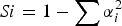 $$Si = 1 - \sum \alpha_i^2$$
This index also has a lower limit at zero. The final measure of intracrop biodiversity used in this study is the share of seeds of non-Waych'a varieties (NW). The data indicate that 80 per cent of the plots in the sample are planted with the native variety Waych'a, 5 per cent are planted with the improved variety Holandesa, about 4 per cent with Puca Nawi and about 3 per cent with Desiree. The large number of plots planted with Waych'a suggests that, when addressing the agricultural biodiversity decision, it merits distinguishing between the share of seeds allocated to plant Waych'a and the share allocated to other varieties.
The key observation from these measures is that farmers who are integrated into the seed market are more likely to have higher levels of intracrop biodiversity than farmers who are not market integrated. This is true for all measures of biodiversity, which suggests that having access to markets is not associated with lower levels of agricultural biodiversity.
With respect to potato production variables used in the analysis of yields, the descriptive statistics show that the yield per ha is on average 7,735 kg of potatoes, of which 54 per cent is sold, 11 per cent is allocated for seeds and 25 per cent is allocated for home consumption. The amount of seeds planted is equal to 1,131 kg per ha; these seeds are bought by the farmer (53 per cent) and also from previous production (49 per cent). Regarding the application of fungicides and insecticides, 58 per cent of the plots are not sprayed with fungicides while only 5 per cent of the plots are not sprayed with insecticides. The average amount of labor used for potato production is 122 jornales Footnote 4 per ha, of which 75 jornales are family labor, about 61 per cent of the total labor used. In addition, 89 per cent of the plots are applied with organic fertilizer, 60 per cent are treated with chemical fertilizer, 19 per cent use a tractor, 97 per cent use yunta (animal traction) and 73 per cent of the plots have some type of irrigation system.
4. Empirical approach
The three subsections below describe the empirical approaches used to test the three main hypotheses stated in section 2.
4.1. Assessing market participation and market choice
To understand the factors that influence a farmer's decision to participate in the seed market, a probit model is used since the dependent variable takes the value of one if the farmer participates in the seed market and zero otherwise. Variables that represent household, farm and community characteristics as well as distance to the market are included as regressors.
To analyze the market characteristics that influence farmers' decision to choose a particular market, a multinomial conditional logit model is used, which allows inclusion not only of household characteristics, but also of specific characteristics of the market, including distance to the market and market-level biodiversity. These variables provide an idea of how these factors affect the farmers' decision of whether or not to participate in a particular market while controlling for household characteristics as follows:Footnote 5
 $$P \lpar M_{ij}\rpar = \alpha_2 + \sum_n\, \theta_n X_n + \sum_j \mu_j D_{mij} + \sum_j \eta_j D_{mij} * B_{mj} + \varepsilon_1$$
where P(M ij) is the probability of farmer i choosing market j; X n is a vector of household characteristics; D mij is a vector with the distances from the community to the different markets; D mij*B mj is a vector of interaction terms between distance to market j and biodiversity at market j; and $\varepsilon_{1}$ is the error term.
The proxies for market-level biodiversity are the Shannon index and the number of varieties found in each of the markets. The data used to create the biodiversity variable was collected by Conny Almekinders of Wageningen University and PROINPA (see Almekinders et al., Reference Almekinders, Cavatassi, Terceros, Pereira-Romero, Salazar, Lipper, Anderson and Dalton2010) in four of the markets from the sample (Tiraque, Colomi, Campesino and El Puente). Farmers who did not participate in these markets are excluded from the analysis. In total, 376 farmers are included for a total of 1,504 observations (each farmer has an observation for each market). The interaction terms between distance and market biodiversity are included to assess the relationship between market biodiversity and farmers' participation in these markets. These terms vary not only across markets but also across farmers who do not belong to the same community and therefore have different distance variables for each market. The hypotheses that distance to the market has a negative effect on market choice and market biodiversity has a positive effect are corroborated if the coefficients μj and ηj are negatively and positively significant respectively.
4.2. Assessing the impact of transaction costs on intracrop biodiversity
To analyze the effect of access to markets and input-market-to-farm transaction costs on intracrop biodiversity, a farm-level regression analysis is used. The four mentioned indexes are used to measure farm-level intracrop biodiversity. Censored regressions are used for the first three measures to account for the left and right censoring of these indexes.Footnote 6 For the count index, an ordered probit regression is estimated since it is an ordered count of varieties. Variables to control for other factors such as household demographic characteristics, household's financial resources, access to market, farm characteristics and community-level characteristics are included as independent variables. The average price of seeds per kg is also included to account for the effect of direct transaction costs, and transportation cost is included as an indirect transaction cost.
Prior to this estimation, a Heckman selection model of market participation and biodiversity is estimated. The instruments used to identify the participation equation are distance to the market and distance squared. The motivation for using distance to markets and its square term is that it affects farmers' participation in the seed market but should not affect yields or biodiversity as it is a fixed cost that is meant to capture travel time. This model allows us to obtain the inverse Mills Ratio that is included in each of the censored regressions to control for the endogeneity of market participation (switching regressions approach). Based on this, equation (12) is estimated:
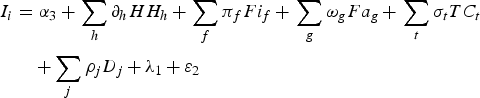 $$\eqalign{I_i &= \alpha_3 \, {+}\, \sum_h \partial_h HH_h \, {+}\, \sum_f \pi_f Fi_f \, {+}\, \sum_g \omega_g F a_g \, {+}\, \sum_t \sigma_t TC_t \cr &\quad + \sum_j \rho_j D_j \, {+}\, \lambda_1 \, {+}\, \varepsilon_2}$$
where I i is the diversity index calculated for household i; HH h is the vector of the household characteristics; Fi f is the vector that represents the financial resources of the household; Fa g is a vector of variables that capture the farm characteristic; TC t is a vector of direct and indirect costs faced by the farmers in the seed market; D j is a vector of variables that capture the distance from the community; λ1 is the inverse Mills ratio calculated in a Heckman selection model where the first stage is participation and the second stage is the level of diversity; and ɛ2 is the error term.
The hypothesis that input-market-to-farm transaction costs have a negative effect on diversity will be corroborated by a negative and significant σt coefficient. Confirmation of this hypothesis would lead to the conclusion that not only do direct transactions costs affect agricultural diversification, but so do indirect transaction costs.
4.3. Assessing the impact of intracrop biodiversity on yields
To assess the production decision, following Di Falco and Perrings (Reference Di Falco, Perrings and Smale2004), a two-stage instrumental variable (IV) procedure is estimated due to concerns regarding the endogeneity of intracrop biodiversity. Input-market-to-farm transportation costs and average seed prices are used as instruments in the first-stage equation. For farmers who do not participate in the seed market, an average cost of transportation and prices is calculated at the community level and used as instruments. These assumptions are justifiable since, after controlling for the amount of seeds on yields, neither seed market prices nor transportation costs of seeds should have any direct impact on the yields – these are sunk costs that must be disbursed by the farmers and therefore should not have a direct effect on yields other than by influencing the demand for intracrop biodiversity.Footnote 7
As with the estimation conducted to model intracrop biodiversity, a switching regression approach is used to evaluate yields to test the hypothesis that seed market participants are substantially different from non-participants. Specifically, the inverse Mills ratio obtained after estimating a Heckman model of participation and yields is included as an independent variable in the IV approach. This procedure allows us to control for possible unobservable characteristics that could influence yields and diversity concurrently. Once again, the instruments to identify the participation equation are distance to the market and distance squared. As noted previously, distance to market serves as a proxy to account for the fixed cost of participating in the market while transportation cost captures the intensity of participation. It should affect farmers' participation in the seed market but not affect yields or biodiversity.
The production decision is modeled using a Cobb–Douglas production function where yields are presumed to depend on capital inputs (K) such as amount of land, fertilizers, fungicides and insecticides among others, labor inputs (L) and other factors (A) where biodiversity is included.
 $$\matrix{Y = AK^{\alpha} L^{\beta} \cr \hbox{such that } F_k\comma \; F_L > 0 and F_{kk}\comma \; F_{LL}< 0\semicolon \; 0 < \alpha\comma \; \beta < 1.}$$
The advantage of this type of production function is that it is easily estimated in a log-linear form by taking logarithms to equation (13) as follows:
 $$\eqalign{Y &= \alpha_4 + \sum_h \phi_h H_h + \sum_f \tau_f Fi_f + \sum_k \beta_k Fa_k + \sum_l \gamma_l L_l + \sum_t \theta_t K_t \cr &\quad + \sum_j \rho_j D_j + \vartheta li + \lambda_2 + \varepsilon_4}$$
where Y is the log of total yield per ha; li is the predicted index of intracrop biodiversity; λ2 is the inverse Mills ratio calculated in a Heckman selection model where the first stage is participation in the seed market and the second stage is yields; H h, Fi f, Fa k, K k, L l, D j are defined previously; and ɛ4 is the error term.
The hypothesis that intracrop biodiversity has a negative effect on yields is verified if ϑ is negative and significant. Note that the assessment of yields is conducted at the plot level while the analysis of intracrop diversity is done at the household level.
5. Results
5.1. Seed market participation
Table A.2 in the online appendix presents the results of the probit model on seed market participation. As predicted, distance to the market reduces participation at a diminishing rate. The findings also show that household characteristics do not seem to affect the participation decision with the notable exception of access to social capital which increases the probability of participation by 13 per cent. This finding corroborates the importance of information and social interaction on market participation. Farm characteristics and community characteristics also seem to play a role in the participation decision. As expected, the amount of land allocated to potato production and having access to irrigation increase the probability that a farmer will participate in the seed market, while being located at a higher altitude reduces the probability of participation. Field research suggests mobility is somewhat limited at higher altitudes so this may explain this result. It may also be the case that farmers need to purchase less seed since it is easier to store seed at higher altitudes where pests are less prevalent. Having access to irrigation increases the probability of participation by 12 per cent, while increasing the altitude at which the farm is located by one extra km decreases the probability that the farmer will participate in the seed market by 38 per cent. The positive coefficient of the amount of land suggests that seed market access is to some extent related to household wealth or an ability to produce a critical threshold of output. With respect to location, farmers who are located in Pocona are more likely to participate than other farmers.
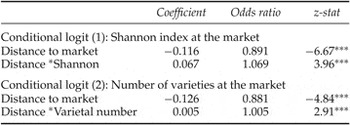
These results are corroborated by the conditional logit that models market choice (table 1). The estimates show that distance to the market reduces the probability of choosing a particular market j. The coefficient is negative and significant whether using the market-level Shannon index or the varietal count variable. However, once this term is interacted with the market-level of biodiversity, there is a significant change. The results show that, when distance is interacted with the Shannon index or the number of varieties, the influence of distance is reduced by almost half – distance becomes ‘less negative’, meaning that biodiversity in the market compensates farmers for traveling long distances. Specifically, simulation procedures show that the probability of choosing market j increases by about 7 per cent when the number of varieties in a specific market is increased by one. Market biodiversity positively influences farmers' participation in seed markets.
Market of choice

Notes: Household and farm characteristics are included but not reported.*, significant at 10%; **, significant at 5%; ***, significant at 1%.
5.2. Intracrop biodiversity
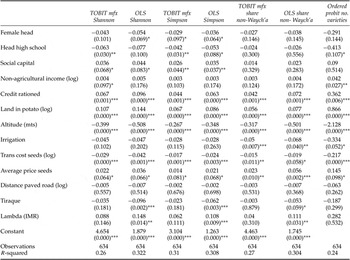
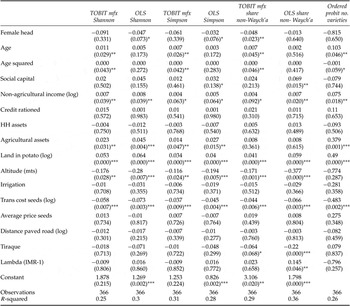
The results for the sample of farmers who are integrated and not integrated into the seed market, after controlling for unobservables that might affect market participation and intracrop biodiversity, are presented in tables 2 and 3 respectively.Footnote 8 The estimates for farmers who are integrated into the seed market show that transaction costs are negatively related to intracrop biodiversity even after controlling for distance from the community to the closest road, which means that facing higher transportation costs reduces the demand for intracrop biodiversity. This corroborates the hypothesis stated in section 2. On the other hand, the average price of seeds per kg faced by the farmer has a positive significant effect. This result does not confirm the hypothesis that both direct and indirect costs have a negative effect on diversification and suggests instead that farmers might be using intracrop diversification as a strategy to deal with the high costs of seeds.Footnote 9 This result provides two interesting implications: first, it corroborates the hypothesis that input-market-to-farm transaction costs play a crucial role on pre-harvest outcomes; and, second, it suggests that direct costs also matter on the demand for diversity.
Assessing biodiversity: farmers integrated to the seed market

Notes: Bootstrap standard errors: 1,000 repetitions. Robust p-values in parentheses; *, significant at 10%; **, significant at 5%; ***, significant at 1%. The variable altitude represents the average for the plots cultivated by the farmer
Assessing biodiversity: farmers not integrated to the seed market

Notes: Bootstrap standard errors: 1,000 repetitions. Robust p-values in parentheses; *, significant at 10%; **, significant at 5%; ***, significant at 1%. The variable altitude represents the average for the plots cultivated by the farmer.
For the case of farmers who are not integrated into seed markets, the results show that, once again, higher transaction costs reduce the level of intracrop diversity demanded by these farmers. However, the average prices paid for seeds do not seem to have any effect on their diversification decision.
For farmers who are integrated into the seed market, the positive relation between credit rationing and intracrop biodiversity might suggest that households use diversity in order to the reduce risk (being credit rationed increases the share of non-Waych'a varieties by 4 per cent). In other words, this result might suggest that credit-constrained households use agricultural diversification as a substitute for credit in order to reduce vulnerability, since it is expected that highly specialized households (households with low levels of diversification) are more exposed to crop losses, pests and price shocks.
Interestingly, there is also some evidence that income from non-agricultural activities increases the level of diversification for both subsamples, but mainly for the subsample of farmers not integrated into seed markets. This could be explained by diversification being costly. Different varieties require different amounts of inputs and lower levels of income diminish the capacity of farmers to obtain the financial resources needed to buy inputs of production to plant the different varieties. For example, varieties that are highly susceptible to fungus and pests, such as the late blight disease, require a higher amount of fungicides which, in some cases, are prohibitively expensive for some farmers. In these cases, farmers are forced to plant only resistant varieties which would reduce the extent of diversification. Second, the positive effect of non-agricultural income suggests that a higher degree of diversification of income sources at the intra-household level is positively correlated with intracrop diversification. Hence, diversification of intra-household labor might be positively related to intracrop diversification.
These findings, along with the positive effect associated with the amount of land for both subsamples, and agricultural assets for farmers non-integrated to seeds markets, suggest that availability to deal with liquidity constraints is correlated with higher levels of diversity, particularly for farmers who do not participate in the seed market. Most of the variables that correspond to household characteristics do not seem to have an effect on the level of intracrop diversification for either sample.Footnote 10
The results regarding social capital differ across subsamples. Specifically, intracrop diversification seems to be highly influenced by the access to social networks, particularly for the market participants. On the other hand, for the case of non-participants, social networks do not seem to play a major role. This suggests that social networking is needed to gather knowledge about different varieties and planting techniques that might influence diversification.
With respect to farm characteristics, farms located at a higher altitude are less diverse, while farmers with larger amounts of land have greater intracrop diversification. These results are not surprising because different varieties of potato might need different climatic conditions that could not be optimal at higher altitudes. On the other hand, the positive significant effect of land allocated to potato production implies that land constraints lead small landholders to have lower levels of intracrop diversification than large landholders. This is expected because, other things being equal, larger plots allow farmers to allocate different amounts of land to different varieties. Also, as mentioned, farmers with large-sized terrains might be less likely to face liquidity constraints allowing them to face the costs of diversification. For the case of irrigation, however, the results are not uniform across subsamples but there is some evidence that irrigation has a negative significant effect on intracrop diversification for the case of market-integrated farmers. An explanation for this might be that farmers who lack access to irrigation systems are more likely to depend on weather conditions for obtaining higher yields; then it is in their best interest to use diverse varieties that could guarantee a certain yield threshold at every state of nature.
To assure that transportation costs of seeds are accurately capturing input-to-market transaction costs and not only representing the distance to the selling point, a measure for distance from the community to the closest road and a dummy for the region of Tiraque are incorporated. The results suggest that, even though being located close to a road does not affect diversity, farmers in Tiraque are less likely to diversify than farmers located in Pocona.
In summary, variables that capture the financial status of the household and transportation costs seem to matter the most for both samples, while household characteristics do not seem to influence biodiversity decisions. Moreover, we find significant differences between market and non-market participants and their decisions to diversify. Specifically, farmers who participate in the seed market are more likely to use diversification to reduce risk and diversification is highly driven by their access to social networks as well as the price of seeds. The same does not hold for non-participants.
5.3. Yields
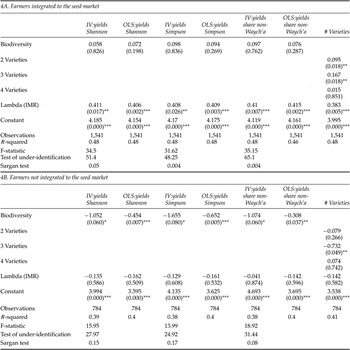
The results of the second stage for the IV approach on yields for both subsamples are presented in table 4.Footnote 11 The inverse Mills ratio is included to control for unobservable characteristics that might affect yields and market participation and is positive and significant, suggesting that unobservable characteristics that affect the participation decision also positively affect yields.Footnote 12
Assessing yields

Notes: Bootstrap standard errors: 1,000 repetitions. Robust p-values in parentheses; *, significant at 10%; **, significant at 5%; ***, significant at 1%. The variable altitude represents the average for the plots cultivated by the farmer.
The results for the subsample of market-integrated farmers show that all the coefficients for the diversity indexes are positive but not significant, which suggests that diversity does not affect yields per se. For the OLS regression, dummies for the different number of varieties planted by the farmer are included as proxies for biodiversity. The results suggest a non-linear positive relationship with a maximum at three varieties planted. In general, table 4 shows that diversity does not seem to have an effect on yields for farmers who participate in the seed market. In fact, the results provide some evidence suggesting that the number of varieties planted is positively related with yields.
These results contrast with the results presented for farmers who are not integrated into seed markets. Here, most of the indexes used to proxy for intracrop biodiversity show a negative significant sign indicating a negative relationship between biodiversity and yields. This is also corroborated by the results shown in the last column, where dummies for the number of varieties planted are included. Interestingly, the results suggest that, for the case of farmers who do not participate in the market, increasing the number of varieties is negatively related with yields, with its lowest at three varieties planted.
This is a very important result because it confirms that increased biodiversity per se does not decrease yields. As mentioned, farmers who are integrated into the seed market have higher levels of biodiversity than other farmers and also obtain higher yields. Alternatively, these results expose the possibility that there is a substantial difference between the portfolio of potatoes chosen by the farmers who are integrated and not integrated into the seed market. For example, farmers who are not integrated into seed markets could prefer to plant lower yielding varieties that provide resistance to certain pests or simply to satisfy particular tastes for home consumption. A second possible explanation for this result is that farmers who are not integrated into seed markets could be caught in a vicious cycle where, in order to reduce vulnerability and risk, they are indirectly compelled to plant lower yielding varieties as an ex-ante mechanism to guarantee a certain level for home consumption. A third explanation could be related to a bad quality of seed since the seed used by these farmers is not from the market but rather from previous harvest.
Also, the results show that household characteristics do not seem to play an important role for either sample. Specifically, only education seems to influence yields negatively and is only significant for the sample of market-integrated farmers. The results for the inputs of production are mainly as expected. Regarding the variables that capture the financial status and social networks of the households, for farmers who are integrated into the seed market, agricultural assets, livestock and non-agricultural income have a positive significant effect on yields. This could be explained by the fact that having access to other resources reduces liquidity constraints which allows farmers to have access to other inputs of production that increase agricultural productivity.
For the second subsample, having access to agricultural assets seems to have a positive significant effect on yields. Access to social capital is not significant for either sample. This suggests that, for participants, social networks affect yields only through their effect on diversity. With respect to the variables that capture location, we find that altitude and being located in Tiraque have a negative effect, while irrigation has a positive effect on the yields of integrated farmers. On the other hand, the positive significant coefficient of the distance to a paved road might be capturing lower land quality. In particular, plots located closer to paved roads, with greater access to markets, are expected to have higher intensity of land use and, therefore, lower land quality.Footnote 13
6. Conclusions
Using data from a study site in Bolivia where many producers transact in the potato market and where there are moderate levels of on-farm potato diversity, this paper analyzes seed market participation and how transaction costs in these markets influence intracrop biodiversity and the influence of biodiversity on yields. The analysis shows that, in this context, market attributes such as distance and market-level biodiversity have a crucial effect on market choice, suggesting that farmers are willing to sacrifice time and income to travel further distances in order to reach markets with a broader range of varieties. Evidence presented in the analysis suggests that transaction costs reduce the demand for diversification on farm. There are also substantial differences in the motivations that lead diverse groups of farmers to acquire certain levels of on-farm biodiversity.
Given that this is the case, policies that aim to improve levels of on-farm biodiversity in the case study region need to target groups of farmers differently and need to understand the degrees of interaction between these farmers and the seed market. By recognizing the factors and motivations that drive the demand for biodiversity among farmers and their degree of interaction with the market, specific policies can be addressed to target specific groups of farmers. Ignoring the differences among the determinants of intracrop biodiversity for specific subsamples of farmers could lead towards the development of ineffective policies. For example, in a region where most of the farmers are integrated into the market, investments in infrastructure that reduce transaction costs faced by the farmers would, at least in the short run, potentially generate an increase in the demand for intracrop biodiversity. Along the same lines, if the intention is to improve farmers' access to the market, then increasing market-level biodiversity and reducing transportation costs in order to decrease travel costs might be appropriate.
The second part of the study was dedicated to the examination of intracrop biodiversity and yields. The results show that, within the study site, seed market participation shapes the relationship between intracrop diversification and yields. Specifically, on-farm intracrop diversification does not affect potato production for the case of market-integrated farmers. For farmers not integrated into the seed markets, however, the levels of diversity are negatively related with agricultural productivity. Hence, estimations that do not account for the degree of market participation might generate senseless estimates that could lead policy makers to consider strategies that would cause unwanted consequences on diversity and yields.
Of course, from year to year – depending on market and harvesting conditions – farmers may switch status and enter or exit the market. Further analysis would be required to determine if these results hold, regardless of yearly conditions. Moreover, the results are valid for the study site in question, which is an area of Bolivia where potato producers tend to be market oriented and hold only moderate levels of diversity. Additional analysis of other sites would be required to determine whether these results are valid in other contexts.
With these caveats in mind, interestingly, the results show that in this particular season farmers who participate in seeds markets are more likely to have higher levels of intracrop biodiversity and higher yields. In addition, for this subsample of farmers, intracrop biodiversity does not seem to have a negative effect on yields, which suggests that markets do not threaten biodiversity. In contrast, it is found that markets are useful tools to increase intracrop biodiversity among farmers through the creation of social networks. However, assuming that maintaining on-farm diversity is a desirable outcome, authorities should be careful to create the appropriate environment such that the development of markets goes hand in hand with the conservation of agricultural diversity, for example, by increasing the supply of diversity in the markets and reducing the costs associated with reaching the marketplace.