Introduction
The growing interest in plant-based insecticides is driven by greater public awareness of the environmental and health drawbacks associated with synthetic insecticides, the banning of certain synthetic pesticides on safety grounds (Koul et al., Reference Koul, Islam and Ketkar1990; Schmutterer, Reference Schmutterer1990) and the identification of plant products effective against a range of insect pests (Singh and Rao, Reference Singh and Rao2000).
Meliaceae is one of the most important plant families in this regard; upwards of 500 species from this family are known to have pesticidal constituents. Among these species, neem (Azadirachta indica A. Juss.) has received much attention throughout the world for its activity against more than 413 species of insects belonging to different orders (Singh, Reference Singh, Dhaliwal and Singh2000).
Another genus of Meliaceae, Trichilia, has about 43 species that are known to possess biological or pharmacological activity (Wikipedia, 2009). Trichilia connaroides is a tall plant distributed widely in India, Indonesia and South China. It is rich in many biologically important compounds, including limonoids, products of limonoid degradation, steroids and triterpenoids. These occur in the leaves, flowers, roots, pericarp, twigs and fruits of the plant (Purushothaman et al., Reference Purushothaman, Sarada and Venkatanarasimhan1983, Reference Purushothaman, Venkatanarasimhan, Sarada, Connolly and Rocroft1987; Venkatanarasimhan and Kundu, Reference Venkatanarasimhan and Kundu1990; Inada et al., Reference Inada, Konishi, Murata and Nakanishi1994; Zhang et al., Reference Zhang, Wu, Shen, Ma, Wu, Qi and Luo2003; Wang et al., Reference Wang, Fan, Yin, Gan and Yue2008; Geng et al., Reference Geng, Fang, Di, Zhang, Zeng, Shen and Hao2009).
The Bihar hairy caterpillar Spilosoma obliqua Walker (Lepidoptera: Arctiidae) is a polyphagous and destructive pest damaging a wide range of field crops, vegetables, medicinal and ornamental plants. Its 2nd and 3rd instars feed gregariously, often leading to the death of infested plants (Bhadauria et al., Reference Bhadauria, Bhadauria and Jakmola2001). The pest has developed resistance to most common synthetic insecticides, making its control difficult (Dhingra et al., Reference Dhingra, Bhandari and Shankarganesh2007).
We studied the growth-regulatory activity of leaf extracts of T. connaroides on S. obliqua. The following biological parameters were assessed: larval mortality, larval duration, larval weight, pre-pupal and post-pupal mortality, pupal duration, adult emergence, adult deformity, fecundity and egg fertility.
Materials and methods
Plant collection and extraction
Mature T. connaroides leaves were collected from July 2007 to October 2008 from Nainital district, Uttarakhand, India, and shade dried. Dry leaves were finely powdered and extracted separately with acetone or n-hexane in a Soxhlet apparatus. The extracts obtained were concentrated in a flash evaporator under reduced pressure at 30 ± 5 °C. The crude extracts thus obtained were diluted in respective solvents (hexane or acetone) to prepare a 20% stock solution (w/v), which was used to prepare further dilutions of 1, 2.5, 5, 7.5 and 10% (v/v) for use in biological assays.
Biological assays
Studies on the biological effects of T. connaroides leaf extracts against S. obliqua were carried out in a biological oxygen demand incubator at 28 ± 2 °C and relative humidity 70 ± 5%. A pure culture of test insects was obtained from the Department of Entomology, College of Agriculture, G.B. Pant University of Agriculture and Technology, Pantnagar, India.
Fresh caster (Ricinus communis) leaves were dipped in extracts of different concentrations and then shade dried for 10 min. Ten 3rd instars of S. obliqua of uniform size were placed in pre-sterilized plastic jars (500 ml capacity with a copper wire mesh air hole on their covers) and offered treated caster leaves for 120 h (replaced every 24 h). The larvae were then removed from treatment jars and released into jars containing fresh, untreated leaves, where they were maintained until pupation.
Larval mortality (%), larval duration (days), larval weight (g/larva), pre-pupal mortality (%), post-pupal mortality (%), pupal duration (days), adult emergence (%), adult deformity (%), fecundity (per female) and egg fertility (%) were recorded. Leaves treated with hexane or acetone alone served as controls. The experiment was carried out in completely randomized design, and all treatments were replicated three times.
Statistical analysis
Data were subjected to ANOVA to determine critical differences among the treatments. Percentage data were subjected to angular transformation (Snedecor and Cochran, Reference Snedecor and Cochran1968).
Results
Effect on larval mortality and larval duration
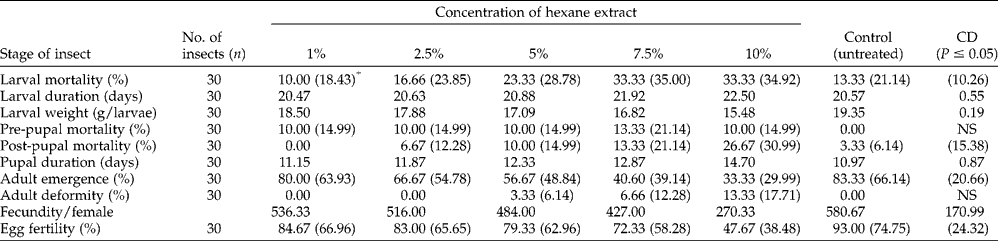
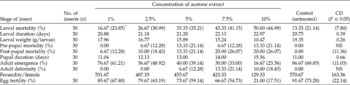
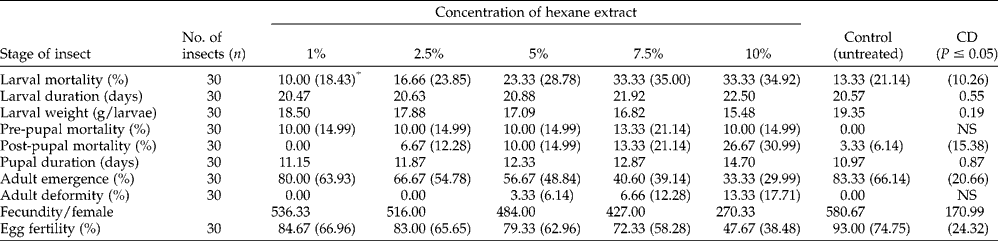
There was a progressive increase in S. obliqua larval mortality and larval duration with an increase in concentration of T. connaroides leaf extracts. Larval mortality in treatments with hexane extracts ranged from 10.0 to 33.33%, compared with 13.33% in control. Larval mortality at hexane concentrations of 1, 2.5 and 5% did not differ significantly from control (Table 1). Acetone extracts were more lethal than hexane extracts. Maximum larval mortality (50.0%) was observed at a 10% concentration. Larval mortality and duration at all concentrations, except 1%, were significantly different from controls (Table 2).
Effect of hexane extract of Trichilia connaroides leaves on biological parameters of Spilosoma obliqua
CD, critical difference; NS, non-significant.
+ Values in parentheses are angular transformed values.
Effect of acetone extract of Trichilia connaroides leaves on biological parameters of Spilosoma obliqua

CD, critical difference; NS, non-significant.
+ Values in parentheses are angular transformed values.
Maximum larval duration (22.50 days) was observed at a 10% concentration of the hexane extract, compared with 20.75 days in control. At a 10% concentration, the acetone extracts prolonged larval duration to 22.97 days, compared with 20.75 days in controls (Table 2); all but the 1% acetone concentration significantly prolonged the larval duration of S. obliqua.
Larval weight
Larval weight decreased with increased concentration of the extracts (Tables 1 and 2). All the concentrations of the hexane and acetone extracts tested caused significant reductions in larval weight compared with controls (Table 1), but the acetone extracts produced a higher overall reduction.
Effect on pre-pupal and pupal stages
Maximum pre-pupal mortality (13.33%) was observed at a 7.5% concentration of the hexane extract (Table 1). However, pre-pupal mortality did not differ significantly from controls at any of the concentrations tested. With the acetone extracts, maximum pre-pupal mortality (13.33%) was observed at the 5 and 10% concentrations, but again, treatments were not significantly different from control mortality (Table 2).
Post-pupal mortality (26.67%) was significantly different from controls at the 10% concentration of the hexane extract (Table 1) and all concentrations of the acetone extract (Table 2).
At 10% hexane extract concentration, maximum pupal duration (14.70 days) was observed (control = 10.97 days). Hexane extract concentrations of 2.5, 5.0 and 7.5% also prolonged the pupal duration significantly (Table 1). The acetone extracts had similar, significant effects on pupal duration (Table 2).
Effect on adult stage, fecundity and egg fertility
Adult emergence, fecundity and egg fertility were influenced variably by treatment with T. connaroides extracts, and percentage adult deformity increased with concentration. Adult emergence at 10% hexane extract concentration was 33.33%, compared with 83.33% in controls (Table 1). Treatment with 7.5 and 10% concentrations significantly reduced adult emergence, while concentrations of 1, 2.5 and 5% had no significant effects on emergence (Table 1). Acetone extracts at 2.5–10% concentrations produced a significant reduction in adult emergence (Table 2).
At the higher concentrations tested (7.5 and 10%), both the hexane and acetone extracts caused significant adult deformities in S. obliqua adults (Tables 1 and 2). Only the highest concentration of the hexane and acetone extracts (10%) caused a significant reduction in fecundity and egg fertility from controls (Tables 1 and 2).
Discussion
Various biological parameters of S. obliqua were influenced by T. connaroides extracts to varying levels. The observed prolongation of larval period and lethal effects indicates antifeedant and insecticidal properties in the extracts (Mittal, Reference Mittal2002). Acetone leaf extracts exhibited significantly greater antifeedant activity than hexane extracts. The differences in efficacy of hexane and acetone extracts may be explained by the difference in the two solvents' polarity. Acetone is the more polar solvent, and thus would have extracted more active principles from the leaves, while hexane is less polar, and extracted mostly fatty substances, which are less active. This finding is in conformity with studies on neem (Singh, Reference Singh, Schmutterr and Ascher1987).
Bark, wood, seed exocarps and leaf extracts of T. connaroides, Trichilia glabra and Trichilia hirta have been shown to significantly reduce larval growth in Peridroma saucia and Spodoptera litura. T. connaroides extracts have also been shown to reduce food consumption and have post-ingestive toxicity in lepidopteran larvae (Xie et al., Reference Xie, Isman, Gunning, MacKinnon, Arnason, Taylor, Sanchez, Hasbun and Towers1994).
Wheeler et al. (Reference Wheeler, Isman, Sanchez-Vindas and Arnason2001) reported that methanol extracts of twigs of various species of Trichilia reduced S. litura larval growth. Extracts of other species of Trichilia have shown activity against Spodoptera frugiperda (Roel et al., Reference Roel, Vendramin, Frighetto and Frighetto2000; Borgorni and Vendramin, Reference Borgorni and Vendramin2003, Reference Borgorni and Vendramin2005; Pereira et al., Reference Pereira, Nebo, Vieira, Fernandes, Fernandes and Rodrigues2009) and tomato pinworm (Vendramin and Thomazini, Reference Vendramin and Thomazini2001; Cunha et al., 2008). The insect growth-regulatory activity of the extracts of T. connaroides is probably caused by the presence of active constituents, such as limonoids and nortriterpenoids, which are commonly found in the family Meliaceae.
Acknowledgements
The authors acknowledge financial grants for the research provided by the Uttar Pradesh government.