1. Introduction
Like most British universities, Oxford is in the process of an upheaval. Its traditional identity, as one of the world’s most prestigious university cities, has been challenged by globalisation, by market forces that require universities to take on the characteristics of a business organisation (Fairclough Reference Fairclough, Caldas-Coulthard and Coulthard1996). It cannot simply, as in the past, rely on word of mouth to sustain its reputation for academic excellence, but instead needs to advertise its services in order to compete with other similar institutions. An ideology of traditional academic excellence has encountered that of the marketplace, with noticeable effects on the language used in Oxford’s publicity material. What once could be taken for granted now needs to be supported by a range of linguistic/semiotic resources, in a perspective that aligns students with consumers, and the university with a service provider (Bok Reference Bok2003; Naidoo Reference Naidoo and Barnett2005). Oxford has begun to participate fully in the logic of the marketplace that requires firms, institutions, and even nations (Pride Reference Pride and Gilmore2001) to devise brands for themselves, to create a marketable identity that will enable them to thrive in the context of global competition (Aronczyk Reference Aronczyk2013; Kavaratzis et al. Reference Kavaratzis, Warnaby and Ashworth2015).
Globalisation is one of the most pervasive features of post-modern society, and has had profound effects on social organisation, including the structures of higher education (Lin Angel and Martin Reference Lin Angel and Martin2005). As Hannerz (Reference Hannerz1992, Reference Hannerz1996, in Coupland Reference Coupland2010, 6–7) suggests, the notion of countries as discrete cultural units has now given place to a more fluid model in which cultures ‘diffuse and flow into each other’. Hannerz describes a world divided into central and peripheral areas, with flows of population and resources around the global system. Although Hannerz does not necessarily conceive of a simple mapping of cultural centres onto powerful political or economic centres, in the context of higher education this does tend to occur. The movement of students is generally from Asia and Africa towards institutions in Europe or North America, not the reverse (Deardorff et al. Reference Deardorff, De Wit, Heyl and Adams2012, 9–10). Where there is movement from the more powerful economies, this often takes the form of established universities opening branches abroad, in order to take advantage of developing markets (Deardorff et al. Reference Deardorff, De Wit, Heyl and Adams2012, 10).
From its origins in the primitive trading economies of the ancient world, globalisation has become, in Foucault’s terminology, a ‘regime of truth’, an all-encompassing, totalising social presence (Giddens Reference Giddens1990; Currie and Newson Reference Currie and Newson1998, 10). The effect of such an ideology on the discourse of Oxford has been to encourage a substantial rebranding, and this article explores the kind of identity now projected, through web pages, by the institution. The intention is to explore how far it is possible to trace the emergence of new aspects of the Oxford brand, and to what extent these can be attributed to the general influence of the globalised social context.
2. Branding
A brand can be defined as ‘a mixture of tangible and intangible attributes, symbolized in a trademark which, if properly managed, creates influence and generates value’ (Clifton and Maughan Reference Clifton and Maughan2000, vii). This is not simply confined to the marketing of products in the industrial sense. As Flowerdew (Reference Flowerdew2004) underlines, it is now commonplace for cities such as Hong Kong to engage in such processes, in order to gain a competitive edge in the tourist sector, for example. In today’s global context, it would seem, the range of institutions of higher education engaged in self-promotion through branding has widened immensely, with the main aim that of competing for a finite series of mainly financial resources (Ashworth et al. Reference Ashworth, Kavaratzis, Warnaby, Kavaratzis, Warnaby and Ashworth2014, 4; Docherty Reference Docherty2015). Such processes involve the identification of the core values (Flowerdew Reference Flowerdew2004, 584) of the product or, in our case, of the institution, which form an essential part of the brand. As Jevons (Reference Jevons2006, 466) argues, in fact, in the university context, branding plays a significant part in effective recruiting, since only those potential students who see their values reflected in those of the institution will apply. Although some studies in branding research have questioned the applicability of business logic to universities (Chapleo Reference Chapleo2011), in practice most British universities have taken on this challenge over the past few decades (Temple Reference Temple2006; Bennett et al. Reference Bennett, Ali-Choudhury and Savani2007; Waeraas and Solbakk Reference Waeraas and Solbakk2008).
In more general branding research, Doyle and Sterne (Reference Doyle and Sterne2006, 165) suggest that products are differentiated from one another on the basis of ‘added values’, which give potential buyers confidence that the product in question is superior to that offered by competitors. Applying this notion to the case of Oxford University, such added values have traditionally been associated with academic excellence, often because of the works of celebrated alumni whose pre-eminence in their fields shed a reflected glory on the university. The view of Oxford that has persisted during the modern period, in the popular imagination, is that portrayed in Matthew Arnold’s nostalgic verses:
The notion of Oxford as connected with a past golden age of intellectual activity, however, does not constitute a brand in the modern sense. Indeed, in the present day, such an image may even be counterproductive: although the ‘dreaming spires’ may represent, for the poet, metaphors for the desirable intellectual qualities of aspiration and inspiration, they also have connotations of sleepiness and also, possibly, anachronism. Resistance to change has always been a criticism levelled at Oxford, as at other elite institutions (Tapper and Palfreyman Reference Tapper and Palfreyman2011, ix). Ironically, in the nineteenth century, too, Oxford was struggling with the necessity for modernisation, as more contemporary spirits such as John Stuart Mill and John Ruskin sought to revise curricula based on medieval models and instruction which too closely adhered to the tenets of Aristotle (Evans Reference Evans2010). What emerges from a glance at the institution’s webpages, and will be explored further in what follows, is the way modernity is embraced; the pages’ designers are at pains to emphasise the forward-looking, international scope of the university’s activities, downplaying the better-known aspects of its more traditional identity.
There is a connection between branding and a phenomenon which has received much attention in Critical Discourse Analysis, ‘framing’ (see, for example, Entman Reference Entman2004; Hart Reference Hart, Hart and Cap2014, 174); that is to say, the specific aspect of a situation, a social structure or a product that is emphasised in discourse, in order to encourage a particular response from the reader. In Entman’s description, framing refers to the ‘selecting and highlighting some facets of events or issues, and making connections among them so as to promote a particular interpretation, evaluation and/or solution’ (Entman Reference Entman2004, 5). In the text studied in this article, traditional elements of the university’s academic reputation are present, but they are accompanied by a detailed description of its international mission, with the accent falling very much on this latter aspect. There are statements such as the following, for example:
Today, Oxford is a modern, research-driven university…
It has been ranked number one in the world for medicine…
Ranked in the top ten globally in life sciences, physical sciences, social sciences and the arts and humanities
These are suggestive of a progressive frame that wards off the old-fashioned image of Oxford, which tended to be spread by less self-conscious methods such as word of mouth reports of past alumni, or indeed, by cultural references such as Arnold’s poem. Instead of dons in gowns, quipping in Latin at the High Table, the intended picture is of an institution devoted to cutting-edge, mainly scientific, research. There is also an implicit frame of ranking, suggestive of a global context in which educational institutions compete to move up or down a sort of league table. An integral part of such a frame, therefore, is competition, one of the fundamental principles of the neo-liberal social order (see Cerny et al. Reference Cerny, Menz, Soederberg, Soederberg, Menz and Cerny2005, 17). Although it is, of course, true that Oxford began life in competition with rival European centres of knowledge such as Paris (Evans Reference Evans2010, 96), the current global context has made such processes more urgent, and intensive than at any previous time. Emphasis on such details assists the text in its attempt to reach out to prospective students who, it is suggested below, are of increasingly international provenance, and are therefore likely to be attracted by courses that might improve their credentials in a globalised labour market.
3. Impact of Globalisation on Universities in the UK
Sarah Churchwell (quoted in Alex Preston Reference Preston2015), coined the phrase ‘the forced professionalisation of academia’ to describe the effect of Margaret Thatcher’s neoliberal reforms of British universities. However, while such processes may have accelerated under Thatcher, their origins appear to date from an earlier period, the post-war years (Woodman Reference Woodman2016, 42). Once it was possible for universities, as non-profit structures receiving hefty subsidies from governments, to focus on abstract goals conceived of in terms such as ‘the pursuit of academic excellence’ or, indeed, on the development of character, as described by Harry Lewis, ex-dean of Harvard, who wrote:
The greater the university, the more intent it is on competitive success in the marketplace of faculty, students, and research money. And the less likely it is to talk seriously to students about their development into people of good character who will know that they owe something to society for the privileged education they have received. (Lewis Reference Lewis2007, xiv)
Such aims have now been replaced by a managerial logic that is wholly directed at maximising the institution’s chances of surviving in a competitive world (Winston Reference Winston1999). In a 1996 article on discourse in the university context, Norman Fairclough summed up the effects of the accelerating programme of government cutbacks, the imposition of market conditions of operation, and the consequent importation of discourses and practices from the world of business:
British universities have experienced major externally imposed changes (cuts in government finance, imposition of market conditions of operation, mechanisms to ensure answerability and ‘relevance’) and internal organisational changes (‘cash economy’, training and appraisal of staff, institutional plans, ‘enterprise units’ as part of degree schemes, etc.) which have been seen as requiring new skills in teaching, management, counselling, and so on, entailing access to knowledges and techniques from outside higher education. (Fairclough Reference Fairclough, Caldas-Coulthard and Coulthard1996, 75–76)
The processes described have not diminished since the article in question was published; rather, the reverse is true, as a book review by Simon Head (Reference Head2011), in the New York Review of Books, makes clear. Head describes the current situation of consolidated infiltration of British universities by a management ethos which, he suggests, is necessarily detrimental to the quality of research carried out, and is more responsive to global economic pressures than to academic considerations. Management systems, he writes, now dominate the lives of British academics to an unprecedented extent. David Lammy, Gordon Brown’s minister of higher education, is quoted as saying:
Since these impacts are things that happen outside the academic realm … [we] propose that the panels assessing research impact will include a large proportion of the end-users of research-businesses, public services, policymakers and so on – rather than just academics commenting on each other’s work.
Head’s comment on this is that, because of the prominence of pharmaceutical research in the modern university context, such projects amount to ‘an invitation to the pharmaceutical industry to tighten its hold over scientific research in the UK’ (Head Reference Head2011, 4). Implicit in Lammy’s mention of academics commenting on each other’s work is a derogation of ‘mere’ academic work; research that has no tangible application in social terms, that cannot form part of government economic policy, is presumably less likely to be funded. In such a vision, there seems little place for research in the Humanities, or for the study of knowledge for its own sake, and the place of many subjects in the university curriculum (including Sociology, History, Archaeology, Anthropology, Literature, Philosophy, among others) would seem to be under threat (Docherty Reference Docherty2011, 120; Pinxten Reference Pinxten, Vanderbeeken, Le Roy, Stalpaert and Aerts2012).
British universities, furthermore, must now conform to a periodical evaluation of their research, conducted by a government office, the Higher Education Funding Council for England, which assigns funds to what it prioritises as worthwhile projects. Responsible to the Department of Education, it has designed and operates a funding system based on performance criteria and quality measures in teaching and research (Alexander Reference Alexander2000, 424). By this mechanism, the universities are compelled to respond to what the government sees as priorities; among which, clearly, are priorities that derive from the logic of the global marketplace. The nature of the conflict of ideas (and ideologies) involved in these issues emerges from the sentiments expressed by the British Committee of Public Accounts, who carried out an internal review of English public universities, and stated in their final report that
We do not accept that their [the universities’] independence and autonomy, although undoubtedly valuable in many respects, is a valid argument against the attempts to defend against the shortcomings in realistic and effective management and control of the public funds on which universities are dependent. (In Alexander Reference Alexander2000, 414)
The message is clear: effective management of public funds ranks higher, as a government priority, than the universities’ independence and autonomy.
It is not just in terms of their research agendas that British universities are feeling the effects of globalisation. Recent years have seen dramatic increases in the number of foreign students at British universities, including Oxford. Percentages of overseas students rose steadily during the period 2007–2013, to reach 12.1% (almost one eighth of all students) in 2012–2013, for a total income of £3.5 billion. At Oxford, in 2015, the figure was 14.3% of all students coming from EU or non-EU countries. Students from non-EU countries frequently pay up to four times more for their tuition than domestic students, according to a recent BBC news report (BBC 2016). This, naturally, makes them a valuable source of revenue for the universities and an important target for marketing campaigns.
All foreign students also benefit Britain’s economy, in ways that are not limited to the income from the fees they pay; rather, they create employment opportunities both on and off campus, and spend money for board and lodging, for entertainment, and suchlike (see Table 1).
Economic impact of EU and non-EU students off-campus expenditure, by region 2010–2011 (from Universities UK 2014 , 39).

Table 1 illustrates the role that universities play in the modern economic context, and the importance of the contribution of international students. There are, therefore, strong reasons for both the British government and the universities to pay close attention to the international context, and for the former to do everything in their power to encourage the latter to reach out to this sector by every means possible.
4. Methodology
This article uses aspects of Wodak’s discourse-historical approach (Wodak and Meyer Reference Wodak and Meyer2001), especially in the foregoing description of the socio-historical context, in line with the principles laid down in Weiss and Wodak (Reference Weiss, Wodak, Weiss and Wodak2007). The discourse-historical approach is, according to Reisigl and Wodak
a context-sensitive theory that follows a complex concept of social critique and focuses on the historical and political dimension of discursive actions. (Reisigl and Wodak Reference Reisigl and Wodak2001, xii)
It is generally accepted within discourse analysis that texts must be considered in relation to the social contexts that produce them (see, for example, Halliday and Mathiessen Reference Halliday and Matthiessen2004; Hyatt Reference Hyatt2005. 522–523; Hyland and Paltridge Reference Hyland, Paltridge, Hyland and Paltridge2011, 1). Wodak’s recent work takes this basic tenet much further, illustrating the value to analysis of a nuanced account of the particular social, historical and geo-political circumstances that surround the text (Wodak Reference Wodak, Hyland and Paltridge2011). Without such background knowledge it will be impossible, for example, to appreciate the pragmatic significance of references, in the following text, to Emo of Friesland, Oxford’s first international student, or to globalisation, or to the international context generally. Wodak proposes three different levels for discourse analysis: from a macro perspective the focus is on ‘topics’, then ‘discursive strategies’ and finally, at the micro level, ‘linguistic means’ (Wodak and Meyer Reference Wodak and Meyer2001, 26–27). In this article, topics refer to the overarching realities of globalisation, the need to situate the university as a service provider in an international market, and the importance of foreign students. These realities of the global context represent the implicit background, knowledge of which is the necessary foundation for pragmatic interpretations, by readers and potential students, naturally, but also by the analyst. Discursive strategies relate to the implicit argumentation advanced through the text, engaging with potential students and attempting to persuade them to apply. At the level of linguistic means, text analysis focuses on discourse framing and the interpretation of pragmatic inferences. In this regard, some tools from Critical Discourse Analysis are employed: presupposition (Levinson Reference Levinson1983), where the truth-value of a proposition may be taken for granted (e.g. ‘the Soviet threat’, see Fairclough Reference Fairclough1989, 154), and pronoun reference (Fairclough Reference Fairclough1989, 127–128).
The analytical approach also draws on some Hallidayan notions such as information structure (Halliday and Matthiessen Reference Halliday and Matthiessen2004, 118) and evaluative language (Martin and White Reference Martin and White2005). An examination of information structure sheds light on priorities of message organisation, while the role of evaluative language as a feature of persuasive discourse, in different contexts, has received considerable attention (Martin Reference Martin2004; Martin and White Reference Martin and White2005; Bhatia Reference Bhatia, Halmari and Virtanen2005).
The starting point is a pragmatic approach based on Grice’s conversational maxims, and especially his maxim of relation (Grice Reference Grice1989, 26–28), which later became an integral feature of the approach of Sperber and Wilson, who used the more common term ‘relevance’ (Wilson and Sperber Reference Wilson and Sperber2012). As Clark (Reference Clark, Levelt and Flores d’Arcais1978, 297) says, the basic problem of all communication is to find an answer to the basic question ‘What did the speaker mean by what he said?,’ and it is from such insights that much later work in pragmatics derives. Clark continues:
The sentence uttered provides only some clues to the solution. Other clues must be sought in the physical and linguistic context of the utterance, the speaker’s assumed beliefs, and all kinds of general knowledge
Thus, in the opening sentence of Oxford’s International Profile website, we read:
You may have heard about Oxford’s history as the first university in the English-speaking world.
Reading between the lines, the words evoke a simple question: who is meant by ‘you’? As we shall see, below, the answer is not straightforward, and entails the application of what Wodak refers to as historical background knowledge, and Clark as ‘all kinds of general knowledge’.
Although the discourse-historical approach presents an effective synthesis of past work on context in discourse analysis, it is not easy to apply tout court to a small-scale study such as this. Wodak set out no fewer than 11 heuristic criteria (Wodak and Meyer Reference Wodak and Meyer2001, 69–70), only some of which have been respected here. The method explicitly countenances an eclectic approach to analytical methodology, for example, in the fourth criterion: ‘The theory as well as the methodology is eclectic; that is theories and methods are integrated which are helpful in understanding and explaining the object under investigation’ (Wodak and Meyer Reference Wodak and Meyer2001, 69).The eighth criterion is also fulfilled: ‘historical context is always analysed and integrated into the interpretation of discourses and texts’. However, since the aim of the discourse-historical method, as of all Critical Discourse Analysis, is to ‘change certain discursive and social practices’, it may be asked whether the current article belongs to this genre at all. If we consider the more ambitious formulations of the CDA mission, articulated in 1996 by one of the movement’s founders, Gunther Kress, this will be plainer: ‘The intention has been to bring a system of excessive inequalities of power into crisis by uncovering its workings and its effects through the analysis of potent cultural objects – texts – and thereby to help in achieving a more equitable social order’ (Kress Reference Kress, Caldas-Coulthard and Coulthard1996, 15).
The transformations that have taken place in British universities have responded to global economic trends, and it is hard to see how the universities could have behaved differently, or how such macro historical trends may be affected in any way by the practices of critical text analysts. In the area of autonomy, too, it may be questioned whether the old system was fairer – more equitable – in any sense. What seems to have gone on is a transfer of power from one set of social actors (university authorities, especially professors) to another (bureaucrats in government departments, business interests), a process that has indeed been responsible for a radical transformation of Britain’s universities, but it is really beyond the scope of this article to pursue the question of whether such changes have been desirable or otherwise.
Rather, the article has the more modest aims of showing how the global context interplays with effects at a textual level, how such background knowledge needs to be activated by a critical reading to correctly understand the text, and how such resources configure the outlines of a text whose pragmatic purpose is to persuade its target readers to take the step from prospective to actual clients.
It is important to identify, at the outset, the text’s ‘ideal reader’ (Fairclough Reference Fairclough1989, 52; Coulthard Reference Coulthard1994, 4–5), which will explicate the persuasive, perlocutionary dimension of this text, and also account for much of its content. Engagement with this figure is important in any text, but it is fundamental in a website such as this, which has a promotional intent. As Klassen (Reference Klassen2002, 81) points out, university web pages are not simply used to provide information but also to provide virtual campus tours for prospective clients, as an interactive resource for actual students, and to create ‘lifelong relationships’ with students and alumni.
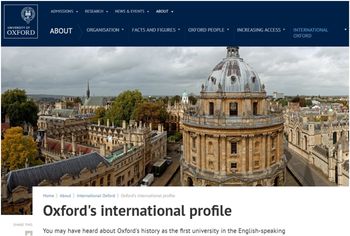
Finally the article also analyses the page from a multimodal perspective, considering aspects such as the interplay between image and text, and the use of colour. The semiotic mode of colour is an important indicator, because of its associative potentials (Kress and Van Leeuwen Reference Kress and Van Leeuwen2002; Machin and Thornborrow Reference Machin and Thornborrow2003, 460; Lazar Reference Lazar2009, 381–382). The relevant page, like the website on which it appears, is dominated by the various shades of the colour blue (Figure 1).
Oxford’s international profile: webpage.

This colour, in the deep shade on the banner, is associated with the university’s sports’ teams, and evokes traditions of excellence and Olympian vigour. It also has connotations of ‘calm’ and ‘relaxation’ (Lazar Reference Lazar2009, 377), of ‘sincerity’ (Hobbs Reference Hobbs2003, 279), and ‘purity’ (Sobolev Reference Sobolev2003, 104), as well as, less positively perhaps, of ‘masculinity’ and traditional gender roles (Weatherall Reference Weatherall2002, 773).
In multimodal analysis, text and image blend into one complete semiotic system (Kress and van Leeuwen Reference Kress and Van Leeuwen2006; Bateman Reference Bateman2008). Here it is noticeable that the banner, with its traditional colour-based associations, is situated above an image of Oxford at its most traditional – the Baroque splendour of the Radcliffe library, in a prominent, almost central position, with some of the ‘dreaming spires’ also in evidence. Kress and Van Leeuwen speak of the principle of horizontal elongation (Kress and van Leeuwen Reference Kress and Van Leeuwen2006, 57), where the higher element tends to be associated with ‘Given’ information, in Halliday’s sense, and the lower with ‘New’ (Halliday and Matthiessen Reference Halliday and Matthiessen2004, 93). In Halliday’s system of information structure, by Given information, which is frequently mapped onto the textual theme, is meant information that, it is assumed by the speaker, the listener already knows. The rheme corresponds to the new information s/he wishes to convey, or, as Halliday puts it: ‘attend to this: this is news’ (Halliday and Matthiessen Reference Halliday and Matthiessen2004, 91). If we apply these notions to the image, we perceive that banner and image, together, appear to convey ‘traditional Oxford’, contrasting with the headline below, ‘Oxford’s International Profile’. This latter information occupies the lower position and is therefore the ‘news’ that the page wishes to communicate. If we consider, finally, that readers are primed to interpret headlines beneath images as in some way inherently connected to the image, we further appreciate the tension in this particular word-image (a term used by Nöth Reference Nöth2001 to describe text and image considered as a single semiotic item). The message appears to be asking the reader to consider the Oxford that we know – traditional, historical, excellent, academic – as having something new (not in evidence in the image): an ‘international profile’. The same tension between traditional and new occurs within the text itself, which is obtained by clicking ‘About’/‘International Oxford’ on the homepage, and is analysed in the next section.
5. Data from the Oxford University Website

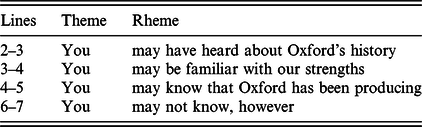
The opening uses the rhetorical feature of anaphora, in the repeated use of the personal pronoun ‘you’ (lines 2–5), and this series of direct engagements with the text’s ideal reader enables us to form some conjectures about his/her possible identity. The text takes for granted that the reader is familiar with certain facts about the university and its mission. These facts are that the university is the first university in the English-speaking world, is strong in the humanities, has outstanding museums and libraries, has been producing leaders for 800 years, and has a distinctive and personal method of teaching (2–5). These are things which are common knowledge about Oxford University, they relate to the core values and traditional vision of Oxford, outlined in some detail above. Applying Grice’s relational criterion, we may wonder why the text refers to these facts at all if they are common knowledge.
If we turn to a consideration of information structure, a possible solution is found (Table 2).
Oxford text, information structure.

‘You’, then, according to Halliday’s mapping of ‘given’ information onto the theme and ‘new’ onto the rheme (Bloor and Bloor Reference Bloor and Bloor1995, 79; Halliday and Matthiessen Reference Halliday and Matthiessen2004, 550), is clearly the focus of the sentences, whose meta-message, as it were, can be expressed as: here is some information about ‘you’. This gives us more clues about the text’s ideal reader; s/he is one who already knows (and accepts as true?) the ideational propositions contained in these first sentences.
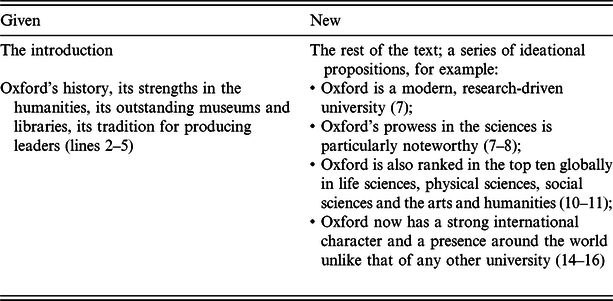
The final proposition (7–8) is different from the first three, in that it contains an explicit reference to what, according to the writer, may be ‘new’ information. Thus, the text itself can be viewed as possessed of a macro information structure, as shown in Table 3.
Oxford text, macro-information structure.

The ideal reader, then, is not only someone who probably knows a lot of the (extremely positive) facts about Oxford University that have traditionally circulated about it, but is also someone who will be interested to learn certain new facts which the text presents. Again, Grice’s relational criterion points a finger in the direction of potential foreign students, especially those interested in science, research, social sciences and the arts and humanities (7–11).
The rest of the text, with its abundant references to the international dimension (1,8,10,13–16, etc.), and to globalisation in particular (13,14,20), confirms the identity of the ideal reader as a prospective overseas student. Other solutions are possible, though not persuasively so. For example, we might suggest that the ideal reader is ‘any prospective student considering Oxford as a possible study destination’. But then we would have to explain the presence, in the text, of the great number of references to the global context. Why should a prospective student from the UK be interested in the reference to Emo of Friesland (13–14), for example, or the international profile of Oxford’s teaching staff and student population (17–18), or how many overseas alumni Oxford has had (28)?
Once the category of ‘prospective overseas student’ has been identified, the text takes shape as part of a deontic, rather than an epistemic, genre. Its function is not simply to describe Oxford, but to attract, to persuade this ideal reader, who may be considering which university to apply to, that Oxford is the right one. The text creators are able to take for granted a certain interest in the international dimension, since their ideal readers, by clicking on the ‘international Oxford’ button, have already revealed this; the text’s overall purpose, then, is that identified by Fairclough (Reference Fairclough, Caldas-Coulthard and Coulthard1996, 80) for many such texts, i.e. ‘to persuade while appearing to be merely informative’.
Identifying the referents for the plural pronouns ‘we’ and ‘our’ is less problematic. The effect of these pronouns is to personalise the university; rhetorically, they create an impression of closeness (Baxter Reference Baxter1984; Spencer-Oatey Reference Spencer-Oatey1996). There is a significant alternation between an impersonal style of presentation (‘Oxford’) and the more personal form, which is expressed in the plural pronouns:
Oxford is a modern, research-driven university. Our prowess in the sciences is particularly noteworthy: we have been ranked number one in the world for medicine [..] Oxford is also ranked in the top ten globally. (7–10)
The intention here seems to be to lend credence to the claims advanced in the text regarding the international scope of Oxford’s activities by using the more ‘distant’ option: the university’s institutional character is expressed in ‘objective’ terms through use of the proper noun, while the instances of pronoun use hold out a possibility for human contact, for relationship (for the rhetorical effects of personal/impersonal representational strategies, see Van Leeuwen Reference Van Leeuwen, Caldas-Coulthard and Coulthard1996).
Presuppositions abound in the opening phrases:
-
You may have heard about Oxford’s history as the first university in the English-speaking world (presupposition: Oxford is the first university).
-
You may be familiar with our strengths in the humanities, or our outstanding museums and libraries (presupposition: we are strong in the humanities, our museums and libraries are outstanding).
-
You may know that Oxford has been producing leaders for 800 years, through a distinctive and personal method of teaching (presupposition: Oxford’s teaching methods are responsible for producing leaders).
Some of these presuppositions appear also to give covert support to the text’s claims – Oxford may have been, historically, the first university. However, this proposition, if considered alongside the manifold positive references to the university throughout the text, may be seen as advancing a claim, based on the semantic ambivalence of the word ‘first’ – that it is also the best.
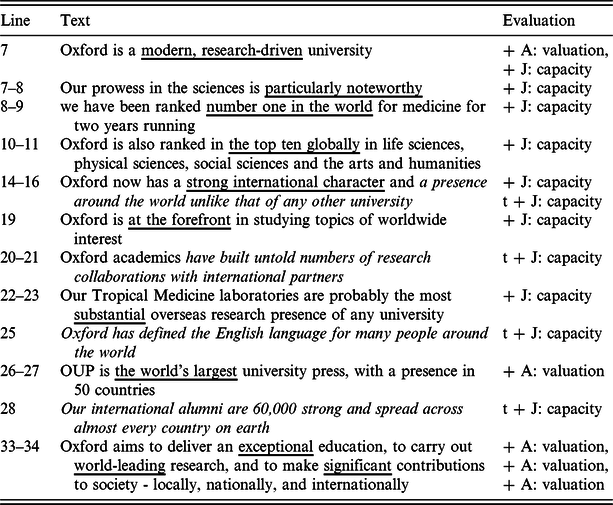
The text is notable for its deployment of evaluative language, a resource that frequently features in the discourse of advertising (see, for example, Cook Reference Cook1992, Goddard Reference Goddard1998, or for a more extensive treatment, Bullo Reference Bullo2014). Bullo emphasises the persuasive function of positive evaluative phrases such as ‘a masterpiece of engineering’, used to describe a Mercedes car (Bullo Reference Bullo2014, 154). From the perspective of place branding outlined above, the University of Oxford has the same essential characteristics as any other marketable product, and the text’s persuasive attempt relies heavily on evaluative language (Table 4).
Oxford text, evaluative language.

Such positive evaluations, from an advertising/branding perspective, provide cogent reasons for potential consumers to select Oxford rather than a competitor. Not only is Oxford a quality product, a characterisation achieved through explicit positive lexical descriptors (modern, noteworthy, number one, strong, at the forefront, substantial, largest, exceptional, world-leading, significant). The evaluation frequently relates to a global context, and claims are advanced in several places that Oxford is either the best in the world or carries out activities at a global level in ways that eclipse the competition (lines 8–9, 10–11, 14–16, 19, 22–24, 25–27, 28, 34–35). Interested readers are referred to Martin and White (Reference Martin and White2005) for detailed explanation of the Appraisal Framework. Here it is sufficient to say, first, that positive (+) judgements (J) refer to the capacity of the human resources of the university; its teaching and administrative staff, its research teams and academics, its publishers and language specialists. Second, that positive Appreciation (A) relates to the evaluation of artefacts such as the ‘university’ (7). Finally, references marked t (= token) refer, in the absence of positive evaluative lexis, not to explicit but rather, to implicit evaluations. A proposition such as that the university ‘has a presence around the world unlike that of any other university’ (14–16) is likely to be viewed as positive, to the extent that the actual reader of this text corresponds to the ideal. Both implicit and explicit lexis, then, work to provide positive evaluation, in support of the university’s attempt to persuade the undecided ideal reader.Footnote 1
One final detail that emerges from these references is the importance of the scientific aspect of Oxford’s mission; this is frequently associated with positive evaluations, e.g. the assertion that Oxford has been ranked number one in the world for medicine (8–10, see also 22–24), or that it is ranked in the top ten globally for life sciences, physical sciences and social sciences (10-11). Other subjects, such as the humanities, are mentioned, but the sciences receive greater emphasis. The intention, once again, is perhaps to engage with what are perceived as the likely interests of the ideal reader, and to ward off the traditional associations of Oxford with merely ‘academic’ subjects, divorced from the hi-tech realities of the age – such is also the inference of the characterisation of Oxford as a ‘modern, research-driven’ university (7).
Analysis therefore appears to confirm the hypothesis that processes of re-framing/re-branding are indeed in progress at Oxford. The text is full of references to the global context, to the skills needed to perform well in the modern labour market, where science and technology are at a premium. Explicit reference is made to employment possibilities in the international context (23–25, 27–28), as well as to research opportunities abroad (21–22, 31–33). The text enacts a kind of re-framing, through the use of the ‘you probably already know/you may not know’ formula. What ‘you’ probably know is the standard frame – Oxford’s traditional reputation for academic excellence, its famous antiquity, its strengths in the humanities, its museums and libraries. However, as good as these things are, in today’s competitive global scenario, they may strike a note that risks being seen as old-fashioned, even out of touch. These aspects are not likely to attract the foreign student looking to develop skills for the global marketplace. Thus, the text adds to this ‘Given’ information the ‘New’ details that present Oxford as an institution that has had a global mission since the arrival of Emo of Friesland in 1190 CE, which is alert to the challenges of globalisation (20), and that has a considerable global presence through its various partnerships and overseas interests.
6. Conclusion
This article has aimed to illustrate some of the linguistic/textual/semiotic effects of the global social context on the website of Oxford University, suggesting that a rebranding operation is indeed underway, and exploring the reasons that underlie it. The issues dealt with are expressed by author Alex Preston (Reference Preston2015) in the colourful language of a recent newspaper article:
The corridors of our universities are stalked by soft-footed technocrats who draw down six-figure salaries in exchange for implementing ‘right-sizing’ exercises and ‘internationalisation programmes’, while harried academics are forced to deal with a wall of bureaucracy that is being constructed, form-by-form, between them and their students. Research is centrally mandated and programmatic; time – once the academic’s greatest resource – must be accounted for in meticulous detail; and everywhere, and at all times, the onus is on academics to ‘monetise’ their activities, to establish financial values for their ‘outputs’, and to justify their existence according to the remorseless and nightmarish logic of the markets.
The large-scale nature of the processes which may be held responsible for these transformations places them in another category to the social ills addressed by studies such as that of Van Dijk, on racism in the press (Van Dijk Reference Van Dijk1991), or Vasta’s critique of Shell’s promotional campaigns (Vasta Reference Vasta, Cortese and Duszak2005). Although both these studies attack large-scale social issues, globalisation is not a comparable phenomenon. Nowadays, it is an uncontroversial proposition in many western societies that expressions of racism are wrong; critical studies, along with changes in attitude at a social level, may have contributed to this recognition. Widespread opposition to fossil fuel, generated by awareness of possible environmental catastrophe, has brought the negative aspects of oil extraction into focus. Globalisation in itself, however, is arguably neither positive nor negative; it is simply a feature of our post-modern societies, a phenomenon whose origins are indeed remote, and one that can hardly be reversed.
Some of the effects of globalisation on the university environment have been the subject of criticism, as has been pointed out, above. Preece expresses the matter as follows:
globalisation has reframed the debate on access to higher education in neoliberal economic discourses. In this scenario, access to higher education is framed in terms of meeting the needs of industries in the global marketplace by providing a highly educated and skilled workforce. (Preece Reference Preece2011, 129)
It is in the light of such reflections that a possible critical dimension to the current article must be posited. As outlined above, there are legislative measures and bureaucratic mechanisms in place that currently impose, to a significant extent, marketplace logic on universities in Britain, including Oxford. It may be possible for hard sciences to adapt to this new context without a struggle; after all, commercial spin-offs have always been a feature of such research, enriching those making the discoveries and bringing prestige to the institution involved. However, it is unclear how the marketplace value of a philosophical tract, an article on Dickens or a study of a Khoisan click language is to be assessed. If the only research to be funded is that which has a commercial value, then the disciplines producing such studies – in other words the Humanities, generally – are destined to dwindle. Thus, the rebranding of the dreaming spires, described in this study, is only a small part of a wider phenomenon, for which globalisation is ultimately responsible, and whose repercussions deserve the serious attention of all those engaged in higher education.
About the Author
Douglas Mark Ponton has lived in Sicily for more than 20 years and is currently Associate Professor of English Language and Translation in the Department of Political and Social Sciences, University of Catania. His research interests include evaluative language, interactive sociolinguistics, ecolinguistics, political discourse analysis and discourses of tourism.