Introduction
Rapid urbanization will result in the generation of more wastes in cities including human urine which has been found to be a good fertilizer for crop productionReference Guzha, Nhapi and Rockström1, Reference AdeOluwa, Adeoye and Yusuff2. However, economic returns and microbial contamination as well as acceptability are issues of concern.
Physiological measurement shows that an adult in a year excretes via urine 2.5–4.3 kg N, 0.7–1.0 kg P and 0.9–1.0 kg K. This is higher than levels excreted via feces and represents 60–90% of the plant N, P and K ingested, which can be retrieved in solutionReference Kirchmann and Peterson3. Although excellent performance of human urine as a fertilizer in crop yield has been reportedReference Hoglund4–6, there is a need to quantify financial returns from urine fertilizer.
It has been reported that fresh human urine is sterile in the bladderReference Schönning7. Leptospira interrogans, Salmonella typhi, Salmonella paratyphi and Schistosoma haematobium are pathogens traditionally known to be excreted in urineReference Feachem, Bradley, Garelick and Mara8. The possibility of transmitting these pathogens via urine as fertilizer in developed countries is negligibleReference Schönning7. Where human wastes such as urine can improve agricultural productivity, independently of their microbial characteristics, they can contribute to the nutritional status of the population, thus improving public healthReference Hoglund4. However, it is necessary to investigate whether the same will hold in a developing country such as Nigeria with less strict environmental health policies. Although the use of urine in agriculture is not newReference Matsui9, attitudes of farmers and consumers to acceptability in crop production is not certain.
Richert et al.Reference Richert, Gensch, Lönsson, Stenström and Dagerskog10 reported that dissemination and knowledge development on urine as a fertilizer are best gained through local demonstration experiments involving organizations that work with small-scale farmers and local communities, as well as local research organizations. Thus, this report presents an investigation of the effects of human urine in comparison with other fertilizer materials on the yield of amaranths (Amaranthus caudatus) on small-scale farms. Post-production analysis of soil nutrient and crop pathogen concentration was done as well as the study of the perception of farmers and consumers to the use of urine in crop production.
Materials and Methods
This study involved a field experiment to determine the response of green amaranths (A. caudatus) to the application of urine and other fertilizer sources using a participatory approach. The vegetables produced from the experimental treatments were analyzed in the laboratory for pathogenic microbial risk as well as the effects of the fertilizer on the nutrient status of the experimental soils before and after planting. Perceptions of farmers and consumers in the study area regarding use of urine as fertilizer for vegetable production was investigated with the aid of a structured questionnaire, participatory field planting/demonstration and laboratory analyses.
This investigation was carried out between December 2008 and August 2009. The study was carried out at the Mokola-Army Barracks of Ibadan, North West Local Government, Oyo State, Nigeria. The local government owns a large area of land with a population of about 147,918 according to the 1991 Census. Average annual rainfall is 1280 mm with a bimodal pattern. Minimum and maximum temperatures range from 12 to 30 °C and 28 to 34 °C, respectively.
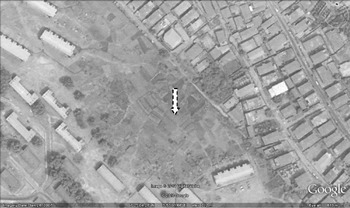
Commercial vegetable production in urban centers in Nigeria is dependent on cultivation of institutional land (such as the Army Barracks). There are up to five such vegetable farming communities within urban and peri-urban Ibadan, but the project community was selected due to the high level of cooperation from the farming community. Farmers in this area are mostly men from different ethnic groups of Nigeria. An aerial photograph of the study location is shown in Figure 1.
Satellite imagery of the project area, Mokola, Ibadan, Nigeria. The arrow points to the experimental plot.

Agronomic study
The planting experiment involved cultivation of green amaranths with fertilizer treatments at a rate of 100 kg N ha−1 using 100% urine, 2/3 urine N + 1/3 compost N, 100% compost N, NPK (15:15:15) and control with no fertilizer treatment. Urine was collected from a male hostel at the University of Ibadan and some households in Ibadan, while the compost is a commercial product. The collected urine was stored under airtight conditions for a month. The total land area is 63 cm2 (average size of small-holding farm in the study area) made up of 20 beds of 2 m × 1 m with fertilizer treatments replicated four times. Plant population was at a rate of 1.8 million plants ha−1. The experiment was laid in a randomized complete block design. Planting was done in two successions; first planting with fertilizer application and second planting without fertilizer application (residual). Yield parameters observed were subjected to statistical analysis using least significant difference to separate means.
Soil samples were collected at depths of 0–15 cm using a soil auger before the experiment began. The physical and chemical analysis of the experimental soils was carried out before the treatments were added to the soil. The soil was air-dried and sieved using a 2 mm sieve. Soil particle analysis was determined by mechanical analysis, using the hydrometer methodReference Bouyoucos11. Soil pH was determined in water and KCl (both in ratio 1:1) using a pH meter with a glass electrode. Total nitrogen was determined using the macro-Kjeldahl procedureReference Jackson12, while organic carbon was determined by using the wet oxidation methodReference Walkley and Black13. Organic matter content was determined by multiplying the organic carbon content by 1.74, while available phosphorus was determined by using the Bray1 methodReference Bray and Kurtz14. Exchangeable potassium (K), calcium (Ca), magnesium (Mg) and sodium (Na) were extracted with 1 N ammonium acetate. The concentration of K, Ca and Na in the filtrate was determined using a flame photometer, while Mg was determined using a Perkins-Elmer atomic absorption spectrophotometer. Exchangeable acidity was determined by means of the titration method and effective cation exchange capacity was determined by summation of exchangeable bases. Extractible copper, zinc, iron and manganese were extracted with EDTA and determined with an atomic absorption spectrophotometer.
Microbial analysis
The microbial analysis was performed on both main and residual plantings of green amaranths from the fertilizer trials on the field. Vegetable samples were selected randomly and taken to the laboratory in sealed envelopes to prevent contamination. An edible portion of the crop from each treatment was homogenized and the fluid extracted and serially diluted to obtain a 10−3 dilution factor using the ten-fold dilution method using sterilized nutrient agar for the isolation of aerobes and sterilized MacConkey agar was used for isolation of the coliforms/enterobacteria.
Perception of farmers and consumers on use of urine as fertilizer
Data were collected using the interviewer-administered questionnaires to obtain information from both the farmers working on the vegetable farm and the household members living in the barracks on socio-demographic characteristics, hygiene and sanitation practices and method of waste disposal. A total of 161 respondents were randomly interviewed for the perception study, of which 60 were farmers and the remaining 101 were consumers or retailers. A structured questionnaire was used to collect data. The interview schedule was conducted on a face-to-face basis with the respondents, while those who could fill in the questionnaires were given the opportunity to do so, with little or no assistance.
Results
The objectives of this project were to investigate the influence of human urine and its compost mixture on the yield of amaranths (A. caudatus), assess their impact on soil and crop quality as well as attitudes of farmers and consumers toward the use of urine in crop production.
Response of amaranths to urine, municipal city waste compost mixture
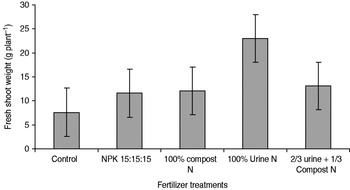
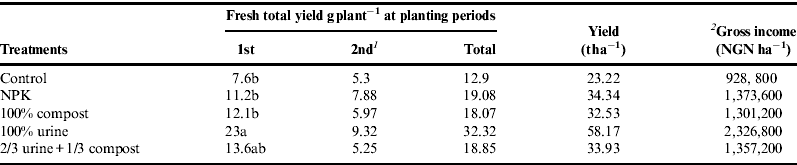
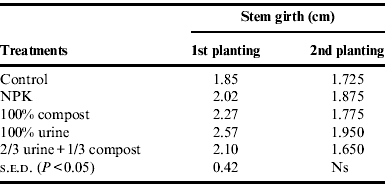
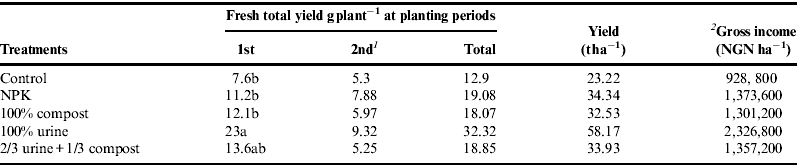
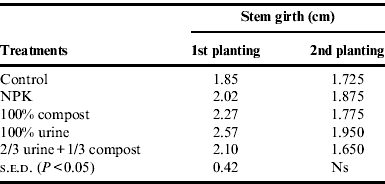
The 100% urine N-treated plants had the highest significant (P < 0.05) fresh total plant weight of 23 g plant−1 (41.4 t ha−1) at the first planting (Figure 2). The lowest yield of 7.6 g plant−1 was recorded from the control plot (no treatment applied) and this yield was not significantly different from other treatments, except that of 100% urine. The results of yield parameters revealed better performance of organic sources on the plants as compared to mineral fertilizer NPK. The best performance was seen with 100% urine N. A similar trend was observed during the second planting season (residual) for 100% urine N (see Table 1). Estimated partial gross return from the production of amaranth revealed that 100% treatment produced the highest value of 2,326,800 NGN, while the least (928,800 NGN) came from control (Table 1). The effect of the applied treatments on plant stem girth is reported in Table 2. The 100% urine N treatment also resulted in the best stem girth (2.57 cm), followed 100% compost N, while there was no significant difference between the control and NPK treatments.
Effects of fertilizer treatments on fresh shoot weight yield of green amaranths at 4 weeks after the first planting.

Estimated partial income from A. caudatus production for two successive plantings.
Means with same letters within column are not significantly different by Duncan’s Multiple Range Test (P = 0.05).
1 No significantly difference in mean by Duncan’s Multiple Range Test (P = 0.05) within the column.
Yield at 40 (farm-gate value) kg−1.
2 Partial income (without other costs of production).
1 = 150 NGN as on 25 January, 2011.
Effect of fertilizer treatments on stem girth (cm) of A. caudatus.
s.e.d. = Standard errors of differences of means (P < 0.05).
Ns = means difference not significant.
Micro-organisms isolated and identified in vegetable samples
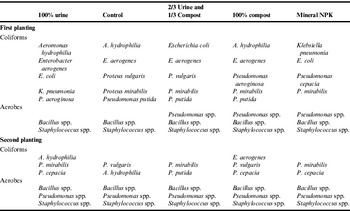
Coliforms isolated from edible portions reveal a slight difference in the presence of Escherichia coli in samples with 100% urine, 2/3 urine and 1/3 compost and mineral NPK-treated samples from the first planting (Table 3). However, the second (residual) harvest did not show presence of E. coli. Also, the number of organisms isolated from the residual planting reduced as compared to the first planting. As shown in the table, the main planting had three basic aerobes isolated from the vegetables. While Bacillus spp. and Staphylococcus spp. was common to all the samples but samples from 2/3 urine + 1/3 compost, 100% compost and Mineral NPK-treated plots had Pseudomonas spp., which was absent in the 100% urine and control treatments. The same aerobes were isolated from main and residual plantiings.
Micro-organisms isolated and identified in harvested amaranths.

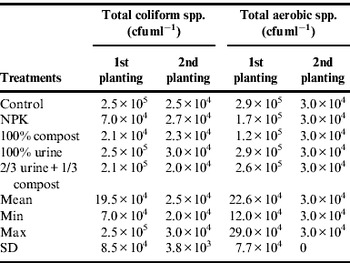
Table 4 shows the total coliform and aerobic microbial species count from the harvested amaranths in the first and second planting. The result reveals that samples from control, 100% urine and 2/3 urine + 1/3 compost had highest coliform counts as compared with NPK and 100% compost treatments in the first planting harvest. The lowest coliform count was recorded in vegetables fertilized with 100% compost. At the second planting harvest, urine treatment samples had the highest coliform count. Generally, the coliform count was much reduced in the second planting as compared with the first. Total aerobic count from the first planting harvest followed the same trend in the coliform count, with control and urine samples with counts of 2.9 × 10⁵ having the highest population of aerobes, followed closely by 2/3 urine + 1/3 compost sample. At the second plant harvest, all samples had the same value of 3.0 × 10⁴ aerobic count.
Counts of total coliform and aerobic species (cfu ml−1) isolated from harvested amaranths.

Effects of the applied treatments on soil nutrient properties
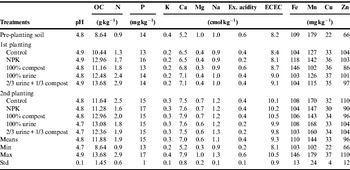
Generally, the soil used is acidic with a pH of 4.8. At the end of the experiment 100% urine and urine plus compost plots had their pH reduced to 4.7. The increase in soil organic matter was also noticed in the treated plots. The 100% urine plots had the highest organic carbon 13.08 g kg−1 followed by the other two organically treated plots. Effects of the applied treatments on other soil essential nutrient elements determined were not that different (Table 5).
Chemical properties of soil at the end of second planting of amaranths.

Std = standard deviation.
Perception of farmers on the use of urine as fertilizer for crops
Social characteristics of farmers
In general, the majority of the respondents (farmers) in this area of investigation were Christians (i.e., two-thirds). This shows that more Christians are involved in vegetable production than Muslims in the study areas. Eighty-five percent of the respondents reported they have no problem getting land, as long as they could make the proper request for land from the concerned authority.
Farmers’ perception and willingness to use urine as a fertilizer
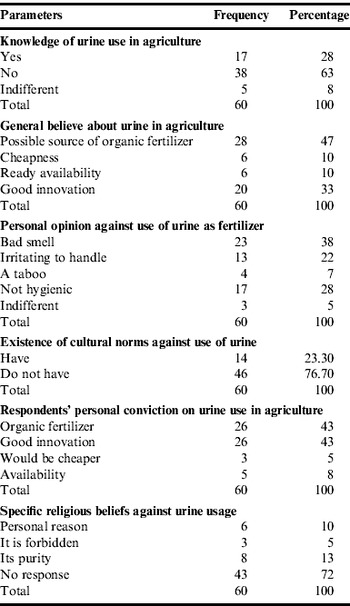
According to Table 6, most of the respondents (69%) had not heard that urine is also a fertilizing agent that can be used for vegetable crop production. Most of the respondents (47%) perceived urine as an organic material, though they never knew it could be incorporated into vegetable crop cultivation. Thirty-five percent perceived it as a good agricultural innovation. A few (7%) felt that it is taboo and not hygienic (28%) to use urine for vegetable crop production. Among the respondents, 77% stated that they do not have any cultural norms against the use of urine for vegetable crop planting. Also, 43% of the respondents felt that urine is an organic matter that could be a good agricultural innovation, while 8% believed that it could be easily available, while only 5% have the opinion that urine would be cheaper. More than two-thirds of the respondents did not have any opinion on religious beliefs against the use of urine for vegetable crop production. Also, 63% (no response) of the respondents did not specify any hindrance in economic terms to the use of urine.
Farmers’ perception and willingness to use urine as fertilizer.

Source: Field survey, 2009.
Consumers’ perception and willingness to buy vegetables planted with urine as fertilizer
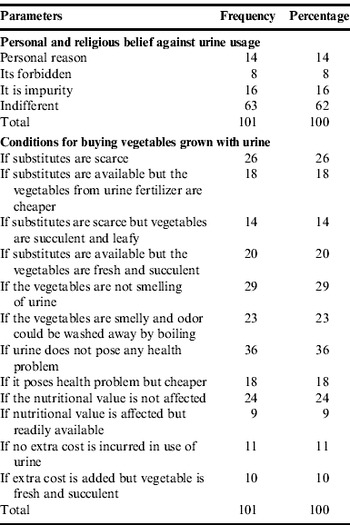
The perception of consumers on willingness to buy vegetables produced with urine fertilizer is reported in Table 7. Sixty-two percent of the vegetable consumers were indifferent to the use of urine as fertilizer in producing vegetables, while just 8% considered urine use in crop production as forbidden by their religions. A greater proportion (24%) of the consumers would buy vegetables produced with urine fertilizer if urine does not pose any health problem, while 29% would purchase the vegetables if they do not smell urine. Only 9% of the consumers indicated interest in buying the vegetables even if nutritional value is affected by the urine fertilizer considering that urine is readily available as fertilizer for crop production.
Consumers’ perception and willingness to buy vegetables planted with urine as a fertilizer.

Source: Field survey, 2009.
Discussion
Amaranthus caudatus is usually consumed fresh, thus the emphasis on fresh weight of the plants. The agronomic experiment revealed that the application of 100% urine N resulted in the highest significant (P < 0.05) fresh total plant weight of 23 g plant−1 (41.4 t ha−1) at the first planting. This yield is far higher than 20 t ha−1 on a sandy soil of poor fertility statusReference Norman15. A similar yield of 16.78 t ha−1 on similar soils was also reportedReference Sridhar, Adeoye and AdeOluwa16. Higher and better yield in 100% urine N-treated plants must have been due to the fact that nutrients in urine are in forms that are readily available to plants. The urea in urine readily degrades to ammonium and nitrate ions, both of which are in forms that plants can absorbReference Schönning7. The improvement on amaranth yield by the 100% urine N over that of mineral fertilizer NPK is in agreement with reports of other researchers in some parts northern EuropeReference Simons, Clemens, Werner, Avendano, Demsat, Eicher, Hernandez, Jung, Kraus, Lacayo, Neupane, Rabiega and Wafler17, Reference Båth18.
A combination of yields (t ha−1) from both planting seasons resulted in 100% urine-treated soil producing 58.17 t ha−1 total plant mass, while NPK 15:15:15 gave 34.34 t ha−1 total plant yield. It was observed that the estimated partial gross returns of 2,326,800 NGN attributable to 100% urine fertilizer doubled that from the use of mineral fertilizer NPK. This is an indication that urine fertilizer could be profitable.
The results obtained agree with research findings from Uganda where urine was found to increase yield more than mineral fertilizer NPKReference Nansubuga5. It also fits with results from Finland where cabbages grown with human urine performs better than those from conventional plots6. Similar results have been seen from previous experiments carried out in the University of Ibadan on Celosia argentea Reference AdeOluwa and Sobamowo19.
Generally, urine- and compost-treated soils were better in nutrient status at the end of the second planting. This increase in organic carbon might be associated with the increase in microbial activities usually found in fields where organic fertilizers are usedReference Zhangliu, Shufu, Xiaoping, Guangli and Tusheng20. Organic carbon content of the NPK plots was reduced at the end of the experiment (organic carbon at the end of the first planting was 12.96 g kg−1 and reduced to 11.28 g kg−1 at the end of the second planting). Total nitrogen of the soil increased from 1.3 up to 2.0 g kg−1 on treated plots. The least improvement as found on NPK plots (1.6 g kg−1). This indicates that urine and compost fertilizers can improve soil nutrient status.
The same populations of aerobes were isolated from main and residual plantings. Generally, high levels of bacteria were recorded in vegetables which were higher than the recommended level of <103 cfu/100 g21. This situation could have been caused by active organisms present in the soil/plant layer interface rather than urine or compost applied. Several factors may account for the high levels of coliform contamination recorded in most of the analyzed vegetables. The principal possible source of the coliform is the application of uncured poultry droppings as fertilizers by the farmers in the investigated area. Fresh poultry litter samples, sometimes used without sufficient drying for vegetable production in Kumasi, had equally high fecal coliform counts between 3.6 × 10⁴ and 1.1 × 10⁷ cfu/100 g.Reference Drechsel, Abaidoo, Amoah and Cofie22
Comparatively lower levels of bacteria recorded in compost-grown vegetables were indicative of the fact that the compost was highly cured and had less bacterial contamination. It was possible that microbes in the urine samples also contaminated the urine/compost composite mixture used in growing vegetables hence the high levels of microbes recorded. In general, the results of the microbial analysis did not establish any negative pathological contamination due to the use of urine. This result is in line with earlier reports that the use of properly treated urine as a fertilizer does not introduce pathological contamination to agricultural fieldsReference Schönning7, 21.
The perception analysis revealed that most farmers and consumers do not have serious cultural norms against urine fertilizer. Analysis showed that most farmers would use urine for vegetable production if it gives a better yield than other organic fertilizers, while most consumers would buy vegetable crops grown with urine if it does not pose any health problem. These results are similar to a report that people in Eastern Uganda's Mbale District accepted the use of urine as a fertilizer because of the financial gain attached23.
Conclusion
The results of the response of A. caudatus to urine and municipal waste composts and their mixtures as fertilizer revealed that 100% urine performed better as a fertilizer at both main and residual plantings. Financial returns using urine as a fertilizer also doubled that of the commonly used mineral fertilizer NPK. The use of urine as fertilizer for A. caudatus improved some useful soil properties and did not result in pathogenic microbial contamination. Although coliform and aerobic bacterial species were detected in the vegetable, this could not be traced to the application of urine or other treatments used in this study but to the poor soil management practices by the farmers before the investigation. Respondents in this study perceived urine to be a good agricultural innovation which can be used for vegetable crop production and did not have any strong cultural norms that could prevent them from using urine for planting or that would prevent them from buying vegetable crops grown with urine. This is an indication that if urine is harvested and made available, farmers would be willing to use it for crop production as long as consumers are willing to buy. However, the logistics of storage and distribution of urine as fertilizer have to be addressed.
Acknowledgements
Funding for this investigation was supplied by RUAF Foundation and International Water Management Institute, Ghana. Field assistantship by T.A. Abayomi (Agriculture economics), J.E. Ogunniyi (Agronomy) and O. Ojo (Public Health) as well as collaborative/supervision efforts of Dr A.S. Oyekale, Dr G. Ana and Mrs E.Y. Thomas are appreciated. Cooperation of Greenland Vegetable Farmers, Mokola Army Barracks is also appreciated.