INTRODUCTION
Low-density residential development has become the fastest growing land use in the USA (Brown et al. Reference Brown, Johnson, Loveland and Theobald2005). This type of development is increasingly located adjacent to protected areas and in areas of high biodiversity, as city dwellers seek out natural surroundings (Hansen et al. Reference Hansen, Knight, Marzluff, Powell, Brown, Gude and Kingsford2005). In the USA, urbanization has been cited as a major cause of more than half of threatened or endangered species declines (Czech et al. Reference Czech, Krausman and Devers2000) and in Canada, almost half of the human population occurs in the same geographic area as almost half its threatened or endangered species (Environment Canada 2005). Thus, determining the impacts of proposed residential developments on environmental resources is a pressing challenge. More challenging still is the determination of the cumulative impacts of projects, which is required by the National Environmental Policy Act (NEPA) in the USA and the Canadian Environmental Assessment Act (CEAA) in Canada.
Urbanization has generally negative effects on amphibian communities. Urban landscapes have lower amphibian abundance and species richness than less developed landscapes (Knutson et al. Reference Knutson, Sauer, Olsen, Mossman, Hemesath and Lannoo1999; Rubbo & Kiesecker Reference Rubbo and Kiesecker2005; Gagné & Fahrig Reference Gagné and Fahrig2007). In addition, the area of developed land surrounding focal wetlands has been implicated in the local extinction of some anuran species (Gibbs et al. Reference Gibbs, Whiteleather and Schueler2005). However, some amphibian species have responded positively to urbanization (Rubbo & Kiesecker Reference Rubbo and Kiesecker2005).
It is less clear how urbanization and other land use changes affect animal communities over time. Previous authors have reported a lag of 10 to 100 years in the response of plant and bird species richness to landscape structure (Findlay & Bourdages Reference Findlay and Bourdages2000; Knick & Rotenberry Reference Knick and Rotenberry2000; Ernoult et al. Reference Ernoult, Tremauville, Cellier, Margerie, Langlois and Alard2006; Cousins et al. Reference Cousins, Ohlson and Eriksson2007). Findlay and Bourdages (Reference Findlay and Bourdages2000) observed a lag of approximately 34 years in the response of herptile species richness to road density surrounding wetlands. Similarly, Löfvenhaft et al. (Reference Löfvenhaft, Runborg and Sjögren-Gulve2004) described a lag of several decades between urban land cover and road traffic intensification and changes in amphibian occurrence. Dorrough and Ash (Reference Dorrough and Ash1999) and Davidson (Reference Davidson2004) reported negative cumulative effects of human activities over time in the form of a negative relationship between years since ploughing and the abundance and occurrence of the striped legless lizard in Australia and a significant effect of historical pesticide use on amphibian occurrence in California, respectively. To our knowledge, only two studies to date have investigated the temporal response of animal community structure to urbanization: that carried out by Löfvenhaft et al. (Reference Löfvenhaft, Runborg and Sjögren-Gulve2004) described above and the work of Miller et al. (Reference Miller, Wiens, Hobbs and Theobald2003), who reported that bird species richness declined with increasing building age.
One of the most useful ways of determining the likely response of an environmental resource to change (in order to quantify a project's cumulative impacts) is to evaluate the effects of past activities similar to those proposed (Council on Environmental Quality 1997). We thus investigated how anuran communities in remnant urban ponds vary in relation to the time elapsed since urbanization, measured as the mean age of residential developments surrounding ponds. For this, we employed 19 remnant ponds surrounded by residential developments of varying ages in the cities of Ottawa (Ontario, Canada) and Gatineau (Quebec, Canada). Following habitat loss and fragmentation, populations in remnant patches are hypothesized to decrease over time resulting in eventual species loss (Ewers & Didham Reference Ewers and Didham2006). We hypothesized that anuran abundance and species richness in ponds exhibit one of two responses to increasing age of surrounding residential development: (1) a steady decline or (2) a U-shaped response. A U-shaped response would occur if there was an initial decrease in habitat quality resulting from the development (for example diminished water quality from construction runoff, altered microclimatic conditions at the pond edge owing to physical disturbance and the removal of existing vegetation) but then a gradual improvement over time in habitat quality as the development aged.
METHODS
Study area
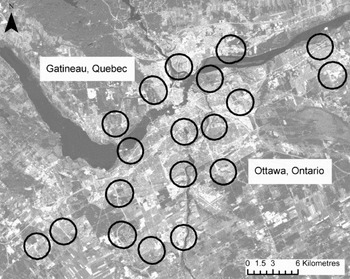
Our study area was 1261 km2 and covered the majority of the cities of Gatineau (Quebec) and Ottawa (Ontario), which together form the National Capital Region (Canada) with a population of c. 1 104 600 people (Fig. 1). Population densities range from 1815.5 people/km2 in the city centre to 178.3 people/km2 in surrounding suburban and rural communities, which are undergoing extensive residential development.
The National Capital Region encompassing the cities of Ottawa (Ontario, Canada) and Gatineau (Quebec, Canada). Black circles are landscapes of 1.5 km radius surrounding focal ponds.

Site selection
We selected 19 non-overlapping landscapes in the study area. We defined landscapes as the area within 1.5 km of permanent focal ponds. The scale at which landscape variables have been shown to affect anuran abundance and species richness ranges from 500 m (Price et al. Reference Price, Marks, Howe, Hanowski and Niemi2004) to 5 km (Davidson Reference Davidson2004). We chose a 1.5 km radius to correspond to these effect distances and to maximize the number of available sites considering the other criteria used for site selection in this study (see below).
We identified potential landscapes using 1:50 000 topographic maps (Centre for Topographic Information, Natural Resources Canada, Ottawa, Canada). Landscapes were selected to maximize the range of available ages of residential development. We selected only ponds with approximately 50% residential development cover in the landscapes surrounding the ponds to control for the amount of urbanization while investigating the effects of the age of urbanization. Nineteen ponds in the National Capital Region met these criteria.
Age of residential development
To account for the progressive development of each landscape over time, in other words how development occurred in stages in each landscape as new housing was added over the years, we calculated the mean age of residential development in each landscape using the ages of developments weighted by their areas. To do this, we used a combination of historical and current aerial photos and a digital map to measure the area of residential development cover in each landscape once per decade from the mid-1920s, when aerial photos began being produced, to 2002, the most recent information available. For the 1990s and 2000s for each landscape, we used a 1:50 000 digital land use map (DMTI Spatial, Markham, Canada) and the most recent aerial photos available (1:15 000, City of Ottawa, Canada), respectively. For the decades before 1990, we traced the residential development in each landscape once per decade on historical aerial photographs (1:10 000 to 1:40 000, Natural Resources Canada, Ottawa, Canada). We scanned the tracings and then digitized them to calculate the area of residential development cover. In all decades, only housing developments were included. We did not consider farm buildings, or commercial, industrial and other urban land uses because we were specifically interested in the effects of residential developments on anuran communities. The mean age of residential development (AGE) in each landscape was calculated as:

where t is the year in which we performed call surveys for breeding anurans in ponds (2004), tn is the year for which we calculated the area of residential development cover, Atn − tn − 1 is the area of new residential development cover added to the landscape in the decade tn − t n − 1, and A t 1 is the current (2002) area of residential development cover in the landscape. The mean age of residential development in our landscapes was not significantly correlated with the areas of other urban land uses (Pearson r = 0.14, p = 0.56), the area of forest cover (Pearson r = 0.18, p = 0.47), or the areas of water bodies and wetlands (Pearson r = 0.44, p = 0.06). However, the mean age of residential development in our landscapes was significantly correlated with road density (Pearson r = 0.57, p = 0.01).
Anuran surveys
There are ten anuran species that occur in the study area, namely the western chorus frog Pseudacris triseriata, wood frog Lithobates sylvatica, spring peeper P. crucifer, northern leopard frog L. pipiens, pickerel frog L. palustris, American toad Anaxyrus americanus, gray treefrog Hyla versicolor, green frog L. clamitans, mink frog L. septentrionalis and bullfrog L. catesbeianus. Sara Gagné and trained volunteer observers performed six evening call surveys for breeding anurans at each pond between 15 April and 30 June 2004. Surveys were performed approximately every week and a half and were completed in as few nights as possible. Surveys occurred between a half-hour after sunset and midnight. After waiting for one minute to allow frogs and toads to become accustomed to their presence, observers listened at the pond edge for five minutes and identified the anuran species calling. The abundance of each calling species was assessed using the following index: 0 = no individuals calling; 1 = individual(s) can be counted, calls are not overlapping; 2 = calls of <15 individuals can be distinguished, but there is some overlapping; 3 = ≥15 individuals are calling (as in Pope et al. Reference Pope, Fahrig and Merriam2000). For each survey, we randomly assigned observers to survey routes. Routes were driven forward, backward and from a middle starting point to vary survey times at the ponds.
Local habitat variables
To control for the effects of local habitat quality on anuran abundance and species richness, we measured pond perimeter, the per cent cover of emergent vegetation, and pH at each pond between 8 June and 5 July 2004. We also determined the occurrence of fish at each pond. Local habitat quality in June and July is not perfectly representative of habitat quality for species that breed earlier in the season (April and May). However, we did not conduct local habitat surveys during April and May because at that time we needed to focus our efforts on performing the maximum number of call surveys possible when most species in the region, including explosive breeders such as the wood frog, begin calling. Pond perimeter, the per cent cover of emergent vegetation and the presence of predatory fish have been identified as important predictors of amphibian species richness in south-western Ontario ponds (Hecnar & M'Closkey Reference Hecnar and M'Closkey1998) and pH has been shown to affect northern leopard frog abundance in eastern Ontario (Pope et al. Reference Pope, Fahrig and Merriam2000).
We measured the perimeter of each pond by walking around the pond with a Garmin eTrex Legend global positioning system unit, accurate to 10 m. We estimated the per cent cover of emergent vegetation along 2 m line transects perpendicular to the pond edge. Measurements were taken at regular intervals along the shoreline so that 6–8 values were collected at each pond, regardless of pond size. We then averaged these values to produce an overall estimate of the per cent cover of emergent vegetation within 2 m of the shore for each pond. When access to the entire pond edge was not possible, we made a visual estimate of the total per cent cover of emergent vegetation within 2 m of the shore. We measured pH 1 m from shore at a depth of 5 cm with a Fisher Scientific accumet portable AP62 pH meter. We took four equally spaced measurements at each pond and calculated their average using the hydrogen ion concentrations. We considered fish to be present in a pond if they were observed during any one of the six evening call surveys described above or any one of six daytime visual encounter surveys conducted at each pond during the course of a separate study (Gagné & Fahrig Reference Gagné and Fahrig2007). Otherwise, fish were considered to be absent from the pond.
Analyses
We evaluated multiple general linear models of the effects of the mean age of residential development in the surrounding landscape (AGE) and the four local habitat variables (pond perimeter, the per cent cover of emergent vegetation, pH and fish occurrence) on the relative abundances of individual anuran species, total anuran relative abundance and anuran species richness using Akaike's Information Criterion corrected for small sample size (AICc) (Burnham & Anderson Reference Burnham and Anderson2002). A rough rule of thumb dictates that predictor degrees of freedom should not exceed m/10, where m is sample size (Harrell et al. Reference Harrell, Lee, Califf, Pryor and Rosati1984). In our case, m equalled 19 ponds, thus restricting the number of predictors included in any given model to two. Consequently, for each response variable, we evaluated general linear models of each individual predictor variable and all possible combinations of two predictor variables. To determine whether the effect of AGE was curvilinear, we evaluated an additional model for each response variable composed of the predictor AGE and a quadratic term (AGE2). In general linear model formulae, lower order terms must precede higher order terms to satisfy the condition of marginality (Grafen & Hails Reference Grafen and Hails2002). Thus, we only assessed the higher order term AGE2 in models containing the predictor AGE (and no other predictors, to satisfy the maximum predictor degrees of freedom rule of thumb above). None of our explanatory variables (with the exception of AGE and AGE2) were significantly correlated (all Pearson r ≤ 0.29, p ≥ 0.23).
We used the sum of the abundance indices from all call surveys at each pond (CALLSUM) as a measure of relative abundance for each species. CALLSUM reflects not only high calling intensity but also consistent calling throughout the breeding season and has been shown to be significantly positively correlated with visual counts of individuals at ponds (Carr & Fahrig Reference Carr and Fahrig2001; Gagné & Fahrig Reference Gagné and Fahrig2007). In addition, call indices have been used successfully as measures of anuran relative abundance in several studies (for example Pillsbury & Miller Reference Pillsbury and Miller2008). Thus, we felt justified in using CALLSUM as an estimate of relative abundance. Finally, we summed the relative abundances of individual anuran species to calculate total anuran relative abundance.
All general linear models were inspected for normality and homogeneity of variance. In the case of the gray treefrog, these assumptions were not met and transformations of the dependent variable did not correct the problem. Gray treefrog model residuals displayed increasing variance typical of count data. In addition, the frequency distribution of gray treefrog relative abundances resembled a Poisson distribution, also typical of count data. Therefore, we assumed that gray treefrog relative abundance conformed to a Poisson distribution and used generalized linear models with a log link function for this species. The dispersion parameter in these models was estimated, rather than assumed to be equal to one, to account for overdispersion (Quinn & Keough Reference Quinn and Keough2002).
RESULTS
The area-weighted age of residential development in our landscapes ranged from 6.68 to 53.93 years, with a mean of 26.68 ± 13.22 (standard deviation [SD]) years. The area of residential development was relatively constant in all landscapes, with a mean of 0.48 ± 0.10%. Of the 10 species considered, five were not widespread enough to be included in analyses of individual species relative abundances; however, their occurrences were included in species richness and total relative abundance calculations. The remaining species occurred at four ponds (21% occurrence, northern leopard frog), eight ponds (42% occurrence, gray treefrog), 10 ponds (53% occurrence, American toad and spring peeper) and 13 ponds (68% occurrence, green frog).
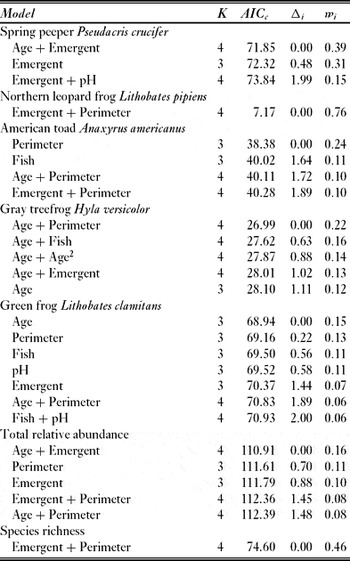
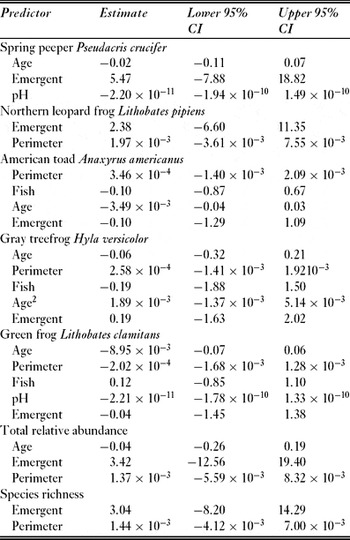
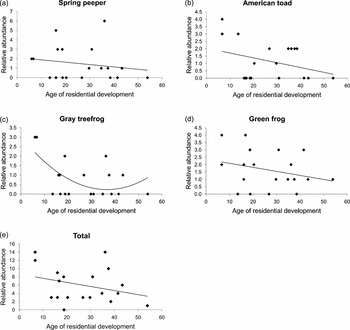
The variable AGE was a predictor in the best models (Δi ≤ 2; Burnham & Anderson Reference Burnham and Anderson2002) describing the responses of spring peeper, American toad, gray treefrog, green frog and total anuran relative abundances (Table 1), and the effect of AGE was negative in all cases (Table 2, Fig. 2). AGE2 was also included in the best model for the gray treefrog, indicating a U-shaped relationship for that species (Fig. 2c).
The best models (Δi ≤ 2; Burnham & Anderson Reference Burnham and Anderson2002) of the relative abundances of five individual anuran species, total anuran relative abundance and anuran species richness in 19 remnant urban ponds in the National Capital Region (Canada). Models are listed in decreasing order of support for each response variable. Results for all the models evaluated for each response variable can be found in Appendix 1 (see supplementary material at Journals.cambridge.org/ENC). K = the number of estimated parameters; AICc = Akaike's Information Criterion corrected for small sample size; Δi = AICci − minAICc for each model i; wi = Akaike weight, or probability of being the best model given the observed data and the set of models evaluated.

Model-averaged estimates of the coefficients of predictors in the best models (Δi ≤ 2; Burnham & Anderson Reference Burnham and Anderson2002) of the relative abundances of five individual anuran species, total anuran relative abundance and anuran species richness in 19 remnant urban ponds in the National Capital Region (Canada). Lower and upper 95% confidence intervals (CI) were calculated using unconditional variances (Burnham & Anderson Reference Burnham and Anderson2002).

The relationships between (a) spring peeper Pseudacris crucifer, (b) American toad Anaxyrus americanus, (c) gray treefrog Hyla versicolor, (d) green frog Lithobates clamitans and (e) total anuran relative abundance at 19 focal ponds and the mean age of residential development in surrounding landscapes. A linear trend line is shown for each relationship except in the case of the gray treefrog, for which a second-order polynomial line of best fit is shown.

DISCUSSION
We are aware of only two analyses of urbanization effects over time on animal community structure. Miller et al. (Reference Miller, Wiens, Hobbs and Theobald2003) reported negative effects of adjacent building age on the species richnesses of low-nesting and cavity-nesting bird guilds in lowland riparian areas in Colorado (USA). Löfvenhaft et al. (Reference Löfvenhaft, Runborg and Sjögren-Gulve2004) found that breeding sites in Stockholm at which amphibian species had disappeared between 1940 and 1990 were surrounded by higher proportions of hostile and unsuitable biotopes than breeding sites with existing amphibian populations. Stockholm experienced a boom in development in the 1960s and 1970s and breeding sites subjected to a high degree of urbanization in the surrounding landscape at this time subsequently lost resident amphibian species over the following decades (Löfvenhaft et al. Reference Löfvenhaft, Runborg and Sjögren-Gulve2004). In this paper, we demonstrated that residential development that occurred up to 54 years in the past in landscapes surrounding remnant urban ponds was an important predictor of spring peeper, American toad, gray treefrog, green frog and total anuran relative abundances. In particular, we found that residential development age was a predictor in all of the best models of gray treefrog relative abundance, although effect size was small (Tables 1 and 2). Both our findings and those of Löfvenhaft et al. (Reference Löfvenhaft, Runborg and Sjögren-Gulve2004) indicate that anuran populations in remnant urban ponds may be responding to the legacy of decades-old development.
We hypothesize that these patterns are the result of the cumulative effects of urbanization over time. The effects of urbanization on remnant aquatic habitats intensify over time following development through, for example, accumulation of continuous inputs of contaminants (Walsh et al. Reference Walsh, Roy, Feminella, Cottingham, Groffman and Morgan2005), increasing channelization of waterways (in part owing to changes in stormwater management practices over time), and increases in building density and road traffic over time. The last may be reflected in the significant positive correlation between the mean age of residential development and road density in our landscapes (see Methods). Urban intensification over time may also lead to continuous increases in, and cumulative impacts of, human-related disturbances such as predation by domestic animals (Crooks Reference Crooks2002) and human intrusion into previously pristine habitats (Riffell et al. Reference Riffell, Gutzwiller and Anderson1996). All of these changes are likely to result in negative cumulative effects on anuran populations, particularly considering their high breeding site fidelity.
We initially hypothesized that increasing time since urbanization would result in one of two responses in anuran abundance and species richness: a monotonic decline or a U-shaped response if habitat quality improved in older developments. In the majority of cases, age of residential development appeared to result in a steady decline in anuran relative abundance (Table 2, Fig. 2). However, in the case of the gray treefrog, we found evidence that this species’ response to the mean age of residential development was non-linear. A model with the predictors AGE and AGE2 was selected as one of the best models for this species (Table 1). The model-averaged estimates for AGE and AGE2 were negative and positive, respectively, indicating a U-shaped response of gray treefrog relative abundance to increasing time since urbanization (Table 2, Fig. 2c). Gray treefrogs spend the majority of the breeding and foraging seasons on the trunks and limbs of shrubs and trees within approximately 200 m of breeding ponds (Johnson et al. Reference Johnson, Knouft and Semlitsch2007). We speculate that, following the initial disturbances caused by development (such as decreased water quality from construction runoff and vegetation removal) that negatively impact gray treefrog populations, the maturation of vegetation in proximity to ponds with increasing time since urbanization may result in improved breeding and foraging habitat for this species.
In addition to the mean age of residential development in landscapes surrounding remnant ponds, local habitat variables were found to be important predictors of anuran relative abundance and species richness (Table 1). Pond perimeter was an important predictor of northern leopard frog, American toad, gray treefrog, green frog and total anuran relative abundances and anuran species richness (Table 1). In all cases, pond perimeter had a positive effect, consistent with previous findings (Hecnar & M'Closkey Reference Hecnar and M'Closkey1998; Gagné & Fahrig Reference Gagné and Fahrig2007), with the exception of the green frog for which pond perimeter had a negative effect (Table 2). It appears that pond area negatively affects the survival of green frog tadpoles if ponds are deep rather than shallow (Pearman Reference Pearman1993). We did not measure pond depth in the present study and this remains an additional factor that may explain green frog relative abundance. The per cent cover of emergent vegetation was an important positive predictor of spring peeper, northern leopard frog, gray treefrog and total anuran relative abundances, as well as anuran species richness (Tables 1, 2). This is consistent with the findings of other authors (for example Hazell et al. Reference Hazell, Hero, Lindenmayer and Cunningham2004). In addition, we found that the per cent cover of emergent vegetation had negative effects on American toad and green frog relative abundances (Table 2). A recent study comparing American toad and green frog populations in wetlands accessed by grazing cattle, with consequently little shoreline emergent vegetation, and in wetlands excluded from grazing reported that American toads were more abundant and green frogs were less abundant in the accessed wetlands (Burton et al. Reference Burton, Gray, Schmutzer and Miller2010), responses consistent with the life histories of these species. It may be that green frogs in urban ponds are subjected to novel impacts, obscuring the expected patterns of response of this species to local habitat conditions. For example, it has been suggested that green frogs in urbanized environments are susceptible to emerging infectious diseases caused by trematodes (Skelly et al. Reference Skelly, Bolden, Holland, Freidenburg, Friedenfelds, Malcolm, Collinge and Ray2006), some species of which are associated with emergent shoreline vegetation (Zelmer et al. Reference Zelmer, Wetzel and Esch1999). Pond pH had negative effects (recall that we measured pH as hydrogen ion concentration) on spring peeper and green frog relative abundances (Table 2), consistent with previous findings (Freda & Taylor Reference Freda and Taylor1992; Vatnick et al. Reference Vatnick, Brodkin, Simon, Grant, Conte, Gleave, Myers and Sadoff1999). Finally, fish occurrence was an important predictor of American toad, gray treefrog and green frog relative abundances (Table 1), having negative effects on the first two species and a positive effect on the last species (Table 2). Others have reported similar patterns (Hecnar & M'Closkey Reference Hecnar and M'Closkey1997; Boone et al. Reference Boone, Semlitsch, Little and Doyle2007).
Call surveys are an efficient method of assessing anuran population size and distribution over broad geographical areas. In addition to the use of call indices as measures of relative abundance (for example Pillsbury & Miller Reference Pillsbury and Miller2008), the data collected from call surveys can be analysed using occupancy modelling (MacKenzie et al. Reference MacKenzie, Nichols, Lachman, Droege, Royle and Langtimm2002). We applied this technique to assess the effects of AGE, AGE2 and local habitat variables on the occupancy of individual anuran species, using the same multi-model approach as that used for general linear models described above. In the majority of analyses, detection probabilities were low, resulting in occupancy estimates very close to 1 with very small standard errors. Mackenzie et al. (2002) also reported that site occupancy tends to 1 with very small standard error when the detection probability is low. However, in the rare instances when occupancy modelling produced realistic estimates, the results were consistent with those we present here using CALLSUM and general linear models. For example, two of the six best models for the gray treefrog contained the variable AGE, indicating that age of residential development may affect the proportion of remnant ponds occupied by that species.
In conclusion, this study represents an important effort to quantify the responses of anuran communities over time to urbanization. Results such as ours have the potential to inform the assessment of the cumulative impacts of a proposed residential development, required by legislation such as the National Environmental Policy Act (NEPA) and the Canadian Environmental Assessment Act (CEAA). Cumulative impact assessment is a complex process, requiring the identification of potential impacts over broad temporal and spatial scales (which may not be feasible or possible in some circumstances). However, taking cumulative impacts into account in environmental impact assessments has the potential to more accurately characterize the full spectrum of impacts on environmental resources of concern. For example, cumulative impact assessment of a proposed residential development could help to identify whether anuran populations at a site have already declined in response to existing development, making them particularly vulnerable to additional disturbance. Local planning efforts could then focus on locating the proposed development at some distance from breeding sites or mitigating the impacts of the proposed development (for example by implementing green stormwater management practices). Future research on the effects of urbanization on anurans should compare communities in ponds before versus after development (perhaps in outlying regions experiencing high levels of exurban development), to more directly assess the effects of urbanization over time on community structure. A before/after, control/impact (BACI; Underwood Reference Underwood1992) sampling design would enable such an analysis.
ACKNOWLEDGEMENTS
This research was supported by Natural Sciences and Engineering Research Council of Canada grants to Sara Gagné and Lenore Fahrig and a Canada Foundation for Innovation grant to Lenore Fahrig. We acknowledge the generous participation of private landowners in this study, without which this work would not have been possible. Two anonymous reviewers provided insightful comments on an earlier version of this manuscript. Special thanks go to L.M. Robertson.