The basic premises of genetics, the scientific study of heredity and variation via genes, are widely known and accepted. In contrast, the processes through which these genes are regulated and expressed are much less understood. Epigenetics is the study of these processes, and it has emerged as a significant focus of research only within the last decade or so. While epigenetics conforms in many ways to the mainstream understanding of the science of genetics, many aspects of epigenetics are controversial. Beyond the scientific challenges, epigenetics presents perhaps even more significant challenges for our contemporary politics. These political challenges of epigenetics are the focus of this article.
In terms of the science of epigenetics, research is showing not only how the regulation or modification of gene expression works but also how it is often affected by influences from the immediate environment. In addition, a growing body of research in epigenetics is demonstrating how some of these epigenetic modifications are being passed on to subsequent generations, but not as changes in the DNA, which is the accepted route for inheritance. This concept of the transgenerational inheritance of epigenetic modifications is the most contentious aspect of contemporary epigenetics because the possibility of supragenetic inheritance fundamentally challenges cornerstone assumptions of the conventional science of genetics. Furthermore, as this article will suggest, epigenetics also potentially raises equally fundamental challenges for our conventional policies and politics.
At present, the study of epigenetics is not yet on the radar of most policy makers. This article helps initiate the eventual policy discussion around epigenetics by identifying the emerging narratives of epigenetics — that is, the causal stories that are constructed from the science of epigenetics. In particular, this article assesses the reporting on epigenetics in two ideologically distinct news sources, the New York Times and the Wall Street Journal, to examine the effects of ideology on the emerging narratives of epigenetics and the potential effects of epigenetics on ideology.
Articles on “epigenetic(s)” found in PubMed database, 1965–2015.

More specifically, I determine whether reporting on epigenetics displays specific patterns or differences related to the ideological bent of the source of a particular narrative. In addition to providing a starting point for discussing the narratives of epigenetics, this analysis provides a first look at the potential ideological uses of epigenetics. Thus, this article establishes a useful baseline against which we can compare the policy narratives of epigenetics that will emerge as scientific debates about epigenetics cross over into public awareness and political discourse.
Because the composition of the narratives of epigenetics has not yet been identified, we need an initial framework to identify the relevant elements of the narratives of epigenetics and establish which aspects of epigenetics might be subject to which kinds of ideological biases. The narratives of obesity provide just such a framework, because obesity is a salient health issue that receives significant media coverage and is a major focus of contemporary public policy. The considerable attention that is paid to obesity allows for the clear identification of narratives as well as evaluation of the ideological influences on these narratives. From the narratives of obesity and the clear ideological influences on these narratives, I construct a rubric for the analysis of the emerging narratives of epigenetics.
The patterns and differences in the descriptions of epigenetics shed light on both the presentation of the science of epigenetics at this early stage and the impact of ideology on the narratives of this emerging science — factors that provide important information about the incorporation of epigenetics into public policy. Furthermore, my analysis also reveals how the science of epigenetics could potentially have a more profound impact on politics beyond public policy.
Defining epigenetics
At this early stage in the emergence of the science behind epigenetics, definitions of epigenetics are controversial. Even among epigeneticists, there is no clear consensus about whether epigenetics refers to a distinct field of scientific study that addresses a coherent set of phenomena, or whether the term is a handy catch-all or even just an overhyped term that confuses more than it illuminates. That being said, it is reasonable to define epigenetics as the study of the biological processes through which genes are turned on and off, including how some of these processes respond to environmental influences, the effects of which can be potentially heritable across multiple generations.
The field of epigenetics did not become a focus of research until the last decade or so, but it is now a rapidly emerging area of study in genetics and the life sciences. Figure 1 uses the number of articles on epigenetics published annually in scientific and academic journals as a metric for demonstrating interest in this topic over the past 60 years.
As mentioned previously, epigenetics research focuses on the different ways that genes regulate themselves and through which the expression of genes is modified. Although scientists have known about some of these processes for decades, these mechanisms have become a significant focus of research only recently, as interest in epigenetics has surged in the last decade or so. For example, methylation is one of the best-known epigenetic processes. It was studied prior to the emergence of epigenetics as a particular focus; however, published studies about methylation suddenly increased in the late 1990s at an exponential rate that correlates with the greater amount of work being done in epigenetics as a whole (see Figure 2). The same is true for other mechanisms and components of epigenetic processes, such as chromatin and histones (to be defined and discussed below), which are now identified with epigenetics (see Figure 3). Thus, while there are significant disputes about the exact definition of epigenetics, and whether it even constitutes a distinct field of study, it seems clear from the increasing attention to epigenetics in general, as well as to the specific processes and components that constitute it, that the landscape of epigenetics is taking shape. Reference Goldberg, Allis and Bernstein1
Articles per year on “methylation” and “epigenetic(s)” found in PubMed database, 1955–2015.

Articles per year on “methylation,” “histone(s),” and “chromatin” in PubMed database, 1955–2015.

Mechanisms and components of epigenetic processes
Scientists have identified different processes of epigenetic change, such as methylation, chromatin remodeling, and RNA-mediated inheritance. Perhaps the most distinctive aspects of epigenetics are that these changes in expression occur without a change in the original sequence of the DNA — that is, the arrangements of the adenine, cytosine, guanine, and thymine (ACGT) bases that constitute specific genes — and that some of these epigenetic changes in expression are being inherited. This modification of the conventional understanding of gene expression and gene-level inheritance has a number of politically significant consequences, which will be explored later in this article.
Methylation
The epigenetic process of methylation/demethylation is one of the most prevalent processes in gene regulation and expression (for example, over 80% of CpG sites in human DNA are methylated
Reference Xia, Han and Zhao2
). In a nutshell, methylation of DNA is the attachment of a methyl group (
 $\text{CH}_{3}$
) to specific genes (in particular, cytosine-phosphate-guanine [CPG] sequences), whereas demethylation is the removal of a methyl group from these genes. Methylation usually represses expression of a gene, and demethylation usually allows for the expression of the gene — in other words, methylation is a sort of on-off switch for genes.
Methylation occurs as the by-product of other processes, or via exposure to specific ubiquitous chemicals such as bisphenol A (BPA), Reference Bernal and Jirtle3 and through diet. Reference Dolinoy4 As such, methylation is one epigenetic pathway through which environmental influences can affect the regulation and expression of genes. Methylation is also one of the ways that the effects of these environmental influences can be — potentially — passed on to subsequent generations.
Chromatin remodeling
Chromatin are complexes of DNA, RNA, and proteins that are wrapped together in specific configurations. Chromatin remodeling is the modification of the configuration of the “spools,” called histones, around which these strands of DNA are wrapped. This architecture is what allows meters of DNA to be compressed into microscopic cells. Different enzymes trigger modifications in the physical configuration of the histones, which then exposes or conceals different sections of DNA. Exposed genes are open to processes such as methylation, whereas concealed genes are not. Thus, chromatin remodeling is another process through which changes in gene expression occur but are not caused by changes in gene sequence.
Chromatin modification is a critical aspect of cell growth and division, playing a significant role in the transmission of cell identities from one generation to another. However, recent work in epigenetics suggests that increases or decreases in the levels of the enzymes involved in chromatin remodeling — again as the by-product of other processes or via exposures to chemicals in the environment — could manifest as disruptions in gene expression, and these disruptions are implicated in many cancers. Reference Wang, David Allis and Ping5 As with methylation, chromatin remodeling is therefore a process through which the external environment can affect the functioning of genes, as well as a mechanism for the supragenetic inheritance of these environmental influences.
RNA-mediated inheritance
RNA is a single-stranded nucleic acid similar to DNA, although the latter is double-stranded. RNA is constructed by an RNA polymerase enzyme that transcribes a section of DNA that has been temporarily unwound and exposed. There are many different types of RNA, which perform distinct functions in the regulation and expression of genes. Messenger RNA (mRNA) migrates out of the cell nucleus to be used in the synthesis of other proteins. In this way, mRNA transmits genetic information from the DNA without the DNA itself being required to leave the nucleus, which protects the original DNA sequence from damage or corruption. This process is one source of the “central dogma of molecular biology,” so-named by Francis Crick, Reference Crick6 which asserts that information comes out of DNA but does not go back in.
However, recent epigenetics research has found that information from the environment can be passed on to subsequent generations via RNA — not as a change in the original genetic sequence. As described by one researcher, “after many years of living in the shadows, RNA is being revealed as an inheritance molecule in its own right.” Reference Casci7 The scientific implications of this change in the understanding of inheritance are considerable, but, as will be discussed, the political implications may be even more dramatic.
Two of the ways that nongenetic information is being passed on to subsequent generations via RNA are through degradation of the RNA and through transmission of the methylation patterns introduced by the RNA. In the first case, the original transcribed DNA sequences decay or are otherwise degraded, Reference Houseley and Tollervey8 and these changes are then passed on in subsequent transcription (what is also called “RNA silencing and interference”). Reference Fire, Xu, Montgomery, Kostas, Driver and Mello9 In the second case, the sequences of the RNA may be methylated in a different pattern than the original DNA, and this methylation is also passed on in addition to the original genetic sequence. Reference Fu, Dominissini, Rechavi and He10 A number of recent studies have linked the regulation of RNA expression to different epigenetic mechanisms, including changes in DNA methylation in promoter regions and via the histone modifications discussed earlier, which have also been associated with many different kinds of cancers. Reference Palmero, de Campos, Campos, Souza, Guerreiro, Carvalho and Marques11
Transgenerational epigenetic inheritance
While epigenetics is an often contentious field of study, there is nothing inherently challenging or controversial about these specific mechanisms per se — at least in terms of the basic science. However, what is indubitably controversial for both the science and the political realm is the role that epigenetic processes play in the potential transmission of epigenetic effects across multiple generations.
Multigenerational animal studies have demonstrated that effects associated with obesity, diabetes, and other health outcomes have been produced from causes to which only the first generation was exposed, but which are manifest in offspring up to four generations later. Reference Daxinger and Whitelaw12,Reference Manikkam, Haque, Guerrero-Bosagna, Nilsson and Skinner13,Reference Yuan, Oliver, Schuster, Zheng and Yan14 Correlational and longitudinal studies have been conducted for humans as well, and these studies indicate that the health outcomes of subsequent generations are linked with the environment and lifestyle choices of progenitors, suggesting that transgenerational inheritance via epigenetic mechanisms is manifest in humans as well.
Among the most prominent of these multigenerational studies are the Overkalix parish studies Reference Kaati, Bygren and Edvinsson15,Reference Northstone, Golding, Smith, Miller and Pembrey16,Reference Pembrey, Bygren, Kaati, Edvinsson, Northstone, Sjostrom and Golding17 and the studies of survivors of the Dutch Hunger Winter and their offspring. Reference Rooij, Yonker, Painter and Roseboom18,Reference Roseboom, de Rooij and Painter19,Reference Schulz20 These studies show that significant differences in cardiovascular disease, diabetes, and other health outcomes of different generations correlate with the environmental conditions, lifestyles, and even lifestyle choices of parents, grandparents, and great-grandparents. A few studies have found that differences in the methylation of specific genes of one generation correlated with the environmental conditions of parents and grandparents, Reference Heijmans, Tobi, Stein, Putter, Blauw, Susser, Slagboom and Lumey21,Reference Tobi, Slagboom, Van Dongen, Kremer, Stein, Putter, Heijmans and Lumey22 thus providing empirical support for a potential epigenetic connection of these causes and their transgenerational effects.
This work in epigenetics has potentially significant political implications for at least two reasons. First, it identifies previously unknown or unidentified causal links between environmental factors and diseases such as cancers, obesity, diabetes, heart disease, and so on. Second, epigenetics suggests that some of these causal links are also having effects across multiple generations. As described by Deborah Stone in her seminal book Policy Paradox: The Art of Political Decision Making, Reference Stone23 one of the core functions of politics and policy, beyond the selection of officials and the allocation of resources, is the fixation of responsibility as either credit or blame. The extent to which the science of epigenetics establishes these novel and unanticipated links between environmental causes and internal effects, some of which appear to cross multiple generations, is also the extent to which epigenetics poses significant challenges to policy makers. As such, the causal links being revealed by epigenetics have the potential to impel fundamental changes in both policies and conventional politics.
Epigenetics as a revolution?
One of the main controversies around contemporary epigenetics is that many people understand it to be a fundamental or revolutionary challenge to the prevailing scientific understanding of genetics, as evidenced in headlines such as Discovery magazine’s 2006 cover story on epigenetics titled “DNA Is not Destiny: The New Science of Epigenetics” Reference Watters24 and Time magazine’s 2010 cover story, “Why Your DNA Isn’t Your Destiny.” Reference Cloud25 However, this belief is a misunderstanding of not only epigenetics but also the history and the science of genetics. While the scientific work underway in epigenetics is introducing substantial new scientific knowledge, this work does not represent a fundamental challenge to the prevailing model of genetics per se. Rather, epigenetics is technically a subfield of genetics dealing with gene regulation and expression, and its findings can be properly understood only when situated appropriately within the prevailing model of genetics.
In science
Although epigenetics does not constitute a wholesale revolution in the study of genetics, some aspects of epigenetics do fundamentally challenge many of the explicit and implicit assumptions made in the conventional understanding of genetics. These assumptions could be modified to accommodate the knowledge being produced by epigenetics research without requiring the replacement of the entire model, as was required in the move from Ptolemaic to Copernican astronomy. However, making these accommodations requires some fairly profound modifications of conventional assumptions, which can have significant ramifications, cause controversy, and provoke animus among scientists to a degree that suggests epigenetics may actually be a revolution from within the existing paradigm.
In politics and policy
If the scientific challenges of epigenetics are great, the political challenges are perhaps even greater. These political challenges come in a couple of different forms. First, the scientific identification of epigenetic causes of health effects has potential consequences for public health policies across many different domains. For this reason, policy analysts, policy makers, and others concerned with public policy should pay considerable attention to epigenetics.
Second, epigenetics-related public policy debates will involve profound aspects of political ideologies. As I will demonstrate, the identifications of novel causes and effects being realized in epigenetics research substantially complicates the foundational assumptions around which so much of our contemporary politics are organized, such as what defines an individual and how humans relate to their environment. In this way, the emergence of the science of epigenetics has the potential to force a fundamental reconfiguration of our politics to an extent not yet seen by the emergence of any other science, save perhaps the introduction of Darwinian evolution in the mid-19th century and the emergence of the modern science of genetics itself in the 1930s. As such, epigenetics could end up having more of an impact in politics than in science.
In genetics, evolution, and development
To explain the depth of the political challenges from epigenetics requires at least a brief explanation of the scientific complications of epigenetics, which in turn requires a brief account of the conventional understanding of genetics, especially with regard to evolution.
The prevailing assumption of the orthodox, gene-centered view of evolution by natural selection is that the focus of selection is genes, and not specific traits, whole organisms, or groups of organisms. Although traits are linked to genes as the expression of specific genes, these traits are being selected for only as the genes that produce these traits and not as the environmentally modified traits themselves.
Gene-level changes in traits occur through small changes in gene combinations (the ACGT sequences described earlier). These small changes in sequence are the result of genetic recombination through sexual reproduction, producing different combinations of different gene sequences, or as the result of random (i.e., neutral) mutations, which are very rare and assumed to not be caused by any influences from the environment. These small, neutral variations in gene sequences are the fodder of evolution, as what is being naturally selected either for or against in evolution.
According to the prevailing understanding, genes are “scrubbed” of any environmental influences through the operation of various processes that occur at specific moments during embryonic development after conception, as the genes are basically reset to a pristine original form. During embryonic development, cells are also differentiated as germline cells, which are those “immortal” cells exclusively passed on in reproduction (i.e., through inheritance), and somatic cells, which go on to constitute the cells of individual bodies. Changes in gene expression that occur during the life of an organism in response to environmental conditions are assumed to occur only in the somatic cells, and not the germline cells. Thus, these gene-level changes in response to the environment are assumed to be limited to just the body of that specific organism and to not be passed on to subsequent generations.
These scrubbing processes and the differentiation of germline cells from somatic cells explain why the offspring of a blacksmith whose right arm is stronger than his left are not born with greater muscular strength in their right arms, and why the effects of environmental exposures of individuals of one generation — like mesothelioma from asbestos or lung cancer from smoking — are assumed to be limited to the individuals who were directly exposed. More generally, any adaptations or gene-level responses to the environment are assumed to be limited to individual organisms in their own lives, and each new generation is presumed to begin their lives with a perfectly clean genetic slate.
However, research in epigenetics demonstrates that some of these influences from the environment are being registered as epigenetic marks on genes that manifest as changes in gene expression, which are being passed from one generation to another but not as changes in gene sequences. The mechanisms of this epigenetic inheritance and the extent to which it occurs are still being studied, and the initial hypotheses are highly controversial. Nevertheless, it seems clear that the identification through epigenetics of the causal pathways for various diseases and conditions, as well as a greater understanding of how environmental influences affect future generations, will have substantial implications for conventional policy and politics.
Methods: Narratives, ideologies, and obesity
To uncover these political effects of epigenetics, the analysis in this article uses the narrative policy framework (NPF) approach developed by Mark McBeth, Michael Jones, and Elizabeth Shanahan, in which the causal stories told by different policy players — or the policy narratives—are the analytical focus. Reference Jones and McBeth26,Reference McBeth, Shanahan, Arnell and Hathaway27,Reference Shanahan, McBeth and Hathaway28 This focus on narratives in policy is a relatively new approach to policy analysis, Reference McBeth, Jones, Shanahan and McBeth29 but it is an approach that reveals important aspects of the policy-making process not available to other more conventional approaches.
As described by Jones and McBeth Reference McBeth, Shanahan, Arnell and Hathaway27 , the NPF combines more traditional positivist methods of policy analysis with a post-positivist recognition of the importance of subjective values in policy formation and implementation, thereby incorporating the best of both worlds. In particular, the NPF begins from the proposition that these causal stories or narratives employ “characters, plots, colorful language, and metaphors” that reveal important information about the motivations and stakes of the groups and people involved. Reference Stone23 The NPF approach is to quantify the occurrence or the patterns of usage of these different narrative elements to reveal important aspects of the policy domain in question.
In other words, even though these narratives themselves may be subjective and transitory, there are quantifiable consistencies in their usage. For example, policy “winners” and policy “losers” will describe the same ostensibly objective situation in much different ways, through distinct configurations of narrative elements that reflect their particular positions. However, these stories will also change over time to reflect changes in relative power dynamics within a policy domain, which may not be observable using more conventional approaches to policy analysis. Identifying changes over time in the composition of these different narratives can thereby reveal important aspects of the policy-making process.
Although the public accounts of epigenetics analyzed in this article may be informed by the science of epigenetics, these narratives are not simply accounts of the actual science of epigenetics. Rather, these narratives are subjective interpretations of that science, often with an explicit or implicit political purpose as revealed by the particular configurations of narrative elements. Therefore, an NPF analysis is a particularly appropriate method to reveal the political implications of the emerging science of epigenetics.
Causal narratives and ideology
Causal narratives — or descriptions of how and why things happen the way they do — are an important factor in the expression of policy preferences and in the formulation of actual policies. Reference Stone23 These policy narratives take the forms they do not by chance but as the products of more general overarching worldviews, or ideologies.
In this context, ideology means much more than just partisan distinctions, such as Republican versus Democrat in the United States. Ideology is not confined to just political phenomena. Instead, ideology refers to “the shared framework of mental models that groups of individuals possess that provide both an interpretation of the environment and a prescription as to how that environment should be structured.” Reference Denzau, North, Lupia, McCubbins and Popkin30 Ideology in this sense is more akin to one’s personality than merely a partisan identification. In fact, recent research identifies neurological and cognitive correlates for these long-standing and fundamental differences in worldviews, suggesting that these ideological differences may extend beyond mere preferences. Reference Amodio, Jost, Master and Yee31,Reference Hibbing, Smith and Alford32,Reference Wendell, Matland and Morrison33 Nevertheless, people’s basic worldviews inform differences in their policy preferences and partisan identifications (i.e., people who perceive the world in a certain way will prefer those policies that reflect their way of seeing the world, and, therefore, they will prefer those political parties that promote the kinds of policies that reflect their worldview). Reference Carsey and Layman34,Reference Erikson and Tedin35
Conservative versus liberal ideologies
Two orientations — labeled in the literature as conservative and liberal — have been identified as the two most basic overarching worldviews. Reference Conover and Feldman36,Reference Huntington37 The use of these terms can be confusing, as they also play such a large part in partisan rhetoric, especially in the United States. However, in this article, I use them as they are used generally in scholarship, as names for the basic organizing framework of two ideologies. Thus, there can be Republicans with a more liberal ideology, just as there can be Democrats who are very conservative — although there do seem to be quantifiable correlations between ideology and partisanship. Reference Box-Steffensmeier and De Boef38
For the purposes of this article, the important points to keep in mind are that there are identifiable differences in liberal and conservative ideologies, these ideological differences manifest in policy preferences, and these differences in ideology and policy preferences are related to differences in partisan identification. To wit, differences across a number of characteristics have been identified for the two main ideological orientations of liberals and conservatives, such as tolerance for ambiguity or epistemic uncertainty, Reference Jost, Napier, Thorisdottir, Gosling, Palfai and Ostafin39 and what is called “belief in a just world.” Reference Stroebe, Postmes, Täuber, Stegeman and John40 The ideological differences between conservatives and liberals have also been correlated with tendencies seemingly unrelated to politics, such as disgust sensitivity. Reference Inbar, Pizarro, Iyer and Haidt41,Reference Smith, Oxley, Hibbing, Alford and Hibbing42 Of these tendencies, two of the most pertinent to public policy — and to the purposes of this paper — are the differences in the location of causal impetus and attributions of responsibility. Reference Bobbio, Canova and Manganelli43 In particular, an emphasis on intrinsic or internal characteristics of people as a primary cause is classified as distinctly conservative, whereas an emphasis on the causal influence of extrinsic circumstances is classified as a liberal orientation. Reference Sweetser44
According to one commentator, this distinction between liberal and conservative worldviews or orientations “has been, and remains, one of the most persistent and ubiquitous concepts in modern political thought,” Reference Mullins45 and it is perhaps the most studied political construct in social and political psychology. Reference Freeden, Sergeant and Stears46 Furthermore, as described by Jost and colleagues in their extensive review of the study of ideologies in the social sciences, liberal and conservative ideologies and their juxtaposition against each other are not only consistent across the contemporary Western political world but also throughout history as they pertain to “age-old disputes” about the proper organization and purpose of society. Reference Jost, Federico and Napier47
To give an example of how persistent this dichotomization of basic worldviews has been throughout history, the historian Gordon Wood recounts how in the late 18th century Adam Smith described the two basic types of government — monarchies and republics — as being rooted in two basic types of personalities, which Smith describes in terms remarkably prescient of the social science literature on ideology today. Reference Wood48 Wood also explores Thomas Jefferson’s assertions that all people by nature could be divided into two types according to roughly the same characteristics identified by Smith, and that although they might be described by different names in different places and at different times, these two types of persons and their preferences for different styles of government were the same everywhere.
Wood further observes that David Hume and Montesquieu also acknowledged these distinct personality types, although Hume and Montesquieu allowed for more mixing of these personality traits than Smith or Jefferson. John Adams likewise referred to similar distinctions as the difference between “patriots vs. courtiers” in preferences for stability and structure, and in the ability to handle more ambiguous social and political relations, which are also quite similar to this contemporary conservative/liberal distinction. 49 In other words, just as Jost and coauthors suggest, the perception that differences in political preferences are related to differences in personality or worldview has been around for a long time, and has been relatively consistent at least over the last 200 years.
However, as also demonstrated by Wood’s examples of political analyses from pre–Revolutionary War America and 18th-century Europe, even if these differences in basic worldviews and preferences have been relatively consistent over time, the specific political arrangements associated with each ideological type are necessarily dependent on historical context. Thus, while the monarchist rhetoric of the conservatives of Jefferson’s time is distinct from the small government rhetoric of so many of the conservatives today, and while the liberals of today are unlikely to rally behind the concept of natural aristocracy that was endorsed by 18th-century liberals, the political differences are more a function of the specific contexts than of ideology. These ideological types are still comparable over time in their shared preferences for social and political stability and their intolerance for ambiguity, and for how these ideologies influence preferences for politics and policy.
Public health policy and ideology as causal narrative
With regard to the effects of ideology for contemporary health policy in particular, previous work has identified ideological differences between liberals and conservatives in the promotion and acceptance of different health policy narratives and the policy solutions recommended by these different causal narratives. As would be expected, the results show that ideological liberals tend to emphasize social and environmental causes and solutions for adverse health outcomes whereas ideological conservatives emphasize the personal responsibility of the individual — and, again, these ideological preferences are also correlated with partisan identification for support of different policies. Reference Cozzarelli, Wilkinson and Tagler50,Reference Kluegel and Smith51,Reference Skitka, Mullen, Griffin, Hutchinson and Chamberlin52,Reference Sniderman, Hagen, Tetlock and Brady53
Notably, epigenetics complicates the conventional distinctions between causes and effects, and between environments and individuals; therefore, partisan and ideological preferences for different health policies are the liberal/conservative distinctions most challenged by the emerging science of epigenetics. As such, epigenetics has the exciting potential to disrupt the ideological oppositions that currently constrain our public health policies, possibly resulting in new policies and novel political alignments. Because these differences in policy preferences reflect more profound differences in ideologies qua causal narratives, epigenetics might even challenge the ideologies at the foundation of our conventional politics and ethics.
Obesity policy and ideology
Perceptions of obesity and obesity policy, particularly in the United States, are in general ideologically dichotomized along the liberal/conservative divide. Reference Barry, Brescoll, Brownell and Schlesinger54,Reference Kim and Willis55,Reference McKay56,Reference Oliver and Lee57 This clear dichotomization of obesity as a specific policy domain will be helpful in interpreting the emerging causal narratives of epigenetics.
For example, one national opinion poll regarding perceptions of obesity in the United States that incorporated ideology as a factor found that “liberals were also much more likely than were conservatives to consistently report that broader social determinants of health have a very strong effect on health.” Reference Robert and Booske58 Likewise, another recent study found that 80 percent of respondents in a nationwide survey identified individuals as primarily to blame for the rise in obesity. Reference Lusk and Ellison59 However, while the overwhelming majority of respondents located the blame for obesity in the individual, a factor analysis of responses to this survey also reveals three distinct dimensions — individual responsibility, agribusiness responsibility, and government-farm policy — which reflect the ideological and partisan liberal/conservative dichotomies discussed previously. In particular, the authors write, individuals who identified with a more liberal viewpoint were more likely to attribute the cause for obesity to environmental/systemic factors, such as government policy and agribusiness practices, as compared to individuals who identified with a more conservative viewpoint.
Therefore, as described by Clemons and colleagues, “public opinion toward obesity and the government’s role is, like much of contemporary U.S. public policy, grounded not in objective facts but rather in the realm of foundational beliefs about morality and in the question of individual versus community responsibility.” Reference Clemons, McBeth and Kusko60 In other words, as suggested by the literature on ideology, most people believe either that obese individuals are responsible for their own obesity or that the true causes of obesity are located in the environments of obese individuals — a division in perceptions that mirrors overarching differences in ideological orientations.
A reasonable expectation, therefore — especially in a representative system of government — is that public policy on obesity will likewise reflect this dichotomization of blame and responsibility, and the literature on obesity policy supports this assumption. Reference Chriqui61,Reference Novak and Brownell62 In the United States, public policy about obesity has begun to coalesce around two seemingly exclusive causal explanations, resulting in an either/or approach to obesity. Reference Kersh63,Reference McBeth, Clemons, Husmann, Kusko and Gaarden64,Reference Niederdeppe, Robert and Kindig65,Reference Singer66 Specifically, partisan policy proposals — because of the distinct causal narratives that inform them — focus on either fixing the environment or fixing the individual as the solution to obesity, with very little overlap between solutions.
All of this being said, the objective of this article is not to analyze either obesity narratives or narratives about epigenetics as it pertains to obesity in particular. Instead, as I will explain in more detail later, I aim to construct a standard from the obesity narratives that can be used in future discussions of the emerging narratives of epigenetics. Because the relevant narrative elements and the ideological biases around obesity are already well established, the obesity narrative constitutes an apt model for the construction of a tool for the narrative analysis of epigenetics. This clear ideological and partisan dichotomization of the causes and solutions for obesity presents a particularly good standard with which to begin to assess the potential for epigenetics to disrupt entrenched ideologies within a specific policy domain.
Genetics and ideology
However, before the actual analysis of the obesity narratives is conducted, let us first consider the causal narratives of genetics as they relate to the narratives of epigenetics. Given the disciplinary and conceptual connections between genetics and epigenetics, one could reasonably assume that the emerging narratives of epigenetics will reflect the ideological orientations of the existing narratives of genetics. However, identifying a specific ideological orientation for genetic explanations has proven difficult. For example, Gollust, Lantz, and Ubel report no statistical differences between conservatives and liberals in the invocation of genetics. Reference Gollust, Lantz and Ubel67 Likewise, Robert and Booske also found no significant differences between conservatives and liberals in references to genetics and health outcomes. Reference Robert and Booske58 This lack of difference between conservative and liberal narratives of genetics would seem to provide little guidance as to the possible ideological orientation of the emerging narratives of epigenetics.
However, more recent work by Suhay and Jayaratne reveals that there are identifiable ideological and partisan differences in the use of genetic narratives, but these differences are quite nuanced. Reference Suhay and Jayaratne68 Through their own analysis, Suhay and Jayaratne find that conservatives and liberals both use genetic narratives, but they use these narratives to explain different outcomes. For example, while conservatives were more likely to endorse genetic explanations for differences in race and class, liberals were more likely to invoke genetic factors to explain differences in sexual orientation. As Suhay and Jaryaratne conclude, ideologues of both stripes “will tend to endorse genetic explanations where their policy positions are bolstered by ‘naturalizing’ human differences.”
Whether this same dynamic holds for the narratives of epigenetics remains to be seen, but it does inform the expectation that those aspects of epigenetics that favor dispositional explanations (i.e., the conservative causal narrative) will be emphasized in conservative media sources, whereas liberal sources will emphasize the external or environmental aspects of epigenetics.
Methods: Revealing the narratives
To test the expectations set out in this article, I conducted searches for the narratives of obesity and epigenetics from articles in two major newspapers, the New York Times (NYT) and the Wall Street Journal (WSJ). These newspapers were selected for the level of circulation of both their print and digital editions, the scope of their readership, and their identifiable ideological differences.
The level of circulation and the scope of readership are important factors for establishing the political saliency of the narrative elements used to describe obesity and epigenetics to the public. According to the Alliance for Audited Media (2015), 69 the WSJ and the NYT are, respectively, the number 1 and number 2 newspapers in the United States in terms of weekday circulation. These two media sources are also two of only three newspapers with a national instead of a local or regional readership; therefore, the selection of articles from these two papers is a reasonable proxy measure for generally accepted obesity narratives in the United States. As discussed by Lawrence, although these two papers are perhaps not as direct an indicator of the general public perception of an issue as a national survey, they are still excellent sources for tracking how an issue is framed by and for elites, and how an issue is presented to the general public. Reference Lawrence70
Also, these news sources are ideologically distinct. According to the analysis of Gentzkow and Shapiro, Reference Gentzkow and Shapiro71 on a scale of user-based ratings of conservativeness — from 1 (liberal) to 5 (conservative) — the NYT (owned by the New York Times Company) scores a 2 and the WSJ (owned by Rupert Murdoch’s News Corp) scores a 4. Each paper is also located at opposite ends of the liberal-conservative slant index constructed by Gentzkow and Shapiro. Reference Gentzkow and Shapiro71 These differences in source ideology are important for identifying possible ideological influences on the composition of the narratives of epigenetics.
Obesity narratives
Searches for obesity narratives were conducted through the publicly accessible search engines of both newspapers. The primary search term was “obesity,” with the secondary terms “policy,” “legislation,” and “cause” applied in different iterations. Articles in which neither causes nor solutions for obesity were mentioned were excluded from analysis. The results were ranked according to relevance and limited to articles only. Searches were first conducted on articles published in 2014, then 2013, then 2012, and so on, until fifty articles from each source were read and coded. The chronological range of articles included in this analysis was from 2010 to 2014.
Epigenetics narratives
To gather data for the analysis of the epigenetic narrative, in the initial round of sampling for articles on obesity, ten articles from the NYT and six articles from the WSJ were found to reference potentially epigenetic processes as significant factors in obesity, although none of these articles explicitly mentioned “epigenetics” as a factor. In the analysis focused on epigenetics, these articles were also coded as “epigenetic” in addition to any other codes for narrative elements or narratives that were present.
Additional searches were conducted on each source to identify other articles about epigenetics, again going year by year. An additional 6 articles from the NYT and 7 from the WSJ from the years 2010 to 2014 were found and coded, for a total of 29 articles on epigenetics (16 from the NYT and 13 from the WSJ). This search exhausted the relevant articles on epigenetics from both sources for those years.
Coding rubric
Given that epigenetics is just now entering public and political awareness, the significant narrative elements of epigenetics have not yet been identified. As such, there is as yet no rubric for a narrative analysis of epigenetics.
This article focuses on identifying the elements of the narratives of epigenetics related to attributions of cause and responsibility so as to determine any differences in ideological biases; therefore, a rubric is needed to identify these narrative elements and biases, if they exist. Obesity is a domain in which substantial narrative analyses have already been conducted. These analyses have revealed specific narrative elements pertaining to causes and the assigning of responsibility for outcomes. These prior analyses have also revealed ideological tendencies to these attributions regarding obesity that aptly fit epigenetics as well.
For these reasons, a narrative rubric from obesity is a reasonable approximation for an initial rubric for epigenetics. The obesity narrative analysis in this article will therefore be used to calibrate the ideological biases of the sources, so as to set expectations about the potential ideological bias from these sources regarding epigenetics. Furthermore, the obesity narrative analysis will also to serve as a rubric for the narrative elements of the reporting on epigenetics.
The rubric for coding the narrative elements for both the obesity and the epigenetics narrative is constructed primarily from the obesity narrative analysis of Niederdeppe, Robert, and Kindig. Reference Niederdeppe, Robert and Kindig65 This analysis was chosen primarily because the authors identified the relevant categories and elements of this narrative from the reports of actual people in discussion groups, which may yield a relatively naturalistic and realistic picture of the connections between causal attributions, ideological inclinations, and policy preferences.
To establish the categories and elements of their narrative analysis, Niederdeppe, Robert, and Kindig assigned participants to discussion groups according to their self-reported political ideology. Participants in these groups were then prompted via the same battery of open-ended questions to talk about obesity in semistructured discussions. The discussions from these focus groups were transcribed, and, through a qualitative analysis software program, four general recurring themes were identified: internal and external causes, and internal and external solutions. Through an ecological framework “that mirrored the structure of the focus group protocol but also allowed for the inductive identification of codes as new themes emerged,” the authors then further divided these main categories into subcategories. Reference Niederdeppe, Robert and Kindig65 Notably, the results of these focus groups corresponded with the expectations of the literature on obesity narratives, with a couple of notable distinctions, which will be discussed in the analysis.
This rubric was supplemented with information from Kersh’s survey of recently published studies on the narratives and policies of obesity. Reference Kersh63 In the literature, Kersh finds that “much of the political discussion regarding obesity is centered on two ‘frames,’ personal-responsibility and environmental,” and that these different frames are associated with very different sets of policy responses. Kersh also concludes that obesity policies are evolving toward a relatively stable state of equilibrium around these two ideologically based poles. The implications of the emergence of epigenetics for this ossification of policies around these two causal narratives will be discussed later in this article.
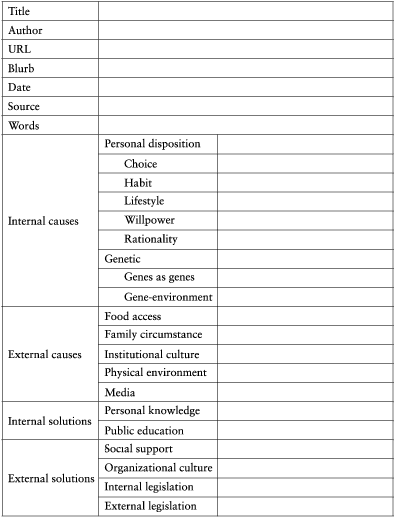
These categories and subcategories provided by Niederdeppe, Robert, and Kindig Reference Niederdeppe, Robert and Kindig65 and supplemented by Kersh Reference Kersh63 constitute the coding rubric displayed in Appendix A. The category “Internal causes” includes references to “Personal disposition,” failure of “Rationality” (i.e., lack of knowledge), and “Genetics” (i.e., genetic causes). The “External causes” category has five subcategories that describe different aspects of the environment (these external causes in particular pertain more directly to obesity than they do to epigenetics in general). Solutions are also coded as “Internal,” which is subdivided as either increasing the “Personal knowledge” of individuals or promoting “Public education,” and “External,” which is subdivided into enhancing “Social supports,” encouraging changes in “Organizational culture” without legislation, and legislation itself, which is then further subdivided into “Legislation of internal causes” versus “Legislation of external causes.”
In addition, to capture any further nuances regarding personal dispositions between or within ideologies, I added “Lifestyle,” “Choice,” “Habit,” and “Willpower” as subcategories of “Personal responsibility.”
Finally, I also further subdivided references to genetics into whether the narrative emphasized the influence of “Genes as genes” (e.g., “a gene for…”), or whether it emphasized the interaction of genes with the environment (“Genes-environment”). As discussed previously, both conservatives and liberals will invoke genetics narratives but only as those narratives suit their normative predispositions. I was curious to see whether there was an identifiable difference in emphasis in the usage of genetics related to the ideological bias of the source of the narrative.
This rubric obviously applies well to obesity — because that is what it was designed for. The rubric also addresses the same constellation of causes, effects, and ideological differences that might be expected in narratives of epigenetics, which is why obesity was chosen as an initial point of reference from which to construct a rubric for epigenetics. However, subsequent rubrics for epigenetics narratives will need to include categories and elements that pertain more specifically to epigenetics — although what these more specific elements might be is difficult to say at this early point, which is why I am using a rubric for obesity as reasonable approximation.
Methods
First, the articles on obesity were read for the presence of the narrative elements identified in the rubric in Appendix A . Each element was counted as it was read, and however many elements were mentioned in an article were scored for that article.
To analyze the data for the obesity narratives, probit regressions were used because they permit the statistical analysis of the influence of independent factors on a dichotomous variable — in this case, either the NYT or WSJ. Categories of causes and solutions were first modeled as the predictors of the source, and then the individual narrative elements within each category were modeled as the predictors of the source. The coefficients returned by the probit regression models are an estimate of the impact of that variable on the probability that the media source is the source of that narrative element. A significant coefficient indicates a significant positive/negative contribution of the predictor to the dependent variable. As the dependent variable is dichotomous, a significant positive contribution of a predictor for one source is necessarily a significant negative contribution of the predictor for the other source. Thus, probit regressions were run with all categories and individual elements for both sources, but only the significant positive coefficients are reported for both sources.
Also, tests for multicollinearity were run between all the categories, and between the individual narrative elements within the categories. There were no indications of significant correlation between either categories or specific variables.
Limitations
A couple of preliminary caveats must be noted about this study: Ideally, there would be many more articles to draw from, as well as additional coders, preliminary tests on sample articles to determine intercoder reliability, and so on. However, at this early stage in the emergence of epigenetics into the public awareness, a sufficient quantity of material to conduct these kinds of tests does not yet exist. Still, there is enough material available at this time to begin to assess what forms these emerging narratives may eventually take.
Therefore, this article is by necessity an exploratory effort or pilot test to begin to establish a baseline for the narrative analysis of epigenetics. Subsequent analyses may support or disprove the conclusions reached here, but at least there will be a baseline for comparison for this future work.
Findings
Obesity narratives and ideological bias
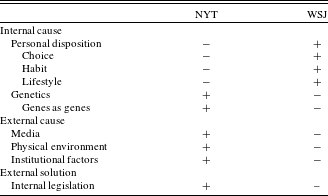
The first assumption to be tested was whether ideological differences in obesity narratives are identifiably related to the source of narrative (i.e., whether more liberal narrative elements are found in the more liberal NYT, and more conservative narrative elements in the WSJ). This test provides the calibration for the expectations of ideological bias for the narratives of epigenetics.
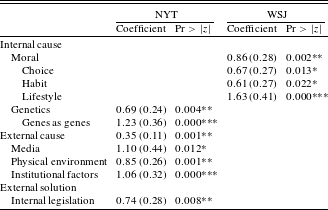
Appendix B provides the coefficients, standard errors, and
 $P$
-values of all the significant results of the probit regressions. Additionally, Table 1 displays the results graphically for ease of comparison and interpretation.
Significant elements of obesity narratives by source (
 $N=100$
).
 $^{\text{a}}$
.

 $^{\text{a}}$
Plus sign (
 $+$
) indicates an element that is a significant predictor of that source. Minus sign (
 $-$
) indicates the necessary obverse of a significant positive result.
The plus signs (
 $+$
) in Table 1 show those instances in which the probit model returned that narrative element as a significant predictor of the source indicated. Of the 20 possible categories and subcategories of narrative elements, 10 significantly increase the probabilities of an article being from either the NYT or the WSJ. Of particular note, each of the significant narrative categories and elements matches the expected ideological tendency of the source.
In terms of causes, references to external causes of obesity as a category and as specific elements are significant aspects of the narrative of obesity in the liberal NYT, as expected. Likewise, references to personal disposition as a cause of obesity — a prototypically conservative narrative — significantly predict the source of the article to be the conservative WSJ. In particular, references to the role of choice, habit, and lifestyle were significant elements in the narrative of obesity as reported in the WSJ.
The only solutions that registered as significant were references to the legislation of internal causes as a solution to obesity, which were significant predictors of the liberal NYT. Even though the focus of this legislation is on internal causes — which is a more conservative narrative element — legislation is itself an external process that works by imposing external constraints. In the Niederdeppe, Roberts, and Kindig discussion groups, legislation was mentioned much more often by liberals; Reference Niederdeppe, Robert and Kindig65 thus, its identification with the liberal NYT still fits the expected pattern.
Obesity and genetics and ideological bias
Regarding genetics and obesity, references to genetics were a significant predictor that the article was from the more liberal NYT. It is also noteworthy that these significant references were to genes as genes, and not to the interaction of genes with the environment.
This result suggests, again per Suhay and Jayaratne, Reference Suhay and Jayaratne68 that obesity in the liberal narrative is being perceived as a naturalized trait that cannot be changed, much like the liberal narrative of sexual orientation. This finding that the causal narrative of genes acting as genes is part of the liberal narrative of obesity is an addition to the discussion of the narratives of obesity.
All of this being said, as I have previously asserted, the specific composition of the obesity narrative is not the focus of this analysis. Rather, the purpose is to calibrate the expectations for causal narratives and ideological biases for the narratives of epigenetics for each source. If no consistent ideological biases for obesity had been found, there would be little reason to expect ideological biases for epigenetics either. Because identifiable narratives of obesity were found using this rubric, and because the narrative elements conformed to the expected ideological biases of each source, one can reasonably assume that similar ideological biases will be found for epigenetics as well when using this rubric.
Epigenetic narratives and ideological bias
Once the ideological biases according to source were established for obesity, the next step was to identify the ideological influences — if any — on the narratives of epigenetics. As discussed, the expectation was that the each ideologically distinct source would emphasize those aspects of epigenetics that are congruent with its ideological predispositions — the NYT would emphasize those aspects of epigenetics that allow causes and solutions to be located in the environment, and the WSJ would describe epigenetics in a way that attributes cause and responsibility to individuals.
To reveal these narratives, the articles on epigenetics were read for the presence of the narrative elements identified in the rubric in Appendix A, but with reference to epigenetics (i.e., although the articles discussed epigenetics in different contexts, the narrative elements were tallied according to the rubric whenever they were mentioned within that context). Again, each element was counted as it was read, so however many elements were mentioned in an article on epigenetics were scored as present for that article.
However, a couple of methodological and interpretive issues arose in testing whether the different media sources would emphasize the different aspects of epigenetics that are compatible with their respective ideological tendencies. First, using probit models to test this hypothesis would require calculating interactions of the binary variable Epigenetic? with the binary variable for the source and the other narrative categories and elements. Per Brambor, Clark, and Golder (2006), Reference Brambor, Clark and Golder72 the proper interpretation of interactions in probit models requires the calculation of marginal effects and other techniques. Given the limitations of the available data (i.e., that there were relatively few articles on epigenetics), the need for such a fine-grained analysis asked more of the data than the data could reasonably deliver.
However, the available material was at least sufficient to reveal the basic outlines of the composition of the narratives of epigenetics, which is the goal at this early stage in the emergence of the narrative. To this end, simple correlations were calculated of the different categories and elements from each source with whether or not an article is about epigenetics. This method has many fewer parts than the probit models but accomplishes similar results. In this case, the results from the NYT and the WSJ were taken separately and correlations were calculated between each of the narrative categories and elements for that source and whether an article was about epigenetics or not.
When similar correlations were run for each narrative category and element of the previous analysis on obesity, the significant probit results reported in previous tables also showed correlations from at least
 $\pm 0.20$
, or in the weak to modest range, up to
 $\pm 0.49$
, or the moderate range of correlation. Thus, a correlation of
 $\pm 0.20$
or greater is used as a reasonable indicator that a narrative element is or is not a significant component of the narratives of epigenetics for a particular source.
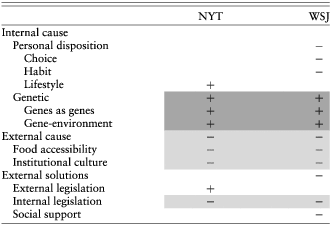
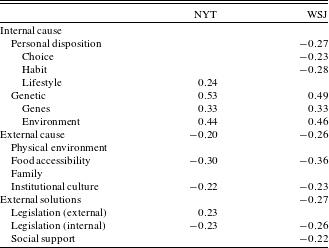
Appendix C reports the statistically significant results of the correlations for all the narrative categories and elements of in each of the media sources. Table 2 graphically displays the results for each source in the same manner as in Table 1; however, this time, the plus and minus signs indicate correlations of
 $\pm 0.20$
or greater.
Significant elements of the epigenetic narratives from the New York Times and the Wall Street Journal (
 $N=113$
).
 $^{\text{a}}$
.

 $^{\text{a}}$
Plus sign (
 $+$
) indicates an element that is a significant predictor of an article about epigenetics from that source. Minus sign (
 $-$
) indicates an element that predicts an article is not about epigenetics from that source. The shaded cells indicate those elements shared in common by the epigenetics narratives from both media sources. The light-gray cells indicate narrative elements shared by both sources with significant negative correlations, and the dark-gray cells indicate shared significant positive correlations.
The mixed ideological narratives of epigenetics
As shown in Table 2, the results provide mixed support for the assumptions that each source would emphasize only those aspects of epigenetics that are congruent with its ideological bias and that the sources would not share narrative elements. Of the 14 significant correlations found, there are 7 instances of congruence between the narratives of the NYT and the WSJ, which indicates that the epigenetic narratives of each source are as similar to as they are different from each other. This result suggests that the emerging narrative of epigenetics is not likely to reflect either of the prevailing ideologies, which is an unexpected outcome.
The congruence of the narratives of epigenetics in both sources in regards to references to genetics is discussed in its own section, later in the article.
Narratives in the New York Times
In the NYT reporting on epigenetics, there is only one narrative element with a significant correlation that is congruent with a liberal ideology: references to legislation focused on external causes, which are positively correlated with reporting on epigenetics. In other words, if an NYT article mentions epigenetics, more often than not that article also mentions legislation as a means to resolve the issues that are raised by epigenetics. This result fits expectations.
In addition to this result, there is one other significant narrative element that the narrative of epigenetics in the NYT does not share with the narrative of epigenetics in the WSJ, which is a positive association of an emphasis on lifestyle with epigenetics. In this case, when epigenetics is mentioned in the NYT, lifestyle factors are also mentioned more often than not. In previous narratives, lifestyle has been an internal or dispositional cause that has been associated exclusively with the conservative narrative. Thus, even when the narrative of epigenetics in the NYT is different from the narrative in the WSJ, the result is counter to the liberal narrative. This finding is unexpected.
All the other significant narrative elements in the narrative of epigenetics in the NYT are shared in common with the WSJ. Except for the positive correlations with references to genetics, which are discussed later, the other significant elements are negative correlations, three for narrative elements invoking external causes, and one for references to the legislation of internal causes. These findings are somewhat surprising, as these factors would seem to align epigenetics with the liberal tendency to locate causes and solutions in the external environment. However, the finding that the narrative of epigenetics in the NYT seems to place little emphasis on the role of the environment again suggests that there is something about the science of epigenetics that complicates the conventional ideological dichotomizations, at least at this early stage in the emergence of the narrative. This finding is also an unexpected result
Narratives in the Wall Street Journal
The pattern of narrative elements revealed in the reporting on epigenetics in the WSJ is much more ambiguous than the pattern for the NYT. Except for the positive correlations of references to genetics with articles on epigenetics — which is obviously to be expected — all the other significant narrative elements in WSJ articles are negatively correlated with epigenetics, meaning that when these elements are mentioned, an article is likely not about epigenetics. Thus, at most, this analysis can suggest which narrative elements are distinctly not a part of the narrative of epigenetics in the WSJ at this early stage.
The fact that references to both external causes and solutions predict that a WSJ article is not about epigenetics is not in itself surprising, as a conservative narrative would not be expected to emphasize these factors. Still, given that the science of epigenetics seems to demonstrate that the environment has gene-level effects via epigenetic processes, one might expect that these elements — especially the external causes — might be mentioned in an article on epigenetics. It is possible that they are specifically not mentioned in WSJ articles on epigenetics because of a conservative ideological bias against locating causal force in the environment for any reason, but the broad analysis conducted in this paper cannot speak to that hypothesis.
Likewise, the negative association of personal dispositions with epigenetics in the WSJ, particularly with regard to choices and habits, may or may not be informative. On the one hand, there is no necessary prerequisite that these elements be positive components of the conservative narrative of epigenetics. On the other hand, these elements are the “bread and butter” of the conventional conservative narrative, so one might reasonably assume that they would be part of a conservative narrative of epigenetics as well, as they are with the obesity narrative. However, the most that can be gleaned from this analysis is that these elements are distinctly not a part of the narrative of epigenetics in the WSJ.
Even so, these negative relationships may also be informative in their own way. As the research in epigenetics demonstrates gene-level responsiveness to the immediate environment, this evidence could be seen as an opening for emphasizing the role of personal choice and action, which fits the conventional conservative narrative (i.e., we are not determined by either our environment or our genetics; we are able to take action to change our epigenetic markers; and so on). The finding that the reporting on epigenetics in the conservative WSJ is defined primarily by what it is not may itself be indicative of a resistance to change, or an intolerance of ambiguity, which typifies the conservative personality or worldview.
In this context, the reporting on epigenetics in the conservative WSJ seems to, if anything, focus more on denying or discounting epigenetic inheritance, as in the article “No, Your Child Won’t Inherit Your Acquired Traits,” Reference Ridley73 than in playing up any emancipatory or transformative possibilities that might be possible. However, even here, one can sense ambiguity, for the same author in an earlier article discusses the genetic scars that “Dickensian childhoods” can leave through epigenetics. Reference Ridley74
This latter account of epigenetic effects in the WSJ is interesting of itself, because it expressly describes the environment as having a substantial influence on outcomes, which is antithetical to the conventional conservative narrative. In this sense, the potential for epigenetics to open up the conservative narrative beyond its traditional boundaries can already be seen. More detailed analyses of specific narrative accounts would be required to ascertain what exactly is the timbre of these conservative descriptions of epigenetics, and to what degree specific accounts of epigenetics conform to or diverge from the conventional narrative, but this article is at least one demonstration of the potential counterideological influence of epigenetics.
Then again, this ambiguity could just be a function of the newness of epigenetics, as commentators struggle to grasp both the complicated science and the greater implications of epigenetics for public policy and health care. That said, the science of epigenetics practically necessitates that one admit to the influence of the environment on health outcomes, and conservatives may therefore be forced to make these allowances, regardless of their inherent preferences, if the science is to be properly understood and communicated. Pointing out this potential force of the science to drive such a fundamental change in narratives — and substantiating these complications via the mixing of ideological narrative elements demonstrated in this analysis — is the central objective of this paper.
It remains to be seen whether the conservative narrative of epigenetics eventually moves to emphasize the positive dispositional aspects of epigenetics, or crystallizes in opposition to the novelty and ambiguity of epigenetics, or fundamentally misconstrues the science to some political end. One may reasonably assume that an ideologically conservative narrative of epigenetics will emerge, as will an ideologically liberal narrative — in fact, this was the original assumption of this analysis — so it is perhaps also noteworthy that such narratives did not emerge ready-made but rather must still be constructed over time.
Genetics, epigenetics, and ideology
Finally, it is noteworthy that the only common elements with positive correlations in both the NYT and WSJ narratives of epigenetics are references to genetics. On the one hand, this is to be expected — how else would epigenetic processes be described except through reference to genetics? On the other hand, the narrative of epigenetics is at least distinct from the obesity narratives, as displayed in Table 1, which show no such overlap or congruency between liberal and conservative narratives.
As discussed previously, liberal and conservative ideologues tend to differ in their applications of the causal narratives of genetics depending on the trait that is being described. For example, the liberal narrative identifies sexual orientation as a naturalized genetic trait beyond personal responsibility or ability to modify, whereas conservatives tend to naturalize race and class differences. The previous analysis (Table 1) finds that the more liberal NYT referred to genetics in the context of obesity, and specifically to the function of genes as genes, more frequently than the more conservative WSJ. This finding indicates that the liberal narrative of obesity in the NYT naturalizes obesity in the same way as sexual orientation.
In the case of epigenetics, however, the narratives from both the NYT and the WSJ share almost identical levels of reference to genetics and genes, and as both genes qua genes and as genes in interaction with their environments. Given the strength of the ideological disagreements over sexual orientation, race and class, and obesity, this overlap through epigenetics of the narratives of the NYT and the WSJ again presents an unexpected point of convergence between these two supposedly juxtaposed worldviews. I will discuss some of the potential implications of this unexpected convergence in the conclusion of the article.
Discussion
The findings reported in this article suggest a couple of aspects of the emergence of epigenetics into public awareness that merit consideration. The first pertains to the potential effects of epigenetics on ideologies and policies, such as for policies related to obesity (as suggested by the previous discussion). The second aspect of epigenetics suggested by this analysis involves the more profound effects of epigenetics on the underlying ideologies and politics themselves.
Policy regimes, ideology, and epigenetics
In the context of a policy domain such as obesity, in which the prevailing policy prescriptions are characterized by clear ideological oppositions centered around locating cause and responsibility in the individual or in the environment, the new narrative possibilities stemming from epigenetics have the potential to disrupt the status quo and allow for the introduction of new policy approaches. As Kersh Reference Kersh63 and others describe, Reference Orren and Skowronek75,Reference Wilson76 issues that emerge rather suddenly, like the issue of obesity did, at first attract a “dynamic, even chaotic, constellation of responses,” Reference Kersh63 but, over time, clear battle lines form into what is called a “policy regime.” Reference McFarland77 Policy regimes are marked by the narrowing of acceptable narratives followed by the commensurate shrinking of legislative and policy responses “from dozens of options to a select handful.” Reference Kersh63 As discussed earlier, this seems to be an accurate description of what is occurring in obesity policy. Again, given the pervasiveness of the basic ideological orientations of conservatism and liberalism, it is unsurprising that obesity policy in the United States has coalesced around the narratives of either personal responsibility or the overriding influence of the environment, for these two basic policy orientations reflect these two seemingly exclusive ideologies.
The formation of policy regimes can be beneficial for policy stability, but policy regimes can also severely limit effective policy by discouraging innovation or combinations ideologically disparate policy elements. Policy historians have detailed how difficult it can be to change policy direction once a policy regime is in place. Reference Banchoff78,Reference Gonzalez79,Reference Kersh80 One potential outcome of the ossification of policy options into a regime is a “punctuated equilibrium” of policy change in which long stretches of relative stasis are marked by sudden swings in policy. Reference Baumgartner and Jones81,Reference Baumgartner, Jones, Mortensen, Sabatier and Weible82,Reference Jones and Baumgartner83 However, some kind of shock — either endogenous or exogenous — is usually needed to break a policy regime out of its stasis. Kersh suggests that new findings from science may in some cases be able to provide such a shock. Reference Kersh63
The recent emergence of epigenetics and its potential to combine two supposedly opposed ideological orientations may present just such an opportunity for a punctuated change in not only obesity policy but also any other policy domain that involves human biology and in which the causal narratives are primarily framed by liberal and conservative orientations. As I have just demonstrated, the emerging science of epigenetics introduces narrative possibilities that incorporate elements of both personal responsibility and environmental influence — but without being exclusive to either ideological orientation. Thus, epigenetics has the potential to exert significant influence in policy discussions not only by directly informing the content of policies as the science of epigenetics develops — which is significant enough in its own right — but also through its potential to influence the causal narratives of conservative and liberal ideological orientations to derive a novel “third way” for policy and politics.
Of course, another potential result from the introduction of the narrative of epigenetics into policy discussions is that epigenetics is subsumed over time within the prevailing partisan narratives to become just another arrow in their respective quivers. This outcome is perhaps the most likely one, given the entrenched nature of these partisan positions and the worldviews they reflect. However, this was the original expectation for the analysis reported in this article, and yet the findings indicate that the narrative of epigenetics does not conform to either narrative, at least as reported in these two ideologically distinct sources at this early stage.
Thus, on the one hand, these early counterideological possibilities of the epigenetic narrative may just be a momentary blip due to the early stage of the emergence of the narrative, only to eventually be swamped by the prevailing forces of entrenched interests and ideologies. On the other hand, these counterideological possibilities of epigenetics could possibly be maintained, resulting in the proposal and implementation of policies which reflect the more holistic and interactive perspective suggested by the emerging science of epigenetics. What the actual result will be remains to be seen, but these preliminary results do provide interesting fodder for subsequent work.
The true political implications of epigenetics
Although the main implications of epigenetics for policy stem from its complications of the conventional self-versus-environment dichotomies that characterize liberal-versus-conservative positions in contemporary policy domains such as obesity, epigenetics also has the potential to upend fundamental assumptions about human nature that have been the basis of prevailing conservative and liberal Western worldviews for at least the last 200 years. Specifically, the science of epigenetics introduces novel information about our relations with each other and with our environments that profoundly challenges the foundational modern Western concept of atomistic individualism, in which each person is regarded as a distinct and autonomous entity, ultimately separate from other people and from the environment. This concept, which is espoused in Cartesianism, Lockeanism, Kantianism, and other philosophies, simply does not reflect the interconnectedness of humans with each other and with their environments, which may even span multiple generations, that is being revealed by the science of epigenetics. To the contrary, epigenetics shows the self, at least on a biological level, to be an inherently relational concept which is constituted through interaction with other people and the environment.
The emergence of a politics and ethics based on this more relational concept of self is not as unrealistic or far-fetched as it might at first seem. For example, the ethical and political traditions of East Asia, some of which have been in practice for thousands of years, are premised upon just this kind of more open and relational concept of self. Reference Ivanhoe84,Reference Ivanhoe and Bruya85 In fact, as I have discussed in more detail elsewhere, Reference Robison86 these non-Western traditions are in many ways a much better fit with this emerging science of epigenetics than are modern Western ideologies, which suggests that the science of epigenetics may be more easily accepted within East Asia than in the West.
East Asian traditions, though, have long been held to be incommensurable with predominant modern Western ideologies, Reference Wong and Krausz87 primarily because of the seemingly fundamental differences in the prevailing concepts of self. Reference Rosemont88 Thus, one might conclude that East Asian traditions would be of little use in efforts to reconstruct Western politics and ethics to more fully incorporate insights from epigenetics. However, scholars have recently been exploring various ways that non-Western and Western systems can be reconciled in philosophy and psychology, Reference Ivanhoe, Flanagan, Harrison, Schwitzgebel and Sarkissian89 and in political theory, Reference Kim90 and this work may also suggest ways that modern Western ideologies grounded in atomistic individualism might be adapted to the profound political complications being introduced by the science of epigenetics.
Even within the Western tradition, there are alternative philosophical frameworks that are not built upon an ontological commitment to atomistic individualism. For example, the ethics and political theory developed by the 17th-century Dutch philosopher Benedict Spinoza are premised upon a concept of the self as ultimately relational. Reference Balibar91,Reference Campos92,Reference Kisner93 At the same time, Spinoza’s system is also a product of the same intellectual and cultural history that produced other modern Western political theories. As such, the philosophy of Spinoza provides a potential bridge between atomistic individualism and the relationality of many non-Western traditions. Reference Robison94 A politics and an ethics based on Spinozist principles should therefore be much more capable of balancing the combination of dispositional and environmental aspects of epigenetics than a dualistic and atomistic worldview would be, Reference Robison95 while also being more compatible with pre-existing modern Western constructs than non-Western traditions are.
The concluding paragraph of this article is not the place to begin to formulate this new politics. Although this article is meant to initiate a discussion about what such a politics could or should look like via its descriptions of the science and the narratives of epigenetics, and their implications for policy, I recognize that whether such an alternate perspective will or could ever emerge in the West is an open question. However, this article does suggest that the ideological bases of our conventional policies and politics as currently conceived are ill-equipped to deal with the descriptions of our biological relationships with each other and with our environments now emerging from the science of epigenetics.
Appendix A
Coding rubric.

Appendix B
Significant results from probit regressions of obesity narrative elements to predict the source
 $(N=100)$
.
 $^{\text{a}}$

Appendix C
Correlations equal to or greater than
 $\pm 0.2$
of narrative elements of epigenetics with source (
 $N=113$
).