THE SIGNIFICANCE OF ON-FLOOR REMAINS
When beginning work at Caracol, Belize, in 1985, one of our explicit research goals was to determine the function of buildings and, thus, we purposefully attempted to find and excavate on-floor material remains associated with ancient Maya structures. Having done archaeological work at Grasshopper Pueblo in the American Southwest in 1973, we were well aware of the fact that the rooms in most of the Southwestern pueblos were littered with whole vessels and other artifacts and features that had been left behind at the time of abandonment (Hill Reference Hill and Longacre1970; Reid Reference Reid1974). Our excavations at Santa Rita Corozal in northern Belize, where we excavated from 1979 through 1985 (Chase and Chase Reference Chase and Chase1988, Reference Chase, Chase and Aimers2013b), also produced whole vessels associated with building floors. Given that the Classic Maya collapse was perceived at the time to have been a rapid process that could be charted in terms of monument dates (Culbert Reference Culbert1973; Lowe Reference Lowe1985), we wondered why similar use-related, on-floor remains had not been encountered in Maya buildings dating to the Terminal Classic period. The dearth of in situ artifactual materials recorded as being associated with Maya structure floors, in fact, contributed to models of “vacant ceremonial centers” in the Maya area (Vogt Reference Vogt1961, Reference Vogt1964; Willey Reference Willey1956).
Contrary to the vacant ceremonial center model, Adams (Reference Adams and Hammond1974) proposed that ancient Maya people actually lived in stone palaces. He calculated elite population numbers for Uaxactun's palaces based on bench space, as he felt that these benches would have served as beds. While there were notations at Uaxactun of ceramic vessels having been left in association with a ritual altar (Smith Reference Smith1932), there were few records of anything reconstructable having been recovered during the excavation of Uaxactun's central palace (Smith Reference Smith1950, Reference Smith1955). Other Uaxactun excavations also did not note the occurrence of material on or above floors (Ricketson and Ricketson Reference Ricketson and Ricketson1937). The same situation was true of Tikal; while Postclassic on-floor materials had been recovered in Temple 1 (Problematic Deposit 38; Culbert Reference Culbert1993:126), there was no mention of reconstructable materials on the floors of Tikal's Central Acropolis or elsewhere (Coe Reference Coe1990; Harrison Reference Harrison1970; Loten Reference Loten2017). It has, however, been noted that some building rooms at both Tikal and Altun Ha were used for the accumulation of trash (Harrison Reference Harrison1999:197–198; Pendergast Reference Pendergast1979:94).
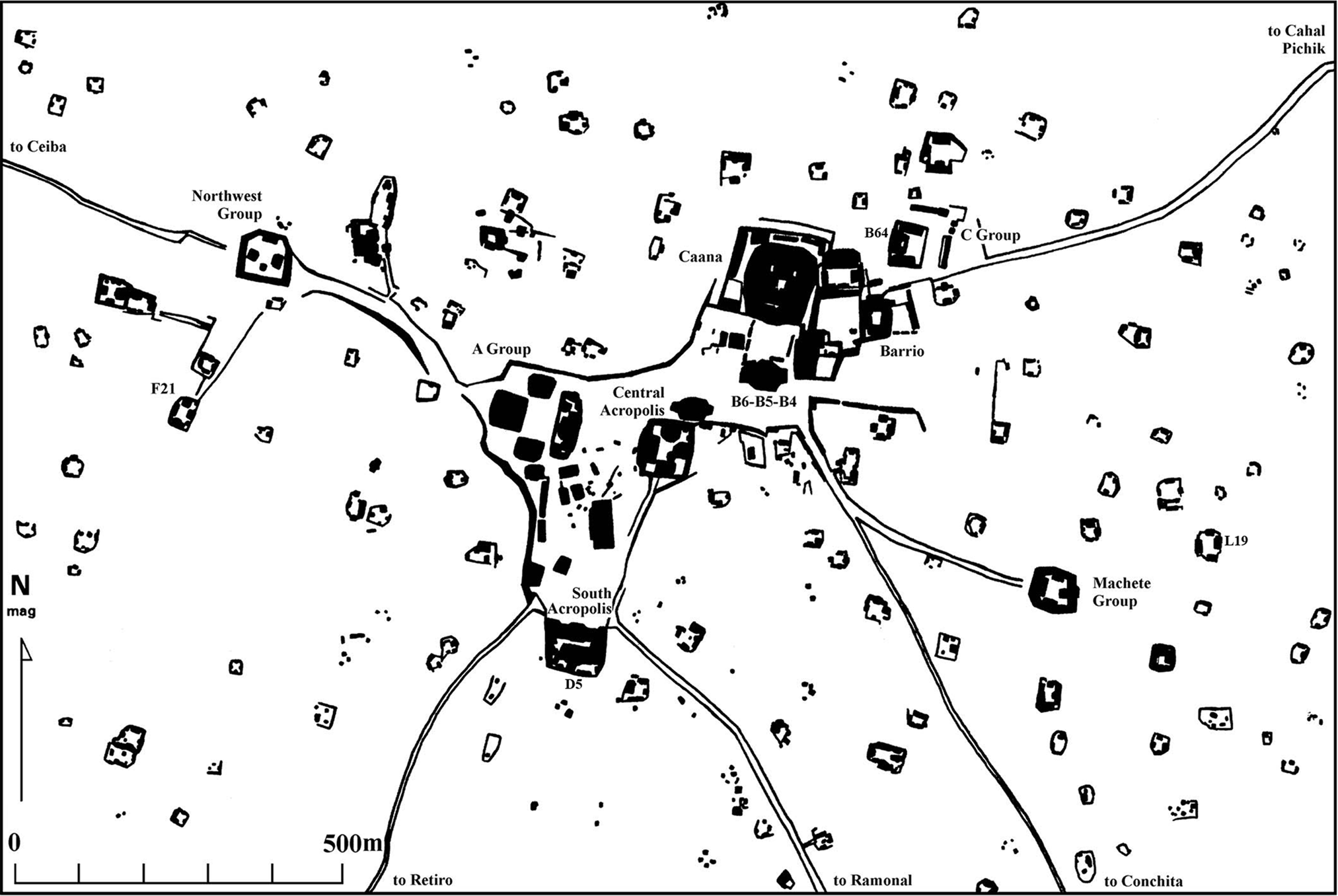
While it was not initially evident whether on-floor materials would be recovered at Caracol, early excavations in epicentral buildings, where architecture had collapsed on top of floors, suggested that this might be the case. In the late 1980s and early 1990s, we were the recipients of United States Agency for International Development and Government of Belize funds that were provided for the excavation and subsequent stabilization of the downtown stone buildings of Caracol for touristic purposes. And, it was largely these resulting excavations that led us to find on-floor artifactual materials associated with Caracol's epicentral stone buildings (Figure 1).
Map of the epicenter of Caracol, Belize. Map by Chase and Chase for the Caracol Archaeological Project.

General Character of On-Floor Deposits at Caracol, Belize
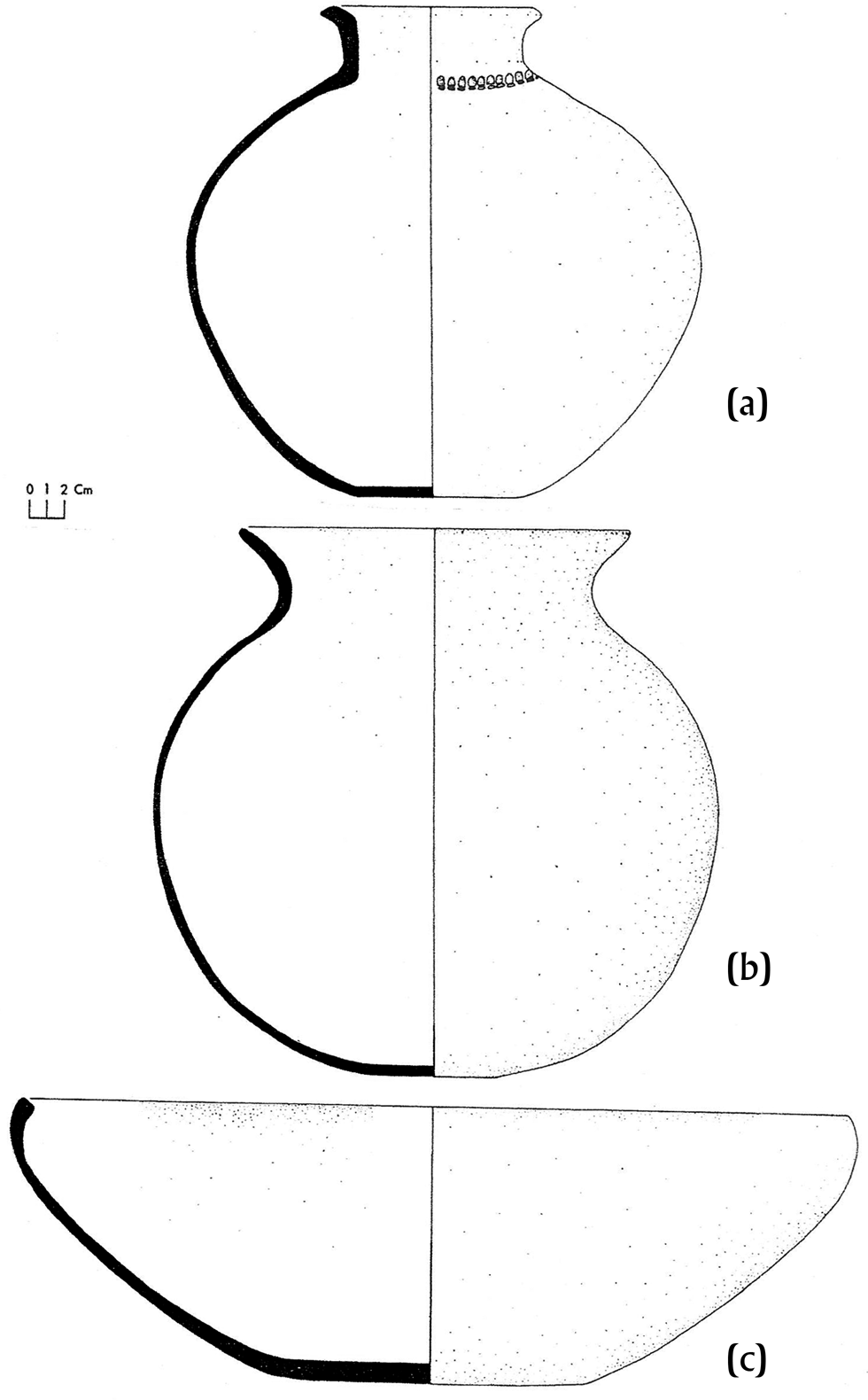
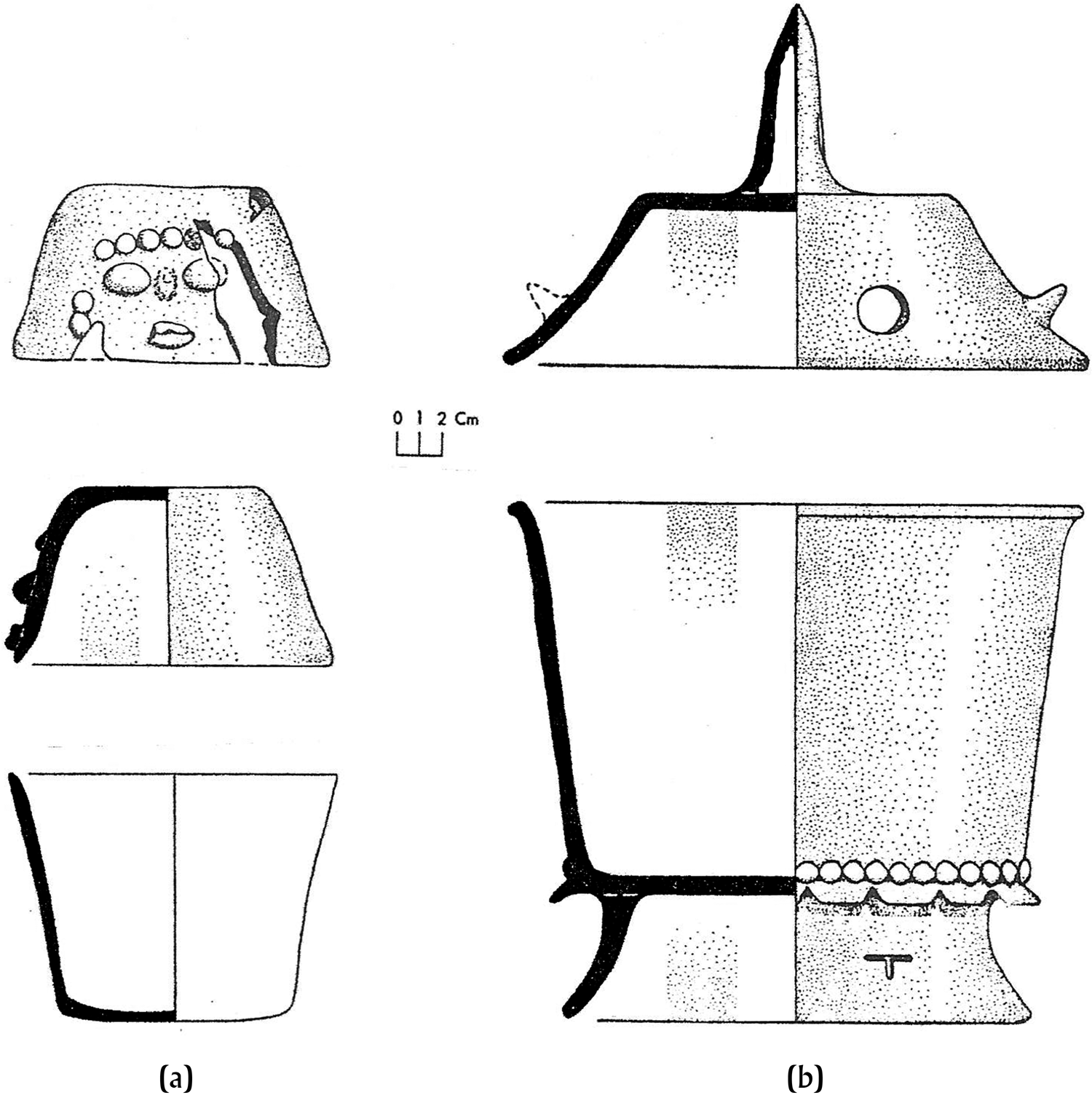
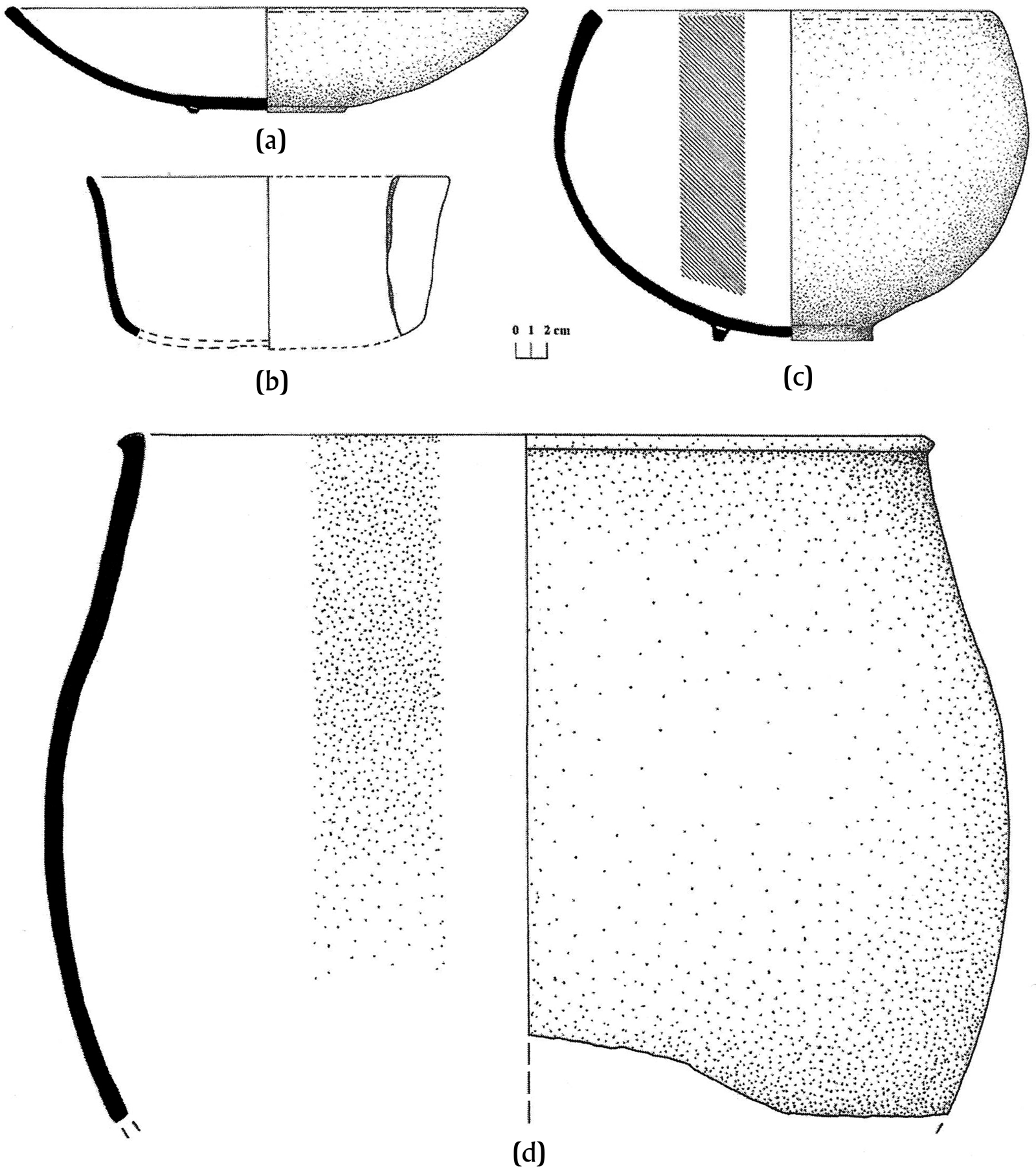
Two broad classes of on-floor (or in some cases, on-stair) artifactual materials were recovered at Caracol. One kind consisted of in situ whole vessels on floors, usually without much in the way of other artifacts; these could be subdivided into quotidian and ritual pottery (Figures 2 and 3). The second kind of on-floor materials consisted of sheet refuse (Schiffer Reference Schiffer1987) of substantially broken artifacts, bone, and ceramics usually exterior to a stone building, often on a portico floor; these deposits were quite variable. Although usually not whole, some of the ceramics in the sheet refuse could be partially reassembled with extensive laboratory work. Also included in sheet refuse throughout the epicenter were small pieces of broken manos, pieces of metates, chert points, chert flakes, slate fragments, fragmentary obsidian blades, river cobbles, faunal bone, and human bone; some sheet refuse also included small pieces of sea shell (worked and unworked), small pieces of jadeite (worked and unworked), spindle whorls, fragmentary mirror backs and pyrite pieces, fragmentary celts, fragmentary hammerstones, and fragmentary worked bone; a piece of speleothem was also recovered in the Structure A6 sheet refuse. In some cases, both sheet refuse and in situ materials were found in association with the same building.
An example of quotidian, on-floor ceramic vessels recovered from a front midrange room on Caana (Operation C55C): (a) Pantano Impressed and (b and c) Valentin Unslipped. Drawings by Chase and Chase for the Caracol Archaeological Project.

An example of ritual on-floor ceramic vessels recovered from a front summit room on Caana (Operation C16L): (a) Ceiba Unslipped container with Hebe Modeled lid and (b) Miseria Appliqued container with Candelario Appliqued lid. Drawings by Chase and Chase for the Caracol Archaeological Project.

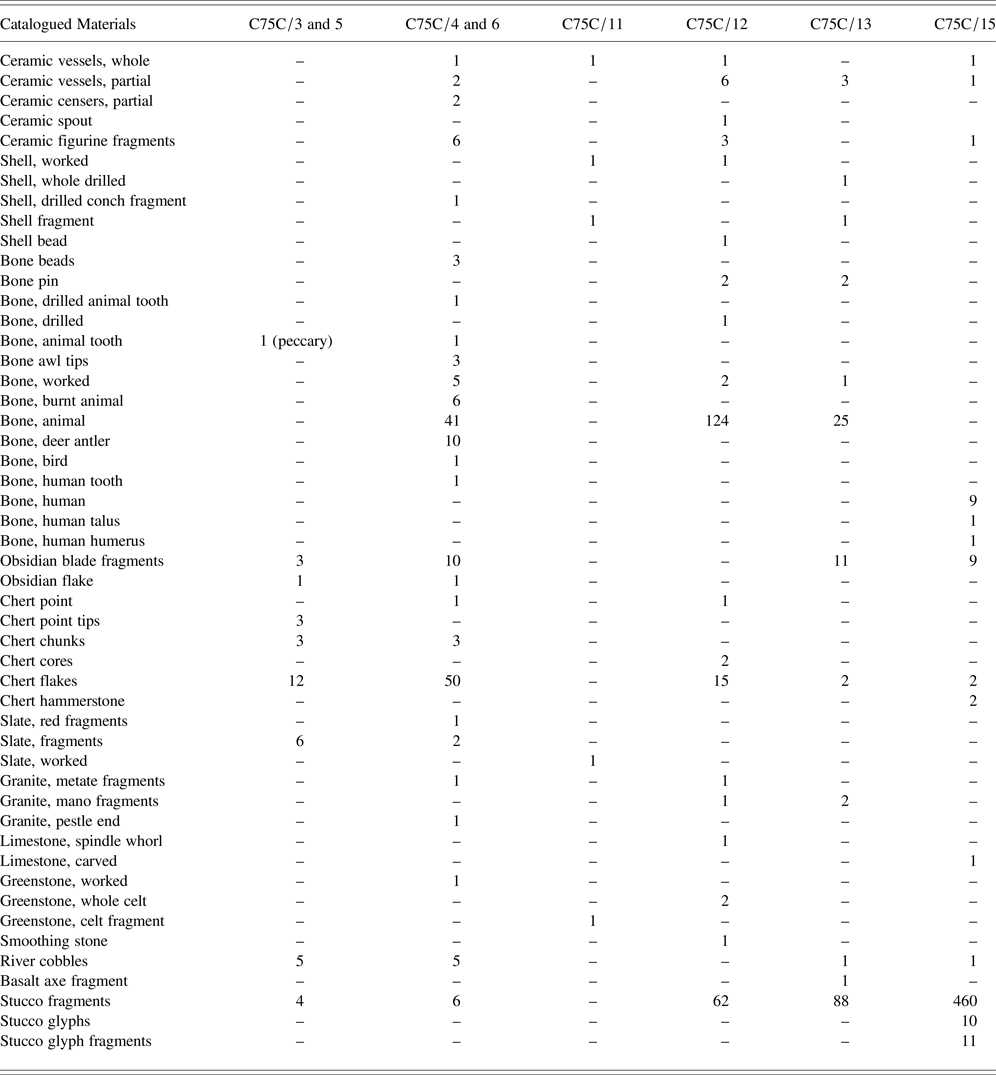
We stress that each distinct context at Caracol differs from others in terms of the specific archaeological materials found above floors. Simply placing these materials in quantified tabular form, like we have done below for Structure B64 (Table 1), does not actually promote full comparison or understanding of a specific context. As Newman (Reference Newman2019:806) has aptly noted for her analysis of El Zotz on-floor materials, “employing reified archaeological categories may actively impede the identification of differences among ancient activities.” More detailed analysis of materials is necessary.
Quantification of on-floor materials associated with Caracol Structure B64 plaza.

Unlike rooms filled with trash, as is reported for Altun Ha (Pendergast Reference Pendergast1979:94) and Tikal (Harrison Reference Harrison1999:197–198), Caracol's on-floor trash was usually in a single lens above floors (see below for a possible exception in one side room of Structure A6). And, it was not piled up in the corners of courtyards, as is reported for some sites in the Belize Valley, such as Baking Pot (Helmke et al. Reference Helmke, Hoggarth, Awe, Bednar and Johnson2017). The ceramic vessels recovered in Caracol's epicenter also generally differ from those recovered in residential groups outside the epicenter (although there was very limited representation of epicentral vessels types in outlying residential groups; see Chase and Chase Reference Chase and Chase2005), leading us to posit that two ceramic subassemblages were being used simultaneously during Caracol's final years (Chase and Chase Reference Chase, Chase, Demarest, Rice and Rice2004, Reference Chase and Chase2005, Reference Chase and Chase2007, Reference Chase and Chase2008). Given that many of the ceramic vessels recovered from the floors of Caracol's epicentral stone buildings were largely complete, we posited that many of them had been left in situ. As there was neither extensive trash build-up nor evidence of return visits for the complete ceramics and other portable materials, we interpreted these remains to mean that Caracol had suffered a rapid abandonment where items were left in a building and final trash collection had never taken place (Chase and Chase Reference Chase and Chase2000, Reference Chase, Chase, Demarest, Rice and Rice2004). This interpretation was augmented by the recovery of unburied bodies (bodies left on the latest surfaces and subsequently covered only through natural causes) on the B Plaza floor and in a palace room on Caana (Chase and Chase Reference Chase and Chase2017).
On-Floor Evidence from the Caracol Epicenter and Residence Groups
Given a rapidly abandoned Caracol epicenter, the distribution of whole vessels and sheet refuse do permit some functional differentiation to be made within the kinds of materials that were recovered in association with the various structures. Complete on-floor vessels were recovered from three temples and many of the palace structures in the epicenter. The vessels associated with temples were usually incensarios. Pedestaled incensarios were also found on the floors of shrines buried by later architectural construction both in the site epicenter (Structure B20) and in an outlying residential group (Structure L19). The northern temple of the A Group, Structure A3, had two complete censers placed within the building on its centerline axis; one is a modeled and pedestaled flanged cylinder and the other is a large pedestaled brazier (Chase and Chase Reference Chase and Chase1987:Figure 9). Two incensarios were also recovered in the front room of the Temple of the Wooden Lintel (Structure A6) set against the interior wall (Chase and Chase Reference Chase, Chase, Demarest, Rice and Rice2004:Figure 16.7t); both were modeled flanged cylinders. And, two modeled and pedestaled flanged cylinder incensarios (one in a state of disrepair) were recovered at the base of Structure B19 in association with Altar 16 (Chase and Chase Reference Chase and Chase1987:Figure 19). The Structure B19 censers were found in direct association with a spouted ladle and an incurved, rim-stamped bowl as well as a human skull cap. The paired incensarios in the Caracol temples presage the use of paired incensarios during the Postclassic period as katun markers (Chase and Chase Reference Chase and Chase1988, Reference Chase and Chase2013a, Reference Chase, Chase, Freidel, Chase, Dowd and Murdock2020a; D. Chase Reference Chase, Robertson and Fields1985), and it is likely that their associations with the Caracol temples indicate a similar use in marking the passage of time in which the incensarios were left in place for an extended period of time. Single, largely complete, incensarios were also recovered in association with the eastern stairs of residential groups (e.g., Structures 3E2, 6G5, and 7O39), having been left in place at the time of abandonment.
There are other similarities between the final occupations of Caracol Structure B19 and Caracol Structure A6. Both temples also contain unsealed Terminal Classic caches (materials placed into pits purposefully dug through the latest floors but not sealed by a floor surface or later construction). Structure A6 contained a small lip-to-lip cache with a modeled bird lid on axis in its rear room and Structure B19 contained a cache of five serving-ware ceramic vessels on axis, also in its rear room (Chase and Chase Reference Chase, Chase, Demarest, Rice and Rice2004:Figure 16.2, Reference Chase and Chase2007:Figure 2d). Both structures were associated with sheet or provisional trash (Schiffer Reference Schiffer1987:65) that yielded a series of other reconstructable vessels and artifactual material, including jadeite beads. The bones of two children were also encountered on the summit floor of Structure B19 and a human premolar was recovered from the floor of Structure A6 with other faunal and possibly human bone; additionally, an extended articulated body was recovered buried within the trash layer in the southern transverse room. The extensive amount of faunal material found on the floors of Structure A6 was probably due to the use of the building as an owl's roost after it was abandoned (Miller and Miller Reference Miller, Miller, Chase and Chase1994). The sheet refuse associated within Structures B19 and A3, however, differed in function; Structure B19 represented ritual offerings made and left on the room floor and at the base of the stair; the on-floor material within Structure A6 includes both ritual and quotidian whole ceramic vessels along with partial vessels and a widespread burnt layer over smaller. largely broken artifacts and extensive faunal bone, making this deposit a functional palimpsest (see also Chase and Chase Reference Chase and Chase2000).
The southern palace building in Caracol's Central Acropolis yielded a series of vessels within the structure itself and broken artifactual materials in the alleyway between the palace and the secondary eastern shrine. Significantly, the southern palace is associated with five almost complete vessels that included: a modeled-carved fine-orange bowl; a footed and fluted cylinder; a pedestaled and punctated cylinder vase; and two, large ceramic ollas (Chase and Chase Reference Chase and Chase2008:Figure 5k) in association with human bone. The complete upper part of a burner, or stove (Ball and Taschek Reference Ball and Taschek2007), was recovered from the provisional trash to the front of the building. These materials likely resulted from the latest occupation of this palace building.
The Northeast Acropolis yielded reconstructable vessels from both the floor and base of the northern summit palace. On the summit of the north building, most of a pronged burner was recovered on the floor of the front room, as well as a whole spouted jar; a whole, small vase; a short, complete cylinder (minus feet); the incomplete remains of a second jar; two, larger fluted cylinders; and the complete rim of a large olla. A rear summit room contained a complete Belize Red flat-bottom, tripod plate and a large, wide-mouth olla. At the base of the northern building, a complete footed incurved bowl was recovered as well as most of a large, fluted cylinder vessel (minus its feet). Provisional trash with reconstructable vessels (a significant portion of a modeled burner, the base of a footed fluted cylinder, much of an incised black water jar, and the rim of a large olla) was recovered from the western side passage for the Northeast Acropolis in association with human bone. The Northeast Acropolis material is seen as resulting from the last occupation of this complex.
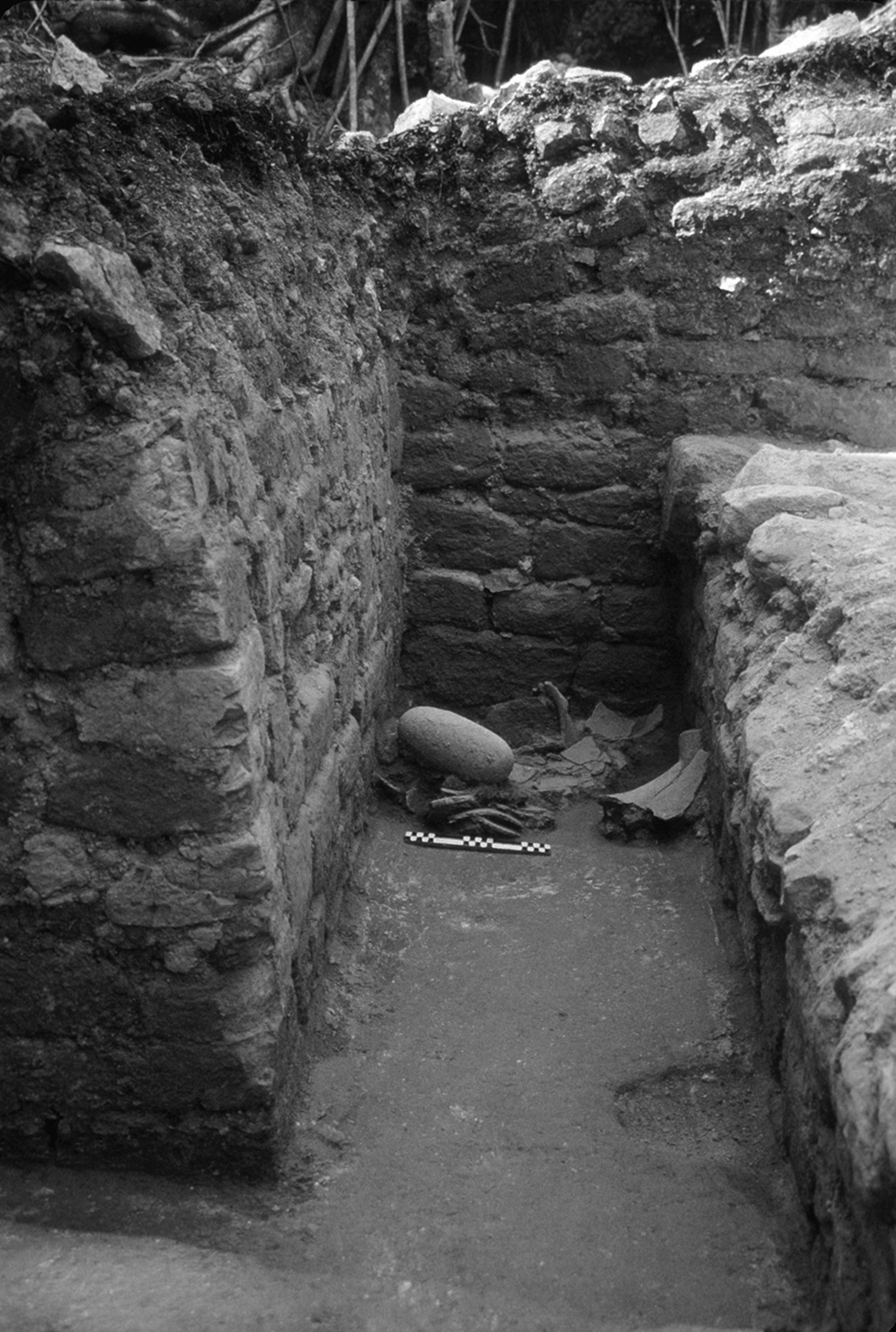
In the Barrio architectural complex, ceramic vessels were recovered in three interior rooms from the eastern building as well as in association with the interior plaza stoop and the exterior western access stair (Chase and Chase Reference Chase and Chase2007:Figure 4). Human bone was also recovered from the floor of one of the rooms and a complete articulated body was recovered on the front southwestern corner of the northern building. The interior plaza stoop was associated with a large, modeled drum; a perfume bottle; three, footed, incurved bowls; and pieces of a Pabellon Modeled-Carved pedestaled vase. One room in the eastern building contained three miniature vessels, probably paint pots for a scribe, in association with a small-footed Belize Red plate with notched basal decoration. Another room probably served a more domestic component in that it contained a complete modeled-carved footed cylinder vase; an impressed, incurved bowl; two red bowls; three, wide-mouth, short-rim ollas (Chase and Chase Reference Chase and Chase2008:Figures 5b, 5e, 5h), and one incised, small-footed plate. A large olla and complete mano were recovered on the floor of the western room of the southern building (Figure 4). Also recovered from the core of an unsealed fill block in the northwest interior corner of the plaza were a host of vessels that included: five impressed bowls; three footed, incurved bowls; one other bowl; one slipped, collared ollas with medial fillet; three water jars (one with punctate design on its shoulder); two restricted ollas with tall rims; one Pabellon Modeled-Carved pedestaled vase; one punctated and modeled cylinder vase; two small, incised, and footed plates; one Belize Red flat-bottom footed plate; and one small vase. In addition, a slipped, collared olla with medial fillet was recovered in association with the western entry stairs for the complex. All of this material is believed to have been related to the occupation and use of this complex.
Photograph of on-floor materials in western room of Caracol Structure B23 (Operation C76N). Photograph by Chase and Chase for the Caracol Archaeological Project.

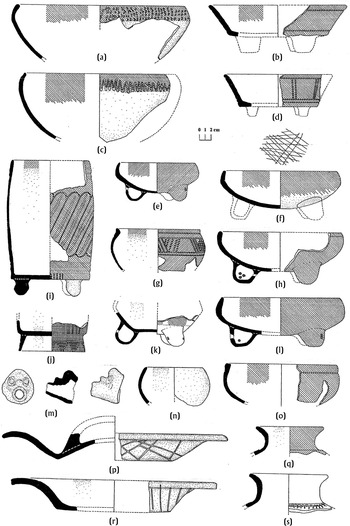
In the C Group, extensive sheet refuse was recovered from the interior courtyard associated with Structure B64 (see Table 1). The recovered reconstructable vessels included: three, footed incurved bowls; one footed, incurved grater bowl; a Belize Red flat-bottom plate; a small, incised plate with nubbin feet; two decorated large incurved bowls; three other bowls; the pedestal base of a cylinder; most of a fluted and footed cylinder; the base of a small-footed jar; two water-jar rims; and pieces of two, platter-like incised censers (Figure 5). Formal analysis of the faunal material revealed 26 worked bones relating to bird (two), dog (five), deer (14), rabbit (two), peccary (one), and fox (one); a similar distribution of worked bone was also recovered in association with Barrio (Teeter Reference Teeter2001:Tables 9.12 and 9.13). The collection of unworked animal bone recovered from this context included all of the species found in the worked bone plus river turtle and snapper fish (Lutjanus sp.). The material associated with this floor also included human bone. Again, however, these materials likely relate to the use of this complex and a breakdown in recycling and trash collection.
Partial and whole ceramic vessels recovered in the provisional or sheet trash associated with Caracol Structure B64 (Operation C75C): (a, c, and s) Pantano Impressed, (b) Martin's Incised, (d) possibly Torres Incised, (e, h, l, and q) Tinaja Red, (f) possibly Portia Gouged-Incised, (g) Conchita Incised, (i and j) Cohune Composite, (k) Silho Fine Orange, (m) San Julio Modeled, (n) Valentin Unslipped, (o) Cameron Incised, and (p and r) unnamed striated and modeled censerware. Drawings by Chase and Chase for the Caracol Archaeological Project.

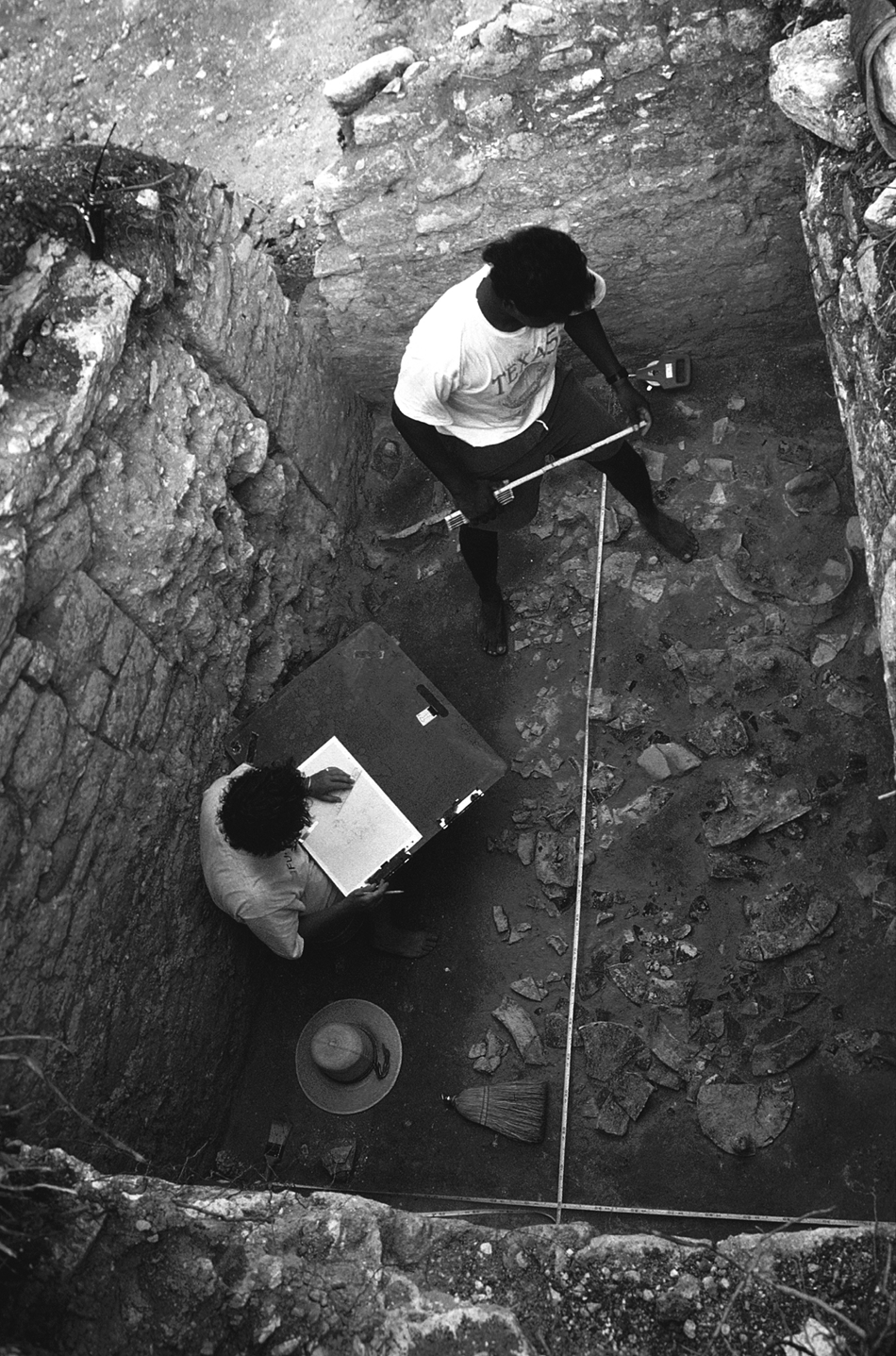
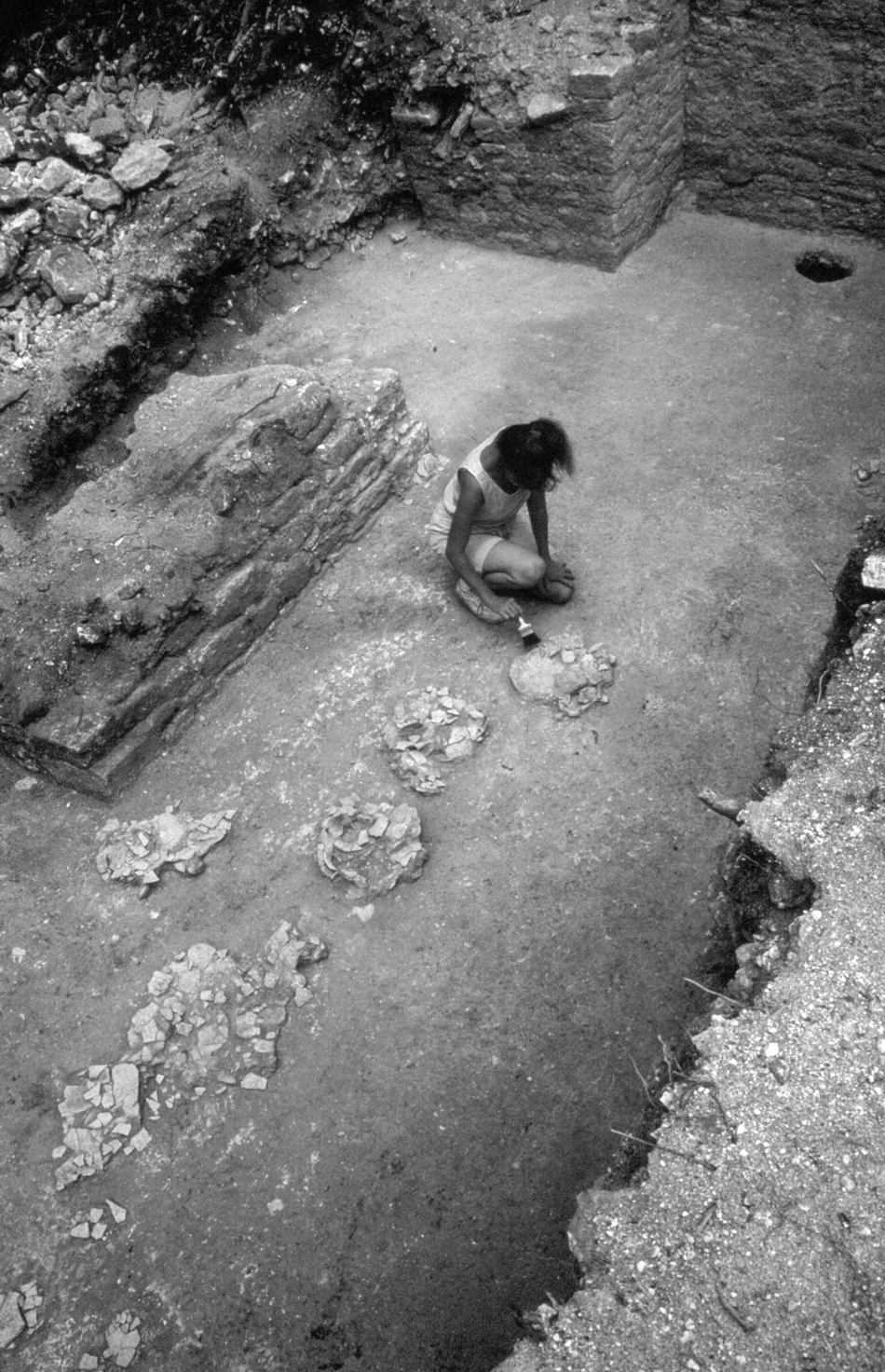
Caana not only had a series of vessels found on the floors of its summit rooms but also some sheet trash associated with the frontal, midrange alley. The midrange alley actually produced several complete vessels: a huge black barrel, a grey cylinder vase, and two black-ware plates minus their feet. Two footed and modeled-carved cylinders were recovered from within the central axis way through the midrange building. Two vessels, a flat-bottom Belize Red plate and a hemispherical incised bowl, were recovered in two midrange building rooms; another midrange front room yielded two complete wide-mouth ollas and a large platter on the interior bench (Figure 2). The sides of the basal Caana stairs yielded most of a fine-orange collared bowl, a Belize Red footed plate, an incurved footed bowl, the rim and incised glyphic panel for a modeled-carved cylinder, and the necks of two water jars. A series of complete vessels were found sealed within a suite of basal rooms on the east side of Structure B19 that had been infilled in order to provide structural support to the pyramid during the Terminal Classic period; the vessels found on the floor of the infilled suite included: 13 footed, black-ware plates; four deep, black-ware vases; and a huge, wide-mouth olla (Figure 6; Chase and Chase Reference Chase and Chase2007:Figure 3). Another small, deep vase and partial burner with a modeled warrior were recovered in the northeast courtyard of Caana. A complete, pedestaled, barrel censer was recovered in the rear room of the western building in the northwest courtyard on the summit of Caana. A complete censer with lid and a vase capped with a modeled bowl was recovered from a front room on the Caana summit (Figure 3). Human bone was also found distributed in the Caana trash; the bone was recovered on either side of the basal plaza stairway for Caana and in one of the midrange front rooms. There was a femur on the floor of the summit plaza and the articulated body of an unburied child was recovered within an interior doorway in the southern building of the northeast summit courtyard. The Caana materials represent ritual and quotidian use of these buildings, as well as the final abandonment of the complex.
Photograph of complete ceramic vessels being recorded on the floor summit room on Caana room that had been sealed in antiquity (before final abandonment; Operation C81M). Photograph by Chase and Chase for the Caracol Archaeological Project.

Across from Caana on the south side of the B Group plaza, Structure B4 had a series of complete vessels on the floor of its rear room (Figure 7; Chase and Chase Reference Chase and Chase2000) and provisional trash on the terrace in front of the building (Chase and Chase Reference Chase and Chase2000:Figure 2). The rear room contained eight in situ ceramic vessels, presumably used for domestic functions: two water jars with punctate decoration at their shoulder break; a restricted-neck, large olla; two wide-mouth ollas; one large tecomate; one decorated small vase; and, one candelero. Partial vessels on the front terrace of Structure B4 included: a faced and footed, incurved bowl; another faced bowl; two paint pots; one small finger bowl; one footed plate with decorated break; and one incurved, fluted barrel with three, large, bulbous feet and a carved row of basal glyphs. A complete collared bowl was recovered from the front room of Structure B6, the companion wing to Structure B4. The materials within the rooms is viewed as being from the final occupation, while the portico materials are interpreted as uncollected sheet refuse.
Photograph of complete ceramic vessels on rear room floor of Caracol Structure B4 (Operation C77E). Photograph by Chase and Chase for the Caracol Archaeological Project.

The South Acropolis is the only epicentral area with stone buildings that has not produced extensive sheet refuse or on-floor human remains, but the buildings were cleaned out by Anderson (Reference Anderson1958, Reference Anderson1959) in the 1950s. A complete, footed cylinder was recovered by the project in the side alley between Structures D17 and D16, suggesting that in situ materials may have once existed in the South Acropolis. Excavations within the core of Caracol Structure D5 recovered ceramic vessels on a floor that was sealed within a later construction (Figure 8); these were use-related materials for the earlier structure.
Ceramic vessels recovered on the earlier floor of a building sealed within Caracol Structure D5 (Operation C164C): (a) Machete Polychrome, (b) Palmar Orange-Polychrome, (c) Subin Red, and (d) Cambio Unslipped. Drawings by Chase and Chase for the Caracol Archaeological Project.

Finally, one other small platform, Structure A31, produced some of the latest ceramic remains from Caracol. These ceramic vessels were distributed to either side of and over the front stairway of the building and consisted of four incensarios (Chase and Chase Reference Chase and Chase2007:Figure 5) and a series of domestic ceramic vessels that included a water jar with handles (Chase and Chase Reference Chase, Chase and Aimers2013b:Figure 4). The incensarios associated with this building were all probably imports. One is a pedestaled, globular brazier similar to a form found at Isla Cerritos in the Yucatan (Rafael Cobos, personal communication 2012); one is a pedestaled and incised brazier known from Lamani in northern Belize (Graham Reference Graham1987:Figure 4.5a); one is a fine-orange, “Mixtec-style” incensario; and, the final one is a ladle-handled incensario. A tripod plate associated with this deposit has trumpet feet and is very reminiscent of forms found at Chichen Itza. While human bone is not definitely in association with these materials, there is a significant amount of unspecified burnt bone, some of which may be human. The ceramic vessels recovered here appear to have been ritually left in place over a period of time just prior to the final abandonment of Caracol; this deposit strongly resembles a similar situation found in the ritual use of Santa Rita Corozal Structure 81 (Chase and Chase Reference Chase and Chase1988, Reference Chase and Chase2013a).
Final Comments
One key aspect of the Caracol Terminal Classic on-floor deposits is their consistent association with human bone. With the exception of the South Acropolis, all of the palace compounds in the site epicenter yielded human bone with the final on-floor ceramics and artifactual materials. Human bone was also recovered from a variety of other non-floor and humus lots. In the B Group plaza two complete skeletons from unburied adults that had been left on the plaza floor at the time of abandonment were recovered in front of the eastern structure as well as nine extra mandibles. In the walled area just south of the epicenter, three human skull caps were recovered in humus during excavation. In one of the residential groups just south of the C Group, human bone was recovered in the humus in front of the eastern structure in association with a modeled-carved footed vase (Chase and Chase Reference Chase and Chase2008:Figure 1), a fluted and footed cylinder vase, a modeled-carved bowl, and the upper half of a burner.
The association of Terminal Classic materials with dispersed human bone has also been found at wide variety of other sites, where it is often associated with violence or ritual disempowerment (e.g., Harrison-Buck Reference Harrison-Buck and Harrison-Buck2012:109–110). Early in our careers, we specifically noted the existence of human bone in on-floor remains at Nohmul, Belize in association with Structure 20, a patio-quad (or gallery-patio) structure, the form of which is best known from Chichen Itza. At Nohmul, the human bone was also burnt and had been included in household provisional refuse placed to the rear of the building in an alley formed between Structure 20 and the preexisting plaza buildings; while difficult to prove, the possibility of cannibalism was raised in association with this bone (Chase and Chase Reference Chase and Chase1982). The inclusion of articulated human remains (albeit as burials) in terminal on-floor deposits is also noted for other sites, such as Baking Pot in the Belize Valley (Helmke et al. Reference Helmke, Hoggarth, Awe, Bednar and Johnson2017:228).
The widespread appearance of human bone in the on-floor deposits at Caracol has several potential origins. We have previously commented on the curation of human bone, possibly in eastern structures, and a two-part burial process at Caracol prior to interment at an appropriate time and in an appropriate place (Chase and Chase Reference Chase and Chase1996, Reference Chase, Chase, Fitzsimmons and Shimada2011). Thus, some of this bone may have been locally stored prior to final interment. Yet, it may also be that some of this bone derives from unburied human bodies from some final battle or raid that Caracol lost. This would be consistent with Caracol's bellicose nature (A. Chase Reference Chase, Robertson and Fields1985; Chase and Chase Reference Chase and Chase1989, Reference Chase, Chase, Okoshi, Chase, Nondedeo and Arnauld2020b; Chase et al. Reference Chase, Grube and Chase1991) and may also be indicative of a different sort of conflict in which the old rules of engagement were not followed (e.g., Chase et al. Reference Chase, Grube and Chase1991). Some of the palace structures in the epicenter were purposefully burnt; others may have had their roofs pulled down. Whether these actions represent ritual destruction by the inhabitants of Caracol or purposeful destruction by someone else is not known. What is interesting is that some of the latest burials were deposited in Terminal Classic trash (e.g., Structure A6), while other bodies were left unburied on plaza (e.g., B Plaza) and building floors (e.g., Caana northeast quadrangle). It is not clear whether the other scattered human bone represents curated bone, unburied dead, the disruption of human remains by animals, or, in the extreme, even cannibalism. Whatever these materials represent (and they could have multiple origins), by the beginning of the tenth century, the epicenter of Caracol was completely abandoned.
As a final statement, we wish to stress that all on-floor contexts are not the same. Each needs to be contextually evaluated in order to understand exactly what took place in the past. As Helmke and his colleagues (Reference Helmke, Hoggarth, Awe, Bednar and Johnson2017:228) have noted, various explanations have been offered for on-floor materials: (1) “re-deposited materials from rituals or feasts” (Clayton et al. Reference Clayton, David Driver and Kosakowsky2005; Garber et al Reference Garber, David Driver, Sullivan, Glassman and Mock1998); (2) “materials from final use of ceremonial public spaces” (Guderjan Reference Guderjan2004); (3) “de facto evidence of rapid abandonment” (Chase and Chase Reference Chase, Chase, Demarest, Rice and Rice2004); (4) “domestic middens from post-abandonment squatters” (Harrison Reference Harrison1999); and (5) “remains of ritual activities from post-abandonment populations” (Awe Reference Awe2012), something also argued for materials at El Peru-Waka (Navarro-Farr and Arroyave Prera Reference Navarro-Farr, Arroyave Prera, Navarro-Farr and Rich2014:51–52). As noted previously, at least for Caracol, we have given serious thought as to what these materials mean (Chase and Chase Reference Chase and Chase2000, Reference Chase, Chase, Demarest, Rice and Rice2004, Reference Chase and Chase2005, Reference Chase and Chase2007, Reference Chase and Chase2008) and while many of the contexts are suggestive of on-floor rapid abandonment, others are not so clear cut. We would note that some of the distinctions that have been made in terms of categorization are actually “shades of grey.” For instance, however framed, these materials do represent the final use of public (and private) space. Some of these materials are whole and simply left in place, representing the last use of quotidian items; others may have been purposefully placed in or on a structure for ritual purposes; still other materials may represent the byproducts of household production and consumption, constituting sheet refuse that may have never been completely collected and redeposited. Some of the on-floor materials contain faunal material that can be interpreted as the remains of food (e.g., the snapper in the B64 plaza), but this does not mean that these materials represent feasting, as they may rather simply be the byproducts of a domestic meal. Yet other materials could derive from the short-term occupation of the site by victors of successful warfare (i.e., post-abandonment, but not lengthy). We emphatically do not believe, however, that the bulk of these materials derived from post-abandonment squatters (Chase and Chase Reference Chase and Chase2005; Stanton et al. Reference Stanton, Kathryn Brown and Pagliaro2008).
Given that individual vessels belonging to the Terminal Classic epicentral ceramic subassemblage do occur within Caracol's outlying residential groups, indicating contemporaneity, we would stress that there was no movement of peoples into the Caracol epicenter, as occurred at Dos Pilas in its final days (Demarest Reference Demarest, Demarest, Rice and Rice2004). Rather, a prosperous Terminal Classic elite used an entirely different ceramic subassemblage than the bulk of the Caracol population (Chase and Chase Reference Chase, Chase, Demarest, Rice and Rice2004), one that presumably was not available through the site's market system (Chase and Chase Reference Chase and Chase2014). These latest Caracol elite continued to use the “palace diet” (Chase et al. Reference Chase, Chase, White, Ciudad Ruiz, Josefa Iglesias Ponce de Leon and Del Carmen Martinez Martinez2001) and were also well-tied into broader trade networks, as seen in the fine-orange ceramics at the site and in the presence of sea fish (Teeter Reference Teeter2001) and other trade objects in the sheet refuse associated with Caracol's epicentral buildings.
We also again note that the appearance of human bone within these final terminal on-floor materials is important to consider. Immediately prior to abandonment and burning, there are various indications of both aggression and alliance on monuments, in iconography that appears on ceramic vessels, and in terms of actual weapons found on floors. As indicated above and in other venues (Chase and Chase Reference Chase and Chase2017), however, there was also a breakdown in Caracol's social and economic system at this time that led to a very divided society, as is seen in the contemporary, but different, ceramic subassemblages. Whether this breakdown was due to predominantly internal or external causes is not clear, but it is evident that this Terminal Classic socioeconomic divide, combined with strife of one sort or another, was key to the final abandonment of this once great city. The combination of burning and social strife is not unusual, but when conjoined with unburied bodies and in situ artifactual materials, there is a strong suggestion that warfare played a role in the ultimate abandonment of epicentral Caracol.
RESUMEN
Dentro de varias excavaciones en Caracol, Belize, se han recobrado artefactos sobre los pisos de edificios epicentrales y elaborados de piedra que se asocian con la más reciente ocupación del sitio central. Éstos se depositaron por medio de desperdicios de facto, y por procesos de abandono a corto plazo. En varios casos, vasijas completas y otros residuos artefactuales se recobraron de los pisos en edificios epicentrales de Caracol. Otros depósitos terminales compuestos de capas finas, muy delgadas, de cerámica destrozada; artículos de piedra; y materiales de fauna que potencialmente indican el paro de la colección de basura durante los días finales de Caracol. Restos humanos se recobraron en la plaza epicentral y sobre los pisos de los edificios, restos que incluyen cadáveres completos; se interpretan como el resultado de un episodio violento durante los últimos días de Caracol. En otros casos se indica que se ofrecían restos humanos ritualmente. En otros contextos se demuestran huesos humanos largos y dientes. En este ensayo se estudian los depósitos terminales de Caracol y se colocan los depósitos dentro del contexto amplio de la arqueología maya.