Introduction
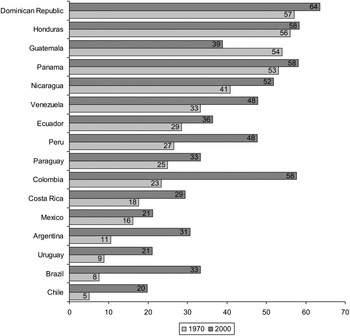
In their 2012 article entitled The Latin American Cohabitation Boom, 1970–2007, Esteve, Lesthaege and López-Gay, asserted that at the turn of the twenty-first century, Latin America was experiencing a ‘sharp rise in the share of cohabitation in the process of union formation’.Footnote 1 Indeed, between 1970 and 2000 cohabitation increased in every country of the region except Guatemala (see Figure 1). Cohabitation grew fastest in those countries with initially the lowest levels: Chile and Brazil showed the steepest growth rates, with cohabitation quadrupling over the period. Argentina, Colombia, Uruguay, Peru, and Costa Rica also saw substantial increases. By contrast, countries with a historically high incidence of cohabitation experienced smaller increases, as was the case of the Dominican Republic, Honduras and Panama.
Changes in Levels of Cohabitation in Latin America between c. 1970 and c. 2000 (% of Women Aged 15–49 in a Cohabiting Partnership)

The study of cohabitation is particularly relevant in Latin America, as it is linked to the accentuated marginalisation of deprived groups by social, educational and financial institutions.Footnote 2 Lack of formal recognition of cohabiting relationships might promote discrimination and marginalisation. Cohabiting couples are often not afforded the same rights as married couples, and may face difficulty in accessing services and social benefits. In fact, in Latin America, cohabitation currently receives either less legal and social protection than marriage, or no protection at all. There is, however, a trend towards gradual recognition.Footnote 3
The possible discriminatory effects of attitudes to cohabitation should be understood in a context in which Latin America has been described as having a marriage regime which mirrors its enduring economic, social, racial and gender inequalities.Footnote 4 Evidence shows that those who are more educated and with better economic prospects marry, while those who are less educated, with poor economic prospects, cohabit.Footnote 5 In addition, there is evidence showing that cohabitation is more frequent among young people, as it is linked to early partnering and pregnancy, and usually involves childbearing.Footnote 6 Previous research also shows that cohabitation is more frequent in countries with a large population of people of colour, Black people, indigenous people or those of mixed race.Footnote 7 Cohabitation in the region has accordingly been described as surrogate marriage for the disadvantaged, as it usually involves childbearing, reproduces conventional gender roles and is more frequent among young people from low-income groups.Footnote 8
This article aims to answer the question of why cohabitation, as opposed to marriage, is currently rising among young people from low-income groups in Chile and suggests that rising cohabitation is driven by two kinds of processes. On the one hand, the historical determinants of cohabitation persist. Enduring income inequalities make it difficult for low-income groups to afford the expense of what is considered to be a ‘proper’ wedding. The continuation of a kinship system based on blood ties also preserves a strong mother-son bond which discourages young men from entering formal marriage. On the other hand, there is change: cohabitation is rising in part because of a decline of parental power. Young couples are not forced, to the same extent as they previously were, to marry due to pregnancy. Third, changes in social protection have had the unintended effect of making it convenient to cohabit in order to receive certain social benefits. However, there is no evidence supporting the view that rising rates of cohabitation are linked to female emancipation or gender equality.
Chile is a good case through which to study recent changes in cohabitation in Latin America. To begin with, cohabitation rates show a particularly sharp increase in Chile (see Figure 1). Rising cohabitation is reversing a historical prevalence of marriage. Marriage rates in Chile have been relatively stable for most of the twentieth century. From 1920 to 1990 the marriage rate ranged from 11 to 15 marriages for every 1,000 people aged 15 to 64. But between 1990 and 2000, this rate dropped to 6.6.Footnote 9 It would appear, therefore, that rising cohabitation is happening in tandem with declining rates of marriage, or the delaying of marriage. These tendencies constitute a profound transformation of historical patterns of union formation in Chile.
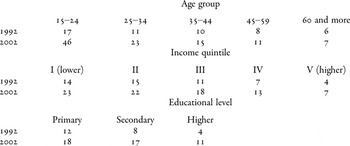
After the end of the Pinochet dictatorship, in 1990, cohabitation began to rise sharply. Between 1992 and 2002, cohabitation increased the most, in absolute terms, among young people, low-income groups, and those with low educational attainment (see Table 1). Cohabitation is not, however, restricted to the most disadvantaged. It is present and fairly common across Chilean society, with the sole exception of the upper strata, those with higher education and from the two highest income quintiles. In other words, cohabitation is most prevalent in the first three income quintiles, namely among low- and middle-to-low-income groups, and among those with only primary or secondary education. Evidence also shows that rates of cohabitation rose after 1990 across all socio-economic groups, with the increase most pronounced among those with higher educational attainment.
Cohabitation by Age Group, Income Quintile, and Educational Level, Chile 1992–2002 (% of People Aged 15 or More in a Cohabiting Partnership)

Source: M. Soledad Herrera and Eduardo Valenzuela, ‘Matrimonios, separaciones y convivencias’, in J. Samuel Valenzuela, Eugenio Tironi and Timothy R. Scully C.S.C. (eds.) El eslabón perdido: familia, modernización y bienestar en Chile (Santiago de Chile: Taurus, 2006), pp. 225–63: Table 11 and Figure 11.
This sharp increase in cohabitation is taking place in a context of profound economic, political, social and cultural change. As mentioned above, cohabitation increased most steeply after the dictatorship, at a time of greater political freedom and general improvement in living conditions, in particular for poorer groups. Primary and secondary education had become almost universal in this period, with women increasingly involved in paid work. Marriage has lost some of its privileged status, with legal discrimination against children born out of wedlock abolished in 1999, the enactment of a divorce law in 2004, and the introduction, in 2014, of civil partnerships for same-sex and heterosexual couples.
Study of the Chilean case seems fruitful not only because of recent changes in cohabitation but also because cohabitation in Chile follows patterns seen elsewhere in Latin America. Thus in Chile, as elsewhere in the region, cohabitation is more frequent among the young, the less educated and low-income groups, and involves childbearing.Footnote 10 Chile also resembles most of the region in the ongoing prevalence of extended households;Footnote 11 acute income inequality in spite of successful economic growth,Footnote 12 and deep-seated (although gradually diminishing) gender inequality.Footnote 13
This research takes a life-course perspective, emphasising the significance of individuals' location in a particular time and place, and of the social ties that mediate between macro structures and individual decisions. The major contribution of this approach is to relate individual life courses to broader social change, paying attention to family bonds as intermediating agencies.Footnote 14
At the macro level, the economic, social and political conditions within which participants' life courses unfold are studied in historical perspective. In connecting these macro changes to individual decisions about cohabitation special attention is paid in this article to family ties, in particular, parent-child relationships. The study accordingly seeks to connect structural continuity and change to issues of individual agency.
At the micro level, an in-depth study of a small sample of cases was conducted. The focus was on the most typical kind of cohabitation in Chile: that which takes place among young people from low-income groups. Specifically, the research subjects were young people, aged 20 to 29, who had never been married despite facing no legal impediment to marriage, had been cohabiting for at least a year, and who had had a child with their cohabiting partner. Cohabitation was defined for the purposes of the study as a sexual partnership entailing a heterosexual couple living together with their children. Twenty-four research subjects were recruited, drawn from the two most deprived municipalities of the Greater Santiago metropolitan area (Cerro Navia and La Pintana). Interviewees were equally divided between women and men, but were not partners, except in one case. Information was collected about the family and life history of each participant, with a focus on union formation. Fieldwork was carried out between September 2008 and January 2009.Footnote 15
The article is structured in four sections. First, the main theoretical approaches to cohabitation in Latin America are reviewed. Second, these theories are examined in the light of the research data obtained, discussing, in turn, explanations focused on poverty and kinship, approaches linking cohabitation to a loosening of parental control, and the contention that gender roles are changing towards gender equality. The third section consists of an analysis of how late twentieth-century social-policy change might have encouraged cohabitation. The article concludes by reassessing available views on cohabitation, suggesting a more complex and comprehensive account of rising cohabitation.
Theoretical Contributions
Although much good research has been conducted on poor families and households in Latin America, relatively little attention has been paid to cohabitation.Footnote 16 Household and family studies in the region have focused on how low-income groups draw on kinship ties as a survival strategy. A growing body of research on female heads of household, and more recently on the feminisation of poverty, incorporates a gender perspective to the survival strategy focus.Footnote 17 Yet most of this research has assimilated cohabitation with marriage, mostly neglecting cohabitation as a separate object of study. The process of union formation has hardly been analysed.Footnote 18
It is possible to identify four main theories to account for cohabitation in Latin America; three of which seek to explain the particular prevalence of cohabitation among deprived groups. These theories emphasise continuity, arguing that cohabitation is a hallmark of Latin American societies. These approaches are referred to, respectively, as ‘colonial legacy’, ‘poverty or income inequality’ and ‘blood-focused kinship system’ explanations, according to the main reason that each identifies as promoting enduring cohabitation. The fourth approach, by contrast, seeks to account for recent change by linking cohabitation to modernisation.
The ‘colonial legacy’ approach offers two main contributions to understanding enduring cohabitation in Latin America. The first of these concerns union formation. Some authors state that in colonial times race was articulated with social class, sexuality and gender to produce a distinctive dual-marriage system.Footnote 19 In this system only those who were of equal status, and had means, could marry. Since race was then the core of the social hierarchy, this system ensured that only white men could marry white women. At the same time, given racial and gender discrimination, white men were allowed to enter into informal sexual unions with women of colour. The dual-marriage system was thus based on seclusion and strict control of white women, plus sexual predation of women of colour by men of every colour.
The dual-marriage system is, then, a colonial-era system of sexual partnership which restricted marriage exclusively to the white elite. Lower/coloured ranks of society, excluded from formal marriage, developed diverse forms of informal coupling, including cohabitation. As Therborn asserts, ‘one family system was an exclusive minority system for elite whites, with vigilant chaperoning of young virgins, an indissoluble Christian marriage, discrete seclusion of married women, and strong patria potestas (legal fatherly power) […]. Another was for the popular classes, ethnically mixed, informal, with unclear boundaries, with considerable instability, phallocratic rather than patriarchal.’Footnote 20 The dual-marriage system was stronger in plantation economy areas with significant slave populations. In fact, cohabitation remains prevalent where slave plantations were common, namely in the Caribbean and Central America (except Costa Rica), and parts of Venezuela, Colombia and Brazil. According to these authors, abolition of slavery and independence of the colonies did not challenge the dual-marriage system, as racial segregation and gender inequality remained almost untouched.
A second contribution of the colonial legacy approach highlights the honour system established in colonial times. Views about the meanings, functions and main players involved in the colonial honour system differ.Footnote 21 Yet historical research generally agrees that women's sexual purity was ‘key to maintaining familial honour’.Footnote 22 White women were strictly controlled to prevent them from engaging sexually with inappropriate suitors, as ‘the wealth and power of the aristocrats could be seriously threatened by a misalliance’.Footnote 23 But sexual control of women was also crucial for the lower classes, as ‘the difference between the aristocracy and the popular classes in spouse selection was one of degree rather than kind’.Footnote 24 Lower-class parents did not have the resources to effectively seclude their daughters, yet familial honour was equally based on women's sexual respectability.
Parents', especially fathers', sexual control over daughters did not come to an end with independence and the enactment of civil codes in the nineteenth century: ‘the gendered nature of honour […], proved remarkably durable from colony to modern republic’.Footnote 25 Chant reports that by the end of the twentieth century, parents in some parts of Latin America had become more open to accepting consensual unions between young partners reluctant to marry. However, the point for Chant is that parents still seek to restrict their daughters' sexual relationships to one male partner. Once a daughter is discovered having sex or is found to be pregnant, her parents will urge her to move in with her partner, formally or not. Women ‘are expected to go from the house of their parents to the house of their husbands’.Footnote 26 Likewise, Montoya states that couples gain recognition from the community by living together. Living with a man, formally or not, shows the community that a woman has a man's backing, which entitles her to be treated with respect.Footnote 27 Raczynski and Serrano report a similar situation for Chile, where women who live without a male partner may lose respect.Footnote 28
Chile's 1857 Civil Code and 1884 Civil Marriage Law clearly enhanced patriarchy, as husbands and fathers were given power and privileges over women and children.Footnote 29 In nineteenth-century Chile parents forced their daughters to marry, and severely punished them, even throwing them out on to the street, if they had premarital sex or became pregnant.Footnote 30 More recent research shows ongoing prevalence of strong parental control over women's sexuality. Ethnographic research conducted in a Santiago shantytown records the following account from a woman describing what happened to her when, in the mid-1960s, she became pregnant with her first child, without being married:
My mother beat me up [me sacó la cresta], took a stick and hit me in the face, in the mouth […]. Afterward, my father came and he beat, beat, beat, beat me in the face, breaking all my teeth. And then all of my brothers – imagine it, I have four brothers […]. Afterward, there was so much pressure for me to marry him. And we married.Footnote 31
Inappropriate female sexual behaviour could be atoned for by entering a marriage-like relationship with the male sexual partner, ideally through formal marriage. Cohabitation, though less ideal, was also tolerated among low-income groups.Footnote 32
A second continuity-based account of cohabitation in Latin America links it to poverty and income inequalities. Research on family life in poor communities has highlighted the various obstacles to marriage that poor people face.Footnote 33 Getting married involves, at a minimum, paying fees for the civil and/or religious ceremony and covering the costs of a wedding reception. Marriage is moreover a formal procedure, requiring the presentation of documents and the fulfilment of certain preconditions. For impoverished groups these hurdles may be difficult to overcome. Some authors posit a continuum between the colonial dual-marriage system and today's income inequalities.Footnote 34 Colonial regimes established a highly unequal political, economic and social order, which was not challenged by independent nation-states. Thus impoverished groups have remained excluded from formal marriage, as evidenced (in this view) by the fact that cohabitation remains prevalent in poorer countries and low-income groups.
The third approach to accounting for enduring cohabitation in Latin America maintains that it was an outcome of a kinship system focused on blood ties.Footnote 35 In this view blood ties take precedence over sexual alliances in Latin America. This focus on consanguinity produces a strong mother-son bond, leaving men reluctant to enter into formal sexual alliances such as legal marriage. Men's strong attachment to their mothers makes it difficult for them to start their own family and set up an independent home. They tend to be less close to their sexual partners than to their mothers. Cohabitation, an informal sexual alliance, may be seen as more compatible with this strong mother-son bond than formal marriage, a strong form of sexual alliance.
Evidence for this view could be found in the positive correlation between cohabitation and the prevalence of extended households in the region.Footnote 36 Evidence from Chile shows that young cohabiting couples frequently start their life together living in an extended household.Footnote 37 Moreover, cohabiting mothers in extended households usually live in the parental home of the male partner. By contrast, married mothers living in extended households live in the parental home of the female partner.Footnote 38
Qualitative evidence linking strong family ties with cohabitation includes life histories collected by Pimentel Sevilla in the late 1960s among the urban poor in Santiago, showing a strong mother-son bond. One man reports many informal sexual relationships with women, saying that he only got married after his mother died because he had promised her that he would not marry during her lifetime.Footnote 39 Raczynski and Serrano, researching women living in poor areas of Santiago in the 1980s, recorded women's complaints about the difficulty of persuading male partners to leave the maternal home and set up independent households.Footnote 40
A fourth approach links cohabitation to modernisation, paying special attention to changing patterns of cohabitation. The link to modernisation foregrounds issues of autonomy, in two main senses, first, autonomy in choice of partner, entailing restriction of parental, especially fatherly, power to influence children's marriage. Here patriarchy, in the classic sense parental rule (fathers in particular) over their children and household, is at stake. Parental power over children's marriage is linked to issues of familial honour, as we saw earlier when discussing the continuity-based theories of cohabitation that trace its roots to colonial practices. Hence, rising cohabitation may proceed from increased autonomy on the part of children, no longer susceptible to being forced into marriage.
A second sense in which ‘autonomy’ is invoked in the modernisation approach refers to female autonomy, understood as gender equality or the disputation of male dominance. Cohabitation, a looser sexual arrangement than marriage, is seen as a better safeguard of individual autonomy, in particular for women.Footnote 41
These two understandings of autonomy, as declining patriarchy and/or as increased female autonomy, are related, respectively, to the first and second demographic transition. The first demographic transition (FDT) denotes a transition from traditional extended families to modern nuclear ones, as an outcome of structural changes such as industrialisation and urbanisation. The extended family is taken here to mean two or more nuclear families under the same paternal authority, and is generally associated with traditional, rural, religious, and hierarchical or caste-like societies. In such strongly patriarchal societies, kinship takes precedence over the individual and women are under the authority of men. Marriage is arranged by parents; dating is chaperoned, and matrimony is endogamous and early.Footnote 42
The modern nuclear family is defined in opposition to this extended family. Formed by parents and their offspring, the nuclear family is urban, with members working individually in manufacturing and services. Romantic love is the main reason for marriage, and parents do not intervene in partner selection. Declining patriarchy is therefore at the core of the FDT, despite which marriage continues to be the privileged form of union formation. Gender roles remain segregated, and familistic policies predicated on the model of the breadwinner predominate.Footnote 43
An example of this interpretation of the FDT is Gino Germani's work on modernisation in Latin America. Germani defined cohabitation as a traditional family arrangement that should decline as modernisation advanced, asserting that the prevalence of cohabitation in the countryside was the main difference between urban and rural families. He predicted that Latin America's transition from the extended to the nuclear family would therefore be marked by the relative decline of cohabitation.Footnote 44
The second demographic transition (SDT) is driven by cultural, rather than structural, change. As countries become more developed, people's concerns move from material to non-material needs. Rising cohabitation is therefore linked in SDT theories to a rising prioritisation of higher-order needs such as individual autonomy. Female autonomy and gender symmetry become key features of the SDT.Footnote 45
The research of Esteve et al., quoted earlier, is an example of efforts to understand rising cohabitation in Latin America from an SDT perspective.Footnote 46 The authors concluded that increased cohabitation is linked to cultural change, in particular, growing social tolerance of previously proscribed behaviour including euthanasia, homosexuality, abortion, single-parent households, and divorce. This link between rising cohabitation and increased social tolerance is especially strong in countries where cohabitation was less frequent, such as Chile, Brazil and Argentina. Esteve et al. also point out that gender equality is advancing in these countries, due to increased female education and employment, and that secularism is expanding in the region. They conclude that, on the whole, Latin American countries show some convergence ‘to the European pattern of the second demographic transition’.Footnote 47
Ethnographic research provides further evidence of a link between cohabitation and increased gender equality. This scholarship states that women from deprived groups prefer to cohabit in order not to be tied to unreliable men, and to enjoy some of the freedom and flexibility granted to men.Footnote 48 In this view, women who cohabit can have an affair, or leave a partner, without the risk of being separated from their children. Women avoid marriage to prevent their male partners becoming authoritarian. Cohabitation does not, either, dilute women's exclusive rights to any property that they might own. In this interpretation, women's preference for cohabitation is seen as an act of resistance to male domination, and cohabitation regarded as entailing more equal gender roles than marriage.Footnote 49
Thus we have seen that income inequality, kinship, patriarchy and gender equality approaches are the four main perspectives from which cohabitation in Latin America has been approached. Each of these approaches is now assessed in the light of the evidence produced by this research.
Income Inequality and Kinship
Some scholarship links cohabitation to poverty or lack of means.Footnote 50 As poor people face greater difficulties in affording marriage expenses, cohabitation is expected to be relatively more frequent among low-income groups. In this view cohabitation is driven by poverty, and should therefore increase in parallel with it. However, Figure 1 shows that cohabitation is growing faster precisely in the region's more developed countries, including Chile, Brazil, Argentina and Uruguay. In the case of Chile, cohabitation rose during a period of significant economic growth, with per capita GDP more than doubling between 1985 and 2003.Footnote 51 This economic growth was accompanied by a decline in absolute poverty. In 1985, 45 per cent of the population was below the poverty line, decreasing to 21 per cent by 2000.Footnote 52 In Chile macroeconomic growth did not, however, entail increased equality: income inequality remained steady and high.Footnote 53
The evidence suggests, then, that in Chile cohabitation rose as poverty declined and while income inequality was, at least, not getting worse. This is counterintuitive for the school of thought that sees cohabitation as driven by poverty.Footnote 54 Below the intention is to explain this apparent paradox, suggesting that even though absolute poverty has diminished, many low-income families still struggle to make ends meet and cannot afford what is socially considered to constitute a ‘proper’ wedding.
Among my interviewees, a proper wedding is understood to mean a religious ceremony, conducted in church, with the bride dressed in white, followed by a night-time party. Getting married is therefore expensive. It involves paying civil and church fees, as well as being able to afford the bride's dress and the wedding party.
Most interviewees started to cohabit as a direct outcome of pregnancy, which frequently happened in their late teens and early twenties. Most interviewees did not practise effective contraception for pre-cohabiting sex. The Chilean healthcare system holds conventional views on sexuality and reproduction: abortion is illegal, and birth-control policies focus on mothers and not on young people wanting to avoid pregnancy.Footnote 55
Interviewees typically got information on contraception from friends and at school. Only a few women said that their mothers offered to get contraception for them. Furthermore, interviewees themselves held conventional views about sex which discouraged pre-cohabiting birth control. Women reported that having used contraception would have meant that they were neither in love with nor committed to their male partner. Similarly, men said that they disliked using condoms, as they limited their sexual pleasure. Most interviewees, especially women, also said that they wanted to have children. Thus, in the words of one interviewee (Celio), having children ‘wasn't unwanted, but it wasn't planned either’.Footnote 56
In contrast with their pre-cohabitation practices, interviewees reported having obtained contraception from public health centres after having their first child. In Chile, family planning is usually offered and discussed during post-natal checks. It is easier for health centres to target women for contraceptive advice during a first pregnancy, that is during pre- or post-natal check-ups.
As young women became pregnant and began living with their male partners, women became full-time mothers and men began to look for work to provide for their new family. Most young people in the study dropped out of school. Some, both women and men, were in unskilled temporary jobs. Men were usually the main earners, working largely as bricklayers or factory workers. Men reported taking any job available, usually temporary, poorly paid, and without a contract. The few women who had paid work at the time of the study were mostly employed in catering and cleaning.
Low-income groups in Chile typically have higher rates of unemployment and informality, and are more likely than other groups to obtain only short-term employment.Footnote 57 Employment and its quality have a substantial effect on families, with unemployment and low-quality employment as the main variables explaining poverty in Chile.Footnote 58 Although social protection improved after the 1990 return to democracy, it is insufficient to prevent people in poor-quality employment falling into poverty.
Economic hardship among young people is not only driven by poor qualifications and low-quality employment. It is exacerbated by the persistence of conventional gender roles. The fact that only men tend to be in paid work limits family budgets and increases economic vulnerability: available evidence suggests most cohabiting mothers in Chile are not in paid work. (Further attention is paid to issues of gender equality among cohabiting couples below.)Footnote 59
Unsurprisingly, economic hardship was the most common problem reported by the young people in the study. Frances, for example, said that her partner wanted to have more children ‘out of love’, but she told him ‘we don't have cash, we don't have a house. He knows about all that, but he wants to forget […], because money stops us getting many things that we want’. Similarly, Albert said: ‘what I need is a good job so I can earn a little bit more. In my current work I haven't been able to save any cash; we need many things, and I just don't earn enough.’
When asked if they would like to marry their partner within the next three years, interviewees were divided regarding the desire to marry or continue to cohabit. Surprisingly, this division was not along gender lines. The specific features of cohabitation and marriage referred to by interviewees help explain why some would like to continue cohabiting, whereas others wished to marry.
Those who wanted to carry on cohabiting generally said that, while cohabitation is similar to marriage in day-to-day terms, cohabitation is easier to terminate or dissolve. Most women in this group also said that continued cohabitation was convenient because it increased their chances of receiving social benefits, particularly housing subsidy. Several women and men did not want to marry due to specific relationship difficulties including economic hardship, infidelity, heavy drinking, domestic violence, and illegal drug use. Some women reported preferring cohabitation to prevent their partner becoming authoritarian. A few participants said they could not have a religious wedding because they had different religious affiliations from their partners. Those who did want to marry wanted to do so to gain social recognition of their relationship.
Yet interviewees, whether they wanted to marry or to carry on cohabiting, said that in practice, cohabitation was the same as marriage. Indeed, they referred to their partner as their ‘husband’ or ‘wife’. Since they were already living with their partner and children, their daily routine was similar to that of married couples with children. They did not see how marriage might entail any change or advantage. For them being a family, namely having children, was what mattered.
As Frances said, ‘if you live together with someone, it is because you are with that person, because you love him, you are together because you want to be. When I started living with him I did it to be with him forever!’ Similarly, Adrian said, ‘I think that to convivir [cohabit] and to be married is the same; there is no difference […]. I do the same things. I am a father. I bring in the cash for the house. It is the same as being married!’
Although the respective daily routines might be the same, it is considered easier to end a cohabiting relationship than a marriage. Participants thought it important that if they did split up, they would not have to go through the formalities of divorce.
In the context of economic hardship, participants who wanted to marry often said that though they would prefer a religious wedding, they would probably have a cheaper, civil ceremony. Paulina explained: ‘the party after a civil wedding is not as lavish as the party after a religious one. If you have a civil ceremony, you don't need to have a party at night. You could just have a lunch, so you can keep it simple. I wouldn't need a wedding dress with a long train!’
Lack of money also promotes young people's dependence on parents. Young women in the study had frequently become pregnant while still living in the parental home. Pregnancy caused the participants to begin to cohabit, typically moving in with their partner into one of the two parental families. In Chile, people who live in another household are called allegados. Most interviewees were allegados, with many reporting having to move around and live with different relatives.Footnote 60
Interviewees reported that it was difficult for some men to leave the maternal home. Adrian reported that his mother did not like him to have girlfriends, as she feared he would leave home. ‘My mother was jealous of my girlfriends because I am a man […]. My mother was always jealous because as a woman she doesn't want to lose her sons'. Similarly, Frances reported difficulties getting along with her mother-in-law because they were somehow competing for the same man, ‘[my partner] is a mamón [a mother's boy]; he is very attached to his mother […]. He is the eldest son.’
It seems, then, that economic hardship and a strong mother-son bond continue to make cohabitation a feasible sexual partnership for low-income groups in Chile. Below, I analyse whether rising cohabitation is linked to declining parental control and increased gender equality.
Patriarchy and Gender Equality
As we have seen, cohabitation has been linked by some to autonomy, understood, variously, as declining patriarchy or parental power or as increased gender equality or female autonomy.
In relation to patriarchy, interviewees said that their parents and grandparents were reared according to old-fashioned values (a la antigua), in which cohabitation was frowned upon. Parents, fathers in particular, often forced offspring into marriage. The parents and grandparents of most interviewees had married formally, and it was not uncommon for mothers and grandmothers to have been forced to marry. Jane told me: ‘my grandma was married, you know, in the old-fashioned way. In past times women were married when they were twelve years old, if they kissed someone […]. She was forced to marry when she was around fifteen.’ Leocadia said that her grandmother forced her parents to marry: ‘my mother got pregnant. […] My grandmother arrived and told my parents “tomorrow you are going to get married!” She brought all the family to the wedding. My parents didn't want to get married. The next day […] they were married.’
Even though interviewees talked about these old-fashioned ways as a thing of the past, their own accounts suggest they were brought up in a similar way. Most said that their parents opposed their development of romantic or sexual relationships. Women reported stronger parental supervision than men, saying their parents limited opportunities for them to go out, did not allow them to date, imposed early curfews, and discouraged or even forbade them to have boyfriends.
Dating was typically forbidden, and young people developed romantic relationships in secret. Dalila recalled how she managed to see her partner when they started to date: ‘my mum didn't want anything to do with him […] my family didn't let me stay with him, […] I had to run away from home to see him. He called from his mobile, and I said I was going to see a friend and so we were able to meet’.
Participants' accounts suggest that what parents really opposed was the possibility of young people having premarital sex, leading to pregnancy. Unsurprisingly, many reported that if pregnancy did occur, parents' reactions were to try to enforce marriage. As Eugenio reported, ‘I didn't have work; it was terrible for our parents and siblings. They were upset. Her mother slapped me […]. She wanted me to marry her; they really put pressure on me.’ Two women interviewees also said their parents opposed them having a boyfriend. Both eventually ran away from the parental home to cohabit with their boyfriends. According to Jane: ‘[there was] just trouble all the time. My mother didn't want to see him in the house, arguments every time, so I ran away, and we went to live with his dad.’
However it should be highlighted that interviewees were not forced to marry, even though they had at least one child with their cohabiting partner. Neither were most female interviewees disowned or forced to leave the parental home as a consequence of premarital pregnancy. Most said their parents reproached them for having children, but did not necessarily pressurise them to marry. In practice, most parents offered support consisting of accommodation and financial help. Dalila described what happened when her father found out about her pregnancy, ‘he said that he would support me, that I would pull through, that he would stay by my side’.
Many parents, mothers in particular, were rather wary of marriage, and some openly rejected it. Interviewees attributed this to the parents' own bad experiences of marriage, particularly forced marriage. Those whose mothers were forced into marriage said their mothers did not want their children to go through the same experience. Danae said: ‘before I had my daughter my mother asked me if we would marry. My mother was forced to marry. That's why she likes the idea of us living together.’
Parents nonetheless encouraged interviewees to stay with their partners and children, probably underpinned by the belief that separation could place the well-being of the child and the woman, who would become a single mother, at risk. According to Elaine: ‘parents never want you to get pregnant [first]. They want you to get married and then to have children; they don't want to have a daughter who is a single mother.’
Parental tolerance towards cohabitation reflects increasing social acceptance of it. As Jessica put it, ‘nowadays people think in a different way, currently almost everybody lives together first. It is not like in the past, when they used to say “first you marry my daughter, then you can go out with her”. Today everybody lives together first, and if it works, it works.’ Likewise Leocadia said, ‘currently you live together instead of marrying like in the old days. Then, if you had a child, they forced you to marry. Not now, now it is freer.’ Social tolerance is more significant for women than men, as women were previously subjected to tighter sexual control.
Participants also felt that children born outside marriage are less discriminated against than in the past. As Paulina said, ‘before, cohabitation was frowned on by people, but not today. Today there is more tolerance. For example, before, children of single mothers only had the mother's surname; they were discriminated against, but not today.’
While interviewees believed that people are generally more open to cohabitation, they still felt that cohabitation is less valued than marriage. Women in particular, reported being embarrassed because they were not married. Dalila said: ‘I think it doesn't look good to live together […]. People ask you, “who is he? Is he your husband?” And you have to answer, “no, he is my pareja [partner]”. It looks terrible!’ Giovanna felt that ‘for people [in general] it is not moral to live together without marrying. The moral thing is to be married.’ Thus, while cohabitation is increasingly tolerated, it does not enjoy the same status and social legitimacy as marriage.
The return of democracy probably promoted increased tolerance towards cohabitation, since it ushered in a general sense of enhanced freedom after almost two decades of authoritarian rule. As regards family life, the less authoritarian atmosphere may have accelerated parents' move to a less patriarchal relationship with their children. Legislation enhancing women's and children's rights, and limiting marriage privileges, further facilitated young people's autonomy.
Another indicator of increased autonomy is that young people, particularly men, reported being in love as the main reason for being with their partner. As Ernesto put it, ‘the affection, the love that we have for each other […]. We can't say that we are together because of the kid. It is because we are fond of each other.’ Notwithstanding, instrumental reasons, such as the desire to leave the parental home, remain relevant. As Giovanna said, ‘the best thing I could do was to leave to live with my partner. It was good to leave my parents' home […] I did it because I wanted to be more independent; they allowed me so little freedom.’ This article suggests, then, that union formation today is at least framed by discourses of romantic love.
It may therefore seem plausible to argue that cohabitation has increased due to the decline of enforced marriage, and that rising cohabitation may mirror declining patriarchy. Yet parental intervention in union formation has not vanished. As we have seen, many parents still expect daughters to live with their male sexual partner in a marriage-like relationship. As Sylvia Chant puts it, cohabitation is seen as second best to marriage.Footnote 61
A decline in enforced marriage does not, either, automatically suggest increased female emancipation or gender equality. As noted above, when young people started to cohabit, they settled into conventional gender roles. Men were the almost exclusive breadwinners, and this was expected by both men and women. There was a widespread belief in a man's ability to provide for his family as the most important sign of his worth. Men accordingly reported that their main responsibility was to get a job to provide for their families. Mauricio explained, ‘the meaning of life for me is to work and to give my family a good standard of living’.
Many women interviewees reported having been in paid work in the past. They also felt that women should work, even if they have young children, and believed that women today are freer to be involved in paid work than in the past. As Giovanna said, ‘today there is more freedom for women. Now women can work and be independent.’ Notwithstanding these positive statements about female employment, women became housewives when they became pregnant and started to cohabit.
Women's reluctance to be in paid work is related to their belief that motherhood and domestic responsibilities come first. As Giovanna said: ‘I have to look after my children. I don't leave them with anyone, not even with my relatives!’ Low rates of female employment also, however, reflect the fact that male partners do not like women having paid work. Women reported their male partners asserting that, as they themselves worked, women should stay at home and look after the house and children. Some women also said their men did not want them to work from fear that the woman would flirt with other men and/or become financially independent. As Verónica said:
He says ‘no, why would you want to work?’ He says that I will make myself look good, that I will meet other men, that I will have my own money. I say, ‘Yes, I want to have my own money.’ He says ‘No’. That as long as he can work, there is no need for me to work, that I should stay at home and look after the children. He is sexist!
Men self-reported similar views. Mauricio, discussing the idea of his partner taking paid work, said ‘it depends on the type of work. You are not going to send your woman to work on a building site. That would be like throwing cheese to mice!’ Other research from Chile shows a significant negative association between having a male partner, formal or informal, and rates of female employment.Footnote 62
Interviewees' reports suggest also that femininity and masculinity are structured around a bifurcation of social space between the home (la casa) and the street (la calle). This division between the home and the street can be taken to mirror an asymmetrical sexual order in which the street is a sexualised place where only men and ‘bad women’ venture.Footnote 63 The street is the locus of men's social life, where they meet and party with male peers, and flirt with loose women. Men are expected to have extra-marital sex. Women, by contrast, should be faithful and be confined to the home. Women's social life is expected to consist of visits to relatives and female friends.
The division between home and street also separates women's from men's labour. Women are expected to be diligent and attentive housewives, managing the home and rearing children single-handed. Men are not expected to spend much time at home: they are encouraged to go out into the streets and work as the sole family breadwinner. Women who work away from home or outside the supervision of their male partner are seen as loose women, who are just looking for opportunities to flirt with other men.
Interviewees, both women and men, expressed the view that the woman's place is in the home, with most women defining themselves as home-loving. Verónica explained why she liked to stay at home: ‘he knows that I respect him, because if he goes out to work I don't go out, I stay at home. If he is working far away he knows that I won't fool around, so he can work without worrying about me. I'm a home-loving woman’. Similarly, men are believed, and believed themselves, to belong outside, in the street.
Women in the study therefore reproduced conventional gender roles, defining themselves as mothers and housewives, and expecting their male partner to be the breadwinner. Given this predominance of conventional views, it is difficult to see how cohabitation could be interpreted as a successful challenge to male dominance. These findings suggest, rather, that cohabitation follows rather than challenges conventional gender roles, and does not necessarily therefore entail female emancipation.
Some women did however say they did not want to marry in order to prevent their male partners becoming authoritarian, implying that marriage encouraged spouses, especially husbands, to believe that they had additional authority over their partner. Danae stated, ‘if I marry him, he would become my official husband, and I think men get above themselves when they marry, they have more power over you, and I don't want that’. Hence, although cohabitation does not seem to challenge conventional gender roles, its looser ties imply certain kinds of freedoms for women.Footnote 64
This article suggests that in cohabiting, interviewees were not reproducing the pattern of partnership passed on by previous generations. Enforced marriage seems to be declining as cohabitation rises. The findings of this study do seem to suggest an attitudinal change among low-income parents such that a daughter's unexpected pregnancy, even when the male partner is disliked by the parents, does not necessarily entail forcing the woman into marriage or barring them from the parental home. Cohabitation emerges as a compromise between parental power and young people's autonomy. Parents see it as preserving familial honour, as daughters enter a marriage-like a sexual partnership. For young people, cohabitation, as a looser arrangement than formal marriage, allows them to retain more of their autonomy as they start a family. However, cohabitation does not seem to be substantively linked to gender equality. Though its looser nature concedes some freedoms to women, the effect of these does not go so far as to undermine conventional gender roles.
Social Policy and Unmarried Mothers
Housing was a key issue for participants in the study, most of whom were living as allegados and dreamed of becoming homeowners. Many reported that they or their partners were applying for housing subsidy. Actual applications were made almost exclusively by women, who moreover applied as single mothers in order to increase their chances of success. Many interviewees said that they would only consider marriage if and when housing subsidy allowed them to obtain a home of their own.
This suggests that welfare provisions intended to assist single parents might also act as an incentive for cohabiting couples to avoid or delay marriage. Paulina told me, ‘right now it is more advantageous to be a single mother, because you have lots of benefits’. Most female interviewees said that when completing screening questionnaires for social welfare programmes, they usually claimed to be single mothers in order to be included in the ‘indigent’ (destitute) category of people entitled to family allowances and free healthcare. As Giovanna explained, ‘to be [classed as] ‘indigent’ you have to be single, have children, and not be living with the father’.
These accounts should be read against the backdrop of the 1990s changes to social policy, intended to expand welfare coverage while also improving targeting the poorest. Targeting, introduced under the military regime largely as a way of reducing social spending, was continued by post-authoritarian administrations, particularly the four consecutive centre-left ‘Concertación’ coalition governments that were in power between 1990 and 2010. One consequence was that marriage ceased to be the privileged form of access to social security for women and mothers not in formal employment.
Chile's social welfare system emerged in the early decades of the twentieth century, and, as elsewhere in Latin America, was shaped by patriarchal values. In particular, it adopted the attitude that the man is assumed to be the head of the family and the main provider. Women and children depended on men for survival, with marriage identifying them as legitimate beneficiaries of social welfare. Motherhood was defined as a woman's first duty. Female employment was a sign of backwardness rather than progress, and paid work was regarded as a source of corruption that could make women bad mothers and sexually licentious.Footnote 65
Chile's welfare system has been described as ‘corporatist’, with protection typically offered to organised formal sector workers, particularly public employees and the armed forces.Footnote 66 By the beginning of the 1970s Chile, despite being one of the few countries to develop something approaching a welfare state, did not achieve universal entitlement or coverage. In the following decade, neoliberal ideas adopted by Pinochet's dictatorship re-focused social welfare only on the poorest.Footnote 67 Targeting disrupted the previously exclusive link between social welfare and marriage or formal employment. Although targeting started during the dictatorship, social spending cuts as part of structural adjustment meant new benefits to the unmarried or unwaged were rarely delivered.Footnote 68
The 1990s therefore represented the first time that groups previously excluded from welfare, due to either their non-wage earning status or not being formally married, had genuine access. Unmarried mothers not in formal employment started to receive social benefits such as family allowances (Subsidio Único Familiar, SUF) and a basic state retirement pension (Pensión Asistencial, PASIS).
Actual provision for unmarried women not in formal employment therefore began with the first Concertación government of 1990. Subsequent administrations, through to 2010, expanded coverage and quality without challenging the logic of targeting. Instead, increased spending was channelled to groups considered particularly vulnerable within the existing category of the poor.Footnote 69 Thus unmarried mothers not formally employed began to be genuinely favoured, in particular by housing policies.Footnote 70
Screening questionnaires were introduced by the military regime in order to classify poor families according to socio-economic need. A modified version of the questionnaire is still used to allocate many targeted social benefits, with monetary subsidies such as SUF and PASIS given only to those the questionnaire classifies as destitute (indigente).
Various iterations of the questionnaire applied since 1990 all classify families according to the educational attainment and occupation of the head of household. The absence of a head of household therefore automatically leads to a finding of relative deprivation or vulnerability: expert assessment of the screening questionnaire has shown that a family made up of a sole parent with dependent children is likely to have access to more social benefits than one consisting of a couple and their children.Footnote 71 Since single-parent families are more commonly headed in practice by lone mothers than lone fathers, single mothers are the group most often reached through use of the questionnaire.
The same expert assessment concluded that people probably give misleading information about household composition in order to receive benefits. In the view of the committee, this would explain apparent overrepresentation of single-parent, one-person, and female-headed households in social disbursements when compared to their known prevalence in the general population. Since social benefits favour single mothers, cohabiting women report their families as one-parent families: ‘hiding the husband’ (esconder al marido) becomes a common practice.
Housing policies are particularly relevant for family life. Social spending on public housing increased significantly in the 1990s,Footnote 72 and unmarried mothers were given the same right as married couples to apply for housing subsidy.Footnote 73 Housing policy has been successful in reaching poor families: in 2006 almost 70 per cent of households were homeowners, with ownership rates not correlated with household income.Footnote 74
Prior to the 1980s, the health system differentiated between blue- and white-collar workers. This distinction was erased by dictatorship-era neoliberal reforms, by which all employed persons, except of members of the armed forces and police, were obliged to contribute 7 per cent of their salary to cover healthcare. Poor people with minimal income can however receive free healthcare if classed as indigentes. By 2009 the public health system, FONASA, covered around 80 per cent of the population, rising to around 90 per cent coverage among the two lower-income quintiles.Footnote 75
Interviewees in this study received health provision through FONASA. Yet there were gender differences in access to healthcare, mirroring gender differences in involvement in formal work. Men were more likely to access health care in their capacity as wage-earners, while most women accessed healthcare as indigentes. Children usually had the same kind of health provision as their mothers, meaning that most children were treated as indigentes in the FONASA system.
Targeting has partially reversed a historic tendency for Chilean social policies to favour marriage. Unmarried mothers have gained more, and sometimes preferential, access to social benefits. Although neither the military regime nor subsequent governments consciously practised positive discrimination in favour of lone mothers, this group did benefit in practice, particularly under the Concertación, when previous barriers were lowered and unmarried mothers were designated as a vulnerable group. Since democratic governments also significantly increased social spending, the content of social welfare also became more able to positively affect the lives of individuals in low-income groups.
Unmarried mothers who are not formal wage-earners ceased to be marginalised by social welfare and even achieved a relatively favourable position, thanks to targeting. These changes may in fact be promoting cohabitation among deprived groups.
Conclusion
This article shows that cohabitation remains linked to poverty for the studied population because of ongoing income inequality. Between 1990 and 2010 Chile experienced significant economic growth and poverty reduction, yet income inequality remained steady. Thus although rising cohabitation is not an outcome of increased poverty, young people from low-income groups still struggle to afford costs beyond the basic civil marriage licence and ceremony. Thus high-income inequality acts as a deterrent to marriage when combined with the dictates of social convention as to what constitutes a ‘proper’ marriage, complete with religious ceremony, celebration, and so on. Hence cohabitation, as an informal and relatively inexpensive arrangement, continues to be more common among less affluent couples, who often live with a parent or other relative.
This study also supports the view that cohabitation is linked to a kinship system based on blood ties. As the cited interviews show, a strong mother-son bond continues to prevent some young men from entering formal marriage. More research is however needed on this point, in particular to understand how blood ties affect union formation across different social classes.
While income inequality and the prevalence of blood ties might help to account for continuing cohabitation among low-income groups, these elements cannot account for the demonstrable sharp increase in cohabitation since the turn of the twenty-first century. Evidence from this study suggests however that declining parental control over children's marriage, and social policies targeted at single mothers, might be encouraging, or at least facilitating, cohabitation. Daughters who become pregnant are less often forced into marriage, and so have gained autonomy. Inasmuch as young people, particularly women, become more independent from their parents as regards union formation, rising cohabitation is connected to modernisation. Increased reference to romantic love, signalling a unique relationship between two persons, also speaks of a more modern approach to union formation. The fact that the rise in cohabitation coincided with the end of almost two decades of authoritarian rule further supports a link between cohabitation and enhanced autonomy for young people. Post-authoritarian reforms recognising women's and children's rights, at the expense of parents and men's privileges, reinforced the link between autonomy and cohabitation.
However, we have also seen that parental control, while diminishing, has not vanished. Parents still encourage daughters to enter marriage-like relationships, such as cohabitation, once they become pregnant. The notion of family honour still lingers in parent-daughter relations, with attempted parental sexual control concentrated on young women.
The evidence analysed here also counsels caution in linking rising cohabitation to increased gender equality. Though cohabitation can entail some freedom for women, it does not appear to substantively challenge male dominance, since cohabiting couples report high levels of conventional gender roles. Most women were mothers and housewives; most men were breadwinners, and both used the terminology of ‘husband’ and ‘wife’, rather than ‘partner’. Cohabitation among low-income groups in Chile does not seem to be linked to female emancipation or gender equality.
This article suggests a new link between poverty, social welfare and union formation. While poverty and income inequality remain entrenched, access to whatever social protection is available is particularly important for low-income families. As social welfare has improved since 1990, social provision has become even more significant for deprived families seeking to make ends meet. Since social spending is also increasingly targeted to the poorest of the poor, meeting the criteria for receipt of social benefits is key. Defining single mothers as a vulnerable population has made marriage less relevant as a gateway to social protection. Therefore today, social policy targeting not only poverty facilitates cohabitation among low-income groups.
In sum, these findings suggest that rising cohabitation among low-income groups in Chile is connected to a process of declining parental power, and to expansion and targeting of social policies, but in a context of the enduring prevalence of blood ties, and ongoing income and gender inequality. Future research is needed to assess whether rising cohabitation among better-off groups in Chile is driven by the same social forces. In this regard, we can hypothesise that while declining parental control is probably also a significant influence in these social strata, it is more doubtful that lack of means or social-policy change have had an effect. Thus separate research needs to be undertaken with regard to rising cohabitation among middle- and high-income groups.
We have also seen that changes in cohabitation are linked to broader social changes, in particular to ways in which certain configurations of resource availability, gender roles, family ties, and welfare provision favour different forms of partnership. Studying cohabitation has accordingly helped us gain a better understanding of what sort of society Chile has become in recent decades. Since cohabitation is also changing across the rest of Latin America, this may be the time to pay more attention to this distinctive, yet often neglected, characteristic of the region.