INTRODUCTION
Negative psychosocial factors, such as depression, have been linked to increased risk for Alzheimer’s disease (Diniz, Butters, Albert, Dew, & Reynolds, Reference Diniz, Butters, Albert, Dew and Reynolds2013; Ownby, Crocco, Acevedo, John, & Loewenstein, Reference Ownby, Crocco, Acevedo, John and Loewenstein2006). Indeed, longitudinal data from older adults initially without dementia indicate that depressive symptoms precede and predict memory decline, but not vice versa (Zahodne, Stern, & Manly, Reference Zahodne, Stern and Manly2014). However, fewer epidemiological studies have considered the effects of positive psychosocial factors on cognitive aging outcomes. In previous cross-sectional studies, we documented positive associations between cognitive functioning and both self-efficacy and social support above and beyond other negative and positive psychosocial factors (Zahodne, Nowinski, Gershon, & Manly, Reference Zahodne, Nowinski, Gershon and Manly2014; Zahodne, Watson, Seehra, & Martinez, Reference Zahodne, Watson, Seehra and Martinez2018). While longitudinal evidence is even more scarce, available data from the MacArthur Studies of Successful Aging support a prospective association of both self-efficacy and social support with later cognitive performance (Seeman, Lusignolo, Albert, & Berkman, Reference Seeman, Lusignolo, Albert and Berkman2001; Seeman, McAvay, Merrill, Albert, & Rodin, Reference Seeman, McAvay, Merrill, Albert and Rodin1996). However, these longitudinal studies were limited in that they were conducted in largely non-Hispanic White (NHW) samples, focused on a single cognitive domain or global cognitive status, and did not model a broad range of positive psychosocial factors in order to clarify which explain cognitive variance above and beyond other related factors such as positive affect. Such detailed information is needed to determine the specificity and potential generalizability of effects, which is critical if the ultimate goal is to target specific positive psychosocial factors for prevention or intervention research in cognitive aging. For example, cross-sectional associations between certain positive psychosocial factors (e.g., social support) and cognition may differ across racial and ethnic groups (Zahodne et al., Reference Zahodne, Watson, Seehra and Martinez2018).
The current study extends our previous cross-sectional work on associations between specific positive psychosocial factors and cognitive domains in ethnically diverse older adults (Zahodne et al., Reference Zahodne, Watson, Seehra and Martinez2018) to a longitudinal framework. In our previous cross-sectional study, greater self-efficacy was associated with better concurrent performance on language tasks (e.g., fluency, verbal abstract reasoning, and naming), and this association did not differ across racial and ethnic groups. However, additional positive associations were limited to NHW or non-Hispanic Blacks (NHB), while additional negative associations were limited to Hispanics. In addition to strengthening evidence that certain positive psychosocial factors have the potential to protect against late-life cognitive decline, a longitudinal design is necessary to clarify the interpretation of ethnic differences in cross-sectional associations between positive psychosocial factors and cognition. Specifically, unexpected negative associations between working memory and both emotional support and purpose in life among Hispanics, but not NHW or NHB, could reflect reverse causation rather than detrimental effects. Hispanics obtained lower cognitive scores than the other two groups, and it is possible that declining cognitive abilities led to a mobilization of social support from network members and/or enhanced meaning-making in that group.
The current study aimed to (1) examine prospective associations between positive psychosocial factors and changes in cognitive domains within a diverse sample of older adults; and (2) explicitly test whether prospective associations differ significantly across NHB, NHW, and Hispanics. Based on our previous cross-sectional findings that greater self-efficacy was most strongly associated with better cognitive functioning (Zahodne et al., Reference Zahodne, Watson, Seehra and Martinez2018), we predicted that greater self-efficacy would be associated with slower cognitive decline after adjusting for other psychosocial factors and covariates. Based on our previous cross-sectional findings that emotional support and purpose in life were inversely associated with cognition in Hispanics compared with NHB and/or NHW, we predicted that these positive psychosocial factors would also be inversely associated with rates of cognitive decline in Hispanics compared with NHB and/or NHW.
METHODS
Participants and Procedures
The 578 individuals in this sample were participants in the Washington Heights-Inwood Columbia Aging Project (WHICAP; Manly et al., Reference Manly, Bell-McGinty, Tang, Schupf, Stern and Mayeux2005; Tang et al., Reference Tang, Cross, Andrews, Jacobs, Small, Bell and Mayeux2001). WHICAP is a longitudinal, community-based study of aging and dementia in Northern Manhattan. In brief, adults aged 65 years and older in Northern Manhattan were identified from Medicare records or a commercial marketing company in three waves: 1992, 1999, and 2009. WHICAP participants are followed up at 18–24 months intervals with a battery of cognitive, functional, and health measures administered in the participant’s preferred language (English or Spanish) by bilingual research staff either in participants’ homes or at the Columbia University Medical Center. With regard to the current sample, 24% were tested in Spanish (83% of Hispanic participants), and the rest were tested in English.
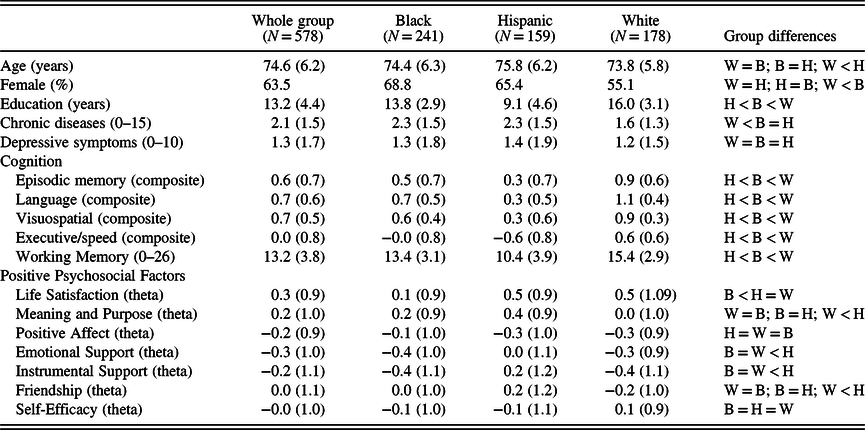
The current sample included only participants recruited in the newest (2009) wave who participated in an ancillary study of psychosocial functioning. Exclusion criteria for the ancillary study were (1) a baseline diagnosis of dementia according to Diagnostic and Statistical Manual of Mental Disorders (DSM-III) criteria via a consensus group of neurologists, psychiatrists, and neuropsychologists; and (2) unwillingness or inability to travel to the Columbia University Medical Center. Unlike the larger WHICAP study, the current study did not use home visits because the NIH Toolbox was not yet available on a tablet. Of the 578 participants who completed an initial ancillary visit, 493 (85%) had available follow-up data an average of 2.4 years later (SD = .7). Characteristics of the final analytic sample (N = 578) are shown in Table 1. Characteristics of participants who did and did not provide follow-up data are provided in Supplementary Table 1. This study complied with the ethical rules for human experimentation that are stated in the Declaration of Helsinki and was approved by the local institutional review board. Informed consent was obtained from all participants.
Sample characteristics

Note. Cognitive composite scores represent the average of individual subtest z-scores. Theta is the standard unit of an item response theory model and has a mean of 0 and standard deviation of 1 in the independent NIH Toolbox calibration sample. Racial/ethnic group differences were tested using analyses of variance and post-hoc comparisons for continuous variables and chi square tests for sex/gender.
Cognitive Outcomes
The following five cognitive outcomes were used in the current study: episodic memory, language, visuospatial functioning, executive/speed, and working memory. Episodic memory, language, and visuospatial functioning were assessed with the core WHICAP neuropsychological battery. Executive/speed and working memory were assessed with the NIH Toolbox Cognition module.
Cognitive functioning in the core WHICAP study is assessed with a comprehensive neuropsychological battery (Stern et al., Reference Stern, Andrews, Pittman, Sano, Tatemichi, Lantigua and Mayeux1992). A previous factor analysis of this battery was found to be invariant across English and Spanish speakers (Siedlecki et al., Reference Siedlecki, Manly, Brickman, Schupf, Tang and Stern2010). Based on this factor analysis, composite scores were derived for the overall WHICAP sample by converting all cognitive test scores to z-scores and averaging them within each cognitive domain. Means and standard deviations used to compute these z-scores were based on baseline values obtained from the larger WHICAP sample in 2007, including individuals with prevalent dementia. Episodic memory composite scores include immediate, delayed, and recognition trials from the Selective Reminding Test (Buschke & Fuld, Reference Buschke and Fuld1974). Language scores include measures of naming, letter and category fluency, verbal abstract reasoning, repetition, and comprehension. Visuospatial scores include recognition and matching trials from the Benton Visual Retention Test (Benton, Reference Benton1955), the Rosen Drawing Test (Rosen, Reference Rosen1981), and the Identities and Oddities subtest of the Dementia Rating Scale (Mattis, Reference Mattis, Bellack and Karusus1976).
Cognitive functioning in the current ancillary study was further assessed with computerized tests from the NIH Toolbox Cognition module, which is available in English and Spanish (Casaletto et al., Reference Casaletto, Umlauf, Marquine, Beaumont, Mungas, Gershon and Heaton2016; Weintraub et al., Reference Weintraub, Dikmen, Heaton, Tulsky, Zelazo, Bauer and Gershon2013). To complement the WHICAP neuropsychological battery, we administered NIH Toolbox tests of attention and inhibition (Flanker Inhibitory Control and Attention), task-switching (Dimensional Change Card Sort), working memory (List Sorting), and processing speed (Pattern Comparison). Comprehensive data on the psychometric properties of these tests are available from a national sample of English and Spanish speakers (Weintraub et al., Reference Weintraub, Dikmen, Heaton, Tulsky, Zelazo, Bauer and Gershon2013). A previous factor analysis of the NIH Toolbox Cognition module revealed that Dimensional Change Card Sort, Flanker, and Pattern Comparison load onto a single executive/speed factor (Mungas et al., Reference Mungas, Heaton, Tulsky, Zelazo, Slotkin, Blitz and Gershon2014). Therefore, composite executive/speed scores were calculated by converting raw scores on these three measures to z-scores and averaging them. Because List Sorting was found to load onto a separate working memory factor (Mungas et al., Reference Mungas, Heaton, Tulsky, Zelazo, Slotkin, Blitz and Gershon2014), the raw score on this test was treated as a separate variable in all analyses.
Positive Psychosocial Predictors
Psychosocial functioning was assessed with the NIH Toolbox Emotion module, which comprises Likert-type items presented using computerized adaptive testing based on item response theory (Salsman et al., Reference Salsman, Butt, Pilkonis, Cyranowski, Zill, Hendrie and Cella2013). These items were completed on a computer by the participant in their preferred language (English or Spanish) under the supervision of a trained administrator. Supplementary Table 2 provides details about the stem and response options used for each survey.
The current study focused on positive psychosocial factors assessed by the NIH Toolbox: self-efficacy (Self-Efficacy), social relationships (i.e., Emotional Support, Friendship, and Instrumental Support), and well-being (i.e., Life Satisfaction, Meaning and Purpose, and Positive Affect). Internal consistency for surveys included in the present study has been reported to range from α = .89 (Meaning and Purpose) to α = .97 (Emotional Support) (Salsman et al., Reference Salsman, Butt, Pilkonis, Cyranowski, Zill, Hendrie and Cella2013). Theta scores on the NIH Toolbox Emotion surveys reflect unadjusted, standardized latent trait values centered on a mean of 0 and standard deviation of 1. Higher theta scores correspond to higher levels of the underlying trait and were included as continuous variables in primary analytic models.
Covariates
Primary models testing the specific aims controlled for age, sex/gender, race and ethnicity, years of education, depressive symptoms, and chronic disease burden. Age, sex/gender, race, and ethnicity [dummy-coded into Hispanic, non-Hispanic Black (NHB), and NHW], and education (0–20 year) were measured via self-report. Race and ethnicity were determined using the format of the 2000 U.S. Census. In this study, Blacks and Whites were all non-Hispanic, and Hispanics could have identified as any race. Of Hispanics, 62% were born in the Dominican Republic, 11% were born in Puerto Rico, 6% were born in the United States, and 21% were born in other countries. Depressive symptoms were quantified with a 10-item version of the Center for Epidemiological Studies Depression Scale (CES-D; Irwin, Artin, & Oxman, Reference Irwin, Artin and Oxman1999). Chronic disease burden was quantified as the sum of the self-reported presence/absence of 15 chronic conditions (e.g., diabetes, hypertension; Zahodne, Stern, & Manly, Reference Zahodne, Stern and Manly2014).
Statistical Analysis
Descriptive statistics were computed using SPSS version 25 (IBM Corp., Armonk, NY). Correlations among the included variables are shown in Supplementary Table 3. Longitudinal analyses were conducted in Mplus version 8 (Muthén & Muthén, Los Angeles, CA). Longitudinal changes in each cognitive outcome were estimated using separate latent difference score (LDS) models (McArdle & Nesselroade, Reference McArdle, Nesselroade, Cohen and Reese1994). Rather than calculating raw difference scores using subtraction, the LDS model defined a latent variable corresponding to residual variance in follow-up cognition above and beyond what is predicted by the baseline value. The LDS approach is mathematically equivalent to regressing follow-up cognition onto the predictors of interest, controlling for baseline cognition and all other covariates, if the same missing data approach were used. In the LDS model, important features of cognitive change (e.g., mean change, interindividual variability in change, and relationship between the baseline value and change) are modeled as explicit parameters (McArdle, Reference McArdle2009).
Longitudinal models were estimated using maximum likelihood estimation with robust standard errors (MLR), which is robust to non-normality. In order to minimize the impact of attrition bias, missing data were managed with full-information maximum likelihood (FIML), which allowed us to retain participants who did not complete a follow-up assessment. If only complete cases were analyzed, results would have only been representative of participants who were retained in the sample. In contrast to a complete case approach, FIML can handle nonrandom missingness due to variables included in the models (i.e., age, sex/gender, race and ethnicity, years of education, depressive symptoms, chronic disease burden, and baseline cognition), which are common predictors of attrition in aging cohort studies.
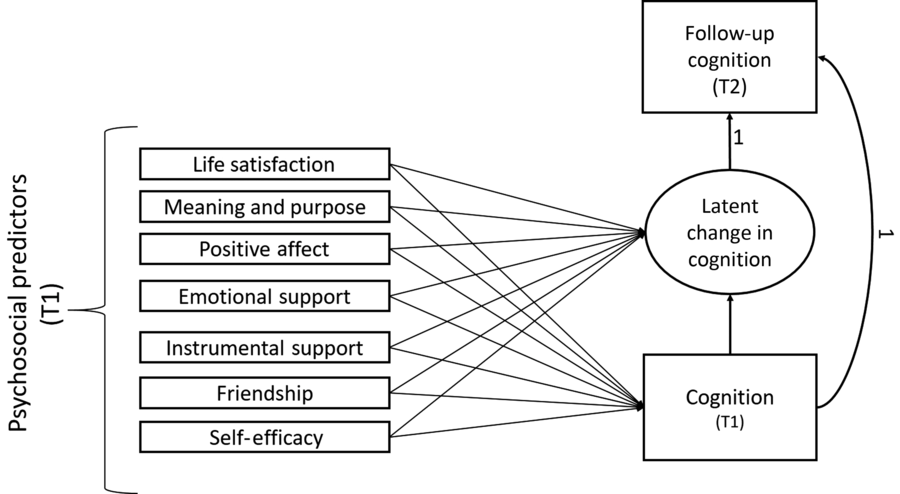
Initial models adjusted only for baseline age to estimate average cognitive changes in the sample. In addition to describing how much change occurred in the sample, these initial models also allowed us to determine whether there was sufficient variance in cognitive change over the study period to add predictors to the models. All other models included all covariates. Final models added in the positive psychosocial variables of interest. See Figure 1 for a depiction of the primary LDS model that included the positive psychosocial predictors of interest. Given the non-independence of tests involving the positive psychosocial variables, the false discovery rate was used to correct for multiple comparisons within each model.
Depiction of the primary analytic model testing associations between the positive psychosocial factors and cognitive change. For simplicity, covariates are not shown. T1 = time 1 (baseline); T2 = time 2 (follow-up).

Racial and ethnic differences in associations between the positive psychosocial variables and cognitive declines were evaluated through pairwise multiple group modeling. In initial multiple group models, all associations between the psychosocial factors and cognitive outcome were forced to be equivalent across two groups (i.e., NHB vs. NHW, NHB vs. Hispanic, or NHW vs. Hispanic). In subsequent models, each association was systematically allowed to vary across groups, one at a time. Give the large number of inferential tests, alpha was set at 0.01. A statistically significant (i.e., p < .01) decrease in the model chi-square value was interpreted as evidence that the parameter of interest differed across groups.
RESULTS
Cognitive Change
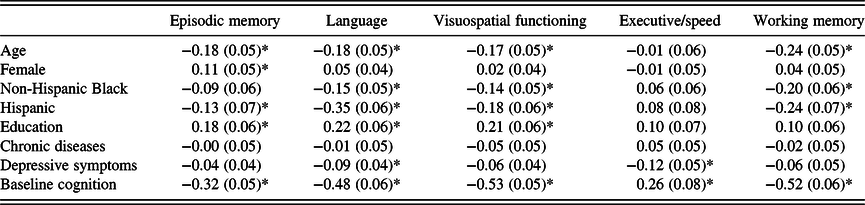
Initial models adjusted only for age indicated that, on average, the sample exhibited declines in all five cognitive domains (Table 2). In addition, there was significant interindividual variability in cognitive decline across all five cognitive domains, indicating that there was sufficient variance in cognitive decline to consider predictors of decline. Subsequent models (Table 3) including all covariates together indicated that participants who were older or Hispanic exhibited faster cognitive decline in domains of episodic memory, language, visuospatial functioning, and working memory. Participants who were NHB exhibited faster decline in language, visuospatial functioning, and working memory. Participants with less education also exhibited faster decline in episodic memory, language, and visuospatial functioning. Female participants exhibited less decline in episodic memory. Depressive symptoms were associated with faster decline in language and executive/speed. Finally, higher baseline performance was associated with more decline in episodic memory, language, visuospatial functioning and working memory, but less decline in executive/speed.
Standardized results from initial LDS models adjusted only for baseline age

Note. Results were obtained from separate LDS models (see Figure 1) for each cognitive outcome, excluding the positive psychosocial factors and covariates other than age. Estimates of intra-individual change quantify how much change was observed in the current sample, on average. Statistically significant estimates of inter-individual variability of change confirm that there was sufficient variance in cognitive change in the sample to consider predictors of that change.
LDS = latent difference score.
Standardized estimates of associations between covariates and cognitive decline from conditional latent difference score models

Note. Results were obtained from separate LDS models (see Figure 1) for each cognitive outcome, excluding the positive psychosocial factors.
* p < 0.05.
Positive Psychosocial Variables and Cognitive Change
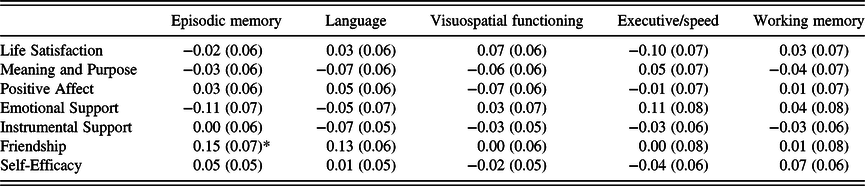
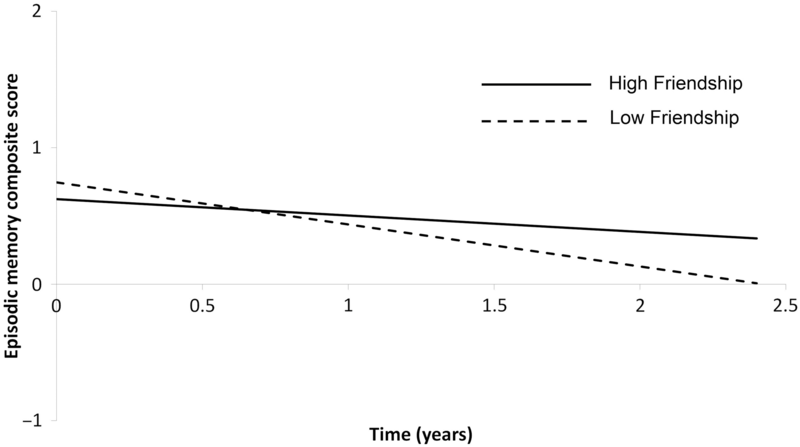
Table 4 presents results from subsequent models that included the positive psychosocial variables of interest. As shown, higher scores on the NIH Toolbox Friendship Survey were associated with less subsequent decline in episodic memory, above and beyond all other positive psychosocial variables, baseline episodic memory, and all covariates. When considering the association between age and episodic memory change in this sample, we can see that one standard deviation increase in friendship corresponded to 6 fewer years of memory aging. Figure 2 displays episodic memory trajectories by NIH Toolbox Friendship Survey theta score, split at the mean score from the NIH Toolbox normative sample for the purpose of visualization. After controlling for age, sex/gender, race and ethnicity, education, chronic diseases, depressive symptoms, and all other positive psychosocial factors examined in this study, participants with low Friendship scores (i.e., theta scores < 0; N = 304) evidenced greater episodic memory decline over the 2.4-year study period (unstandardized estimate = −0.308; SE = 0.119; p = 0.010) than participants with high Friendship scores (i.e., theta scores ≥ 0; N = 273), who did not evidence a significant decline in memory (unstandardized estimate = −0.120; SE = 0.098; p = 0.222).
Standardized estimates of associations between positive psychosocial factors and cognitive decline from final latent difference score models

Note. Results were obtained from separate LDS models (see Figure 1) for each cognitive outcome. For simplicity, covariate effects are not shown.
* p = 0.018 (significant after consideration of the false discovery rate).
Main effect of friendship on cognitive change. The figure depicts model-estimated episodic memory trajectories for participants with low (theta scores < 0) versus high (theta scores ≥ 0) scores on the NIH Toolbox Friendship survey. Note that friendship was modeled as a continuous variable in the analytic models and only dichotomized here for the purpose of visualization. Depicted results are set at the following covariate values: age 75, female sex/gender, 12 years of education, no chronic diseases, no depressive symptoms, and theta = 0 on all other positive psychosocial surveys.

A series of sensitivity analyses including only one positive psychosocial factor at a time was conducted to explore whether any associations were being masked by including all of the positive psychosocial factors of interest in each model. Results did not reveal any additional associations between any of the positive psychosocial factors and change in any cognitive domain.
Racial and Ethnic Differences
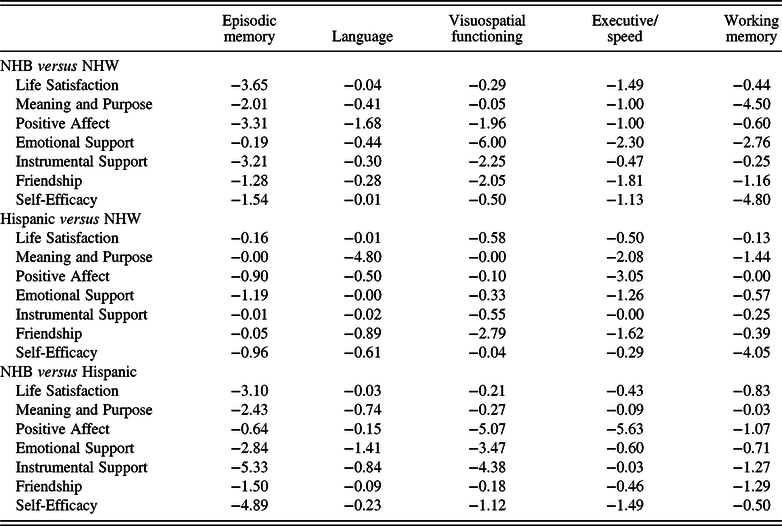
As shown in Table 5, multiple-group models revealed no group differences in the associations between the positive psychosocial factors and cognitive decline. The association between Meaning and Purpose and language decline differed across Hispanics and NHW. However, the association was not significant in either group (Hispanics: β = .12; SE = .10; p = .202; NHW: β = −.14; SE = .10; p = .136). This association did not significantly differ between Hispanics and NHB or between NHB and NHW.
Results (chi-square differences) from multiple-group models testing differential associations between positive psychosocial factors and cognitive decline across race and ethnicity

Note. Results were obtained from separate multiple group LDS models for each cognitive outcome and reflect the difference in model fit between models in which all regression parameters were forced to be equivalent across two groups versus models in which one parameter of interest (i.e., association between a positive psychosocial factor and cognitive change) was allowed to vary across groups.
NHW = Non-Hispanic White; NHB = Non-Hispanic Black.
DISCUSSION
The results of this longitudinal study clarify previous cross-sectional findings (Zahodne et al., Reference Zahodne, Watson, Seehra and Martinez2018) regarding associations between positive psychosocial factors and cognition in older adults. In a large and racially and ethnically diverse sample, we found that having a stronger network of friends is prospectively associated with less episodic memory decline, above and beyond other positive psychosocial factors, depressive symptoms, chronic diseases, and baseline episodic memory. Further, this association did not differ significantly across NHB, NHW, and Hispanic older adults.
Evidence for a prospective association between the NIH Toolbox Friendship survey and slower episodic memory decline is consistent with the growing body of literature on social relations and cognitive aging. Indeed, recent cognitive aging studies that have parsed the multidimensional construct of social relations into its potential “active ingredients” have converged on the importance of friends for maintaining episodic memory (Haslam, Cruwys, & Haslam, Reference Haslam, Cruwys and Haslam2014; Sharifian, Kraal, Zaheed, Sol, & Zahodne, Reference Sharifian, Kraal, Zaheed, Sol and Zahodne2020a,b; Sharifian, Manly, Brickman, & Zahodne, Reference Sharifian, Manly, Brickman and Zahodne2019; Zahodne, Ajrouch, Sharifian, & Antonucci, Reference Zahodne, Ajrouch, Sharifian and Antonucci2019). For example, ties to a social group are more strongly associated with preserved global cognition than ties to a series of individuals (i.e., pair-based ties) among older adults in England (Haslam, Cruwys, & Haslam, Reference Haslam, Cruwys and Haslam2014). In the U.S.-based Health and Retirement Study, more frequent contact with friends was a stronger predictor of slower episodic memory decline than contact with children or other family, social support from friends, family or children, social strain from friends, family or children, marital status, or overall social network size (Zahodne et al., Reference Zahodne, Ajrouch, Sharifian and Antonucci2019). This observational evidence is consistent with the possibility that interacting with friends protects against age-related cognitive declines. A recent randomized control trial also points to a causal interpretation by documenting significant cognitive improvements following 6 week of daily, web-enabled conversational interaction with non-family members (Dodge et al., Reference Dodge, Zhu, Mattek, Bowman, Ybarra, Wild and Kaye2015). Further, these findings extend prior research examining these associations in predominantly NHW samples and demonstrate the robust effect of friendships on memory functioning across ethnic and racial groups.
Friendships may be particularly beneficial for cognitive aging because they require more active maintenance (i.e., communication and shared activities) than family relationships, which can be more obligatory (Roberts & Dunbar, Reference Roberts and Dunbar2011, Reference Roberts and Dunbar2015). Indeed, data from the Survey of Midlife in the United States indicate that the greater engagement in cognitively stimulating leisure activities mediated the positive association between contact frequency with friends and subsequent changes in both episodic memory and executive functioning (Sharifian et al., Reference Sharifian, Kraal, Zaheed, Sol and Zahodne2020a). In addition, friendships have been shown to provide a greater source of immediate joy (Larson, Mannell, & Zuzanek, Reference Larson, Mannell and Zuzanek1986) and a greater sense of companionship (Huxhold, Miche, & Schüz, Reference Huxhold, Miche and Schüz2014) than family relationships for older adults. As shown in Supplementary Table 4, items in the NIH Toolbox Friendship survey used in the current study tap both contact (e.g., I have friends I get together with to relax) and relationship quality (e.g., I feel close to my friends). However, evidence from the Health and Retirement Study suggests that it is the frequency of contact with friends rather than the quality of friendships that is most strongly related to subsequent cognitive trajectory (Zahodne et al., Reference Zahodne, Ajrouch, Sharifian and Antonucci2019). Future research should continue to examine what it is about friendship that may be consequential for cognitive aging.
In the current study, friendship was only significantly associated with changes in episodic memory. Episodic memory is a particularly important cognitive outcome in cognitive aging due its salient association with dementia risk (Backman, Small, & Fratiglioni, Reference Backman, Small and Fratiglioni2001). The specificity of findings may relate to the fact that episodic memory exhibited the steepest declines over the study period. This pattern of results may also hint at potential mechanisms underlying the link between social relations and cognition. Specifically, episodic memory performance reflects the integrity of the hippocampus, and experimental studies in mice support a causative link between social ties and hippocampal function (Smith, Yao, Chen, & Kirby, Reference Smith, Yao, Chen and Kirby2018). Future studies are needed to investigate whether the link between friendship and episodic memory in humans is mediated by hippocampal integrity and whether the potential protective effects of friendship reflect stress-buffering and/or cognitive enrichment mechanisms.
Several previous cross-sectional findings in this data set (Zahodne et al., Reference Zahodne, Watson, Seehra and Martinez2018) did not extend to longitudinal cognitive change. While self-efficacy was positively associated with concurrent language functioning, it did not predict subsequent changes in language. Given that self-efficacy was not prospectively associated with cognitive change in any domain, it is possible that previously reported concurrent associations between self-efficacy and cognition reflect reverse causation. Specifically, having stronger cognitive abilities may contribute to feelings of self-efficacy among older adults. In the Advanced Cognitive Training for Independent and Vital Elderly randomized controlled trial, older adults who received a 10-session cognitive intervention evidenced moderate improvements in internal locus of control (Wolinsky et al., Reference Wolinsky, Vander Weg, Martin, Unverzagt, Willis, Marsiske and Tennstedt2010). Indeed, a previous longitudinal study documented bidirectional associations between instrumental self-efficacy and verbal memory, although both associations were limited to men (Seeman et al., Reference Seeman, McAvay, Merrill, Albert and Rodin1996). While the current finding that self-efficacy was not prospectively associated with later cognition contrasts with this prior observational study, it is noted that the NIH Toolbox Self-Efficacy survey is domain-general, while the self-efficacy questionnaire used by Seeman et al. (Reference Seeman, McAvay, Merrill, Albert and Rodin1996) was domain-specific. In his foundational work, Bandura (Reference Bandura1989) emphasized that domain-specific measures are more likely to be associated with functioning than domain-general measures.
In contrast to previous cross-sectional findings (Zahodne et al., Reference Zahodne, Watson, Seehra and Martinez2018), there was no evidence in the current longitudinal study that any of the positive psychosocial factors were more negatively associated with cognitive outcomes among Hispanics. In fact, the only longitudinal association that differed significantly across groups suggested that the prospective association between greater purpose in life and better subsequent language functioning was strongest in Hispanics. Our previous finding of a cross-sectional association between greater purpose in life and lower working memory among Hispanics may have reflected reverse causation or been confounding by religiosity. Indeed, religiosity is associated with both greater purpose in life (Ardelt & Ferrari, Reference Ardelt and Ferrari2019) and lower cognitive abilities (Kraal, Sharifian, Zaheed, Sol, & Zahodne, Reference Kraal, Sharifian, Zaheed, Sol and Zahodne2019; Ritchie, Gow, & Deary, Reference Ritchie, Gow and Deary2014), but not with age-related cognitive decline (Ritchie et al., Reference Ritchie, Gow and Deary2014).
These differences in results from cross-sectional versus longitudinal analyses may highlight the utility of longitudinal data for clarifying which modifiable factors may be most likely to influence cognitive decline and underscore the nonequivalence of cross-sectional and longitudinal studies. Indeed, patterns of different findings between cross-sectional and longitudinal approaches have been interpreted as suggesting that longitudinal data are more robust in modeling changes over time, particularly those involving multiple cohorts and variable sociocultural factors (Baltes & Nesselroade, Reference Baltes, Nesselroade, Nesselroade and Reese1979; Schaie, Reference Schaie1965). Furthermore, unlike cross-sectional approaches, longitudinal analyses are equipped to directly identify intra-individual changes, inter-individual variability in intraindividual changes, and inter-relationships among those changes (Baltes & Nesselroade, Reference Baltes, Nesselroade, Nesselroade and Reese1979; Schaie, Reference Schaie and Schaie1983). However, contrasting results in cross-sectional versus longitudinal studies may also indicate that some positive psychosocial factors contribute to individual differences in cognitive level, while others contribute to subsequent rates of cognitive change. Importantly, both cognitive level and rate of cognitive change contribute to dementia incidence. Additional research, particularly experimental or intervention studies, are needed to clarify the causal contributions of different positive psychosocial factors to cognitive level versus cognitive change.
Limitations of this study include its relatively short follow-up period. Longer follow-up may have yielded greater decline, greater inter-individual variability in decline, and therefore additional prospective associations between the psychosocial variables and subsequent cognitive change. The fact that a significant association between the NIH Toolbox Friendship survey and episodic memory decline emerged despite the limited follow-up period underscores the robustness of this finding. The availability of longitudinal data also helped to clarify previously reported cross-sectional associations. Another limitation of the current study is that participants were required to travel to the testing site rather than being seen in their homes, which may limit generalizability to the larger WHICAP sample. Of note, we are currently collecting NIH Toolbox data in participants’ homes using an iPad.
Finally, given the examination of multiple predictors across multiple outcomes, it is possible that the identified association between friendship and episodic memory reflects type I error. However, we attempted to address this issue through multiple comparison correction, visualization, and a detailed description of effect size. Of note, the signs of nonsignificant associations between the various positive psychosocial factors and cognitive domains are not consistent. That the identified effect is consistent with a growing literature emphasizing the potential protective effects of friends for cognitive aging (including studies that similarly covary for a variety of related psychosocial factors) increases confidence in the current findings. Nonetheless, replication with independent and/or larger samples using the same study design are needed.
Strengths of this study include the racially and ethnically diverse sample, which allowed for inferential tests of differences in associations across NHB, NHW, and Hispanics living in the same geographic area. Another strength is the inclusion of a comprehensive, in-person neuropsychological battery, which allows for examination of multiple cognitive domains. Finally, while including multiple positive psychsocial factors in each model may have increased the risk of type I error, this approach may also represent an improvement over previous studies that have focused on one or two factors while ignoring other related factors that may be stronger contributors to cognitive performance.
In conclusion, this longitudinal study of racially and ethnically diverse older adults provides support for the relevance of friendships for episodic memory trajectories in late life. These results are consistent with recent observational (Sharifian et al., Reference Sharifian, Kraal, Zaheed, Sol and Zahodne2020a,b; Zahodne et al., Reference Zahodne, Ajrouch, Sharifian and Antonucci2019) and interventional work (Dodge et al., Reference Dodge, Zhu, Mattek, Bowman, Ybarra, Wild and Kaye2015) linking friendship to subsequent cognitive functioning in later life. Maintaining friend networks may contribute not only to better socioemotional functioning (Crohan & Antonucci, Reference Crohan, Antonucci, Adams and Blieszner1989; Fuller-Iglesias, Webster, & Antonucci, Reference Fuller-Iglesias, Webster and Antonucci2015; Sherman, De Vries, & Lansford, Reference Sherman, De Vries and Lansford2000; van der Horst & Coffé, Reference van der Horst and Coffé2012), but also to better cognitive functioning over time, which is a key component of successful aging (Rowe & Kahn, Reference Rowe and Kahn1998).
Acknowledgements
Data collection and sharing for this project was supported by the WHICAP (P01AG07232, R01AG037212, and RF1AG054023) funded by the National Institute on Aging (NIA) and through NIA grant numbers R00AG047963 and R01AG054520. This manuscript has been reviewed by WHICAP investigators for scientific content and consistency of data interpretation with previous WHICAP Study publications. We acknowledge the WHICAP study participants and the WHICAP research and support staff for their contributions to this study. This publication was supported by the National Center for Advancing Translational Sciences, National Institutes of Health, through grant number UL1TR001873. The content is solely the responsibility of the authors and does not necessarily represent the official views of the NIH.
CONFLICT OF INTEREST
The authors have nothing to disclose.
SUPPLEMENTARY MATERIAL
To view supplementary material for this article, please visit https://doi.org/10.1017/S1355617720000648.