


Food consumption outside the home tends to increase with age in children, with the peak occurring in late adolescence (15–18 years) and young adulthood (19–29 years)(Reference Burke, McCarthy and O’Neill1,Reference Adams, Goffe and Brown2) . In Brazil, 30·6 % of adolescents (aged 10–19 years) reported purchasing food for out-of-home consumption according to data from the Household Budget Survey 2002–2003(Reference Powell and Nguyen3) and 48 % of adolescents reported the consumption of at least one item away from home on a food record in 2008–2009(Reference Lachat, Nago and Verstraeten4).
The consumption of food outside the home, especially in fast-food restaurants, is associated with higher energy consumption, as well as lower nutritional quality of the diet in both children and adults(Reference Powell and Nguyen3,Reference Lachat, Nago and Verstraeten4) .
There are few studies in the literature assessing the consumption of food outside the home among Brazilian adolescents(Reference Bezerra and Sichieri5–Reference Cunha, Bezerra and Pereira7), and none has investigated the influence of foods consumed at school and at other away-from-home places on the adolescents’ diet, considering a population-based sample of Brazilian adolescents. In general, Brazilian adolescents consume traditional Brazilian foods, as rice and beans, as well as ultraprocessed foods, as sweetened beverages, desserts and savoury snacks(Reference Souza, Barufaldi and Abreu8).
The type of place where food is consumed has been overlooked, and this is particularly important among adolescents, since they spend part of their day at school. In Brazil, the National School Feeding Program offers food for students in basic education (kindergarten to high school and education of young adults) from public schools, aiming to meet between 20 and 70 % of students’ nutritional needs(Reference Soares, Martinelli and Fabri9,Reference Sinader, Balaban and Burlandy10) . This paper aims to compare the contribution of different places of food consumption (home, public and private schools, and other away-from-home places) with the energy and nutrient intake of Brazilian adolescents.
Methods
Population and study design
We used data from The Study of Cardiovascular Risk in Adolescents – ERICA, carried out in 2013–2014. ERICA is a national school-based study performed with 78 004 adolescents of both genders, aged 12–17 years, enrolled in public and private schools of 124 cities with more than 100 000 inhabitants from all states of Brazil. Information on the sampling process and data collection has been published elsewhere(Reference Vasconcellos, Silva and Szklo11,Reference Silva, Klein and Souza12) .
In brief, ERICA has adopted a three-stage sampling design. In the first stage, schools were previously stratified in thirty-two geographic strata (twenty-seven capitals and five strata comprising the remaining municipalities with more than 100 000 inhabitants of each Brazilian region) and selected through probability proportional to size sampling. In the second stage, three combinations of shift (morning and afternoon) and school year (one of the last 3 years of elementary school or one of the high school) were selected. In the third stage, a class was selected for each of the combinations described above.
All students were invited to participate in the research. Adolescents who had some degree of disability that made anthropometric evaluation and filling in the questionnaire impossible and pregnant adolescents were excluded, as well as those outside the age range of 12–17 years. A total of 102 327 adolescents were eligible to participate in the study: 73 160 answered the 24-h food recall, 74 589 self-filled the questionnaires using a Personal Digital Assistant and 73 787 underwent the anthropometric evaluation.
Sample weights were calculated for each of the defined subsets of participants who answered each study dimension. All data collection was supervised by trained professionals. For this study, we included all adolescents that had undergone anthropometric evaluation and provided information through the questionnaires and 24-h recall (n 71 740).
Data collection
Data collection was performed using a Personal Digital Assistant, an electronic device with self-filled items with around 100 questions, addressing sociodemographic, health and lifestyle variables. For this study, we analysed the following variables: age, gender, mother’s education and number of household members.
To record food consumption, a trained researcher recorded a 24-h food recall in an offline software that used the list of foods from the 2008–2009 Brazilian Household Budget Survey(13). Interviewers recorded all foods and beverages consumed by participants on the day before the interview, the place of consumption of the food items (at home, at school and away from home) and the time at which they were consumed. The interview technique used was the multiple-pass method, which consists of a five-step interview with the objective of reducing underreporting of food intake.
Reported food amounts were transformed into grams or millilitres, using a food portion table specially developed for the survey, and energy intake was estimated using a food composition table based on the Brazilian Table of Food Composition(14) and the Nutrient Data System for Research software, version 2008.
For the analysis of energy intake, we added soyabean oil to all cooked and braised preparations of meat and vegetables. The consumption of sugar and sugar substitutes added to beverages was estimated by asking the respondents about the type of sweeteners usually added to beverages: sugar, non-energetic artificial sweeteners, both or none. If the participant reported the intake of sugar or both sugar and non-energetic sweeteners, a proportional amount of sugar was added to commonly sweetened beverages, such as juices, tea and coffee. A 10 % sugar dilution was applied to the intake of respondents who usually added sugar, and a 5 % sugar dilution was applied to the intake of respondents who usually added both sugar and non-energetic sweetener.
The definition of away-from-home food consumption includes all foods and drinks, except water, that were consumed away from home (at restaurants, fast-food places, street food vendors, school cafeteria, etc.). We classified away-from-home food consumption into two ways: (1) foods consumed only at school (school) and (2) foods consumed at restaurants, fast-food places, street food vendors, etc. (other places). All foods consumed at home, including relatives’ homes or neighbour’s homes, were included as at-home foods.
Data analysis
For this analysis, food codes representing similar food and beverage items were combined into thirty-three mutually exclusive food categories and divided into healthy (Bean, Cereals, Chicken, Corn, Egg, Fish, Fruit, Fruit Juices, Legume, Manioc, Meats, Milk and dairy products, Nuts, Potato, Soups, Tubers and Vegetables) and unhealthy (Bread, Cake, Cheese, Chocolate, Coffee, Crackers, Desserts, Instant Noodles, Oils, Pasta, Pizza, Processed meats, Rice, Sandwiches, Savoury snacks and Soft Drinks) food markers. A description of each food category is detailed in Table 1. We did not evaluate the consumption of alcoholic beverages and food groups that showed a mean consumption of <4·184 kJ/d (1 kcal/d) (soyabean beverages and sauces). Sugar intake was evaluated as a nutrient (added sugar) and not as a food item.
Description of food groups (Study of Cardiovascular Risk in Adolescents – ERICA, Brazil, 2013–2014)

Mean energy intake was calculated according to socio-economic characteristics (age, gender, type of school – public or private), considering the places where foods were consumed (at home or away from home – public or private school and other places). For this study, other places included all foods eaten out of home (at full-service restaurants, fast-food places, street food vendors, etc.), except foods consumed at school.
We calculated the mean energy intake from each food group, considering the place of food consumption (at-home, public or private school or other places).
We also estimated the mean intake of specific nutrients (total fat, saturated fat, monounsaturated fat, polyunsaturated fat, carbohydrate, added sugar, protein, fibre, Ca and Fe), according to the place of food consumption (at-home, public or private school, or other places). The association between eating away from home and nutrient intake was tested by linear regression models. Firstly, we considered the consumption at both school and other places, and then we included only the consumption at other places. Models were adjusted for age, gender and type of school.
All statistical analyses were weighted and performed using survey analysis procedures from SAS STUDIO (https://www.sas.com/en_us/software/studio.html), to take into account the sample design effect.
Results
The main portion of energy intake per day was consumed within the adolescents’ households (8108·592 kJ (1938 kcal), 95 % CI 1892·3, 1985·0), accounting for approximately 84·6 % of the daily consumption. However, half of the adolescents (52·1 %, 95 % CI 49·7, 54·6 %) reported the consumption of at least one item away from home. This number decreased to 22·5 % (95 % CI 21·2, 23·8 %) when foods consumed at school were excluded and were similar between adolescents from private and from public schools (24·9, 95 % CI 22·7, 27·0 % v. 21·2, 95 % CI 20·5, 23·4, respectively).
The mean energy intake at public schools was higher than the intake at private schools. Adolescents aged between 15 and 17 years showed higher mean energy intake in other places when compared with the younger ones; however, there was no difference regarding the contribution of energy from foods consumed at public or private schools between the age ranges. At-home mean energy intake differed according to the type of school, being higher among students from public schools. Boys consumed more energy daily than girls, especially when considering at-home food consumption, but there were no differences between the genders when comparing at-school (public or private) consumption and that in other places (Table 2).
Total mean energy intake (kcal/d) and from at-home and away from home (public and private schools, and other places), and 95 % CI, according to age group, gender and type of school (Study of Cardiovascular Risk in Adolescents – ERICA, Brazil, 2013–2014)*
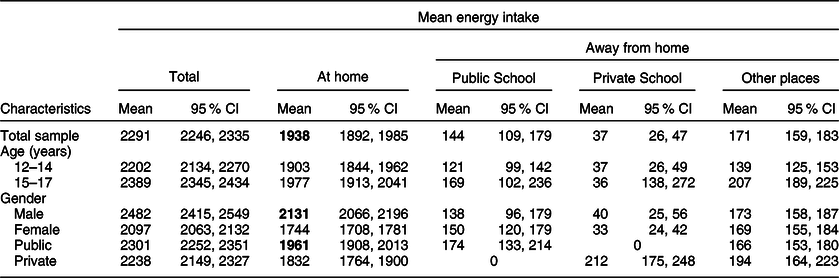
Bold refers to confident interval to compare means between the groups.
* To convert energy values from kcal to kJ, multiply it by 4·184.
Meats, cakes, beans, rice, bread, fruit juices, chicken and chocolate were the most often consumed groups, independently of the place of consumption. Away-from-home energy sources showed high intake (more than 20 % of the energy consumed from these food groups came from away-from-home sources) for savoury snacks (43·9 %), crackers (37·4 %), nuts (36 %), desserts (35·8 %), sandwiches (29·3 %), pizza (27·2 %), soft drinks (23·3 %) and chocolate (20 %). Mean energy intake was higher at other places than at private schools, except for cereals, instant noodles, legumes, vegetables, fruit, cake, egg and oil. Energy intake from public schools and other places was similar for almost all food groups. Bread, pasta, potato, tubers, nuts, savoury snacks, soft drinks, sandwiches, pizzas and coffee presented higher energy intake at other places than at public schools. The mean energy intake from soups was higher at public schools than at other places (Table 3).
Frequency of consumption (%), total mean energy intake (kcal/d) and from at-home and away from home (public and private schools, and other places), and 95 % CI, according to food groups (Study of Cardiovascular Risk in Adolescents – ERICA, Brazil, 2013–2014)†
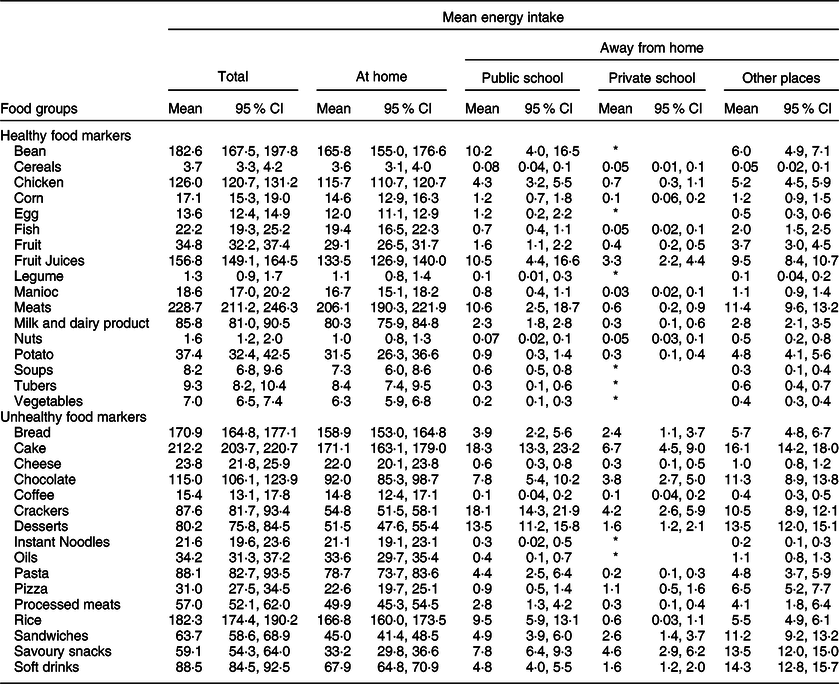
† To convert energy values from kcal to kJ, multiply it by 4·184.
* 95 % confident interval less than 0·1.
The percentage contribution of foods consumed at private schools was lower than at public and other places. On the other hand, the percentage contribution of foods consumed at public schools and other places was very similar with respect to nutrients, differing only in saturated fat, monounsaturated fat and Ca, which showed a higher mean intake in foods from other places (Table 4). However, food consumption at other places showed a significant influence on the adolescents’ diet, reducing the intake of protein, fibre and Fe, while increasing the intake of carbohydrates, added sugar and fats. Na intake was negatively associated with food consumption at other places. Considering the consumption in both restaurants and at school, the associations remained, except for saturated and monounsaturated fats, carbohydrates and Fe (Table 5).
Total mean nutrient intake, and from at-home and away from home (public and private schools, and other places), and 95 % CI (Study of Cardiovascular Risk in Adolescents – ERICA, Brazil, 2013–2014)

Nutrient mean intake and regression coefficients comparing consumers with non-consumers of food away from home, according to the place of food consumption (Study of Cardiovascular Risk in Adolescents – ERICA, Brazil, 2013–2014)†
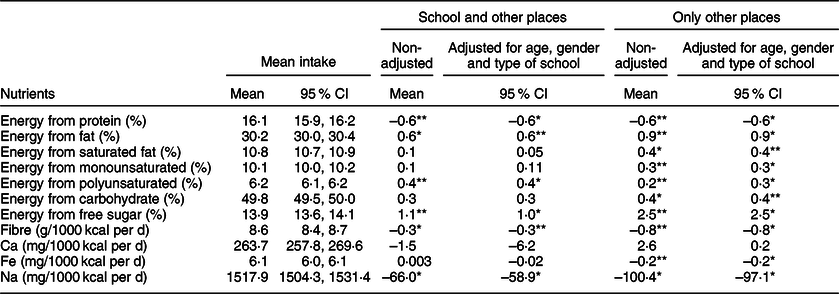
† To convert energy values from kcal to kJ, multiply it by 4·184.
*P < 0·0001, **P < 0·05.
Discussion
The main findings of the study indicated that out-of-home meals are higher in all types of fat and free sugar and have reduced amounts of fibre, protein, Fe and Na. School meals from public schools show the same pattern of out-of-home meals at other places. On the other hand, private schools present lower mean intake for the majority of food groups and nutrients.
For Brazilian adolescents, the out-of-home meals still contribute to a small portion of the total energy intake (around 15 %). Thus, the greatest contribution of energy consumption comes from the adolescents’ households, strengthening the information found in Taillie’s study that investigated food intake inside and outside the Mexican children’s homes, which showed they consumed most of the daily energy at home(Reference Taillie, Afeiche and Eldridge15).
Results showed that savoury snacks, crackers, nuts, desserts, sandwiches, pizza, soft drinks and chocolate were among the most important contributors to away-from-home foods. Although mean intake of food groups was similar between public schools and other places, mean energy intake of bread, pasta, potato, tubers, nuts, savoury snacks, soft drinks, sandwiches, pizzas and coffee was higher at other places than at public schools.
These results support and extend prior studies about the influence of away-from-home foods on adolescent diet. Other studies also identified high energy-dense food intake away from home (e.g. baked and fried snacks, pizza, soft drinks, sandwiches and sweets), including studies carried out with the Brazilian population(Reference Bezerra, Souza and Pereira6). On the other hand, among Mexican children, the top contributors to away-from-home foods were both a source of staple foods (wheat and rice-mixed dishes, and corn-mixed dishes) as well as snack-type foods and sugar-sweetened beverages(Reference Taillie, Afeiche and Eldridge15).
In our study, most of the food intake was consumed at home. Excluding foods consumed at school, only 22 % of the adolescents reported the consumption of at least one item away from home, representing 7·5 % of total energy intake, which is lower than that observed in older Mexican children (19 %)(Reference Taillie, Afeiche and Eldridge15), and North-American children (between 29 and 35 % of energies were consumed away from home)(Reference Poti and Popkin16,Reference Ng, Slining and Popkin17) . Including school as a place where away-from-home foods are consumed, the contribution increased to 15·4 %. This reinforces the importance that schools have in providing meals to Brazilian adolescents, especially public schools. In our study, the mean energy intake at private schools was lower than public schools and other places, showing that among adolescents from private schools, out-of-home consumption may come mainly from other places.
A negative finding from our study was the mean of energies from crackers consumed at public schools (around 20 % of all energies consumed from crackers), since the acquisition of biscuits and salted products is restricted with limits imposed by legislation. In Brazil, the National School Feeding Program (PNAE, Programa Nacional de Alimentação Escolar) guarantees the provision of at least one up to three meals per student attending public schools(Reference Soares, Martinelli and Fabri9,Reference Sinader, Balaban and Burlandy10) ; however, private schools and even some public schools have cafeterias that sell food to students. These establishments are not under federal food regulations, being in charge of each state, allowing the supply of foods rich in sugar, fat and Na.
One important finding of our study is the higher mean energy intake of rice, meats and beans offered in public schools. These sources of staple foods can be considered as healthy food markers. Bento et al.(Reference Bento, Moreira and do Carmo18) described a possible dose-response effect in improving the consumption of fresh and minimally processed foods and reducing the consumption of ultraprocessed products with the daily consumption of two or three school meals.
On the other hand, the consumption of crackers and cakes highlights the offer of non-healthy foods at schools. Corroborating this finding, an evaluation of nutritional adequacy of meals served at schools in Brazil showed that meals served at schools do not reach nutritional adequacy, according to the PNAE(Reference Issa, Moraes and Francisco19). However, it is important to consider the definition of away-from-home food used in the survey. Food consumption was classified as occurring outside the home based on the place where food was consumed, not considering its source. Thus, crackers and cakes can also indicate the type of food adolescents bring to eat at school. Nevertheless, it shows the preference for this type of food to be consumed during the school period. In our study, among all soft drinks consumed, 7 % was consumed at school. In addition, 10 % and almost 20 % of all chocolate/candy bars and desserts were consumed at school, respectively, showing that schools are missing the opportunity to stimulate the consumption of fresh and staple foods.
Similar to Taillie et al.(Reference Taillie, Afeiche and Eldridge15) who studied 4773 Mexican children and adolescents, foods consumed at home contributed most to the children’s daily macro- and micro-nutrient intake. This is particularly important when we consider that foods consumed at home might not differ from what is consumed outside home, showing poor eating habits regardless of the place of consumption. For instance, the daily average Na intake was higher than the maximum tolerable level (UL) of 2300 mg/d(20), but away-from-home food showed a negative contribution to Na intake, raising concerns about the amount of Na these adolescents may be consuming at their homes.
In our study, adolescents aged between 15 and 17 years showed higher mean energy intake in restaurants, when compared with the younger ones. Considering that greater autonomy for decision-making tends to increase with age(Reference Celen, Cok and Bosma21) and that adolescents who have financial autonomy showed higher consumption of snacks(Reference Araújo, Cunha and Bezerra22), this finding reinforces the need for developing specific strategies for this population.
Our results showing that the frequency of away-from-home energy sources was high for food groups that have low nutrient density, but high-energy content, corroborate other studies carried out in Brazil that show that away-from-home foods tend to be high in energy density (e.g. baked and fried snacks, pizza, soft drinks, sandwiches and sweets)(Reference Bezerra, Moreira and Cavalcante23). These results reflected on the daily nutrient intake by adolescents, since foods consumed at restaurants were negatively associated with the intake of protein, fibre and Fe, and positively related to the intake of added sugar and fats. Other studies have already shown the negative influence of away-from-home food in the diet(Reference Lachat, Nago and Verstraeten4).
Also, Cunha et al.(Reference Cunha, Bezerra and Pereira7) found that the main difference between patterns identified in at-home and away-from-home food consumption was the increase in the number of food items in the latter category. However, we found that items such as pizza, sandwiches and soft drinks, which are considered markers of unhealthy eating, were more consumed at restaurants than at school, showing that the type of food, regardless of the place where it is consumed, should be of better nutritional quality.
Conclusions
Away-from-home food contributed to 15·4 % of the total energy intake among Brazilian adolescents, being mainly due to high energy-dense foods. The consumption of foods at restaurants showed a negative association with the intake of protein, Na and fibre, and a positive association with added sugar and fats. Family meals at home may provide a better diet for adolescents and should be stimulated. Future studies should compare strategies to increase the number of meals at home and also to improve school meals.
Acknowledgements
Acknowledgements: None. Financial support: H.B.N.M. received a scholarship from Ceará Foundation of support to the scientific and technological development (FUNCAP) No.: BMD-0008-01416.01.05/18. Conflict of interest: The authors have no conflicts of interest to disclose. Authorship: Dr I.N.B. conceived the study, interpreted the data, drafted the initial manuscript, and reviewed and revised the manuscript. Ms H.B.N.M. contributed to the interpretation of the data, drafted the initial manuscript, and reviewed and revised the manuscript; Dr A.M.S. coordinated the study, conducted the analysis and contributed to the interpretation of the data; Dr R.S. participated in the study coordination and critically reviewed the manuscript for important intellectual content; All authors approved the final manuscript as submitted and agreed to be accountable for all aspects of the work. Ethics of human subject participation: This study was conducted according to the guidelines laid down in the Declaration of Helsinki, and all procedures involving study participants were approved by the Research Ethics Committee of the Federal University of Rio de Janeiro (no. 01/2009). Written informed consent was obtained from all adolescents.



