


Over the last few decades, democratic theory has grown dramatically in its power and sophistication. A large part of this growth has been fueled by deliberative approaches to democracy, which collectively have developed into a nuanced set of theories, a broad empirical research program, and a rapidly growing number of practical experiments and political innovations. A central feature of these developments has been a robust debate between advocates and critics of deliberative democracy. But the debates are now less productive than they should be. The reasons, I suggest, often have less to do with substantive claims than with a common style of thinking about the roles of deliberation, elections, and other means of organizing democracy into a political system. We democratic theorists usually think in terms of “models of democracy”—a strategy that encourages us to center our thinking on an ideal typical feature of democracy, such as deliberation or elections, and then to overextend the claims for that feature.
Here I sketch an alternative strategy for constructing democratic theories. Rather than centering a theory on practices such as voting or deliberation—no matter how essential to democracy—we should take a step back and ask two kinds of questions. First, “What problems does a political system need to solve if it is to function democratically?” If a political system empowers inclusion, forms collective agendas and wills, and organizes collective decision capacity, it will count as “democratic.” Second, “What are the strengths and weaknesses of generic political practices as ways and means of addressing these problems?” I shall suggest that political systems that solve democratic problems will make use of seven kinds (or classes) of generic political practices: recognizing, resisting, deliberating, representing, voting, joining, and exiting. A democratic political system should combine these practices, usually into institutions, in ways that maximize their strengths and minimize their weaknesses, relative to the three broad democratic problems. To the extent that democratic theorists address these two questions, they will produce theories that are both normatively robust and sufficiently fine-grained to frame democratic problems, possibilities, and deficits in complex polities.
In the first two sections, I introduce the discussion with a diagnosis as to why models-based thinking is no longer productive. The “models” approach, I shall argue, leads us into unnecessary theoretical dead-ends because the style of theorizing tends to foreground a single problem (e.g., inclusion), practice (e.g., deliberation or voting), or norm (e.g., nondomination) to the exclusion of others. We should simply step away from “models” of democracy because they increasingly undermine our capacities to think about democratic political systems. In the third section, I introduce a problem-based alternative, building on the idea of functional requirements of democratic systems as a conceptual pivot between ideals (What problems must a political system address to count as “democratic”?) and generic practices available for addressing these ideals, deliberation and voting among them. In the fourth section, I develop these general problems, and in the fifth, I identify and discuss the strengths and weaknesses generic practices available for addressing them.
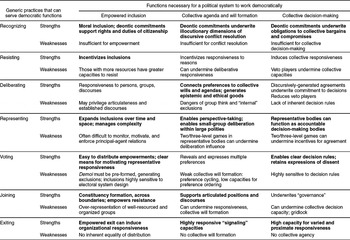
Once we sort the problems a political system needs to solve to count as democratic and practices that can address them, the payoffs will emerge very clearly. The practices we associate with democracy—for example, voting and deliberating—have problem-relative strengths and weaknesses. Deliberating, for example, is one means among others for addressing (democratically) desirable functions with political systems. Its primary strengths reside in collective agenda and will formation. But it functions weakly as a means of empowering inclusion, and hardly at all as a means for making collective decisions. For its part, voting can be distributed in ways that help equalize inclusions, and it operates as a strong decision rule. But because voting is a low information, nonpropositional means of communicating, it functions poorly as a way of developing collective agendas and forming collective wills. We can likewise sort other generic political practices (recognizing, resisting, representing, joining, and exiting) by their problem-specific strengths and weaknesses. Political systems are more democratic just to the extent that they use (and institutionalize) these practices in ways that maximize their strengths and minimize their weaknesses, relative to the problems of empowered inclusion, collective agenda setting and will formation, and collective decision making.
THE TROUBLE WITH MODELS OF DEMOCRACY
In the late 1970s and 1980s, political theory was undergoing a transformation from a discipline anchored in the history of political thought to one that was more focused on contemporary problems and more analytic in style. In the area of democratic theory, political theorists gravitated toward the idea of “modeling” forms of democracy (Macpherson Reference Macpherson1977), an approach that retained historical lineages but had the advantage of extracting claims in a way that could allow theoretical comparison across contexts and do so with a contemporary focus. In the best cases, the modeling strategy enabled clear normative claims, as well as corollary claims that related them to political institutions as well as social and economic conditions and contexts (Held Reference Held2006). Models had several disciplinary advantages: At a time when the study of democracy in political science was increasingly dominated by empirical methods and positive theory, they clarified normative presuppositions, enabling critical debate about better and worse forms of democracy. They also served to identify and bound research programs, and did so in ways that the normative stakes were clear. They have hugely benefitted democratic theory by identifying and justifying the norms, institutions, and functions associated with democracy. As I shall indicate below, the conceptual strategy I suggest here builds on these developments by absorbing their contributions.
But the “models of democracy” approach is now hampering the further development of democratic theory. The trouble is built into the strategy of model building, which typically foregrounds a particular practice (e.g., voting, deliberation, participation, or resistance), institutional device (e.g., elections or corporatism), norm (e.g., nondomination or the common good), or outcome (e.g., reflexivity or progress), and then defines the model in terms of the foregrounded feature. The consequence is that we now have a proliferation of adjectives that name and differentiate models: electoral democracy, competitive elite democracy, competitive multiparty democracy, pluralist democracy, corporatist democracy, developmental democracy, republican democracy, advocacy democracy, agonistic and adversarial democracy, pragmatic democracy, participatory democracy, progressive democracy, and—of course—deliberative democracy.
The difficulties with model-building of the kind that focuses on particular practices, institutional devices, norms, or outcomes are nicely illustrated by deliberative democratic theory, which came of age within this intellectual style, and is now arguably the most productive research paradigm within democratic theory. Most of those who originated the model contrasted “deliberative” to “aggregative” models of democracy (Cohen and Rogers Reference Cohen, Rogers, Fung and Wright2003; Elster Reference Elster, Bohman and Rehg1997; Habermas Reference Habermas1994; Miller Reference Miller1992; Young Reference Young2000; cf. Mansbridge, et al. Reference Mansbridge, Bohman, Chambers, Estlund, Føllesdal, Fung, Lafont, Manin and Martí2010). In particular, deliberation (the giving and responding to reasons and coming to a collective decision) was contrasted with voting (making decisions by aggregating preferences). By setting deliberation against aggregation, deliberative democrats were able to focus on new questions—in particular, questions as to how to form individual preferences into collective agendas and wills. But although productive in these ways, the frame organized other problems of democracy out of the picture, the most obvious of which were problems of distributions of power and voice, and actionable decision mechanisms. Critics pounced, arguing that deliberative democracy failed to pay attention to power and interests (Sanders Reference Sanders1997; Shapiro Reference Shapiro and Macedo1999); that it was insufficiently “political” because it failed to attend to the deeply agonistic character of politics (Mouffe Reference Mouffe1999); that it overlooked inequalities of voice and power (there were many critics, including some working within the model, such as Young (Reference Young2000)); that deliberation is subject to distortion and pathology when operating within political fields populated by strategic actors (Stokes Reference Stokes and Elster1998); and that deliberative models justify ideological domination because deliberation (in effect) alters individual consciousness under the coercive pressure of collective action (Pzerworski Reference Przeworski and Elster1998).
While there are very good responses to these criticisms (e.g., Bohman Reference Bohman1996; Chambers Reference Chambers2003; Cohen and Rogers Reference Cohen, Rogers, Fung and Wright2003; Dryzek Reference Dryzek2010; Warren Reference Warren, Stokes and Carter2002; Young Reference Young2000), we should step back and ask: What should we expect deliberation to accomplish within a democratic political system? If we ask this question, the strengths and limitations of deliberation are quite clear. A model of deliberative democracy, insofar as it is centered on deliberation, is not a theory of power, nor of distribution of power, nor of inequality, nor of political decision making. It is a primarily a theory of communicative responses to disagreement, preference formation, and collective will formation, focused on mediating conflict through the give and take of reasons (Habermas Reference Habermas1996). Although, of course, any democratic theory should address these other problems as well, the modeling strategy has encouraged expansionist claims along single dimensions, de-emphasizing necessary elements of democratic political systems. Perhaps predictably, criticisms often follow the modeling strategy into contrasting single channels, such as Sanders’ (Reference Sanders1997) “Against Deliberation,” Shapiro's (Reference Shapiro and Macedo1999) “Enough Deliberation: Politics is About Interests and Power,” and Pzerworski's (Reference Przeworski and Elster1998) attempt to show that deliberation, in contrast to voting in competitive elections, threatens ideological domination.
Although I will not do so here, it is possible to extend this critique well beyond democratic theory. Much political science, for example, assumes that “democracy” means “competitive electoral democracy,” focusing research on elections and voting behavior while overlooking democracy-relevant activities in the courts, public administration, public spheres, and civil society (Cain, Dalton, and Scarrow Reference Cain, Dalton and Scarrow2004; Fung and Warren Reference Fung and Warren2011).
BEYOND MODELS OF DEMOCRACY
Debates such as these have produced democratic theories that are more refined, stronger, and more creative than even a decade ago. This said, as the above examples suggest, a significant amount of debate appears to be the result of model-building strategies that are now stunting further theoretical development. Viewed from within these strategies, we might think that models are different answers to the same problem—usually the democratic legitimacy of political order. But what we actually get, as the examples above suggest, is something more like the same answers (e.g., deliberation or elections) to different problems of democratic political organization (in particular, empowered inclusion, collective agenda and will formation, and collective decision making). Rather than modeling democracy after a mechanism, practice, or norm, we should build democratic theory as a set of responses to the question: What kinds of problems does a political system need to solve to function democratically? That is, we need to think about the kinds of questions we are posing—questions that specify the domain boundaries of problems—such that deliberation or any other means, mechanism, practice, or institution could be the answer.
Two complementary developments within deliberative democratic theory push in this direction. The first is comprised of finer-grained, middle-level theories that pose questions as to what specific kinds of practices, like deliberating and voting accomplish. Sometimes the approach is to “reconcile” models, as Dryzek and List (Reference Dryzek and List2003) propose with respect to deliberative and social choice models. Reconciliation, however, involves showing that deliberation and aggregation mechanisms serve different functions: “the former [deliberative democracy] is concerned with identification of the functions that deliberation ought to, and indeed can, perform in democratic decision making, and the latter [social choice] is concerned with the clarification of the logical properties of available procedures for solving the aggregation aspects of democratic decision problems” (2003, 28). Similar kinds of functional sorting of practices can be found in the work of Fung (Reference Fung2003; Reference Fung2006); Goodin (Reference Goodin2008); Knight and Johnson (Reference Knight and Johnson1994; Reference Knight and Johnson2011); Mansbridge (Reference Mansbridge1980; Reference Mansbridge and Macedo1999; Reference Mansbridge2006); Smith (Reference Smith2009); Vermeule (Reference Vermeule2007); Warren (Reference Warren2001); and Young (Reference Young2000). The approach I sketch here generalizes these strategies of sorting political mechanisms and practices according to their strengths and weaknesses in addressing the three general problems a political system must solve to count as a democracy: empowered inclusion, collective agenda and will formation, and collective decision making.
A second development is a rediscovery of systems thinking of the kind that had been submerged by models thinking—a “rediscovery” in the sense that the first well-developed account of deliberative democracy, Habermas's Between Facts and Norms (Reference Habermas1996, especially chaps. 7 and 8), was less a “model” than a systems approach. On Habermas's account, deliberative features of democracy should be conceived as embedded within a variety of institutionalized practices and social structures that enable them to function. These include institutions that underwrite a variety of rights and protections that empower individuals and groups to have a say (Reference Habermas1996, chaps. 3 and 4). Different institutions, on Habermas's account, constrain and enable deliberation in different ways, depending upon their roles within political systems. Any viable democratic theory must theorize social and institutional ecologies, within which each practice or institution carries out a niche function, and which together can push political systems in democratic directions. Similar ideas underwrite more recent embraces of systems thinking in democratic theory (Dryzek Reference Dryzek2010; Mansbridge Reference Mansbridge and Macedo1999; Mansbridge et. al. Reference Mansbridge, Bohman, Chambers, Christiano, Fung, Parkinson, Thompson, Warren, Parkinson and Mansbridge2012; Warren Reference Warren2001, chap. 7). The problem-based approach I sketch here builds on systems approaches, but does so by focusing on those interconnected features of political systems that are important (that is, functional) for democratic problems. The approach links systems theory to normative democratic theory by specifying the normative content of functions, while using these same functions to specify system boundaries as those features of political systems relevant to democratic problems. While the problem-based approach I sketch here is congruent with the emerging deliberative systems approach in deliberative democratic theory (Mansbridge et al. Reference Mansbridge, Bohman, Chambers, Christiano, Fung, Parkinson, Thompson, Warren, Parkinson and Mansbridge2012), the questions it frames are broader. We should be thinking about deliberative contributions to collective will formation as just one of the functions necessary to democratic political systems (Owen and Smith Reference Owen and Smith2015).
A PROBLEM-BASED APPROACH: SYSTEMS, FUNCTIONS, PRACTICES, INSTITUTIONS
Building on these developments, the problem-based approach to democratic theory I am suggesting here combines the functional sorting of practices with an account of the system-level functions necessary for a political system to count as “democratic.” The conceptual building blocks are as follows.
Functions and systems
A problem-driven approach to democratic theory is grounded in the question: What problems must a political system solve to count as a democracy? To put the question in this way is to ask what kinds of problems a political system must address, such that it functions democratically, and then to ask how a variety of practices—voting, deliberating, representing, etc.—might be organized to address these functions. Thus, the idea of a “function,” as I use it here, is both normative and systematic. It is normative because identifying a democratic function is the same as claiming that a system should function in ways that support democratic ideals. The concept of function is also systematic because it frames the question in terms of normatively desirable consequences or outcomes (functions) of practices within their encompassing context. For these reasons, a problem-based approach to democratic theory is consequentialist and pragmatic (see also Knight and Johnson Reference Knight and Johnson2011).
To use the language of “functions” is, of course, to invite misunderstanding, since the term comes with quite a bit of baggage from the history of the social sciences. It has been conventional wisdom in the social sciences for several decades that “functionalism” is dead. Habermas (Reference Habermas1985; see also Giddens Reference Giddens1986) extensively argued against “functionalist reason” which derives from the functionalism originated by Durkheim, later incorporated into the structural functionalism of Talcott Parsons (Reference Parsons1951), and the newer systems theory associated with Niklas Luhmann (Reference Luhmann and Bednarz1995). This genre of functionalism objectifies social systems as an object, and then specifies the “objective” functions necessary for the system to reproduce itself. This approach tacitly reads normative value onto these “objectively necessary” features of the system. The result was a form of social science that reified social functions while failing to theorize the agency of individuals and collectivities. It supported conservative ideologies by placing value on whatever exists, deducing functional necessity from survival within encompassing systems (Habermas Reference Habermas1985, chap. 7).
But the conceptual strategy criticized by Habermas and many others (including methodological individualists since Max Weber) is not exhaustive of functionalist thinking. We can just as well put the normative questions implied in functionalist thinking directly, by articulating the normative implications of functions rather than hiding them within “objective functions” required by a social system. We shall need to conceptualize the notion of a “function” more normatively, and the idea of a “system” more contingently.
A normative conception of function is implied in the question of what common practices such as voting and deliberating achieve from a democratic perspective. When we ask about ways and means of achieving democratic norms—say, distributing votes or empowering voice—we are asking whether these ways and means function in ways that address (say) the problem (or norm) of empowered inclusions (cf. Habermas Reference Habermas1996, chap. 7). What are the problems to which voting and deliberation are the answers? In short, what are the democratic functions of practices like voting and deliberating?
The concept of a system is always implied in functional questions such as these, just because practices have effects that are contingent on their environments. In social science, however, systems thinking has commonly run into two kinds of problems. First, systems thinkers often conflate systems with natural entities, thus missing the fact that system-level social phenomena are reproduced by human agents who can change qualities of systems by changing their practices—although, of course, macro-level changes often require solving very difficult collective action problems (Giddens Reference Giddens1986; Habermas, Reference Habermas1985). Second, the boundaries of social systems are often fluid and their stability is highly contingent, affecting our abilities to define systems as objects. Key international systems, for example, depend on the existence of polities organized as nation-states within which some operate as global hegemons. Markets depend on institutions that underwrite and regulate money supplies, as well as institutions that protect buying and selling. Democratic theory often suffers a parallel problem: self-government is often conceptualized as bounded by nation-state systems, even as systematic effects increasingly flow across borders (Bohman Reference Bohman2007).
We can address simultaneously the problems of reification and object definition by conceiving of systems as relative to normatively significant problems. Thus, rather than trying to define systems as entities comparable to natural objects, for purposes of democratic theory we should view systems as comprised of those features of social relationships that are relevant to the ways individuals (or classes of individuals) are enabled, supported, empowered, constrained, dominated, marginalized (etc.) by the social relationships in which they are entangled, or upon which they depend. Thus, a set of problems will, for conceptual and practical purposes, “call forth” features of a social context as the relevant system. Some features of a system or its subsystems—say, a system of electoral representations—might exhibit relative stability with clear boundaries, practices, and embedded deontic features, such as duties for representatives who lose office to make way for those who win. Within political science, such a system will be consistently called forth by (say) problems of empowered inclusion. Other kinds of systems, such as markets, will exhibit some level of self-programed autonomy. Still others, such as the sectors of civil society comprised of voluntary associations, will be less autonomous owing to their more direct dependencies on purposes of association members.Footnote 1
For purposes of democratic theory, we will want to think of systems as comprised of resources, interdependencies, and constraints that are relevant to problems of democracy. Thus, for example, an institutionalized system of rights can be identified as an object of analysis for, say, legal purposes. But it becomes part of a democratically relevant system just to the extent that rights empower inclusions. Once we understand the concept of a “system” in this way, we can then pose the key question of democratic theory: What should a political system accomplish to count as “democratic? We then can ask how generic practices such as voting and deliberating should be organized within a (problem-relevant) system to serve democratic functions.
Practices and institutions
In using the term “generic political practices,” I mean to identify ideal-typical social actions that are commonly organized or enabled by institutions that serve democratic functions: recognizing, resisting, representing, deliberating, voting, joining, and exiting. I follow Weber (Reference Weber2013 [1922], 3–63) in considering “social actions” to be socially intended behaviors, and count them as the basic entities (ontologically speaking) to which any kind of social analysis refers. While democracy is a property of political systems, it is enacted and reproduced through social actions, and thus retains (ontologically speaking) its agent-focused, normative foundation in self-government. Institutions such as elections and legislatures are rule-based, incentivized, and sociologically stable combinations of social actions that assign roles to individuals (e.g., voter, representative, etc.). Insofar as social actions are rule oriented, they imply institutions. In democratic systems, for example, to “vote” implies institutions within which votes have meanings and functions: in voting I elect a representative or a party, or I help to decide a ballot measure. Institutional rules also have deontic properties that assign duties, obligations, and responsibilities, and powers to individuals (e.g., Searle Reference Searle2005). From the standpoint of democratic theory, however, we need to avoid identifying any particular institution with “democracy”—say, a competitive electoral system—so we can ask the normative question as to whether any particular institutional organization of practices serves democratic functions within its context.
THREE NECESSARY FUNCTIONS FOR A POLITICAL SYSTEM TO COUNT AS “DEMOCRATIC”
We can now turn to the normative question: What must a political system accomplish to count as “democratic?” I suggest that there are three broad functions, which I shall call empowered inclusion, collective agenda and will formation, and collective decision making. The common sense behind this short list is straightforward, and builds on widely shared intuitions within democratic theory as to what political systems must accomplish to count as “democracies.” Democratic political systems include those people entitled to voice and impact into political processes through distributed empowerments. Once inclusions are achieved—that is, once those who should have power and voice have a place at the table—democracies need to form this input into collective agendas or wills, through communication, deliberation, negotiation, and bargaining. Finally, democracies need to make decisions through which “the people” are reflexively constituted into collective agents capable of doing collective things for themselves. It is normatively necessary for a political system to solve each of these problems if it is to count as “democratic.” If any one of these functional capabilities is missing, the system cannot instantiate democracy. It will fail democracy in one or more of these three ways: it will exclude those with claims to inclusion, or it will fail to form collective agendas and wills that reflect the interests, perspectives, and values of those included, or it will fail to act as a collective agent of the relevant people. As an empirical matter, of course, each of these functions is continuous rather than dichotomous: political systems can function more or less democratically. And, although I cannot develop here, it would be possible to regroup conceptually the many indicators common in increasingly sophisticated comparative democracy assessments (extent of the franchise and elections, rights and rule of law, a free media and transparency, civil society engagement, legislative capacities, etc.) by looking at the ways they support these three democratic functions, in this way tying empirical assessments more closely to normative democratic theory (see, e.g., Coppedge and Gerring, et. al. Reference Coppedge, Gerring, Altman, Bernhard, Fish, Hicken, Kroenig, Lindberg, McMann, Paxton, Semetko, Skaaning, Staton and Teorell2011).
Why these three (normative) functions, and not more or fewer? These are the functions that describe the relationships between individual and collective agency that establish democracy as “rule of the people.” The first function frames questions as to how individual agents gain status and influence within collectivities. The second frames questions as to how they enter into relationships of understanding with others, such that they can identify and understand their preferences, and relate their preferences to others and to collective agendas. The third frames questions of collective agency, through which people provide collective goods for themselves.
At a high level of abstraction, these functions are probably exhaustive the agent-centered features of democracy. But they are minimalist. They do not encompass goods that are consistently associated with democracy—goods such as social stability, peace, prosperity, human development, and low cost collective coordination (Dahl Reference Dahl1998, chap. 5; Ober Reference Ober2008). There are other goods associated with democracy, such as freedom, liberty, and nondomination (e.g., Pettit Reference Pettit2012) and the relative epistemological robustness of public decisions (Estlund Reference Estlund2009; Knight and Johnson Reference Knight and Johnson2011; Landemore Reference Landemore2013) that are conceptually and practically implied in these three agent-focused functions, but can also be justified independently of democracy.
Nor are these three functions sociologically and institutionally sufficient to democratic political systems: I am not offering a theory of democratization. Depending upon the issue, a political system's democratic functions will almost certainly depend, for example, upon state or statelike capacities. Insofar as voting functions to empower inclusions and constitute governments, for example, it requires administrative structures for organization. Actionable rights that serve to include voice and to protect deliberation depend upon functioning judicial structures as well as an effective control by the state over the means of violence. Social capabilities for pressure, advocacy, resistance, and bargaining are deeper and more effective where states are able to provide basic welfare functions, such as basic income, health, and education. Tilly's (Reference Tilly2007) argument that successful democratization builds on the consolidation and development of these kinds of state capacity is almost surely right. Likewise, it is almost certainly the case that democratic systems are stronger and more effective in societies with high degrees of generalized trust within society, and high confidence in institutions (Warren Reference Warren1999). These circumstances, although favorable for democracy and maybe even necessary, are not coextensive with democratic norms and mechanisms, as they may exist in their absence. The theory I am sketching here focuses more narrowly on the three broad functions that political systems must serve in order to count as “democratic.”
Empowered inclusion
We might think of democratic processes as beginning (functionally speaking) with inclusion, justified by a norm of inclusion, such as the idea that those who are affected (or potentially affected) by collective decisions ought to have some say, or a chance to have some say, over the decision (Fung Reference Fung, Nagel and Smith2013; Goodin Reference Goodin2007; Young Reference Young2000). Democracies do more than include, however: they empower inclusion. It is not enough, for example, for a government to include by consulting its citizens; people who are (normatively) entitled to be included must have powers through which they can, as it were, demand and enforce their inclusions, through votes, legal standing, representation, vetoes, organized opposition, and so on. Generally speaking, this function requires that those who have claims for inclusion by virtue of being affected or potentially affected by collective decisions possess the powers of speaking, voting, representing, and dissenting (Fung Reference Fung, Nagel and Smith2013; Goodin Reference Goodin2007; Habermas Reference Habermas1996; Young Reference Young2000). Political equality—a core democratic value—is functionally important for empowered inclusion: those who have claims to inclusion should have equal rights to vote, speak, organize, as well as equal protections that enable individuals to use these empowerments. Moral and ethical considerations have primarily to do with the recognitions that underwrite inclusion, and justifying distributions of empowerments and inclusions (Dahl Reference Dahl1998, chaps. 6 and 7).
Collective agenda and will formation
Once the interests, values, perspectives, and preferences of individuals or classes of individuals are included within a collectivity through empowerments, they need to be formed communicatively into collective agendas and wills. The primary means for doing so include advocacy, argument, persuasion, negotiation, and bargaining—that is, forms of deliberation, broadly conceived. The guiding idea here is an old one, found in Aristotle, Rousseau, Kant, Mill, and Dewey, and is now highly developed in theories of deliberative democracy: individual preferences (interests, perspectives, arguments, etc.) need to be related communicatively to collective judgments, so that individual self-government extends through collective self-government. Self-rule within a collective requires that individuals know how their preferences relate to collective judgments, and to understand the reasons that justify collective judgments. Political theorists who use neo-Kantian language refer to these elements as public and private autonomy (Habermas Reference Habermas1996, chap 4). Some institutional conditions indirectly support the communicative means for collective agenda and will formation by neutralizing or minimizing the kinds of coercion, domination, and oppression that suppress communication, thus enabling the media of advocacy, argument, and persuasion to operate among and between individuals, groups, and their representatives. Other conditions operate more directly: elected legislatures, for example, ideally comprise spaces of communicative agenda formation focused by their decision-making powers (Habermas Reference Habermas1996, chap. 7; Manin Reference Manin1997). In addition, we are seeing novel kinds of bodies, such as the Oregon Citizens’ Initiative Review, constructed for explicitly deliberative purposes (Warren and Gastil Reference Warren and Gastil2015).
The moral and ethical considerations that justify this function include deliberation-enhancing norms such as respect and reciprocity, as well as those related to moral judgments based on generalized perspective-taking, including fairness (Gutmann and Thompson Reference Gutmann and Thompson1996; Habermas Reference Habermas1990; Rawls Reference Rawls2001). Political equality within communication is performative, embedded in the illocutionary features of speech through which individuals are mutually recognized as “self-authenticating sources of valid claims” (Rawls Reference Rawls1993, p. 72; see also Young Reference Young2000, chap. 2).
Collective decision-making
Like inclusion, collective decision-making is about empowerment rather than collective will formation. But whereas empowered inclusion (the first function) is about empowering individuals, this function is about collective empowerment, which occurs when collectives have the capacity to make and impose binding decisions upon themselves; it is about “getting things done” (Habermas Reference Habermas1996, Ober Reference Ober2008, Mansbridge Reference Mansbridge2011, Martin and Mansbridge Reference Martin and Mansbridge2015). Collective decision capacity enables peoples to provide common goods and securities for themselves, as well as to regulate quasi-autonomous systems such as markets. But it also enables a collectivity to provide the conditions of empowered inclusions and collective will formation (Habermas Reference Habermas1996). Political systems that fail to enable these moments of constitution also fail to empower peoples as collective agents.
Democracy is often viewed as possible only within strong, constitutionally-regulated state contexts, largely because it has been assumed that the binding qualities of collective decision require state coercion (Pettit Reference Pettit2012, chap. 3, Tilly Reference Tilly2007, Habermas Reference Habermas1996). Constitutional states are essential to democratic possibilities. But we can now see democratic possibilities developing beyond nation-states, mostly because organizations increasingly work across state boundaries (Bohman Reference Bohman2007). The binding qualities of collective decision-making capacities can follow from non-state-based incentives, such as capturing economic benefits or avoiding the costs of externalities and uncertainties, including war. This again is why, for purposes of democratic theory, we should avoid equating “democracy” with specific institutions such as constitutional states, no matter how essential. Instead we should ask how practices and institutions function within political systems, so that we can identify and assess democratic possibilities within new or novel contexts.
The moral and ethical considerations related to collective decision-making are not well developed within democratic theory, probably because of the intrinsic but tense fraught relationship between collective empowerment and coercion in democratic theory and practice (cf. Habermas Reference Habermas1996; Mansbridge, et al. Reference Mansbridge, Bohman, Chambers, Estlund, Føllesdal, Fung, Lafont, Manin and Martí2010; Warren Reference Warren, Dryzek, Honig and Phillips2006). But we do find these considerations developed within the liberal strands of modern political thought, which, beginning with Hobbes, have long posed the question of the legitimacy of collective coercion (Klosko Reference Klosko2005; see also Pettit Reference Pettit2012, chap. 3).
Although I do not develop a theory of democratic legitimacy here (cf. Rosanvallon Reference Rosanvallon2011), key dimensions of this composite concept attach to each function, such that higher degrees of democracy should generate greater democratic legitimacy. Legitimacy based on inclusion—sometimes called input legitimacy—follows from status and voice within a collectivity. Legitimacy based on collective agenda and will formation (roughly equivalent to throughput legitimacy, Schmidt Reference Schmidt2013) follows from reasons that people find compelling, and thus acceptable, reasons that people appreciate as important to others, as well as confidence that institutions support due consideration in making decisions in ways that are transparent and accountable. Finally, collective decision-making is a necessary condition of performance legitimacy (often called output legitimacy), although, of course, this dimension is contingent upon organizational systems that translate decisions into collective responsiveness.
SEVEN GENERIC PRACTICES THAT CAN SERVE DEMOCRATIC FUNCTIONS
These three functions encompass most—possibly all—of the problems a political system must solve to count as democratic. It is another question as to how political practices might be organized, usually into institutions, so as to best achieve these (idealized) functions. But we now have a conceptual head start: we can identify kinds of political practices that might address these functions, and then ask about their potential strengths and weaknesses relative to democratic functions.
For purposes of this theoretical sketch, I identify and discuss seven kinds of generic practices that can be institutionalized, incentivized, or protected so they function to produce democratic effects: recognizing, resisting, deliberating, representing, voting, joining (producing association), and exiting (producing competition-based accountability). I intend this list to identify practices that people understand and can perform, especially but not only within the developed democracies. I shall not argue that this particular list is exhaustive: there may be more such democracy-relevant generic practices, though probably not fewer.
As I suggested above, institutions can be conceived as organizations (usually combinations) of practices, and can be assessed as to how well they serve democratic functions. In this way, the approach retains its normatively critical function: rather than identifying democracy with (say) competitive elections, we can ask how specific organizations of (say) voting serve democratic functions, such as empowered inclusion. From the perspective of normative democratic theory, we want to know, for example, whether organizing voting practices through the many variants of proportional representation electoral systems serve to empower inclusions or to form collective decision-making powers better than single member plurality systems (see, e.g., Lipjhart Reference Lijphart1999; Powell Reference Powell2000; cf. Vermeuile Reference Vermeule2007). If we can frame and answer questions such as these, we can critically assess what is “democratic” about existing practices and their institutional combinations.
A problem-based approach to democratic theory, however, does much of its work conceptually prior to this kind of institutional analysis, by sorting generic practices according to their function-specific strengths and weaknesses. Table 1 summarizes this kind of sorting, with strengths relative to the three democratic functions indicated in bold. Few of the judgments in Table 1 are original; they summarize knowledge already well developed in the literature. What a problem-based approach offers is a context of functional questions so we can understand the strengths and weaknesses of each kind of practice from a democratic perspective. The result will be a relatively fine-grained set of assessments as to when, where, and why we should want more, better, or different deliberating, voting, and so on.
Strengths and Weaknesses of Practices Relative to Democratic Functions

It follows, of course, that not every class of practice will suit every function. It also follows that none of these practices is inherently democratic. Most can support nondemocratic systems. Voting in a plebiscite can support dictatorship. Emerging deliberative politics in China may strengthen authoritarianism (He and Warren Reference Warren2011). Representation of a variety of castes and corporate bodies was a key part of European feudalism. And the so-called “illiberal democracies” are typically labelled “democracies” only because they include elections, not because such political systems function democratically (Gandhi Reference Ghandi2008; Zakaria Reference Zakaria1997). So we shall need to ask how each practice supports (or undermines) the three functions that together comprise democracy: empowered inclusion, collective agenda and will formation, and collective decision-making.
Recognizing
The act of recognizing others is a founding moment of democracy, through which “peoples” come into existence. Recognizing is democratically significant in a number of ways. First, recognizing is the most basic act of inclusion: in the minds of agents, recognitions establish mutual connections to shared circumstance, affected interests, fate, concern, common injuries, or common aspirations. Recognitions of these kinds put into place moral relationships: to the extent that I recognize you as bound to me by a common concern, I assume duties to you, as you do to me, to take into account your perspectives, interests, and values, as we develop common plans (Honneth Reference Honneth1995, Young Reference Young2000). Second, recognitions can be empowered, typically in the form of rights and duties that attach to citizenship or membership (Williams Reference Williams, Bernstein and Coleman2009). Third, when I commit these recognitions to language and when you assent, revise, or respond, I am developing sets of deontic commitments to you, and you to me (Brandom Reference Brandom2001). In deliberative interactions, recognition is always the first inclusionary moment (in speech act theory, the illocutionary moment) in which I grant you the status of someone who can be motivated by claims and reasons (Gutmann and Thompson Reference Gutmann and Thompson1996; Habermas Reference Habermas1985, 3–42; Rawls Reference Rawls1993). Finally, initial recognitions provide legitimacy to collective bargains and compromises, as they provide some moral assurance that a decision was fair, insofar as the interests, values, and perspectives of each entered into decision processes (Habermas Reference Habermas1996, chap. 4; Rawls Reference Rawls2001). For all these reasons, recognitions play essential roles in moving political conflict toward democratic interactions.
It is often argued that democracy is paradoxical because it is impossible to democratically establish the boundaries of the demos, which can then organize itself democratically (Dahl, Reference Dahl1989; Whelan Reference Whelan1983). The paradox is, however, mostly an artifact of noting that some political mechanisms—voting or rights supported by a state, for example—cannot establish demoi. But these are the wrong expectations for these kinds of practices. Rather, we should be focused on recognitions as the originating moment of demoi. Likewise, we should not assume that existing political boundaries, including states, are sufficient to the many ways in which people are connected, especially in a world in which recognitions of mutual connection or fate cross established political boundaries, producing many overlapping demoi—with, potentially, many political organizations and associations that can (and often are) building upon them (Bohman Reference Bohman2007).
This said, recognizing is primarily a moral act of inclusion. While moral claims and recognitions can carry important influence, it must, typically, combine with other kinds of power and actions to underwrite democratic functions. Likewise, recognitions are relatively weak in the face of intractable conflicts and cleavage, in which opponents simply refuse recognition to one another. Finally, while always part of democratization processes, recognitions are ongoing performative features of democracies that enact inclusions. Thus, if I hold and use rights as a member of a collectivity, then others recognize me as having moral standing as a member, with the entitlements and duties that follow.
Resisting
Historically, democracy has never emerged de novo, but more often out of situations in which agents resist domination, oppression, exploitation, or imposed rule—that is, forms of exclusion from places and processes of deliberation and decision about matters that affect them. While I am not offering a theory of democratization, acts of resistance so often lead to eventual inclusions that they stand as a class of practices on their own (Foucault Reference Foucault and Rabinow1984; Rosanvallon Reference Rosanvallon2008). Resisting is, typically, combined with moral demands for recognition, often focused by injury or injustice, and usually combined with some kind of power resource, from passive resistance (work to rule, civil disobedience) and noncooperation, to withholding labor (as in a strike), flight from administration, nonpayment of taxes, or taking up arms. Because power is, ultimately, the ability of some to command the actions of others, resistance undermines the powers that elites can deploy. Elites often crush resistance, of course. But if resistance is significant enough to impose costs on the powerful, it can produce inclusions that can be in turn progressively routinized—indeed, such was the origin of the Magna Carta. From the standpoint of democratic political systems, resistance remains so important to inclusions that spaces for resistance become part of the system itself (Rosanvallon Reference Rosanvallon2008)—for example, in rights to strike, rights to withhold votes or to vote no, rights to organize and demonstrate, and, of course, rights to criticize and dissent.
Yet there is nothing inherently democratic about resistance in itself. Raw powers of resistance are typically unequally distributed relative to legitimate claims. Capitalists can resist taxation and regulation for broadly agreed public purposes by moving or withdrawing investments. Homeowners can resist renter-friendly developments. With respect to collective agenda and will formation, resisters may demand recognitions, but refuse to reciprocate, making collective agendas difficult to find and collective decisions impossible. Finally, if a polity is constructed in such a way that powerful minorities can easily veto collective decisions—the United States is arguably a case in point—it may be difficult for any collective decision to be made, and peoples will be unable to act collectively for themselves (Martin and Mansbridge Reference Martin and Mansbridge2015).
Deliberating
By “deliberating” I mean practices that generate influence through the offering and receiving of cognitively compelling reasons about matters of common concern. Deliberation thus includes negotiation and bargaining, insofar as these involve the forming or revealing of preferences, such that deliberating parties can count upon this information in decision making, as well as the commitments of agents to bargains (Warren and Mansbridge Reference Warren, Mansbridge, Martin and Mansbridge2015).
When we ask about the contributions of deliberating to the three democratic functions, the strengths and weaknesses stand out in relief—so much so that they hardly need a detailed accounting. The key strength of deliberation is in communication and collective agenda and will formation. The goods that follow are well theorized: they include epistemic goods, including revealing preferences and pooling information (Estlund Reference Estlund2009; Landemore Reference Landemore2013). There are ethical benefits that follow from perspective-taking: hearing from others, empathizing with them, and imagining oneself in their place (Gutmann and Thompson Reference Gutmann and Thompson1996; Young Reference Young2000). Common and overlapping preferences can emerge from the give and take of reasons. And, importantly, deliberation increases chances that participants will recognize their preferences (their interests, values, and ethics) in collective wills or agendas, thus increasing the legitimacy of collective decisions. Deliberative theorists have also noted a variety of weaknesses: deliberative processes may be subject to group think, bandwagon effects, confirmation biases (Elster Reference Elster1998; Goodin Reference Goodin2007; Sunstein Reference Sunstein2002), as well as a variety of what have come to be known as “internal” exclusions following from differing styles of communication and status effects of sex, race, culture, or ethnicity (Mendelberg and Karpowitz Reference Mendelberg and Karpowitz2014; Young Reference Young2000).
By assessing deliberation relative to the three democratic functions, it is also quite clear what we should not expect from deliberation. First, we should not expect deliberation to address problems of empowered inclusion. The key reason is that deliberation is not, in itself, a mode of empowerment, nor is it a mechanism for distributing empowerments according to entitlements for inclusion. If we fail to make this distinction, then it is difficult to explain why deliberation in the context of skewed empowerments (a context, say, in which the wealthy can buy more voice, or deliberation among elites) can undermine democracy. Critics of deliberative democracy make this kind of point continually, but its force depends upon treating deliberation as if it functions as to empower. The proper response is, simply, that inclusions work through empowerments that are not in themselves features of deliberation. This said, some features of deliberation reinforce inclusions in subtler ways. The illocutionary dimensions of deliberation can function as recognitions that can serve to endow others with the status of discursive participant (Brandom Reference Brandom2001; Habermas Reference Habermas1985; Young Reference Young2000).
The other function we should not expect deliberation to serve is collective decision-making. Indeed, the common term “deliberative decision-making” confuses the two quite different functions of collective agenda and will formation, and collective decision-making. There are three key differences. First, deliberation has often been defined as discourse aimed at consensus—a specific kind of decision-making (and a misreading of Habermas’ theory of communicative action). Deliberation is, however, a mode of influence in which participants hope to sway one another to their positions—that is, participants seek a consensus in the sense that they wish to persuade others of their positions. But an expectation of consensus for a deliberative process is, in fact, a commitment to a decision rule of unanimity. Such a commitment prejudges the nature of the issue, and may be quite inappropriate—when, for example, positions are based on conflicting comprehensive worldviews (Mansbridge Reference Mansbridge1980; Reference Mansbridge2006). Under these circumstances, a consensus decision rule undermines deliberative goods such as the clarification and sorting of issues in ways that produce the agendas necessary, for example, for voting to return results that reflect majority preferences and minority dissent (Dryzek and List Reference Dryzek and List2003).
Second, deliberation and decision differ in their temporal qualities. As Goodin (Reference Goodin2008, chap. 6) argues, deliberative influence is, by its nature, temporally serial: A responds to B who then responds to A. Collective decisions, however, must happen within a short period of time if they are to constitute a collectivity as an agent. Thus, Goodin rightly argues, good procedures should be based on the rule “first talk, then vote.”
Third, collective decisions introduce bindingness: that is, everyone is subject to the decision, whether or not they agree with the decision (Elster Reference Elster, Bohman and Rehg1997, 18–9; Mansbridge, et al. Reference Mansbridge, Bohman, Chambers, Estlund, Føllesdal, Fung, Lafont, Manin and Martí2010). Individuals should be able to count on decisions to resolve collective action problems and then depend upon the securities and certainties that follow (Habermas Reference Habermas1996). To treat deliberation as if it were a decision rule that can serve these functions would be to treat bindingness as if it were a discursively achieved agreement. Where these are conflated, deliberative influence ends up buried under the demands of collective decisions. This said, binding decisions made by (say) voting can benefit from the legitimacy generated by deliberative processes, either because win-win agreements have been found, or participants consider their interests to have been fairly represented and considered in processes leading up to decisions. Generally speaking, however, we should not look to deliberative influence to secure empowered inclusion, nor to function as an effective and legitimate way of making collective decisions. For practices that serve these functions, we should look elsewhere.
Representing
Practices of representation in which one agent stands, speaks, or acts for another are ubiquitous in large-scale, complex political systems (Pitkin Reference Pitkin1967). They are also essential to all three democratic functions, as is well recognized in the literature. With respect to empowered inclusion, representative relationships overcome the limitations of time, space, and complexity. Through representative relationships, many millions, grouped by constituency, can have a “place at the table.” Through public deliberation, advocacy, and voting, representatives can be held accountable, thus empowering inclusion. With respect to collective agenda and will formation, representative relationships enable the formation of bodies such as legislatures that are small enough to focus on an issue, deliberate, and bargain (Manin Reference Manin1997). Advocacy representatives are essential to forming and focusing public debate and deliberation, out of which broad public agendas emerge (Montanaro Reference Montanaro2012; Saward Reference Saward2010). Practices of representation also enable perspective taking: when people make representative claims, they are asking their audience to see the world from their perspective. Empathy, one of the effects of perspective taking, is a key precursor of successful deliberation (Morrell Reference Morrell2010). And with respect to collective decision-making, representation can produce legislative bodies that can focus and sequence decisions, thus collectively empowering people to provide collective goods for themselves (Martin and Mansbridge Reference Martin and Mansbridge2015).
But it is also well recognized that representation has weaknesses specific to each function, which is why representative relationships need to be combined with other practices—deliberating, voting, joining, and exiting—if they are to serve democratic purposes. With respect to empowered inclusion, it is often difficult for principals to monitor their representative agents, even when combined with voting. Likewise, it is often difficult for agents to choose the interests or values they would like to be represented, as aggregation by constituency tends to swamp finer-grained preferences. As is well known, these effects vary with electoral system design, with single member plurality systems typically less sensitive than proportional representation systems. Empowered inclusions that work through advocacy representatives—those who “speak for”—are more effective with dense, well-protected civil societies that enable individuals to enter and exit advocacy organizations (Warren Reference Warren2001).
The weaknesses of representing with respect to collective will formation are also well studied and need only mention. When combined with voting, representatives are embedded in two- and three-level games: they must respond to their constituents, to their parties in government or opposition, and to one another. The resulting strategic incentives can often undermine the deliberation, negotiation, and bargaining necessary to collective agenda and will formation (Warren and Mansbridge Reference Warren, Mansbridge, Martin and Mansbridge2015). Collective decisions can be taken apart by similar kinds of strategic incentives. Both kinds of weakness increase the importance of institutional designs that enable and shelter deliberation, and incentivize agreements (Martin and Mansbridge Reference Martin and Mansbridge2015).
Voting
The strengths of voting follow from its functions as empowerments. With respect to inclusions, the universal franchise—the most visible victory in the history of democratization—serves to get people, groups, or their representatives a place at the table, simply because votes can be used as vetoes (adding some power to resistance), organized, and shifted from one representative or proposal to another. A key condition for votes to empower inclusions is that they occur within contexts of choice, a point I elaborate upon below in discussing the importance of exiting to democracy. Thus, voting in plebiscites or for government-approved candidates cannot function as empowerments because voters cannot use their votes to select or remove representatives or policies (that is, they cannot exit). Beyond such cases, however, there are many ways of structuring choices through electoral system design, with consequences for the ways voting serves to empower inclusions—a well-studied area within political science (Farrell Reference Farrell2001; Lijphart Reference Lijphart1999; Powell Reference Powell2000).
A second kind of empowerment follows from the strengths of voting as a decision rule, as with majority rule. When well organized, elections have capacities to produce governments, which can (and should) transform peoples into collective agents. Voting also has the advantage of measuring the strength of a decision by retaining and expressing dissent (though it is not the only way): when votes are counted, people know who won and who lost. Dissenters gain an indication of their strength, which may then become the basis for their next political campaign even as they accept the legitimacy of the decision.
But voting also has weaknesses, particularly with respect to collective agenda and will formation. Indeed, it is this weakness that fueled the contrast between “aggregative democracy” and “deliberative democracy” in the deliberative democracy literature. Voting is a poor means of communication, largely because it is not propositional. It communicates only in the form of low information signals. The common claim that the “people speak” through elections is a conceit of winners. As Rosenvallon (Reference Rosanvallon2011, 2) puts it, “[d]emocratic election . . . conflates a principle of justification with a technique of decision.” Nor is voting a good way of forming collective agendas: voting can at best aggregate preferences that are already structured into an agenda. Even then, aggregation can produce paradoxical results such as preference cycling in which voters appear to prefer A over B, B over C, but also C over A, as famously demonstrated by Kenneth Arrow (Pzreworski Reference Przeworski2010, chap. 5). Closely related, voting does a poor job of ordering preferences. As Dryzek and List (Reference Dryzek and List2003) argue, deliberating does what voting cannot: enables a collectivity to clarify preferences sufficiently that voting can produce decisions that reflect ordered preferences. In short, we should not be choosing between “aggregative” and “deliberative” democracy: voting and deliberation serve different, but necessary, democratic functions (Knight and Johnson Reference Knight and Johnson1994; Reference Knight and Johnson2011, chap. 4; Mansbridge et al. Reference Mansbridge, Bohman, Chambers, Estlund, Føllesdal, Fung, Lafont, Manin and Martí2010).
Nor should voting be viewed as exhaustive of empowerments, as often implied by champions of electoral democracy such as Pzerworski (Reference Przeworski2010). The effectiveness of voting as an empowerment depends upon the existence of a relevant demos to which voting-based empowerments can be distributed. When there are mismatches between the ways demoi are organized and issues that affect people, voting is a weak empowerment or fails to empower at all, which should cause us to focus on other kinds of practices to serve these functions (Bohman Reference Bohman2007; Rehfeld Reference Rehfeld2005).
Joining
Among the generic acts that can serve democratic functions is joining an association—that is, an organization created by members to achieve a collective purpose (Putnam Reference Putnam1993; Tocqueville Reference Tocqueville and Mayer1969 [1840], 517; Warren Reference Warren2001). There are conditions favorable to joining: most importantly, the freedom to associate (as well as related freedoms of speech and conscience), secured by the powers of states. Where such securities exist, people come together to pursue countless purposes related to lifestyle, hobbies, identities, spirituality, politics, self-help, community service, and so on. Collectively, acts of joining can comprise democracy-supporting civil societies (Edwards Reference Edwards2009; Habermas Reference Habermas1996, chap. 8; Warren Reference Warren2001).
The most important democratic function of joining is empowered inclusion: through association, people can organize votes, representation, and resistance. Tilly (Reference Tilly2007) emphasizes association as a key precursor of democratization: states democratize when resources are controlled outside of states and by members of society, in such a way that political elites are induced to bargain, and may eventually routinize bargaining through (for example) representative institutions. Association-based capacities for resistance tend to generate inducements for inclusions owing to their potential for veto. Moreover, in contrast to voting, joining an association is not limited by existing political constituencies and boundaries. People can associate to form demoi around common issues and causes; joining is the conduit for informal constituency formation of those affected by or concerned about an issue (Montanaro Reference Montanaro2012; Saward Reference Saward2010). Once associations become vectors for inclusion, they also function as means to pressure, represent, set agendas, and underwrite public discourses. They provide the social infrastructure for public spheres, within which public opinion feeds collective agendas and wills (Habermas Reference Habermas1996, chap. 8). Associations can also serve as partners in collective actions, dramatically increasing capacities for collective action, a role most fully theorized under the concept of “governance” (Warren Reference Warren, Griggs, Norval and Wagenaar2014).
Of course joining and associating have functional weaknesses that become evident when generalized beyond their key areas of strength in empowering inclusions. But even with respect to this function, associational powers often follow existing distributions of resources, particularly education, such that they are more likely to be deployed by those with relatively privileged positions in society (Verba, Schlozman, and Brady Reference Verba, Schlozman and Brady1995). Voting, in contrast, is easier to distribute without regard to resource endowments.
There are weaknesses in the other two democratic functions as well. While associations help to form collective agendas, they can undermine collective will formation. Associations tend to self-select for those who are like-minded, reinforcing biases in ways that increase adversarial discourse at the expense of deliberation. Similarly, because those who have more resources tend to be better joiners, association often biases toward resistance by the relatively privileged, which in turn can undermine collective decision-making capacities in favor of the status quo. As Mansbridge (Reference Mansbridge2011) has argued, these effects are underappreciated in democratic theory: the “resistance tradition” undervalues “the importance of getting things done.” In the terms I am using here, the resistance tradition often overgeneralizes the contributions of association to empowered inclusion at the expense of the (necessary) democratic function of collective decision and action. In the United States, for example, political institutions are highly sensitive to the veto capacities of powerful advocacy groups, producing a paralyzing hyperpluralism in contested areas of policy. In weak state contexts, strong associations can make collective actions impossible, as they displace collective action capacities into local, tribal, or religious associations (Tilly Reference Tilly2007).
Exiting
Finally, I consider a generic act not commonly thought to be part of the arsenal of democratic practices: exiting, which both indicates the presence of choices, and enables market-like competition. While this is not the place to develop a full account of this practice (see Hirschman Reference Hirschman1970; Warren Reference Warren2011), it is worth noting that choice, empowered by the possibility of exit, has long been designed into democratic institutions through competitive elections. More recently, many of the strongest democracies, such as Denmark, have structured choice into public service provision: public agencies underwrite multiple providers and allow citizens to choose from among them (Sørensen Reference Sørensen1997). Demand is publicly funded, but follows each individual in such a way that organizations have incentives to respond to individuals so as to retain their resources.
The broader point is that when exit is designed into institutions to support individual choices, it can function to empower individuals in ways that are especially appropriate to complex, mass societies. In such societies, individuals, by themselves or even in small associations, often have little leverage to affect institutions without massive amounts of organization, resources, and time—all of which bias political systems toward those who are well endowed with resources. In contrast, the individual choice to exit requires relatively fewer resources to be effective: organizations faced with loss of members, income, or votes have inducements to reach out to individuals proactively. Under these circumstances, exit within the context of organizational competition can enhance empowered inclusions (Warren Reference Warren2011).
The same logic also serves collective agenda and will formation. Individual exit choices are, in themselves, low information signals—much like votes. But signals also communicate to organizations that they need to engage with their members—to find out what they want and need, and to mold responses accordingly (Hirschman Reference Hirschman1970; Warren Reference Warren2011). A relatively recent study, for example, found that after a school district introduced choice among its public schools, each school became more internally democratic (Mintrom Reference Mintrom2003).
With respect to collective decisions, exiting can induce organizations to devolve decisions to levels that enable varied and proximate responsiveness to individuals and small groups—an important development in complex mass societies within which high-level organizational decision-making can be far removed from the needs and interests of those affected (see, e.g., Rosanvallon Reference Rosanvallon2011, part 4).
But exiting does not in itself provide for appropriately distributed capacities for demand, nor does it form collective wills, nor can it provide for collective agency. These are all features that must be achieved through other kinds of practices and organized into institutions, such that choice and competition support rather than undermine the three functions that comprise democratic systems (Warren Reference Warren2011).
CONCLUSION
I have been arguing that we should jettison the “models” approach to democratic theory in favor of a problem-based, normatively functionalist approach. We need to ask what problems political systems need to solve to count as “democracies.” At a high level of abstraction, the list is short: systems need to empower inclusions, to enable communication among members of collectivities in order to form collective agendas and wills, and to make collective decisions that empower peoples to provide for themselves as collective agents. From a democratic perspective, every other feature of political systems—in particular, practices and their organization into institutions—should be assessed relative to these problems.
A problem-based approach has a number of key advantages that will help keep democratic theory current and forward looking.
-
• The approach is tractable in spite of the complexity of democratic political systems. Using a relatively spare conceptual palette, the approach generates a kind of complexity that is probably very close to the institutional mixes that democracies need to function within today's complex societies.
-
• The approach avoids conflating the concept of “democracy” with particular practices or institutions, thus retaining its normative content. Because the approach distinguishes the normative functions of democracy (e.g., inclusion) from common practices within political systems (e.g., voting), it avoids identifying the normative ideals of democracy with specific practices or institutions, such as voting or majority rule. Complexities within institutional organizations of practices—for example, different ways of arranging voting through electoral system design—can be relatively easily assessed in terms of the functions they should fulfill (or the democratic problems they should solve).
-
• The approach shows that many so-called “democratic paradoxes” may be problems, but they are not paradoxes. Closely related to the point above, the approach puts to rest many of the “paradoxes” of democracy that political scientists are fond of identifying—for example, that “democratic” elections can produce illiberal results. The confusion resides in identifying “democracy” with sets of institutions or practices that are present in all existing developed democracies. While it is important to identify the presence of (say) competitive elections and secure political rights, their mere presence does not make a system a “democracy.” Rather, we need to know whether these practices and institutions are functioning democratically. Do they empower inclusions of those affected? Do they enable collective agenda and will formation? Is the political system able to make collective decisions in response to empowered inclusions and collective will-formation?
-
• The approach makes it relatively easy to relate normative democratic theory to comparative democracy assessment. A problem-based approach shares affinities with comparative democracy assessment, which is moving toward disaggregating “components” of democracy, in recognition that existing democracies are comprised of unique mixes of more generic institutional components (see, e.g., Coppedge and Gerring, et al., Reference Coppedge, Gerring, Altman, Bernhard, Fish, Hicken, Kroenig, Lindberg, McMann, Paxton, Semetko, Skaaning, Staton and Teorell2011). The approach I am suggesting here adds two dimensions. On the one hand, it treats institutions as combinations of a more concise list of generic practices. On the other hand, it adds a short and explicit set of normative set of questions: How do practices combine to produce democratic effects? A problem-based approach to democratic theory should make it relatively easy, conceptually speaking, to bridge democratic theory and comparative democracy assessment.
-
• The approach enables us to conceptualize and assess democratic innovations. Sorting practices by their functional strengths and weaknesses enables us to theorize institutional innovations that optimize democratic outcomes. Indeed, the developed democracies may be entering into a period of institutional innovation in which we need precisely these kinds of theoretical tools (Fung and Warren Reference Fung and Warren2011; Smith Reference Smith2009).
-
• The approach enables us to identify functionally equivalent solutions to problems of democracy. Most contexts have high degrees of institutional path dependence. A problem-based approach can help to identify alternative paths to democratic outcomes. For example, although majoritarian electoral systems tend to be less inclusive than proportional representative systems, a civil society with strong advocacy may help to compensate. A problem-based approach can be context sensitive without sacrificing the most important democratic norms and goals.
In short, if we assess practices and their institutional combinations in light of their normatively democratic functions, we will be better placed to frame, theorize, and assess the many emergent possibilities for democracy in complex societies.



Comments
No Comments have been published for this article.