1. Introduction
North American Icelandic (NAmIce) is a heritage language (HL) still spoken in certain parts of the US and Canada (for example, Bessason Reference Bessason1967; Arnbjörnsdóttir Reference Arnbjörnsdóttir2006, Reference Arnbjörnsdóttir, Johannessen and Salmons2015; Johannessen & Salmons Reference Johannessen, Salmons, Johannessen and Salmons2015; Thráinsson Reference Thráinsson2016). Today's speakers of NAmIce are descendants of Icelandic immigrants to North America, who settled mainly in areas of Manitoba and Saskatchewan in Canada and North Dakota in the United States between 1872 and 1914 (Bessason Reference Bessason1967, Arnbjörnsdóttir Reference Arnbjörnsdóttir2006, Reference Arnbjörnsdóttir, Johannessen and Salmons2015). In other words, today's NAmIce speakers are typically third or fourth generation speakers. In 2014, when the present study was carried out, NAmIce speakers were 77 years old on average (see also Thráinsson Reference Thráinsson2016). Speakers of NAmIce typically grew up with Icelandic as their first and only language (L1) until the age of 5 or 6 (school entry), when their second language, North American English (NAmEngl; L2), became the dominant and thus primary language due to school policy at the time. Many grew up speaking NAmIce to first generation immigrants (that is, their grandparents). Today, their dominant language is NAmEngl—and it has been for decades—and NAmIce is only used occasionally, if it is used at all (see section 3.2). They generally have little or no contact with native speakers of present-day Icelandic spoken in Iceland (IceIce). Arnbjörnsdóttir (Reference Arnbjörnsdóttir2006) reports that even back in 1986, when her data were gathered, very little NAmIce was spoken even on the occasion of Icelandic social events. Present day speakers of NAmIce have typically not received formal instruction in either variety of Icelandic, including instruction or practice in reading. NAmIce thus conforms to the definition of HLs in North America put forward in Benmamoun et al. Reference Benmamoun, Montrul and Polinsky2013 and Montrul Reference Montrul2016: It is a language other than NAmEngl (and French in Canada) spoken by immigrants and their descendants; its typical speaker is an early bilingual who grew up hearing and speaking their L1 (NAmIce) and L2 (NAmEngl) sequentially in early childhood, and for whom NAmEngl became dominant at school entry. Arnbjörnsdóttir (Reference Arnbjörnsdóttir2006) and Johannessen & Salmons (Reference Johannessen, Salmons, Johannessen and Salmons2015) agree that it is remarkable that NAmIce has survived comparatively well until today, given that there has been no continuation of immigration from 1914 until recently and little to no travel to and from Iceland between 1914 and 1975.
The present paper focuses on the intonation of NAmIce in production, more specifically, on the intonation of polar questions (PQs; also known as yes/no-questions). NAmIce PQs are compared to PQs in IceIce and to PQs in NAmEngl as spoken in Manitoba. PQs are interesting because while their syntax is very similar in the two languages—NAmEngl and IceIce—their intonation is very different (see section 2 below for details). The study of the intonation of PQs in NAmIce thus contributes i) to the documentation of the intonational grammar of NAmIce, as well as ii) more generally to the study of maintenance and interference effects in intonation, using the case of the HL NAmIce in contact with the dominant language NAmEngl.
While documentation of the intonation of the NAmIce spoken by the immigrants to Manitoba does not exist, I assume that it was not strikingly different from the language of the IceIce speakers included in this study. The following points lead to this assumption. First, IceIce has generally undergone fewer changes in its history than other languages. Compared with the other Scandinavian languages, it is the most conservative and has the fewest changes in structure and lexicon compared with Old Norse (Haugen Reference Haugen1984, Thráinsson Reference Thráinsson1994). Henriksen & van der Auwera (Reference Henriksen and Auwera1994:7) refer to it as “a unique case of linguistic continuity.” Notably, the long Danish rule (1380–1918) in the history of Iceland did not have a “lasting effect on the Icelandic culture or language” (Arnbjörnsdóttir Reference Arnbjörnsdóttir2006:33). According to Haugen (Reference Haugen1984:35), grammatical and lexical conservatism was even a source of pride in the 19th century. Arnbjörnsdóttir (Reference Arnbjörnsdóttir2006:37) maintains that “[f]rom the beginning of the last century until today, modern Icelandic … has only undergone minor changes.”
Second, most of the NAmIce speakers tested here grew up and spoke NAmIce with first generation immigrants. Immigrants to Manitoba, Arnbjörnsdóttir (Reference Arnbjörnsdóttir2006:33) argues, brought with them “their wish to retain their old customs and own culture and language,” and actions were taken to preserve the Icelandic language (see Arnbjörnsdóttir Reference Arnbjörnsdóttir2006, chapter 2). Third, the speakers of IceIce used for comparison are of the same age as the NAmIce speakers, and all effort has been made to ensure that they are from the same regions of Iceland as the immigrants. Unlike many other languages, IceIce is generally known for little regional variation in intonation and is generally said to have only “minimal linguistic differences … among different regional varieties of Icelandic” (Arnbjörnsdóttir Reference Arnbjörnsdóttir2006:20; see also Haugen Reference Haugen1984).Footnote 1 Phonological variation in IceIce is documented in Thráinsson & Árnason Reference Thráinsson and Árnason1992, but that study does not include prosodic/intonational variation. IceIce clearly does not have dialects to the same extent as some of its relatives such as Faroese, Norwegian, and German (see, among others, Kügler Reference Kügler, Karstadt, Gunnarsson, Bergström and Eklund2004 and Peters Reference Peters2006 for regional intonational variation in German). It has been noted, for example, that different source dialects going back to different regions of origin of German-speaking settlers have to be taken into account for the study of Pennsylvania German (PG; see, for instance, Huffines Reference Huffines and Enninger1986 for intonation). This is different from the situation one finds for NAmIce. Moreover, while most regions in Iceland saw emigration to North America, many immigrants came from the north or northeast of Iceland because those regions were hit hardest by the natural disasters that led to poverty, which, in turn, led to emigration (Arnbjörnsdóttir Reference Arnbjörnsdóttir2006). For example, of a total of 14,268 emigrants from Iceland to North America between 1870 and 1914, only 294 came from Reykjavík, while taken together, 4,391 emigrants (31%) came from the three districts of Skagafjarðarsýsla, Eyjafjarðarsýsla, and Þingeyjarsýsla adjacent to each other in the north of Iceland, and 435 emigrants came from Ísafjarðarsýsla in the West fjords (numbers taken from Arnbjörnsdóttir Reference Arnbjörnsdóttir2006:27, whose source is Kristinsson Reference Kristinsson1983).Footnote 2 Crucially, the IceIce informants whose data were used for comparison in the present study also came from these districts (see section 3.2).Footnote 3
Finally, many of the NAmIce speakers included in this study grew up with first generation immigrants, typically their grandparents. I therefore assume that the IceIce spoken by speakers of about the same age as the heritage speakers recorded in Manitoba, and from exactly the same regions as a third of the immigrants, is as close as one can currently get to an appropriate baseline for present-day NAmIce. Arnbjörnsdóttir (Reference Arnbjörnsdóttir2006) reports two general types of changes in the 1986 NAmIce as compared to the immigrants’ language: i) lexical and grammatical borrowings from NAmEngl, and ii) leveling and simplification due to language attrition and reduced functions of the language (see Arnbjörnsdóttir Reference Arnbjörnsdóttir2006, Reference Arnbjörnsdóttir, Johannessen and Salmons2015 for details).
Earlier descriptions of NAmIce do not include a description of its intonation. For example, the studies by Stefánsson (Reference Stefánsson1903) and Bessason (Reference Bessason1967) focus on lexical borrowings, their morphology and pronunciation as well as shifts in meaning, and, in the case of Bessason Reference Bessason1967, also on proper nouns and place names. The main emphasis in Arnbjörnsdóttir Reference Arnbjörnsdóttir2006, which is based on recordings made in 1986, is on the vowel system of NAmIce, but the book also discusses aspects of morphology and syntax. A lot of previous research on the phonetics and phonology of HLs more generally has also concentrated on the pronunciation of specific segments in production and on their perception, on phonemic contrasts, VOT, and other segmental characteristics (see Montrul Reference Montrul2016:82–85 for a recent overview). Benmamoun et al. (Reference Benmamoun, Montrul and Polinsky2013:153) conclude that “[p]honology in general seems to be the best-preserved area of heritage grammar.” Recent studies on prosodic aspects have mainly focused on perceived global accent (Kupisch et al. Reference Kupisch, Barton, Hailer, Klaschik, Stangen, Lein and Weijer2014, Stangen et al. Reference Stangen, Kupisch, Ergün, Zielke and Peukert2015, Bergmann et al. Reference Bergmann, Nota, Sprenger and Schmid2016), tone (for example, Chang & Yao Reference Chang and Yao2016), and the use of prosodic cues such as accent position in language processing (for example, Sekerina & Trueswell Reference Sekerina and Trueswell2011, Hoot Reference Hoot2012).
Previous research on intonation in the context of HLs has looked at intonational features in both the HL and the dominant language. Huffines (Reference Huffines and Enninger1986) studies the intonation of Pennsylvania German English (PGE), that is, the English of the descendants of German-speaking immigrants to Pennsylvania, and finds influence of PG on PGE. In her study comprising 50 speakers with varying proficiency, aged ≥ 41 at the time, she finds two patterns in PGE intonation usually not found in the NAmEngl spoken in the area, one being L% in PQs, that is, an intonation contour falling to a low level at the end of the utterance. Of the 701 PQs in her data set, 392 (56%) were produced with final L% as boundary tone of a rising-falling nuclear contour. The pattern was found throughout the PG community, that is, sociolinguistic factors such as age did not seem to play a role. Huffines (Reference Huffines and Enninger1986:31–32) also presents PQ examples of code-switching. She finds that question intonation in PG is variable, exhibiting both PQs rising (to H%) and PQs falling (to L%). Huffines (Reference Huffines and Enninger1986:34) attributes the falling contours in PGE PQs to maintenance in PG, and then transfer of the maintained features into PGE. She argues that maintenance of intonational features and their transfer into the dominant language has a sociolinguistic function of expressing ethnic identity and belonging. Also, discussing interference patterns between NAmEngl and (Canadian) PG, Burridge (Reference Burridge, Aikhenvald and Dixon2007:194f.) argues that because intonation and stress are acquired early and before morphosyntactic features, it is unsurprising that they “are the ones we find most readily transferred from PG to E[nglish] … [and] … which in PG show the greatest resistance to influence from English.”Footnote 4
Bullock's (Reference Bullock2009) study of two speakers of moribund Frenchville French (Pennsylvania) reveals that some of the prosodic features of this heritage variety of French closely resemble features of its contact language, NAmEngl, but are strikingly different from the prosody of standard French as described in the literature. For example, in Frenchville French, focused elements, including pronouns, may be marked by in-situ prominence, as in English, while standard French uses syntax and prosodic phrasing. Moreover, the nuclear contour associated with left-dislocated elements is strikingly similar to that used in NAmEngl, but it lacks features of standard French. Bullock (Reference Bullock2009:189) uses the term prosodic calquing to refer to this kind of borrowing of prosodic features, “a contact phenomenon […] whereby a variety of intonation patterns from the dominant language are recruited into the minority language and employed for similar communication purposes.”
Robles-Puente (Reference Robles-Puente2014) studies the intonation of Spanish in Los Angeles. He finds that in declaratives, Spanish heritage speakers retain pitch accent types and intonational contours specific to Spanish (for example, prenuclear L*+H, nuclear L+¡H* L%) when speaking Spanish, and they also transfer them to their L2, English.Footnote 5 At the same time, he finds that bilinguals also use accent types and contours specific to English (prenuclear H*, nuclear H* L%) in their Spanish. Robles-Puente (Reference Robles-Puente2014) thus finds both maintenance of Spanish intonational features and mutual influence between the two languages, that is, transfer from L1 Spanish to L2 English as well as the other way around.
In Europe, Queen (Reference Queen2001) finds that, along with interference-based structures, Turkish/German bilingual children aged 10–12 also provide evidence of maintained language-specific intonation structures. For example, the Turkish question particle was produced with the typical Turkish intonation contour even when it was code-switched into a German utterance. Queen (Reference Queen2001) also finds the use of the Turkish utterance-final rise in both the German and Turkish interrogatives produced by the Turkish/German bilingual children. This specific contour—L%H% in Queen Reference Queen2001—typical for Turkish interrogative utterances, is never found in the speech of monolingual German children, but it occurs in the speech of their bilingual counterparts. At the same time, she finds the typical German rise, L* H-H%, in both Turkish and German interrogatives. Taken together, these studies report maintenance of prosodic features in the HL, as well as bidirectional influence between the HL and the dominant language.
To study the intonation pattern of NAmIce speakers today, as well as potential interference or possible transfer from NAmEngl to NAmIce, it is important to know whether these speakers had fully acquired the intonation of their L1 Icelandic by the age of 5 or 6, that is, by the age when NAmEngl became their dominant every-day language. I am not aware of a study on the L1 acquisition of Icelandic (IceIce or NAmIce) intonation until the critical age of 5. However, following recent research on the monolingual and bilingual L1 acquisition of intonation in other languages, it seems safe to assume that by the age of school entry, the NAmIce speakers had acquired the phonetics of interrogative intonation and the relationship of intonational contours to their meaning in context. For example, Lleó & Rakow (Reference Lleó, Rakow, Rinke and Kupisch2011) show that monolingual speakers of both German and Spanish, as well as bilingual German/Spanish children, adequately produce target intonation contours in PQs no later than age 3;0. Prieto et al.'s (Reference Prieto, Thorson, Estrella, Vanrell and Ortiz-López2011) study of one Spanish child shows that by the end of the time analyzed at age 2;6, the intonation contours of several utterance types, among them interrogatives, are produced correctly. Most interestingly in the present context, the phonetically correct and pragmatically adequate production of a PQ was documented at age 1;6.16 (Prieto et al. Reference Prieto, Thorson, Estrella, Vanrell and Ortiz-López2011:210; see also Prieto et al. Reference Prieto, Estrella, Thorson and Vanrell2012). Thorson et al. (Reference Thorson, Borras-Comes, Crespo-Sendra, Vanrell and Prieto2015) study PQ intonational patterns in monolingual Catalan- and Spanish-speaking children aged 1;5 (the age at which PQs are first uttered) to 2;4. They specifically investigate the relation between the intonational form of PQs and their pragmatic functions (information-seeking, confirmation-seeking, offers, pure and resumptive echoes). The authors compare the intonational-pragmatic pattern in PQs produced by the children with the one in PQs produced by adults in child-directed speech. The results show that in their production of PQs, the children make use of the same pitch patterns that were found in child-directed speech and which have been observed in the literature on Spanish and Catalan question intonation more generally. Regarding the relationship between form and meaning, the authors show that despite the intonational variation within pragmatic types expected in both child and adult language, “young children use a variety of interrogative intonation patterns in a pragmatically coherent way to signal communicative intent, confirming earlier accounts” (Thorson et al. Reference Thorson, Borras-Comes, Crespo-Sendra, Vanrell and Prieto2015:95). Thus, at this early age children have already acquired form-meaning relationships in an adult-like way. I therefore assume that present-day NAmIce speakers had fully acquired the intonation of PQs by the time NAmEngl became their dominant language.
The aim of the current study is twofold. The first aim is to document the intonation of NAmIce PQs as a part of NAmIce intonation more generally, in comparison to NAmEngl as the dominant language and to modern IceIce as the best possible baseline. The second aim is to contribute to a better understanding of intonation in HLs more generally, including interference between the HL and the dominant language. The predictions of this study are formulated at the end of section 2, based on the literature review in the current section as well as the syntactic and intonational properties of PQs in IceIce and NAmEngl introduced in section 2.
The remainder of the paper is organized as follows. Section 2 provides an introduction to the syntax and default intonation of PQs in IceIce and NAmEngl. Sections 3 through 5 report on the map task study carried out in Iceland and Manitoba, data treatment, and results. The results of the study are discussed in section 6. Section 7 is a conclusion.
2. The Syntax and Intonation of PQs in IceIce and NAmEngl
PQs in both IceIce and NAmEngl are verb first (V1) clauses. However, they differ in the verbal element occupying V1 position: In IceIce, both main and auxiliary verbs occur in V1 position; in NAmEngl, only auxiliaries occur in V1 position, but main verbs need do-support. The examples in 1 contain canonical PQs in IceIce and NAmEngl (the IceIce examples are from Thráinsson Reference Thráinsson2007:147).
(1)


The default intonation of IceIce PQs—as well as of declarative sentences and wh-questions—is assumed to be falling to a low boundary tone (L%; Árnason Reference Árnason and Werner1998, Reference Árnason2005, Reference Árnason2011, among others). According to Árnason (Reference Árnason2005:477, Reference Árnason2011:323), PQs as well as wh-questions with rising intonation “have special connotations” (such as surprise or impatience) beyond being neutral and purely information seeking, while PQs with falling intonation are neutral. For example, L*+H combines with L% in “matter of fact” PQs that function “as simple requests for information.” In contrast, H% may be used in a PQ that functions more like a “friendly suggestion […], which calls for an immediate reply” (Árnason Reference Árnason and Werner1998:56). According to Árnason (Reference Árnason2011:322–323), one intonational difference between IceIce statements and PQs is the type of nuclear accent. While the early rise (L+)H*, that is, a rise to a high peak associated with the accented syllable, is the typical nuclear accent in statements (see also Dehé Reference Dehé2010), the late rise L*+H, that is, a rise from a low accented syllable, is typical of PQs. The intonation contour of both neutral declaratives and neutral PQs continues with a fall after the peak, that is, both sentence types terminate in L%. According to the literature, the typical nuclear contour of IceIce PQs is thus a rise-fall (L*+H L-L%). Example 2 shows an IceIce PQ with default intonation (from Árnason Reference Árnason2011:323).
(2)

In contrast, the default intonational contour of PQs in NAmEngl is rising to a high final boundary tone (H-H%; see Pierrehumbert & Hirschberg Reference Pierrehumbert, Hirschberg, Cohen, Morgan and Pollack1990, Bartels Reference Bartels1999, Hedberg et al. Reference Hedberg, Sosa and Görgülü2017, among others). For example, Hedberg et al. (Reference Hedberg, Sosa and Görgülü2017) find that 90.5% of PQs in their corpus study (N=410; verb-first PQs without negation) are rising, with the low-rise L* H-H% being the predominant nuclear contour (N=323 out of 410). This is the same contour that has been referred to by Pierrehumbert & Hirschberg (Reference Pierrehumbert, Hirschberg, Cohen, Morgan and Pollack1990:290, 292) as the “standard” or “canonical” contour for PQs, and by Bartels (Reference Bartels1999:124) as the “most typical” in PQs.
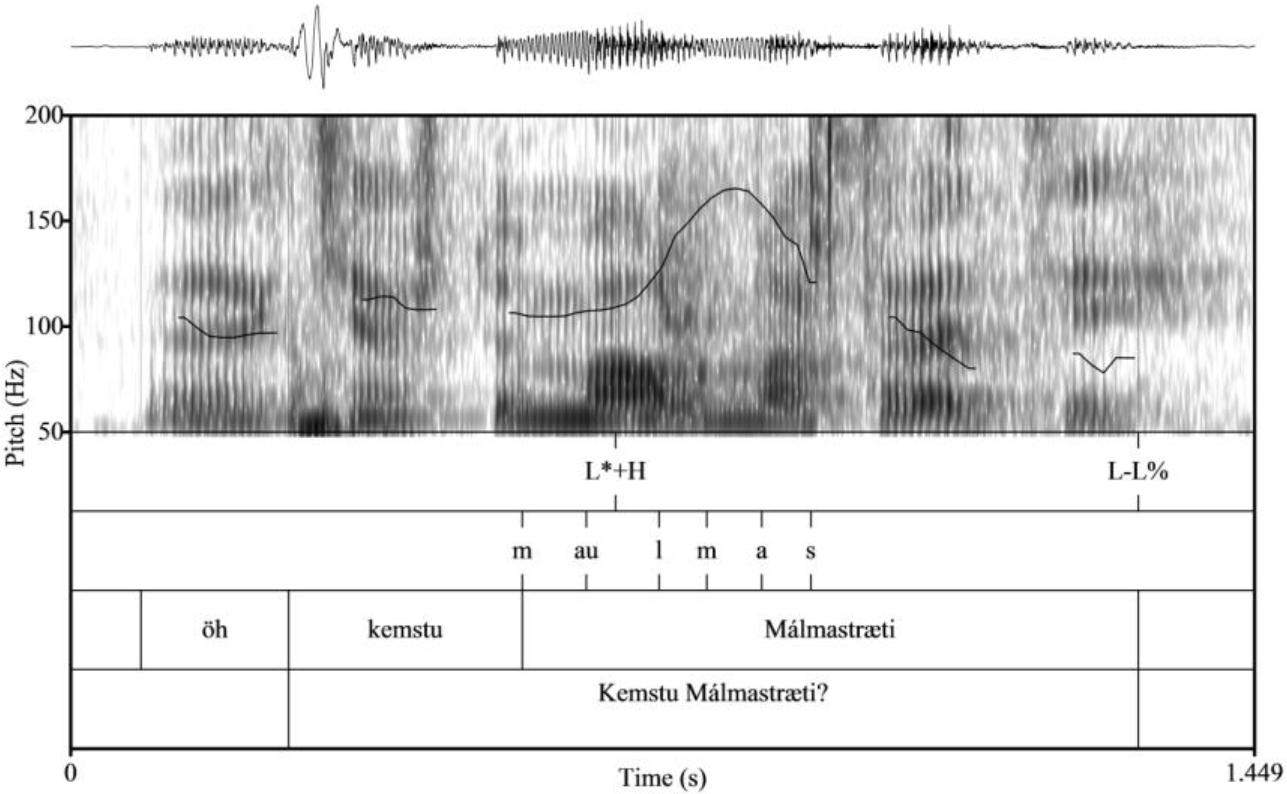
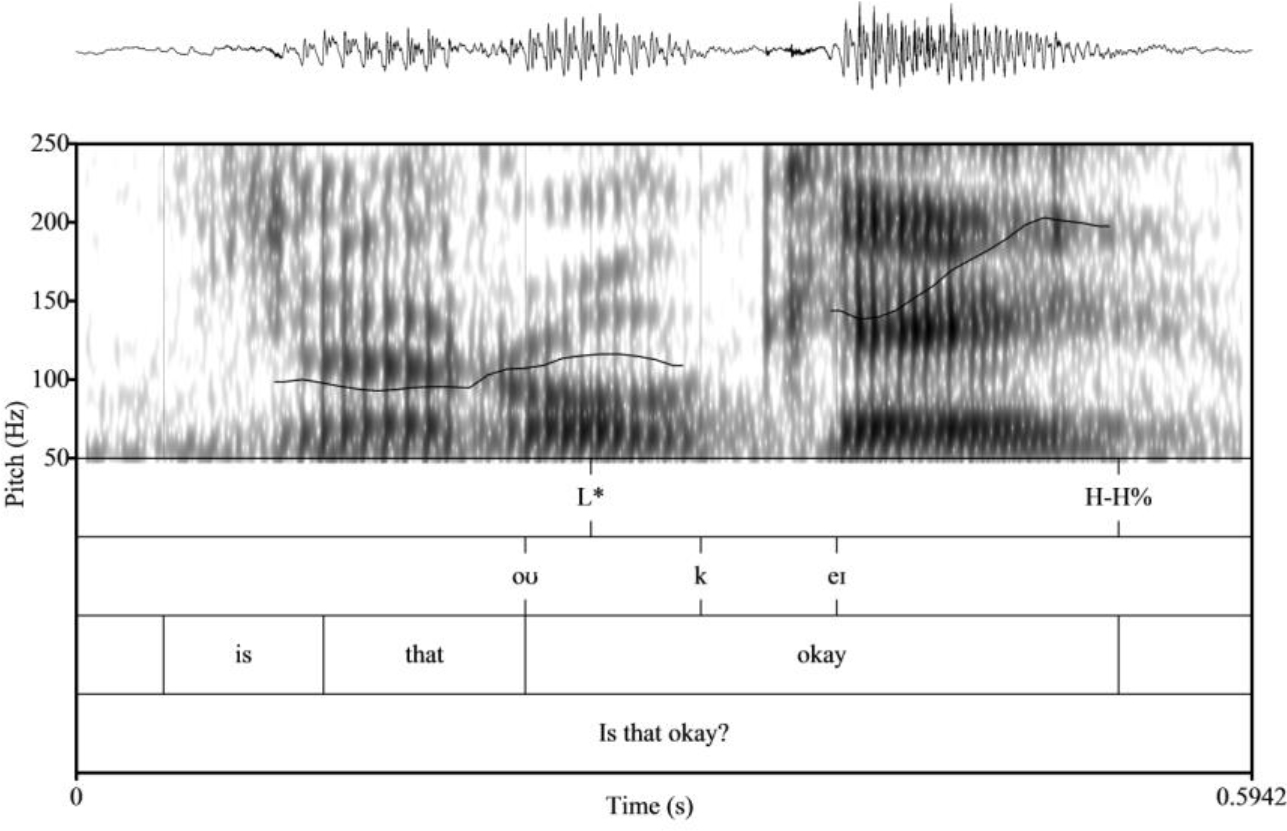
This difference between IceIce and NAmEngl question intonation is also evident in the present data set (see section 5 below). These data confirm that rising intonation is typical of information-seeking PQs in NAmEngl, but falling intonation is typical of information-seeking PQs in IceIce. Representative examples of PQs from the present map task data are given in figure 1 for IceIce and figure 2 for NAmEngl.
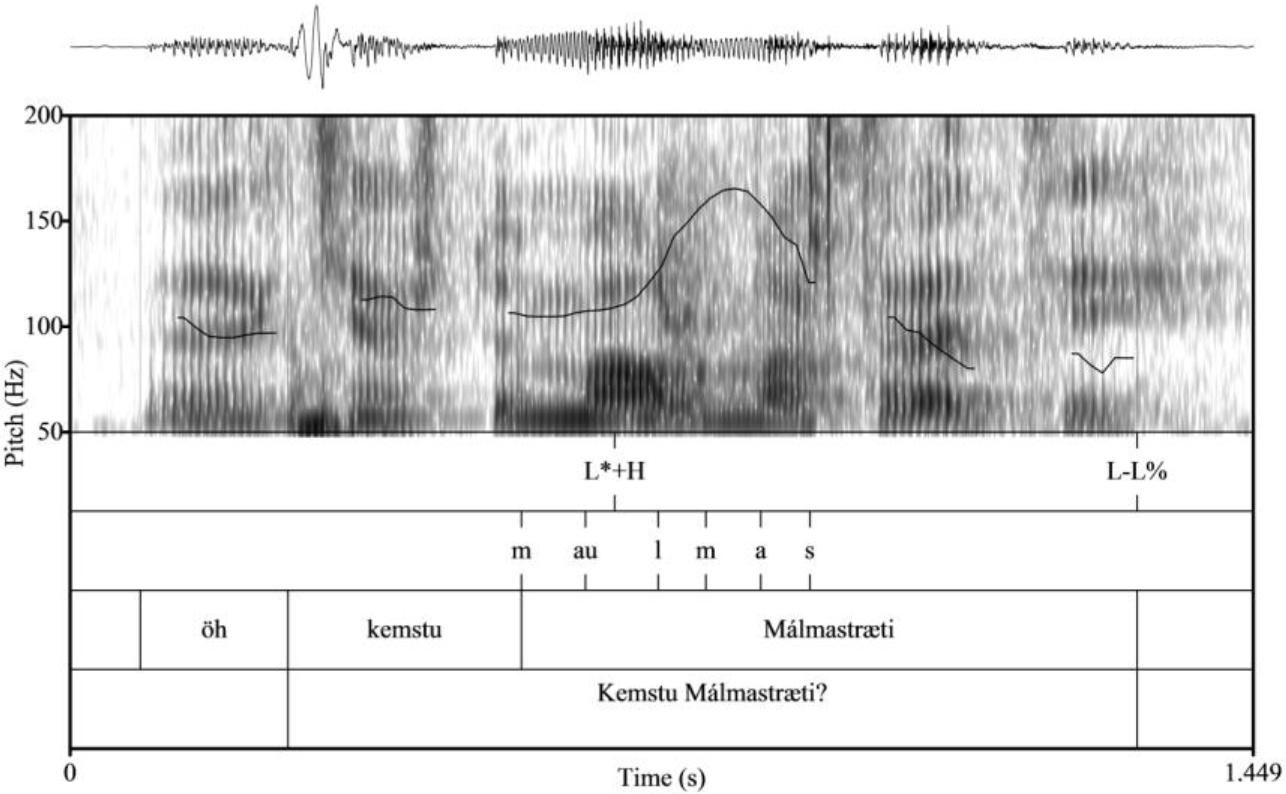
IceIce; nuclear contour L*+H L-L%; speaker H14 (male).

NAmEngl; nuclear contour L* H-H%; speaker CW03 (male).

In the IceIce PQ Kemstu Málmastræti ‘Can you take Málmastræti?’ in figure 1, the nuclear syllable (the first syllable Mál /m l/ of Málmastræti) is associated with a low tonal target; the contour then rises to a local peak reached in the following syllable ma /ma/ (L*+H). Immediately after the peak, starting at the end of the second syllable, the contour falls toward the end of the question (L-L%). Note that the third syllable of Málmastræti, which bears secondary lexical stress, is associated with the fall and the low phrase accent L-. In the NAmEngl PQ in figure 2, the nuclear syllable (second syllable of okay) is associated with a low pitch accent L*, followed by a rise, such that the nuclear contour terminates in H-H%.
In sum, the intonation in IceIce PQs is typically falling, with the rise-fall (L*+H L-L%) being the default nuclear contour, while the intonation in NAmEngl PQs is typically rising, with the low-rise (L* H-H%) being the default nuclear contour. Thus, both languages have a clear default intonational pattern in PQs. Given the different intonational features of PQs in the two languages, NAmIce lends itself well to a study of HL intonation; in particular, NAmIce allows one to investigate interference between the HL (NAmIce) and the dominant language (NAmEngl).Footnote 6 The obvious question is whether NAmIce shares the following characteristics with other HLs: i) whether intonational features such as the IceIce rise-fall are persistent, that is, whether they are maintained in NAmIce, ii) whether intonational features typical of NAmEngl, such as the nuclear low-rise, can be found in NAmIce, too, suggesting transfer from NAmEngl, and iii) whether transfer of intonational features is bidirectional such that Icelandic intonational features can also be found in the NAmEngl spoken by speakers with a NAmIce background. Based on the previous findings on the intonation of NAmEngl and IceIce PQs, combined with previous results on intonation in HL contexts (see section 1 above), the predictions of the present study are given below.
(i) Intonational features typical of IceIce PQ intonation can still be found in NAmIce. In particular, I predict considerable use of the low boundary tone (L%) as well as the rise-fall nuclear contour in NAmIce PQs.
(ii) Tonal events typical of NAmEngl PQs are found in NAmIce PQs, too. In particular, I predict that compared with IceIce PQs, the high boundary tone (H%) and the low-rise nuclear contour feature more prominently in NAmIce PQs.
(iii) Since interference between an HL and a dominant language has been shown to be bidirectional, I predict that compared with NAmEngl PQs produced by speakers without Icelandic background, the NAmEngl PQs produced by speakers with a NAmIce back-ground contain more intonational features typical of Icelandic PQs (that is, L%, nuclear rise-fall).
The results of the study reported below show that these predictions are borne out.
3. Methodology
3.1. Data Source: The Icelandic Map Task
The data used here are taken from a map task study carried out by the author of the present paper in Iceland during the months of October 2013 to January 2014 and May–June 2014, and in Manitoba, Canada in August 2014 (see also Dehé Reference Dehé2015). The map task has the advantage of eliciting quasi-spontaneous speech produced in an interactive discourse while at the same time allowing for i) some control over the lexical elements used by the participants and thus the segmental make-up of target elements, ii) comparability between groups of speakers, and iii) control over sociolinguistic factors such as age, regional origin, and the like. The same map task was carried out with speakers of IceIce in Iceland, and speakers of NAmEngl and NAmIce in Manitoba, Canada, allowing for comparison between the languages while keeping the task the same.
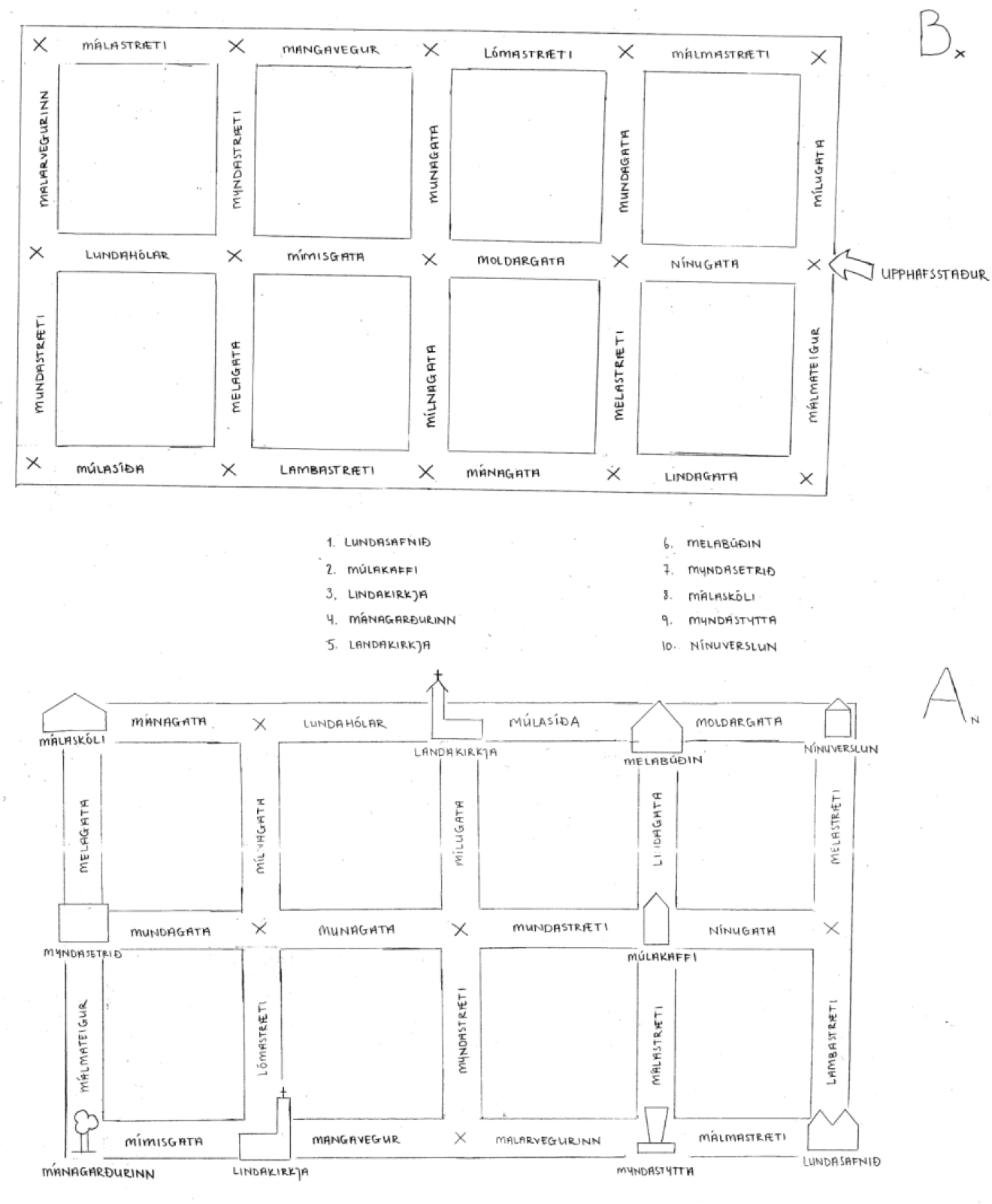
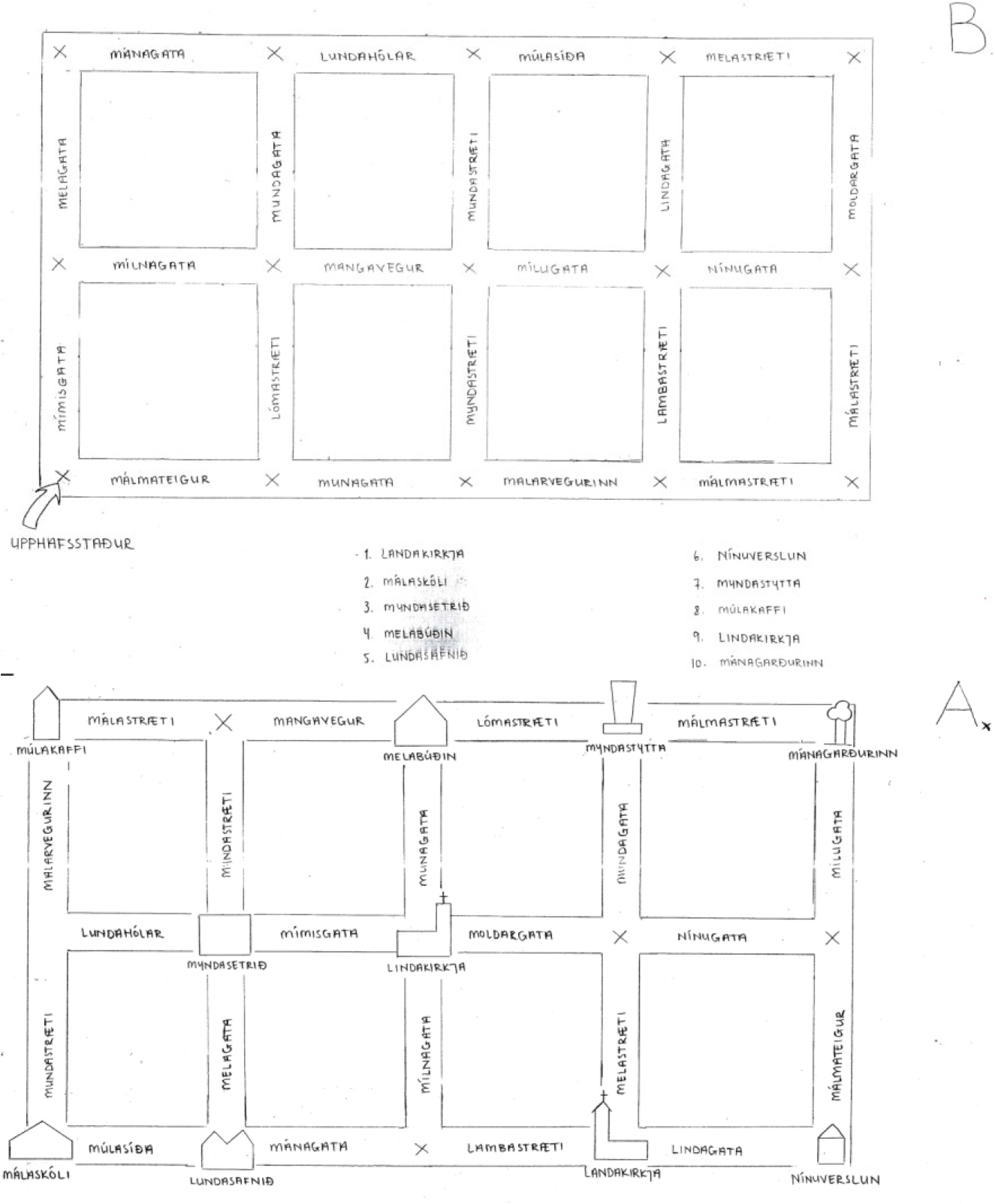
Versions of the map task have frequently been used in research on intonation (for example, Grice et al. Reference Grice, Benzmüller, Savino, Andreeva, Elenius and Branderud1995, Grice & Savino Reference Grice and Savino2003, Lickley et al. Reference Lickley, Schepman and Robert Ladd2005, Savino Reference Savino2012, Fletcher & Stirling Reference Fletcher, Stirling, Durand, Gut and Kristoffersen2014). The maps used in the present study differ from maps used in previous map task experiments in two ways. First, unlike previous maps (for example, the maps pictured in Anderson et al. Reference Anderson, Bader, Bard, Boyle, Doherty, Garrod, Isard, Kowtko, McAllister, Miller, Sotillo, Thompson and Weinert1991, Grice & Savino Reference Grice and Savino2003, Helgason Reference Helgason, Ambrazaitis and Schötz2006, Savino Reference Savino2012, Fletcher & Stirling Reference Fletcher, Stirling, Durand, Gut and Kristoffersen2014), none of the maps used in this study show routes. Second, instead of drawn objects, target words (street names and landmarks) were written on the maps, and crosses (X) marked intersections between streets and potential landmarks. In addition, as in Savino's (Reference Savino2012) study on Italian question intonation but not in other studies, the participants within each pair acted as both instruction givers and instruction followers to allow for maximal interaction. Four maps were created: two tourist (instruction follower) maps and two guide (instruction giver) maps; they are provided in figures 3 and 4. The maps were designed as a grid, with street and landmark names. All the names were chosen based on their maximal sonority. I also made sure to select the same number of street and landmark names with open and closed first syllable. For example, streets: N=11, as in Nínugata; landmarks: N=5, as in Nínuverslun—open first syllable /niː/; streets: N=11, as in Lundahólar; landmarks: N=5, as in Lundasafnið; closed first syllable /lʏnˑ/ (see 3 and 4). This was important because IceIce has word-initial primary stress (Einarsson Reference Einarsson1973; Árnason Reference Árnason1985, Reference Árnason, Gregersen and Basbøll1987, Reference Árnason and Werner1998; Thráinsson Reference Thráinsson1994, among others). Control of syllable structure allows for the study of pitch-to-segment alignment (for example, Dehé Reference Dehé2010 for IceIce).
(3) Street names
(4) Landmark names


Maps used by P1; upper panel: tourist map Bx; lower panel: guide map An.

Maps used by P2; upper panel: Tourist map B; lower panel: guide map Ax.

The tourist maps (maps B and Bx; see upper panels in figures 3 and 4) have lists of landmarks at the bottom and Xs in every junction as potential sites of landmarks. The guide maps (maps An and Ax; see lower panels in figures 3 and 4) have all the landmarks in the junctions allowing for the guide to give directions to the tourist. For each experimental session, two participants, P1 and P2, were paired in such a way that they knew each other well (for example, close friends, life partners, parent and son or daughter) in order to allow for informal speech in a comfortable situation. In every session, each participant received one tourist map and one guide map. More specifically, participant P1 received tourist map Bx and guide map An (see the pair in figure 3), and participant P2 received tourist map B and guide map Ax (see the pair in figure 4). Hence, both participants played both roles, tourist and guide, in one experimental session.
The task of the tourist was to locate all landmarks given at the bottom of the map by asking the guide for directions. The task of the guide was to direct the tourist to these landmarks, using the street names provided on the map. The participants were instructed to avoid the words áfram ‘forward, straight on’, vinstri ‘left’, and hægri ‘right’ to make sure they made use of the target street names as much as possible. Participants in Manitoba, who typically had little to no experience in reading IceIce, were given additional time to familiarize themselves with the names of streets and landmarks.
All four maps were slightly different in that the landmarks and the street names were identical, but the locations of some of them on the maps differed. The participants did not see each other's maps during the experimental session, and they were unaware of the fact that their maps were not the same. However, their task was to correctly locate their landmarks, anyway.
The participants usually switched roles each time they located a landmark shown on the map. For example, P1 (tourist) began by asking P2 (guide) for the location of her first landmark: Lundasafnið, so that she could locate it on her map Bx. P2 used his map Ax to guide P1 from her point of departure, Upphafsstaður, to this landmark. Since the maps were not identical, there had to be some interaction (such as questions and answers, imperatives, repair sequences) before P1 found the landmark. Once the landmark was located, the participants switched roles. P2, now the tourist, asked P1, now the guide, for directions to the landmark Landakirkja on his map B. P1 now used her map An to give directions until the landmark on P2's map B was located. The procedure was repeated until each participant found the last of the 10 landmarks listed on their tourist maps. To find the first landmark, the participants started at their point of departure. For every following landmark, they typically started from the one previously located.
During each session, the participants were recorded using two Microtrack II (M-Audio) recorders and two Rode NT-5 condenser microphones. Two separate channels were used to avoid overlap when the participants were speaking simultaneously. Based on the recordings, all map task dialogues were transcribed orthographically by native speakers of IceIce. The dialogues were between 15 and 59 minutes in length (NAmIce dialogues between 23 and 50 minutes). Based on the transcripts, utterances were edited into individual sound files and saved and sorted according to syntactic utterance type (for example, PQ).
3.2. Participants
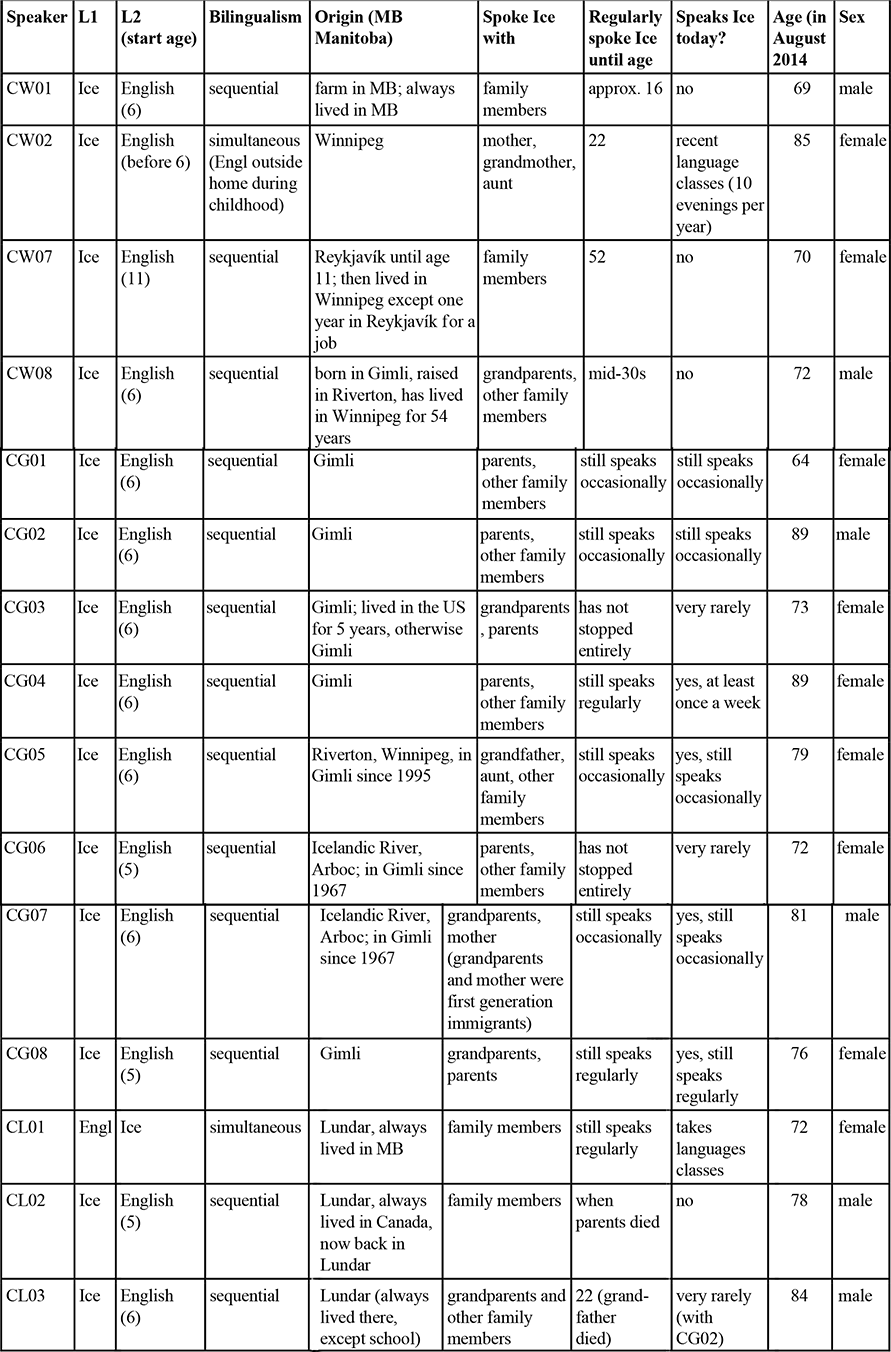
Overall, 16 speakers of NAmIce (8 pairs) were recorded in three locations in Manitoba: Winnipeg (4 speakers; speaker identifier CW01, CW02, CW07, CW08), Gimli, on Lake Winnipeg (8 speakers; speaker identifier CG01–CG08), and Lundar, Interlake area (4 speakers; speaker identifier CL01–CL04). Speaker CL04 was later discarded from the analysis because she was of Swedish descent and had learned NAmIce only as an adult. Of the remaining 15 speakers (6 male, 9 female), 14 grew up in Manitoba. Of these, 13 were sequential bilinguals. Twelve of them grew up with L1 NAmIce until the age of 5 or 6, that is, until school entry, when they started to speak NAmEngl, which then became their dominant language. One speaker (CW02) said she spoke NAmEngl before that age, that is, she was a simultaneous bilingual as she grew up with both languages as L1, but said that NAmIce was her first language. One speaker (CL01) said that NAmEngl was her first language, but NAmIce had been around from the very beginning, both in the family and outside home. Thus she, too, was a simultaneous bilingual. One participant (CW07) grew up in Iceland until age 11, and then moved to Canada, that is, she was a sequential bilingual growing up with L1 IceIce until age 11. All participants continued to speak NAmIce with family members during school breaks until at least the age of 16. Several speakers reported that they still speak some NAmIce, but only one speaker (CG04) said she did so regularly. One speaker (CW02) said she recently started language classes (10 evenings per year), while one other speaker (CL01) said she took regular language classes, but did not specify how frequently she took classes. The 15 NAmIce speakers were between 64 and 89 years of age at the time of recording (average 76.9 years). More information about the NAmIce speakers is provided in table A1 in the appendix to this paper.
Comparing the three locations (see table A1), it seems that the speakers tested in Gimli have one feature in common: They stated they still speak NAmIce, even if not on a regular basis. This is no surprise, given that Gimli is the center of Icelandic heritage and culture in Canada. The speakers recorded in the capital Winnipeg have stopped speaking NAmIce, or, in one case, have recently taken up (infrequent) language classes. In Lundar, the picture is mixed. Given these differences in frequency of NAmIce use, the results for the three locations are compared in the analysis (section 5.1).
Note that the NAmIce speakers were tested in NAmIce only, thus I do not have NAmEngl and NAmIce map task data sets from the same speakers. Crucially, this is due to the nature of the map task. It was essential that the participants not be aware at the beginning of the task that the maps used by each member of a pair were not the same. This condition would not have been met had the task been completed twice by the same speakers. Having instead some of the NAmIce speakers complete the task in NAmEngl and some in NAmIce would have reduced the number for NAmIce, because all available NAmIce speakers fluent enough to engage in map task-related conversations were tested. The map task was used to enable comparison with the IceIce data elicited in Iceland. Therefore, it was carried out in the same way in Iceland and Canada.Footnote 7
Eighty-four speakers of IceIce (42 pairs) were recorded in three locations in Iceland: Reykjavík (24 speakers), Ísafjörður and Flateyri in the West Fjords (26 speakers), and Ólafsfjörður and Húsavík in the north (34 speakers). The data from two non-native speakers had to be discarded from the data set. For the current purpose, all speakers aged 64 and over were selected from the available data set to match the age of the group recorded in Manitoba and thus to control for healthy aging effects. The IceIce data reported here are thus taken from 12 speakers (5 male, 7 female) between 64 and 85 years of age at the time of recording (average 70.25). No speakers recorded in Reykjavík were included in this group in order to match the regional origin of the HL speakers as best as possible (see section 1 above). Instead, the speakers came from Húsavík (5 speakers; speaker identifiers H01, H02, H05, H13, H14), Ólafsfjörður (4 speakers; speaker identifiers Ó07, Ó08, Ó13, Ó14), and Ísafjörður (3 speakers; speaker identifiers Í02, Í03, Í17).
In addition to the data from these two groups (NAmIce speakers and IceIce speakers), four speakers of NAmEngl (2 male, 2 female), who had no knowledge of IceIce and were not of Icelandic descent, completed the map task in NAmEngl. They were between 60 and 79 years of age (average 71).Footnote 8
4. Data Treatment
All information-seeking PQs produced by the three groups of participants were included in the analysis. All and only syntactically complete, verb-first, information-seeking PQs without negation were considered. Overall, 120 NAmIce PQs and 152 IceIce PQs were analyzed. In addition, 19 NAmEngl PQs produced by the NAmEngl speakers without Icelandic background were analyzed. Examples are given in 5–7.
(5)
(6)
(7)


In addition, 28 NAmEngl PQs produced by NAmIce speakers as the result of code-switching were also analyzed (NAmEngl-csw). They were typically produced in one of the following three situations: First, during the map task, a participant had a question for the experimenter. Even though the experimenter spoke (non-native) IceIce in the experimental situation, some participants addressed the experimenter in NAmEngl. Second, at times there were pauses in the discourse, for example, when a participant did not immediately find a certain street or landmark and took time to locate it on the map. After such a pause, participants often restarted their conversation in NAmEngl, their dominant language, and had to be reminded to switch back to Icelandic. Third, the two participants in the same pair were unsuccessful in locating a landmark, and so they switched to NAmEngl to be able to communicate faster and more easily. They were then reminded to switch back to Icelandic.
All target utterances (that is, PQs and as much surrounding material as necessary) were prosodically analyzed in Praat (Boersma Reference Boersma2001, Boersma & Weenink Reference Boersma and Weenink2016). The PQs were analyzed using four tiers (see figure 1 repeated below as figure 5). Starting with the top one, they are: i) tonal tier for intonational analysis in terms of the nuclear contour, that is, nuclear pitch accent and edge tones; ii) tier showing phonetic transcription for segmental landmarks; iii) an orthographic tier containing word boundaries; iv) text tier containing the whole utterance.
IceIce; nuclear contour L*+H L-L%; speaker H14 (male).

The NAmEngl PQs were annotated on the tonal tier according to ToBI (Silverman et al. Reference Silverman, Beckman, Pitrelli, Ostendorf, Wightman, Price, Pierrehumbert, Hirschberg and Ohala1992, Beckman et al. Reference Beckman, Hirschberg, Shattuck-Hufnagel and Jun2005). The nuclear contours were holistically described following, among others, Hedberg et al. (Reference Hedberg, Sosa and Görgülü2017), as in L* H-H%: low-rise; H* L-L%: high-fall. The IceIce PQs were analyzed on the tonal tier, following previous intonational analyses of IceIce in the autosegmental-metrical framework (Dehé Reference Dehé2010). Nuclear rises were annotated L+H* when the peak (H) was aligned within the nuclear syllable. This typically happened within the vowel in open syllables (CVː) and within the half-long consonant in closed syllables (CVCˑ; see Árnason Reference Árnason2011 for IceIce syllable structure). Nuclear rises were annotated L*+H when the high target was aligned in the syllable following the nuclear syllable. Nuclear contours of IceIce PQs were holistically described in the same way as the NAmEngl ones (for example, L*+H L-L%: rise-fall). As far as the complete nuclear contours are concerned, L*+H and L+H* were grouped together as rises, and rises followed by a fall were described as rise-falls. Consequently, both L*+H L-L% and L+H* L-L% were described as rise-falls. The NAmIce PQs were analyzed accordingly.
All PQs analyzed in Praat were entered into an Excel file with their ToBI annotations and nuclear contour to allow for sorting according to relevant parameters and to perform basic analyses. The PQs were sorted by language (NAmEngl, IceIce, NAmIce), with the two English sets (NAmEngl, NAmEngl-csw) considered separately to begin with. Within languages, they were sorted according to intonational categories. Since rising (NAmEngl) versus falling (IceIce) nuclear PQ contours form a crucial contrast between the two languages, nuclear contours were divided into rises (H%) and falls (L%).
5. Results
In this section, the results are first reported for NAmEngl, IceIce, and NAmIce separately and then compared. The focus is on the phonology of intonation rather than phonetic variation, that is, on the question of whether PQs are produced with rising (H%) or falling (L%) terminals, and on the default nuclear contours for PQs in the three groups.
5.1. NAmEngl, IceIce, and NAmIce PQs
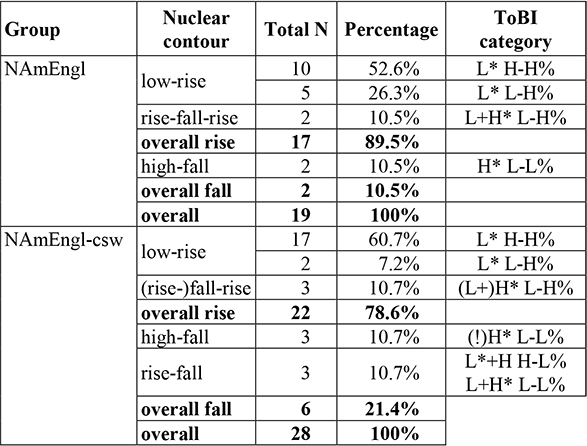
Let me begin with the NAmEngl group. First, the results for the NAmEngl PQs produced by the NAmEngl speakers without Icelandic background or knowledge of Icelandic are fully in line with previous assumptions about the intonation of NAmEngl PQs (see section 2 above) and with Hedberg, et al.'s (Reference Hedberg, Sosa and Görgülü2017) corpus results. Of the 19 questions, 15 (79%) were produced with a low-rise (L* H-H% or L* L-H%; see figure 2 in section 2 above for an example). Of the remaining four questions, two (10.5%) were produced with a rise-fall-rise (L+H* L-H%) and two with a high-fall (H* L-L%). Overall, 17 PQs (89.5%) were thus produced with a rising contour, and only 2 PQs (10.5%) with a falling contour. This distribution is in line with all the previous literature on the intonation of NAmEngl PQs.
Second, the results for the NAmEngl PQs produced by NAmIce speakers while code-switching (NAmEngl-csw) show a slightly lower percentage of rising contours. Of the 28 questions, 19 (67.9%) were produced with a low-rise. In addition, three (10.7%) were produced with a fall-rise (L+H* L-H%), so that overall, 22 PQs (78.6%) were realized with a rising terminal. The remaining six PQs were produced with a falling contour; more specifically, with either a high-fall (H* L-L%; N=3, 10.7%) or a rise-fall (L*+H H-L%; N=3, 10.7%). The distribution of intonational patterns for the two groups is provided in table 1.
Distribution of nuclear contours in NAmEngl PQs.

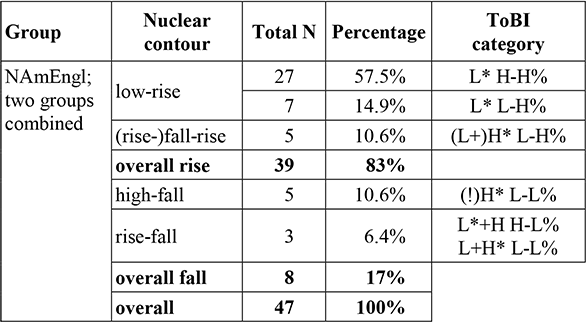
To test the significance of the difference between NAmEngl and NAmEngl-csw (89.5% versus 78.6% rising contours), a linear mixed-effects logistic regression model was calculated using the lme4-library in R (Version 3.1.0; Bates & Sarkar Reference Bates and Sarkar2007). The dependent variable was binary coded (occurrence of overall rise: yes/no), Group was entered as a fixed factor and Speaker as a random effects factor, allowing for random intercept and slope (see Jaeger Reference Jaeger2008). The results for the variable Rise versus Fall turned out not to be significant (p>0.3). Therefore, the two NAmEngl groups have been combined in the subsequent comparisons (see table 2): 83% rising PQs (N=39) and 17% falling PQs (N=8). I return to this issue in section 6 below. For the high fall in table 2, (!) indicates that both H* and downstepped !H* are included.
Distribution of nuclear contours in PQs: Combined results for NAmEngl and NAmEngl-csw.

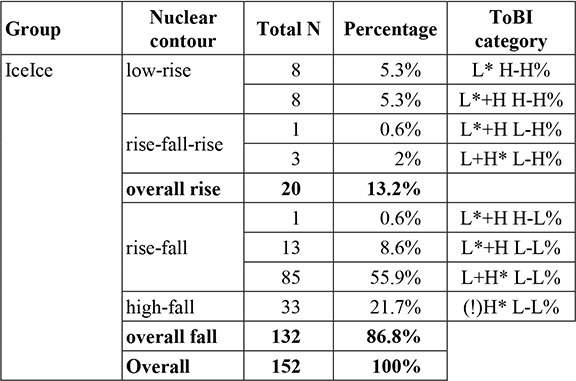
Now consider the IceIce group. The results for IceIce show that IceIce PQs are predominantly falling, as previously noted in the literature (Árnason Reference Árnason and Werner1998, Reference Árnason2005, Reference Árnason2011, among others). Specifically, of the 152 IceIce PQs analyzed here, 132 (86.8%) were falling, while only 20 (13.2%) were rising. Within the falls, nuclear rise-falls (N=99) were more frequent than nuclear high-falls (N=33). The contours observed with IceIce PQs are presented in table 3, showing that the rise-fall is the most frequent nuclear contour (see figure 5 for an example), followed by the high-fall.
Distribution of nuclear contours in IceIce PQs.

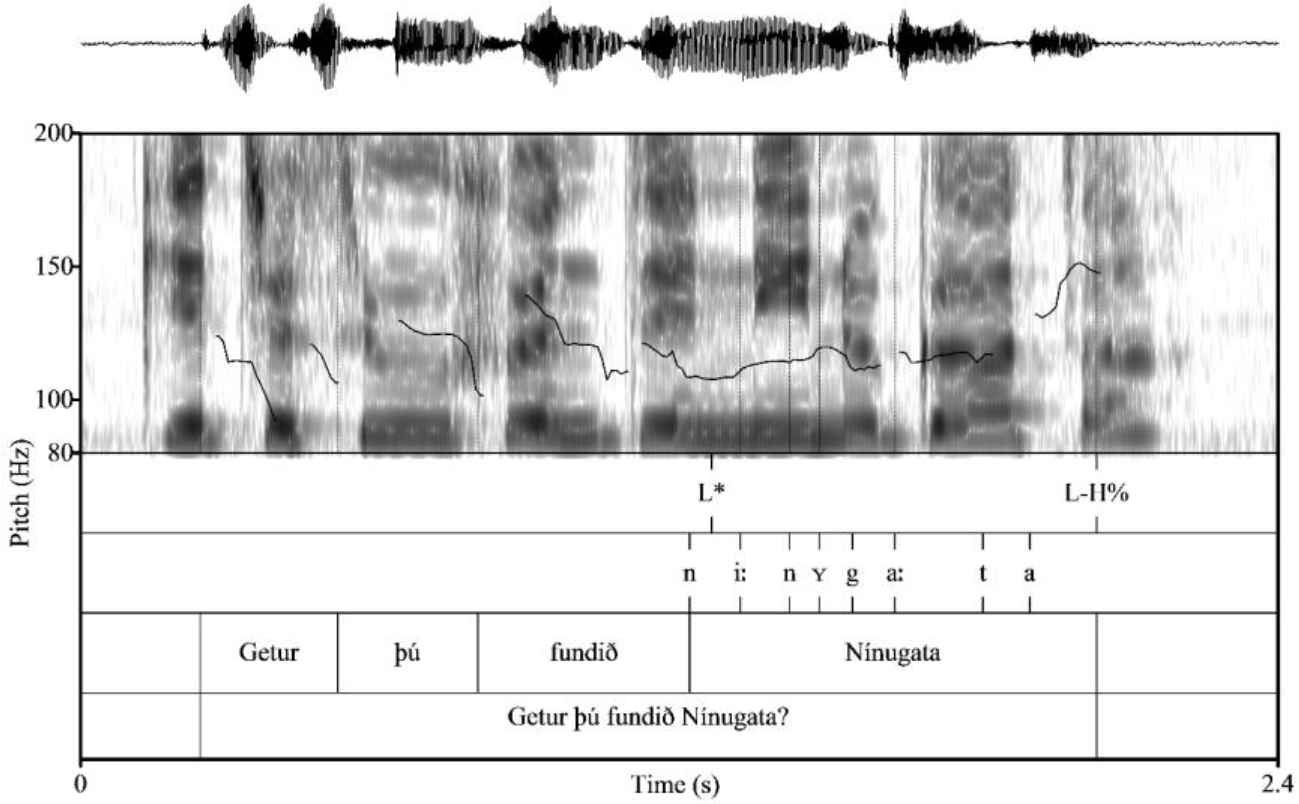
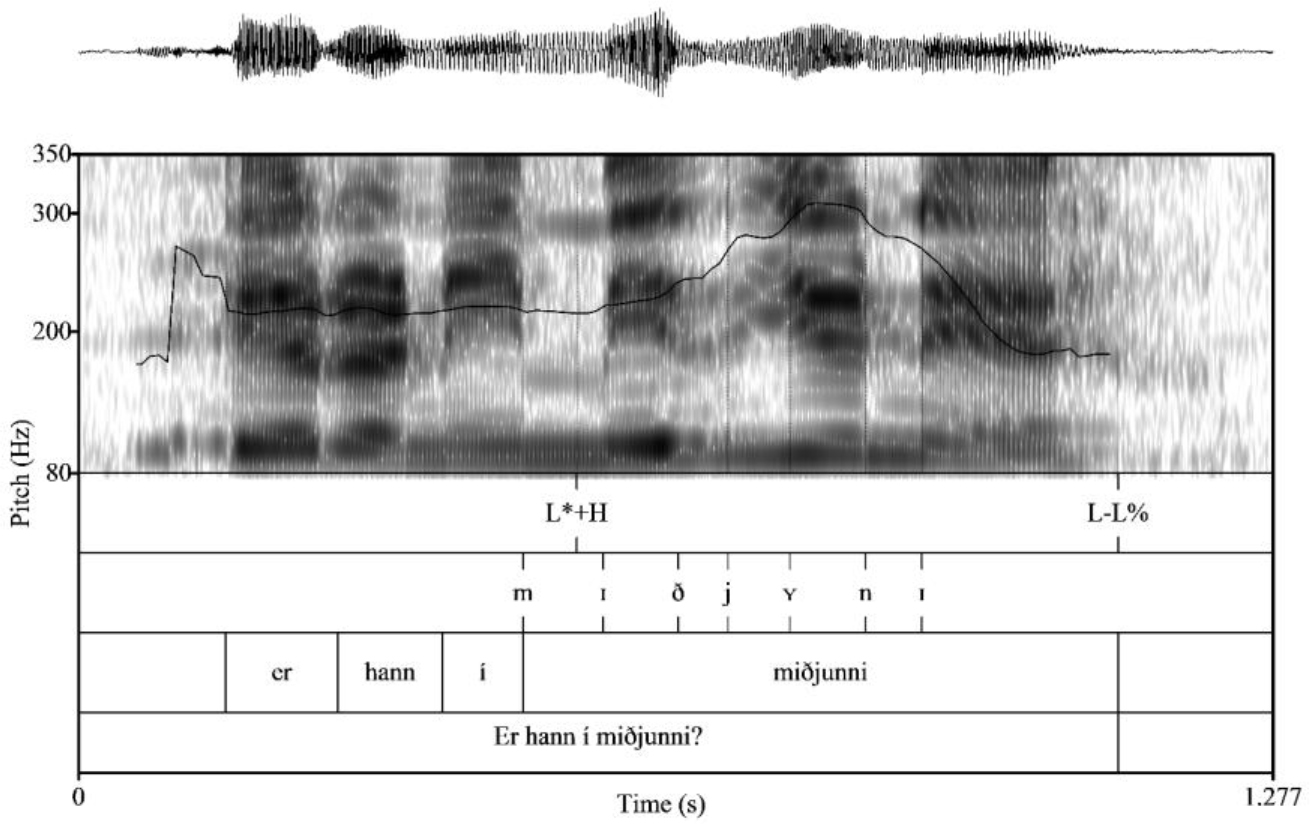
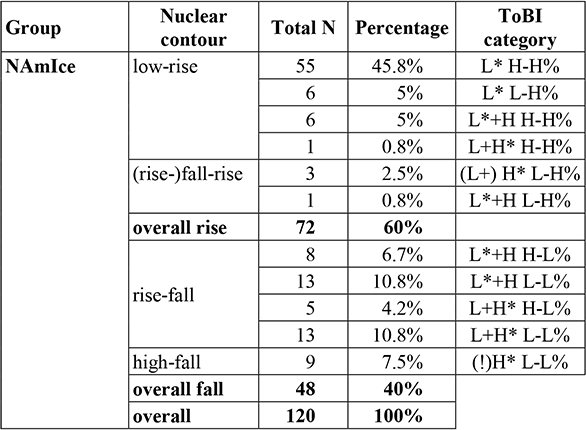
Finally, I discuss the results for the NAmIce group. While NAmEngl PQs are typically rising and IceIce PQs are typically falling, the results regarding rises versus falls are more balanced for NAmIce PQs. Table 4 provides all observed nuclear contours. Overall, 72 NAmIce PQs (60%) had a rising terminal. The remaining 48 PQs (40%) were produced with a falling contour. Within the rises, the low-rise was the most frequent nuclear contour (N=68; 56.7%). Other rising patterns were the fall-rise (N=3; 2.5%) and the rise-fall-rise (N=1; 0.8%). Falls were either a rise-fall (N=39; 32.5%) or a high-fall (N=9; 7.5%). The two most frequent contours, low-rise and rise-fall, are illustrated in figures 6 and 7, respectively, using representative NAmIce PQs from speaker CG03 (female).
Getur þú fundið Nínugata ‘Can you find Nínugata?’ Nuclear contour: low-rise (L* L-H%).

Er hann í miðjunni ‘Is he [it] in the middle?’ Nuclear contour: rise-fall (L*+H L-L%).

Distribution of nuclear contours in NAmIce PQs.

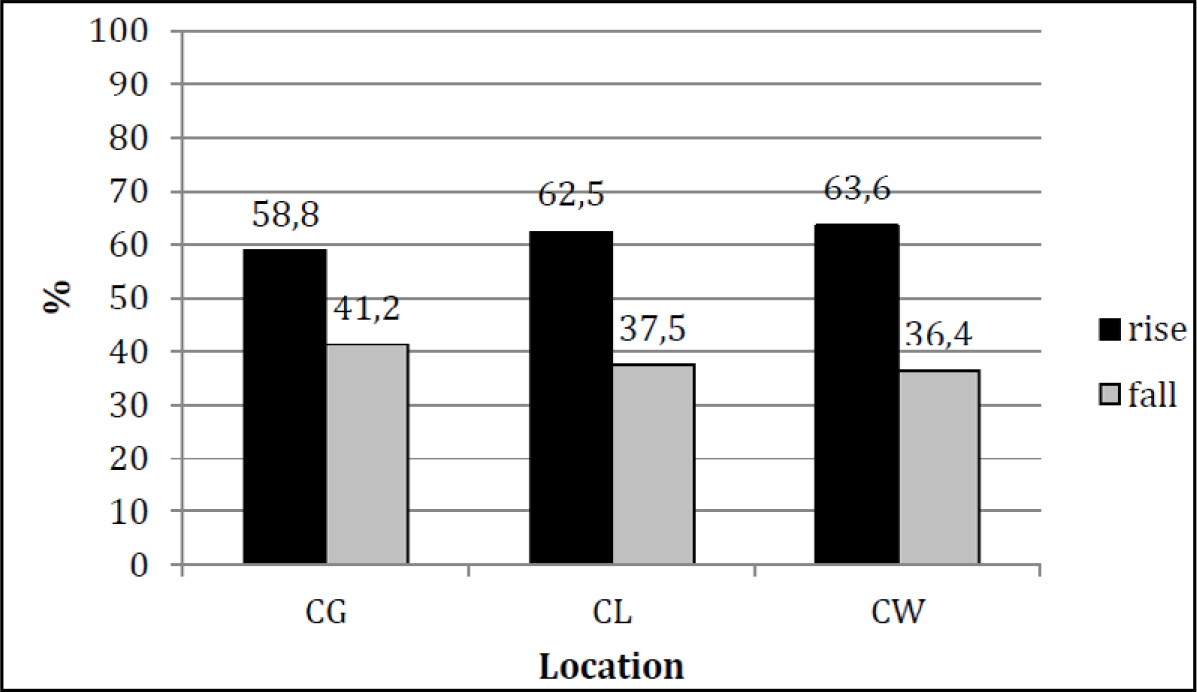
Given the general distribution of intonational contours within the NAmIce group and the differences in language use between the three locations (Winnipeg, Gimli, Lundar; see section 3.2), it makes sense to compare the distribution of rises and falls between the three locations (see table 5 and figure 8). I calculated a generalized linear mixed effects model with Rise (yes/no) as a dependent variable and Location as a fixed factor. As before, Speaker was entered as a random effects factor (random intercept and slope). A binomial linking function was applied in order to account for the binary character of the dependent variable (Rise). While overall more falls were produced in Gimli than in both Lundar and Winnipeg, differences between the three locations in the fall:rise ratios turned out not to be significant (all comparisons p>0.1).
Distribution of rises and falls as a function of region.

Distribution of rises and falls as a function of region.

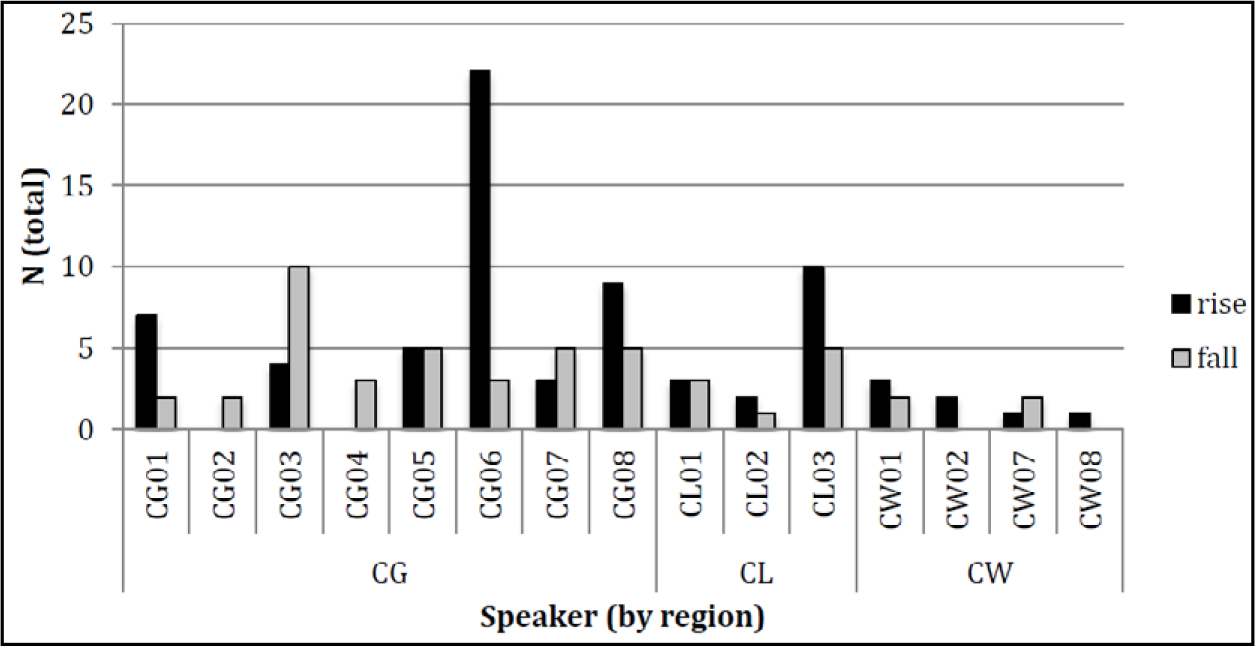
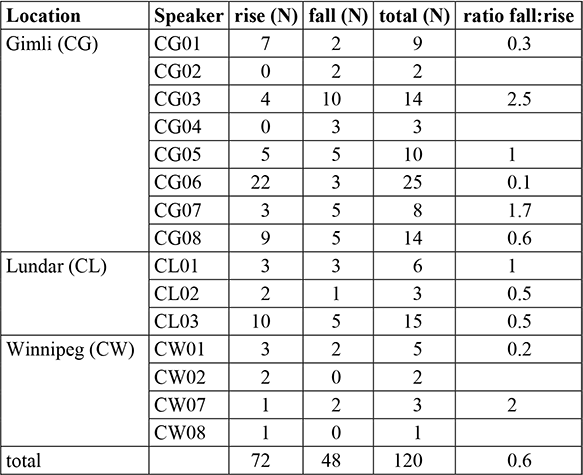
Next, the results for individual speakers appear in table 6 and figure 9.
Distribution of rises and falls by speaker.

Distribution of rises and falls by speaker.

The data in table 6 and figure 9 show that except for four speakers (CG02, CG04, CW02, and CW08), all speakers produce both rises and falls. Speakers CG02 and CG04 (both from Gimli) produce only falls, while speakers CW02 and CW01 (from Winnipeg) produce only rises. However, total item numbers are very low for all four speakers (N≤3), thus no further conclusions can be drawn from these numbers. All other speakers produced both rises and falls.Footnote 9
5.2. Comparisons Between Groups
For a comparison between the groups (NAmEngl, IceIce, and NAmIce), a linear mixed-effects logistic regression model was run with Group as a fixed factor and Speaker as a random effects factor. First, I compared the distribution of falling versus rising contours in the three groups (the dependent variable for statistical analysis: L% versus H%). Distribution numbers and ratios are given in table 7, which shows that rises (H%) are more frequent than falls (L%) in both NAmEngl and NAmIce PQs, while falls are more frequent than rises in IceIce. The results are highly significant: i) NAmEngl PQs have significantly more rises than IceIce PQs (83% versus 13%; ß=4.44, SE=0.69, z=6.4, p<0.0001); ii) NAmIce PQs also have significantly more rises than IceIce PQs, although the difference is smaller (60% versus 13%; ß=2.74, SE=0.53, z=5.1, p<0.0001); iii) crucially, NAmIce PQs also have significantly fewer rises than NAmEngl PQs (60% versus 83%; ß=1.70, SE=0.54, z=3.16, p<0.002).
Distribution numbers and ratios for falling (L%) versus rising (H%) PQ contours.

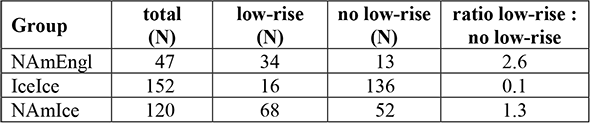
Second, I compared the distribution of two most frequent nuclear contours: the low-rise and the rise-fall (the dependent variable: presence versus absence of low-rise). The low-rise is the default nuclear contour in NAmEngl and NAmIce PQs, but it occurs less frequently in NAmIce. The distribution numbers (for the low-rise as compared to all other contours) and ratios are given in table 8. The results are as follows: i) NAmEngl PQs have significantly more low-rises than IceIce PQs (72% versus 11%, ß=4.00, SE=0.68, z=5.88, p<0.0001); ii) NAmIce PQs also have significantly more low-rises than IceIce PQs (57% versus 11%, ß=2.76, SE=0.55, z=4.97, p<0.0001); finally, iii) NAmEngl PQs have significantly more low-rises than NAmIce PQs (72% versus 57%, ß=1.24, SE=0.50, z=2.47, p=0.01).
Distribution numbers and ratios for the low-rise (L* H-H%, L* L-H%).

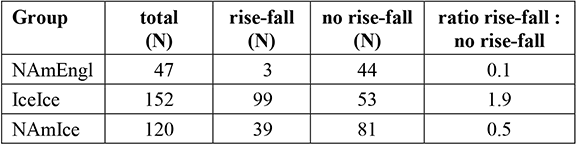
While the low-rise is the default contour in NAmEngl PQs, the rise-fall is the default nuclear contour in IceIce PQs. A comparison was therefore also calculated for the rise-fall (the dependent variable: presence versus absence of rise-fall). The distribution numbers (for the rise-fall as compared to all other contours) and ratios are given in table 9. The results show that i) NAmEngl PQs have significantly fewer rise-falls than IceIce PQs (6% versus 65%, ß=4.03, SE=0.82, z=4.92, p<000001); ii) NAmIce PQs have significantly fewer rise-falls than IceIce PQs (33% versus 65%, ß=1.48, SE=0.51, z=2.93, p<0.005); iii) NAmEngl PQs have significantly fewer rise-falls than NAmIce PQs (6% versus 33%, ß=2.55, SE=0.74, z=3.41, p<0.001).
Distribution numbers and ratios for the rise-fall.

The final comparison focuses on the nuclear rise-fall in the two Icelandic varieties, IceIce and NAmIce (the dependent variable: L+H* versus L*+H). The distribution numbers and ratios are given in table 10.
Distribution numbers and ratios for L+H* and L*+H in rise-fall nuclear contours in IceIce and NAmIce PQs.

Variation in the realization of the rise can be observed. Nuclear rises in IceIce PQs typically have early peaks, that is, the rise is completed within the nuclear syllable (L+H*). By contrast, the distribution is almost balanced in NAmIce PQs, with slightly more late peaks (L*+H) than early peaks (L+H*). This difference is statistically significant such that NAmIce PQs have significantly fewer early peaks (L+H*) than IceIce PQs (ß=2.08, SE=0.54, z=3.86, p=0.0001).
6. Discussion
In this section, the results reported in section 5 are discussed, focusing first and foremost, but not exclusively, on the predictions put forward at the end of section 2 and repeated below for convenience:
(i) Intonational features typical of IceIce PQ intonation can still be found in NAmIce. In particular, I predict considerable use of the low boundary tone (L%) as well as the rise-fall nuclear contour in NAmIce PQs.
(ii) Tonal events typical of NAmEngl PQs are found in NAmIce PQs, too. In particular, I predict that compared with IceIce PQs, the high boundary tone (H%) and the low-rise nuclear contour feature more prominently in NAmIce PQs.
(iii) Since interference between an HL and a dominant language has been shown to be bidirectional, I predict that compared with NAmEngl PQs produced by speakers without Icelandic background, the NAmEngl PQs produced by speakers with a NAmIce background contain more intonational features typical of Icelandic PQs (that is, L%, nuclear rise-fall).
First, features typical of IceIce PQs can also be found in NAmIce PQs (prediction i). In particular, the low boundary tone (L%) is found in NAmIce PQs in 40% of all cases, a figure significantly higher than in NAmEngl PQs (17%). Even though these results contrast with the 86.8% occurrence of L% in IceIce PQs (the difference also being statistically significant), it is remarkable that falling PQs can be found in NAmIce to such an extent, given that for decades, the dominant language of all the NAmIce speakers in the study has been NAmEngl.
Similarly, the default nuclear contour of IceIce PQs, the rise-fall, also reaches considerable numbers (32.5%) in NAmIce PQs. Moreover, the remaining falls belong to the category of high-falls (7.5% in NAmIce PQs), which is also the second most frequent pattern in IceIce PQs. These results are in line with the assumption that prosodic features are persistent in the phonological system of languages in contact situations (for example, Mackey Reference Mackey and Wei2000:48). NAmIce, which is the L1 for all the NAmIce speakers and the only L1 for most speakers (i.e., for the sequential bilinguals, recall that two speakers were simultaneous bilinguals), has been in contact with NAmEngl for decades, and NAmEngl has been the dominant language for all the NAmIce speakers for a very long time. The results are also in line with Queen's (Reference Queen2001:67) idea that the maintenance of specific prosodic structures may be linked to specific morphosyntactic forms, and that interrogatives are a case in point. Moreover, the results lend support to Robles-Puente's (Reference Robles-Puente2014) finding that heritage speakers retain intonational features of their L1, that is, their HL.
Second, tonal events typical of NAmEngl PQs were found in NAmIce PQs, too, to a considerable extent (prediction ii). Specifically, this concerns the presence of H%, as well as the most typical nuclear contour in NAmEngl PQs: the low-rise (for example, Pierrehumbert & Hirschberg Reference Pierrehumbert, Hirschberg, Cohen, Morgan and Pollack1990, Bartels Reference Bartels1999, Hedberg et al. Reference Hedberg, Sosa and Görgülü2017; see section 2 above). The prediction that both the rise to H% and the specific nuclear accent low-rise are used in NAmIce PQs to a considerable extent is also borne out. The final rise to H% (60% of NAmIce PQs) and the low-rise (56.6% of NAmIce PQs) are the most frequent patterns in NAmIce PQs, although clearly—and statistically significantly so—not to the same extent as in NAmEngl PQs. Thus, one finds the use of NAmEngl intonational features in NAmIce, in addition to typical IceIce features. I interpret this finding as an interference effect, such that features belonging to one language are used while speaking the other (Mackey Reference Mackey and Wei2000). In NAmIce, the relevant features (final rise to H%, low-rise nuclear contour) are used in the same environment as the corresponding IceIce intonational features, namely, in information-seeking PQs. They do not fully replace the IceIce features, but are used alongside them in an almost balanced distribution. These findings are in line with Bullock Reference Bullock2009 that finds features typical of NAmEngl intonation in moribund Frenchville French.
Notice, however, that given the use of IceIce features in NAmIce PQs, these results cannot be fully interpreted along the lines of Bullock's (Reference Bullock2009) prosodic calquing, because the low-rise also occurs in 10.6% of the IceIce PQs (N=16), and there are 13.2% rises (H%; N=20) altogether. Therefore, phonologically speaking, the rise cannot be interpreted as a feature recruited from NAmEngl. Rather, the frequency of H% and the extension of its use beyond special connotations can be argued to be due to the influence of NAmEngl on NAmIce. The results are in line with Robles-Puente Reference Robles-Puente2014, which finds features typical of Los Angeles English intonation in heritage Spanish spoken in Los Angeles.
Third, there is a tendency for NAmEngl PQs produced by speakers with a NAmIce background to contain more intonational features typical of Icelandic PQs than NAmEngl PQs produced by speakers without Icelandic background (prediction iii), even though this difference is not significant. Here I return to the intonational patterns given in table 1, section 5.1: NAmEngl versus NAmEngl-csw. What is particularly noteworthy is the difference in the frequency of the rise (H%) between the two groups (NAmEngl: 89.5%; NAmEngl-csw: 78.6%). While this difference is statistically not significant, it does suggest that the Icelandic intonation system, which typically has falling PQs, influences the NAmEngl of the NAmIce speakers. This influence is in line with Huffines’ (Reference Huffines and Enninger1986) finding that certain prosodic features of the dominant language (NAmEngl) as spoken by heritage speakers of another language (NAmIce in the present study, PG in Huffines’ study) may result from the influence of the HL on the dominant language. It is also in line with Robles-Puente (Reference Robles-Puente2014), who finds that heritage speakers of Spanish transfer certain intonational features specific to Spanish to their L2, Los Angeles English.
In sum, all three predictions have been borne out, although the results concerning prediction (iii) are statistically not significant. Therefore, they should be considered a tendency, which could possibly be strengthened by increasing the number of tokens. Thus, taken together, the results of the present study add to the evidence for bidirectional interference in intonation between an HL (here NAmIce) and the dominant language (here NAmEngl).
Two further points deserve discussion. The first concerns the use of the rise-fall nuclear contour in IceIce versus NAmIce PQs (final comparison in section 5.2, table 10), and specifically the use of the bitonal rising nuclear accent (L+H). The comparison between the nuclear rises in the two Icelandic varieties revealed the following differences. Nuclear rises in IceIce typically have early peaks, that is, the rise is completed within the nuclear syllable (L+H*). By contrast, the distribution is almost balanced in NAmIce, with slightly more late peaks (L*+H) than early peaks (L+H*; see table 10). The difference turned out to be statistically significant. The late peak rise (L*+H), however, has been argued by Árnason (Reference Árnason and Werner1998, Reference Árnason2005, Reference Árnason2011) to be the default nuclear pitch accent in IceIce PQs (see section 2 above). In his account, IceIce PQs differ from declaratives in that the latter typically have H* pitch accents. In the present analysis, the difference between L*+H and L+H* is a phonetic difference in the exact timing of the rise and peak. In particular, following Dehé Reference Dehé2010, nuclear rises were annotated L+H* if H was aligned within the nuclear syllable (typically, within the vowel in open CVː syllables, and in the final consonant (cluster) in closed CVCˑ syllables). However, note that peak alignment must generally be seen as gradual rather than categorical (for discussion, see Arvaniti et al. Reference Arvaniti, Ladd, Mennen, Broe and Pierrehumbert2000, Atterer & Ladd Reference Atterer and Ladd2004, as well as Dehé Reference Dehé2010 for IceIce, among others). Thus, both L*+H and L+H* are described here as nuclear rises.
As far as the distinction between nuclear accents in PQs versus declaratives is concerned, H alignment in most IceIce PQs in the present data set is very similar to peak alignment in declarative nuclear accents as reported in Dehé's (Reference Dehé2010) study on peak alignment in IceIce declaratives. These results seem to go against Árnason's assumptions about nuclear accents in IceIce PQs (late rise) versus declaratives (early rise). However, Árnason's analysis of nuclear rises was guided by (his own) perception, and a systematic comparison between the phonetics of nuclear pitch accents in declaratives versus PQs in IceIce has yet to be made. Moreover, future research will have to reveal further differences between the intonational contours of questions versus declaratives in, for example, the prenuclear region (see Petrone & Niebuhr Reference Petrone and Niebuhr2014 for German, among others), both in production and in perception.
Two possible explanations for the significant difference between the rises produced by IceIce and NAmIce speakers come to mind. First, there may be a change in intonational features: The IceIce nuclear PQ accent is shifting gradually from late to early peak, whereas the NAmIce nuclear PQ accent is not shifting, but the late peak is maintained. However, given the age of the IceIce speakers included in the present study, this explanation would not be compatible with Árnason's (Reference Árnason and Werner1998, Reference Árnason2005, Reference Árnason2011) observations concerning late peaks in PQs in present-day IceIce. A comparison between different age groups would provide more information about this contrast.
A second option is that the (late) rise produced by the NAmIce speakers is due to influence from NAmEngl. Recall that the most frequent contour in NAmEngl PQs is the low-rise L* H-H%, that is, a rise leading to a peak even later in the utterance. The high tone following L* is analyzed not as a trailing tone, which is part of the nuclear pitch accent, but as a phrasal edge tone. If this accent type gradually influences the NAmIce nuclear rise, then the peak in NAmIce nuclear PQ accents may be reached later than in IceIce, but not as late as in NAmEngl; this peak is then followed in NAmIce by a fall terminating in L%. These options will have to be addressed in research that would consider earlier recordings, and ideally, if at all possible, later recordings, too.
In any case—and this leads me to the second point yet to be discussed—a longitudinal study could add evidence. Although I detailed above why it is reasonable to assume that IceIce has not changed too much since the time of emigration, one cannot exclude the possibility that the intonation of PQs around 1900 was different from the one found in the IceIce group tested in this study. If the intonational features of IceIce PQs have changed since the 1900s, this could explain the difference in the rise between the two Icelandic varieties. Moreover, it is important to keep in mind that the current study (as well as previous studies on the intonation of HLs) represents just one point in time. A longitudinal study would reveal how intonational features develop in NAmIce. For example, it is conceivable that over time, NAmEngl features become more dominant, and while Icelandic features persist, they may become less frequent. Recordings of earlier stages of NAmIce do exist (for example, Bessason's Reference Bessason1967 interviews recorded in the 1960s and Arnbjörnsdóttir's Reference Arnbjörnsdóttir2006 interviews recorded in the 1980s), and they can hopefully be used for comparison in future research. Another group the current data will have to be compared with include speakers of Icelandic who have immigrated to English-speaking countries more recently and are now first- or second- generation immigrants, that is, more recent heritage speakers.
Building on previous approaches to periods of L1 acquisition, Benmamoun et al. (Reference Benmamoun, Montrul and Polinsky2013:139) present two hypotheses relating to linguistic acquisition in sequential bilinguals. They argue that heritage speakers whose L1 was the HL (here NAmIce) and whose L2 became the dominant and thus the primary language at some point during childhood (here NAmEngl) would provide a particularly valuable testing ground for these hypotheses. The first is the permanence hypothesis, according to which “once commitment has taken place” during the childhood period of acquisition, the cognitive “resources dedicated to the original language cannot be reassigned, and the relevant knowledge persists throughout life.” The second hypothesis, the contingency hypothesis, maintains that “reorganization of the resources can occur” if the input of L1 ceases and the child is exposed to another language. The authors argue that results of previous phonological studies focusing on phonemic contrasts support the permanence hypothesis. The results of the current study, which tested the intonational patterns produced by NAmIce speakers, may also be interpreted in such a way that they lend support to the permanence hypothesis, given that NAmIce speakers frequently use intonational categories typical of IceIce.
7. Conclusion
To conclude, focusing on intonation, the present study adds to the evidence for (bidirectional) interference between an HL (here moribund NAmIce) and the dominant language (here NAmEngl). In particular, I interpret the considerable presence of intonational features typical of IceIce PQs in NAmIce PQs as a maintenance effect, which supports the view that prosodic features are persistent in HLs. Moreover, I interpret the considerable presence of intonational features typical of NAmEngl PQs in NAmIce PQs as evidence for transfer of certain features from the dominant language to the HL. While the present results are fully in line with the observation that interference between an HL and a dominant language is bidirectional, the way that NAmIce influences NAmEngl will have to be studied more carefully and with more data. Future research, in particular, research using existing recordings from earlier stages of NAmIce, as well as research including recent Icelandic immigrants to North America and more generally bilingual Icelandic speakers, may reveal more insights on intonational development in HLs.
APPENDIX
Speaker information; CW: recorded in Winnipeg; CG: recorded in Gimli; CL: recorded in Lundar.