Resilience is regarded as both a process and a characteristic or attribute of an individual or community.Reference Ingirige and Amaratunga1 From a process perspective, resilience is viewed as a positive trajectory of functioning associated with risk reduction in the face of disturbance, trauma, and Potentially Traumatic Events (PTE)Reference Paton, Smith and Violanti2-Reference Bonanno and Diminich5; the process of positive self-appraisals, which can buffer individuals from the negative impact of stressful life eventsReference Johnson, Gooding and Wood6; or the process of adapting well in the face of adversity, trauma, tragedy, threats, or significant sources of stress—such as family and relationship problems, serious health problems, or workplace and financial stressors. It means to ‘bounce back’ from difficult experiences.7 Experiences of resilience may vary across the course of life.Reference Windle3
The concept of resilience originated with Norman Garmezy’s research on schizophrenia and the psychopathology of children in stressful conditions.Reference Garmezy and Rodnick8 Garmezy explored the reasons why some patients were able to ‘bounce back’ and continue living a ‘normal’ life, while others were not. He identified internal and external factors relating to the ability of people to ‘bounce back’ and coined the term ‘resilience.’Reference Garmezy and Rodnick8,Reference Waters and Sroufe9
Resilience can be defined as: the capacity of individuals, communities, institutions, businesses, and systems to cope with an unanticipated situation and return to equilibrium and even grow after an extreme eventReference Manyena10-Reference Harrison and Williams12; the ability to continue to function under conditions of uncertainty and increasing stress, to absorb minor and major disturbances, and to retain essential key attributes and functionsReference Ingirige and Amaratunga1; or the ability of individuals to prepare, respond, and recover after a disaster.Reference Goode, Salmon and Spencer13
Studies on resilience have focused on various negative life events experienced by many individuals. Many of these studies have concentrated on children and adolescents who have experienced adversity, such as severe illnesses,Reference Brown and Harris14,Reference Chen, Chen and Wong15 poverty,Reference Shumba16 and maltreatment.Reference Narayan, Cicchetti and Rogosch17 Recently, researchers have begun paying attention to adults who have undergone a divorce,Reference Kelly and Emery18 patients with a life-limiting illness,Reference Santos and Moreira19 victims involved in disaster trauma,Reference Norris, Stevens and Pfefferbaum11-Reference Alvarez and Hunt20 and rescue workers who have been dispatched to a disaster site.Reference Brooks, Dunn and Sage21-Reference Yasien, Nasir and Shaheen23
Several reviews have been conducted to explore the characteristics of resilience in different contexts. The evidence demonstrates that resilient children and adolescents exhibit five characteristics namely, social competence, problem-solving skills, critical consciousness, autonomy, and a sense of purpose.Reference Zolkoski and Bullock24 Patients suffering from medical problems who possess the traits of hope, motivation, optimism, and a sense of coherence are considered resilient.Reference Molina, Jean and Martinez-Gutierrez25
Resilience is a desirable quality in disaster rescue workers, since being resilient will increase one’s self-protection and survival skills during a disaster.Reference Mao, Loke and Fung26 Resilience has also been reported to be a positive factor that will protect disaster rescue workers from developing psychiatric disorders after deployment to disaster sites.Reference Mao, Fung and Hu27 It has been reported that those with a high level of resilience experienced fewer symptoms of depression and post-traumatic stress disorder (PTSD) after earthquakes, tsunamis, and nuclear accidents, while those with low scores on resilience suffered higher levels of psychological disturbance.Reference Kukihara, Yamawaki and Uchiyama28 It has also been reported that resilience may help to mitigate symptoms of post-traumatic stress disorder among disaster rescue workers.Reference Harker, Pidgeon and Klaassen29-Reference McCanlies, Mnatsakanova and Andrew32
Understanding the special characteristics of the resilience of disaster rescuers could provide valuable insights for preparing a disaster workforce. Using a checklist of characteristics of resilience, researchers and disaster work managers who are interested in reducing disaster risks can identify appropriate disaster rescue workers during recruitment drives or devise strategies to focus on the characteristics of resilience that can be enhanced to train rescuers to become more resilient. Most importantly, tailored interventions aimed at fostering disaster resilience in rescuers could be developed based on the findings of this paper.
The aim of this literature review was to identify the characteristics of resilience among disaster rescue workers, including firefighters, police officers, military personnel, soldiers, healthcare rescuers, humanitarian aid workers, and volunteers. The results of this review will provide researchers and administrators with information that can be used to design a screening tool for recruiting disaster workers, and an intervention framework to enhance disaster resilience, with the aim of alleviating or preventing negative psychological consequences.
METHODS
Data Sources and Search Strategy
To identify studies on the characteristics of resilience of disaster rescuers, a systematic literature search was conducted using seven electronic databases, namely, MEDLINE (U.S. National Library of Medicine, United States), CINAHL (EBSCO, Ipswich, MA), Science Citation Index Expanded (Clarivate Analytics, Canada and Hong Kong), Scopus (Elsevier, Amsterdam, Netherlands), PubMed (National Library of Medicine, Bethesda, MD), PsychINFO (American Psychological Association, United States), and the China Academic Journals Full-text Database (Tsinghua University, Beijing, China) from inception to May 2019. The keywords or Medical Subject Heading (MeSH) terms used in the search were “disaster *” or “catastrophe*” AND “rescue personnel*” OR “emergency responder*” OR “first responder*” or “humanitarian aid worker*” OR “rescue worker*” OR “disaster worker*” OR “rescue*” OR “volunteer*” AND “resilien*” OR “protective factor*” OR “hardiness*.” A secondary literature search was performed by combing through the reference lists of all of the included papers, and also by searching for relevant publications by leading scholars in this field. All articles were screened and selected following the criteria for inclusion and exclusion.
Criteria for Inclusion and Exclusion
The studies that were included in the present review were published in English or Chinese, focused on the resilience of rescue workers dispatched to disaster sites, and separately listed results for rescue workers and victims. Studies were excluded if they were focused on survivors, residents, and patients; focused only on psychological or physical illnesses and did not consider resilience, or were commentaries, editorials, literature reviews, and conference proceedings.
Selection
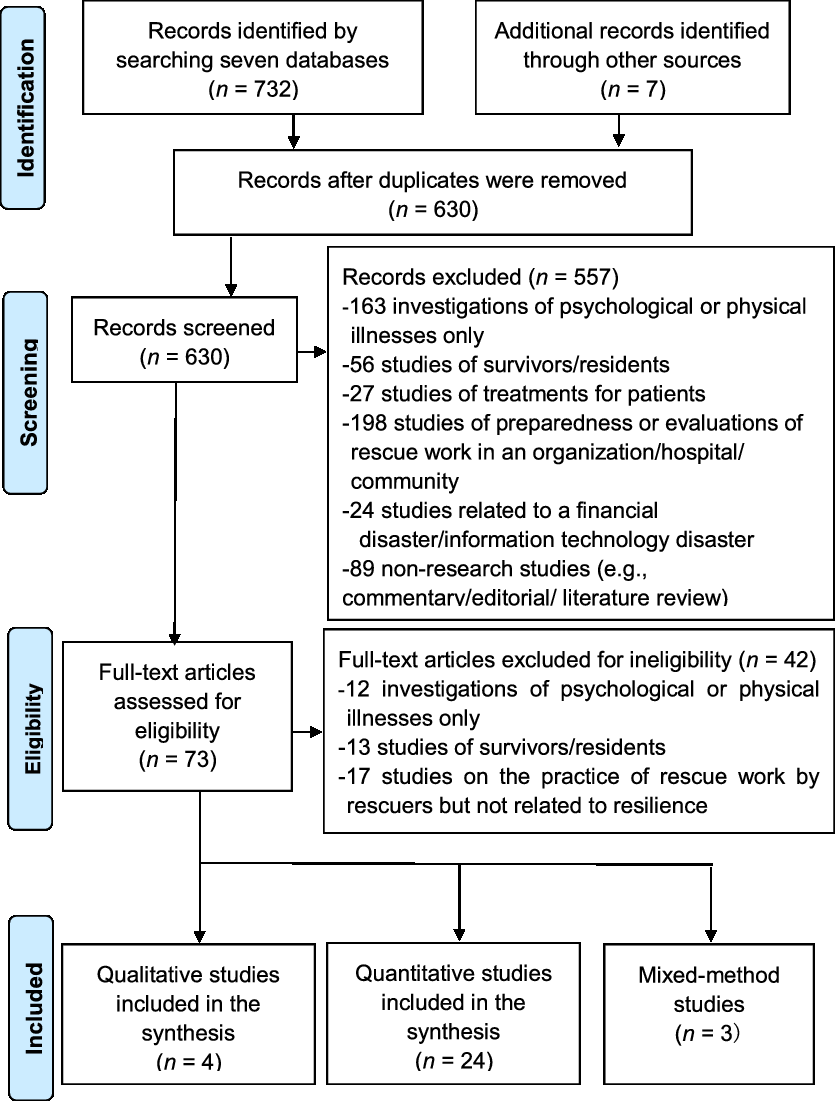
A total of 739 works were identified through electronic databases and additional searches. After duplicates were removed, 630 articles were screened based on title and abstract. Of these, 557 articles did not fulfil the criteria for inclusion. Seventy-three full-text articles were then assessed for eligibility. Ultimately, 31 articles were included in this review. Figure 1 outlines the flow diagram of the selection process.
The flow diagram on identifying the literature

Data Extraction
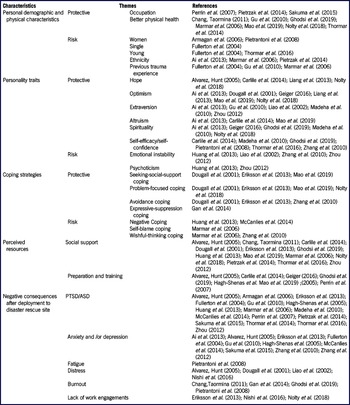
After an extensive review of the articles, a content analysis approach was used to synthesize the data. The researchers identified six commonly mentioned characteristics, namely, demographic and physical characteristics, personality traits, coping strategies, perceived resources, being equipped with special skills for disaster rescue, and adverse consequences from exposure to disaster. The above six categories were used for extracting data from the included articles. Table 1 provides detailed information on the extracted data.
Summary of the characteristics of resilience among disaster rescue workers

Abbreviations: Acute Stress Disorder, ASD; Post-Traumatic Stress Disorder, PTSD
Assessment of the Quality of the Methodology
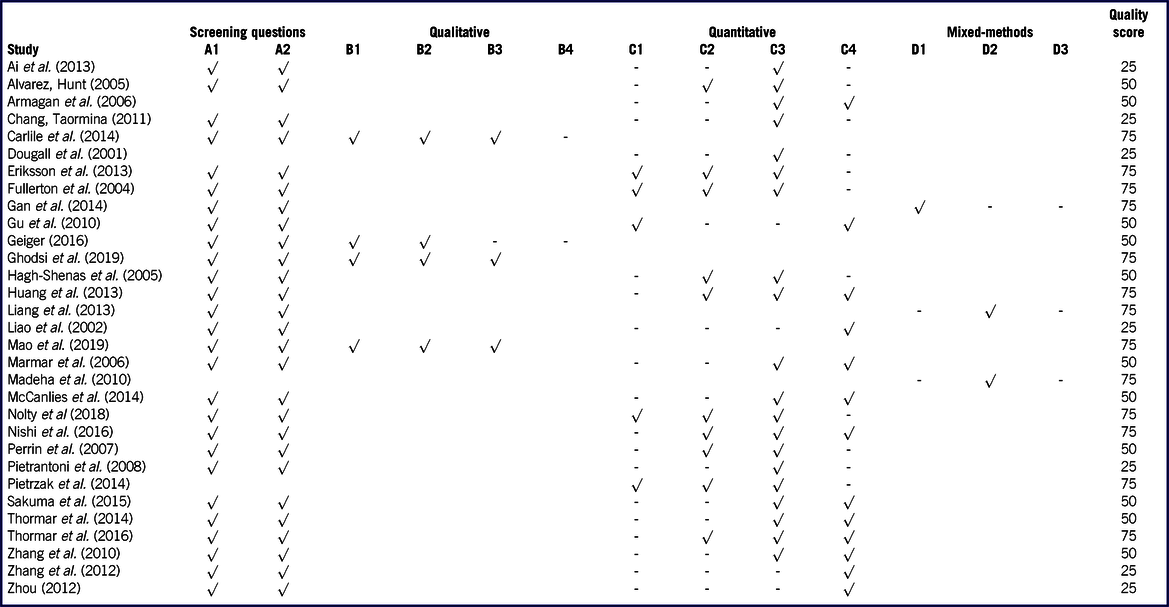
All of the included articles were appraised for methodological quality using the Mixed Methods Appraisal Tool (MMAT), which was designed for systematic literature reviews that include qualitative, quantitative, and mixed-method studies (i.e., mixed study reviews).Reference Pluye, Robert and Cargo33 The MMAT has good validity and reliability.Reference Pace, Pluye and Bartlett34 The output from the MMAT can be reported with a rate ranging from zero to four or presented as a percentage value ranging from zero to 100. The results of the appraisal of the quality of the literature included in this review are presented in percentage values in Table 2.
Appraisal of the methodological quality of the included studies

Notes.
A1: Are there clear qualitative and quantitative research questions, or a clear mixed-methods question?
A2: Do the collected data allow the research question to be addressed?
B1: Are the sources of qualitative data (archives, documents, informants, observations) relevant to addressing the research question?
B2: Is the process for analysing qualitative data relevant to addressing the research question?
B3: Is appropriate consideration given to how the findings relate to the context?
B4: Is appropriate consideration given to how the findings relate to the researchers’ influence?
C1: Is the sampling strategy relevant to addressing the quantitative research question?
C2: Is the sample representative of the population under study?
C3: Are the measurements appropriate?
C4: Is the response rate acceptable (60% or above)?
D1: Is the mixed-methods research design relevant to addressing the qualitative and quantitative research questions?
D2: Is the integration of qualitative and quantitative data relevant to addressing the research questions?
D3: Has appropriate consideration been given to the limitations associated with this integration?
The results of the methodological quality appraisal showed that clear research questions were asked in all the 31 included articles, and that these questions could be addressed by the collected data. The majority (n = 24, 77.4%) of the articles were considered to be of high methodological quality. The quality score for 11 studies was 50,Reference Alvarez and Hunt20,Reference McCanlies, Mnatsakanova and Andrew32,Reference Armagan, Engindeniz and Devay35-Reference Zhang, Zhu and Miao42 while the quality score for 13 studies was 75.Reference Mao, Loke and Fung26,Reference Carlile, Mauseth and Clark43-Reference Eriksson, Lopes Cardozo and Foy54 However, the remaining seven studies only achieved a quality score of 25.Reference Ai, Richardson and Plummer55-Reference Zhou61 Since all of the studies were considered relevant and valuable in contributing to a better understanding of the characteristics of resilience, they were all included in this review.
RESULTS
Characteristics of the ‘Included Studies’
The 31 selected studies were conducted in 10 countries, including the United States of America (n = 11), China (n = 9), Japan (n = 2), Indonesia (n = 2), Iran (n = 2), and other countries (Italy, Israel, Haiti, Turkey, and Taiwan, n = 5). A total of 24 quantitative studies, four qualitative studies, and three mixed-method studies were included in this review. The number of participants in the included studies ranged from four to 28692. In the list, 20 of the 24 quantitative studies were cross-sectional surveys, while the remaining four studies were longitudinal studies. The four qualitative studies were conducted using semi-structured interviews. The three mixed-method studies used both interviews and a cross-sectional survey to collect data.
Characteristics of Resilience Among Disaster Rescue Workers
In this review, the characteristics of resilience among disaster rescue workers are summarized under six domains: personal and physical characteristics, personality traits, coping strategies, perceived resources, being equipped with special skills for disaster rescue, and having less adverse consequences from exposure to disaster (Table 1).
Personal and Physical Characteristics
The included studies indicated that certain demographic and physical characteristics, and protective and risk factors, are related to the resilience of disaster rescue workers. Being in a uniformed profession, such as the police officer or firefighting, is considered a protective factor in the resilience of disaster rescuers. Following the 9/11 terrorist attack, professional police responders exhibited more resilience than non-traditional responders after participating in rescue activities.Reference Perrin, DiGrande and Wheeler39 Police officers were also at a lower risk of developing PTSD than those in other occupations.Reference Perrin, DiGrande and Wheeler39-Reference Pietrzak, Feder and Singh50 The prevalence of PTSD, depression, and psychological distress was lower among firefighters (1.6%, 3.8%, and 2.6%) than among municipal workers (6.6%, 15.9%, and 14.9%) and medical workers (6.6%, 14.3%, and 14.5%).
Risk factors for low resilience among disaster rescuers were being female, single, young, of Hispanic race, and having previously had a traumatic experience. People with these characteristics were more likely to suffer from negative psychological problems after deployment. Female rescuers were shown to be at a higher risk of developing severe PTSD symptoms and burnout within six months after a disaster rescue than male rescuers.Reference Armagan, Engindeniz and Devay35,Reference Pietrantoni and Prati59 Rescue workers who were single and younger were more likely to develop Acute Stress Disorder (ASD),Reference Fullerton, Ursano and Wang44 characterized by the development of severe anxiety, dissociation, and other symptoms within one month after exposure to an extreme traumatic stressor,Reference Steve62 while voluntary rescuers who were married and older were more likely to be regarded as resilient individuals.Reference Thormar, Sijbrandij and Gersons51 Hispanic-American rescuers reported more severe symptoms of PTSD than European-American and African-American rescuers.Reference Marmar, McCaslin and Metzler38-Reference Pietrzak, Feder and Singh50 Yet another study reported that responders from visible minority groups were more resilient than whites.Reference Ai, Richardson and Plummer55 In addition, rescue workers with previous traumatic experiences have been found to be prone to suffering from psychological problems, such as PTSD and depression, after a disaster rescue.Reference Marmar, McCaslin and Metzler38,Reference Fullerton, Ursano and Wang44-Reference Gu, Song and Shao63
Physical fitness is another protective factor affecting the resilience of rescue workers. Chinese soldiers and healthcare rescuers in good physical health had low levels of secondary trauma and burnout after being dispatched to an earthquake site and were regarded as resilient.Reference Mao, Loke and Fung26-Reference Chang and Taormina56 Another study involving 1024 military rescue workers revealed a positive association between poorer physical health and severe PTSD symptoms.Reference Gu, Song and Shao63 Humanitarian aid workers viewed good physical health as necessary to maintaining physical capacity, which could help them to solve problems in their mission.Reference Nolty, Bosch and An52,Reference Ghodsi, Jazani and Sohrabizadeh53 Poor sleep quality was also found to strongly contribute to PTSD symptoms in professional humanitarian aid workers and volunteer rescue workers after a disaster event.Reference Marmar, McCaslin and Metzler38,Reference Thormar, Gersons and Juen41,Reference Eriksson, Lopes Cardozo and Foy54
Personality Traits
Certain personality traits, including hopefulness, extroversion, optimism, altruism, spirituality, and self-confidence, which contribute to the positive handling of traumatic situations are considered characteristics of resilience.
Hopefulness is associated with resilience. A qualitative study found that voluntary rescuers who had a sense of hope had a high level of psychological resilience after a large-scale disaster than those who did not.Reference Carlile, Mauseth and Clark43 A study of 1553 humanitarian aid workers indicated that those with a hopeful outlook had a high level of resilience.Reference Nolty, Bosch and An52 Another study noted that rescue workers deployed during 9/11 who were without a sense of hope were at a higher risk of developing symptoms of PTSD, anxiety, and depression 6 months after the disaster, compared to non-deployed rescuers.Reference Alvarez and Hunt20 A study on 452 members of rescue teams also reported that those who possessed a sense of hope in their disaster rescue work and in their personal life were regarded as resilient.Reference Liang and Peng47
Extraversion is a personality trait that is negatively correlated with symptoms of psychological disorders among disaster rescue workers.Reference Liao, Lee and Lee58,Reference Zhou61 A study employing factor analysis found that the personality trait of extraversion contributed to the resilience of rescue workers after they had been exposed to trauma.Reference Madeha, Saleem and Mamood48 Another study revealed that, unlike extraversion, introversion is reported to be positively associated with PTSD.Reference Gu, Song and Shao63
The trait of optimism is yet another positive characteristic related to resilience. Two quantitative studies of 159 rescue workers who responded to a plane crash and 21 healthcare rescuers showed that individuals with an optimistic personality reported less distress during a disaster than those with a pessimistic personality.Reference Mao, Loke and Fung26,Reference Dougall, Hyman and Hayward57 A cross-sectional study of 554 students who engaged in disaster relief efforts found a negative association between optimism and depression after the devastation resulting from hurricanes Katrina and Rita.Reference Ai, Richardson and Plummer55 Semi-structured interviews revealed that resilient rescuers were optimistic about their rescue work during deployment and their future tasks.Reference Geiger36,Reference Liang and Peng47
The personality traits of altruism and spirituality were also associated with resilienceReference Isaacs, Mota and Tsai64,Reference Sharma, Marin and Koenig65 Studies have shown that following the Haiti earthquake and Wenchuan earthquake, increased resilience was seen among those who had a desire to help others.Reference Mao, Loke and Fung26,Reference Carlile, Mauseth and Clark43,Reference Ai, Richardson and Plummer55 It has also been reported in a qualitative study that having a religious belief can mitigate symptoms of trauma and promote post-traumatic resilience and growth after disastrous events.Reference Geiger36 Other studies reported that spirituality contributes to the enhancement of resilience,Reference Madeha, Saleem and Mamood48,Reference Ghodsi, Jazani and Sohrabizadeh53 particularly when the focus of spirituality is not only on inner beliefs but also on external practices.Reference Nolty, Bosch and An52
Self-efficacy or self-confidence also improves psychological resilience. A study of 241 military men exposed to the Wenchuan earthquake found a negative correlation between anxiety and self-efficacy.Reference Zhang, Zhu and Miao42 Those with self-efficacy were also reported to be more likely to exhibit symptoms of compassion fatigue and burnout.Reference Pietrantoni and Prati59 In addition, self-confidence has been found to contribute to the enhancement of resilience among frontline workers, humanitarian aid workers, and volunteers exposed to disastrous events.Reference Carlile, Mauseth and Clark43,Reference Madeha, Saleem and Mamood48,Reference Thormar, Sijbrandij and Gersons51,Reference Ghodsi, Jazani and Sohrabizadeh53
Negative personality traits weaken the resilience of disaster rescue workers and contribute to psychopathologic symptoms. Emotional instability is the most frequently reported predictor of negative personality traits among those suffering from PTSD and psychological stress.Reference Zhang, Zhu and Miao42,Reference Huang, Liu and Li46,Reference Liao, Lee and Lee58,Reference Zhou61 Having a psychotic personality is another predictor of PTSD.Reference Madeha, Saleem and Mamood48,Reference Zhou61
Coping Strategies
Coping strategies, including seeking social support, problem-focused coping, avoidance coping, and expressive suppression, were positively correlated with resilience among disaster rescuers. A longitudinal study indicated that greater use of seeking-social-support coping strategies predicts the lessening of stress among rescue workers approximately 2 and 6 months after deployment, whereas problem-focused and avoidance coping strategies are associated with less stress months after a disaster.Reference Dougall, Hyman and Hayward57 This finding is consistent with those from the studies of 214 humanitarian aid workers and 21 healthcare rescuers.Reference Mao, Loke and Fung26,Reference Eriksson, Lopes Cardozo and Foy54 Another two studies reported that avoidance coping was negatively related to the state of anxiety of rescuers after deployment.Reference Zhang, Zhu and Miao42,Reference Eriksson, Lopes Cardozo and Foy54 A mixed-methods study showed that suppression is associated with the lowest levels of job burnout among rescue medical staff, and that these effects were mediated by positive reappraisals.Reference Gan, Wen and Wang45
However, poor coping strategies significantly affect resilience. Two studies showed that poor coping strategies were positively correlated with PTSD after disasters.Reference McCanlies, Mnatsakanova and Andrew32,Reference Huang, Liu and Li46 Self-blame and wishful-thinking coping have also been identified as risk factors that reduce resilience.Reference Marmar, McCaslin and Metzler38 In addition, wishful-thinking coping has been positively associated with anxiety and PTSD.Reference Marmar, McCaslin and Metzler38,Reference Zhang, Zhu and Miao42
Perceived Resources
Social support, defined as resources from family, friends, colleagues, and work organizations or communities, has frequently been reported as predicting resilience and aiding in the prevention of psychological stress, anxiety, burnout, and PTSD.Reference Alvarez and Hunt20,Reference Marmar, McCaslin and Metzler38,Reference Sakuma, Takahashi and Ueda40,Reference Carlile, Mauseth and Clark43,Reference Huang, Liu and Li46,Reference Pietrzak, Feder and Singh50,Reference Thormar, Sijbrandij and Gersons51,Reference Chang and Taormina56,Reference Dougall, Hyman and Hayward57,Reference Zhou61
Rescue workers who perceive that they have a high level of social support or social acknowledgement are less likely to suffer from negative consequences such as burnoutReference Marmar, McCaslin and Metzler38,Reference Thormar, Sijbrandij and Gersons51,Reference Chang and Taormina56 and PTSDReference Huang, Liu and Li46,Reference Pietrzak, Feder and Singh50,Reference Eriksson, Lopes Cardozo and Foy54,Reference Dougall, Hyman and Hayward57,Reference Zhou61 during or after deployment in a disaster area. A qualitative study showed that volunteers with strong social support enjoyed psychological benefits, although volunteers can be regarded as survivors who have experienced considerable material loss after a large-scale disaster.Reference Carlile, Mauseth and Clark43 In a longitudinal study, great social support for workers involved in air crashes was negatively linked with concurrently reported distress at 2, 6, 9, and 12 months after the incident.Reference Dougall, Hyman and Hayward57 Social support was found to help disaster rescuers balance their emotions to improve their mood,Reference Ai, Richardson and Plummer55 and to have motivated them to remain part of the disaster rescue team.Reference Mao, Loke and Fung26,Reference Nolty, Bosch and An52,Reference Ghodsi, Jazani and Sohrabizadeh53
Being Equipped with Special Skills for Disaster Rescue
Being equipped with special preparation and training can enhance the resilience of disaster rescuers. Disaster rescuers without formal training demonstrated lower levels of physical and psychological health when compared with trained rescue personnel such as police officers.Reference Hagh-Shenas, Goodarzi and Dehbozorgi37 Canine search and rescue handlers who were certified members of the Federal Emergency Management Agency (FEMA) were less likely to report PTSD symptoms.
It was postulated that their special training and preparedness for disaster gave them a sense of efficacy and a locus of internal control.Reference Alvarez and Hunt20 A study also reported that adequate disaster preparedness reduced the prevalence of PTSD among rescue workers.Reference Perrin, DiGrande and Wheeler39 It has been suggested that trained disaster rescuers were able to focus on task performance and goal achievement when they served at a disaster scene, and that this ability may have enhanced their resilience.Reference Mao, Loke and Fung26,Reference Geiger36,Reference Carlile, Mauseth and Clark43,Reference Ghodsi, Jazani and Sohrabizadeh53
Had Less Adverse Consequences
The nature of rescue work and the occurrence of disasters are stressors that could have negative psychological consequences on rescue workers dispatched to disaster sites. However, disaster rescuers with the attributes of resilience reported fewer symptoms of ASD or PTSD.Reference Alvarez and Hunt20,Reference McCanlies, Mnatsakanova and Andrew32,Reference Armagan, Engindeniz and Devay35,Reference Hagh-Shenas, Goodarzi and Dehbozorgi37-Reference Thormar, Gersons and Juen41,Reference Fullerton, Ursano and Wang44,Reference Huang, Liu and Li46,Reference Madeha, Saleem and Mamood48,Reference Pietrzak, Feder and Singh50,Reference Thormar, Sijbrandij and Gersons51,Reference Eriksson, Lopes Cardozo and Foy54,Reference Zhou61,Reference Gu, Song and Shao63 With resilience, rescue workers would also not be prone to developing anxiety and/or depression,Reference Alvarez and Hunt20,Reference McCanlies, Mnatsakanova and Andrew32,Reference Hagh-Shenas, Goodarzi and Dehbozorgi37,Reference Sakuma, Takahashi and Ueda40,Reference Zhang, Zhu and Miao42,Reference Fullerton, Ursano and Wang44,Reference Eriksson, Lopes Cardozo and Foy54,Reference Ai, Richardson and Plummer55,Reference Zhang, Chen and Xia60,Reference Gu, Song and Shao63 fatigue,Reference Pietrantoni and Prati59 distress,Reference Alvarez and Hunt20,Reference Nishi, Kawashima and Noguchi49,Reference Dougall, Hyman and Hayward57,Reference Liao, Lee and Lee58 burnout,Reference Gan, Wen and Wang45,Reference Ghodsi, Jazani and Sohrabizadeh53,Reference Chang and Taormina56,Reference Pietrantoni and Prati59 and lack of work engagement.Reference Nishi, Kawashima and Noguchi49,Reference Nolty, Bosch and An52,Reference Eriksson, Lopes Cardozo and Foy54
DISCUSSION
A total of 31 articles were reviewed in this study. Resilient rescue workers who were less likely to develop adverse psychological symptoms demonstrated certain qualities that contribute to resilience. These consisted of certain personal and physical characteristics, personality traits, coping strategies, perceived resources, and having special skills for disaster rescue.
The negative consequences of disaster exposure are said to be preventable with resilience. While certain demographic factors (gender, age, and ethnicity) are unchangeable, other personal and physical characteristics such as physical fitness and personality traits are modifiable. In the literature included in this review, firefighters and policemen were found to be less likely to suffer from negative psychological consequences and to be more resilient than other rescue workers such as healthcare professionals. This can be credited to the fact that these uniformed troops are recruited and selected based on a process of screening for certain qualities (i.e., strong physical and psychological characteristics) that make them more resilient.Reference North, Tivis and McMillen66 It is suggested that as part of the process of recruiting disaster rescue workers, physical and psychological tests should be performed to identify those with the qualities to resist negative psychological consequences after deployment to disaster sites.Reference Yasien, Nasir and Shaheen23,Reference McCanlies, Mnatsakanova and Andrew32
Rescue workers who adopt appropriate coping strategies can effectively resolve psychological difficulties, which would reduce their chances of suffering from harmful effects in the aftermath of a disaster. Positive coping strategies, including seeking-social-support and problem-focused coping, are correlated with resilience in rescuers exposed to disastrous situations.Reference Hagh-Shenas, Goodarzi and Dehbozorgi37,Reference Zhang, Zhu and Miao42,Reference Dougall, Hyman and Hayward57 An avoidance style of coping, although regarded as a risk factor contributing to anxiety and depression among lawyers,Reference Holahan and Moos67 HIV patients,Reference Fukunishi, Hosaka and Negishi68 and adolescents in general,Reference Gomez and McLaren69 facilitates the development of resilience in rescuers after adversity. The explanation for this is that disaster responders often have limited resources to confront their disturbances during the early period of the rescue work.Reference Zhang, Zhu and Miao42,Reference Dougall, Hyman and Hayward57 An avoidance coping strategy has been found to be effective in the immediate or short-term period, whereas seeking-social-support and problem-focused coping are more effective in the long term.Reference Roth and Cohen70 Thus, appropriate coping strategies among rescue workers may vary at different points in time after a disaster rescue.Reference Dougall, Hyman and Hayward57,Reference Folkman and Moskowitz71 It is inevitable that if rescue workers are introduced to coping strategies before they are dispatched to disaster sites, they can become familiar with those strategies and use them to help themselves.
Social support could contribute to resilience among rescue workers. It has been demonstrated from the studies that were included in this review that rescue workers with more social support would have higher levels of resilience and fewer symptoms of PTSD. This can be explained by social cognitive theory, which maintains that a belief in one’s capacity to manage situations can help one to respond effectively to stressful conditions through the perception that one has the self-efficacy to cope.Reference Benight and Bandura72 Individuals who perceive that they have a higher level of social support tend to have higher levels of coping self-efficacy and control, and are less likely to suffer from PTSD.Reference Sumer, Karanci and Berument73,Reference Fikretoglu, Brunet and Poundja74 However, rescue workers seldom share their emotions with family members, instead sharing their emotional disturbances due to disaster work with close colleagues and friends.Reference Geiger36 Therefore, further research should be conducted on interventions to facilitate support from colleagues in order to enhance resilience among rescue workers.
The characteristics contributing to resilience in rescuers are interrelated. Those rescuers who adopted problem-focused/seeking-social-support coping strategies, and who had more readily available social support, were found to be more optimistic than rescue workers who were pessimistic.Reference Dougall, Hyman and Hayward57 On the other hand, the resilience of those who were less optimistic could be enhanced with the employment and development of appropriate coping strategies and social skills (modifiable characteristics).
Professional preparation and training in coping skills could contribute to individual resilience. Psychological First Aid (PFA) training has been found to be effective at increasing people’s confidence in engaging in rescue activities, in turn enhancing the resilience of rescuers.Reference Allen, Brymer and Steinberg75-Reference Everly, Barnett and Sperry77 Researchers, officials, and disaster managers should become more aware of the importance of this aspect. Before deployment, rescuers should be provided with instruction in some of the psychological knowledge and skills that are part of PFA training. This would not only benefit the rescuers themselves, but could also be of help to victims of disaster.
Limitations
There are several limitations in this review. Only studies published in English and Chinese were included in this review, while other types of so-called ‘grey literature’ (conference abstracts and dissertations) were excluded. This may have contributed to publication bias in the reported findings.
While qualitative studies are considered suitable for exploring the internal hidden feelings or resilience of rescue workers, only four qualitative studies were identified for inclusion in this review. There were also shortcomings in the quantitative studies that were included, with 24 out of the 31 studies being cross-sectional studies that had been conducted at different points in time after the carrying out of rescue work, but not longitudinal studies that followed the same cohort of rescue workers to observe changes in their psychological status. Lastly, different instruments were adopted in these quantitative studies to measure the same attributes, making it impossible for conclusive results to be obtained from a meta-analysis.
CONCLUSION AND IMPLICATIONS
This review makes possible a more comprehensive understanding of the concept of resilience for rescue workers. Positive personal and physical characteristics, personality traits, coping strategies, perceived resources, and being equipped with special skills for disaster rescue contribute to resilience and protect rescuers from negative psychological consequences. This enhanced understanding is valuable for the management personnel of organizations involved in disaster rescue efforts. A screening tool should be developed for use in recruiting disaster rescue workers and volunteers who possess the characteristics of resilience, and interventions should be developed to prevent rescue workers from suffering negative psychological consequences. The screening tool that is employed could focus on both non-modifiable and modifiable characteristics, but the interventions/psychological training should focus on modifiable factors, such as self-awareness, coping strategies, and social resources, to improve psychological wellbeing.
Author Contributions
The co-first authors of this study, Xiaorong Mao and Olivia WM Fung, contributed equally to this work.