Introduction
Nearly 50%-75% of the global population does not have access to acute care referral systems.Reference Mock 1 The lack of emergency systems of transport and prehospital care in low- and middle-income countries (LMICs) leads to delays in treatment and increased out-of-hospital morbidity and mortality.Reference Mock, Jurkovich, nii-Amon-Kotei, Arreola-Risa and Maier 2 The increasing burden of non-communicable disease and trauma in LMICs underscores the need for effective, formal, acute care referral systems.Reference Krug, Dahlberg, Mercy, Zwi and Lozano 3 - Reference Ameratunga, Hijar and Norton 5 Until recently, focus on acute care referral needs in LMICs has been under-emphasized and under-studied.Reference Sethi, Aljunid, Sulong and Zwi 6 , Reference Razzak and Kellermann 7 Referral systems in LMICs have largely focused on strengthening specific categories of patient care, including development of emergency obstetric care and improvement in care of the sick child by standardizing approaches via the Integrated Management of Childhood Illness.Reference Koblinsky, Campbell and Heichelheim 8 - Reference Molyneux, Ahmad and Robertson 11 Efforts to develop broad, acute referral systems, beyond use in maternal and childhood emergencies, have shown to be a critical component of effective health care delivery and to play an important role in improving health outcomes in resource-limited settings.Reference Nakahara, Saint and Sann 12 - Reference MacFarlane 14 There remains room for continued improvement as previous studies on referral mechanisms for patients in LMICs have uncovered deficiencies in communications and transport.Reference Razzak and Kellermann 7 , Reference Forjuoh, Mock, Friedman and Quansah 15 , Reference Nakahara, Yi, Phy and Sann 16
In 2003, after nearly two decades of armed conflict, the Liberian health system began a slow but significant process of reconstruction and rehabilitation. Although literature regarding Liberia’s health care system prior to the civil war is scarce, at the end of armed conflict, the country faced a crippled health system, a shortage of health care workers, a lack of basic infrastructure, deep distrust in the government, and pervasive poverty.Reference Sun, Dennis, Bernstein and Achenbach 17 At wars end, a significant proportion (80.0%) of clinics were closedReference Lee, Kruse and Chan 18 and the number of clinical health care workers in the country was largely diminished to 90 physicians, 1,393 nurses, and 412 midwives. 19 Liberia’s infrastructure, including roads and bridges, also was destroyed, further hampering access to care.Reference Downie 20
The Liberia Ministry of Health and Social Welfare (MOHSW; Monrovia, Liberia) sought to rebuild their health system through the Basic Package of Health Services (BPHS), which identified scalable, high-priority services focused on improving the provision of basic health services. 21 , Reference Roberts 22 In 2011, efforts were expanded to the Essential Package of Health Services (EPHS), which developed a more comprehensive care delivery system, with an emphasis on an improved referral system among primary, secondary, and tertiary care health facilities. 19 Although the successes and challenges of BPHS have been evaluated,Reference Lee, Kruse and Chan 18 , 23 there are limited data regarding the progress of EPHS implementation. This descriptive study aimed to systematically characterize the state of acute care referral and transfer systems in Liberia in 2012, two years prior to the West African Ebola outbreak. While much has been published on the Ebola outbreak and its aftermath, this study offers a view of the state of affairs of health care delivery in the most populous county in Liberia leading up to the crisis.
Methods
Study Area
The Republic of Liberia is a low-income country located in West Africa and is divided into 15 counties. This study focused on Montserrado County, which contains the capital city of Monrovia and is the most populous county with 1.14 million people, around 25% of the country’s population. 24 This county was chosen because of its broad availability of health facilities, from clinics to referral hospitals (RHs), as well as its geographic variability including both urban and rural facilities.
At the time of this study, Montserrado County counted 234 separate private and public (government-run) health facilities.Reference Cleveland, Dahn and Lincoln 25 The Liberian MOHSW organizes health facilities into three levels of care based on differences in resources and capabilities: primary, secondary, and tertiary. Primary health care (PHC) clinics provide basic health services at the primary level. The secondary level is comprised of health centers (HC), district hospitals, and county hospitals. Regional hospitals and the national RH, John F. Kennedy Medical Center, located in Monrovia, have been designated to provide tertiary-level care. In addition, numerous private health facilities supplement the government health service; however, there is limited supervision over private facilities, and the number and quality of these facilities fluctuates greatly. 26
Sampling
A cross-sectional survey was conducted at a representative sample of health facilities in Montserrado County over a 6-week study period, during June and July 2012. Data regarding health facilities were obtained from the 2011 accreditation process performed by the Liberian MOHSW with support from the Clinton Health Access Initiative (Boston, Massachusetts USA) and other international donors and nongovernmental organizations. From the accreditation data, geographical coordinates were utilized to map the facilities using the open source software QGIS (QGIS 2.4; QGIS Development Team; online resource). Liberian MOHSW designations were used to categorize public and private health facilities into PHC clinics, HCs, and RHs. A systematic random sample of all PHC clinics, fraction proportional to district population size based on population data from the 2008 census, was included in the study sample. 24 All HC and RH facilities were included in the study sample. Despite their important roles in the health system, specialty hospitals, including mental health and prison/jail facilities, were excluded from the study sample. The study received University of Chicago (Chicago, Illinois USA) Institutional Review Board exemption from full review, and approval from the Liberian MOHSW was obtained.
Data Collection and Analysis
A single observer collected information by a pre-tested, structured questionnaire administered via in-person interview with a qualified director of the health facility (Appendix 1; available online only). The qualified director at the PHC clinic or HC level was the Officer in Charge and at the hospital level included Medical or Nursing Directors or Assistant Directors of the hospital. Objectives and procedures of the survey were explained and oral consent was obtained prior to each interview. The survey was written and administered in English with clarification provided by study personnel when needed.
Collected data focused on categories of effective function of the referral system as described by Hensher, et al.Reference Hensher, Price and Adomakoh 27 Health facility characteristics included: facility type, funding source (private versus public), location (rural versus urban, geographic coordinates), services provided, number and type of staff, and patient flow information in the three months prior to survey administration. Questions regarding communication included: usage of referral/transfer forms, whether and by what means contact with a higher-level facility was made prior to patient transport, presence of staff accompaniment during patient transport, and evidence of feedback from the receiving facility after transfer. Transportation-related questions included: estimated cost of transport, time and distance to preferred facility, mode of transport to initial facility and to the referral facility, and ambulance access. Data about protocols regarding patient care and referral included: number and proportion of patients referred in a 3-month period, presence and use of protocols for transfer, and initiation of treatments prior to transfer. Lastly, respondents also were asked about the role community health workers, traditional trained midwives, traditional healers, and bonesetters play within larger systems of patient referral to their health facilities.
Variables and Analysis
Survey data were converted to numeric values and analyzed to look for inconsistencies in the data. Baseline data were analyzed from 62 separate facilities. Both cost of transport and average distance and time to closest or preferred referral facility were based on interviews with the medical director rather than by geographic calculations to account for road conditions and real-life experiences. Actual straight-line distances between health facilities also were calculated with geographic information system/GIS coordinates.
Data regarding the types of facilities available and specific health services provided were reported as frequencies and percentages. Likert-based questions were analyzed as ordinal variables and reported as frequencies and percentages or median and interquartile ranges when appropriate. Characteristics of the transfer process were stratified based on health facility type and geography, with univariate and bivariate analyses performed using Stata (StataCorp LP; College Station, Texas USA: 2015).
Results
Facility Characteristics
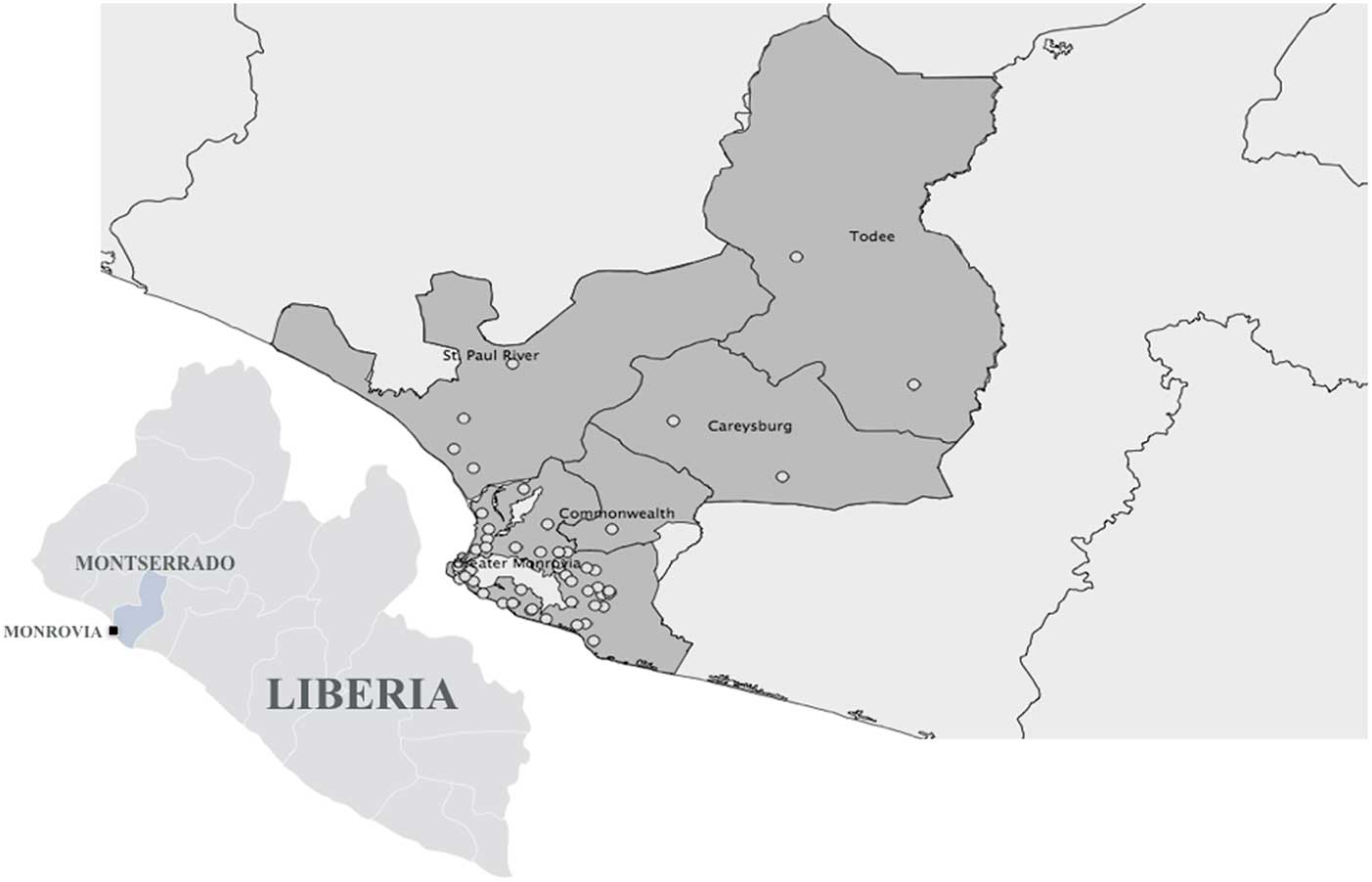
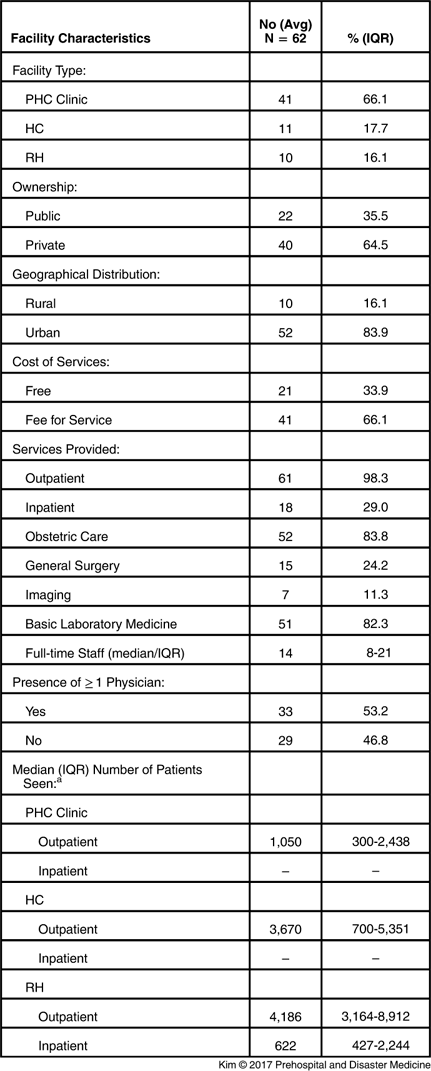
Of 234 separate health facilities in Montserrado County, 62 (26.0%) facilities were surveyed during the 6-week study period. The 62 health facilities included 41 (66.0%) PHC clinics, 11 (18.0%) HCs, and 10 (16.0%) RHs (Figure 1). Surveys revealed that two HCs and one RH were operating as lower-level health facilities (PHCs and HCs, respectively) than their previously designated levels according to their 2011 accreditation status. Of facilities interviewed, 22 (35.5%) were publicly financed and 40 (64.5%) were privately financed (Table 1). The majority of facilities surveyed were geographically urban (n=52; 84.0%) as opposed to rural (n=10; 16.0%).
Geographic Distribution of Health Facilities Surveyed in Five Districts of Montserrado County, Liberia, 2012.

Characteristics of Health Facilities Surveyed in Montserrado County, Liberia, 2012

Abbreviations: HC, health center; PHC, primary health care; RH, referral hospital.
a Calculated or estimated total over a 3-month period prior to survey.
Staffing at the majority of health facilities was limited, with 43 (69.0%) facilities employing less than 20 full-time staff members and with at least one physician available at only 33 (53.0%) of the reporting facilities. By facility type, 100.0% of tertiary facilities (n=9) reported at least one employed physician, while at primary and secondary facilities, the percentage with at least one doctor was 47.0% (n=18) and 55.0% (n=6), respectively.
During the three months prior to survey administration, the median (IQR) number of patients presenting to PHC clinics was 1,050 (300-2,438) outpatients; to HCs was 3,670 (700-5,251) outpatients; and to RHs was 4,186 (3,164-8,912) outpatients and 622 (427-2,244) inpatients.
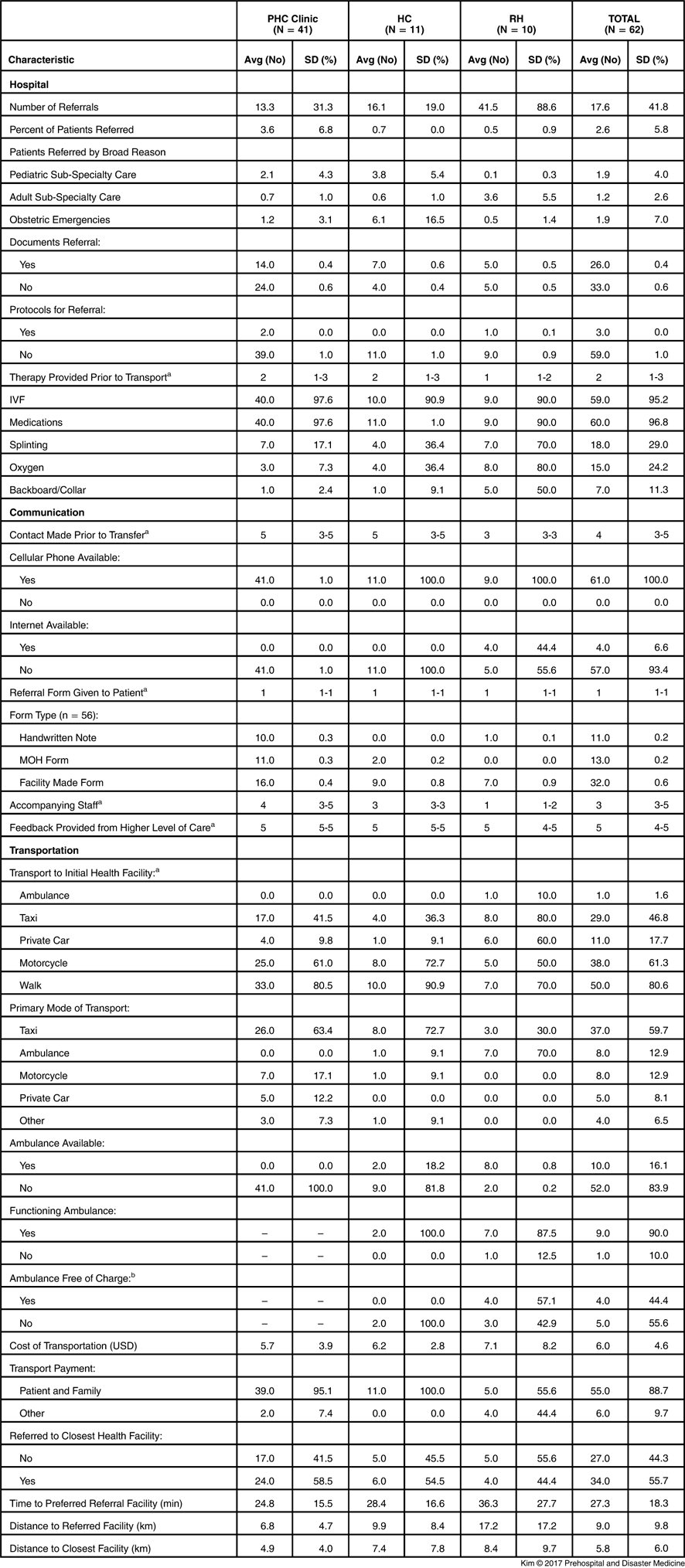
In the 3-month period prior to survey administration, RHs made more referrals as compared to PHCs and HCs (41.5 [SD=88.6], 16.1 [SD=19.0] versus 13.3 [SD=31.3]; P<.001, respectively; Table 2). However, when comparing the mean percent of patients referred among health facilities, PHC clinics were far more likely to refer to a higher-level of care (P<.001).
Referral Characteristics, Communication, and Transportation Processes among Health Facilities, Montserrado County, Liberia, 2012

Abbreviations: HC, health center; PHC, primary health care; RH, referral hospital.
a Median (IQR) from 5-point Likert Scale where Never=1 and Always=5.
b Among those with a functioning ambulance.
The most common reasons for patient transfer listed by health facility directors from all levels of care were sub-specialty and emergency care: pediatric sub-specialty, 40 (65.0% of responding facilities); adult sub-specialty, 34 (55.0%); and obstetric emergency care, 27 (44.0%). Few facilities had organized systems in place for patient transfer, including both protocols for referral (n=3; 5.0%) and documentation (n=26; 44.0%). Some aspect of care was administered prior to transfer all or most of the time among 38 (61.0%) reporting health facilities. Health directors also reported not having designated referral sites; rather, referrals were made to higher-level care facilities at which clinical staff had known personal relations.
Communication between Health Facilities
Overall, there was little communication between initiating and receiving facilities. Nineteen percent (n=12) of facilities reported contacting the referral facility most or all of the time prior to transfer. When contacted, the primary means of contact was by personal cell phone. While cell phones were ubiquitous and available at every clinic, most were personal cell phones with only 10.0% (n=6) of facilities providing access to cell phones or radios to clinical staff. Additionally, access to the internet was similarly poor with 93.0% (n=57) of facilities reporting no access.
Fifty-six (90.0%) facilities reported using some type of transfer form; however, the forms were not standardized and their content varied widely. Only 21.0% (n=13) of health facilities reported using a standard form generated and distributed by the MOHSW. Eighty-two percent (n=52) of the surveyed facilities reported always giving referral forms to patients prior to transfer of care; however, less than one-half (40.0%) of receiving hospitals indicated that referral patients always or most of the time presented with referral forms. Furthermore, the usage of referral forms was more frequent among public facilities, with 100.0% (n=21) of public facilities always using referral forms compared to 75.0% (n=30) of private facilities (P=.012). Once referred, lower-level health facilities rarely or never (n=52; 84.0%) provided feedback from receiving facilities regarding the referral of patients.
Transport
While both urban and rural roads were generally poor, access to more remote areas of the county was particularly challenging, with most dirt roads becoming impassable during the rainy season. Few ambulances were available for use in patient transfer. The Montserrado County Health Team (MCHT), a branch of the MOHSW, assigned an ambulance to each health district within Montserrado County, and each assigned ambulance was housed at a regional public hospital. Some private health facilities also reported having ambulances, although many of them were regular vehicles converted into makeshift ambulances. Among the 10 (16.0%) health facilities reporting access to an ambulance, 90.0% of the ambulances were functioning at the time. Only four (44.0%) of the facilities, all of them publicly financed, provided ambulance transport free of charge. Among the ambulances that charged, the average cost was $10.81 USD (SD=$7.24).
The majority of health facilities (PHC clinics, n=26, 63.0%; HCs, n=8, 73.0%) making emergency referrals relied on commercial taxis as the main mode of transportation. The MCHT also provided rural clinics with motorcycles; however, health directors reported difficulties in using motorcycles as a mode of patient transport due to a variety of reasons: patient’s clinical instability, staff’s inability to operate motorcycles, lack of fuel, and poor road conditions making remote areas difficult to access. Other methods of patient transport included commercial motorcycles, bicycles, wheelbarrows, and hammocks.
On average, transportation costs to referral sites amounted to $6.00 USD (SD=$4.60). A majority of facilities (90.0%) reported payment for transport was primarily dependent on patients’ family and friends. The median (IQR) travel time was 25 (12-35) minutes. The median (IQR) distance to the preferred/most often referred facility was 6.6 (3.5-12) km. This is in comparison to the closest possible RH, which was a median (IQR) distance of 4.4 (2.2-75) km away.
Public versus Private
There were some notable differences between referral processes of public and privately financed facilities. Public, as compared to private, facilities were much more likely to use referral forms (100.0% versus 75.6%; P=.012) and to contact the health facility prior to transfer (66.7% versus 32.5%; P=.009). Public facilities often referred patients to facilities at greater distances away (13.54 versus 6.56 km; P=.006) and at less cost to the patient than private facilities ($4.27 versus $6.91 USD; P=.0311). Owing to the fact that all of the rural facilities were operated by the MOHSW, differences in referral practices among rural and urban facilities were similar to differences in comparing public and private facilities. Additionally, there was little difference in transportation referral patterns among health facilities when stratified by rural versus urban and government versus private facilities.
Referral from the Community
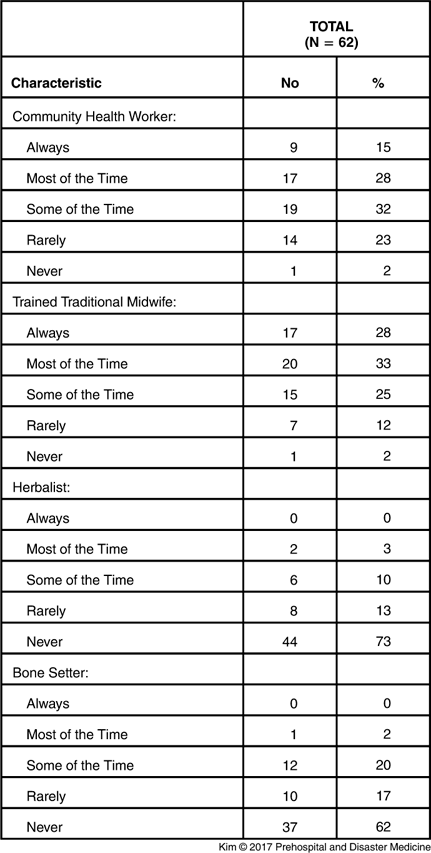
Informal and community-based health providers were viewed by health facility directors as being variable in their knowledge of making timely and adequate referrals. Approximately one-half of health directors thought community health workers (n=26; 42.0%) and traditional midwives (n=37; 60.0%) were adequately trained (all or most of the time) to know when to make referrals to a higher-level of care. In contrast, 84.0% (n=52) and 76.0% (n=47) of medical directors felt traditional healers and bone setters, respectively, were viewed as rarely or never adequately trained to know when to refer patients (Table 3).
Perception of Health Facility Directors on Whether Informal Health Practitioners are Properly Trained in Referral and Transfer Practices

Discussion
Effective patient referral processes rely on several key factors: systems design, clear transportation and communication channels, and compliance of health facilities and personnel involved with referral protocols and processes aimed at minimizing inappropriate system use.Reference Hensher, Price and Adomakoh 27 This study systematically characterized the state of acute care and transfer systems in the largest county of Liberia in 2012 and identified several weaknesses. Conversely, several well-functioning, often informal referral mechanisms were recognized and may serve as the basis for a more robust system.
In general, patient referrals occurred across all levels of the health system and across a wide spectrum of disease patterns. However, decisions to refer rested on individual assessment rather than specific protocol and without standardized documentation. The decision of which center to refer patients to largely rested on personal relations rather than designated referral sites.
The use of protocols for acute care referrals in low-resource settings has been shown to improve patient flow and decrease times to treatment.Reference Slabbert and Smith 28 In Liberia, referrals to tertiary hospitals were often made via informal networks among health providers. Lack of clinical practice guidelines for referral and focused care during transport have been identified as a major constraint in many African countries without coordinated acute referral systems.Reference McCaul and Grimmer 29 Creating designated referral sites based on distance and capacity would streamline referral processes, with the potential to minimize cost and enable more efficient and timely referrals. Providing standard, content-specific guidelines for pre-transfer processes as well as strengthening operational capacity at the referral sites would also further improve referral patterns.
Engaging health care workers at all levels of the health system to strengthen protocols for referral is needed. Previous studies have shown that Liberians rely on both formal and informal forms of health care, sometimes with poor health outcomes.Reference Bills 30 , Reference Kruk, Rockers, Varpilah and Macauley 31 Relying on traditional community-based health workers to strengthen processes of early referral may be one way to offset barriers to the larger health system and serve to improve health access.Reference Husum, Gilbert and Wisborg 32
In this study, most referral instances had no successful communication from the referring center to the receiving institution. The receiving center was contacted only 19.0% of the time by the referring center, usually by personal cell phone. Furthermore, while 82.0% of referring institutions reported giving referral forms to patients, only 40.0% of institutions report actually receiving referral forms once the patients arrived at their facility. Communication from the receiving institution to the referring center also was lacking, with 84.0% of receiving institutions providing no feedback to the referring institution. Poor communication between initiating and receiving facilities has been shown to reduce quality of care.Reference Nakahara, Saint and Sann 33 Even in well-resourced settings, poor documentation and sign-out of patient care from one facility to another leads to worse clinical outcomes.Reference Laudermilch, Schiff, Nathens and Rosengart 34 The lack of referral forms and feedback letter use in Liberia is similar to research in other LMICs.Reference Atkinson, Ngwengwe and Macwan’gi 35 Low-cost interventions aimed at the creation, distribution, and use of a standard referral and feedback systems may help to systematize communication between health facilities.
The widespread use of cell phones has greatly enhanced communication in LMICs, often at a lower cost than more formal closed-communication systems.Reference Krasovec 36 The reliance on private cell phones, as was common among health workers in this survey, is not without drawbacks. In Liberia, as is the case throughout much of the developing world, phone plans are not available and individuals must pre-pay for their cell phone usage leading to an added out-of-pocket expense. Adjuncts to cellular technology, including attempts at developing sustainable African-centric emergency medical dispatch systems, have been proposed, appear feasible, and ought to be encouraged.Reference Mould-Millman, de Vries and Stein 37
Most hospitals made creative use of existing means of both public and private vehicles, but an organized and integrated transport or Emergency Medical Service (EMS) system was lacking. Patient transport was considered a major challenge by most medical directors. Transport to initial health facilities is particularly important as around 40.0% of Liberia’s population lives more than a one-hour walk from the nearest health facility. 19 Only 16.0% of health care facilities surveyed had access to an ambulance, some of which were regular vehicles serving as makeshift ambulances. While a few public HCs provided ambulance transport for free, most centers charged for this service, with an average cost of $10.81 USD per ambulance ride.
Further, problems persisted over ambulance operability, maintenance cost, and service use often leading to misuse or neglect. When ambulances were used for patient transport, they were limited to inter-facility transports and often consisted of a driver only, without an accompanying health care provider. The presence of at least two providers, including a driver and trained health care worker, is the recommendation of many leading authorities on prehospital care. 38 In addition to a shortage of or ill-functioning designated transport vehicles, other transportation barriers also were thought to delay care. Though average distances between initiating and receiving health facilities were relatively short, actual travel times were variable and often prolonged given poor road conditions, a limitation shared by previous research from similar contexts.Reference Samai and Sengeh 39
Overall transport costs by patients and families were seen as barriers to effective care. The average cost of transportation ($6.00 USD) to a referral facility is a proportionally large sum, especially when considering 84.0% of Liberia’s population lives below the international poverty line of USD $1.25 per day. 40
High transport costs have been shown to delay care and make it harder for families to further overcome the financial constraints of poverty, especially in more remote areas.Reference Whitehead, Dahlgren and Evans 41 Similar to what this study found in Montserrado County, the burden of transporting patients to health facilities often falls on commercial buses, taxis, and private vehicles in much of Africa.Reference Tiska, Adu-Ampofo and Boayke 42 , Reference Jayamaran, Mabweijano and Lipnick 43 While expanding the public ambulance transport system could help ease the cost burden from patients, establishing an organized EMS system is itself costly and would require significant support from the Liberian government. Efforts in Madagascar and Nigeria to train commercial and private drivers in the basics of lay first response are promising.Reference Geduld and Wallis 44 , Reference Essien, Ifenne and Sabitu 45 This crowd-sourcing approach, building on existing taxi transport already in use in an ad hoc manner, may prove more reliable and sustainable than the creation of a fleet of ambulances supplied by the government, especially in the short term. Subsidized private car and taxi owners serving as designated transporters may further help to lower costs for patient transport. In fact, the World Health Organization (WHO; Geneva, Switzerland) encourages layperson first responder training as an initial step in the development of more robust prehospital systems.Reference Sasser, Varghese and Kellerman 46
This study uniquely provides a systematic, detailed characterization of health care delivery in a country which would, two years later, be ravaged by the worst Ebola outbreak in modern history. Much effort has been devoted to understanding the evolution of the outbreak and the health system’s weaknesses that were consequently exposed on the local, national, and global levels. Delays in transport to treatment centers or laboratories resulted in increased mortality or lab sample errors. 47 Over the course of the epidemic, foreign agencies aided the MOHSW in developing a call center to dispatch vehicles to the homes of suspected Ebola victims. At the peak of the outbreak, there were approximately 15 ambulances, both government-sponsored and privately donated, in operation in Monrovia.Reference Sieff 48 Still, many patients continued to rely on known means of transport, including commercial taxis, leading the Liberian government to restrict transport in taxis to three people in the back seat in order to reduce potential rider-to-rider contact and further disease transmission.Reference Cooper 49 The legacy of the Ebola outbreak necessitates continued development of more functional and systematic acute care referral and transfer processes. Toward this end, this study provides a window into the everyday workings of the health transport and referral system in Liberia just prior to the Ebola crisis, placing the subsequent literature on the Liberian response into a broader context.
Limitations
Limitations to this study should be noted. Many of the health facilities that were included lacked records regarding referral patterns and patient flow. In these cases, survey responses relied on self-reporting by staff, which could result in over-estimation or under-estimation of some data points. Nine health facilities initially randomized for sample were no longer in operation at the time of the study, could not be located given the geographical data, or could not be reasonably accessed during the rainy season due to poor travel conditions. Given the small sample size, inclusion of these health facilities may have produced different results. The reliance on medical directors and the use of self-report in filling out much of the survey answers may produce an inherent bias in the quality of the data. Lastly, the survey study period took place before the Liberian health system was disrupted by the Ebola epidemic, which placed significant strain on the country’s health infrastructure.
Conclusion
This study characterizes the acute care referral systems in the largest county in Liberia. Acute care referrals occurred across all tiers of the health system via several ad hoc referral processes, including informal communication among facilities, variable patient documentation, and reliance on layperson transport with limited access to ambulances. Many of these same practices could serve as the basis for development of more systematic referral protocols in the future.
Supplementary Material
To view supplementary material for this article, please visit https://doi.org/10.1017/S1049023X1700677X