Introduction
Species of Haemoproteus (Haemosporida, Haemoproteidae) are important pathogens of birds due to their high prevalence in many bird populations, diseases and even mortality caused in some non-adapted avian host (Garvin et al., Reference Garvin, Homer and Greiner2003; Donovan et al., Reference Donovan, Schrenzel, Tucker, Pessier and Stalis2008; Olias et al., Reference Olias, Wegelin, Freter, Gruber and Klopfleisch2011; Pacheco et al., Reference Pacheco, Escalante, Garner, Bradley and Aguilar2011) Haemoproteosis belongs to a group of neglected parasitic diseases, yet it might result in severe infection in some birds (Cardona et al., Reference Cardona, Ihejirika and McClellan2002; Cannell et al., Reference Cannell, Krasnec, Campbell, Jones, Miller and Stephens2013; Valkiūnas, Reference Valkiūnas and Mehlhorn2015). Much information is available about prevalence (Ishtiaq et al., Reference Ishtiaq, Gering, Rappole, Rahmani, Jhala, Dove, Milensky, Olson, Peirce and Fleischer2007; Latta and Ricklefs, Reference Latta and Ricklefs2010; Silva-Iturriza et al., Reference Silva-Iturriza, Ketmaier and Tiedemann2012; Neto et al., Reference Neto, Pérez-Rodríguez, Haase, Flade and Bensch2015), genetic diversity (Szymanski and Lovette, Reference Szymanski and Lovette2005; Dimitrov et al., Reference Dimitrov, Zehtindjiev and Bensch2010; Belo et al., Reference Belo, Pinheiro, Reis, Ricklefs and Braga2011; Ivanova et al., Reference Ivanova, Zehtindjiev, Mariaux and Georgiev2015; Reeves et al., Reference Reeves, Smith, Meixell, Fleskes and Ramey2015; Smith et al., Reference Smith, Van Hemert and Merizon2016) and phylogenetic relationships (Santiago-Alarcon et al., Reference Santiago-Alarcon, Outlaw, Ricklefs and Parker2010; Carlson et al., Reference Carlson, Martínez-Gómez, Valkiūnas, Loiseau, Bell and Seghal2013; Yoshimura et al., Reference Yoshimura, Koketsu, Bando, Saiki, Suzuki, Watanabe, Kanuka and Fukumoto2014; Olsson-Pons et al., Reference Olsson-Pons, Clark, Ishtiaq and Clegg2015; Bensch et al., Reference Bensch, Canbäck, DeBarry, Johansson, Hellgren, Kissinger, Palinauskas, Videvall and Valkiūnas2016) of avian haemoproteids, but vectors, sporogonic development and patterns of transmission of these blood parasites have been insufficiently investigated.
Haemoproteus parasites are cosmopolitan in birds (Scheuerlein et al., Reference Scheuerlein and Ricklefs2004; Ishtiaq et al., Reference Ishtiaq, Gering, Rappole, Rahmani, Jhala, Dove, Milensky, Olson, Peirce and Fleischer2007; Loiseau et al., Reference Loiseau, Iezhova, Valkiūnas, Chasar, Hutchinson, Buermann, Smith and Sehgal2010; Smith et al., Reference Smith and Ramey2015). They are transmitted by louse flies (Hippoboscidae) and biting midges (Ceratopogonidae). Species of subgenus Parahaemoproteus are transmitted by Culicoides biting midges (Garnham, Reference Garnham1966; Valkiūnas, Reference Valkiūnas2005; Atkinson, Reference Atkinson, Atkinson, Thomas and Hunter2008). Louse flies are responsible for transmission of a handful species parasitizing doves, pigeons and several species of marine birds (Atkinson, Reference Atkinson, Atkinson, Thomas and Hunter2008; Levin et al., Reference Levin, Valkiūnas, Iezhova, O'brien and Parker2012; Santiago-Alarcon et al., Reference Santiago-Alarcon, Palinauskas and Schaefer2012; Valkiūnas, Reference Valkiūnas and Mehlhorn2015). Recent experimental studies showed that the wild-caught biting midge Culicoides impunctatus is susceptible to many Parahaemoproteus species (Žiegytė et al., Reference Žiegytė, Markovets, Bernotienė, Mukhin, Iezhova, Valkiūnas and Palinauskas2017), but information about other biting midges remain scanty, and it is still absent in all parts of the world except for North America (Fallis and Wood, Reference Fallis and Wood1957; Bennett and Fallis, Reference Bennett and Fallis1960;Atkinson et al., Reference Atkinson, Greiner and Forrester1983; Garvin and Greiner, Reference Garvin and Greiner2003) and Europe (Valkiūnas et al., Reference Valkiūnas, Liutkevičius and Iezhova2002; Žiegytė et al., Reference Žiegytė, Palinauskas, Bernotienė, Iezhova and Valkiūnas2014;, Reference Žiegytė, Bernotienė, Palinauskas and Valkiūnas2016;, Reference Žiegytė, Markovets, Bernotienė, Mukhin, Iezhova, Valkiūnas and Palinauskas2017; Bukauskaitė et al., Reference Bukauskaitė, Žiegytė, Palinauskas, Iezhova, Dimitrov, Ilgūnas, Bernotienė, Markovets and Valkiūnas2015).
It is important to note that several studies reported Haemoproteus parasite DNA in vectors using polymerase chain reaction (PCR)-based tools (Ishtiaq et al., Reference Ishtiaq, Guillaumot, Clegg, Phillimore, Black, Owens, Mundy and Sheldon2008; Martínez-de la Puente et al., Reference Martínez-de la Puente, Martinez, Rivero-de Aguilar, Herrero and Merino2011; Njabo et al., Reference Njabo, Cornel, Bonneaud, Toffelmier, Sehgal, Valkiūnas, Russell and Smith2011). MtDNA sequences of both Plasmodium and Haemoproteus species were identified in wild-caught biting midges Culicoides circumscriptus (Ferraguti et al., Reference Ferraguti, Puente, Ruiz, Soriguer and Figuerola2013). However, PCR-based tools detect parasite DNA regardless of the stage of development present in insects. For instance, DNA of ookinetes present in midgut or DNA from oocysts, that abort development in the insect, might be amplified. In other words, the presence of DNA of the parasite alone is not sufficient proof of an insect species ability to transmit the parasite (Valkiūnas et al., Reference Valkiūnas, Kazlauskienė, Bernotienė, Palinauskas and Iezhova2013a). To identify the vectors of haemosporidian parasites, it is essential to determine the presence of sporozoites in the salivary glands. Experimental observations, microscopic examination and PCR-based diagnostic methods should be combined in order to obtain convincing data about vectors in wildlife populations.
Several studies used wild-caught biting midges for experimental exposure and investigation of the sporogonic development of Haemoproteus parasites. It was shown that several Haemoproteus species can be transmitted by numerous Culicoides species (Žiegytė et al., Reference Žiegytė, Markovets, Bernotienė, Mukhin, Iezhova, Valkiūnas and Palinauskas2017). For example, Haemoproteus mansoni (syn. Haemoproteus meleagridis) from wild turkeys completes sporogony and can be transmitted by Culicoides edeny, Culicoides hinmani, Culicoides haematopodus, Culicoides arboricola (Atkinson et al., Reference Atkinson, Greiner and Forrester1983) and Culicoides knowltoni (Atkinson et al., Reference Atkinson, Forrester and Greiner1988); H. mansoni (syn. Haemoproteus canachites) from grouse sporogonic development completes in Culicoides sphagnumensis (Fallis and Bennett, Reference Fallis and Bennett1960). Methodology for infection of wild-caught biting midges with haemoproteids is developed (Valkiūnas, Reference Valkiūnas2005) and was successfully applied in field studies (Bukauskaitė et al., Reference Bukauskaitė, Žiegytė, Palinauskas, Iezhova, Dimitrov, Ilgūnas, Bernotienė, Markovets and Valkiūnas2015; Žiegytė et al., Reference Žiegytė, Markovets, Bernotienė, Mukhin, Iezhova, Valkiūnas and Palinauskas2017). However, because of high mortality of wild-caught biting midges in laboratory conditions (Bukauskaitė et al., Reference Bukauskaitė, Bernotienė, Iezhova and Valkiūnas2016), it is difficult to use them in more delicate long-lasting experiments aimed at better understanding of host–parasite relationships. Experimental observations of laboratory-reared biting midges would be helpful in parasitology studies, particularly because the insect colonies are permanently available. That would provide opportunities for the all-year around the research of difficult designs, which is difficult or even hardly possible in case of many species of wild-caught biting midges.
Culicoides nubeculosus is widely distributed in the Palearctic (Mathieu et al., Reference Mathieu, Cêtre-Sossah, Garros, Chavernac, Balenghien, Carpenter, Setier-Rio, Vignes-Lebbe, Ung, Candolfi and Delécolle2012) and probably is a natural vector of avian haemoproteids. This species was colonized (Boorman, Reference Boorman1974) and is susceptible to several Haemoproteus species (Miltgen et al., Reference Miltgen, Landau, Ratanaworabhan and Yenbutra1981; Bukauskaitė et al., Reference Bukauskaitė, Žiegytė, Palinauskas, Iezhova, Dimitrov, Ilgūnas, Bernotienė, Markovets and Valkiūnas2015; Žiegytė et al., Reference Žiegytė, Bernotienė, Palinauskas and Valkiūnas2016). However, the range of Haemoproteus parasites, which can complete sporogony in this insect remains unclear. The aim of this study was to gain new knowledge about sporogony development of haemoproteids in the laboratory-reared biting midge C. nubeculosus. Here, we examined the development of three common Parahaemoproteus parasites in this experimentally exposed insect, i.e., Haemoproteus minutus (cytochrome b gene lineage hTURDUS2), Haemoproteus motacillae (hYWT2) and Haemoproteus attenuatus (hROBIN1). We also determined phylogenetic relationships among Haemoproteus species, which vectors have been identified, and reviewed the literature on Culicoides species-transmitted avian haemoproteids.
Materials and methods
Study site, selection of experimental birds, collection of blood samples and microscopic examination
Experiments were carried out at the Ventės ragas Ornithological station, Lithuania (https://vros.lt) in May of 2015 and 2017. Birds were caught with mist nets, ‘Zigzag’ traps and a big ‘Rybachy’ type trap. The blood was collected from the brachial vein using heparinized microcapillaries, stored in SET buffer (0.05 M Tris, 0.15 M NaCl, 0.5 M EDTA, pH 8.0). The samples were kept at ambient temperature in the field and were preserved at −20 °C at the laboratory. A small amount of freshly obtained blood was used to make three blood smears, which were rapidly dried using a battery-operated fan, fixed with absolute methanol and stained with 10% Giemsa solution, as described in Valkiūnas (Reference Valkiūnas2005).
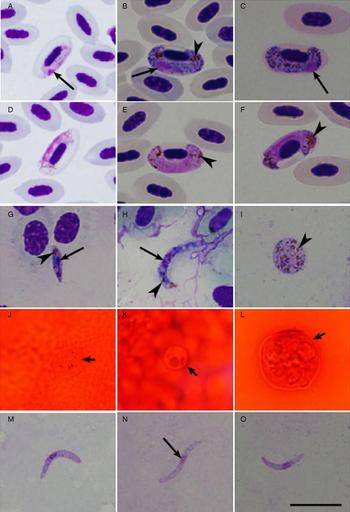
Preparations were examined using Olympus BX-43 light microscope equipped with Olympus SZX2-FOF digital camera and imaging software QCapture Pro 6.0, Image Pro plius (Tokyo, Japan). Blood smears were examined for 15–20 min at low magnification (×400), and when approximately 100 fields were studied at high magnification (×1000). The intensity of gametocytaemia was determined as a percentage by actual counting of the number of mature gametocytes (Fig. 1A–F) per 1000 red blood cells. All vectors preparations were examined at high (×1000) magnification. Statistical analyses were carried out using the ‘R studio’ version 3.4.3. Student's t-test for independent samples was used to determine statistical significance between the mean linear parameters of parasites. A P value of 0.05 or less was considered significant. Representative preparations for vector stages (49011 NS – 49018 NS) were deposited in Nature Research Centre, Vilnius, Lithuania.
Gametocytes (A–F) and sporogonic stages (G–O) of Haemoproteus minutus (lineage hTURDUS2) (A, D, G, J, M), Haemoproteus motacillae (hYWT2) (B, E, H, K, N) and Haemoproteus attenuatus (hROBIN01) (C, F, I, L, O) in Culicoides nubeculosus. Mature macrogametocytes (A–C) and microgametocytes (D–F) in the blood of common blackbird Turdus merula (A, D), white wagtail Motacilla alba (B, E) and thrush nightingale Luscinia luscinia (C, F). Ookinetes (G, H), zygote (I), oocysts (J–L) and sporozoites (M–O) in Culicoides nubeculosus preparations. Methanol-fixed and Giemsa-stained thin films (A–I, M–O). Formalin-fixed whole mounts stained with hematoxilin (J–L). Long simple arrows – nuclei of parasites, simple arrowheads – pigment granules, short arrow – oocysts. Scale bar = 10 µm.

Experimental design
Birds naturally infected with single Haemoproteus infections were used as donors of gametocytes to expose biting midges. One common blackbird Turdus merula, one white wagtail Motacilla alba and one thrush nightingale Luscinia luscinia infected with H. minutus (cytochrome b gene lineage hTURDUS2), H. motacillae (hYWT2) and H. attenuatus (hROBIN1), respectively were used to infect biting midges. All experimental birds survived and were released approximately 1.5 h after their capture at the study site.
Culicoides nubeculosus biting midges were reared in the laboratory according to Boorman (Reference Boorman1974). Briefly, they were kept in small cardboard boxes covered with fine mesh bolting silk. Each box contained approximately 50–70 individuals of biting midges. A box with unfed insects was gently pressed to the feather-free area on pectoral muscles of infected birds. The midges willingly took blood meal through the bolting silk, and the majority of them were fully engorged approximately after 30–40 min. Then, the experimental insects were released in a cage made of bolting silk (12 × 12 × 12 cm3) and males and non-fed females were removed. The remaining engorged biting midges were kept in a room with controlled temperature (22 °C), humidity (75 ± 5%) and light-dark photoperiod (17:7 h). Cotton pads moistened with 10% solution of sugar were placed on the top of each cage in order to feed insects daily.
Dissection of biting midges and making preparations of parasites
Experimentally infected biting midges were dissected and preparations of ookinetes, oocysts and sporozoites were prepared. Before dissections, the insects were anesthetized by placing them in a tube covered with cotton-wool pads moistened with 96% ethanol. Preparations of ookinetes were made by extraction of the midgut, which was gently crushed on the slide. One thin film was prepared from each insect, and the preparation was fixed with methanol and stained the same way as blood films. In order to visualize oocyst, midguts were gently isolated on objective slides and a drop of 2% mercurochrome solution was placed on each of them. Then, the midguts were covered with cover-slips and oocysts were visualized in these temporary preparations. Permanent oocyst preparations were made according to Valkiūnas (Reference Valkiūnas2005). Briefly, midguts were fixed in 10% normal formalin solution for 24 h. Then, formalin was replaced by placing the preparations in 70% ethanol for 6 h. The preparations were washed with distilled water, stained with Ehrlich's hematoxylin for 10 minutes, steeped in water with a pinch of sodium bicarbonate and differentiated with acid-ethanol for 5 min and steeped again in water with sodium bicarbonate. Then, the preparations were dehydrated with 70% and then with 96% ethanol. A drop of clove oil and xylene was used to clear the preparation. Finally, a drop of Canada balsam was placed on midguts, which were covered with cover-slips and air-dried for several days.
Preparations of sporozoites were made by extracting the salivary glands from biting midges and gently crashing them to prepare small thin smears, which were fixed with absolute methanol and stained with 4% of Giemsa solution for 1 hour.
After each insect dissection, residual parts of their bodies were fixed in 96% ethanol and used for PCR-based analysis in order to confirm the presence of corresponding parasite lineages in vectors. Dissected needles were disinfected in the fire to prevent contamination after each dissection.
Polymerase chain reaction, sequencing and phylogenetic analysis
Total DNA was extracted from all samples using the standard ammonium acetate extraction method (Richardson et al., Reference Richardson, Jury, Blaakmeer, Komdeur and Burke2001). Nested PCR protocol was used to amplify cytb gene fragment (Bensch et al., Reference Bensch, Stjernman, Hasselquist, Ostman, Hansson, Westerdahl and Pinheiro2000; Hellgren et al., Reference Hellgren, Waldenström and Bensch2004). The primers HaemNFI and HaemNR3 were used to amplify fragments of Haemoproteus, Plasmodium and Leucocytozoon parasites. The primers HaemF and HaemR2 were applied for the second PCR, which amplifies DNA of Haemoproteus and Plasmodium parasites. The success of the performed PCR was evaluated by running 1.5 µL of PCR product on a 2% agarose gel. One negative control (nuclease-free water) and one positive control (a Haemoproteus sp. infected sample, which was positive by microscopic examination) were used every 7 samples to control for possible false amplifications.
Fragments of DNA from the PCR positive amplifications were sequenced. Big Dye Terminator V3.1 Cycle Sequencing Kit and ABI PRISM™ 3100 capillary sequencing robot (Applied Biosystems, Foster City, California) were used for sequencing. Sequences were edited and aligned using BioEdit software (Hall, Reference Hall1999). The genetic analyser ‘Basic Local Alignment Search Tool’ (National Centre of Biotechnology Information website: http// www.ncbi.nlm.nih.gov/BLAST) was used to compare detected sequences to those deposited in the GeneBank.
To determine the phylogenetic relationship among Haemoproteus parasites, which vectors have been identified, we constructed a phylogenetic tree using 33 sequences of the mitochondrial cytb gene. Three sequences of Plasmodium spp. were also used to increase the resolution of the phylogenetic reconstruction. Leucocytozoon sp. was used as an outgroup. The tree was developed using a Bayesian algorithm (MrBayes version 3.1; Ronquist and Heulsenbeck, Reference Ronquist and Heulsenbeck2003). Best fit model of evolution (GTR+I+G) was selected by software Modeltest 3.7 (Posada and Crandall, Reference Posada and Crandall1998). The analysis was run for a total of 10 million generations with a sample frequency of every 100th generation. Before the construction of the consensus tree, 25% of the initial trees was discarded as ‘burn in’ period. The tree was visualized using the software FigTree v1.4.3 (http://tree.bio.ed.ac.uk/software/figtree/). The absence of double-base calling in sequence electropherograms was used as an indication of single infections (Pèrez-Tris and Bensch, Reference Pèrez-Tris and Bensch2005).
Results
Both microscopic examination (Fig. 1A–F) and PCR-based testing showed the presence of single Haemoproteus infections in donor birds. Haemoproteus minutus (cytb lineage hTURDUS2), H. motacillae (hYWT2) and H. attenuatus (hROBIN1) were present in donor common blackbird, white wagtail and trush nightingale, respectively. PCR and sequencing confirmed the presence of corresponding parasites lineages in experimentally infected insects.
Sporogony of Haemoproteus parasites in Culicoides nubeculosus
Sporogony of all three parasite species occurred and completed in experimentally infected biting midges C. nubeculosus (Fig. 1G–O). Sporozoites of H. minutus, H. motacillae and H. attenuatus developed and were visualized in salivary glands preparation (Fig. 1M–O).
Mature ookinetes of H. minutus (Fig. 1G) were reported in midguts 1–2 h post infection (hpi), while the ookinetes of H. motacillae (Fig. 1H) were detected 12 hpi, indicating the markedly different rate of development in these parasites. Only zygotes of H. attenuatus were seen between 3 and 6 hpi (Fig. 1I). Ookinetes of this parasite possibly develop later, but the preparations were not made on later hours.
Oocysts of all three species were seen in exposed biting midges. Oocyst of H. minutus (Fig. 1J) were seen 3–5 days post infection (dpi) and oocysts of H. motacillae (Fig. 1K) and H. attenuatus (Fig. 1L) were reported 3–4 dpi and 5–7 dpi, respectively.
Sporozoites of H. minutus were reported in salivary gland preparations 7 dpi (Fig. 1M). Sporozoites of H. motacillae (Fig. 1N) and H. attenuatus (Fig. 1O) were seen 8–9 dpi and 6–9 dpi, respectively. Measurements of sporozoites are given in Table 1. There was a significant difference in sporozoite length between all parasite species. Sporozoites of H. minutus were longer than those of H. motacillae (p < 0.001) and H. attenuatus (p < 0.001) and sporozoites of H. motacillae were longer than in H. attenuatus (p = 0.005). There was no difference discernible between H. minutus and H. motacillae in sporozoite width (p = 0.96) and area (p = 0.86). However, sporozoites of H. attenuatus were significantly thinner and smaller in area than sporozoites of H. motacillae (p = 0.008, p < 0.001, respectively) and H. minutus (p = 0.002, p < 0.001, respectively).
Morphometry of sporozoites of three Haemoproteus species in the biting midge Culicoides nubeculosus

a All measurements are given in micrometres. Minimum and maximum values are provided, followed in parentheses by the arithmetic mean and standard deviation.
Phylogenetic analysis
Three species of Haemoproteus used in this study appeared in one well-supported clade with other Culicoides species-transmitted parasites (Fig. 2, clade A). These parasites belong to subgenus Parahaemoproteus. Species of subgenus Haemoproteus, which are transmitted by louse flies appeared in a separate well-supported clade (Fig. 2, clade B).
Bayesian phylogeny of mitochondrial cytochrome b lineages (479 bp) of avian Haemoproteus parasites, which are transmitted by biting midges (clade A, green box) and louse flies (clade B, red box). The tree was rooted with Leucocytozoon sp. (lineage SISKIN2) and it is drawn to scale based on inferred substitutions per site. Nodal support values indicate Bayesian posterior probabilities. Codes of the lineages are given according to MalAvi database (Bensch et al., Reference Bensch, Hellgren and Pérez-Tris2009). GenBank accession numbers of sequences are provided in the parenthesis. Data about parasites used in this study are given in bold font. Parasite species completing sporogony in Culicoides nubeculosus were underlined.

Discussion
The key result of this study is that three species of Haemoproteus completed sporogonic development in laboratory-reared biting midge C. nubeculosus. Sporozoites of H. minutus, H. motacillae and H attenuatus were seen in salivary gland preparations (Fig. 1M–O), indicating that this biting midge likely is the natural vectors of these parasites. All these haemoproteids are parasites of passeriform birds. Žiegytė et al. (Reference Žiegytė, Bernotienė, Palinauskas and Valkiūnas2016) also reported complete sporogony of Haemoproteus (Parahaemoproteus) tartakovskyi, the parasite of passeriform birds in C. nubeculosus. However, there are also experimental data showing that this biting midge is susceptible and support the complete sporogonic development of Haemoproteus species parasitizing birds belonging to other orders, i.e. Haemoproteus (Parahaemoproteus) handai, the parasite of parrots belonging to Psittaciformes (Miltgen et al., Reference Miltgen, Landau, Ratanaworabhan and Yenbutra1981) and Haemoproteus (Parahaemoproteus) noctuae and Haemoproteus (Parahaemoproteus) syrnii, the parasites of owls belonging to Strigiformes (Bukauskaitė et al., Reference Bukauskaitė, Žiegytė, Palinauskas, Iezhova, Dimitrov, Ilgūnas, Bernotienė, Markovets and Valkiūnas2015). In all, the available data show that seven species of avian haemoproteids parasitizing birds of three orders can use C. nubeculosus as final host and the vector (Fig. 2). According to limited available data, C. nubeculosus is not specialized in the blood meal. This biting midge willingly takes blood from various mammals and birds (Jennings and Mellor, Reference Jennings and Mellor1988). Recent experimental studies, which applied experimental exposure of sheep (Pages et al., Reference Pages, Bréard, Urien, Talavera, Viarouge, Lorca-Oro, Jouneau, Charley, Zientara, Bensaid, Solanes, Pujols and Schwartz-Cornil2014), canaries (Svobodova et al., Reference Svobodova, Dolnik, Čepička and Radrova2017), owls (Bukauskaitė et al., Reference Bukauskaitė, Žiegytė, Palinauskas, Iezhova, Dimitrov, Ilgūnas, Bernotienė, Markovets and Valkiūnas2015) and various species of wild passeriform birds (Žiegytė et al., Reference Žiegytė, Bernotienė, Palinauskas and Valkiūnas2016) support this conclusion. Further field studies using molecular markers are needed for better understanding the feeding preferences of C. nubeculosus in different ecosystems. This insect is highly susceptible to various Haemoproteus infections and likely participate in the natural transmission of haemoproteosis. Due to broad distribution in Eurasia (Mathieu et al., Reference Mathieu, Cêtre-Sossah, Garros, Chavernac, Balenghien, Carpenter, Setier-Rio, Vignes-Lebbe, Ung, Candolfi and Delécolle2012), C. nubeculosus should be considered as important haemoproteid vector, which is worth more attention in parasitology research.
Sporozoites of H. minutus, H. motacillae and H. attenuatus were reported in salivary glands on 7, 8–9 and 6–9 dpi, respectively (this study), while the sporozoites of H. noctuae, H. syrnii and H. tartakovskyi were seen between 7 and 11 dpi (Bukauskaitė et al., Reference Bukauskaitė, Žiegytė, Palinauskas, Iezhova, Dimitrov, Ilgūnas, Bernotienė, Markovets and Valkiūnas2015; Žiegytė et al., Reference Žiegytė, Bernotienė, Palinauskas and Valkiūnas2016). Sporozoites of H. handai were first reported in salivary glands 5 dpi (Miltgen et al., Reference Miltgen, Landau, Ratanaworabhan and Yenbutra1981). In experimental research at a temperature of approximately 20–22 C, we advise to access sporozoites in exposed insects between 7 and 9 dpi when they are numerous in salivary glands.
Bukauskaitė et al. (Reference Bukauskaitė, Žiegytė, Palinauskas, Iezhova, Dimitrov, Ilgūnas, Bernotienė, Markovets and Valkiūnas2015) showed that morphologically identical sporozoites of H. noctuae developed in C. nubeculosus and C. impunctatus, while sporozoites of different parasites species (H. noctuae and H. syrnii) were morphologically different and readily distinguishable during development in C. nubeculosus biting midge. Sporozoites of H. syrnii were significantly smaller both in length and in area than those of H. noctuae. This shows that the size of sporozoites might be used as a taxonomic character in distinguishing avian haemoproteids in vectors. In this study, the sporozoites of H. attenuatus were significantly shorter than those of H. minutus and H. motacillae (Fig. 1M–O, Table 1). Ookinetes of different Haemoproteus species also markedly vary in size and shape (compare Fig. 1G and H) and were proved to be readily distinguishable in many avian haemoproteid species during development both in vivo and in vitro (Valkiūnas, Reference Valkiūnas2005; Valkiūnas et al., Reference Valkiūnas, Palinauskas, Križanauskienė, Bernotienė, Kazlauskienė and Iezhova2013b; Žiegytė et al., Reference Žiegytė, Markovets, Bernotienė, Mukhin, Iezhova, Valkiūnas and Palinauskas2017).
Available data show that C. nubeculosus is susceptible to seven Haemoproteus (Parahaemoproteus) species (Table 2). Culicoides impunctatus is also the highly susceptible species of biting midges, which support complete sporogony of 11 Parahaemoproteus parasites (Table 2). Culicoides impunctatus is widespread in the Palearctic and is abundant in Europe (Glukhova and Valkiūnas, Reference Glukhova and Valkiūnas1993; Blackwell et al., Reference Blackwell, Lock, Marshall, Boag and Gordon1999; Patakakis et al., Reference Patakakis, Papazahariadou, Wilson, Mellor, Frydas and Papadopoulos2009). Experimental studies show that infective sporozoites of haemoproteids develop in this biting midge (Valkiūnas et al., Reference Valkiūnas, Liutkevičius and Iezhova2002), which certainly is an effective natural vector. Wild-caught C. impunctatus insects were used in many experimental studies (Žiegytė et al., Reference Žiegytė, Palinauskas, Bernotienė, Iezhova and Valkiūnas2014; Bukauskaitė et al., Reference Bukauskaitė, Žiegytė, Palinauskas, Iezhova, Dimitrov, Ilgūnas, Bernotienė, Markovets and Valkiūnas2015; Žiegytė et al., Reference Žiegytė, Markovets, Bernotienė, Mukhin, Iezhova, Valkiūnas and Palinauskas2017). However, experimental research with wild-caught C. impunctatus insects is limited due to a short-period (several weeks in spring-summer time) when they are very abundant and are easy to sample in large numbers for experimental infections at many study sites in Europe (Liutkevičius, Reference Liutkevičius2000). This complicates the use of wild-caught insects in experimental research in wildlife. Additionally, mortality of wild-caught C. impunctatus insects is high in captivity (Valkiūnas and Iezhova, Reference Valkiūnas and Iezhova2004b; Bukauskaitė et al., Reference Bukauskaitė, Bernotienė, Iezhova and Valkiūnas2016). Meanwhile, C. nubeculosus is easy to rear at the laboratory conditions and survive well (Boorman, Reference Boorman1974). We recommend using this insect in experimental Haemoproteus parasite studies, which can be designed and carried out all the year round. This opens new opportunities for delicate experimental observations on various aspects of haemoproteid parasite biology.
Species of Culicoides biting midges that support the complete sporogonic development of avian Haemoproteus parasites of subgenus Parahaemoproteus

a Originally (Atkinson et al. Reference Atkinson, Greiner and Forrester1983, Reference Atkinson, Forrester and Greiner1988), this parasite was attributed to Haemoproteus meleagridis.
b Originally (Valkiūnas et al. Reference Valkiūnas, Križanauskienė, Iezhova, Hellgren and Bensch2007), this parasite was attributed to Haemoproteus belopolskyi.
c Originally (Fallis and Bennett Reference Fallis and Bennett1960), this parasite was attributed to Haemoproteus canachites.
As far, 11 species of biting midges have been proved to support complete sporogony of avian Haemoproteus parasites (Table 2). The majority of tested Culicoides species supported sporogony of several (up to 11) species of avian Haemoproteus. This provides an opportunity to conclude about the low specificity of Culicoides biting midges to Haemoproteus parasites, each species of the latter can use different biting midges for transmission. That contributes to better understanding of the cosmopolitan distribution of many avian Haemoproteus species (Valkiūnas, Reference Valkiūnas2005), which likely can assess susceptible Culicoides vectors in various ecosystems.
Phylogenetic analyses placed all species transmitted by C. nubeculosus and other Culicoides spp.-transmitted haemoproteids in a separate well-supported clade (Fig. 2, clade A), which contains parasites of subgenus Parahaemoproteus. Parasites of subgenus Haemoproteus appeared in the sister clade (Fig. 2, clade B), and they are transmitted by louse flies (Valkiūnas, Reference Valkiūnas2005, Reference Valkiūnas and Mehlhorn2015; Atkinson, Reference Atkinson, Atkinson, Thomas and Hunter2008; Levin et al., Reference Levin, Valkiūnas, Iezhova, O'brien and Parker2012; Santiago-Alarcon et al., Reference Santiago-Alarcon, Palinauskas and Schaefer2012). This result supports and strengthens conclusions of former studies, which suggest the use the phylogenies based on partial cytb genes for estimation groups of most possible vectors (biting midges or louse flies), which are involved in haemoproteid transmission. Such preliminary estimation is useful due to difficulties in experimental research with parasites of wild birds, particularly protected species and during research in remote areas. Phylogenetic relationships provide clear links to most possible vector groups of Haemoproteus parasites and are recommended as a useful easy tool before planning expensive and difficult to design experimental vector research. However, the experimental observations and vector dissection remain essential for a final demonstration in which insect species infective sporozoites develop and sporogony is completed (Bukauskaitė et al., Reference Bukauskaitė, Žiegytė, Palinauskas, Iezhova, Dimitrov, Ilgūnas, Bernotienė, Markovets and Valkiūnas2015; Žiegytė et al., Reference Žiegytė, Markovets, Bernotienė, Mukhin, Iezhova, Valkiūnas and Palinauskas2017).
It is interesting to note that phylogenies based both on partial cytb gene and complete mtDNA of haemosporidian parasites show that major parasite clades were associated with certain dipteran vector groups. Mainly, haemosporidians transmitted by species of Hippoboscidae, Ceratopogonidae, Simuliidae and Culicidae appeared in separate well-supported clades (Martinsen et al., Reference Martinsen, Perkins and Schall2008; Bukauskaitė et al., Reference Bukauskaitė, Žiegytė, Palinauskas, Iezhova, Dimitrov, Ilgūnas, Bernotienė, Markovets and Valkiūnas2015; Žiegytė et al., Reference Žiegytė, Markovets, Bernotienė, Mukhin, Iezhova, Valkiūnas and Palinauskas2017; Pacheco et al., Reference Pacheco, Matta, Valkiūnas, Parker, Mello, Stanley, Lentino, Garcia-Amado, Cranfield, Kosakovsky Pond and Escalante2018). Relatively strict linkage of haemosporidian parasites of particular clades to specific insect families remain insufficiently understood, and there is no convincing explanation of this observation. It might be an indication that development of vectors may be essential in the selection of the drive of evolution in mtDNA genes in the haemosporidian parasite. These protists use both glycolysis and oxidative phosphorylation energy metabolism during their life cycle. However, the glycolysis predominates during haemosporidian development in the vertebrate host, but the parasites switch mainly to oxidative phosphorylation in the insect vectors, in which glucose is insufficiently available for adenosine triphosphate synthesis (Hino et al., Reference Hino, Hirai, Tanaka, Watanabe, Matsuoka and Kita2012). Thus, the mitochondrial genes are crucial for survival haemosporidians in vectors, but not so important during development in vertebrates, in which glycolysis predominates (Hall et al., Reference Hall, Karras, Raine, Carlton, Kooij, Berriman, Florens, Janssen, Pain, Christophides, James, Rutherford, Harris, Harris, Churcher, Quail, Ormond, Doggett, Trueman, Mendoza, Bidwell, Rajandream, Carucci, Yates, Kafatos, Janse, Barrell, Turner, Waters and Sinden2005; Jacot et al., Reference Jacot, Waller, Soldati-Favre, MacPherson and MacRae2016; Pacheco et al., Reference Pacheco, Matta, Valkiūnas, Parker, Mello, Stanley, Lentino, Garcia-Amado, Cranfield, Kosakovsky Pond and Escalante2018). Because dipteran insects belong to genetically different groups and are markedly different environments for parasites, this should be reflected in phylogenies based on mitochondrial DNA genes. In other words, the phylogenies based mtDNA may reflect well the parasite–vector evolutionary relationships, but not so well the modes of evolution of entire ‘vertebrate host – parasite – vector’ system. That might explain the contradictions in haemosporidian phylogenies based on different genes (Bensch et al., Reference Bensch, Canbäck, DeBarry, Johansson, Hellgren, Kissinger, Palinauskas, Videvall and Valkiūnas2016). Analysis of phylogenies based on complete haemosporidian genomes is needed to answer this question. However, such analysis is currently premature due to still limited taxon sampling in wildlife haemosporidian parasites on the genomic level.
It is worth noting that Miltgen et al. (Reference Miltgen, Landau, Ratanaworabhan and Yenbutra1981) experimentally exposed C. nubeculosus to H. handai (syn. Haemoproteus desseri) infection and demonstrated the development of numerous sporozoites in salivary glands, indicating the high vectorial ability of this insect. A naturally infected Blossom-headed parakeet Psittacula roseata imported from Thailand to France was used as a donor of gametocytes of this parasite to expose the biting midges. Haemoproteus handai is a specific parrot infection, which normally does not occur in European birds (Valkiūnas, Reference Valkiūnas2005). Due to the high susceptibility of C. nubeculosus not only to European haemoproteids (Table 2) but also the parasites of tropical exotic birds, this blood-sucking insect might contribute to the distribution of invasive haemoproteosis in regions where such infections are absent. Haemoproteus parasites are relatively specific to vertebrate hosts, and the same pathogen usually does not complete a life cycle in birds belonging to different orders (Valkiūnas, Reference Valkiūnas2005). This is a natural obstacle for the establishment of the new nidus of Haemoproteus infections in wildlife. However, Haemoproteus infections might proceed partially in unusual avian hosts and produce tissue stages, which then abort development, but cause severe pathology and even mortality in birds (Donovan et al., Reference Donovan, Schrenzel, Tucker, Pessier and Stalis2008; Olias et al., Reference Olias, Wegelin, Freter, Gruber and Klopfleisch2011). Such infections are difficult to diagnose, and treatment of them remains non-developed. We advise the responsible veterinary agencies to the attentive control of the import of birds for haemoproteid infections because local biting midges of Culicoides are highly susceptible to many Haemoproteus species and might transmit new diseases to wildlife and poultry (Opitz et al., Reference Opitz, Jakob, Wiensenhuetter and Vasandradevi1982; Valkiūnas and Iezhova, Reference Valkiūnas and Iezhova2017).
Acknowledgements
V. Jusys and V. Eigirdas (Ornithological Station, Ventės Ragas, Lithuania) are acknowledged for support during fieldwork and R. Bernotienė, for assistance in the laboratory.
Ethics approval
Experimental procedures were performed by licensed researchers and were approved by the Lithuania and Environmental Protection Agency, Vilnius (2015-04-05, no 21 and 2017-04-26, no. 23).
Financial support
This study was funded by the Research Council of Lithuania (nr. MIP-045/2015) and also supported by the Open Access to research infrastructure of the Nature Research Centre under Lithuanian open access network initiative.
Conflicts of interest
None