Surgical results for hypoplastic left cardiac syndrome are improving with concomitantly higher survival rates.Reference Ohye, Devaney, Hirsch and Bove1 There are new indications for pulmonary artery banding in hypoplastic left cardiac syndrome, either as a rescue procedure for critical neonates or as an elective preparation for a subsequent surgical stage. Bilateral pulmonary artery banding is increasingly selected as first-stage palliation.Reference Takabayashi, Shimpo, Kajimoto, Yokoyama, Kado and Mitani2–Reference Akinturk, Michel-Behnke and Valeske4 We describe a patient with hypoplastic left cardiac syndrome who developed systemic-to-pulmonary collateral arteries after bilateral pulmonary artery banding and prostaglandin E1 administration.
Case report
A healthy 29-year-old mother vaginally delivered a baby girl weighing 1970 grams at 34 weeks and 4 days of gestation. Cyanosis and a cardiac murmur at 5 hours after birth indicated a diagnosis of hypoplastic left cardiac syndrome and prostaglandin E1 was administered immediately. Echocardiographic evaluation revealed hypoplastic left cardiac syndrome with mitral stenosis, aortic stenosis, a hypoplastic ascending aorta, and an aortic annulus of 2.8 millimetres. The diameters of the right and left pulmonary arteries measured 3.7 and 3.6 millimetres, respectively. We applied mechanical ventilation with supplemental nitrogen inhalation, 1.0–1.5 litres per minute, to bring the function of inspired oxygen concentration to 0.17–0.18Reference Takabayashi, Shimpo, Kajimoto, Yokoyama, Kado and Mitani2 and maintained percutaneous oxygen saturation at 85–90%. The neonate underwent bilateral pulmonary artery banding at the age of 16 days, weight 2026 grams. We performed banding to create a circumference on the right and left of 8.5 and 9 millimetres, respectively, using our in-house banding tape comprising expanded polytetrafluoroethylene sheets of 0.4 millimetre thickness that is trimmed to a width of 2 millimetres. As ductal constriction developed, we gradually increased the prostaglandin E1 to 8.0 nanogram per kilogram per minute and applied balloon arterial septostomy when she reached 68 days of age. Post-operative percutaneous oxygen saturation remained stable at 70–80%.
At 107 days of age, weight 3240 grams, we performed the Norwood procedure with a right ventricle–pulmonary artery shunt, which is an expanded polytetrafluoroethylene graft with a diameter of 5 millimetres. The duration of bilateral pulmonary artery banding placement and prostaglandin E1 administration was 91 and 107 days, respectively.
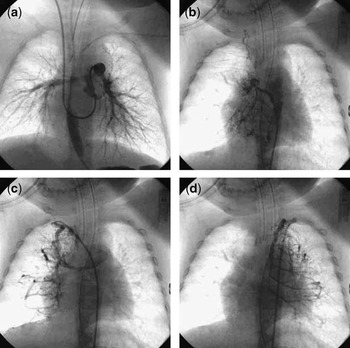
During the post-operative period, congestive cardiac failure presented as high pulmonary flow on chest X-rays and a relatively high oxygen saturation of 90–95%. At the age of 145 days, 38 days post-operation, cardiac catheterisation was performed to identify the cause of cardiac failure. Pulmonary angiography via a right ventricle–pulmonary artery shunt showed reasonable flow (Fig 1a) and the pulmonary artery pressure measured 14–16 millimetres of mercury. In contrast, aortography and selective angiography revealed that numerous systemic-to-pulmonary collateral arteries originated from the bilateral internal thoracic arteries, the subclavian arteries, and the descending thoracic aorta (Fig 1b–d). We considered these collateral arteries to be the cause of deteriorating cardiac failure, and performed coil embolisation, which gradually improved the congestive cardiac failure.
Bilateral pulmonary arteries revealed via right ventricle – pulmonary artery shunt (a). Systemic-to-pulmonary collateral arteries originate from descending aorta (b), and right (c) and left (d) internal thoracic arteries. Blood flows from collateral arteries into the pulmonary artery.

Discussion
Systemic-to-pulmonary collateral arteries can present a disadvantage for patients with hypoplastic left cardic syndrome, which advances subsequent to bidirectional Glenn procedure and Fontan procedures. This pathological condition results in pulmonary hypertension, which can be a disadvantage for the Fontan candidates.Reference Nakanishi5 Systemic-to-pulmonary collateral arteries are often features of children with complex congenital cardic disease and reduced pulmonary blood flow. Such secondary collateral arteries can originate from the descending aorta, bronchial, internal throracic, subclavian, and intercostal arteries. To the best of our knowledge, hypoplastic left cardic syndrome with systemic-to-pulmonary collateral arteries has not been described. We presumed that bilateral pulmonary artery banding can lead to the development of systemic-to-pulmonary collateral arteries since hypoplastic left cardic syndrome itself is a type of congenital cardiac disease associated with increased pulmonary flow. The duration of bilateral pulmonary artery banding placement in our patient was 91 days, which is quite standard according to previous reports.Reference Takabayashi, Shimpo, Kajimoto, Yokoyama, Kado and Mitani2–Reference Akinturk, Michel-Behnke and Valeske4
Recent reports indicate that prostaglandin E1 is a potent stimulator of angiogenesis via upregulation of vascular endothelial growth factor and hepatocyte growth factor production.Reference Haider, Bucek and Giurgea6–Reference Makino, Aoki and Hashiya8 The angiogenic action of prostaglandin E1 in patients with ischaemic cardic disease or peripheral artery disease induces capillaries and small non-muscular vessels to sprout from extant capillaries and thus increases collateral blood flow in the ischaemic regions.Reference Mehrabi, Serbecic and Tamaddon7, Reference Makino, Aoki and Hashiya8 Future studies should investigate the action on systemic-to-pulmonary collateral arteries. We speculated that desaturation induced by bilateral pulmonary artery banding together with prostaglandin E1 led to the growth of collateral vessels, although the dosage and duration of prostaglandin E1 was similar to those reportsReference Takabayashi, Shimpo, Kajimoto, Yokoyama, Kado and Mitani2–Reference Akinturk, Michel-Behnke and Valeske4.
The development of collateral arteries in similar patients has not been clinically investigated, because this procedure has only been developed over the last 10 years.Reference Takabayashi, Shimpo, Kajimoto, Yokoyama, Kado and Mitani2–Reference Akinturk, Michel-Behnke and Valeske4 Systemic-to-pulmonary collateral arteries should be evaluated in patients with hypoplastic left cardic syndrome who undergo bilateral pulmonary artery banding and prostaglandin E1 administration as first-stage palliation.