INTRODUCTION
Metastrongyloids include a heterogeneous group of nematodes characterized by an indirect life cycle, with the exception of species belonging to the family Filaroidae (i.e. Filaroides spp. and Oslerus spp.). The infestation is acquired when receptive animals (e.g. dog, cat) ingest third-stage larvae (L3) harboured by intermediate or paratenic hosts (Anderson, Reference Anderson2000). Among the causes of pulmonary infection of domestic cats, Aelurostrongylus abstrusus (Strongylida: Angiostrongylidae) is regarded as the most common and widespread in cat populations throughout many European countries, with recorded prevalence as high as 24·4% (Traversa et al. Reference Traversa, Di Cesare, Milillo, Iorio and Otranto2008). Recently, Troglostrongylus brevior and Troglostrongylus subcrenatus (Strongylida: Crenosomatidae) have been implicated in broncho-pulmonary disease in cats in southern Italy (Brianti et al. Reference Brianti, Gaglio, Giannetto, Annoscia, Latrofa, Dantas-Torres, Traversa and Otranto2012) and mixed infestation by A. abstrusus and Troglostrongylus sp. has been reported in Spain (Jefferies et al. Reference Jefferies, Vrhovec, Wallner and Catalan2010). Depending upon the parasite species and the worm burden, infestations by metastrongyloids in cats may be asymptomatic (subclinical) or cause severe clinical conditions (Bowman et al. Reference Bowman, Hendrix, Lindsay and Barr2002). Due to its deep localization in the lung parenchyma, A. abstrusus may cause cough, sneezing, mucopurulent nasal discharge, tachypnoea and dyspnoea (Traversa et al. Reference Traversa, Di Cesare, Milillo, Iorio and Otranto2008). Although data on the pathogenicity of Troglostrongylus spp. are meagre, the condition that this infestation causes is likely to be associated with the large body size of the worms and to their localization in the upper respiratory airways (e.g. trachea, bronchi and bronchioles) (Brianti et al. Reference Brianti, Gaglio, Giannetto, Annoscia, Latrofa, Dantas-Torres, Traversa and Otranto2012).
Scientific information on Troglostrongylus spp. is scant, and it is largely accepted that first-stage larvae (L1) released in the environment by infested cats penetrate the integument of a range of terrestrial molluscs (e.g. Agriolimax spp., Helicella spp., Helix sp., Monacha sp., Theba sp.), the intermediate hosts, where they develop into infective larvae (L3) (Gerichter, Reference Gerichter1949; Scott, Reference Scott1973). Upon ingestion of infested molluscs, amphibians, birds, reptiles and rodents may serve as paratenic hosts and, subsequently, transmit the infection to cats (Anderson, Reference Anderson2000). In the cat, Troglostrongylus spp. infective larvae penetrate the intestinal tract and migrate to the lungs via the lymphatic system or bloodstream; the life cycle completes within about 28 days post-infestation (Gerichter, Reference Gerichter1949).
In the present study, infestation by T. brevior is reported for the first time in 3 suckling kittens and observed data suggest the occurrence of direct transmission, from mother to suckling kittens, of this metastrongyloid parasite.
MATERIALS AND METHODS
Cases
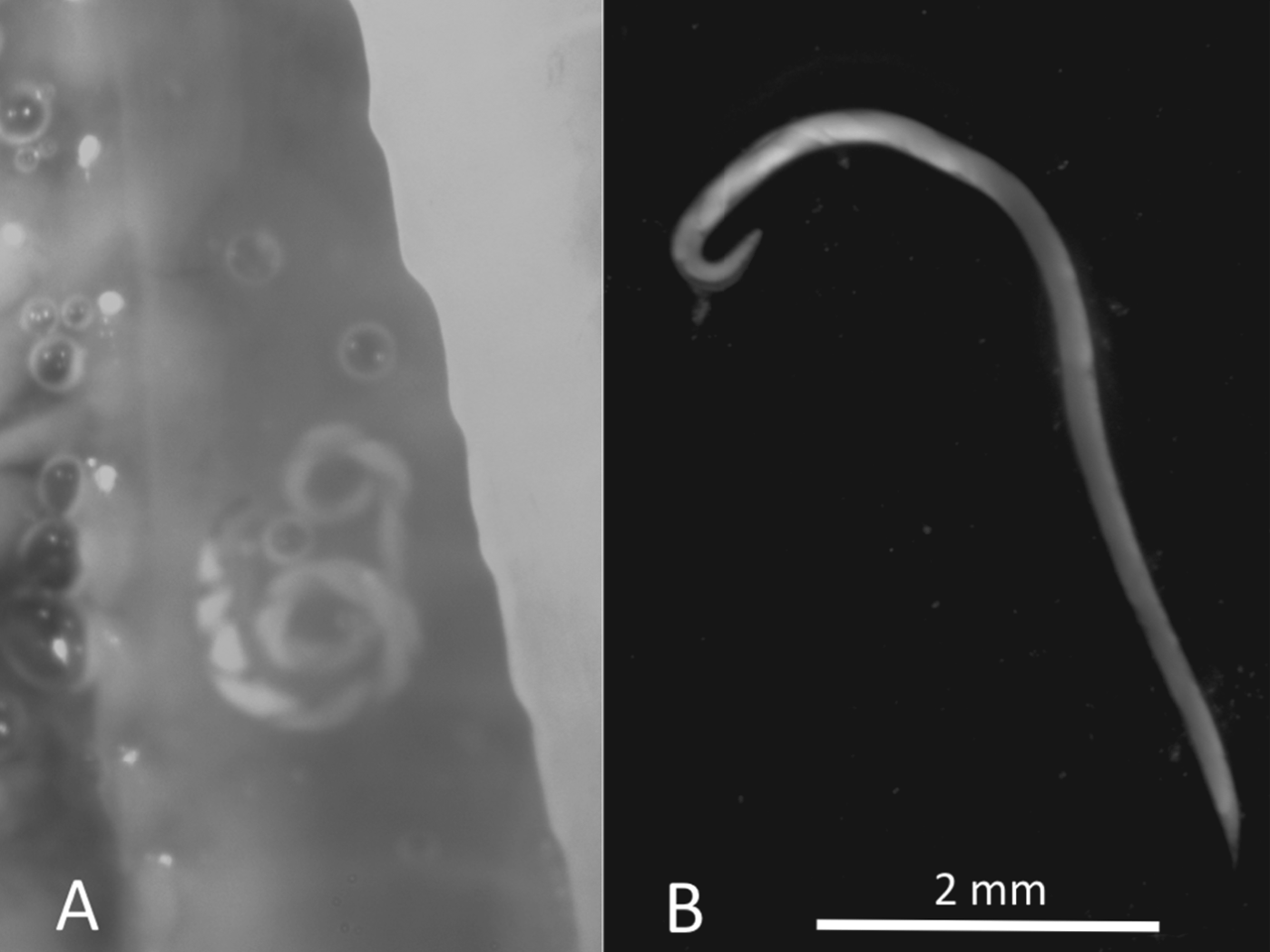
A queen with a litter (1 male and 1 female, cases 1 and 2, respectively) was referred to and hospitalized in a private veterinary clinic in Messina (Sicily, Italy) 4 days after giving birth, with a history of death, for unknown reasons, of 2 other kittens. The queen was 2 years old, at her second delivery and was kept as a companion animal in the outskirts of Messina, with free access to the outside environment. At the clinical examination, the queen displayed normal nursing behaviour, she was in good general condition and normothermic. Biochemistry and complete blood count were within species ranges. Kittens were unweaned and they were actively sucking from their mother. At the referral (T0), routine copromicroscopical examination revealed the presence of lungworm larvae in the feces of the queen. However, because of the absence of clinical signs and due to the very young age of the lactating kittens, no anthelmintic treatment was administered. The queen was fed commercial dry food (for lactating cats) and hospitalized with her kittens in the same crate (80 cm×40 cm×60 cm). After 2 weeks of hospitalization (T+14), dyspnoea was observed in one of the kittens (case 1) and, consequently, symptomatic treatments were undertaken (amoxicillin 20 mg kg−1 PO BID for 7 days and dexamethasone 1 mg kg−1 SC, IV fluids and oxygen). In spite of the treatments, the kitten of case 1 deceased 1 week later (T+21). At necropsy, the lungs were oedematous and hyperaemic and 1 nematode was collected from the trachea (Fig.1A). Both the queen and the other kitten (case 2) did not show any respiratory signs throughout the hospitalization period.
Female Troglostrongylus brevior found in a 25-day-old kitten. (A) The worm recovered in the trachea at necropsy. (B) Macroscopical view of the worm.

A further ∼40-day-old female kitten (case 3), found abandoned in the countryside of Conversano (province of Bari, Apulia region, Italy), was referred to the Department of Veterinary Medicine of Bari due to a severe respiratory condition. The kitten was fed commercial powdered milk for puppies. Routine parasitological examination performed at the referral revealed the presence of lungworm larvae and the cat was hospitalized for further analyses and treatment.
Parasitological examinations and parasite identification
Parasitological examinations were performed, both by flotation and Baermann methods (MAFF, 1986), once a week on the feces of the queen and on those of cases 1, 2 and 3 starting from referral to exitus (T+21) (case 1) or to the end of hospitalization. Parasites found at necropsy (case 1) and larvae retrieved at copromicroscopy were identified using both morphological and molecular approaches. The adult parasite was washed in saline solution, fixed in 70% alcohol and thereafter mounted on a slide using the glycerol method (s'Jacob and van Bezooijen, Reference s'Jacob and van Bezooijen1984). Larvae extracted by the Baermann method were concentrated by centrifugation, stained with a few drops of Lugol solution and mounted on slides for microscopical observation. Microscopical images and measures were taken using a digital image processing system (AxioVision rel. 4·8, Carl Zeiss, Germany). The adult parasite and larvae were identified at species level using morphometric keys (Gerichter, Reference Gerichter1949; Skryabin et al. Reference Skryabin, Shikhobalova, Schulz, Popova, Boev and Delyamure1992; Brianti et al. Reference Brianti, Gaglio, Giannetto, Annoscia, Latrofa, Dantas-Torres, Traversa and Otranto2012). Molecular identification was performed using a central fragment of the adult parasite and on aliquots of larvae extracted from feces of the queen cat and cases 2 and 3 using the protocol described by Brianti et al. (Reference Brianti, Gaglio, Giannetto, Annoscia, Latrofa, Dantas-Torres, Traversa and Otranto2012). Briefly, partial mitochondrial cytochrome c oxidase subunit 1 gene (pcox1, ∼400 bp) and 18S gene (∼1700 bp) were amplified and amplicons sequenced directly using the Taq DyeDeoxyTerminator Cycle Sequencing Kit (v.2, Applied Biosystems) in an automated sequencer (ABI-PRISM 377).
RESULTS
The adult parasite found at necropsy was a female nematode of 7·4 mm in length and 0·35 mm width presenting an inflated cuticle thrown into folds (Fig. 1B). The oesophagus was short and club-shaped, the stoma small and the excretory gland extended almost to the posterior extremity of the body and opened within the first third of the oesophagus.
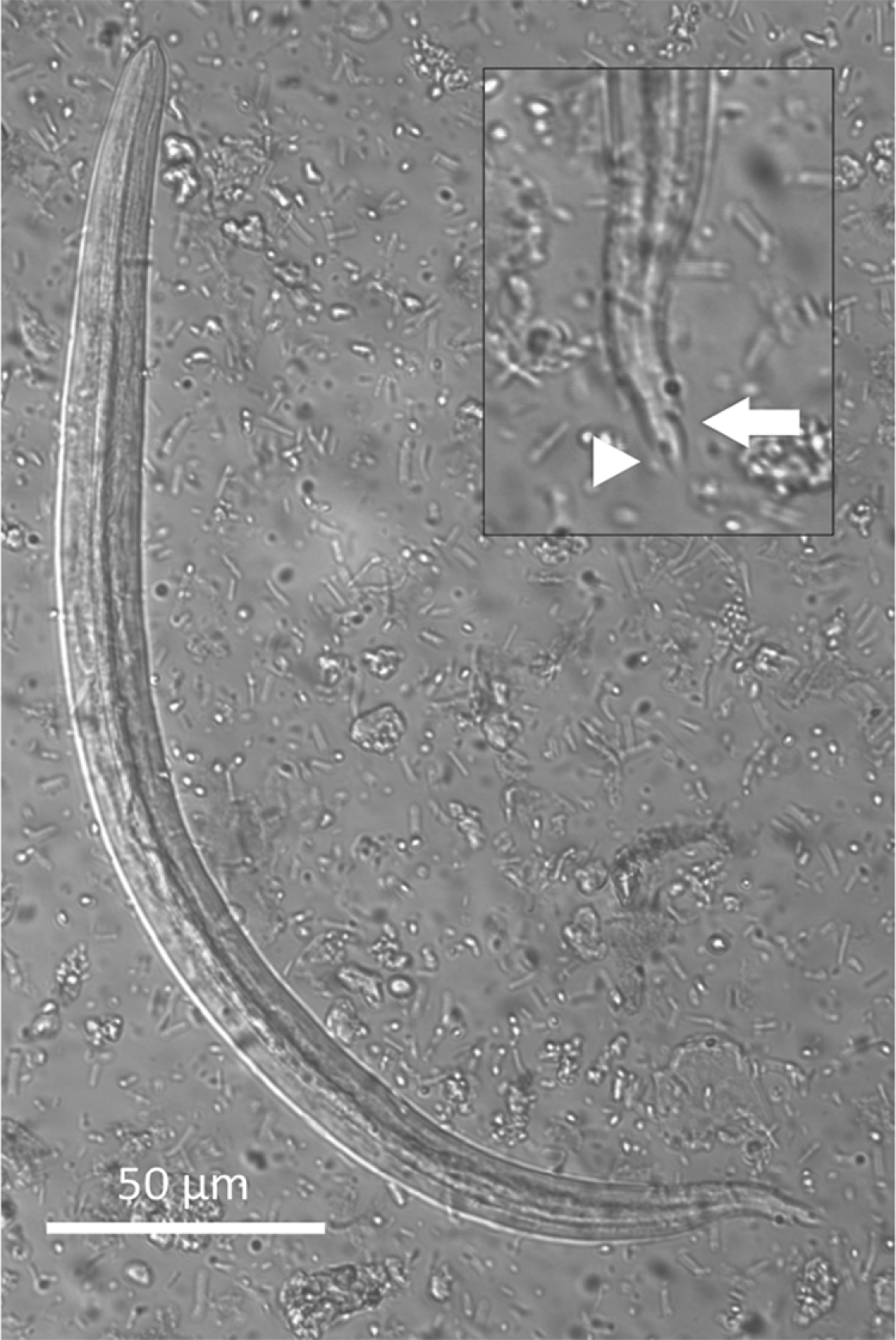
First-stage larvae (L1) were retrieved in the feces of the queen cat from day T0, of case 2 from T+42 and of case 3 from referral (i.e. 40 days of age) until the end of the observation period (T+66). Copromicroscopy did not reveal the presence of any nematode larvae in the feces of case 2. First-stage larvae (average length of 336·6 μm and width of 16·4 μm) had a rhabditoid oesophagus, numerous intestinal cells filled with granules and a pointed tail with a pronounced dorsal cuticular spine and a shallower ventral spine (Fig. 2).
Light microscopy (200×). First-stage larva (L1) of Troglostrongylus brevior extracted by the Baermann method. Note in the magnification the typical sigmoid shape of the tail and the presence of deep dorsal (arrow) and shallow ventral (arrowhead) incisures.
Morphometric features of the adult parasite and L1s were all consistent with those of T. brevior (Table 1). In accordance with the morphological identification, the BLAST analysis of cox1 and 18S genes showed a 100% nucleotide identity with sequences of T. brevior available in GenBank (JX290563, JX290562).
Comparison of the lungworm reported in the present study and morphometrical features of Troglostrongylus brevior (Gerichter, Reference Gerichter1949; Brianti et al. Reference Brianti, Gaglio, Giannetto, Annoscia, Latrofa, Dantas-Torres, Traversa and Otranto2012)

DISCUSSION
Data presented herein suggest that, besides the indirect life cycle via intermediate or paratenic hosts, T. brevior may also be transmitted directly from the mother to the offspring. Indeed, the detection of an adult worm at necropsy in a 25-day-old kitten (case 1) indicates that kittens are capable of acquiring the infestation from their dam soon after birth, during the lactation period, most likely through colostrum and/or milk. Thereafter, adults develop into the sexually mature forms within ∼25 days, whereas elimination of L1s in the feces occurs starting at ∼40 days of age (case 3). We hypothesize that lactational transmission from queens to newborn kittens occurred immediately after delivery. In particular: (i) infective L3s may undergo somatic migration in adult cats and the ‘reactivation’ of encysted larvae may be a direct consequence of the suppression of the immune system during pregnancy or lactation; (ii) L3s may migrate to the mammary glands soon after being ingested by queens during pregnancy or lactation. The latter hypothesis is also supported by information available for the vertical transmission of Toxocara cati (Coati et al. Reference Coati, Schnieder and Epe2004), while an increased need of protein intake during lactation or pregnancy could account for an incremented hunting attitude of the queens, which ultimately might be more easily infested by T. brevior L3 through the predation of paratenic hosts. However, the possibility of direct infestations by L1s eliminated through the feces or present in the saliva of infected queens, similar to other metastrongyloid species (i.e. Filaroides hirthi and Oslerus osleri) infesting canids, cannot be ruled out (Polley and Creighton, Reference Polley and Creighton1977; Georgi et al. Reference Georgi, Fahnestock, Bohm and Adsit1979; Anderson, Reference Anderson2000).
This new knowledge will revise our current scientific information on this parasite and shed new light on the biology and epidemiology of the genus Troglostrongylus. Further studies are needed to elucidate the means of transmission from infested queens to kittens and whether direct transmission may also occur in other species within the metastrongyloid group, such as A. abstrusus.
ACKNOWLEDGEMENTS
The authors thank Dr Rosamaria Mirabito (Veterinary Clinic ‘Peloro’, Messina) for referral of cases (queen cat and cases 1 and 2) and for care of animals during hospitalization, and Dr Cinzia Cantacessi (Queensland Tropical Health Alliance, James Cook University, Queensland, Australia) for commenting on an early draft of the manuscript.