Introduction
Olive tree has been a well-known crop since ancient times. It is one of the most economically important crops and has highly valued healthy attributes. Olive tree classification is very difficult due to the number of varieties and the long life of the trees (Barranco et al., Reference Barranco, Cimato, Fiorino, Rallo, Touzani, Castaneda, Serafini and Trujillo2000). Complexity in the identification of olive cultivars is further increased by the different names under which they are known in different locations (Therios, Reference Therios2009). As a result, the same variety is present with many different and variable names in different locations. Thus, highly accurate methods are needed to identify and discriminate olive cultivars. DNA-based methods have helped towards identification of tree cultivars such as cherries (Ganopoulos et al., Reference Ganopoulos, Kazantzis, Chatzicharisis, Karayiannis and Tsaftaris2011b), olives (Cipriani et al., Reference Cipriani, Marrazzo, Marconi, Cimato and Testolin2002; Donini et al., Reference Donini, Sarri, Baldoni, Porceddu, Cultrera, Contento, Frediani, Belaj, Trujillo and Cionini2006; Roubos et al., Reference Roubos, Moustakas and Aravanopoulos2011; Marra et al., Reference Marra, Caruso, Costa, Di Vaio, Mafrica and Marchese2013) and apples (Evans et al., Reference Evans, Patocchi, Rezzonico, Mathis, Durel, Fernández-Fernández, Boudichevskaia, Dunemann, Stankiewicz-Kosyl and Gianfranceschi2011). Recently, DNA-based methods used for the identification and characterization of Greek Gene Bank germplasm collection have been favoured by the development of high-resolution melting analysis (HRM) combined with microsatellite molecular markers (SSR-HRM) (Xanthopoulou et al., Reference Xanthopoulou, Ganopoulos, Tsaballa, Nianiou-Obeidat, Kalivas, Tsaftaris and Madesis2013). HRM is an analytical method that uses DNA-intercalating fluorescent dyes to measure the rate of DNA dissociation from a double strand to a single strand (Reed and Wittwer, Reference Reed and Wittwer2004).
Experimental
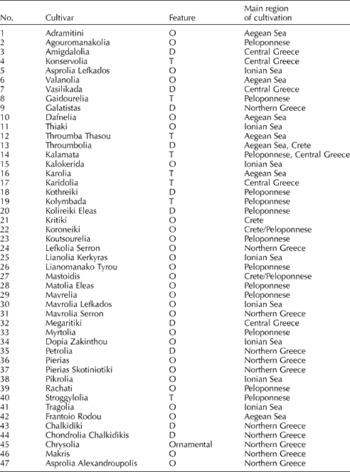
Olive cultivars were collected from the National Olive Tree Germplasm Collection at the Institute for Olive Tree and Subtropical Plants, Hellenic Agricultural Organization ‘Demeter’. Genomic DNA was isolated from very young, healthy leaf tissue collected from three trees per cultivar using the PureLink Genomic Plant DNA Kit (Invitrogen, Carlsbad, CA, USA) following the manufacturer's instructions. Microsatellite analysis, PCR amplification, DNA melting, HRM and end-point fluorescence-level determination were carried out on a Rotor-Gene 6000 Real-Time 5P HRM PCR Thermocycler (Corbett Research, Sydney, Australia) according to Ganopoulos et al. Reference Ganopoulos, Argiriou and Tsaftaris(2011a) and Xanthopoulou et al. (Reference Xanthopoulou, Ganopoulos, Tsaballa, Nianiou-Obeidat, Kalivas, Tsaftaris and Madesis2013). An initial set of five polymorphic microsatellites developed from Olea europaea were selected (Table S1, available online; Sefc et al., Reference Sefc, Lopes, Mendonca, Santos, Machado and Machado2000). SSR-HRM experiments were repeated twice (Table 1). PCR products were analysed on conventional agarose (3%) gel to verify their size range. For genotyping by HRM analysis, the genotype of each DNA sample was determined based on the shape of curves depicted by temperature-shifted melting curves or difference plots.
Olive cultivars used for microsatellite high-resolution melting (SSR-HRM) analysis

O, oil; D, dual use; T, table olives.
Results and discussion
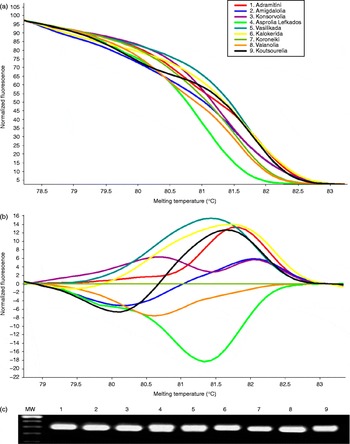
To genotype the main Greek olive cultivars, five different microsatellite markers were analysed. A total of 43 HRM profiles were revealed by the five primer pairs used. Polymorphisms within the 47 olive cultivars were detected based on the pattern of temperature-shifted curves. The analysis of conventional melting curves does not allow sufficient discrimination of the different genotypes, as it uses only the melting temperature (T m) values. On the contrary, the potential resolving power of HRM is much greater than the conventional melting curve analysis (Ganopoulos et al., Reference Ganopoulos, Argiriou and Tsaftaris2011a; Distefano et al., Reference Distefano, Caruso, La Malfa, Gentile and Wu2012). Figure 1(a) shows the normalized HRM melting curves of nine representative olive cultivars, using the microsatellite marker DCA03 (only unique HRM genotypes are shown). A representative agarose gel of PCR-HRM products produced by DCA03 using the nine olive genotypes from Fig. 1(a) is presented in Fig. 1(c). Using the shape of the melting curves, we could reveal the differences between the cultivars under investigation and show that all the cultivars used could be easily distinguished visually by their melting curves, for example ‘Koroneiki’ and ‘Konservolia’. The results of the other markers used were similar, showing a clear discrimination of most of the cultivars used (data not shown). Figure 1(b) shows the difference graph of a representative set of nine unique olive genotypes produced by DCA03 using the ‘Koroneiki’ cultivar as the baseline. Regarding DCA03 microsatellite loci, Roubos et al. (Reference Roubos, Moustakas and Aravanopoulos2011) found seven different alleles in 26 olive cultivars, while Štambuk et al. (Reference Štambuk, Sutlović, Bakarić, Petričević and Andelinović2007) found eight alleles in a collection of 44 genotypes.
Discrimination of 47 olive cultivars using a combination of five microsatellite primers and high-resolution melting (HRM) analysis. (a) HRM profiles of the genotypes analysed with the marker DCA03. HRM profiles show nine representative distinct genotypes in a normalized melting plot. (b) Representative profiles of the melting curves (difference plot curves) of DCA03 amplicons for eggplant genotypes. Difference graph of nine unique genotypes using the cultivar ‘Koroneiki’ as the reference genotype. (c) Conventional agarose (3%) gel of HRM products. MW, molecular weight.

In this study, we present a distinct genetic fingerprint produced by five microsatellite markers from 47 olive cultivars studied that allowed their discrimination based on their HRM profiles. Furthermore, this study also shows the analytical power and potential of HRM analysis in genotyping. The HRM method is a very sensitive and simple closed-tube technique, with reduced cross-contamination danger, as well as it is time-efficient, facilitating high throughput. HRM uses not only amplicon length, but also the whole amplicon sequence for inferring variation. It has been shown that HRM could potentially uncover further polymorphisms than conventional electrophoresis, due to the presence of SNPs in the region flanking the microsatellite repeats, hence producing a higher number of alleles/genotypes (Distefano et al., Reference Distefano, Caruso, La Malfa, Gentile and Wu2012). In this respect, HRM can reveal other genetic information than typical microsatellite analyses in cases of allelic homoplasy, a phenomenon that has already been observed in Prunus (Ganopoulos et al., Reference Ganopoulos, Argiriou and Tsaftaris2011a).
The results presented herein show a clear separation of 47 olive cultivars using five microsatellite markers. This suggests that this panel of microsatellites could be applied to identify different cultivars using the HRM approach without any requirement for a post-PCR procedure, as has been required in the case of traditional microsatellite analysis. Therefore, the information generated herein could also be used in other biodiversity and breeding projects by the international olive community.
Supplementary material
To view supplementary material for this article, please visit http://dx.doi.org/10.1017/S147926211400001X
Acknowledgements
The authors thank Mr Giorgos Kostelenos for valuable discussions on cultivation of olive varieties in Greece, as well as Kostelenos Plant Nurseries for their contribution to the collection of genetic material. The authors also acknowledge the Institute of Applied Biosciences/CERTH for continuous support.