If the government's candidate wins everyone will say it was fraud. If he loses everyone will say it was a fair election. So it is more in our interests than anyone else's to be able to show it was an absolutely fair election.Footnote 1
Information plays a fundamental role in democratic governance. In institutionalized democracies, citizens and political parties can be reasonably confident that violations of democratic norms, such as election fraud, will be widely reported. Political actors who might otherwise be tempted to bend the rules in their favor are held in check by an informed public willing to “enforce” democracy should it become necessary.Footnote 2 If serious election fraud occurs, media, political parties, citizens, or other members of civil society are expected to blow the whistle, calling on citizens and the judiciary to enforce the democratic rules of the game, potentially including widespread protest or other mass revolt. Thus, fraudulent elections are rarely witnessed in democracies, in part because the probability of getting caught is high and the consequences for engaging in election fraud are predictably severe.
If this equilibrium of “self-enforcing democracy” does not already exist in a country, how can it be established? Can international actors facilitate this process? These questions are particularly relevant because national elections have been adopted by nearly all countries in the world, and election fraud and other forms of election manipulation are widespread.Footnote 3 Informational problems are also common, making it difficult for citizens, political parties, and other domestic actors to evaluate which elections are acceptable and which elections merit protest. In addition, unpopular political parties can adopt a strategy of calling for postelection protest regardless of the quality of the election in an effort to discredit the regime or save face.Footnote 4 Thus, even though electoral institutions have spread to nearly all countries in the world, many citizens in these countries face significant barriers in learning “what they need to know”Footnote 5 about election quality, which should make manipulated elections more likely, and act as a significant barrier to the establishment of self-enforcing democracy.
In countries that have not already reached an equilibrium of self-enforcing democracy, institutions such as international election observation, which increase information about election quality, should increase incentives for leaders to hold democratic elections. When more accurate and credible information about the quality of elections is available, the incentives for governments to hold clean elections increase in part because clean elections are more likely to be recognized by citizens, and documented fraud is more likely to be punished through postelection protest.
We argue in this article that international election observation has the potential to provide credible and nonpartisan information on election quality, thereby lessening informational problems that surround many potentially fraudulent elections. Based in part on the notion that elections can serve as a focal point for collective action,Footnote 6 credible information about election fraud should make successful coordination among citizens for postelection protest more likely. Similarly, credible information that elections are not fraudulent should make postelection protest less likely, even when opposition parties call for protest. In other words, credible information about the quality of elections should make opposition parties less likely to adopt a default strategy of protesting when they lose, and more likely that citizens join protests of elections that were, in fact, fraudulent. These dynamics suggest that leaders should be more likely to hold clean elections when the probability of a coordinated citizen response to stolen elections is high, and when clean elections are more likely to be recognized as such. Together, these claims suggest that credible international election observation should make postelection protest more accurate, which in the long run should increase incentives for leaders to hold clean elections.
The argument is not that international observers provide perfect information about election quality. Given the frequently illicit nature of election fraud and the difficulty in judging the overall quality of an election, it is likely that not all fraud is detected by international observers. It is also likely that international monitors fail to criticize some manipulated elections, and this failure to criticize may legitimate some leaders. Even conceding this point, the fact that observers are not flawless detectors of election fraud does not undermine the claim that they can make democratic elections more likely. The relevant comparison is not whether imperfect monitoring legitimizes some electoral autocrats, but how elections would have proceeded in the absence of foreign monitors. If international election observation did not exist, autocrats could still be viewed as legitimate winners of elections. At the same time, as we argue, monitoring improves the chances that a clean election will be recognized as clean. It follows that without observers, the same or greater number of cheaters are likely to be deemed legitimate winners of elections that were stolen, and more governments will be undeservedly accused of manipulation and pay the associated costs. If the incumbent government is aware of this dynamic, their incentives to hold clean elections diminish. The net result is that, in a counterfactual world without observers, fewer governments would be motivated to hold clean elections. Thus, the central argument is that election observation can increase incentives for leaders to hold democratic elections in the long term by, in the short term, increasing the benefits associated with holding clean elections, making postelection protest more likely to follow fraudulent elections, and making protest less likely to follow elections that are relatively clean.
This article contributes to two distinct literatures. First, by providing and testing a theory of how international election observers can facilitate self-enforcing democracy, it contributes to the debate on how international actors influence democratization, which is relevant to both academic and policy circles.Footnote 7 Second, by outlining a more general argument about the role of information in self-enforcing democracy, it contributes to theoretical debates about how self-enforcing democracy can be established, and it brings international actors more explicitly into work on electoral revolutions and self-enforcing democracy.Footnote 8 Although international election observation is supported in part because of a belief that it helps promote democracy, the potential mechanisms by which election observation promotes democracy are not well theorized or tested.Footnote 9 Existing work on election observation has focused primarily on explaining why sovereign states invite observers, critiquing their methods, or arguing against their judgments in specific cases.Footnote 10 Thus, the broader aim of this article is to evaluate the role that information provided by international observers can play in facilitating democratic elections.
The argument's empirical implications are evaluated with two data sets, including cross-national and intertemporal data. These data show, first, that over-time patterns are consistent with the central argument, and suggest that postelection protest became less likely with the rise of election observation, but more accurate. Furthermore, in the post–Cold War period in which international election observation was widely available, the evidence suggests that postelection protest was more likely and lasted longer following elections declared fraudulent by international observers, even when controlling for other factors that should predict postelection protest, such as pre-election expectations that the election will be fraudulent and the performance of the opposition in the election. Thus, our central findings show that information provided by international actors can increase the relative costs of fraud, and by implication, can facilitate self-enforcing democracy.
Elections and Self-Enforcing Democracy
Since the 1990s, elections have become nearly universal, and one important distinction among elections is between those that are relatively clean and those that are manipulated.Footnote 11 Of course, democracy is much more than clean elections, as the existing literature on democracy makes abundantly clear.Footnote 12 It follows that democratic institutions do not necessarily mean that democracy exists in a given country, or that democracy is durable. Nevertheless, elections are a fundamental part of democratic governance, and scholars generally agree that clean elections are necessary for a country to be considered a democracy.Footnote 13
Throughout the world, elections are scheduled and administered by national governments who have a stake in their outcome, and in most cases, who also have the ability to steal the election.Footnote 14 There are many possible reasons why a government might choose to hold clean elections, and the literature on election quality is growing rapidly.Footnote 15 These works have grown out of a number of distinct research agendas, including work on electoral authoritarianism (and related regime subtypes), prodemocracy revolutions, the global diffusion of democracy, political repression and human rights abuses, and the international dimensions of democratization. Although we draw on all of these distinct research agendas, the theory is most centrally grounded in the literature on self-enforcing democracy.
As Przeworski argues, “democracy endures only if it is self-enforcing.”Footnote 16 The concept of self-enforcing democracy means that, very generally, elected leaders are motivated to obey the rules of the game and govern in a manner responsive to the peoples’ wishes by the implicit threat of mass uprising. As Fearon paraphrases Locke, “popular sovereignty is maintained by an implicit threat of rebellion if rulers misbehave too much.”Footnote 17 Much of the existing work on self-enforcing democracy focuses on explaining the puzzle of why democracy can endure over time once it has been established. Przeworski highlights national wealth and a relative absence of inequality as central reasons why the “democratic bargain” between election winners and losers can prevail.Footnote 18 Weingast also focuses on explaining why democracy can endure and highlights constitutions as useful focal points for citizens because they outline commonly understood boundaries on the behavior of leaders. If a given leader violates constitutionally agreed-on rules, citizens are better able to overcome their collective action problem, and the threat of such collective action motivates leaders to abide by constitutional rules.Footnote 19
Fearon focuses on the role that elections can play in facilitating self-enforcing democracy. In equilibrium, if citizens were able to constantly monitor and respond to a government's actions, elections might not be necessary to bring about many of the benefits associated with democracy, such as increased provision of public goods.Footnote 20 He argues that if such monitoring of government actions is difficult or if signals are noisy, then citizens “face a difficult problem of how to coordinate to pose a credible threat of rebellion in the event of misbehavior by the ruler.”Footnote 21 In other words, if citizens have any difficulty in evaluating their leaders’ performance, self-enforcing democracy should be hamstrung by coordination problems. Fearon argues that “publicly understood rules for regular elections” represent one solution to the coordination problem faced by citizens, giving them an observable signal of the government's behavior and allowing for a credible threat of protest if elections are not held.Footnote 22 But, he argues, elections cannot help facilitate democracy “if they are not held, if they are fraudulent, or if leaders and parties do not abide by the results.”Footnote 23 It is relatively easy for citizens to observe the first and third: whether elections are held when scheduled, and whether leaders and parties abide by the results. But it is much more difficult to observe whether elections are fraudulent, particularly given incentives for losing parties to potentially misrepresent election quality and falsely accuse the government of engaging in election fraud. Although Fearon does not highlight these informational concerns explicitly, we build on his work and argue that increasing information should help solve coordination problems inherent to self-enforcing democracy.
In addition to the literature on self-enforcing democracy, other relevant work discusses the dynamics of collective action and citizen protest following violations of democracy, particularly in the context of elections.Footnote 24 Some of this research focuses explicitly on electoral revolutions or elections within an authoritarian context. Electoral fraud, the argument goes, is a blatant violation of democracy and can also provide a focal point for citizens to coordinate protests that have the potential to bring down the government.Footnote 25 Under most circumstances, public protest does not occur against governments, even when they violate democratic rules, because protest is individually costly and because of the logic of collective action.Footnote 26 Election fraud can change this calculation. For example, as Tucker argues,
When the regime commits electoral fraud, however, an individual's calculus regarding whether to participate in a challenge to the regime can be changed significantly. The likelihood of protests occurring following electoral fraud can greatly lower the perceived costs to any individual of participating in a challenge against the regime. Similarly, if the electoral fraud calls into question the very outcome of the election, then it can significantly increase the expected benefit from participating in the collective action, as the bums literally can be tossed out if things go well. Taken together, the logic of collective action problems can explain why citizens in oppressive societies that seemingly tolerate government abuses most of the time can rise up in the face of electoral fraud.Footnote 27
Although a number of works highlight that elections and election fraud can serve as a focal point for collective action, and that postelection protest can be motivated by election fraud, little existing work focuses on the central informational problem: How can citizens know when an election is sufficiently fraudulent to merit protest?Footnote 28 Given the incentives of many opposition parties to declare fraud irrespective of the election's true quality, how can citizens distinguish between elections that are truly fraudulent, elections that have some (insignificant) problems, and elections that are falsely declared fraudulent by opposition parties?
The information provided by reputable election observers represents one possible mechanism by which citizens can judge whether an election merits protest. In cases of negative reports from observers, the report's announcement can serve as a focal point for collective action. Given a credible and nonpartisan source of information, citizens who would otherwise be suspicious of opposition claims of fraud should be more likely to view an election as fraudulent, thus making postelection protest not only more likely to occur, but also more likely to attract mass support. In cases where the opposition calls for postelection protest but observers do not concur with their claims of fraud, observer reports can have the opposite effect, making postelection protest less likely or less potent.
Election Manipulation, Information, and Protest
If democracy is already a self-enforcing equilibrium, then significant election fraud should be rarely observed. The expectations are less clear for the dozens of countries throughout the world that have adopted some democratic institutions but in which democracy is not (yet) a self-enforcing equilibrium. Many of these are the same countries that, since the end of the Cold War, have received significant international attention aimed at promoting democracy.
In the absence of an expectation of self-enforcing democracy, incumbent politicians and political parties have few reasons to hold clean elections. Because it can change these incentives, credible information about election quality is an essential but often overlooked element that can facilitate the creation of self-enforcing democracy. Increasing credible information about the quality of elections can increase the incentives for leaders to abstain from election fraud and instead choose to push for democratic elections. Institutions designed to increase information about election quality can have a longer-term effect of helping to facilitate self-enforcing democracy.
Overall, the conventional wisdom is that election fraud should be more likely when the incumbent candidate or party needs fraud to win the election.Footnote 29 Yet this is not a complete picture. First, incumbent politicians who are confident of victory are often surprised by their poor performance.Footnote 30 If any electoral competition is allowed, surprise losses are possible, and even incumbents who believed themselves to be popular have lost in “stunning” defeats.Footnote 31 If an incumbent is risk-averse, if the incumbent's true popularity is difficult to evaluate, or if the costs of losing an election are sufficiently high, then even a potentially popular incumbent can have incentives to engage in election manipulation.Footnote 32 Scholars have also shown that many governments prefer not only to win, but to win by a large margin, in part to signal their strength.Footnote 33
Assuming that elections are held and a minimal level of competition is permitted,Footnote 34 elections, in theory, present some risk to all incumbents.Footnote 35 If incumbent candidates or parties choose to run in an election, they most likely prefer to win. Election fraud should result in a “cheater's premium,” which can be thought of as an increase in vote share for the candidate engaged in election fraud that is attributable to election manipulation. Therefore, without any cost of fraud, if electoral manipulation increases the chances of winning, stealing elections is, arguably, the default strategy for many leaders.
The costs of cheating may be sufficient to deter fraud. But, if the costs of cheating are sufficiently low, incumbents prefer to commit election fraud, and fraudulent elections should be common. If incumbents expect that their opponents will level accusations of fraud regardless of the true quality of the election, incumbents may end up paying some of the reputational costs of fraud even if they do not actually cheat (and therefore do not benefit from the cheater's premium). Thus incumbents who expect to be accused of fraud even if they do not cheat have even less of an incentive to hold clean elections.Footnote 36
These incentives are also shaped by the preferences and actions of citizens. Although politicians and parties may have reason to commit election fraud, citizens typically prefer democratic over fraudulent elections. For a given election, citizens must also judge whether reported election fraud is sufficient to motivate their participation in protest. The implication is that a credible signal to citizens about the quality of elections can help mitigate informational problems. If a credible signal of election quality exists, it should both discredit “sore loser” protests when the signal is positive and, when the signal is negative, can provide a focal point for collective action. Thus, credible information about the quality of the election not only makes it more likely that incumbent governments are judged accurately regarding the quality of the election; they may also make postelection coordination and protest more likely in the event that the election is publicly revealed to be fraudulent.
International Election Observation and Information
How, exactly, do observers increase information about election quality? Although we assume that international observers can provide credible information about election quality, it is also clear that information from international observers is not uniformly credible, and international observer missions vary in the degree to which they are considered reputable sources. Some observer delegations are obviously not credible, such as those from the Shanghai Cooperation Organization or the Commonwealth of Independent States. It is important to recognize that contextual factors within a specific country can contribute to how a given report from international observers is perceived. A given organization's reputation in a given country may also have to do with a particular organization's ability to influence material benefits of interest to the government. Reputation and credibility of specific observer organizations may be influenced by the organization's previous willingness to criticize elections in other countries.Footnote 37 Reputable observers sometimes disagree, and can issue reports that can be interpreted as conflicting.Footnote 38
Recognizing these challenges, we nevertheless argue that there is a bright line between elections that are observed but not criticized by any reputable group, and elections that are observed and criticized by at least one reputable group. Despite variation in the credibility of observers, and the existence of dubious observer groups, in practice, criticism by one internationally reputable group is usually sufficient to cast doubt on the quality of the process and potentially arm postelection protesters with greater legitimacy.Footnote 39 Similarly, uniform consensus among international observers that an election does not merit condemnation is often sufficient to discredit postelection protests. Based on this logic, the theory and the empirical analysis both focus on comparing elections that received at least one negative report from a reputable group with those that did not receive any negative reports from reputable groups.
International observers are usually invited by the host country government and attempt to observe all aspects of the electoral process using a variety of methods, including information collected by long- and short-term observers who are deployed throughout the country.Footnote 40 Within days after an election, observers typically hold a postelection press conference, sharing their preliminary findings about the quality of the election with domestic and international news media. The content of their reports can range from enthusiastic congratulations to a country for holding democratic elections to detailed condemnations of the electoral process, including accusations that the elections were stolen from the rightful winner.
International observers’ reputations are formed primarily by their work in other countries, and they maintain excellent contacts with international news media. As such, foreign observers are usually much harder for the government to discredit or paint as partisan. In addition, they can credibly threaten to leave a country and effectively condemn the election before it takes place, as in the Gabon (1998), Ivory Coast (2000), Panama (1989), Togo (1993), or Uzbekistan (2005) elections.Footnote 41 These characteristics of international observers make it difficult for a government to discredit them, control their message, or suppress their efforts after they have been invited. The same is not true for other domestic actors such as domestic election observers, who do not typically have the same access to international media, and who can be more easily intimidated, suppressed, or discredited.Footnote 42
A close examination of the practices and experiences of observers reveals that they can add to the informational environment in two ways: (1) using improved technologies of election observation, they provide new information about election quality, and (2) when viewed as impartial outsiders, they provide independent verification of information already available from less-credible outlets. The skeptic may point out that domestic political parties, voters, and civic groups are likely to know far more about their country than a delegation of foreigners. All else held equal, this is a valid point. However, in environments with citizen mistrust of government, an absence of checks and balances, or a lack of an independent news media, observers can be one of the few reliable sources of information about election quality.
On average, international election observers have several advantages over other actors who could provide information about election quality. The reputation of a given international observer group is formed outside of the host country, and is therefore much more difficult for an incumbent to manipulate.Footnote 43 This is in stark contrast to domestic observers who motivated incumbent governments can more easily discredit or refuse to credential. In the absence of international observers, domestic observers have few means of recourse against a government that does not wish to tolerate their presence. As an example of international observers’ leverage, in the 1991 elections in Zambia, the incumbent government initially invited and welcomed a joint observer mission from the National Democratic Institute (NDI) and the Carter Center. Quickly, however, the government began a campaign to discredit them, running full-page newspaper ads alleging that international observers were biased against the government. In response, the international observer mission demanded and received a public apology and set a variety of other conditions for their continued presence, and international observers successfully combated the government's attempt to undermine their legitimacy.Footnote 44
International observers can also be disinterested third-party observers, without a stake in the outcome of the election. Although some observers are biased, evidence suggests that the most well-known organizations, such as the Carter Center, the European Union, the NDI, the Organization of American States (OAS), the Organization for Security and Cooperation in Europe's Office for Democratic Institutions and Human Rights (OSCE/ODIHR), and a number of others, are more often than not viewed as independent from the government and opposition parties, and therefore as relatively more credible sources of information.Footnote 45
When international observers are present, postelection protests should be more likely when observers issue a negative report. Additionally, calls for postelection protest, especially “sore loser” protests, should be undermined when observers are present and do not validate opposition claims of fraud by issuing a negative report.
Although international observers can improve the accuracy of signals about election quality, they are far from perfect at detecting election manipulation. Observers tend to be risk-averse when deciding whether to criticize an election. In practice it is more likely that a truly clean election will be declared clean by international observers than a truly manipulated election will be declared fraudulent by international observers. This is because observers often collect enough information to know that an incumbent has not rigged the vote but hesitate to call a contest fraudulent even when they do encounter some evidence to that effect. For most organizations, widespread and incontrovertible evidence of fraud is required to seriously criticize an election. Because this evidence is not likely to appear when an election is actually clean, the most common type of error committed by observers is validating a somewhat manipulated election. However it is also clear that they are able and willing to find election fraud, as evidenced by the more than 150 elections they have criticized since the mid-1980s. As we show, it is also clear that they are more likely to observe in countries where there are significant pre-election concerns about fraud, indicating that they are in fact targeting elections in which they can be useful.
Does cross-national evidence also support the idea that observers are able to provide additional information about the quality of elections? If observers are to improve the informational environment around elections, they should be present in cases in which the informational environment is poor, and they should be present at elections in which there are pre-election concerns about the quality of the election.Footnote 46
As indicators of the informational environment, our analysis uses four variables from the relatively new National Elections across Democracy and Autocracy (NELDA) data set to identify when countries held elections of uncertain quality. This variable is a binary indicator that is coded as one if any of the following questions from the NELDA data were answered in the affirmative: “Were regular elections suspended before this election?” “Were these the first multiparty elections?” and “Was the country ruled by ‘transitional leadership’ tasked with ‘holding elections?’Footnote 47 A fourth variable indicates whether there were “significant pre-election concerns that the elections would not be free and fair,” coded separately as pre-election concerns.Footnote 48
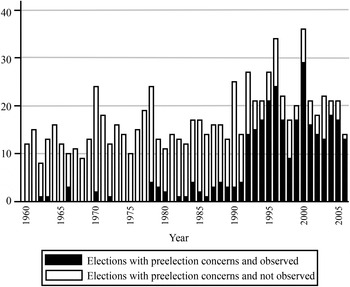
Consistent with the scope conditions of the argument, and the contention that observers increase information, Table 1 and Figure 1 show that observers are more likely to observe elections of uncertain quality than those that are not, and more likely to be present for elections with pre-election concerns about fraud than those that were not. As Figure 1 shows, beginning in about 1992, election observers were present at the majority of elections with pre-election concerns. This figure excludes cases in which elections are held but multiparty competition is not permitted. In 1992, 63 percent of elections with pre-election concerns about fraud were internationally observed. By the end of the period under study (2006), nearly 92 percent of these elections were observed.
Pre-election concerns about fraud and the demand for election observation

Election observation and uncertainty about election quality, 1992–2006

These trends become stronger over the time period under study. For example, out of the twenty-nine total elections of uncertain quality in 1992, twenty-two (or 76 percent) were internationally observed. By 2006, 100 percent of all elections of uncertain quality were observed. Table 1 shows the overall number of elections by whether the election was of uncertain quality, 1992–2006. Although these are simple descriptive statistics, they suggest that in the post–Cold War period, observers were usually present at elections in which they could potentially facilitate self-enforcing democracy.
Empirical Implications
International election observers can serve as disinterested and credible sources of information about the quality of elections and therefore can facilitate self-enforcing democracy. The ideal empirical test of this argument would involve the random assignment of international observers across countries. Yet international observers are not randomly assigned across countries and the empirical approach attempts to account for possible selection effects in several ways.
The first hypothesis relates to the initiation of election observation, and the expectation of trends over time that are consistent with the argument. Credible international election observers were relatively rare before the end of the Cold War, and their popularity and reach (as well as their reputations) increased extensively beginning in the early 1990s. Thus, postelection protest should be more likely in the period before credible election observation was widely available, and less likely, on average, after election observation became widely available. Credible information about the quality of elections should make opposition parties less likely to adopt a default strategy of protesting when they lose, and more likely to protest elections that were, in fact, fraudulent.
H1
If international election observation increases information about election quality, then postelection protest should be more likely when observers are not widely available, and postelection protest should be less likely when observers are widely available
Within the time period in which international election observation is widely available, if international observers document and criticize election fraud, the election should be more likely to be followed by postelection protest. If postelection protest occurs, protests should last longer in elections declared fraudulent by international observers than elections that are observed but not declared fraudulent.
H2
If international observers criticize an election, postelection protest should be more likely and last longer
These hypotheses are evaluated using cross-national data on elections, international observation, and protest; and a separate data set on the timing and duration of protests.
The increased probability of protest associated with observer declarations of fraud is likely to be conditional on a number of other factors such as whether the opposition parties performed well, whether fraud was expected, and a country's history of postelection protest. Briefly, if opposition parties perform well, postelection protest should be less likely, as opposition gains are another signal about the quality of the election. Protest should be more likely if fraud is anticipated in advance of the election. Countries that have had previous experience with postelection protest should also make postelection protest more likely. Although these conditions are not framed as explicit hypotheses, they are included in the analysis.
Empirical Analysis
The analysis relies on two data sets: a cross-national data set in which elections are the units of observation, and a supplementary data set on the timing and duration of protest that was coded for all elections that experienced postelection protest or that were criticized by reputable international observers. H1 is evaluated using the cross-national elections data set, and both data sets are used to evaluate H2.
Cross-National Evaluation of Observation and Protest
For cross-national data on elections and protest, the analysis relies primarily on the NELDA data set.Footnote 49 The relatively new data set covers all elections between 1960 and 2006.Footnote 50 Each observation in the data set is an election round, rather than a country-year.Footnote 51 There are more than 1,800 distinct election events, taking place in 141 countries. The unit of observation is the election round, and the data are structured such that some countries have more than one election in a given year and some elections involve multiple rounds, each of which could be followed by protest. To limit the sample to cases that are of theoretical interest to the research questions outlined here, elections are excluded if electoral competition is not allowed. Additionally, elections held in twenty-one long-term consolidated democracies are also excluded.Footnote 52 Elections in which electoral competition is not allowed are defined as those in which there is no opposition, opposition is illegal, or there is no choice of candidate on the ballot.Footnote 53
The first dependent variable, protest is a binary indicator equal to 1 if “there were riots and protests after the election” that “involved allegations of vote fraud” (nelda29 and nelda30, respectively). This measure is election-specific, and was coded separately for each round of all multiround elections.
Data on election observation include three variables. The first variable, observed, is a binary indicator equal to 1 if one or more official delegations of international observers were invited to the election.Footnote 54 Journalists, individual experts, embassy staff, and tourists are not considered observers. The second variable is reputable observers, equal to 1 if the election was observed by one or more “reputable” international observer groups, defined as those groups that had been previously willing to criticize a fraudulent election.Footnote 55 In the post-1992 period in which election observation was widely available, reputable delegations attempted to observe all aspects of the electoral process, beginning well before an election takes place, and departing after postelection disputes have been resolved. The third variable is negative report, coded from the official reports and press releases from international observers, and equal to 1 if observers seriously questioned the winner of the election or the legitimacy of the process (165 election events). Most observer reports include some criticism, and only those statements that are quite critical are considered a negative report. The majority of election observation reports are neither overtly negative nor overwhelming endorsements of the election process.Footnote 56 Multiple observers may be present at a given election, and they do not always agree.Footnote 57 The focus in this analysis is on whether any reputable group issued a negative report because even one negative report is typically sufficient to discredit the process and serve as a focal point for collective action.
Globally, between 1960 and 2006, there were 2,014 election events, of which 188 were followed by protests involving allegations of election fraud (representing 9 percent of all elections). An additional 5 percent of elections experienced other forms of postelection protest that were not related to election fraud. In the 1992–2006 period, which represents the bulk of the analysis, 935 election events occurred, 132 of which were followed by some form of election-related protest. Of these, 106 involved allegations of election fraud.
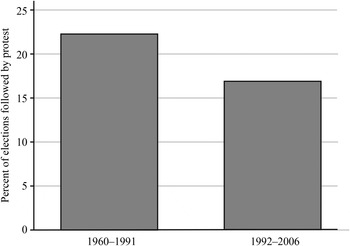
Recall H1, that postelection protest should be more common in the era before election observation than in the period in which election observation is widely available. Figure 2 illustrates the percentage of elections followed by postelection protest in 1960–91 when election observation was relatively scarce, and in 1992–2006, when international election observation became widely available. This pattern is consistent with the argument that increased information about the quality of elections should make a strategy of “always protesting” less likely, thereby reducing the overall rate of protest.
Rates of postelection protest, 1960–1991 and 1992–2006

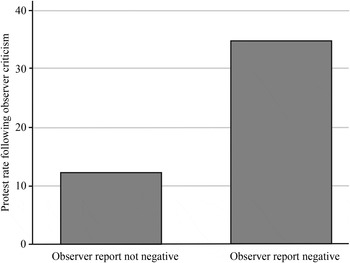
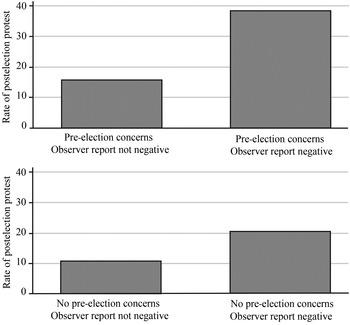
As H2 suggests, the lower rate of protest in the 1992–2006 period glosses over interesting variation. Given that observers are present, postelection protest should, in theory, be much more likely following a negative report from observers. The overall trend is represented in Figure 3 which shows that among elections that are internationally observed, protest is almost three times more likely following elections that are criticized by international observers than following elections that are observed but not criticized. This difference holds regardless of whether fraud is anticipated in advance of the election, as shown in Figure 4, although postelection protest is generally more likely when there are also pre-election concerns about fraud. Between 1992 and 2006, out of all potentially competitive elections that were criticized by international observers, 29 percent also experienced postelection protest. Out of potentially competitive elections that were observed but not criticized, only 10 percent experienced postelection protest. The percentages are almost the same when only elections observed by reputable observers are included.
Rates of postelection protest, by negative reports, 1992–2006

Rates of postelection protest by observer reports and whether fraud was anticipated, 1992–2006

To more systematically evaluate H2, several additional variables are included to control for other contextual factors that may influence the probability of postelection protest. First, pre-electoral expectations that the elections will be fraudulent may jointly increase the probability of a negative report and the probability of protest. Additionally, if the opposition performance exceeds expectations, this would be an even stronger signal to citizens that the election was relatively democratic. If the opposition gains on previous electoral performance, protest should be significantly less likely. To capture this possibility, all models of protest include a measure of whether there were pre-election concerns (from any domestic or international actors) that the elections would not be free and fair, labeled pre-election concerns (nelda11). All models also include a measure of whether the vote represented a “gain for the opposition,” labeled opposition gain (nelda27).
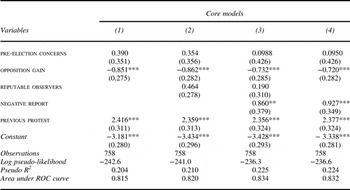
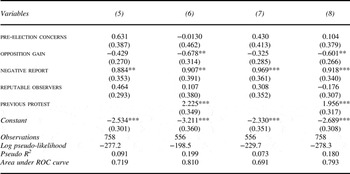
All models are binary logit, with robust standard errors clustered by country. Because country fixed effects predict “failure” (no protest) perfectly in a large number of cases, the analysis instead attempts to account for unmeasured country characteristics and temporal dependence with an indicator of whether the country has experienced postelection protest in any previous election in our sample, called previous protest. Because this variable could approximate a lagged dependent variable, an alternative specification in Table 3 shows the core model without previous protest. The results are presented in Table 2.
Postelection protest, 1992–2006, binary logit

Notes: Robust standard errors in parentheses, adjusted for clustering on country. *** p < .01; ** p < .05; * p < .1.
Postelection protest, 1992–2006, binary logit, alternative specifications

Notes: Robust standard errors in parentheses, adjusted for clustering on country. *** p < .01; ** p < .05; * p < .1.
Model 1 in Table 2 presents a minimal model of protest, excluding variables related to election observation. Model 1 shows that postelection protest is significantly less likely in elections in which the opposition performs well, and significantly more likely when the country has previously experienced postelection protest. When the opposition gains over prior performance in an election, it is an observable signal that the election was sufficiently democratic to allow some challenge to the government. previous protest may capture a variety of other characteristics of a country that make protest more likely on average, including experience participating in protest, organizational skill, or a culture in which public protest is accepted. The variable pre-election concerns is positive but not statistically significant.
Model 2 introduces reputable observers to confirm expectations that the presence of observers alone is not sufficient to increase the probability of postelection protest. Model 3 is the core model and includes an indicator of whether observers issued a negative report. Consistent with expectations, negative report is positive and statistically significant. Model 4 confirms this result but removes reputable observers, which makes the estimated first differences and predicted probabilities more straightforward.Footnote 58
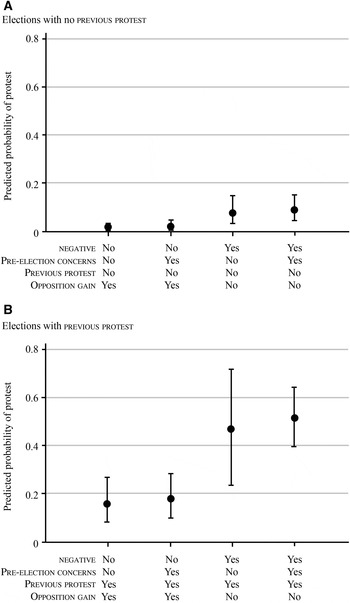
Because the estimation technique is binary logit, the substantive effect of these variables on the probability of protest is not clear from Table 2. Predicted probabilities are computed from Model 4 in Table 2. Note that all of the explanatory variables used to estimate the probabilities of protest shown in Figure 5 are dichotomous. This means that it is possible to estimate the predicted probability of protest for all possible combinations of negative report, pre-election concerns, previous protest, and opposition gain.Footnote 59 Figure 5 presents the predicted probability of protest across several categories of interest.Footnote 60 The top panel includes estimates when previous protest has not occurred, and the bottom panel presents estimates when the country has experienced previous protest.
Predicted Probability of protest, 1992–2006

In logit models with dichotomous explanatory variables and a potential interaction between them, there is some debate about whether including a product term, such as pre-election concerns*negative report, is necessary to evaluate interactive effects.Footnote 61 The alternative is to simulate predicted probabilities or first differences under conditions associated with the possible values of the interaction. Both methods have been analyzed, and the outcomes are nearly identical. The models presented are those without the interaction terms.
Overall, the probability of protest is much greater if the country had previously experienced a postelection protest. The effect of a negative report is clearest when comparing elections in a least likely case of protest (no pre-election concerns, opposition gain, and no negative report) with the most likely case (pre-election concerns, no opposition gain, negative report). This difference is apparent both in cases in which the country had not experienced previous protest (Panel A in Figure 5) and countries in which they had previous protest, although the overall rates of protest are much higher in countries with a history of postelection protest. Turning to estimated effects of negative report on protest, in the least likely case when all other variables make protest less likely, changing negative report from 0 to 1 is associated with a change in the probability of protest of 0.02. Under the “most likely” conditions, change in the probability of protest associated with a negative report is 0.22.
Table 3 presents several alternative specifications. Model 5 is estimated without previous protest, as we noted, because previous protest may approximate a lagged dependent variable. Model 5 should alleviate such concerns, because the estimates are similar to those in Model 4. To address some possible selection concerns, Models 6 and 7 limit the sample to observed elections only, showing that a negative report from international observers continues to have a positive and significant relationship to protest in the subsample. Model 8 introduces an alternative measure of postelection protest, which includes any election-related protest in the postelection period, even if such postelection protest is not focused on election fraud.Footnote 62
Thus far, the empirical evidence suggests a strong relationship between postelection protests and negative reports from reputable international observers. Yet this relationship between protest and observer reports of fraud could also be attributable to reverse causality. What if protest causes a negative report, rather than negative reports increasing the probability of protest? As H2 outlines, negative reports from international observers should be more likely to be followed by protest. Following the same logic, if protest does begin before observers issue a report, the size and duration of the protest should be conditioned on the content of observers’ report: if protest is ongoing when observers issue their report, a negative report should increase the size and duration of protest and conversely, a positive report should have a dampening effect.
Timing and Duration of Protest
A new supplementary data set on the duration and sequencing of protest-related events between 1990 and 2006 helps analyze the relationship between reports of fraud and postelection protest. This secondary data set includes all elections that received a negative report from observers or that were protested, totaling 150 elections.Footnote 63 In addition to the timing of observers’ reports, public statements or decisions by domestic opposition parties or candidates in the election were also coded. Although these actors were almost always opposition parties, the more general term “domestic contestants” is used here to account for any candidate or party that chose to reject the election results or call for postelection protest.
Whenever possible, research assistants coded the date of international observers’ first postelection statement, the date of any public decision by domestic contestants to accept the results of the election or protest them, and the duration (in days) of postelection protests. In 138 of these cases, one or more of these groups criticized the election. If domestic contestants criticized, they nearly always called for postelection protest, although their calls often failed to draw significant participation.
In ninety-four of the 150 elections in the supplementary data set, coders were able to establish the dates that both domestic contestants and international observers issued statements on the quality of the election. Consistent with expectations, when negative observer reports precede the reports of domestic actors, the mean protest duration is eleven days. If positive observer reports follow a negative report from domestic actors, they are associated with a mean protest duration of just four days.
More generally, as Table 4 illustrates, given that protest occurred, if both domestic contestants and international observers declare the election fraudulent, the average protest is ten days. If domestic contestants in the election complain of fraud in the postelection period, but observers do not issue a negative report, the average protest duration is nearly halved, to six days. Also consistent with expectations, even when the reaction by domestic contestants is positive, protest is rare but lasts slightly longer when international observers issue a negative report.
Duration of postelection protest by international and domestic contestants’ verdicts

Note: Average number of days (number of elections in parentheses).
Part of the relationship between observer-declared fraud and protest may result from the fact that when monitors do not declare an election fraudulent, they may work to prevent postelection protest by discrediting the claims made by losing political parties or advocating peaceful acceptance of the results. It is also possible that the informational story could be reversed, and protesting by domestic groups could cause negative reports by observers. Based on a close examination of the role of observers in dozens of elections, this appears to be an unlikely chain of events, since many protests are launched only following the first postelection statement from observers. Even if it were initially the case that domestic protests led to negative observer reports, it appears that criticism from international observers and protest by domestic groups reinforce each other to amplify the consequences of fraud and reduce the legitimacy of fraudulent election results.
The exact mechanisms by which these protests develop vary. In many cases, protests are called for or begin for reasons unrelated to reports from observers. The common thread is that once observers have declared an election fraudulent, protests are more likely to occur, and ongoing protests tend to gain in strength. Positive reports from observers are associated with fewer, shorter, and weaker protests.
One prominent example occurred surrounding the 2000 Peruvian elections in which incumbent president Alberto Fujimori attempted to secure a controversial third term in office. These elections provide an example of domestic and international actors coordinating to discredit a fraudulent electoral process, contributing to the legitimacy of postelection protests, and otherwise undermining Fujimori's autocratic tactics. Beginning criticism two months before the elections, a joint mission from the Carter Center and NDI announced that “Peru's electoral process does not yet meet international standards for democratic elections,” and issued a series of pre-election recommendations to “establish confidence in the electoral process,” with additional criticism issued just before the first-round election.Footnote 64
As the first round ended, observers strongly condemned the pre-election period and the tabulation process in which “ballot totals mysteriously decreased as the tally progressed and … showed about 1 million more ballots were cast than there were voters.”Footnote 65 After a fraudulent first round, international and domestic observers called for a number of changes and postponement of the second-round runoff. When the Fujimori government refused to concede to their demands, the Carter Center, NDI, and the domestic observer group Transparencia withdrew their missions, issuing statements that effectively condemned the runoff before it took place, and triggering protests. News reports suggest that even though opposition candidate Alejandro Toledo had planned for a massive rally to follow the runoff on Sunday, “thousands of people already took to the streets on Thursday after the authorities rejected Toledo's request to postpone the vote amid claims, notably by international observers, that a fair electoral process was not guaranteed.”Footnote 66
Similarly, following the 2005 legislative elections in the Kyrgyz Republic that were immediately criticized by the OSCE/ODIHR for failing to meet international standards, protests broke out throughout the country, which continued through the second-round runoff, which was also criticized by observers. The protests culminated in the resignation of the president and the calling for new presidential elections. Evidence that observer reports contributed to the protests is, oddly enough, provided by Russian representatives to the OSCE, who are known for opposition to many democracy promotion programs. In an official statement, a Russian OSCE representative blamed observers from the OSCE/ODIHR for fomenting protest and encouraged the OSCE “not to provide destructive elements with an opportunity to use [observer reports] as a ‘justification’ for unlawful actions.”Footnote 67
Before the November 2005 election in Azerbaijan, even though the government was widely expected to steal the election, opposition groups held off their decision to protest on election day until observers announced their evaluation of the election. Observers from the OSCE/ODIHR validated opposition claims of fraud, and postelection protests were carried out.Footnote 68 There are a number of similar cases in which declarations of fraudulent elections appear to legitimize postelection protest. The well-publicized “colored revolutions” fall into this category, as do a number of other prominent cases throughout the developing world.Footnote 69
There are also many cases in which postelection protests were discredited by foreign observers. After the extremely close 2006 Mexican election in which both candidates declared victory, presidential candidate Andrés Manuel López Obrador alleged fraud and called for mass protest. Rather than being branded as defenders of democracy, protesters and their leader, López Obrador, were labeled as “sore losers.”Footnote 70 Major world publications cited observer judgments as evidence that the elections were not fraudulent, discrediting López Obrador's claims of fraud, and undermining the legitimacy of the protest movement.
Similarly, the 1990 elections in the Dominican Republic represent a relatively early case of observers undermining the legitimacy of opposition calls for postelection protest:
[Opposition candidate Juan Bosch] charged “colossal fraud” in vote counting and said he would call for street protests [Friday], “no matter what the consequences.” But former President Jimmy Carter, one of thirty international election observers, said Thursday he saw “no evidence of fraud or manipulation” in the vote count. He urged candidates to remain calm and wait for final results.Footnote 71
In part because of the statements made by international observers that the vote count was successful, protesters did not take to the streets. Bosch ultimately revoked his calls for his supporters to protest when he agreed to a review of electoral tally sheets conducted in the presence of international observers.Footnote 72
There is little evidence that observers work to cause protest. Rather, the default strategy for many opposition groups is to claim fraud and call for protest. When observers have declared an election fraudulent, they do little to discourage protests, and protests may be more likely because observer reports work as a focal point for collective action. When observers find an election acceptable, they often work to bring about an end to protests and a peaceful acceptance of the results.
Contrast the following news reports following protested elections. The first report is from the Ethiopian 2005 parliamentary elections after observers initially approved the election:
Foreign observers said they could not verify opposition claims of rigging. The chief European Union election monitor, Ana Gomez, called the election a victory for democracy, and a credit to all parties who had participated. She told the BBC it was a bit absurd for the opposition—who have alleged fraud and intimidation—to dismiss the poll at such an early stage.Footnote 73
This second report is from the Azerbaijan 2005 parliamentary elections when observers criticized the polling:
An estimated 10,000 people gathered in Victory Square, on the outskirts of the capital, Baku, to protest against the results of parliamentary elections on November 6, which international observers said were marred by fraud.Footnote 74
The Ethiopian case offers an interesting example because international observers reversed course relatively quickly, thereby validating opposition protests, which grew in magnitude until they were met with deadly suppression by the Ethiopian government. Although the precise mechanisms vary from case to case, anecdotal evidence also suggests that protests are more potent and last longer when validated by a critical report from reputable international observers.
Conclusion
Although international election observers do not seek to cause postelection protest, their efforts to provide credible information about the quality of elections have the side effect of dampening incentives for “sore loser” protests, and increasing the probability of postelection protest when they have judged an election to be fraudulent. The information added by international observers about election quality can provide a focal point for collective action, and when elections are declared fraudulent, can make postelection protest more likely and last longer. When observers are present and do not criticize an election, their reports are likely to suppress protests or undermine opposition calls for protests. This post–Cold War dynamic contrasts with the period before credible election observation was widely available, and in which the default strategy for opposition parties was to call for postelection protest.
Two possible extensions of this theory could be interesting avenues for future research. There are two mechanisms by which self-enforcing democracy can be facilitated through elections. First, increasing information about the quality of elections should increase the benefits of holding clean elections and increase the costs of holding fraudulent elections. Although we have focused on international election observation as a new international institution that can address this issue, other institutions could also be effective at providing credible information in specific cases. Second, if a source of credible information exists, any cost or benefit conditioned on the quality of elections should also increase incentives for democratic elections. Such conditions may be linked to international benefits, such as trade, foreign aid, tourism, preferential trade agreements, and so on. Any costs or benefits conditioned on election quality are less likely to work in the absence of an accurate signal about the quality of elections.
Thus, in part because many countries with unstable political institutions are also heavily dependent on international support for their regimes, an expected reduction in international benefits following elections declared fraudulent by international observers could further increase incentives for leaders to hold clean elections. Although a number of donors have made repeated rhetorical commitments to democracy, the political uses of foreign aid have also been well documented in the literature, and governments receive foreign aid for strategic reasons that often trump donor interest in promoting democracy.Footnote 75 Yet there is also a substantial literature on the ways in which international actors have attempted to encourage the spread of democracy, especially since the end of the Cold War.Footnote 76 Recent studies have shown that outside actors, such as regional intergovernmental organizations, can help states commit to democracy and enforce democratic conditionality.Footnote 77
To encourage the development of self-enforcing democracy, our findings suggest that funding for domestic and international observation missions can contribute to the establishment of self-enforcing democracy. Additionally, the theory suggests that the positive effect of supporting election-observation missions could be reinforced if donor governments were to react more consistently to credible reports of election fraud.
Within the dynamic process of democratization in which governments prefer to stay in power, information is an important but neglected variable in motivating governments to hold clean elections, and is one way in which international actors could help to encourage democratization. In the absence of institutionalized democratic practices, it is not clear why leaders begin holding democratic elections. Our work suggests that leaders have increased incentives to hold clean elections when there is an informational mechanism, such as international election observation, which signals the quality of the election to the public. Given credible information about the quality of elections, there must also be costs, such as postelection protest, for those leaders who are exposed for allowing election fraud. If information is provided about election quality and costs are conditioned on this information, governments have greater incentive to hold clean elections. International election monitors are one source of increased information about election quality. Even imperfect election monitoring can result in increased domestic costs for leaders who manipulate elections, and increased benefits for leaders who hold clean elections, indicating that election observers (or other institutions that increase information about election quality) can facilitate self-enforcing democracy. In documenting the relationship between international election observation and postelection protest, the findings also underscore the crucial role that domestic actors play in encouraging governments to allow democratic elections.
Supplementary material
Replication data are available at <http://hdl.handle.net/1902.1/19786>.