Introduction
For parasitoids, a suitable host is one that allows the development of parasitoids from immature stages to fertile adults; however, suitability is determined by how well a parasitoid handles the host’s defensive system, detrimental toxins, nutritional adequacy, and environmental factors (Vinson and Iwantsch Reference Vinson and Iwantsch1980a). Parasitoid acceptance of different host species is a dynamic process in which parasitoids select hosts with low to high levels of suitability (Heimpel et al. Reference Heimpel, Neuhauser and Hoogendoorn2003; Hopper et al. Reference Hopper, Prager and Heimpel2013). For parasitoids that are expanding their host range, success is related to the suitability of the selected new host species, the quality of which may optimise or diminish parasitoid success (Salt Reference Salt1938; Godfray Reference Godfray1994; Harvey et al. Reference Harvey, Ximénez de Embún, Bukovinszky and Gols2012). The host range of a parasitoid is mainly determined by the selection of new hosts that are usually phylogenetically and ecologically similar to the parasitoid’s natural hosts (Askew and Shaw Reference Askew, Shaw, Waage and Greathead1986; Godfray Reference Godfray1994; Paynter et al. Reference Paynter, Fowler, Gourlay, Groenteman, Peterson, Smith and Winks2010). In the assembly of ecological communities, the interaction between nonnative hosts and local parasitoids may result in the expansion of a parasitoid’s host range and a subsequent change in the structure of the food web with novel host–parasitoid relationships (Cornell and Hawkins Reference Cornell and Hawkins1993; Ives and Godfray Reference Ives and Godfray2006; Grabenweger et al. Reference Grabenweger, Kehrli, Zweimüller, Augustin, Avtzis, Bacher, Freise, Girardoz, Guichard, Heitland, Lethmayer, Stolz, Tomov, Volter and Kenis2010). Phenotypic plasticity, correlated traits, and phylogenetic relationships provide parasitoid species with adaptive mechanisms to counter the immune systems and other physiological processes of novel hosts, helping to render the novel hosts suitable for successful parasitoid development (Henry et al. Reference Henry, Roitberg and Gillespie2006; Agosta and Klemens Reference Agosta and Klemens2008; Harvey et al. Reference Harvey, Ximénez de Embún, Bukovinszky and Gols2012). However, host suitability as a dynamic process of parasitoid survival, growth, development time, and brood size of gregarious parasitoids varies according to host quality (Mackauer and Sequeira Reference Mackauer and Sequeira1993; Godfray Reference Godfray1994; Mackauer et al. Reference Mackauer, Sequeira and Otto1997; Harvey Reference Harvey2005).
Trichoplusia ni Hübner and the nonnative Chrysodeixis chalcites Esper (Lepidoptera: Noctuidae) are the main lepidopteran insects attacking field and greenhouse vegetable crops in southwestern Ontario, Canada (Murillo et al. Reference Murillo, VanLaerhoven, Garcia and Hunt2018). Murillo et al. (Reference Murillo, VanLaerhoven, Garcia and Hunt2018) found seven species of larval parasitoids on these two hosts and reported that (1) Campoletis sonorensis Cameron (Hymenoptera: Ichneumonidae), the most common native solitary larval parasitoid of T. ni in the region before the invasion of C. chalcites, was also the most frequent parasitoid of C. chalcites, (2) Cotesia vanessae Reinhard (Hymenoptera: Braconidae), an introduced and well-established gregarious parasitoid, was the second most common larval parasitoid of both hosts, and (3) the native gregarious egg–larval parasitoid Copidosoma floridanum Ashmead (Hymenoptera: Encyrtidae), reported on C. chalcites in other parts of the world, was the most common parasitoid of T. ni not found on C. chalcites. Therefore, based on the aforementioned observations, we evaluated relevant host-suitability parameters of T. ni and C. chalcites for these three parasitoid species that have recently expanded their host range into nonnative hosts in North America. We sought to better understand how the suitability of T. ni and C. chalcites relates to the host range expansion of these parasitoids. We also quantified basic parameters for the development of mass-rearing systems for these parasitoids.
Materials and methods
Insect colonies
Trichoplusia ni and C. chalcites colonies were initiated with specimens collected from tomato (Solanaceae) crops in the municipality of Kingsville, Ontario, Canada. Their taxonomic identification was confirmed by the Canadian National Collection of Insects, Arachnids, and Nematodes (Ottawa, Ontario, Canada). Colonies of each species were set up with 50 adults in 5-L plastic containers and fed a 5% sugar solution. Every other day, the eggs were collected from paper towels that were used as the container lid and oviposition substrate. Eggs were disinfected with a 0.5% solution of commercial bleach and, once hatched, larvae were reared on a pinto bean diet (Shorey and Hale Reference Shorey and Hale1965) in 355-mL Styrofoam cups. Larvae were moved into 29.6-mL transparent plastic cups (Solo Cup Company, Urbana, Illinois, United States of America) once they moulted to the second instar. Campoletis sonorensis and C. vanessae were collected from both insect hosts in the field and from colonies of each species and were maintained on each host species separately. Copidosoma floridanum was collected and reared only on T. ni, because C. chalcites did not support its development. However, we pursued a trial with C. chalcites to learn if sublethal effects of parasitism occurred on this host, which is reported as a successful host for this parasitoid in Europe, Hawaii, and New Zealand after its introduction to those regions as a classical biological agent (Noyes Reference Noyes1988a; Bosque et al. Reference Bosque, Figueras and Izquierdo1996). Campoletis sonorensis females were allowed to mate for 48 hours, per Hoelscher and Vinson (Reference Hoelscher and Vinson1971), who reported that the success of C. sonorensis was better when females mate for 48 hours before they were exposed to hosts. Because C. floridanum mates immediately after hatching, we allowed 24 hours for all the brood to hatch and mate. The strain of C. vanessae employed in this study was a thelytokous parthenogenetic strain that does not need to mate to produce viable offspring. All colonies and trials were kept in a room at 24 °C and 60% relative humidity, with a 12-hour-light:12-hour-dark photoperiod.
Experimental design
To evaluate the effect of host-suitability parameters of T. ni and C. chalcites on the parasitoids, one trial for each of the three parasitoid species was set as described below. Each parasitoid trial was replicated 10 times for each host species, making for a total of 60 replicates with parasitoids. A set of an additional 10 replicates with nonparasitised hosts for each host species was kept as control, making 40 replicates without parasitoids, including 20 replicates with host larvae and 20 with host eggs.
Campoletis sonorensis trial. Fifty early second-instar larvae (three days old) of each lepidopteran host species feeding on a pinto bean diet (Shorey and Hale Reference Shorey and Hale1965) were exposed to two naïve 48-hour-old mated female C. sonorensis parasitoids in a 355-mL Styrofoam container (top diameter: 10.8 cm; bottom diameter: 7 cm; height: 8.3 cm). One container was used for each host species. Transparent plastic lids with punctures made with a needle were used to cover the containers. Because C. sonorensis usually takes long periods of time (minutes to hours) between parasitism events and does not start parasitising as soon as it is exposed to hosts, the females were allowed to parasitise for 24 hours. After exposure, the larvae were observed under a stereoscope at 40 × magnification to count the number of parasitoid eggs inside each larva without damaging them. Each of the first 20 host larvae that were infected with only one parasitoid egg was placed in its own 29.6-mL plastic cup with a pinto bean diet until it developed into a moth or the parasitoid emerged.
Cotesia vanessae trial. Thirty early second-instar larvae (three days old) of each lepidopteran host feeding on a pinto bean diet were exposed to 10 naïve 24-hour-old female parasitoids in a 355-mL Styrofoam container. Because C. vanessae females start parasitising as soon as they are exposed to hosts, and they continue parasitising over short intervals of time (a few seconds to minutes), the first 20 host larvae that were parasitised once were removed immediately. Each of the larvae was placed in its own 29.6-mL plastic cup with a pinto bean diet until it developed into a moth or a parasitoid emerged.
Copidosoma floridanum trial. One hundred eggs of each lepidopteran host species oviposited on a 28 × 22.8 cm paper towel were exposed to approximately 50 naïve 24-hour-old female parasitoids. Because C. floridanum females start parasitising as soon as they are exposed to hosts and continue parasitising over short intervals of time (a few seconds to minutes), a stereoscope at 40 × magnification was used to directly observe parasitoids inserting their ovipositors into eggs. As soon as an egg was parasitised, a pencil mark was made on the paper towel next to the egg. To prevent parasitoids from superparasitising host eggs, the parasitoids were removed with a thin paintbrush as soon as they walked close to an already parasitised egg. The first 50 parasitised eggs were selected and placed in a 355-mL Styrofoam container with a pinto bean diet as food for the eclosing larvae. After six to seven days, all host larvae had hatched, and each larva was placed in its own 29.6-mL plastic cup with a pinto bean diet until it developed into a moth or produced parasitoids.
Egg-parasitism by C. floridanum was confirmed by dissecting random samples of 10 recently parasitised eggs of each host under a stereoscope at 100 × magnification. These samples were not part of the samples used for the trials. All samples dissected were found to be parasitised.
Response variables
For the three species of parasitoids, the following variables were measured: (1) parasitoid success, expressed as the number of parasitised hosts from which adult solitary or gregarious parasitoids emerged; (2) parasitoid cocoon mortality, expressed as the number of developed parasitoid cocoons from which adult parasitoids did not emerge, measured for C. sonorensis and for C. vanessae; (3) parasitoid sex ratio, expressed as the proportion of the emerged parasitoid that were male offspring, where > 0.5 is a male-biased ratio, measured for only the solitary parasitoid C. sonorensis; (4) brood size per host, expressed as the number of adult parasitoids that emerged from the cocoon masses of the gregarious parasitoids C. vanessae and C. floridanum; (5) host success, expressed as the number of parasitised or nonparasitised (control) hosts that developed into adult moths; (6) host mortality, expressed as the number of parasitised or nonparasitised (control) hosts that died without developing into a moth or producing a parasitoid; and (7) developmental times of C. sonorensis, C. vanessae, C. floridanum, T. ni, and C. chalcites, measured to provide information on the sublethal effects of the suitability of the host species. For C. floridanum, development times were measured on only parasitoids that developed from T. ni, because this parasitoid was not able to develop on C. chalcites in this study. Oviposition to cocoon formation, cocoon to adult emergence, and oviposition to adult emergence for each parasitoid species, as well as times from oviposition to pupa formation, pupa to adult emergence, and oviposition to adult emergence for each host species, were measured as development times. Development times of hosts parasitised by C. floridanum that survived parasitism and developed as moths were also measured.
For control, host mortality for each host species was measured in 10 replicates of 20 larvae each, and host success, host mortality, and development times for each host species were also measured in 10 replicates of 50 eggs each where the larvae and eggs were not exposed to parasitoids.
Statistical analysis
Because the normality and homogeneity of variance of the data obtained from the response variables differed across the parasitoids and host species, data were analysed using one-way analysis of variance (ANOVA) where both the normality and homogeneity assumptions were met, one-way ANOVA Welch where the homogeneity of variance was not met, and Mann–Whitney U tests for independent samples where the normality assumption was not met. We compared: (1) the measures of parasitoid success, parasitoid cocoon mortality, host success, host mortality, brood size, parasitoid sex ratio, and development times between the two host species for C. sonorensis and C. vanessae; (2) the measures of host success, host mortality, and development time between the parasitised and nonparasitised hosts for each of the three parasitoid species; and (3) the measures of development times between nonparasitised hosts species.
The effect of the interactions between the suitability parameters of the two insect hosts was analysed with a multinomial logit model. Host species was treated as a categorical dependent variable (two categories, T. ni and C. chalcites), and parasitoid success, host success, and host mortality data were converted into a categorical factor variable with three categories. In the case of C. sonorensis, the parasitoid cocoon mortality parameter was included in the multinomial logit model as a fourth category. Data were analysed using the Statistical Package for the Social Sciences (SPSS) for Windows (SPSS Inc., Massachusetts, United States of America; version 23.0).
Results
Campoletis sonorensis
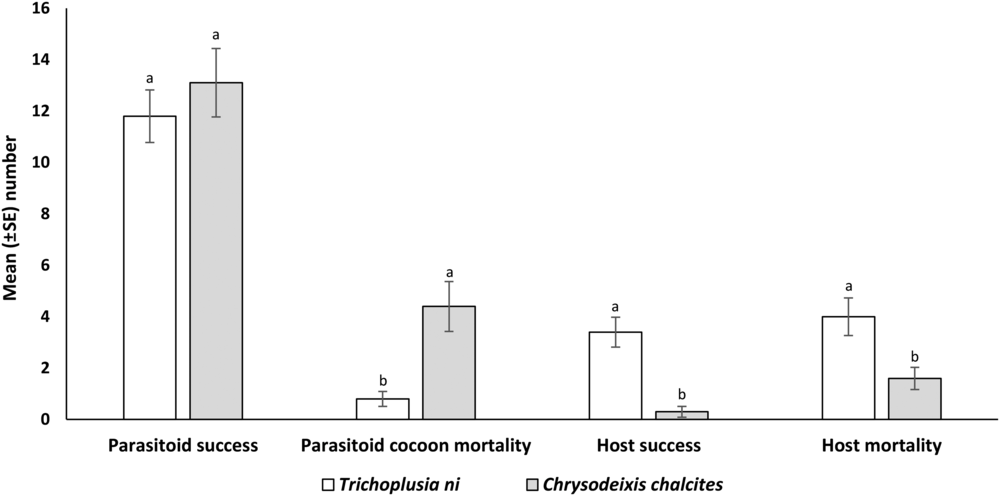
Parasitoid success of C. sonorensis was similar on T. ni and C. chalcites (F 1,18 = 1.28, P = 0.273; Fig. 1). Host success and host mortality were higher amongst parasitised T. ni than amongst C. chalcites, but parasitoid cocoon mortality was lower (F 1,18 = 8.05, P = 0.011; F 1,11.38 = 25.07, P < 0.001; F 1,10.61 = 12.68; P = 0.005, respectively; Fig. 1). Host mortality was higher amongst parasitised T. ni than amongst nonparasitised T. ni (F 1,18 = 7.31, P = 0.015; Means ± SE: 4.00 ± 0.73 and 1.80 ± 0.36 dead larvae, respectively), but for C. chalcites, host mortality amongst parasitised larvae was similar to that amongst nonparasitised larvae (F 1,18 = 1.16, P = 0.296; Means ± SE: 1.60 ± 0.43 and 2.20 ± 0.36 dead larvae, respectively). The host success of parasitised hosts was mostly associated with the cuticular encystment of parasitoid eggs (Vinson and Iwantsch Reference Vinson and Iwantsch1980b; Namba et al. Reference Namba, Saigusa and Tanaka2004). On more than 50% of the surviving parasitised hosts, host larvae were observed moving the parasitoid eggs from the insertion locations in their bodies to the ends of their bodies, then isolating the eggs in bubble-like extensions that developed on top of the hosts’ last abdominal segments.
Suitability parameters of hosts Trichoplusia ni and Chrysodeixis chalcites parasitised by Campoletis sonorensis. Parasitoid success is expressed as the number of hosts from which adult solitary or gregarious parasitoids are developed. Parasitoid cocoon mortality is expressed as the number of developed cocoons from which adult parasitoids did not emerge. The host success is measured as the number of hosts that developed into adult moths, whether the host was parasitised or not. Host mortality is calculated from the number of hosts that died after parasitism without developing into a moth or parasitoid. Sample size = 20; replicates = 10. Note: Means (±SE) with the same letter are not significantly different (P > 0.05). Parasitoid success and host mortality were analysed using analysis of variance (ANOVA), and parasitoid cocoon mortality and host success were analysed using Welch’s ANOVA.

Multinomial logistic regression indicated a difference in the interaction of host success (Wald = 17.545; df = 1; P = 0.001), host mortality (Wald = 10.995; df = 1; P = 0.001), and parasitoid cocoon mortality (Wald = 14.798; df = 1; P = 0.001) with parasitoid success between parasitised T. ni and C. chalcites by C. sonorensis. The success of C. sonorensis declined more on T. ni than on C. chalcites with the increase of host success (Coefficient = 2.577) and host mortality (Coefficient = 1.066); however, it declined less than on C. chalcites with the increase of parasitoid cocoon mortality (Coefficient = −1.555).
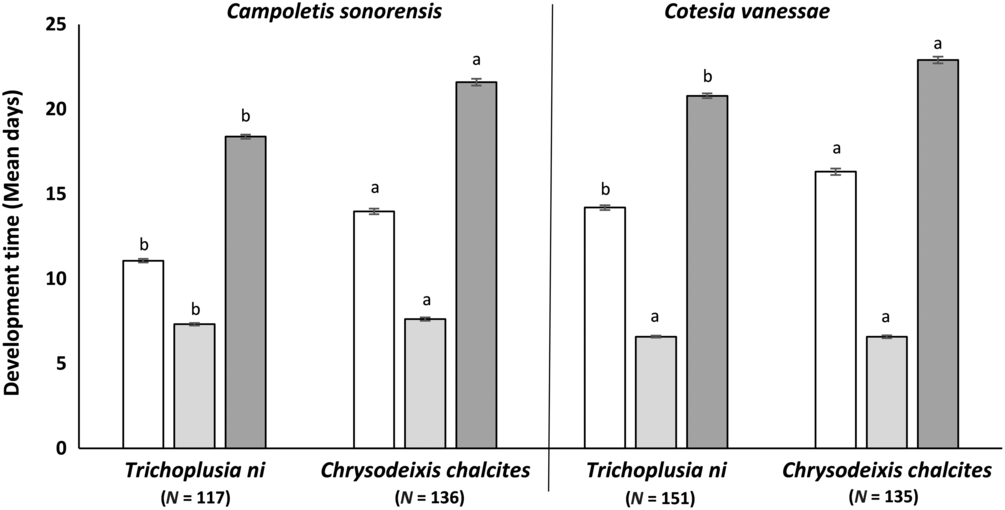
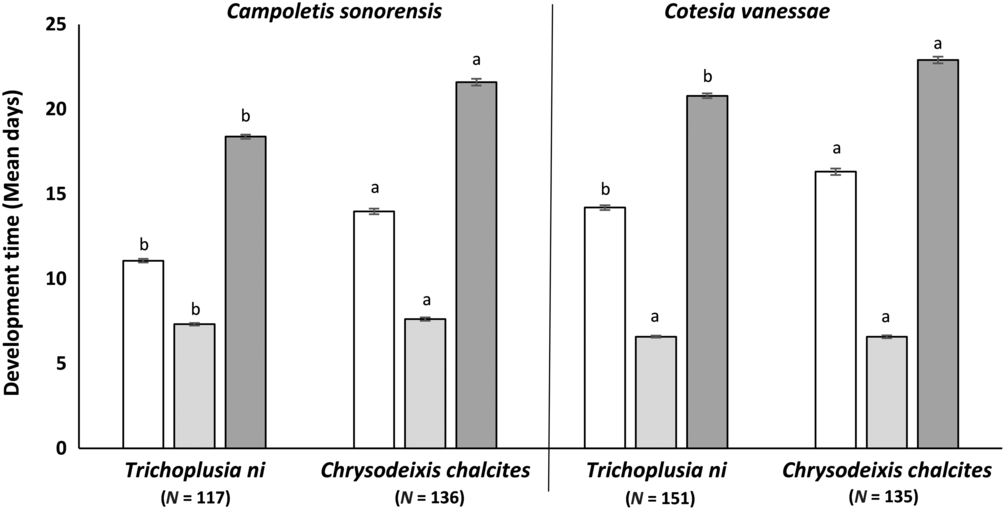
The development times from oviposition to cocoon formation, cocoon to adult emergence, and oviposition to adult emergence of C. sonorensis reared on T. ni were shorter than on C. chalcites (U = 1562.50, P < 0.001; U = 6567.00, P = 0.010; U = 1900.50, P < 0.001, respectively; Fig. 2). The mean sex ratio was slightly female-biased on T. ni (0.48 ± 0.08) and male-biased on C. chalcites (0.66 ± 0.08), but not significantly different between them (F 1,18 = 2.65, P = 0.121).
Development times in days for Campoletis sonorensis and Cotesia vanessae on Trichoplusia ni and Chrysodeixis chalcites. White: days from oviposition to cocoon formation; light grey: days from cocoon to adult emergence; dark grey: days from oviposition to adult emergence. Means (±SE) with the same letter within each parasitoid species are not significantly different (P > 0.05). Parameters were analysed using Mann–Whitney U tests for independent samples for each parasitoid species and each parasitoid development stage separately.
Cotesia vanessae
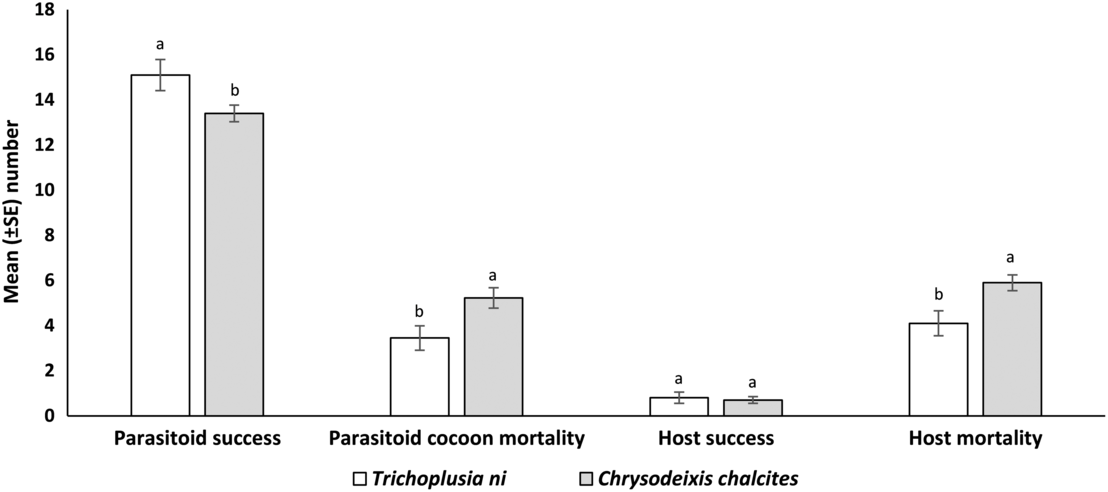
Parasitoid success of C. vanessae was higher on T. ni than on C. chalcites, yet parasitoid cocoon mortality was lower on T. ni than on C. chalcites (F 1,18 = 4.703, P = 0.044; U = 13,874.00, P < 0.001, respectively; Fig. 3). Host mortality was lower on parasitised T. ni than on parasitised C. chalcites (F 1,18 = 7.714, P = 0.012), and host success was similar between both parasitised host species (U = 48.00, P = 0.912; Fig. 3). Host mortality of parasitised T. ni and C. chalcites (4.10 ± 0.55 and 5.90 ± 0.35 dead larvae, respectively) by C. vanessae was higher (F 1,18 = 12.37, P = 0.002; F 1,18 = 54.76, P < 0.001, respectively) than on nonparasitised hosts (1.80 ± 0.36 and 2.20 ± 0.36, respectively). The brood size of C. vanessae was higher (U = 4720.50, P < 0.001) on T. ni than on C. chalcites (52.11 ± 2.11 and 30.24 ± 1.3 parasitoids, respectively).
Suitability parameters of hosts Trichoplusia ni and Chrysodeixis chalcites parasitised by Cotesia vanessae. Parasitoid success is expressed as the number of hosts from which adult solitary or gregarious parasitoids are developed. Parasitoid cocoon mortality is expressed as the number of developed cocoons from which adult parasitoids did not emerge. The host success is measured as the number of hosts that developed into adult moths, whether the host was parasitised or not. Host mortality is calculated from the number of hosts that died after parasitism without developing into a moth or parasitoid. Sample size = 20; replicates = 10. Notes: Means (±SE) within each variable response with the same letter are not significantly different (P > 0.05) between host species. Parasitoid success and host mortality were analysed using ANOVA, and parasitoid cocoon mortality and host success were analysed using Mann–Whitney U tests for independent samples.
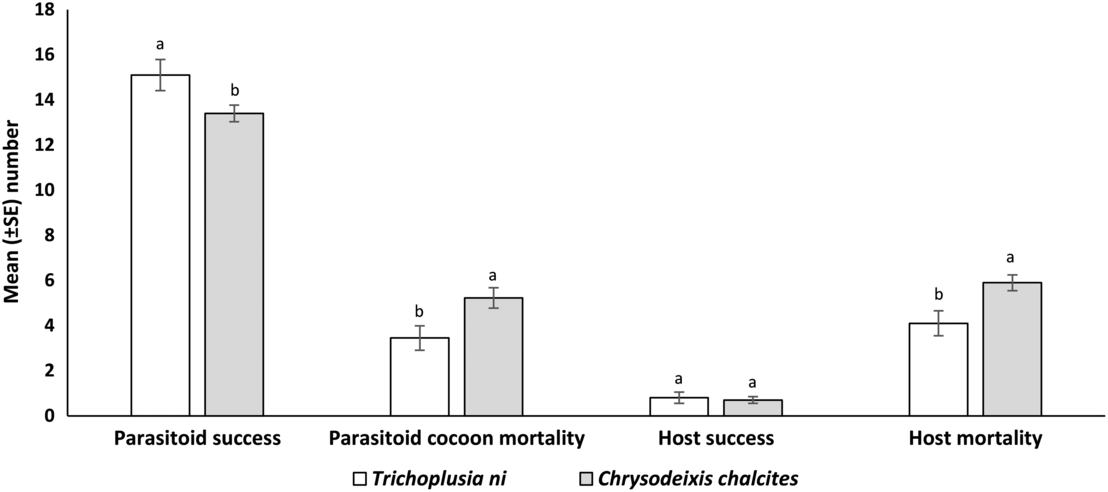
The multinomial logistic regression indicated that the interaction of host success (Wald = 0.003; df = 1; P = 0.959) and host mortality (Wald = 3.28; df = 1; P = 0.070) with parasitoid success was similar between the parasitised larvae of host species.
The development times from oviposition to cocoon formation and oviposition to adult emergence of C. vanessae were shorter on T. ni than those on C. chalcites (U = 16 184.00, P < 0.001; U = 4411.00, P < 0.001, respectively; Fig. 2). However, the time from cocoon formation to adult emergence of the parasitoid did not differ significantly between either host species. (U = 9833.00, P = 0.573; Fig. 2).
Copidosoma floridanum
Copidosoma floridanum could not develop on C. chalcites even though on additional replicates to the trial we confirmed that, during parasitism, eggs were oviposited inside host eggs. The trial on C. chalcites was repeated an additional three times (the last two times using individuals from new specimens collected from tomato fields), and parasitoid development was always unsuccessful. On T. ni as host, the mean (±SE) success of C. floridanum was 24.5 ± 2.88 out of 50 larvae, its mean brood size was 1478.05 ± 20.25 parasitoids per larvae (range: 761–2037), and its development time from oviposition to adult emergence was 33.44 ± 0.14 days, from oviposition to cocoon formation was 21.81 ± 0.13 days, and from cocoon to adult emergence was 11.68 ± 0.06 days.
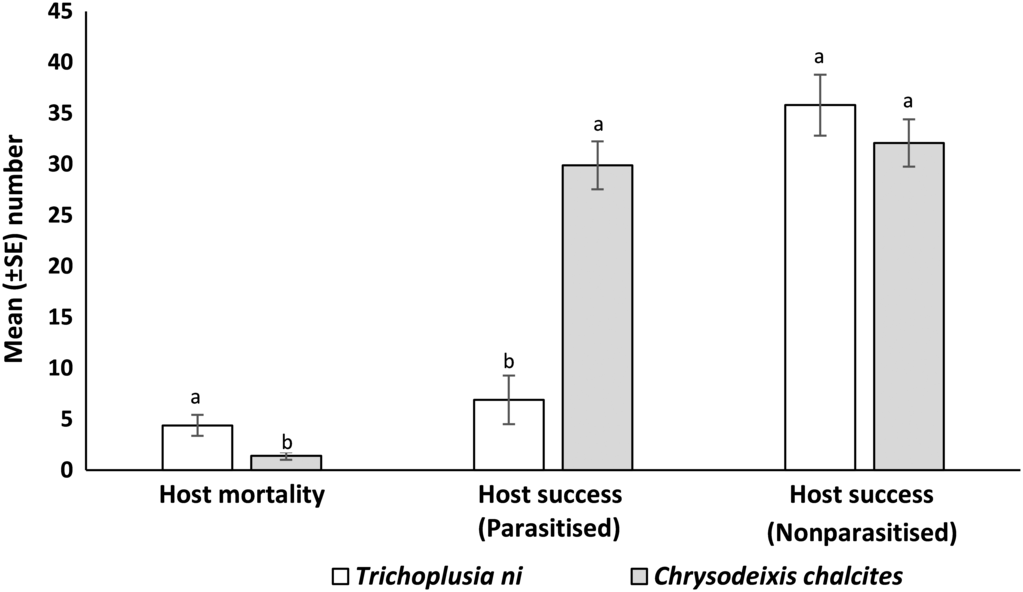
Host mortality on parasitised hosts (T. ni = 4.40 ± 1.02 dead larvae; C. chalcites = 1.40 ± 0.37 dead larvae) was similar (T. ni: U = 49.00, P = 0.971; C. chalcites: F 1,18 = 1.301, P = 0.269) to their respective nonparasitised hosts (T. ni = 3.70 ± 0.80 dead larvae; C. chalcites = 0.90 ± 0.23 dead larvae). The host success was also similar (T. ni: F 1,18 = 0.542, P = 0.471; C. chalcites: F 1,18 = 0.746, P = 0.399) between parasitised (T. ni = 35.80 ± 2.98 larvae; C. chalcites = 32.10 ± 2.32 larvae) and nonparasitised hosts (T. ni = 33.10 ± 2.14 larvae; C. chalcites = 29.10 ± 2.58 larvae). Host mortality was higher in T. ni than in C. chalcites, host success was lower in T. ni than in C. chalcites and was similar between parasitised hosts (F 1,18 = 7.584, P = 0.018; F 1,18 = 47.335, P < 0.001; F 1,18 = 0.959, P = 0.340, respectively; Fig. 4).
Suitability parameters of hosts Trichoplusia ni and Chrysodeixis chalcites parasitised by Copidosoma floridanum. Host mortality is expressed as the number of hosts that died after parasitism without developing into moths or parasitoids. The host success is measured as the number of hosts that develop into adult moths, whether the host was parasitised or not. Sample size = 50; replicates = 10. Notes: Means (±SE) with the same letter are not significantly different (P > 0.05). Parameters were analysed using ANOVA for each variable response between host species separately.

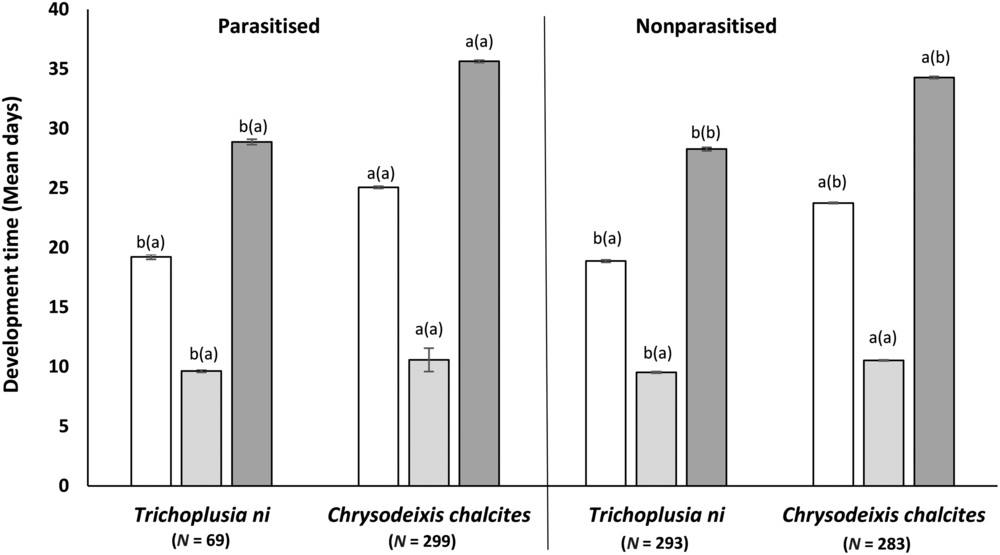
The development times from oviposition to pupa formation and from pupa to adult emergence were similar for hosts that developed into moths from parasitised T. ni and from nonparasitised T. ni eggs, but the time from egg to adult emergence was longer for those developing from parasitised hosts (U = 8748.50, P = 0.076; U = 10 467.50, P = 0.615; U = 11 793.00, P = 0.028, respectively; Fig. 5). The times from oviposition to pupa formation and from oviposition to adult emergence were longer for hosts that developed into moths from parasitised C. chalcites than for those developing from nonparasitised eggs, but the time from pupa to adult emergence did not differ significantly (U = 62 164.00, P < 0.001; U = 61 545.50, P < 0.001; U = 43 863.00, P = 0.404, respectively; Fig. 5).
Development times for hosts Trichoplusia ni and Chrysodeixis chalcites that survived parasitism by Copidosoma floridanum and for nonparasitised hosts. White: days from oviposition to pupa formation; light grey: days from pupa to adult emergence; dark grey: days from oviposition to adult emergence. Letters outside parentheses indicate a comparison between host species inside each group (parasitised or nonparasitised). Letters inside parentheses indicate a comparison between parasitised and nonparasitised within host species. Means (±SE) with the same letter are not significantly different (P > 0.05). Parameters were analysed using Mann–Whitney U tests for independent samples by developmental parameters separately, as indicated above for letters outside and inside parentheses.

The development times from oviposition to pupa formation, from pupa to adult emergence, and from oviposition to adult emergence were shorter for hosts that developed into moths from parasitised T. ni than the development times for parasitised C. chalcites (U = 20 287.00, P < 0.001; U = 16 150.50, P < 0.001; U = 20 252.50, P < 0.001, respectively; Fig. 5). Development times from oviposition to pupa formation, from pupa to adult emergence, and from oviposition to adult emergence were shorter for hosts that developed into moths from nonparasitised T. ni than for nonparasitised C. chalcites (U = 1834.00, P < 0.001; U = 67 703.50, P < 0.001; U = 81 246.00, P < 0.001, respectively; Fig. 5).
Discussion
The differential suitability and related traits evaluated in this study for the native T. ni and the nonnative C. chalcites as hosts of C. sonorensis, C. vanessae, and C. floridanum are directly related to the host range expansion of these parasitoids. We observed the following three outcomes: (1) the native and nonnative hosts had similar suitability for C. sonorensis, the native parasitoid; (2) the native host was more suitable for C. vanessae than the nonnative host was; and (3) the nonnative host was not suitable for the native parasitoid, C. floridanum.
As reported by Murillo et al. (Reference Murillo, VanLaerhoven, Garcia and Hunt2018), both the native and nonnative hosts supported the survival of the native parasitoid, C. sonorensis, under field and greenhouse crop conditions. Chrysodeixis chalcites provided an alternative host that, according to the current study’s results, offers host suitability similar to that of the native host in the tomato–cucumber (Cucurbitaceae)–pepper (Solanaceae) field and greenhouse agroecosystem of southern Ontario, where T.ni and C. chalcites were the only hosts found for this parasitoid during a two-year weekly survey, and C. chalcites became more abundant after its introduction than the native host was (Murillo et al. Reference Murillo, VanLaerhoven, Garcia and Hunt2018). The trade-offs between the availability of T. ni and C. chalcites under the trophic web presented in the southern Ontario agroecosystem and their suitability for the parasitoid allowed the host range expansion of C. sonorensis into the nonnative C. chalcites.
Additionally, the nature of C. sonorensis as a solitary generalist parasitoid of mostly Noctuidae species, including a few Plusiinae species, from across the North American continent that belong to the same phylogenetic group and have an ecology similar to that of C. chalcites makes this parasitoid highly adapted for host range expansion (Lingren et al. Reference Lingren, Guerra, Nickelsen and White1970; Araya et al. Reference Araya, Machuca and Arretz1989; De Moraes et al. Reference De Moraes, Loeck and Belarmino1991; Centre for Agriculture and Bioscience International 2007; Jourdie et al. Reference Jourdie, Virla, Murillo, Bento, Turlings and Alvarez2010; Camargo et al. Reference Camargo, Brito and Penteado-Dias2015). Jourdie et al. (Reference Jourdie, Virla, Murillo, Bento, Turlings and Alvarez2010) reported a genetically different lineage of C. sonorensis parasitising Spodoptera frugiperda J.E. Smith (Lepidoptera: Noctuidae) in a corn field located next to tomato fields and greenhouses where this parasitoid was also found parasitising T. ni and C. chalcites.
The survival of C. sonorensis was influenced differently in both hosts by the proportion of hosts that died not yielding a parasitoid (host mortality), by the proportion of hosts that overcame parasitism (host success), and by the proportion of parasitoids that developed only up to cocoon stage (parasitoid cocoon mortality). However, the trade-off between host mortality and host success being higher in T. ni than in C. chalcites and parasitoid cocoon mortality being lower in T. ni than in C. chalcites resulted in similar survival rates of the parasitoid between hosts.
Harvey et al. (Reference Harvey, Ximénez de Embún, Bukovinszky and Gols2012) reported that C. sonorensis was about 15% more successful on C. chalcites at 1 °C warmer and with a shorter photoperiod and a sample size that was 60% smaller than were applied in this study. If the study conditions of Harvey et al. (Reference Harvey, Ximénez de Embún, Bukovinszky and Gols2012) had been applied here, the success of C. sonorensis on T. ni may have attained a similar level.
The survival and brood size per host of the nonnative parasitoid, C. vanessae, was increased on T. ni compared to on the nonnative C. chalcites; therefore, we confirm that C. chalcites supports the host range expansion of C. vanessae as reported by Murillo et al. (Reference Murillo, VanLaerhoven, Garcia and Hunt2018) under southwestern Ontario agroecosystem conditions. Cotesia vanessae is widely distributed throughout Europe, Asia, and North Africa, attacking primarily species of Vanessini (Nymphalidae), some Noctuidae (including the Plusiinae Autographa gamma (Linnaeus, 1758)), Cornutiplusia circumflexa (Linnaeus, 1767), a few Lithocolletidae, Zygaenidae, Geometridae, Arctiidae, Satyridae, Pyraustidae, Notodontidae, and Lasiocampidae, although the latter must be confirmed (Papp Reference Papp1990; Stefanescu et al. Reference Stefanescu, Askew, Corbera and Shaw2012; Yu et al. Reference Yu, van Achterberg and Horstmann2012). We suspect that, in North America, C. vanessae may be opportunistically parasitising Noctuidae hosts, which are likely less suitable than the preferred Nymphalidae hosts in the parasite’s native range. Chrysodeixis chalcites has been described previously as a host of C. vanessae in their native range in Holland and Spain (Bloemhard and Messelink Reference Bloemhard and Messelink2005; Grosman and Bloemhard Reference Grosman and Bloemhard2014). The quality of T. ni as a novel host may offer an adaptive improvement over C. chalcites. Cotesia vanessae, which was the third most common parasitoid of T. ni in southwestern Ontario, Canada (Murillo et al. Reference Murillo, VanLaerhoven, Garcia and Hunt2018), parasitises Noctuidae hosts in Europe as a strategy for overwintering, because their preferred Nymphalidae hosts migrate to North Africa (Stefanescu et al. Reference Stefanescu, Askew, Corbera and Shaw2012). This generalist parasitoid has a history of parasitising Plusiinae hosts in its native European range; therefore, finding hosts with similar phylogeny and ecology in North America will ensure a successful host range expansion.
The host range expansion of C. vanessae is likely related to the optimal host-selection theory that predicts that acceptance of a less suitable host by parasitoids is based on a low encounter rate with a more suitable host (Charnov and Skinner Reference Charnov and Skinner1985; Godfray Reference Godfray1994; Teder et al. Reference Teder, Tammaru and Pedmanson1999). Murillo et al. (Reference Murillo, VanLaerhoven, Garcia and Hunt2018) further described that C. vanessae was most likely present in southwestern Ontario and parasitising T. ni in vegetable crops under field and greenhouse systems before the introduction of C. chalcites; after C. chalcites became established, C. vanessae became its second most common parasitoid. Therefore, we suspect that after the introduction of C. chalcites, which became more abundant than T. ni (Murillo et al. Reference Murillo, VanLaerhoven, Garcia and Hunt2018), C. vanessae switched to its former native European host, C. chalcites, even though C. chalcites is not a better host for its offspring than T. ni is.
Unlike the native generalist larval parasitoid C. sonorensis, the egg–larval parasitoid C. floridanum could not develop on the nonnative host C. chalcites. Our laboratory experiments indicate that the eggs of C. chalcites were accepted and parasitised very rapidly by C. floridanum, but no offspring emerged. Copidosoma floridanum is reported as a parasitoid of several phylogenetically and ecologically related Plusiinae hosts worldwide, including C. chalcites in Europe and Hawaii (Swezey Reference Swezey1931; Bosque et al. Reference Bosque, Figueras and Izquierdo1996; Guerrieri and Noyes Reference Guerrieri and Noyes2005). We suspect that the strain of C. floridanum used in this study may not have developed the phenotypic adaptations needed to overcome the defence responses of the host strain of C. chalcites found in Canada. Differences in morphological, physiological, and behavioural characteristics observed between parasitoid strains based on the conditions where they have evolved have been correlated to host range variability (Goubault et al. Reference Goubault, Krespi, Boivin, Poinsot, Nenon and Cortesero2004; Boivin and Brodeur Reference Boivin, Brodeur, Brodeur and Boivin2006). Also, C. chalcites and C. floridanum may have been taxonomically misidentified. Copidosoma floridanum had been misidentified or synonymised with C. trucatellum and other species that now are considered separate species, and the Hawaiian host of C. floridanum, Plusia chalcites – a synonym of Chrysodeixis chalcites – has recently been confirmed as Chrysodeixis eriosoma (Doubleday) (Lepidoptera: Noctuidae) (Noyes Reference Noyes1988b; Guerrieri and Noyes Reference Guerrieri and Noyes2005; The Center for Plant Health Science and Technology 2013; McQuate and Sylva Reference McQuate and Sylva2018; Centre for Agriculture and Bioscience International 2020). This study confirms Murillo et al.’s (Reference Murillo, VanLaerhoven, Garcia and Hunt2018) finding that C. floridanum has not expanded its host range into the nonnative host, C. chalcites, within the vegetable agroecosystem of southwestern Ontario, Canada.
Shorter development times were observed for C. sonorensis and C. vanessae in T. ni compared to the parasites’ development times in C. chalcites. Similarly, the development times of nonparasitised T. ni were shorter than those of nonparasitised C. chalcites. Some parasitoids can adapt their development time according to differences in the development and size of their hosts (Slansky Reference Slansky1986; Harvey and Strand Reference Harvey and Strand2002; Harvey et al. Reference Harvey, Canovas-Molina, Bezemer and Malcicka2014). Harvey et al. (Reference Harvey, Ximénez de Embún, Bukovinszky and Gols2012) reported shorter development times for C. sonorensis on C. chalcites than those measured in the current study (about 17 versus 21.6 days). The difference in the two studies’ environmental conditions and the sample sizes (58 versus 136 parasitoids) may have affected this parameter as well.
We observed that parasitised egg and larval hosts that had no adult parasitoid emergence had longer development times, higher mortality, or a combination of both, compared to the same measures in nonparasitised hosts. This may be due to the venom proteins injected during oviposition by Ichneumonidae and Braconidae parasitoids; these venoms can paralyse the host, delay their development, cause mortality, and enable parasitoids to evade or directly suppress their hosts’ immune systems (Federici and Bigot Reference Federici and Bigot2003; Asgari and Rives Reference Asgari and Rivers2011).
The suitability parameters measured indicate that T. ni is a more suitable host for mass-rearing the three parasitoid species investigated here. This study provides further support for the potential of C. sonorensis and C. vanessae for the biological control of T. ni and C. chalcites, yet caution must be taken with C. vanessae, given its role as a primary parasitoid of Vanessini (Nymphalidae). Finally, this study’s results were obtained under laboratory conditions and an artificial diet; the presence of host-plant volatiles, the impacts of varying host plants on host nutrition and physiology, and varying environmental and microhabitat conditions found in natural field environments may result in different responses. Therefore, the determining factors of host range expansion by these parasitoids require further investigation.
Acknowledgements
Thanks to Jamie D’Alimonte and family for supporting this study and allowing H.M.P. to work with them at Sunrise Greenhouses, Kingsville, Ontario, Canada. Thanks to Dan Edelstein at the Academic Data Centre, University of Windsor, Windsor, Ontario, Canada, for assisting with the statistical analysis. Thanks to Dr. David Hunt at the Greenhouse and Processing Crops Research Centre, Agriculture and Agri-Food Canada, Harrow, Ontario, Canada, for his support during this research. Thanks to Bozica Petrovic-Prvulovic for her help on keeping and checking the insect colonies and to Liliana Ibanez for providing the English and composition reviews of this manuscript.