Introduction
Associations between adolescent substance use and a variety of externalizing problems have been demonstrated in many previous studies (Costello et al. Reference Costello, Erkanli, Federman and Angold1999; King et al. Reference King, Iacono and McGue2004; Moore et al. Reference Moore, Zammit, Lingford-Hughes, Barnes, Jones, Burke and Lewis2007; Maggs et al. Reference Maggs, Patrick and Feinstein2008; Gudjonsson et al. Reference Gudjonsson, Sigurdsson, Sigfusdottir and Young2012; Reef et al. Reference Reef, Diamantopoulou, van Meurs, Verhulst and van der Ende2012; Colder et al. Reference Colder, Scalco, Trucco, Read, Lengua, Wieczorek and Hawk2013). Substance use has also been linked with internalizing (emotional) problems, such as depression (Bovasso, Reference Bovasso2001; Moore et al. Reference Moore, Zammit, Lingford-Hughes, Barnes, Jones, Burke and Lewis2007; Wittchen et al. Reference Wittchen, Fröhlich, Behrendt, Günther, Rehm, Zimmermann, Lieb and Perkonigg2007; Fergusson et al. Reference Fergusson, Boden and Horwood2011; Colder et al. Reference Colder, Scalco, Trucco, Read, Lengua, Wieczorek and Hawk2013), although there is some evidence that childhood internalizing problems may be protective for later substance use (Monshouwer et al. Reference Monshouwer, van Dorsselaer, Verdurmen, Bogt, de Graaf and Vollebergh2006; Maggs et al. Reference Maggs, Patrick and Feinstein2008; Colder et al. Reference Colder, Scalco, Trucco, Read, Lengua, Wieczorek and Hawk2013). As many previous studies examining associations between internalizing, externalizing and substance use behaviors have been cross-sectional, and as many previous studies have been unable to take all the relevant confounding factors into account, it remains unclear whether adolescent substance use is a consequence of externalizing and/or internalizing problems in childhood and/or is a predictor of psychiatric disorders (or symptoms) in early adulthood. Most existing studies have concentrated on describing the time period before (King et al. Reference King, Iacono and McGue2004; Hayatbakhsh et al. Reference Hayatbakhsh, McGee, Bor, Najman, Jamrozik and Mamun2008; Maggs et al. Reference Maggs, Patrick and Feinstein2008; Niemelä et al. Reference Niemelä, Sourander, Elonheimo, Poikolainen, Wu, Helenius, Piha, Kumpulainen, Moilanen, Tamminen and Almqvist2008) or after the initiation of substance use (Bovasso, Reference Bovasso2001; Brook et al. Reference Brook, Brook, Zhang, Cohen and Whiteman2002), and there is a pressing need for studies to include mental health information both before and after substance use commencement (Patton et al. Reference Patton, Coffey, Carlin, Degenhardt, Lynskey and Hall2002; Chinet et al. Reference Chinet, Plancherel, Bolognini, Bernard, Laget, Daniele and Halfon2006; Griesler et al. Reference Griesler, Hu, Schaffran and Kandel2008; Griffith-Lendering et al. Reference Griffith-Lendering, Huijbregts, Mooijaart, Vollebergh and Swaab2011; Colder et al. Reference Colder, Scalco, Trucco, Read, Lengua, Wieczorek and Hawk2013). Study populations, methodology and study quality have all varied in previous studies, and potential covariates need to be considered more extensively (Moore et al. Reference Moore, Zammit, Lingford-Hughes, Barnes, Jones, Burke and Lewis2007). Further methodological complexities in this field result from differences between males and females in substance use habits and in the prevalence of mental problems and disorders (Zahn-Waxler et al. Reference Zahn-Waxler, Shirtcliff and Marceau2008), suggesting that the sexes should be studied separately (King et al. Reference King, Iacono and McGue2004). Many studies only consider the effects of one substance, although abusing adolescents commonly use various different substances (Schiffman, Reference Schiffman2004) and these substances may have different associations with mental health problems (Degenhardt et al. Reference Degenhardt, Hall and Lynskey2001). It can be argued that substance use in childhood and adolescence is an act of rule-breaking and could necessarily be considered an externalizing problem; it is also possible that substance use and abuse could occur in the context of depression with no associated delinquency or aggression, suggesting that the causes of substance use and externalizing behaviors are not necessarily identical. Thus, in this study we analyzed associations between adolescent substance use and internalizing and externalizing problems, using nationwide registers and prospectively collected data including comprehensive information on potential confounding factors.
Aims of the study
Overall, whether substance use predisposes to mental health problems or vice versa remains controversial (Moore et al. Reference Moore, Zammit, Lingford-Hughes, Barnes, Jones, Burke and Lewis2007). The aim of the current study was to investigate longitudinal associations between externalizing and internalizing psychopathology and substance use in a prospective population study design. Based on the previous literature, we hypothesized that childhood externalizing problems would predict initiation of substance use and that substance use in turn would predict externalizing problems in early adulthood. We hypothesized similar, but weaker, associations for internalizing problems and substance use. We also hypothesized that different substances would vary in their relationships with externalizing and internalizing problems.
Method
Sample
The sample comprised a prospective mother–child birth cohort collected from the two northernmost provinces in Finland. The general population-based Northern Finland Birth Cohort 1986 Study (NFBC 1986) originally included 9432 children (4865 males) born alive, whose expected date of birth fell between 1 July 1985 and 30 June 1986. The study was approved by the ethical committee of the Northern Ostrobothnia Hospital District. We required written informed consent from both the children and their parents.
Information on early externalizing and internalizing problems was collected first from teachers' and parents' reports of 8135 children (4145 males) at age 8 years. When the cohort members were aged 15–16 years (in 2000–2001), they were asked to complete a postal questionnaire about their living habits (e.g. smoking) and social background, including the Youth Self-Report (YSR) questionnaire (Achenbach, Reference Achenbach1991; Achenbach & Rescorla, Reference Achenbach and Rescorla2001). These adolescents were also invited to a clinical examination, which included questions on substance use (Miettunen et al. Reference Miettunen, Törmänen, Murray, Jones, Mäki, Ebeling, Moilanen, Taanila, Heinimaa, Joukamaa and Veijola2008). At the time of this follow-up, 9340 individuals (4806 males) were alive.
Only participants with data on substance use and data on externalizing and internalizing problems at age 8 or at age 15–16 were included in the analyses. The final sample included 6349 adolescents (3103 males).
Measures
Externalizing and internalizing problems at 8 years of age
When the children were 8 years old, their teachers and parents rated their behavior during the previous year using the Rutter scales (Rutter, Reference Rutter1967; Elander & Rutter, Reference Elander and Rutter1996). The teachers' Rutter B2 scale (Elander & Rutter, Reference Elander and Rutter1996) includes 26 items of which six are considered to measure externalizing problems (e.g. ‘Fights every so often or quarrels often with other children’ and ‘Teases other children’) and four internalizing problems (e.g. ‘Is often worried’ and ‘Seems often low-spirited, unhappy, weepy or anguished’). The parents' Rutter A2 scale originally had five externalizing and five internalizing items (Rutter, Reference Rutter1967). The questionnaire was sent to the homes of the children by mail. In the current study, the externalizing subscale lacked one item (destroying belongings), so it had a total of four items. We had the full version of the internalizing subscale (five items), but one of its items ‘fearful/nervous of school’ was compiled from answers to the question ‘How does your child think about going to school?’ The scales deviated from the original scales in that some items were dropped because of the large number of questions and because they were partly overlapping with some other questions included in the field study. The Rutter items were scored from 0 to 2 (0 = does not fit, 1 = fits partly, 2 = fits well). The Rutter scales did not include questions on substance use. If there was one missing item in a subscale, the missing item was imputed with the mean item score for that individual in the scale in question. Individuals with more than one missing item were excluded. The reliability and validity of the Finnish versions of the Rutter scales have been shown to be appropriate (Kresanov et al. Reference Kresanov, Tuominen, Piha and Almqvist1998). In the current sample, Cronbach's α for teachers' ratings was 0.83 for externalizing and 0.71 for internalizing problems, and the corresponding α values for parents' ratings were 0.66 and 0.49.
Externalizing and internalizing problems at 15–16 years of age
The YSR questionnaire developed by Achenbach (Reference Achenbach1991) is a method of psychiatric assessment for evaluating the competencies and problems of 11–18-year-old adolescents. Adolescents rate themselves for how true each item is now or was within the past 6 months. The version of the YSR we used was slightly modified from the 1991 version (one question omitted and one modified); in the analyses the items were classified into subscales based on the 2001 version of the scale (Achenbach & Rescorla, Reference Achenbach and Rescorla2001). The YSR includes 29 items for externalizing problems (e.g. ‘I am mean to others’ and ‘I get in many fights’) and 30 items for internalizing problems (e.g. ‘I worry a lot’ and ‘I am unhappy, sad or depressed’).
The YSR externalizing problems included a question on use of alcohol and other substances; to avoid spurious associations this item was excluded from the analyses. Scores on each question range from 0 (not true) to 1 (true sometimes) and 2 (definitely true). Scores on the questions are added together to obtain a summary score for each scale. In 65 participants (0.9%), YSR subscales were excluded if more than three answers were missing in the subscales. The reliability and validity of the YSR have previously been found to be good (Achenbach, Reference Achenbach1991; Achenbach & Rescorla, Reference Achenbach and Rescorla2001). In the current sample, the internal consistencies of the YRS scales were good, with α equal to 0.86 for externalizing and 0.87 for internalizing problems. These values are similar to those published previously (0.87 and 0.90 respectively) in another Finnish sample (Helstelä & Sourander, Reference Helstelä and Sourander2001). If there were at most three missing values in a subscale, those were replaced by the mean value of items in the particular subscale for that person; this method was considered appropriate as the α values were good.
Criminal conviction during follow-up until age 20
Our measure of criminal behavior was based on nationwide data from the Legal Register Center on criminal convictions handed out in the lower (original trial court or appellate court) court by the end of the year 2005. These convictions were linked to the data using personal identification codes. This information was provided to us in four general offending categories reflecting the most serious charge in the conviction: property crime, violent crime, traffic violations, and drug and alcohol offenses. Given the obvious conceptual overlap between the last two categories and substance use, our measure includes only convictions for property and violent crimes. We conducted separate analyses for convictions relating to substance use (drunk driving and drug crimes). Crimes against property included theft, vandalism and fraud. Violent crimes included homicide, attempted homicide, assault, robbery and sexual assault. The age limit of criminal responsibility in Finland is 15 years. Individuals who had been convicted prior to their participation in the adolescent wave (five males and 10 females) were excluded from the analyses of criminal behavior.
Internalizing disorders during follow-up until age 25
To study the predictive validity of substance use for internalizing problems, we used new-onset (after the 15–16-year follow-up study) clinical diagnoses of internalizing disorders requiring hospital treatment from the Finnish Hospital Discharge Register (FHDR) by the end of year 2010. These data were linked to the data using personal identification codes and were available for all participants. The nationwide FHDR covers all in-patient care in mental and general hospitals, along with beds in local health centers, and prison, military and private hospitals. Internalizing disorders included (ICD-10 codes): depressive disorders (F32–F33, F34.1, F38.10), anxiety disorders (F40–F41), obsessive–compulsive disorders (F42), reaction to severe stress, adjustment disorders (F43), dissociative disorders (F44), and other neurotic disorders (F48). Individuals who had been hospitalized prior to their participation in the adolescent study (10 males and 22 females) were excluded from the analyses of internalizing disorders.
Substance use
Information on substance use was collected in two phases in the 15–16-year follow-up: information on regular smoking was ascertained in postal questionnaires and other data on substance use were collected in the questionnaire that the participants received during clinical examinations. We studied frequent use of alcohol and tobacco but only experimental use with cannabis and other substances, as these were relatively rare in our sample. These variables on adolescent substance use were of a different levels of severity, but all these variables can be seen as markers for possible substance abuse in adulthood. We used the following variables from the questionnaires: ‘Are you currently smoking, daily (no/yes)’, and ‘Have you been drunk during the past year (0–9 times v. 10 or more)’. Lifetime cannabis use was dichotomized (never v. ever). Data were also collected on any use of ‘other substances’. These substances were, for example, medicines for intoxication, alcohol and pills (medicines) together, sniffing glues or solvents, and ecstasy, heroin, cocaine, amphetamine, and LSD.
Other variables
Several other variables were used as covariates in the analyses; the variables were all categorical in nature and were dichotomized to increase reliability in multivariate analyses. To account for confounding due to place of residence, we collected data based on the population density of residential area at age 15–16 years (Keränen et al. Reference Keränen, Malinen and Aulaskari2001). The variable was dichotomized in the analyses (urban v. rural). We also collected data on family type using a combination of information collected from parents at the birth of the child and when the child was aged 15–16. The classification of the family pattern included families with (1) both parents living with the subject all the time (intact families) and (2) other (non-intact) families (Miettunen et al. Reference Miettunen, Törmänen, Murray, Jones, Mäki, Ebeling, Moilanen, Taanila, Heinimaa, Joukamaa and Veijola2008). The educational status of the family was estimated by the highest education achieved by either parent when the child was aged 15–16. This variable was categorized as: professional (professionals, entrepreneurs and other white-collar workers) and non-professionals (Miettunen et al. Reference Miettunen, Törmänen, Murray, Jones, Mäki, Ebeling, Moilanen, Taanila, Heinimaa, Joukamaa and Veijola2008). The current frequency of parental alcohol use was determined from parental postal questionnaires when the children were 15–16 years old. The questions assessed each parent separately with eight ordinal answer options, and the results were combined to form a dichotomized variable: either or both parents drinking ‘a few times a week or more’ (high use) and ‘once a week or less’ (low use). We also used information from parental hospitalizations (from the FHDR) due to psychiatric disorders (no/yes) as a covariate; included diagnoses were all mental and behavioral disorders, except organic mental disorders and mental retardation (ICD-8: 295–308; ICD-9: 295–316; ICD-10: F10–F69, F80–F99 from 1972 until the end of 2010).
Statistical methods
We studied internalizing/externalizing problems by categorizing the original variables using the 90th percentile as a cut-off by gender; this is a recommended clinical cut-off for case definition in the YSR subscales (Achenbach & Rescorla, Reference Achenbach and Rescorla2001). In the current study, parents' and teachers' Rutter scales were combined; we classified high scorers as those who scored above the 75th percentile by gender in both parents' and teachers' versions. Using this method approximately 10% in both externalizing and internalizing scales were considered as high scorers. We present unadjusted and adjusted odds ratios (ORs) and 95% confidence intervals (CIs) for associations between dichotomized substance use and internalizing/externalizing problem variables. The following family-related covariates were used when predicting substance use and when predicting adult outcomes: place of residence, family pattern, social status, parental alcohol use, and parental psychiatric disorders. When predicting adult outcomes, our covariates also included earlier externalizing/internalizing problems (dichotomized variables as described earlier) as covariates: these problems were included from both age 8 and age 15–16 years. To study the relative importance of our main predictor variables, we also present results for covariates, if these were statistically significant. We studied genders separately as this has been recommended previously (King et al. Reference King, Iacono and McGue2004). We also tested whether the results differed between genders by studying genders together and adding interaction terms (gender × predictor) in the logistic regression analyses. Coefficient ψ = OR11/(OR01 × OR10), where OR11 is the odds ratio if both male gender and substance use are present, OR01 and OR10 if only one of those risks is present. Coefficient ψ > 1 indicates an interaction larger than expected with multiplicative risks. As there were many covariates, sample sizes in adjusted analyses are somewhat lower (15–25%) than in unadjusted analyses. The level of statistical significance was set to p < 0.05 (two-tailed tests). The statistical analyses were conducted with the PASW 18.0 software (SPSS Inc., USA).
Attrition analysis
In drop-out analyses for the 15–16-year follow-up we used register-based information. Of the adolescents who were alive at the time of the follow-up, 67.0% participated. Fewer males than females participated in the follow-up study (64% v. 71%; χ 2 test, p < 0.001), as did participants living in urban areas (66% v. 71%, p < 0.001). Adolescents with a parental history of psychiatric disorder (58% v. 69%, p < 0.001) participated less frequently than others. We weighted our adjusted analyses by these variables using inverse probability weighting (Haukoos & Newgard, Reference Haukoos and Newgard2007), that is on the proportions of these participants in the whole target population including non-participants. All the statistically significant ORs of unweighted analyses were also significant in the weighted analyses and were similar in magnitude (data available from the authors). The final outcomes were based on nationwide registers, that is there were no missing data.
Results
Girls reported having used all substances more commonly than boys, were more often daily smokers (13.4% v. 11.0%, p = 0.004), were drunk at least 10 times during the past year (19.7% v. 16.6%, p = 0.001), and had tried cannabis (6.1% v. 4.9%, p = 0.045) and other substances (14.2% v. 6.5%, p < 0.001).
Externalizing and internalizing problems at age 8 years and substance use at age 15–16
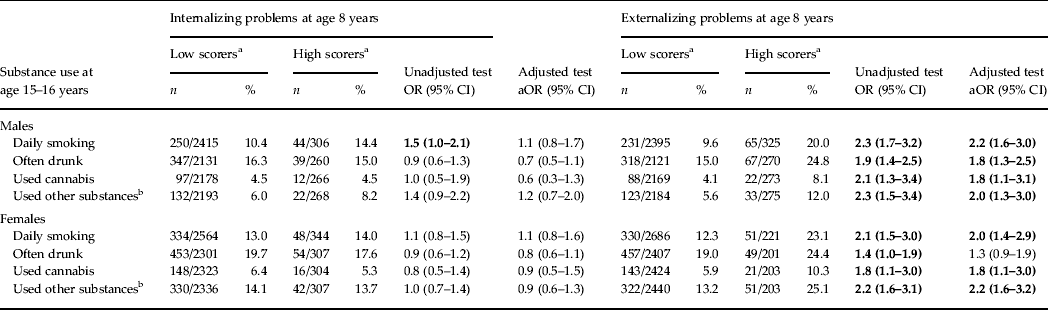
Among both males and females, externalizing problems were statistically significantly associated with all substance use variables, except being often drunk among females. Associations were strongest in daily smoking (males: adjusted OR 2.2, 95% CI 1.6–3.0; females: OR 2.0, 95% CI 1.4–2.9) and in ‘other substance’ use (males: OR 2.0, 95% CI 1.3–3.0; females: OR 2.2, 95% CI 1.6–3.2). These effects were at the same level or even stronger than those of the sociodemographic and other covariates (data available from the authors). In general, internalizing problems were not associated with substance use. Gender differences in ORs were not significant. These results are presented in Table 1.
Proportion of substance users at age 15–16 years by Rutter B2 externalizing and internalizing problems at the age of 8 years in the Northern Finland 1986 Birth Cohort by gender

OR, odds ratio; aOR, adjusted odds ratio; CI, confidence interval.
a Cut-offs (above the 90th percentile in either Rutter A2 (parents) or B2 (teachers) scales defined by gender.
b Includes medicines for intoxication, alcohol and pills together, sniffing thinner, glue or similar drugs for intoxication, and ecstasy, heroin, cocaine, amphetamine, LSD, etc.
Statistically significant differences (χ 2 tests, p < 0.05) are in bold.
Gender differences in ORs were not statistically significant.
Adolescent substance use and criminality by age 20 years
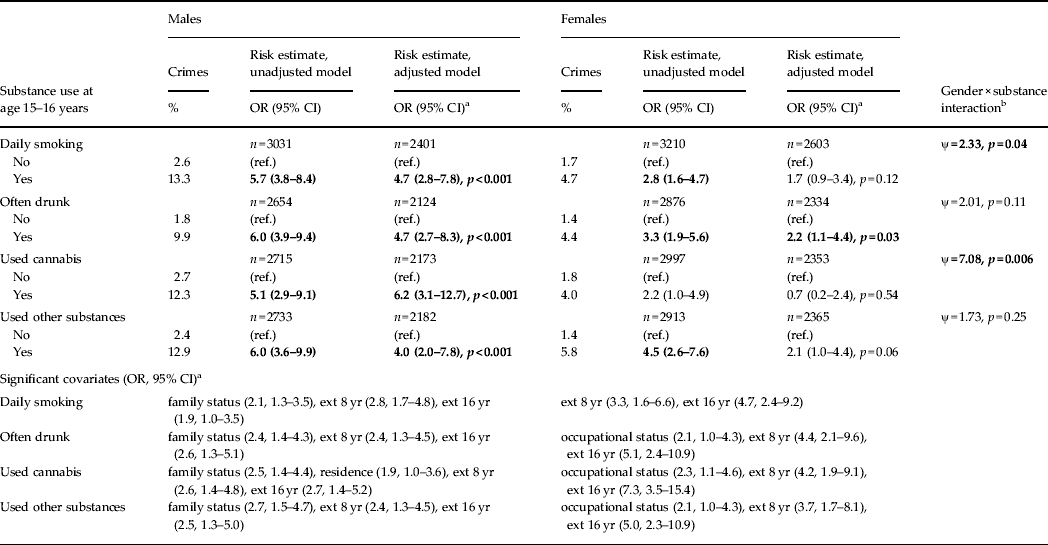
Among males, each measure of substance use had a statistically significant bivariate association with the risk of a criminal conviction in adjusted analyses. The ORs for males were about twice as high as those for females. Adjusting for socio-economic background, parental alcohol use and history of psychiatric disorders and previous externalizing and internalizing problems had little impact on this pattern of findings. Among males, experimentation with cannabis (OR 6.2, 95% CI 3.1–12.7) was the strongest predictor of criminal convictions. Among females, being often drunk predicted future crimes (OR 2.2, 95% CI 1.1–4.4), whereas other associations were non-significant. The gender × substance interaction term was significant in analyses of daily smoking (p = 0.04) and cannabis use (p = 0.006). Substance use had a relatively large effect for future crimes in males, in the adjusted model childhood and adolescence externalizing symptoms and family status also predicted crimes, but effect sizes were substantially smaller. Among females, externalizing symptoms had a strong effect. Table 2 shows these results in detail.
Association of adolescent substance use (age 15–16) with later violent crimes or offences against property (until age 20) in the Northern Finland 1986 Birth Cohort

OR, Odds ratio; CI, confidence interval; ref., reference.
a Included covariates: family pattern, place of residence, family occupational level, parental alcohol use, parental psychiatric disorder, externalizing and internalizing problems at childhood (ext/int 8 yr) and at adolescence (ext/int 16 yr).
Statistically significant differences (Wald χ 2 test, p < 0.05) are in bold.
b Coefficient ψ = OR11/(OR01 × OR10), where OR11 is the odds ratio if both male gender and substance use are present, OR01 and OR10 if only one of those risks is present. Coefficient ψ > 1 indicates an interaction larger than expected with multiplicative risks.
Adolescent substance use and substance-related crimes by age 20 years
In total, 182 (6.9%) males and 81 (2.8%) females reported substance-related crime during the follow-up. All of the substances studied were associated with statistically significant ORs for convictions relating to substance use (drunk driving and drug crimes). For males, the adjusted ORs were between 3.9 (95% CI 2.4–6.3) in other substances and 5.2 (95% CI 3.6–7.5) in being drunk. For females, lowest risk was with cannabis (OR 2.3, 95% CI 1.1–4.7) and the highest with daily smoking (OR 3.7, 95% CI 2.3–6.2) (further data available from the authors).
Adolescent substance use and internalizing problems by age 25 years
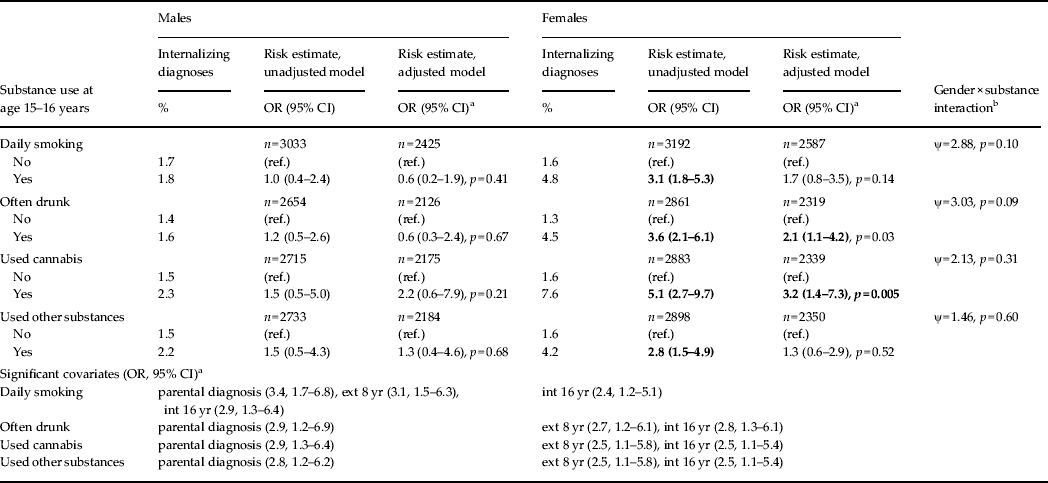
In a follow-up from age 15–16 until age 25, there were 116 individuals (53 males, 46%) with initial hospital diagnoses of internalizing disorders. The diagnoses included: 27 males and 41 females with affective disorders (ICD-10 F30–F39) and 36 males and 41 females with anxiety disorders (F40–F44). Twenty-nine individuals (10 males and 19 females) had both affective and anxiety diagnoses during the follow-up. Among males, there were no statistically significant associations between adolescent substance use and later hospitalization for internalizing problems. Among females, cannabis use (adjusted OR 3.2, 95% CI 1.4–7.3) and being drunk (OR 2.1, 95% CI 1.1–4.2) were significant risk factors for later internalizing disorder hospitalization. Of the females who had tried cannabis, 7.6% (13/171) and had hospital diagnoses for internalizing disorders in the follow-up, as did 1.6% (43/2710) of others. The gender × substance interaction was not statistically significant in these analyses. Among boys, parental diagnoses predicted internalizing disorders; and among girls, childhood externalizing and adolescence internalizing problems predicted internalizing disorders. The results for internalizing disorders in males and females are presented in Table 3.
Association of adolescent substance use (age 15–16) with later in-patient hospital diagnoses (until age 25) of internalizing disorders in the Northern Finland 1986 Birth Cohort

OR, odds ratio; CI, confidence interval; ref., reference.
a Included covariates: family pattern, place of residence, family occupational level, parental alcohol use, parental psychiatric disorder, externalizing and internalizing problems at childhood (ext/int 8 yr) and at adolescence (ext/int 16 yr).
Statistically significant differences (Wald χ 2 test, p < 0.05) are in bold.
b Coefficient ψ = OR11/(OR01 × OR10), where OR11 is the odds ratio if both male gender and substance use are present, OR01 and OR10 if only one of those risks is present. Coefficient ψ > 1 indicates the interaction is larger than expected with multiplicative risks.
Discussion
Main results
The current study yielded several important findings. Externalizing symptoms often precede and follow substance use; internalizing symptoms may follow the initiation of substance use, especially among females. Cannabis use was a risk factor for internalizing problems among females and for externalizing problems among males. Use of different substances both followed and predicted externalizing problems among both males and females; associations were stronger among males.
Childhood externalizing problems and adolescent substance use
Externalizing problems in childhood predicted adolescent cigarette smoking and use of ‘other substances’, which in our study were mainly solvents or medicines for intoxication. In other childhood studies illicit drugs and medicines for intoxication have also been associated with externalizing behavior (Gudjonsson et al. Reference Gudjonsson, Sigurdsson, Sigfusdottir and Young2012). We did not find an association between externalizing problems and cannabis use, and it can be noted that a previous study found that externalizing problems may predict cannabis use only indirectly through cigarette smoking (Korhonen et al. Reference Korhonen, van Leeuwen, Reijneveld, Ormel, Verhulst and Huizink2010). We found that childhood externalizing problems predicted adolescent drunkenness in boys with an analogous marginal effect in girls. In general, externalizing problems were relative good predictors for substance use, comparable with sociodemographic and other variables.
Adolescent substance use and subsequent criminality
Among males, all categories of substance use in adolescence were robustly associated with subsequent criminality. Among females, ORs were considerably lower. Risk estimates were similar for substance use-related and other crimes. A study by Hodgins et al. (Reference Hodgins, Larm, Molero-Samuleson, Tengström and Larsson2009) found elevated risks for multiple adverse outcomes such as mental illness and criminality among individuals who were treated for substance misuse as adolescents. In prisons samples, prior drug use has been linked with violence (Young et al. Reference Young, Wells and Gudjonsson2011). Two studies (Griffith-Lendering et al. Reference Griffith-Lendering, Huijbregts, Mooijaart, Vollebergh and Swaab2011; Marmorstein & Iacono, Reference Marmorstein and Iacono2011) found that, in adolescence, externalizing behaviors more often precede cannabis use than vice versa. In males, the effect of substance use on subsequent criminality was even larger than the effect of childhood and adolescent externalizing problems, whereas among females, previous externalizing problems were more important in explaining criminal outcome.
Internalizing problems in boys do not predict later substance use
We found that boys with early internalizing problems were not at later risk for substance use. Our findings are consistent with those of Monshouwer et al. (Reference Monshouwer, van Dorsselaer, Verdurmen, Bogt, de Graaf and Vollebergh2006) and Maggs et al. (Reference Maggs, Patrick and Feinstein2008). King et al. (Reference King, Iacono and McGue2004) found major depressive disorder at age 11 to predict substance use at age 14, although the effect was relatively modest. Taking these results together, we conclude that childhood internalizing problems in boys do not predict adolescent substance use or abuse. This might be explained by the fact that substance use experimentation often begins in adolescent groups, and those with internalizing problems often withdraw from these groups. Most previous studies have explored this topic with both genders combined; based on our results, gender differences should be further studied in other samples.
Substance use in adolescence and later internalizing disorder
We found that, in females, adolescent substance use predicted later hospitalization for internalizing problems. Some of these effects were no longer significant after adjustment, although there was a robust association between cannabis use and later internalizing problems. The effect sizes were fairly large, comparable to those of childhood externalizing and internalizing problems and larger than those of other covariates. Cannabis use as risk factor for depressive and anxious disorders and symptoms has been studied in a meta-analysis by Moore et al. (Reference Moore, Zammit, Lingford-Hughes, Barnes, Jones, Burke and Lewis2007), who concluded that the findings were inconsistent. In a review by Thornton et al. (Reference Thornton, Baker, Johnson and Lewin2012), in individuals with mental disorders, most frequently reported motives for cannabis use were social reasons, intoxication effects and dysphoria relief. We found that females who had used cannabis had higher rates of subsequent hospitalizations related to internalizing disorders, even after comprehensive adjustment for sociodemographic factors and for prospectively collected data on childhood externalizing and internalizing problems. In males, there were no associations between adolescent substance use and later internalizing disorders. A study of 1449 adolescents found no longitudinal associations between internalizing behavior and cannabis use, although genders were not studied separately (Griffith-Lendering et al. Reference Griffith-Lendering, Huijbregts, Mooijaart, Vollebergh and Swaab2011). There are also other factors that may partially explain associations between adolescent substance use and internalizing problems; for instance, childhood traumas and both psychological and physical abuse have been linked with later internalizing problems (Hovens et al. Reference Hovens, Giltay, Wiersma, Spinhoven, Penninx and Zitman2012).
Summary of associations between internalizing problems and substance use in males and females
Overall, we found that, in males, there were no longitudinal associations between substance use and internalizing disorders. In females, there were associations between internalizing disorders in childhood and frequency of being drunk in adolescence, and between cannabis use in adolescence and subsequent hospitalization for internalizing disorders. These findings reinforce the importance of studying differences between males and females with interaction terms or studying genders separately in this research area.
Strengths of the study
As far as we know, this is the largest study in which associations between substance use and general mental health have been studied in a general population-based sample of adolescents prospectively. The participants are all born during 1 year, which eliminates confounding due to age, and the population-based nature of the sample reduces the likelihood of selection bias. We were also able to adjust for several potential confounders and study externalizing and internalizing problems longitudinally, with children at age 8 years (before initiation of substance use) rated by parents and teachers, and adolescents rating themselves at age of 15–16 years, and assessments made with the use of the nationwide register for all psychiatric hospital treatments until the age of 25 and crimes until the age of 20. Unlike previous studies we used nationwide registers and hence there was no notable attrition between measurement of substance use and subsequent hospitalizations/crimes. The participants were all white European, so ethnicity did not affect the findings.
Limitations of the study
One limitation of the study is that we had no information on children between ages 8 and 15, and that we had only one measurement for substance use. Some of the previous studies had more frequent follow-ups, although with smaller sample sizes (Brook et al. Reference Brook, Brook, Zhang, Cohen and Whiteman2002; Wittchen et al. Reference Wittchen, Fröhlich, Behrendt, Günther, Rehm, Zimmermann, Lieb and Perkonigg2007; Colder et al. Reference Colder, Scalco, Trucco, Read, Lengua, Wieczorek and Hawk2013). This limitation should be recognized when interpreting putative causal relationships between externalizing/internalizing problems and substance use. Although the temporal order of follow-ups is clear, the findings of the study are not necessarily causal but can be explained, for example, by the same risk factors (e.g. genetic predisposition) for substance use and externalizing/internalizing problems. We had a fairly large number of non-participants; however in additional analyses we weighted the data based on data available from non-participants, which revealed that the attrition was unlikely to affect our results. The information on substance use was based on self-reports, which may underestimate the use of substances. We concede the limitation that our early adulthood outcome measures represent only ‘the tip of the iceberg’ of young adult mental disorder, as most depressive and neurotic mental disorders are treated outside of hospital, and most externalizing problems are not recorded on criminal registers. In our study, the proportions of cannabis and other illicit drug users were relatively low, so the results on these analyses may be less robust than those of the other substances studied.
Clinical implications
Some former studies suggest that adolescent substance misuse is preceded by both externalizing and internalizing problems. In the present study, externalizing problems both preceded and followed substance use. There were sex differences in associations between substance use and the mental health problems studied. In females, childhood internalizing problems predicted adolescent alcohol use, and cannabis use predicted severe internalizing disorders (hospitalizations). In males, there were no longitudinal relationships between internalizing problems and substance use.
For clinicians planning interventions in substance use either at the individual subject level or at the population level, these clarifications of the possible causality behind substance use and mental illness associations may be useful. Our data support arguments for early prevention of externalizing problems to prevent later violence and criminality, and externalizing problems were found to be relatively strong predictors. School-based individually tailored interventions have been shown to be effective in reducing aggressive behavior in children with externalizing problems; it is possible that such interventions will reduce long-term criminality, but further research is required to demonstrate this definitively (Stoltz et al. Reference Stoltz, van Londen, Dekovic, de Castro, Prinzie and Lochman2012). Our data are also relevant for clinical decision making at the individual subject level: in adolescents with difficult behavior and substance use, it may be very tempting to blame the drugs whereas in fact the drug use may be a current manifestation of long-standing externalizing problems.
Acknowledgments
This study was funded by the Academy of Finland (project grants 1 047 81, 1 203 15, 125 853, 268 336, 214 273, 1 114 194, 24 300 796, Center of Excellence in Complex Disease Genetics and SALVE. NHLBI grant 5R01HL087679-02 through the STAMPEED program (1RL1MH083268-01), ENGAGE project and grant agreement HEALTH-F4-2007-201413, EU FP7 EurHEALTHAgeing-277849). NARSAD: The Brain and Behavior Research Fund (Dr Mortimer D. Sackler Developmental Psychobiology Research Program), the Jalmari and Rauha Ahokas Foundation, the Signe and Ane Gyllenberg Foundation, the Thule Institute, University Hospital Oulu, Finland, University of Oulu, the European Commission (EURO-BLCS, Framework 5 award QLG1-CT-2000-01643), the Sigrid Jusélius Foundation, the UK Medical Research Council (G0500539, G0600705, G1002319, PrevMetSyn/SALVE), the Northern Finland Health Care Support Foundation, and the US National Institutes of Health (NIMH) (5R01MH63706:02). The funders had no role in the design or conduct of the study.
Declaration of Interest
None.