Introduction
Attention deficit hyperactivity disorder (ADHD) is a disorder characterized by developmentally inappropriate and impairing levels of inattention, hyperactivity and impulsivity. Follow-up studies of children with ADHD into adolescence and early adulthood show a substantial degree of continuity across time (Barkley et al. Reference Barkley, Murphy and Mariellen2008; Biederman et al. Reference Biederman, Petty, Evans, Small and Faraone2010a, Reference Biederman, Petty, Monuteaux, Fried, Byrne, Mirto, Spencer, Wilens and Faraoneb), with around 65% of children with ADHD retaining the full syndrome or in partial remission by the age of 25 years (Faraone et al. Reference Faraone, Biederman and Mick2006). Despite an increased interest in the developmental continuity of ADHD (Wilens et al. Reference Wilens, Faraone and Biederman2004), knowledge on the role of genetic and environmental influences on the two DSM-IV ADHD symptom dimensions (i.e. inattention and hyperactivity–impulsivity) in adulthood is still limited.
Family studies have shown that children of adults with ADHD are at increased risk of having ADHD compared to control groups (Biederman et al. Reference Biederman, Faraone, Mick, Spencer, Wilens, Kiely, Guite, Ablon, Reed and Warburton1995; Faraone et al. Reference Faraone, Biederman and Monuteaux2000). Two large-scale twin studies of adult ADHD symptoms recently estimated the heritability using self-ratings of the Conners' Adult ADHD Rating Scales (CAARS; Boomsma et al. Reference Boomsma, Saviouk, Hottenga, Distel, de Moor, Vink, Geels, van Beek, Bartels, de Geus and Willemsen2010; Saviouk et al. Reference Saviouk, Hottenga, Slagboom, Distel, de Geus, Willemsen and Boomsma2011). The heritability was estimated at 30% for total ADHD symptom load (Boomsma et al. Reference Boomsma, Saviouk, Hottenga, Distel, de Moor, Vink, Geels, van Beek, Bartels, de Geus and Willemsen2010), 35% for inattention and 23% for hyperactivity (Saviouk et al. Reference Saviouk, Hottenga, Slagboom, Distel, de Geus, Willemsen and Boomsma2011). These results are largely consistent with a previous twin study of a sample of adults (aged 18–30) that estimated the heritability of self-reported attention problems as 40% (van den Berg et al. Reference van den Berg, Willemsen, de Geus and Boomsma2006). Heritability estimates in the range 30–40% have generally been reported in other studies using self-reported ADHD symptoms: in a study of adolescent twins and their siblings aged 12–19 years (Ehringer et al. Reference Ehringer, Rhee, Young, Corley and Hewitt2006), and in two adult twin studies of retrospectively recalled childhood ADHD symptoms (Schultz et al. Reference Schultz, Rabi, Faraone, Kremen and Lyons2006; Haberstick et al. Reference Haberstick, Timberlake, Hopfer, Lessem, Ehringer and Hewitt2008), with one small twin study (286 adolescent twin pairs; Martin et al. Reference Martin, Scourfield and McGuffin2002) estimating the heritability of ADHD as zero using the Strength and Difficulties Questionnaire (SDQ) hyperactivity subscale (Goodman, Reference Goodman1997). By contrast, twin studies of ADHD among children and adolescents, rated by parents or teachers, have been highly consistent in showing strong genetic influences, with heritability estimates around 60–90% (Faraone et al. Reference Faraone, Perlis, Doyle, Smoller, Goralnick, Holmgren and Sklar2005; Burt, Reference Burt2009). The available literature therefore suggests that ADHD self-ratings yield lower heritability estimates than do parent and teacher ratings.
Twin studies of adult ADHD symptoms have additionally shown that self-ratings have moderate to high reliability (around 0.66), that the heritability is similar across gender and is stable from early (average age 20 years) to late adulthood (average age 55 years), and also that the stability of self-rated symptoms is largely due to genetic factors (van den Berg et al. Reference van den Berg, Willemsen, de Geus and Boomsma2006; Boomsma et al. Reference Boomsma, Saviouk, Hottenga, Distel, de Moor, Vink, Geels, van Beek, Bartels, de Geus and Willemsen2010). Less is known about the genetic and environmental overlap between inattention and hyperactivity–impulsivity. Childhood and adolescent studies suggest a strong genetic overlap between symptoms of inattention and hyperactivity–impulsivity (Larsson et al. Reference Larsson, Lichtenstein and Larsson2006; Schultz et al. Reference Schultz, Rabi, Faraone, Kremen and Lyons2006; McLoughlin et al. Reference McLoughlin, Ronald, Kuntsi, Asherson and Plomin2007; Haberstick et al. Reference Haberstick, Timberlake, Hopfer, Lessem, Ehringer and Hewitt2008) but this has not been studied for ADHD symptoms in adults.
In this study we used self-ratings from more than 15 000 adult twins from the national Swedish Twin Registry to examine the genetic and environmental contribution to the variation within inattention and hyperactivity–impulsivity and to the covariation between these two components of DSM-IV ADHD. We also studied the role of sex differences in the genetic and environmental effects. In addition, because results from a recent meta-analysis suggest that the magnitude of the non-shared environmental component underlying hyperactivity–impulsivity increases from childhood to adolescence (Nikolas & Burt, Reference Nikolas and Burt2010), we explored the impact of age on the genetic and environmental contribution.
Method
Sample
A sample of 42 582 Swedish twins was recruited from the population-representative Swedish Twin Registry. The inclusion criteria were all twin pairs born in Sweden between 1959 and 1985 where both individuals survived their first birthday. Of this target sample, 25 321 (59.5%) individuals took part in the Swedish Twin study of Adults: Genes and Environment (STAGE; Lichtenstein et al. Reference Lichtenstein, Sullivan, Cnattingius, Gatz, Johansson, Carlstrom, Bjork, Svartengren, Wolk, Klareskog, de Faire, Schalling, Palmgren and Pedersen2006). Twins were sent a letter inviting them to participate in the study and were given a personal login to the study web page. Non-responders were approached with up to three reminders. Twins could also choose to complete the questionnaire by telephone with a trained interviewer using a computer-based data collection method, supplemented with a self-administered paper questionnaire for sensitive topics. As all of the twins were born in Sweden, none of them were first-generation immigrants. Of the participants in STAGE, 64% were married or living with their partner, 5% had a stable relationship without living together, 27% were single, and 4% were separated, divorced, widowed or did not indicate their status. Furthermore, 5% had completed or attended elementary school, 41% high school, 12% vocational education, military college or other, and 42% college or university as their highest academic degree (Furberg et al. Reference Furberg, Lichtenstein, Pedersen, Thornton, Bulik, Lerman and Sullivan2008), which is consistent with the total Swedish population (Statistics Sweden, 2011).
The majority of our responders (72%, n = 18 327) chose to answer over the web, 12% (n = 2946) completed the telephone interview and also sent in the paper questionnaire, and 16% (n = 4105) completed the telephone interview but did not return the paper questionnaire. As the DSM-IV items were included in the paper questionnaire, we had to exclude those who only undertook the telephone interview. Although we cannot rule out the possibility that this subsample differed from the full sample of twins, lack of response to the ADHD symptom assessment seemed to be due mainly to the survey design and a general unwillingness to participate in this rather lengthy survey (Frisell et al. Reference Frisell, Lichtenstein, Rahman and Langstrom2010). The response rate for the ADHD symptom assessments of STAGE was 72% (n = 18 316), of whom 40% (n = 7366) were men and 60% (n = 10 950) were women. Participants were between 20 and 46 years old (mean = 33.7, s.d. = 7.7) at the time of assessment. It was not possible to assign zygosity with certainty to 3112 twins, resulting in a sample of 15 198 twins with known zygosity. Individuals (n = 4170) from incomplete twin pairs and individuals (n = 11 028) from complete twin pairs were included in the twin analyses resulting in 2091 monozygotic male (MZM) twins, 1437 dizygotic male (DZM) twins, 3660 MZ female (MZF) twins, 2483 DZ female (DZF) twins and 5527 DZ opposite-sex (DZOS) twins. Zygosity was established using standard physical similarity questions that have been validated previously through genotyping (Lichtenstein et al. Reference Lichtenstein, Sullivan, Cnattingius, Gatz, Johansson, Carlstrom, Bjork, Svartengren, Wolk, Klareskog, de Faire, Schalling, Palmgren and Pedersen2006).
The project has been reviewed and approved by the regional ethics committee of the Karolinska Institutet. All subjects provided informed consent electronically during the web-based survey or orally during the telephone interview.
Measures
Adult ADHD symptoms were assessed by using a self-report questionnaire containing the 18 DSM-IV symptoms, consisting of nine inattentive, six hyperactive and three impulsive items. Each item had a three-point answer format (0 = ‘no’, 1 = ‘yes, to some extent’ and 2 = ‘yes’). The 18 DSM-IV items, which were slightly modified to fit adults and also expressed to assess current ADHD symptoms, are presented in the online Appendix (Table A1). As expected from a general population sample, many individuals reported having no ADHD problems. The symptoms were summed to create two scales of inattention and hyperactivity–impulsivity. The distribution of the two sum scores (range 0–18) is shown in the online Appendix (Fig. A1). About one-third of the twins reported no inattention (32.74%) or hyperactivity–impulsivity symptoms (32.30%). Values for the reliabilities of the inattention and hyperactivity–impulsivity scales were α = 0.79 and α = 0.77 respectively. The two scales were positively skewed (skewness: inattention, 2.70; hyperactivity–impulsivity, 2.80) and were therefore independently transformed [log 10(x + 1)] before analyses to increase the normality of their distributions (skewness: inattention, 0.33; hyperactivity–impulsivity, 0.34). We conducted sensitivity analyses by excluding extreme values (i.e. 4 standard deviations from the mean) in the inattention and hyperactivity–impulsivity scales and by applying threshold models to predict inattention and hyperactivity–impulsivity categories (i.e. cut-off imposed at 2.0 and 1.0 standard deviations above the mean of the scales). Similar results were obtained, suggesting that bias due to non-normal scales is of limited importance (data not shown).
A subset of 54 twins in STAGE was assessed again with the World Health Organization (WHO) Adult ADHD Self-report Scale (ASRS; Kessler et al. Reference Kessler, Adler, Barkley, Biederman, Conners, Demler, Faraone, Greenhill, Howes, Secnik, Spencer, Ustun, Walters and Zaslavsky2006) after a minimum 18-month follow-up period (mean follow-up time = 28.06 months, s.d. = 4.16, range 18–35). The ASRS includes 18 questions about the frequency of recent DSM-IV Criterion A symptoms of adult ADHD. The correlation between the total score of the initial STAGE ADHD measure (sum score of the 18 DSM-IV symptoms) and the total ASRS score at follow-up (sum score of the 18 ASRS items) was estimated as 0.63 (p < 0.0001). This relatively high stability coefficient corresponds to the results reported in other longitudinal studies of self-reported ADHD symptoms in adults (van den Berg et al. Reference van den Berg, Willemsen, de Geus and Boomsma2006; Boomsma et al. Reference Boomsma, Saviouk, Hottenga, Distel, de Moor, Vink, Geels, van Beek, Bartels, de Geus and Willemsen2010) and parent-reported ADHD symptoms in children (Larsson et al. Reference Larsson, Larsson and Lichtenstein2004; Rietveld et al. Reference Rietveld, Hudziak, Bartels, van Beijsterveldt and Boomsma2004; Kuntsi et al. Reference Kuntsi, Rijsdijk, Ronald, Asherson and Plomin2005).
Statistical analyses
Mean differences across sex and age intervals were estimated using linear mixed effect models in SAS version 9.2 (SAS Institute Inc., USA), which allowed us to account for the dependent nature of the twin observations.
The twin method is a natural experiment that relies on the different levels of genetic relatedness between MZ and DZ twins. MZ twins are almost genetically identical whereas DZ twins share on average 50% of the polymorphic genetic variation. We used the twin method to decompose the variance of each phenotype and also the covariation between phenotypes into additive genetic factors (A) reflecting additive effects of different alleles, non-additive genetic factors (dominance, D) reflecting interaction effects between alleles at the same gene locus, and non-shared environmental factors (E) reflecting experiences that make sibling pairs dissimilar (Plomin et al. Reference Plomin, DeFries, McClearn and McGuffin2008).
Twin correlations (i.e. within-twin pair maximum likelihood correlations) were used for an initial examination of the relative contributions of A, D and E. Specifically, MZ correlations higher than DZ correlations indicate A whereas E is indicated by the extent to which MZ correlations are <1. DZ correlations lower than half the MZ correlations suggest D or sibling interaction effects (usually labeled ‘s’). Sibling interaction effects and D effects can be distinguished by making use of the fact that sibling interaction effects lead to differences in variances in MZ and DZ twins but non-additive genetic effects do not. Thus, lack of significant variance differences between MZ and DZ twins suggests that the presence of sibling interaction effects is not plausible.
We used the structural equation modeling program Mx (Neale et al. Reference Neale, Boker, Xie and Maes2003) to perform univariate and bivariate model-fitting analyses by the method of raw maximum likelihood estimation. This method allows the inclusion of singletons, where information from only one twin in a pair is available. In the univariate and bivariate model-fitting analyses, the following combinations of variance components were considered: ADE, AE, ADEs and AEs. Three sex-limitation models were fitted to the data. The full sex-limitation model allows for qualitative differences (i.e. sex-specific genetic parameters) and quantitative differences (i.e. differences in the magnitudes of the genetic and environmental parameters across sex) (Neale et al. Reference Neale, Roysamb and Jacobson2006). The common effects sex-limitation model allows quantitative sex differences between males and females, but no qualitative differences. Finally, the null model equates all genetic and environmental parameter estimates for males and females, testing the hypothesis that there are no sex differences.
The bivariate model estimates the additive genetic (r a), dominance genetic (r d) and non-shared (r e) environmental correlations, which vary from −1.0 to +1.0 and indicate the extent to which genetic and environmental influences in one phenotype overlap with those of another phenotype.
Goodness of fit for the different twin models was assessed by a likelihood-ratio χ2 test. Akaike's Information Criterion (AIC = χ2 – 2 df) was also computed; a lower AIC value indicates better fit of the model to the observed data.
Results
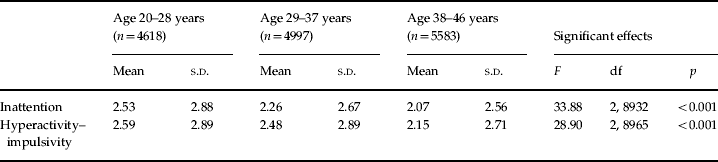
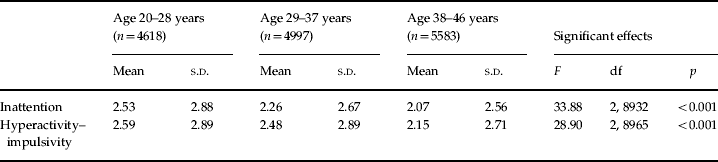
Inattention scores were significantly lower in females than in males (F 1,8716 = 16.28, p < 0.001) whereas hyperactivity–impulsivity scores were similar across gender (F 1,871 = 0.84, p = 0.36). Inattention (F 2,8932 = 33.88, p < 0.001) and hyperactivity–impulsivity (F 2,8965 = 28.90, p < 0.001) were significantly associated with age. Age-stratified means and standard deviations for the non-transformed inattention and hyperactivity–impulsivity scales are presented in Table 1, which shows that, for both scales, mean symptom scores decreased with age.
Means and standard deviations (s.d.) for inattention and hyperactivity–impulsivity symptoms scales, by age group
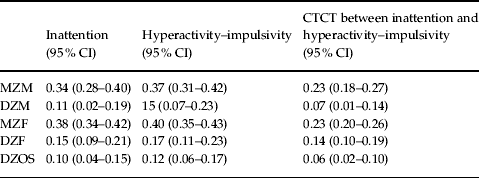
The twin correlations of inattention and hyperactivity–impulsivity scores suggest significant additive and non-additive genetic influences for both inattention and hyperactivity–impulsivity because DZ correlations tended to be half or less than half of the MZ correlations for both sexes (Table 2). All MZ correlations were <1, suggesting non-shared environmental influences (including measurement error) for both inattention and hyperactivity–impulsivity.
Twin correlations and cross-twin cross-trait (CTCT) correlations for inattention and hyperactivity–impulsivity symptoms scales in 15 198 twins (5514 complete twin pairs)
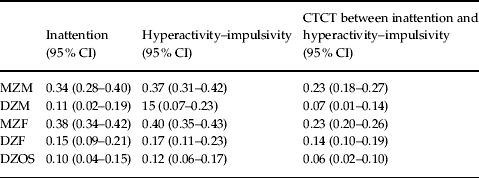
MZM, Monozygotic male; DZM, dizygotic male; MZF, MZ female; DZF, DZ female; DZOS, DZ opposite-sex; CI, confidence interval.
The MZ and DZ cross-trait cross-twin (CTCT) correlations (one twin's score on inattention correlated with their co-twin's score on hyperactivity–impulsivity score) are also presented in Table 2. MZ CTCT correlations were higher than DZ CTCT correlations, suggesting genetic influences for the overlap between inattention and hyperactivity–impulsivity. Non-shared environmental influences were also evident because MZ CTCT correlations were almost half the phenotypic correlation (i.e. <1).
Twin and CTCT correlations were similar for males and females, which suggests no quantitative genetic and environmental differences for the variation within inattention and hyperactivity–impulsivity, and also for the covariation between these two components of ADHD. In addition, both intra-class and CTCT correlations were similar for same-sexed DZ and DZOS twins, suggesting no qualitative sex differences.
The potential importance of sibling interaction effects was tested by examining variance differences between MZ and DZ twins. We observed no statistically significant birth order, sex or zygosity effect on the variances of inattention and hyperactivity–impulsivity. Thus, for inattention (Δχ2 = 4.84, df = 9, p = 0.85) and hyperactivity–impulsivity (Δχ2 = 4.19, df = 9, p = 0.90), variances could be equated across sex and zygosity without a significant decrease in fit.
Univariate and bivariate model fitting
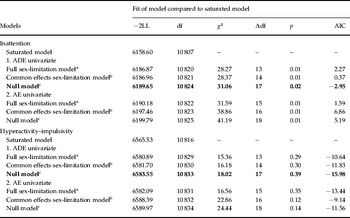
As expected from the magnitude of the difference between MZ and DZ correlations (Table 2) and the lack of significant variance differences across zygosity groups, the univariate ADEs (where ‘s’ is the sibling interaction term) models provided a poor fit to the data compared to ADE models (data not shown). Table 3 displays the model-fitting results of ADE and AE sex-limitation models for inattention and hyperactivity–impulsivity and shows that the ADE models without sex differences (the null model) provided the best fit to the data. For inattention, the additive genetic, dominant genetic and non-shared environmental factors explained 11% [95% confidence interval (CI) 6–17], 25% (95% CI 10–31) and 63% (95% CI 60–67) of the variance respectively. The corresponding estimates for hyperactivity–impulsivity were 18% (A; 95% CI 4–33), 20% (D; 95% CI 5–35) and 62% (E; 95% CI 58–65). Thus, the broad-sense heritability (A + D) was 36% for inattention and 38% for hyperactivity–impulsivity. We also refitted the ADE and AE sex-limitation models but now using an ADHD total score (sum score of all 18 DSM-IV symptoms). The best-fitting model (i.e. ADE model without sex differences) suggested that the additive genetic, dominant genetic and non-shared environmental factors explained 20% (95% CI 6–34), 22% (95% CI 6–37) and 58% (95% CI 57–62) of the variance respectively.
Model-fitting results of univariate analysis of inattention and hyperactivity–impulsivity

LL, Log likelihood; df, degrees of freedom; AIC, Akaike's Information Criterion.
a The full sex-limitation model allows quantitative and qualitative differences in the parameter estimates between males and females.
b The common effects sex-limitation model allows quantitative sex differences between males and females but no qualitative differences.
c The null model equates all genetic and environmental parameter estimates for males and females, testing the hypothesis that there are no sex differences.
Best-fitting models indicated in bold.
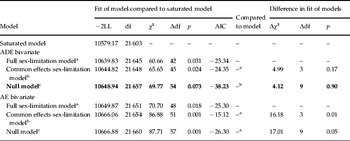
Table 4 displays the model-fitting results for the ADE and AE bivariate sex-limitation models. As can be seen from the AIC values, the full ADE model without sex differences (the null model) provided the best fit to the data, indicating that the genetic and environmental contribution to the variation within inattention and hyperactivity–impulsivity and to the covariation between these two components of ADHD could be estimated to be the same in both sexes.
Bivariate model-fitting results of inattention and hyperactivity/impulsivity symptoms

LL, Log likelihood; df, degrees of freedom; AIC, Akaike's Information Criterion.
a The full sex-limitation model allows quantitative and qualitative differences in the parameter estimates between males and females.
b The common effects sex-limitation model allows quantitative sex differences between males and females but no qualitative differences.
c The null model equates all genetic and environmental parameter estimates for males and females, testing the hypothesis that there are no sex differences.
Best-fitting model indicated in bold.
Table 5 provides parameter estimates for the additive genetic, dominant genetic and non-shared environmental influences for the overlap between inattention and hyperactivity–impulsivity. The additive genetic correlation was estimated at 1.00 (95% CI 0.39–1.00), suggesting a substantial genetic overlap between inattention and hyperactivity–impulsivity. The dominant genetic (0.37, 95% CI 0.12–0.71) and non-shared environmental correlations (0.33, 95% CI 0.30–0.36) were also significant but substantially lower. Table 5 also indicates that the phenotypic correlation between inattention and hyperactivity–impulsivity (r = 0.43, 95% CI 0.42–0.44) was explained by additive genetic (33%, 95% CI 8–47), dominant genetic (19%, 95% CI 3–50) and non-shared environmental (48%, 95% CI 43–52) influences. Thus, 52% (95% CI 48–57) of the phenotypic covariance was explained by broad-sense genetic influences (bivariate a2 + bivariate d2).
Parameter estimates (95% CI) from the best-fitting bivariate model

CI, Confidence interval; r a, additive genetic correlation; r d, dominance genetic correlation; r e, non-shared environmental correlation; a2, proportion of phenotypic correlation due to genetic effects; d2, proportion of phenotypic correlation due to dominance genetic effects; e2, proportion of phenotypic correlation due to non-shared environmental effects.
Follow-up analyses
First, age-stratified model-fitting results revealed similar estimates of broad heritability (A + D) for inattention and hyperactivity–impulsivity across age. To maximize power in the analyses of age-dependent genetic and environmental influences, we compared the CIs around the age-stratified non-shared environmental estimates. The results suggest similar non-shared environmental (E) estimates for inattention (age 20–28 years: E = 0.61, 95% CI 0.56–0.64; age 29–37 years: E = 0.62, 95% CI 0.57–0.67; age 38–46 years: E = 0.68, 95% CI 0.62–0.74) and hyperactivity–impulsivity (age 20–28 years: E = 0.58, 95% CI 0.56–0.64; age 29–37 years: E = 0.63, 95% CI 0.58–0.68; age 38–46 years: E = 65, 95% CI 0.59–0.70). Thus, the non-shared environmental contribution to inattention and hyperactivity–impulsivity symptoms did not increase as a function of age, and therefore the proportion of the variance explained by genetic influences also remains stable across the different age groups.
Second, given that hyperactivity (measured by the six DSM-IV symptoms of ADHD) and impulsivity (measured by the three DSM-IV symptoms of ADHD) may represent separate components of ADHD (Sandra Kooij et al. Reference Sandra Kooij, Marije Boonstra, Swinkels, Bekker, de Noord and Buitelaar2008), we also applied a trivariate Cholesky model to allow for potential differences in the genetic and environmental contribution underlying these two symptom components. These analyses showed that broad heritability estimates for hyperactivity (0.36) and impulsivity (0.31) were similar to the corresponding estimate of hyperactivity–impulsivity (0.38). Thus, we do not find evidence for differences in the magnitude of the heritability underlying hyperactive and impulsivity, suggesting that the main results of this study are robust across both the two- and three-component definitions of ADHD.
Discussion
In accordance with studies using current or retrospective self-rated measures of ADHD symptoms from childhood or adolescence (Ehringer et al. Reference Ehringer, Rhee, Young, Corley and Hewitt2006; Schultz et al. Reference Schultz, Rabi, Faraone, Kremen and Lyons2006; Haberstick et al. Reference Haberstick, Timberlake, Hopfer, Lessem, Ehringer and Hewitt2008), we found a moderate broad heritability of ADHD symptoms in adults. There was no evidence for sex differences in the genetic and environmental effects underlying the two DSM-IV symptom dimensions of ADHD. Overall, we conclude that although self-ratings in adults give lower heritabilities than those derived from parent and teacher reports of ADHD symptoms in children, the overall pattern of the variance components in relation to age and the degree of shared genetic effects between the two symptom domains of inattention and hyperactivity–impulsivity are similar to previous studies of ADHD symptoms in children and adolescents.
The finding that self-rated symptoms of inattention and hyperactivity–impulsivity in adulthood are moderately heritable is in line with results from three adult twin studies of self-reported ADHD symptoms/attention problems (van den Berg et al. Reference van den Berg, Willemsen, de Geus and Boomsma2006; Boomsma et al. Reference Boomsma, Saviouk, Hottenga, Distel, de Moor, Vink, Geels, van Beek, Bartels, de Geus and Willemsen2010; Saviouk et al. Reference Saviouk, Hottenga, Slagboom, Distel, de Geus, Willemsen and Boomsma2011), an adolescent twin study of self-reported ADHD symptoms (Ehringer et al. Reference Ehringer, Rhee, Young, Corley and Hewitt2006) and two twin studies of retrospectively self-reported childhood ADHD symptoms (Schultz et al. Reference Schultz, Rabi, Faraone, Kremen and Lyons2006; Haberstick et al. Reference Haberstick, Timberlake, Hopfer, Lessem, Ehringer and Hewitt2008). Our data also indicate that a large proportion of the broad heritability is due to genetic dominance, which is consistent with previous childhood twin studies of ADHD (Burt, Reference Burt2009) but in contrast to the above-mentioned studies. Prior research indicates that the balance between additive and dominant genetic effects for ADHD might differ as a function of age and informants (Rietveld et al. Reference Rietveld, Hudziak, Bartels, van Beijsterveldt and Boomsma2003). However, age- and/or informant-dependent differences do not provide a good explanation for the difference between our study and the previous studies of ADHD symptoms in adults (van den Berg et al. Reference van den Berg, Willemsen, de Geus and Boomsma2006; Boomsma et al. Reference Boomsma, Saviouk, Hottenga, Distel, de Moor, Vink, Geels, van Beek, Bartels, de Geus and Willemsen2010) because all the studies were based on self-ratings and the age distributions of the different samples were similar. Several twin studies have explored the influence of different ADHD rating scales on the genetic and environmental estimates (Freitag et al. Reference Freitag, Rohde, Lempp and Romanos2010). For example, a twin study found evidence for dominant genetic effects when ADHD was assessed using the DuPaul Rating Scale but not when the Rutter A Scale was used (Thapar et al. Reference Thapar, Harrington, Ross and McGuffin2000). We therefore suggest that the observed difference in the proportion of dominant genetic effects might be explained by the use of different measures to assess ADHD. Future studies should therefore consider these differences in the selection of rating scales for the investigation of genetic effects on ADHD in adults.
Our results regarding the etiology of the covariation between inattention and hyperactivity–impulsivity suggest a substantial genetic overlap between the two symptom dimensions of ADHD, with some unique genetic effects on each dimension. In line with several earlier twin studies using parent ratings of childhood ADHD symptoms (Larsson et al. Reference Larsson, Lichtenstein and Larsson2006; McLoughlin et al. Reference McLoughlin, Ronald, Kuntsi, Asherson and Plomin2007), we report a strong additive genetic correlation (1.00) for inattention and hyperactivity–impulsivity. The dominant genetic correlation was substantially lower, indicating that the genetic overlap between inattention and hyperactivity–impulsivity is mainly due to additive genetic effects. Together, our results suggest that future molecular genetic studies of ADHD in adults (and in children) should expect both ‘dimension-general’ and ‘dimension-specific’ genetic risk markers.
We further extended previous studies of ADHD in adults by investigating potential genetic and environmental sex differences for adult DSM-IV ADHD symptom dimensions. Sex effects are difficult to study because their reliable detection requires large samples, which might explain why childhood studies have produced mixed results, with evidence both for (Rhee et al. Reference Rhee, Waldman, Hay and Levy1999) and against (Hudziak et al. Reference Hudziak, Derks, Althoff, Rettew and Boomsma2005) sex differences underlying the etiology of ADHD. We found no significant sex differences in the genetic and environmental factors for inattention and hyperactivity–impulsivity, a result that is congruent with the two prior twin studies of adult ADHD symptoms/attention problems (van den Berg et al. Reference van den Berg, Willemsen, de Geus and Boomsma2006; Boomsma et al. Reference Boomsma, Saviouk, Hottenga, Distel, de Moor, Vink, Geels, van Beek, Bartels, de Geus and Willemsen2010). Thus, the same genetic effects are operating in men and women.
Limitations
This study of self-reported DSM-IV ADHD symptoms from more than 15 000 adult twins from the national Swedish Twin Registry should be interpreted in the context of two main limitations. First, the response rate of the STAGE questionnaire was relatively low (59.5%), partly because of its length. Non-participants of STAGE were more likely than participants to be male, less educated, have at least one parent born outside of Sweden, to have been convicted of any type of crime and diagnosed with a psychiatric disorder (Furberg et al. Reference Furberg, Lichtenstein, Pedersen, Thornton, Bulik, Lerman and Sullivan2008). We also compared the ADHD symptom scores of complete and incomplete twin pairs because they provide an indication of the extent to which missing values are non-random. Hyperactivity–impulsivity scores were significantly higher in incomplete pairs than in complete pairs (p < 0.01) whereas no significant difference was observed for inattention scores (p = 0.10). Thus it is possible that the variations in ADHD symptoms at the extremes are truncated. Importantly, we have previously reported that twins in STAGE with high ADHD scores are at increased risk for co-morbid psychiatric disorders and stressful life events. Previous childhood studies (Levy et al. Reference Levy, Hay, McStephen, Wood and Waldman1997) have suggested that the genetic and environmental etiology of ADHD scores at the extreme end is no different from the etiology of scores across the normal range. However, because non-responders might have higher levels of behavioral problems, our results may not be generalizable to the most extreme ADHD cases.
Second, although some studies have shown that DSM-IV-based self-report questionnaires are reliable sources of information when making the diagnosis of ADHD in adults (Murphy & Schachar, Reference Murphy and Schachar2000; Adler et al. Reference Adler, Spencer, Faraone, Kessler, Howes, Biederman and Secnik2006; Sandra Kooij et al. Reference Sandra Kooij, Marije Boonstra, Swinkels, Bekker, de Noord and Buitelaar2008), others highlight the importance of using multiple informants (Barkley et al. Reference Barkley, Fischer, Smallish and Fletcher2002). In addition, confirmatory factor analyses of the 18 DSM-IV symptoms indicate that hyperactivity and impulsivity may represent separate dimensions of ADHD in adults (Sandra Kooij et al. Reference Sandra Kooij, Marije Boonstra, Swinkels, Bekker, de Noord and Buitelaar2008). However, our results suggest that heritability estimates for hyperactivity and impulsivity were similar to those of the collapsed hyperactivity–impulsivity scale. In addition, we did not have information regarding impairment caused by ADHD symptoms in different settings such as social or occupational environments. Moreover, information regarding age of onset of ADHD was not available. Hence, our results may not be extrapolated directly to clinical settings.
Conclusions
Overall, our findings are consistent with the previous but limited literature on self-rated ADHD symptoms in older children and adolescents, and retrospective and current reports of self-rated childhood ADHD by adults. Our data suggest a clear discrepancy in the estimated heritability rates between self and informant ratings. However, because there are no published informant data on adult twins and no studies that investigate the continuity of genetic influences from adolescence into adulthood, we are unable to determine whether our data indicate a true fall in the magnitude of genetic influences on ADHD in adults compared to children, or whether this relates to the use of self-ratings in contrast to informant data.
As indicated by results from a recent meta-analysis (Nikolas & Burt, Reference Nikolas and Burt2010), lower heritability estimates for ADHD symptoms in adults may reflect an increase in the contribution of non-shared environmental factors as a function of age. However, the results of our follow-up analyses provide little support for such an explanation, as non-shared environmental estimates of inattention and hyperactivity–impulsivity were found to be stable across age, a result that has also been reported in a meta-analysis of childhood and adolescent ADHD (Bergen et al. Reference Bergen, Gardner and Kendler2007).
Another possible explanation for the observed discrepancy is that self-ratings for adult ADHD symptoms may have lower reliability compared to informant reports. This explanation is, however, unlikely because our DSM-IV ADHD self-report questionnaires show high internal consistency and also a high cross-time correlation that corresponds closely to stability results observed in younger populations using other informants (Larsson et al. Reference Larsson, Larsson and Lichtenstein2004; Rietveld et al. Reference Rietveld, Hudziak, Bartels, van Beijsterveldt and Boomsma2004; Kuntsi et al. Reference Kuntsi, Rijsdijk, Ronald, Asherson and Plomin2005).
Lower heritability estimates for ADHD symptoms in adults could also arise if adult-onset conditions that give rise to similar symptoms confound the ratings in adults. This may occur because all the studies to date have used cross-sectional data and have not taken the developmental course of ADHD into account. There are, however, two points against this view. First, our data are consistent with other self-rated studies of ADHD symptoms during adolescence. Second, the overall pattern of findings is similar to that seen for parent and teacher ratings of ADHD among children and adolescents, including a substantial and similar degree of genetic overlap between inattention and hyperactivity–impulsivity.
Finally, the observed discrepancy in heritability may be explained by the fact that ratings of ADHD in childhood are usually based on informant reports whereas ratings of ADHD in adults are often based on self-reports. Such an explanation is in line with the well-established discrepancies among parent ratings and self-ratings of psychopathology (Loeber et al. Reference Loeber, Green, Lahey and Stouthamer-Loeber1991; De Los Reyes & Kazdin, Reference De Los Reyes and Kazdin2005) and also with previous studies of parent–offspring ADHD showing greater parent–offspring associations with informant report or cognitive performance data than self-report data (Alberts-Corush et al. Reference Alberts-Corush, Firestone and Goodman1986; Epstein et al. Reference Epstein, Conners, Erhardt, Arnold, Hechtman, Hinshaw, Hoza, Newcorn, Swanson and Vitiello2000; Curko Kera et al. Reference Curko Kera, Marks, Berwid, Santra and Halperin2004). Further work is required to determine whether alternative measures such as informant ratings, neurocognitive measures or improved descriptions of ADHD symptoms in adults provide more heritable measures related to the ADHD phenotype in adults, or whether there is a greater impact of the non-familial environment on ADHD during the transition from adolescence to adulthood.
Supplementary material
For supplementary material accompanying this paper visit http://dx.doi.org/10.1017/S0033291712001067.
Acknowledgments
This research was supported by grants from the Swedish Council for Working Life and Social Research and from the Swedish Research Council. H. Larsson was supported by grants from the Swedish Research Council (2010-3184), Swedish Brain Foundation and Karolinska Institutet Center of Neurodevelopmental Disorders. All authors had full access to all the data in the study. H. Larsson takes responsibility for the integrity of the data and the accuracy of the data analysis.
Declaration of Interest
None.