Adolescent cannabis use has remained relatively stable at high levels over the past several years, as 36% of high school seniors reported using within the past year (Johnston et al., Reference Johnston, Miech, O’Malley, Bachman, Scheulenberg and Patrick2019). The relative popularity of cannabis within adolescents and young adults makes it of interest to parse out the long-term effects of cannabis use, specifically in neurocognition. Adolescence and emerging adulthood is a time of great neurodevelopmental growth, including in the endocannabinoid system (Giedd et al., Reference Giedd, Blumenthal, Jeffries, Castellanos, Liu, Zijdenbos and Rapoport1999; Jernigan, Trauner, Hesselink, & Tallal, Reference Jernigan, Trauner, Hesselink and Tallal1991). Therefore, adolescents may be more susceptible to the effects of repeated and early cannabis use (Ehrenreich et al., Reference Ehrenreich, Rinn, Kunert, Moeller, Poser, Schilling and Hoehe1999; Lisdahl, Wright, Medina-Kirchner, Maple, & Shollenbarger, Reference Lisdahl, Wright, Medina-Kirchner, Maple and Shollenbarger2014).
Regular cannabis use during adolescence and early adulthood has been previously associated with neurocognitive deficits (Lisdahl, Gilbart, Wright, & Shollenbarger, Reference Lisdahl, Gilbart, Wright and Shollenbarger2013; Lisdahl et al., Reference Lisdahl, Wright, Medina-Kirchner, Maple and Shollenbarger2014). Specifically, cannabis use during this period has been associated with deficits in processing speed (Gruber, Dahlgren, Sagar, Gönenc, & Killgore, Reference Gruber, Dahlgren, Sagar, Gönenc and Killgore2012; Lisdahl & Price, Reference Lisdahl and Price2012; Medina, Hanson et al., Reference Medina, Hanson, Schweinsburg, Cohen-Zion, Nagel and Tapert2007), verbal working memory (Medina, Hanson et al., Reference Medina, Hanson, Schweinsburg, Cohen-Zion, Nagel and Tapert2007; Solowij et al., Reference Solowij, Jones, Rozman, Davis, Ciarrochi, Heaven and Yücel2011; Tait, Mackinnon, & Christensen, Reference Tait, Mackinnon and Christensen2011; Thoma et al., Reference Thoma, Monnig, Lysne, Ruhl, Pommy, Bogenschutz and Yeo2011), and executive functioning (Gonzalez et al., Reference Gonzalez, Schuster, Mermelstein, Vassileva, Martin and Diviak2012; Gruber, Dahlgren et al., Reference Gruber, Dahlgren, Sagar, Gönenc and Killgore2012; Gruber, Sagar, Dahlgren, Racine, & Lukas, Reference Gruber, Sagar, Dahlgren, Racine and Lukas2012; Lisdahl & Price, Reference Lisdahl and Price2012; Mathias et al., Reference Mathias, Blumenthal, Dawes, Liguori, Richard, Bray and Dougherty2011; Medina, Hanson et al., Reference Medina, Hanson, Schweinsburg, Cohen-Zion, Nagel and Tapert2007; Wade, Wallace, Swartz, & Lisdahl, Reference Wade, Wallace, Swartz and Lisdahl2019). Animal models have revealed that chronic cannabis use leads to downregulation of endocannabinoid receptors located within the central nervous system (De Fonseca, Gorriti, Fernandez-Ruiz, Palomo, & Ramos, Reference De Fonseca, Gorriti, Fernandez-Ruiz, Palomo and Ramos1994). This downregulation of receptors may play a role in the observable neurocognitive deficits highlighted above. As adolescence marks a time of great neurodevelopmental growth, teens may be more vulnerable to the effects of cannabis in these receptors as the brain is still undergoing maturation (Casey, Getz, & Galvan, Reference Casey, Getz and Galvan2008). This point has been emphasized by work investigating early age of onset of cannabis use, which suggests that earlier use is associated with neurocognitive deficits (Fontes et al., Reference Fontes, Bolla, Cunha, Almeida, Jungerman, Laranjeira and Lacerda2011; Gruber, Dahlgren et al., Reference Gruber, Dahlgren, Sagar, Gönenc and Killgore2012).
While differences in neurocognition have been reported across cannabis using samples, the persistence of these deficits following cessation of use has been questioned. Some research suggests that cognitive deficits found in cannabis users may no longer be observed following even short periods of abstinence (e.g., 72 hr), suggesting that some effects may be due to residual intoxication (Schreiner & Dunn, Reference Schreiner and Dunn2012; Scott et al., Reference Scott, Slomiak, Jones, Rosen, Moore and Gur2018). This residual intoxication is attributed to the fat-soluble properties of delta-9-tetrahydrocannabinol (THC), allowing for it to stay within the human body and slowly release over a period of months (Grotenhermen, Reference Grotenhermen2003). Furthermore, there is some evidence that the downregulation of endocannabinoid receptors may by reversible after monitored abstinence (Hirvonen et al., Reference Hirvonen, Goodwin, Li, Terry, Zoghbi, Morse and Innis2012). However, it is notable that meta-analyses examining the impact of length of abstinence on neurocognitive outcomes include almost exclusively cross-sectional studies that also mix a wide variety of traditional cognitive and magnetic resonance imaging (MRI)-based tasks; thus, the heterogeneity of methodologies may obscure real differences. Furthermore, longitudinal functional studies provide evidence showing differences in cerebral blood flow after cannabis use that persists up to 7 days post-cannabis use compared to controls, suggesting residual effects from cannabis use may be more long-lasting (Sneider et al., Reference Sneider, Pope, Silveri, Simpson, Gruber and Yurgelun-Todd2008). Cross-sectional neuroimaging studies examining cannabis users after a month of abstinence have shown structural (Jacobus, Squeglia, Sorg, Nguyen-Louie, & Tapert, Reference Jacobus, Squeglia, Sorg, Nguyen-Louie and Tapert2014; McQueeny et al., Reference McQueeny, Padula, Price, Medina, Logan and Tapert2011; Medina et al., Reference Medina, McQueeny, Nagel, Hanson, Yang and Tapert2009; Medina, Nagel, & Tapert, Reference Medina, Nagel and Tapert2010) and functional differences (Padula, Schweinsburg, & Tapert, Reference Padula, Schweinsburg and Tapert2007; Tapert et al., Reference Tapert, Schweinsburg, Drummond, Paulus, Brown, Yang and Frank2007), suggesting neural changes remain even after cannabis cessation. This conflicting literature points to a need for more longitudinal studies examining the effects of cannabis use following periods of abstinence.
In an attempt to address these concerns, studies examining how the length of abstinence impacts cognitive performance have gained attention (Ganzer, Bröning, Kraft, Sack, & Thomasius, Reference Ganzer, Bröning, Kraft, Sack and Thomasius2016). Only three known longitudinal studies have examined the impact of monitored sustained abstinence from cannabis use in adolescents and young adults. Hanson et al. (Reference Hanson, Winward, Schweinsburg, Medina, Brown and Tapert2010) examined neuropsychological function between users and nonusers over 3 weeks of abstinence, assessing verbal learning, verbal working memory, and attention on a weekly basis. Schuster et al. (Reference Schuster, Gilman, Schoenfeld, Evenden, Hareli, Ulysse and Evins2018) randomized cannabis users into an abstinence or continuous-using group and examined the impact of sustained abstinence over a 4-week period on memory and attention outcomes measured weekly. Roten, Baker, and Gray (Reference Roten, Baker and Gray2015) examined cannabis cessation in treatment-seeking adolescents in a placebo-controlled trial comparing cognitive performance of abstinent and nonabstinent adolescents at 4 and 8 weeks. Findings across these three studies suggest that abstinence from cannabis results in verbal learning and memory recovery after 1–2 weeks of abstinence and psychomotor speed after a month of abstinence, while deficits in sustained and selective attention and inhibition endured for at least 3–4 weeks (Hanson et al., Reference Hanson, Winward, Schweinsburg, Medina, Brown and Tapert2010; Roten et al., Reference Roten, Baker and Gray2015; Schuster et al., Reference Schuster, Gilman, Schoenfeld, Evenden, Hareli, Ulysse and Evins2018). It is worth noting that the effects of continuously monitored cannabis cessation within young adult cannabis users compared to controls have not yet been investigated, as the only study that included young adults (Schuster et al., Reference Schuster, Gilman, Schoenfeld, Evenden, Hareli, Ulysse and Evins2018) compared abstinent users to still using cannabis users without a healthy control group. Taken together, findings suggest that some cognitive deficits from cannabis use may be from acute intoxication or resolve with abstinence. However, deficits in attention may represent a long-term chronic effect of cannabis use (Hanson et al., Reference Hanson, Winward, Schweinsburg, Medina, Brown and Tapert2010; Pope & Yurgelun-Todd, Reference Pope and Yurgelun-Todd1996; Schuster et al., Reference Schuster, Gilman, Schoenfeld, Evenden, Hareli, Ulysse and Evins2018). Notably, these studies often neglect to account for length of abstinence leading up to their enrollment in the study, despite the fact that this initial abstinence period may play an important role in the return of cognitive functioning (Ganzer et al., Reference Ganzer, Bröning, Kraft, Sack and Thomasius2016). In order to better address how monitored sustained cannabis abstinence impacts neurocognition in both adolescents and young adults while also taking into considerations for pre-enrollment cannabis abstinence, we have proposed the following study.
The current longitudinal study aimed to investigate how continuous abstinence from cannabis use affects cognitive performance, including measures of attention, inhibition, verbal working memory, and learning in adolescents and young adults. Participants were monitored over a period of 2 weeks, with toxicology-confirmed abstinence. We hypothesized that adolescent and young adult cannabis users would experience improved performance on cognitive tests measuring verbal working memory and learning after 1 week of monitored sustained abstinence but would continue to exhibit deficits in sustained attention compared to controls across the entire 2-week period of monitored abstinence.
METHOD
Participants
Participants included seventy-four 16- to 26-year olds (35 cannabis users and 39 controls) balanced for gender (53% male) and predominantly Caucasian (66%). Cannabis users were current users [nearly weekly; (Lisdahl & Price, Reference Lisdahl and Price2012; Medina, Hanson et al., Reference Medina, Hanson, Schweinsburg, Cohen-Zion, Nagel and Tapert2007; Medina, Schweinsburg, Cohen-Zion, Nagel, & Tapert, Reference Medina, Schweinsburg, Cohen-Zion, Nagel and Tapert2007)] who smoked over 44 times in the last year, over 100 times in their lifetime, and demonstrated negative results or downward trends in THC levels in sweat patch analyses for the period of monitored abstinence. Controls smoked no more than 5 times in the past year and no more than 20 times in their lifetime (Wade, Wallace et al., Reference Wade, Wallace, Swartz and Lisdahl2019; Wallace, Wade, Hatcher, & Lisdahl, Reference Wallace, Wade, Hatcher and Lisdahl2019). Controls who had used cannabis in the past 30 days on the Timeline Followback (TLFB) or had positive toxicology screens at session one (baseline) were excluded from the study. Participants were excluded from the study if they were left-handed, possessed MRI contraindications (claustrophobia, pregnancy, or mental in body), had major medical or neurological conditions (such as seizures, migraines, tumor, chemotherapy exposure, multiple sclerosis, and movement disorders), past head trauma where they experienced unconsciousness for longer than 2 min, independent Axis I mood, anxiety, and attention disorders, prenatal substance use exposure or complications (gestations <35 weeks), or excessive illicit substance use (>20 lifetime uses across all major drug categories). Inclusion and exclusion criteria were selected based off previous neurocognitive and neuroimaging studies done with cannabis using adolescents and young adults (Lisdahl & Price, Reference Lisdahl and Price2012). Four participants (three cannabis users and one control) dropped out during the first 3 weeks of the study. Rationale for why participants dropped out was not obtained.
Procedures
Screening
Participants were recruited through the local community and university and were required to call in if interested in the study. Interested participants completed initial phone screening wherein they were asked basic questions to verify eligibility for the study. Participants who met initial eligibility requirements were invited to complete written consent (assent for participants under the age of 18) via mail and then underwent a more detailed screening. During detailed screening, participants were given the Mini International Neuropsychiatric Interview [MINI (Sheehan et al., Reference Sheehan, Lecrubier, Sheehan, Amorim, Janavs, Weiller and Dunbar1998)], and adolescents under 18 and their parents were separately given the MINI-Kid (Sheehan et al., Reference Sheehan, Sheehan, Shytle, Janavs, Bannon, Rogers and Wilkinson2010). Furthermore, participants were given the Customary Drinking and Drug Use Record (CDDR) to assess for current and lifetime substance use history. All participants were compensated for completing the detailed screening, and participants who met full study inclusion criteria were invited to complete the remainder of the study. Ineligible participants were not informed of study eligibility criteria.
Study sessions
Participants enrolled into the larger study were required to come in weekly for a brief battery of neuropsychological testing and questionnaires, once a week for 3 weeks (creating a 2-week monitored abstinence period for the current study). During the last visit of the brief neuropsychological battery, participants were given the TLFB to assess for substance use over the past year. Participants were asked to remain abstinent over the course of the study from all substances for the entire study duration, except for nicotine use. Participants were asked to abstain from nicotine use 1 hr prior to testing, so as not to confound results with effects from nicotine withdrawal (Ashare, Falcone, & Lerman, Reference Ashare, Falcone and Lerman2014). Abstinence was monitored via weekly urinalysis (sessions one, two, and three) drug testing as well as continuous drug sweat patch testing (administered at study sessions one, two, and three); thus, abstinence was confirmed for a minimum of 2 weeks between study sessions one and three. One week after the last brief neuropsychological testing visit, participants went on to complete an expanded neuropsychological battery as well as volume oxygen maximum (VO2 max) testing (aerobic fitness) and MRI scan [data described in more detail in Wade, Wallace et al. (Reference Wade, Wallace, Swartz and Lisdahl2019)]. Visits were scheduled approximately 7 days from their previous visit in order to attain at least 14 days of abstinence between study sessions one and three. Examiners were not blinded to the status of participant’s drug use status, in part due to the fact that participants had to report on the date of their last substance use episodes. All data were collected in accordance and with oversight of the local Institutional Review Board.
Materials
MINI psychiatric interview
The MINI is a semistructured clinical interview and was utilized during the detailed screener to identify comorbid Axis-I diagnoses (Sheehan et al., Reference Sheehan, Lecrubier, Sheehan, Amorim, Janavs, Weiller and Dunbar1998). Participants under the age of 18 completed the MINI-Kid separately from their parents, who also completed the MINI-Kid (Sheehan et al., Reference Sheehan, Sheehan, Shytle, Janavs, Bannon, Rogers and Wilkinson2010).
Substance use
(1) Customary Drinking and Drug Use Record. During the detailed screen, participants completed the CDDR, a valid self-report measure for assessing adolescent substance use, to collect age of first use and regular use (defined as using cannabis once a week) as well as the frequency and quantity of the participant’s lifetime usage (Brown et al., Reference Brown, Myers, Lippke, Tapert, Stewart and Vik1998).
(2) Timeline Followback. The TLFB (Sobell & Sobell, Reference Sobell, Sobell, Litten and Allen1992) was used to measure past year use (including the period of monitored abstinence). Trained research assistants utilized holidays and memorable events to the participants (e.g., birthdays, family gatherings, and parties) as anchor points to help the participant remember exact substance use over the past year. Substances were measured by standard units and included alcohol (in number of standard drinks), nicotine (in number of cigarettes and hits of chew/snuff/pipe/cigar/hookah), cannabis {in number of joints [number of cannabis concentrates converted to joints (based on estimated 0.5 gram = 1 joint)]}, and other illicit substances including stimulants, sedatives, gamma-hydroxybutyric acid, ketamine, hallucinogens, ecstasy, methylenedioxy-methamphetamine, opioids, prescription opiates, and inhalants. Last date of use was also collected for each substance.
(3) Substance use toxicology measurement.
(1) Continuous Sweat Patch. All participants (cannabis users and controls) wore a PharmChek drug patch throughout the course of the study. PharmChek drug patches capture sweat excreted across multiple days, which allows detection of substances that may not be found in weekly urinalysis tests. This form of testing has proven to be a valid and accurate way of detecting substances within users across various substances including THC (Gentili, Mortali, Mastrobattista, Berretta, & Zaami, Reference Gentili, Mortali, Mastrobattista, Berretta and Zaami2016; Saito et al., Reference Saito, Wtsadik, Scheidweiler, Fortner, Takeichi and Huestis2004). PharmChek drug patches allowed for the quantitative detection of cocaine, benzoylecgonine, heroin, 6-monoacetylmorphine, morphine, codeine, amphetamines, methamphetamine, THC, and phencyclidine (PCP) at a minimum cutoff of 0.5 ng/ml for THC, 7.5 ng/ml for PCP, and 10 ng/ml for all other drugs tested.
(2) Alcohol Breathalyzer. Participants were required to undergo breathalyzer testing for detection of recent alcohol use before every study session.
(3) Urine Toxicology. Weekly urine samples were collected, and drug toxicology was tested via ACCUTEST SplitCup 10 panel drug tests. Substances that were screened included (minimum cutoffs included) amphetamines (1000 ng/ml), barbiturates (300 ng/ml), benzodiazepines (300 ng/ml), cocaine (300 ng/ml), ecstasy (500 ng/ml), methadone (300 ng/ml), methamphetamines (500 ng/ml), opiates (300 ng/ml), PCP (25 ng/ml), THC (15,000 ng/ml), and 11-Nor-9-carboxy-THC (THC-COOH) (50 ng/ml) as well as nicotine usage through additional testing via Nicalert cotinine urinalysis test strips.
Abstinence decision-making
Since THC can be detected in the body for several weeks after cessation of cannabis use, participants were allowed to test positive for THC in their system via PharmChek as long as THC levels continued to drop between each study session (session one to two and two to three). If participants tested positive for any other substances, had a breath alcohol concentration higher than 0.000, had an increase in their THC levels during study participation, or self-reported the use of cannabis throughout the 2-week abstinence period, participants were excluded from the present analyses.
Neuropsychological testing
The neuropsychological tests were selected based off previous research indicating they are sensitive to the effects of cannabis use, are associated with aberrant brain structure results related to cannabis use, and have been used in prior investigations of the role of sustained cannabis abstinence in adolescent users (Hanson et al., Reference Hanson, Winward, Schweinsburg, Medina, Brown and Tapert2010; Lisdahl et al., Reference Lisdahl, Gilbart, Wright and Shollenbarger2013, Reference Lisdahl, Wright, Medina-Kirchner, Maple and Shollenbarger2014; Medina, Hanson et al., Reference Medina, Hanson, Schweinsburg, Cohen-Zion, Nagel and Tapert2007). The CVLT-II Forced Choice trial was used as an embedded validity measure during the fourth testing session (Wade, Wallace et al., Reference Wade, Wallace, Swartz and Lisdahl2019). As no participants were below cutoff scores, participants are believed to have given appropriate effort on testing measures. Examiners were not blinded to whether participants were within the control or cannabis use group.
(1) The Stroop task was used to measure inhibition and cognitive control (Golden & Freshwater, Reference Golden and Freshwater2002). Participants were required to correctly identify the ink color of words while suppressing the response to read the word, which was written as an opposing word color. The number of correct responses and incorrect responses within a 60-s time period was recorded.
(2) Wechsler Adult Intelligence Scale-Third Edition (WAIS-III) Letter–Number Sequencing (LNS) was used to measure verbal working memory (Wechsler, Coalson, & Raiford III, Reference Wechsler, Coalson and Raiford1997). Participants were asked to remember a series of letters and numbers and repeat them back in alphabetical and serial order. The length of letters and numbers participants were required to remember slowly grew with subsequent trials. Total raw correct responses were measured.
(3) The Hopkins Verbal Learning Task (HVLT) measures verbal learning and verbal working memory (Brandt & Benedict, Reference Brandt and Benedict1991). Participants were read a list of 12 words and required to freely recall as many of the words as they can remember. After three trials of being read and asked to recall said list, participants were given a 20- to 25-min delay before being asked to recall the list again. Alternative forms were used every week of testing.
(4) The Ruff 2&7 measures selective and sustained attention (Ruff & Allen, Reference Ruff and Allen1996). Participants were asked to scan across a series of lines containing target and distractor stimuli. Participants were asked to mark the target stimuli (2 and 7) as quickly and accurately as possible while ignoring distractor stimuli (other numbers or letters). Participants were timed on how long it takes to complete each of the 20 given trials. Scores reported are summed T-values.
Statistical analyses
A series of repeated measures analyses of covariance (ANCOVA) were run to examine the interaction between time (three study sessions) and group (cannabis users and controls). The number of past year alcohol and nicotine uses (as measured by the TLFB) was used as separate covariates within the repeated measures model to control for impact of comorbid substance use on recovery rates. Cognitive measures that were used for outcomes included the number of correct responses made during the Stroop task, total score from LNS, total score from immediate free recall and delayed free recall from the HVLT, and total accuracy and total response time from the Ruff 2&7. All statistical differences were made at a p-value less than .05.
RESULTS
Demographics
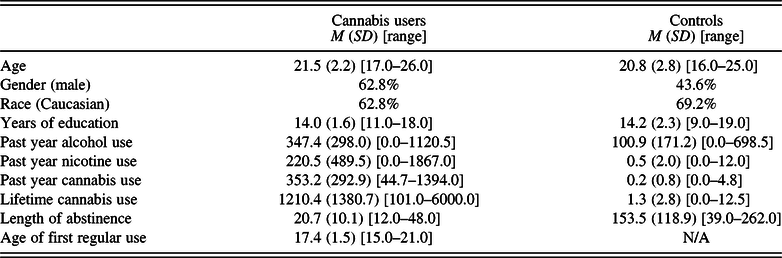
Cannabis users and controls did not significantly differ by age, race, gender, or years of education. See Table 1 for more demographic information.
Demographics and group descriptors

Note. M = mean, SD = standard deviation. Past year and lifetime substance uses reflect total standard substance uses in the past year (e.g., alcohol in number of standard drinks; nicotine in number of cigarettes and hits of chew/snuff/pipe/cigar/hookah; and cannabis in number of joints). More detail of how this information was collected is reflected in the Method section under TLFB.
Substance use
As expected, cannabis users had significantly more cannabis use in the past year [t(34) = −7.1, p < .001] as well as lifetime uses [t(34) = −5.2, p < .001]. On average, cannabis users had been abstinent from cannabis for 20.7 days by the third session. In the control group, four participants had used cannabis within the past year, and their length of abstinence on average was 153.5 days; there was no reported use during the period of the study. Cannabis users had significantly more past year alcohol (t(53) = −4.3, p < .001), nicotine use [t(34) = −2.7, p = .01], and session three cotinine levels [t(41) = −2.7, p = .01] compared to controls. Due to these differences, past year alcohol and nicotine use was included in the model to account for their potential influence in outcomes. See Table 1 for full substance use information by group.
Repeated measures
Time
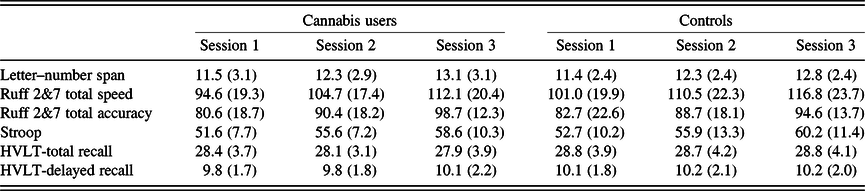
Repeated measures ANCOVAs revealed a significant main effect by time with improved performance over time for LNS performance [F(1,69) = 11.73, p < .001,  $\eta _p^2$ = 0.15], Ruff 2&7 Total Time [F(1,69) = 74.03, p < .001, $\eta _p^2$ = 0.52], Ruff 2&7 Total Accuracy [F(1,69) = 37.41, p < .001, $\eta _p^2$ = 0.35], and total Stroop performance [F(1,69) = 16.24, p < .001, $\eta _p^2$ = 0.19].
Group effects
There were no significant effects between cannabis group, past year alcohol use, and past year nicotine use on neuropsychological performance (see Table 2).
Mean neuropsychological scores across sessions

Note. Values include means and standard deviation in the format of mean (standard deviation).
Interaction effects
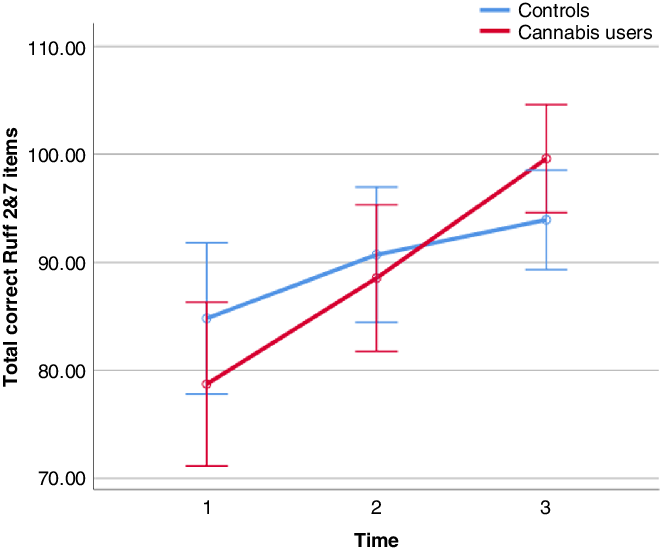
There was a significant interaction between time and cannabis group on Ruff 2&7 Total Accuracy [F(1,69) = 6.47, p = .01, $\eta _p^2$ = 0.09], with cannabis users demonstrating significant improvements in accuracy compared to controls (see Figure 1). There was a significant interaction between time and past year alcohol use on Ruff 2&7 Total Accuracy [F(1,69) = 12.22, p = .001, $\eta _p^2$ = 0.15] and HVLT Immediate Free Recall [F(1,69) = 4.31, p = .04, $\eta _p^2$ = 0.06] with heavier alcohol users showing increased performance with more time. There were no significant interactions with past year nicotine use.
Ruff 2&7 total accuracy across sessions between cannabis users and controls.

DISCUSSION
We predicted that cannabis users would have significant deficits in cognitive performance compared to controls at baseline, but that domains of verbal working memory and verbal learning would recover with 1 week of monitored sustained abstinence, but would continue to exhibit deficits in sustained attention compared to controls. However, our findings suggested that cannabis users were not significantly different from controls at baseline on these brief measures [although this same sample did demonstrate some deficits on a more expansive battery at a later time point (Wade, Wallace et al., Reference Wade, Wallace, Swartz and Lisdahl2019)], nor did they demonstrate improved performance in verbal working memory and learning tests compared to controls. However, the adolescent and young adult cannabis users in this study did show significant improvement in their sustained attention performance following the 2-week period of monitored abstinence.
While previous research has suggested sustained deficits in attention following 3 weeks and 1 month of monitored abstinence in a sample of adolescents (Hanson et al., Reference Hanson, Winward, Schweinsburg, Medina, Brown and Tapert2010) and a sample of adolescents and young adults (Schuster et al., Reference Schuster, Gilman, Schoenfeld, Evenden, Hareli, Ulysse and Evins2018), respectively, our findings indicate that attentional deficits may continue to recover with continued abstinence in adolescents and young adults. It is also important to note that although our period of monitored abstinence was a minimum of 2 weeks, our cannabis users reported that they had on average an additional six and a half days of abstinence prior to enrolling the study, suggesting a total of at least 3 weeks of abstinence prior to the final date of testing. Thus, it is possible that subtle deficits in verbal learning and working memory had already recovered by the first day of testing and could explain the lack of significant neurocognitive differences between cannabis users and controls at any time point. This is consistent with Schuster et al. (Reference Schuster, Gilman, Schoenfeld, Evenden, Hareli, Ulysse and Evins2018) who found that these cognitive domains recovered within the first week. However, Hanson et al. (Reference Hanson, Winward, Schweinsburg, Medina, Brown and Tapert2010) demonstrated at least 2 weeks of sustained abstinence for cognitive recovery in these areas in a younger sample of adolescents. The age difference in the included cannabis user samples (Hanson et al., Reference Hanson, Winward, Schweinsburg, Medina, Brown and Tapert2010; mean age = 18.1; present study’s mean age = 21.5) may indicate that adolescents may require more time to experience cognitive recovery than their young adult counterparts. Furthermore, the cannabis users within our sample had relatively late onset of regular cannabis use (M = 17.4 years old), which may explain a lack of significant differences in cognitive functioning at baseline due to both later onset of cannabis use and potentially fewer years of cannabis exposure [mean age of regular use was 15.6 for Hanson et al. (Reference Hanson, Winward, Schweinsburg, Medina, Brown and Tapert2010)]. Consistent with this, age of regular cannabis use and duration of use have been implicated as important factors in attention deficits (Ehrenreich et al., Reference Ehrenreich, Rinn, Kunert, Moeller, Poser, Schilling and Hoehe1999; Solowij, Michie, & Fox, Reference Solowij, Michie and Fox1995). Taken together, these studies highlight the importance of measuring date of last cannabis use as the length of sustained abstinence depending on age may determine rates and domains of neurocognitive recovery from chronic cannabis use. Furthermore, years of chronic cannabis use may also moderate the above effects. Accordingly, future studies should examine these factors more closely. Finally, it is notable that we did observe cognitive deficits in primarily the same sample following 3 weeks of monitored abstinence on other neuropsychological tasks measuring psychomotor processing speed and sustained attention, including the CPT-2 and D-KEFS Trail Making Test (Wade, Wallace et al., Reference Wade, Wallace, Swartz and Lisdahl2019; Wallace et al., Reference Wallace, Wade, Hatcher and Lisdahl2019). In addition, cannabis users demonstrated impaired working memory on the letter–number sequencing task after controlling for aerobic fitness level, and low-fit cannabis users had impaired verbal memory performance on the CVLT-II (Wade, Wallace et al., Reference Wade, Wallace, Swartz and Lisdahl2019). Thus, it is also possible that the tests utilized in the mini-NP battery were not sufficiently sensitive to detect cognitive deficits.
The underlying mechanism explaining recovery of cognitive functioning with continued abstinence from cannabis is most likely due to recovery within the endogenous endocannabinoid system (Hirvonen et al., Reference Hirvonen, Goodwin, Li, Terry, Zoghbi, Morse and Innis2012). Continued cannabis exposure has been shown to downregulate CB1 receptors, which are found largely within frontal and limbic regions of the brain (Howlett et al., Reference Howlett, Breivogel, Childers, Deadwyler, Hampson and Porrino2004). Animal models have shown that this CB1 receptor downregulation may exhibit recovery comparable to controls after 7 days within the striatum and 14 days within the hippocampus after cannabis cessation (Sim-Selley et al., Reference Sim-Selley, Schechter, Rorrer, Dalton, Hernandez, Martin and Selley2006). Due to the timeline and areas of CB1 recovery, this mechanism provides a potential explanation for the relatively rapid recovery of certain domains of cognitive functioning. Still, these findings must first be replicated within human populations. Additional research examining the direct relationship between these mechanism and cognition needs to be done.
Overall, these findings provide a message of hope that cannabis cessation could lead to the recovery of attentional deficits in adolescents and young adults. As research has shown that youth are at particular risk for harm from cannabis use (Turner, Spithoff, & Kahan, Reference Turner, Spithoff and Kahan2014), treatment models for adolescents engaging in cannabis use have been established (Diamond et al., Reference Diamond, Godley, Liddle, Sampl, Webb, Tims and Meyers2002). While these programs seem promising, continuous abstinence rates within youth remain low (Budney, Roffman, Stephens, & Walker, Reference Budney, Roffman, Stephens and Walker2007). Thus, additional research is needed to encourage continuous abstinence in adolescents and young adults, which may help to attenuate more long-term cognitive deficits that may occur with continued use and as the brain continues to mature.
Interestingly, past year alcohol also significantly predicted improved performance on attention and verbal working memory tasks over the period of abstinence. Recent studies have suggested that co-use of alcohol and cannabis can be an important consideration when disentangling the effects of substance use on cognition (Jacobus et al., Reference Jacobus, Squeglia, Sorg, Nguyen-Louie and Tapert2014; Ramaekers et al., Reference Ramaekers, Theunissen, De Brouwer, Toennes, Moeller and Kauert2011; Wade, Thomas et al., Reference Wade, Thomas, Gruber, Tapert, Filbey and Lisdahl2020). Our findings highlight that abstinence from concurrent cannabis and alcohol use in co-users may play a role in the recovery of neuropsychological functioning. Patterns of substance use and co-use should be more closely investigated within future studies examining the impact of cannabis on cognition. Though these two issues are entangled in the present design, future studies may want to consider different groups abstaining from alcohol and cannabis separately.
There are limitations to consider within the context of our study. Cannabis users reported at least a week of abstinence from cannabis prior to entering the study; this may have resulted in some recovery of function prior to the monitored abstinence period. Furthermore, we were unable to disentangle the effects of abstaining from alcohol or cannabis use in the current design. Of other note, one study reported that toxicology testing with the sweat patch may miss small doses of edible cannabis (Huestis et al., Reference Huestis, Scheidweiler, Saito, Fortner, Abraham, Gustafson and Smith2008); however, none of our participants reported recent edible use in the past month, edible use during the past year was very low, and we also conducted urine toxicology analyses weekly. Examiners were not blind to participant drug status, which may have impacted results as recent research has emphasized that neuropsychologists have intrinsic biases on the cognitive effects of chronic cannabis users (Hirst, Watson, Rosen, & Quittner, Reference Hirst, Watson, Rosen and Quittner2019). Furthermore, no specific validity testing was done until session four. So while appropriate effort was given at session four, we can only infer valid effort during previous neuropsychological testing sessions leading up to session four. Our brief neuropsychological battery did not include measures of psychomotor speed or visual learning and memory, which have also been shown to be impaired in cannabis users (Bolla, Brown, Eldreth, Tate, & Cadet, Reference Bolla, Brown, Eldreth, Tate and Cadet2002; Lisdahl & Price, Reference Lisdahl and Price2012; Wade, Wallace et al., Reference Wade, Wallace, Swartz and Lisdahl2019; Winward, Hanson, Tapert, & Brown, Reference Winward, Hanson, Tapert and Brown2014). Furthermore, we did not conduct repeated neuroimaging and it is notable that previous studies have reported subtle deficits in brain function, connectivity, and structure following 2–4 weeks of monitored abstinence (Jacobus et al., Reference Jacobus, Goldenberg, Wierenga, Tolentino, Liu and Tapert2012, Reference Jacobus, Squeglia, Sorg, Nguyen-Louie and Tapert2014; Maple, Thomas, Kangiser, & Lisdahl, Reference Maple, Thomas, Kangiser and Lisdahl2019; Price et al., Reference Price, McQueeny, Shollenbarger, Browning, Wieser and Lisdahl2015; Schweinsburg et al., Reference Schweinsburg, Schweinsburg, Medina, McQueeny, Brown and Tapert2010; Shollenbarger, Price, Wieser, & Lisdahl, Reference Shollenbarger, Price, Wieser and Lisdahl2015; Tapert et al., Reference Tapert, Schweinsburg, Drummond, Paulus, Brown, Yang and Frank2007); thus, additional longitudinal studies utilizing more sensitive measures of neuroimaging are needed before it can be concluded that full recovery is obtained following abstinence.
Research on the impact of sustained abstinence from cannabis on neuropsychological outcomes is understudied. Our findings add to this literature by demonstrating significant recovery in sustained attention deficits in regular adolescent and young adult cannabis users following 2 weeks of monitored abstinence. Further investigations into confirming the impact of sustained abstinence in samples with an earlier age of cannabis use onset and examining other outcomes, especially neuroimaging, are needed. The implications of these findings are hopeful and suggest that sustained abstinence in late adolescent and young adult regular users can improve cognition in the domain of sustained attention. Thus, programs that promote abstinence in young users should remain a high public health priority.
ACKNOWLEDGMENTS
This work was supported by the National Institute on Drug Abuse (NIDA) grant (R01DA030354) to Krista Lisdahl. During manuscript preparation, the authors were supported by NIDA grant (U01DA041025) to Krista Lisdahl.
CONFLICT OF INTEREST
The authors have no conflicts of interest to declare.