Rock-cut Tombs and Bucrania in Late Neolithic Sardinia
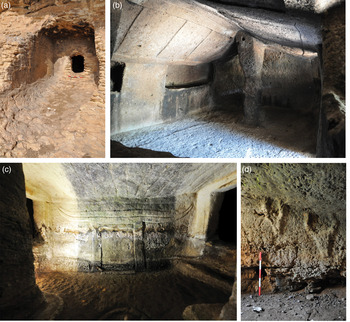
Domus de janas (‘houses of the fairies’) rock-cut tombs are the most emblematic monuments of the Sardinian Late Neolithic and Chalcolithic periods (4400–2300 cal bc), with about 3500 examples recorded across the island (Tanda, Reference Tanda2009; Melis, Reference Melis2012). They are complex underground chambered tombs carved out of rocky cliffs, outcrops, and boulders, and comprising several chambers separated by doorways (Figure 1). Their interior sometimes includes carved and painted architectural features mimicking the wooden structures of houses, such as pillars, roof beams, lintels, false doorways, or other components of dwellings such as hearths. About 250 of these tombs also have imagery and abstract art on their walls, including painted, carved, or engraved spirals, zigzags, checkerboard motifs, and schematic anthropomorphic figures, as well as depictions of cattle horns or head and horns together (bucrania) (Tanda, Reference Tanda1985; Reference Tanda2015; Robin, Reference Robin2016). The term bucranium refers specifically to the representation of bovine head and horns, not the actual remains of the animal's head as often misrepresented in the archaeological literature.
Neolithic rock-cut tombs in Sardinia: (a) entrance dromos and portal at Ochila tomb 2, Ittiri; (b) house-like interior of Sant'Andrea Priu tomb 8, Bonorva; (c) false doorway surmounted by a large double-horn motif on the back wall of tomb 2, Mesu‘e Montes, Ossi; (d) the majority of bucrania and horn motifs in Sardinian tombs are small-scale (natural-scale), as in Anghelu Ruju tomb A, Alghero.

While motifs such as zigzags or spirals are widely found in Neolithic tombs across Europe, from Malta to Ireland and from Germany to Portugal, cattle head motifs are more specifically associated with Sardinia, and only rarely found elsewhere in Neolithic tombs of other European regions. In Brittany, complete depictions of cattle are known on two massive mid-fifth-millennium stelae: at the Table des Marchands, Locmariaquer (Cassen & Robin, Reference Cassen, Robin and Cassen2009), and at La Tremblais, Saint-Samson-sur-Rance (Giot & Morzadec, Reference Giot and Morzadec1990; Cassen et al., in press). The so-called ‘yokes’ and U-shaped motifs from other Breton monuments have long been interpreted as abstract representations of cattle horns (Bailloud et al., Reference Bailloud, Boujot, Cassen and Le Roux1995: 86; Le Quellec, Reference Le Quellec, Joussaume, Laporte and Scarre2006: 708–11) but this has recently been challenged (Cassen, Reference Cassen2005). Definite engravings of schematic bucrania are found in Germany on the walls of two late fourth-millennium megalithic gallery graves (Züschen I and Warburgh; Anati & Varela Gomes, Reference Anati and Varela Gomes2013) associated with depictions of wheeled vehicles and human figures. Rock-cut tombs decorated with sculpted bucrania are known on the other side of the Mediterranean, in Tunisia, but their date is uncertain (probably second half of the first millennium bc; Camps & Longerstay, Reference Camps and Longerstay2000).
The bucranium is the most frequently found motif in Sardinian rock-cut tombs, with 116 monuments (out of 250 decorated ones) featuring the motif (Robin, Reference Robin2016). It is also most diverse in style and form. Some motifs are nearly realistic, with horns and heads having natural proportions and sometimes additional anatomical details such as ears, nostrils, and eyes, whereas others can be extremely schematic and stylized, reduced to a simple ‘V’ or ‘U’ design (Tanda, Reference Tanda, Tanda and Lugliè2008, Reference Tanda2015) (Figure 1).
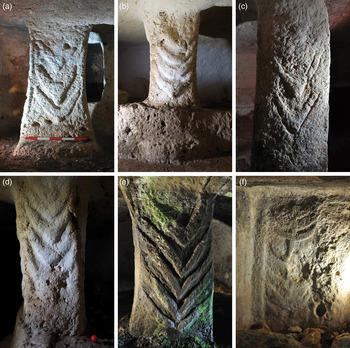
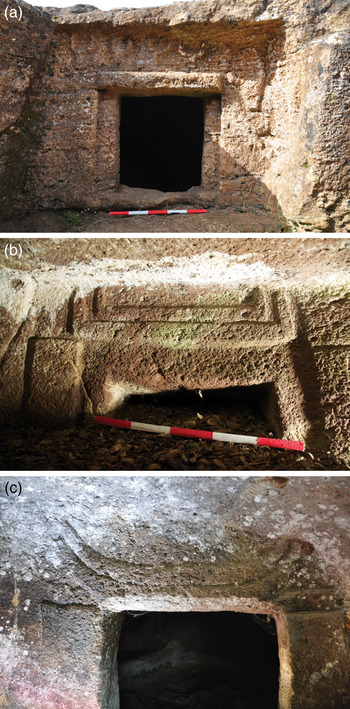
By contrast, the way bucrania are placed within the architectural space of the tombs is much more standardized (Robin, Reference Robin2016; see also Tanda Reference Tanda2015: 251–350, Reference Tanda and Anati2016). Two main patterns can be observed. First, bucrania are more frequently found in groups of several motifs than as single occurrences. They can be in groups of two to six motifs, sometimes more. They can be arranged side by side or, more often, on top of each other, forming vertical rows of horns along the pillars or the walls of the tombs (Figure 2). Second, bucrania are repeatedly associated with doorways: 103 doorways in eighty-one tombs are decorated with one or more bucranium. Several cattle heads can be carved side by side over the entrance to a chamber, single heads can be placed on the wall on the side of a doorway, but the most typical arrangement is single or multiple nested horns positioned centrally immediately above the doorway (Figure 3). Multiplicity and liminality are two important characteristics to which we shall return after a brief overview of how archaeologists have studied and interpreted Sardinian bucrania so far.
Bucrania inside Sardinian tombs are rarely found in isolation and most often in groups of several motifs. On pillars or on walls, vertical compositions of inserted horns are a typical arrangement. Examples from: (a) Tomba delle Clessidre, S'Adde ‘e Asile, Ossi; (b) and (d) Monte d'Accoddi tomb 1, Sassari; (c) Mesu ‘e Montes tomb 2, Ossi; (e) Enas de Cannuia 4, Bessude; (f) Tomba Maggiore, S'Adde ‘e Asile, Ossi.

Bucrania are often associated with doorways, which mark the passage from one space to another inside the tombs. Examples from: (a) Anghelu Ruju tomb A, Alghero; (b) Baldedu, Chiaramonti; (c) Pubusattile tomb 4, Villanova Monteleone.

Bucrania and the Bull God Theory
Since the beginning of the twentieth century a number of scholars have studied in detail the representations of cattle heads in Sardinian rock-cut tombs. Most research has focused on iconography and typo-chronological classifications (Tanda, Reference Tanda1977, Reference Tanda1985, Reference Tanda, Tanda and Lugliè2008, Reference Tanda2015). However, surprisingly little effort has been devoted to interpreting the significance of this intriguing tradition in Neolithic art. The most common explanation found in the literature is that bucrania were depictions of a male divinity called the Bull God (dio toro). Together with a Mother Goddess (best represented by female figurines found in tombs and other contexts), the Bull God formed the basis of Sardinian Neolithic religion and had a central role in beliefs and death rituals. Where does this explanation come from?
The idea was first put forward in the early twentieth century by Antonio Taramelli, who conducted the first major excavation of a Sardinian rock-cut tomb complex at Anghelu Ruju near the city of Alghero between 1904 and 1908. Before undertaking a long and rich series of fieldwork campaigns across Sardinia, Taramelli trained and worked in Crete, where he had been influenced by the work and ideas of Arthur Evans. At the time Taramelli discovered sculpted cattle heads in Anghelu Ruju, no such motifs had been academically recognized or studied in Sardinia. Not surprisingly, Taramelli explicitly linked the bucrania from Anghelu Ruju to Arthur Evans’ ‘horns of consecration’ in Crete. He interpreted the Sardinian motifs as representing a ‘superior divinity’ guarding the tombs and the dead, and suggested that the whole site was created by Late Neolithic Aegean immigrants who had brought with them their chambered-tomb tradition, female figurines, and bull-worshipping religion (Taramelli, Reference Taramelli1909: 451–56, 525).
The idea was taken up by others, in particular Christian Zervos in his influential book La Civilisation de la Sardaigne published in 1954. Before writing on Sardinia, the Franco-Greek art historian and critic studied the ancient arts and religions of Mesopotamia and Greece, which clearly shaped his prolific (and often confusing) speculations on the art of the domus de janas. Zervos saw a female moon divinity in the crescent-like horns of some bucrania, and thus was the first to introduce the idea of a Mother Goddess associated with the Sardinian Bull God. In Zervos’ model, the ‘generator’ and ‘fertilising’ bull was not the main divinity of the Neolithic pantheon but merely the partner, substitute, or consort of the Mother Goddess (Zervos, Reference Zervos1954). A few years later, the model gained long-term credibility and popularity with the work of the major Sardinian archaeologist Giovanni Lilliu. In his 1958 seminal essay ‘Religion of Pre-Nuragic Sardinia’, Lilliu identified the (presumably female) figurines found in several Sardinian tombs as representations of the ‘Dea Madre’, the central element of a matriarchal religion and giver of life and fertility. Her sexual union with the Bull God, the male fertilizing principle represented by the cattle head carved on the walls of the monuments, ensured that the dead came back to life in the other world (Lilliu, Reference Lilliu1958).
With Lilliu, the Bull God theory soon reached the status of archaeological dogma among Sardinian archaeologists (e.g. Tanda, Reference Tanda1985: 39, 110, 148, 168, Reference Tanda2015: 272; Contu, Reference Contu1997: 139–40; Moravetti, Reference Moravetti2000: 766) and was rarely challenged (Levi, Reference Levi1952: 48–49; Castaldi, Reference Castaldi1976). Ercole Contu has long been the only scholar to consider bucrania as possible depictions of actual cattle rather than divinities, and first suggested that the display of multiple motifs in tombs could be commemorations of sacrifices of herds at funerals (Contu, Reference Contu1962: 634). Without rejecting the divinity/fertility model, Giuseppa Tanda later suggested that bucrania might also have referred to domestic cattle (some being consumed at burial ceremonies) and had multiple symbolic meanings (wealth, food, strength, fecundity) (Tanda, Reference Tanda and Melis2000: 405–06).
In southeast European and Anatolian Neolithic sites, and particularly Çatalhöyük, James Mellaart's (Reference Mellaart1967) and Jacques Cauvin's (Reference Cauvin2000) idea of bucrania as evidence of a Neolithic cult of the bull started to be seriously called into question from the end of the 1990s onwards (e.g. Treuil & Darcque, Reference Treuil and Darcque1998: 22–24; Testart, Reference Testart2006b; Keane, Reference Keane and Hodder2010). In Sardinia, a first critical and alternative view came in the early 2000s. For Juan Antonio Cámara Serrano and Liliana Spanedda, the origin of bucrania was not religious but related to the importance of cattle as an economic capital and prestigious symbol of wealth and status within Neolithic societies. They argued that bucrania inside tombs were not primarily dedicated to death rituals but were simply imitations of actual cattle heads displayed inside the houses of the living as ‘trophies’ of feasts. Bucrania referred to the prestige of the living rather than to a divinity for the dead (Cámara Serrano & Spanedda, Reference Cámara Serrano, Spanedda, Waldren and Ensenyat2002; Spanedda, Reference Spanedda2009). This work provided a new explanation and emphasized the social meaning of bucrania. However, the argument was not sufficiently developed nor supported by archaeological or ethnographic evidence. Taking a similar angle, the aim of the present article is to investigate further the social functions of bucrania and how they may have been used for particular strategies during the Neolithic.
Tomb Art as Social Action: Questions, Approach, and Method
Initial questions
Why do we have so many bucrania in Sardinian tombs? Why did it matter so much to Neolithic Sardinians to display cattle horn carvings in contexts related to death? Interpreting bucrania as the protective symbols of a divinity is a tempting idea, but there are two main problems with it. First, depictions of divinities are normally not duplicated inside the same space whereas bucrania often appear several times on the same walls inside the tombs. As Ercole Contu (Reference Contu1997: 140–41) pointed out, ‘if these were a divinity, it would have been sufficient to make only one representation of it’. The second problem is the absence of bucrania in most Sardinian tombs: why were only a minority (116 out of 3500, i.e. some 3.3 per cent) decorated with the motif? Were most of the dead not worth being protected or regenerated by the Bull God?
Previous research has stressed the stylistic variety of bucrania across Sardinia, but equally striking is the fluctuating number of motifs from one tomb to another: why do some monuments only have one or two bucrania while others have five, six, and up to eighteen motifs? Does the quantity of bucrania reflect the number of burials or ceremonies that had been performed during the lifetime of the monuments? Or does it reflect something else, such as social differences between individuals or groups related to the tombs? This leads us to our main question: what exactly were bucrania used for in the domus de janas? What role(s) did bucrania play in the activities that took place inside and outside the tombs? Why are they so significantly and repeatedly associated with funerary architectures? Were they used for death rituals only or did they serve other purposes too?
Ethnographic parallels in South-East Asia
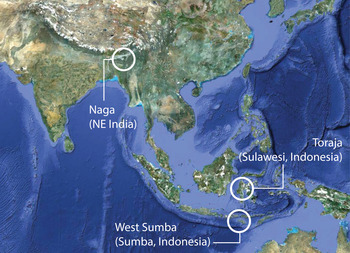
One way to start answering these questions is to look at ethnographic contexts. In South-East Asia, three traditional small-scale farming societies have been building monumental tombs and decorating them with bucrania until now or recently: the Naga of North-East India, the Toraja of Sulawesi, and the people of West Sumba in Indonesia (Figure 4). All have been studied and documented by generations of Western visitors and ethnographers.
Location of the three ethnographic case studies in South-East Asia.

Why focus on these three groups in particular? The display of actual bovine skulls and horns on tombs has been recorded in many places across the world. It has been closely studied for the Mahafaly and Tandroy of South Madagascar (Pannoux, Reference Pannoux and Esoavelomandroso1991; Parker Pearson et al., Reference Parker Pearson, Godden, Heurtebize, Radimilahy, Ramilisonina, Schwenninger and Smith2010). In South-East Asia, it has been reported among the Adi of Arunachal Pradesh (Roy, Reference Roy1960: 66–67, 154), the Dafla of Assam (Simoons, Reference Simoons1968: 50–51), the Chin of Burma (Shakespear, Reference Shakespear1912: 85–90), and the Mnong of Vietnam (Condominas, Reference Condominas1957: 282–85). There is a significant and widely shared repertoire of beliefs and practices associated with buffalo horns across South-East Asia (Adams, Reference Adams2005: 186). However, depictions of bovine heads (i.e. sculpted or painted bucrania) are only known in these three specific social groups.
Theoretical approach and objective
The aim of this article is not to apply ethnography to archaeology, but rather to explore the ethnographic record to expand our range of ideas concerning the origins and functions of cattle head depictions in Neolithic burial monuments (David & Kramer, Reference David and Kramer2001; Testart, Reference Testart2006a). The objective is not limited to search for the meaning of the bucrania. My aim is to investigate the agency of the motifs, that is, the particular effects and actions they were created for, and the social relationships they can mediate and influence within these communities.
Following Alfred Gell's Art and Agency (Reference Gell1998) as well as more recent approaches (e.g. DeMarrais & Robb, Reference DeMarrais and Robb2013; Robb, Reference Robb2015), my objective is to focus on (1) the actors involved in the making, display, and viewing of bucrania on tombs, (2) the relationships between them, and (3) the roles of bucrania within these relationships. This requires answering the following questions: who commissions/sponsors or carves the bucrania and who is the targeted audience? What kinds of relationships are engaged and negotiated around bucrania? What specific actions or effects do bucrania provide within these relationships?
Methodology
The research has been undertaken on the basis of an original review of all the extant ethnographic literature for the Naga, Toraja, and West Sumba contexts (c. 150 books and articles). For each of the three case studies the same five simple questions were posed:
-
• Where are bucrania located/displayed?
-
• Who commissions/displays them?
-
• For whom are they intended, what is the target audience?
-
• What effects/results are wanted or obtained by the display of bucrania on tombs?
-
• How are the desired effects put into action?
Feasts, Buffaloes, and Bucranium Displays in South-East Asia
The social significance of buffaloes and feasting
Before discussing bucrania and associated practices I must briefly introduce the context of this tradition in South-East Asia. Bucranium ‘art’ has two joint origins: buffaloes and feasting.
Water buffaloes (Bubalus bubalis) and mithuns (Bos frontalis) are two very special and important kinds of animals in Central and South-East Asia (Simoons, Reference Simoons1968). In North-East India and Indonesia they are semi-domesticated, owned by villagers and commonly seen in herds in the landscape. Unlike cattle, buffaloes and mithuns are neither used for traction nor as a resource for subsistence. They are exclusively used as symbolic capital for sacrifices and exchange, and represent the main symbol and index of wealth, prosperity, virility, rank, and status (Volkman, Reference Volkman1985: 70–71; Jacobs et al., Reference Jacobs, Macfarlane, Harrison and Herle1990: 127–29; Hoskins, Reference Hoskins1993a: 162–63). The prestige value of buffaloes is measured by the beauty of their hide, but most importantly by the size, length, and shape of their horns. Horns are the key part of buffaloes and mithuns because they crystallize all the values cited above. The bigger and more regularly shaped the horns are, the more valued and prized the animal is for prestige transactions and ceremonial sacrifices (Nooy-Palm, Reference Nooy-Palm1979: 187–89; Adams, Reference Adams2004a: 14).
The second essential aspect is feasting. Feasting is a classical theme in anthropology and has often been discussed in relation with prehistoric archaeology (e.g. Hayden, Reference Hayden2009; Dietler, Reference Dietler and Insoll2011). In South-East Asia generally, and in our three contexts in particular, feasting takes different forms and serves various purposes, but it always involves the slaughtering of domesticated animals, in particular buffaloes. In the Naga villages of North-East India, the social promotion of (usually male) individuals is achieved through a series of increasingly competitive ‘feasts of merit’. The final feast, only attained by the wealthiest men, requires the sacrifice of a mithun and gives the right to display special body ornaments and house decorations (Jacobs et al., Reference Jacobs, Macfarlane, Harrison and Herle1990: 77–78). In Sulawesi and West Sumba, the largest feasts are associated with death: they are held by influential individuals or families on specific occasions such as a funeral or the construction of a megalithic tomb (Hoskins, Reference Hoskins and Barbier1998: 168; Adams, Reference Adams2004b).
In all these contexts, the central element of the feast is the sacrifice of a large number of buffaloes and/or other species (pigs, chickens). The meat is then distributed to the participants and guests. The number of animals killed, proportional to the number of guests, is crucial as an index of wealth and status: the more buffaloes an individual or family is able to offer at a feast, the more prestige and influence is gained. Up to sixty buffaloes can be slaughtered over a week at a Toraja funeral (Jannel & Lontcho, Reference Jannel and Lontcho1992: 31; Jong, Reference Jong2013). Feasting covers ritual functions (the souls of the buffaloes are sent to the ancestors) but the main purpose is promotional through social display and prestige.
During these spectacular events, the meat of slaughtered buffaloes is carefully shared and taken away by the guests, but the horns of the animals are kept by the sponsor as prestigious evidence of feast giving. At the end of a feast, buffalo horns quickly pass from the status of remains of a butchered animal to that of very special objects. They become a type of material culture with a highly important range of significations and actions. And what do the sponsors do with these horns once the feast is over? They display them on their houses.
Displaying horns and bucrania on houses
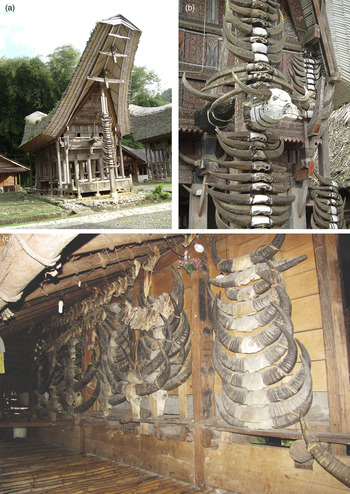
The most frequent place where the sponsors of a feast display horns of sacrificed buffaloes is the exterior (public) faces of their house (Figure 5). In West Sumba, for instance, buffalo horns are normally displayed on the veranda of household or ancestral houses. They are also found on the interior posts of these houses where they can be seen from outside through the open doorway (Hoskins, Reference Hoskins1993b: 202–03; Keane, Reference Keane and Hodder2010: 202). The most impressive examples are the well-known tongkonan kinship houses of the Toraja in Sulawesi, whose fronts are decorated with vertical stacks of dozens of horns, reflecting the number of feasts over several generations within the group (Nooy-Palm, Reference Nooy-Palm1979: 231–40; Waterson, Reference Waterson1993: 84–85). These horns are prestigious evidence of conspicuous feasts, showing rank and status. They are in view of all villagers and anyone visiting the village so that it is possible to tell at a glance which house has the best track record of sacrifices and, consequently, which families are historically the most important.
Stacks of buffalo horns displayed in the front of Toraja tongkonan kinship houses (top) and in the front veranda of a house in West Sumba, Indonesia (bottom).

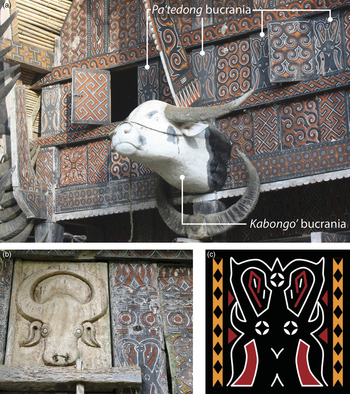
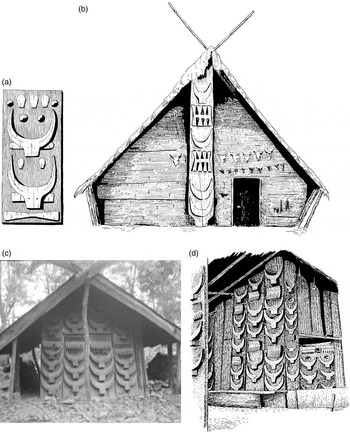
Interestingly for our topic, it is however not always necessary to use the actual horns of sacrificed buffaloes to show evidence of feasting achievements: this can also be done by bucrania, i.e. ‘artistic’ representations of buffalo heads and horns. In Sulawesi, the front of houses and rice barns belonging to the highest-ranking nobles are decorated with life-size naturalistic wood-carved buffalo heads (kabongo’) and stylized painted depictions (pa'tedong) (Figure 6). These items are even more prestigious and socially controlled than true horns (Nooy-Palm, Reference Nooy-Palm1979: 193–94, 231–54; Waterson, Reference Waterson1988: 35). The public display of such bucranium ‘substitutes’ is actually the norm among the Naga (Figure 7). There, the real mithun horns deriving from feasts of merit are stored in discreet places inside houses, granaries, or morung men's houses (Mills, Reference Mills1926: 370–96). The commemoration of feasts is achieved through large stylized wood-carved mithun heads (stylistically very similar to the Neolithic bucrania found in Sardinian tombs). They are displayed on the façades of private or communal houses (Mills, Reference Mills1937: 50–63), ceremonial forked posts (Simoons, Reference Simoons1968: 204–07), village gates (Kauffmann, Reference Kauffmann1955), doors of granaries (von Fürer-Haimendorf, Reference von Fürer-Haimendorf1939: 39), and sometimes bridges (Kauffmann, Reference Kauffmann1962: 91–93). Of course, displaying wood-carved mithun heads on Naga houses is socially restricted and monitored. Carvings are executed by specialists and not everyone is entitled to place such artwork in front of his house. One needs to have held certain types of feasts to do so and both the number and types of bucrania reflect the cursus honorum of the owner of the house through the long, ranked series of feasts of merit (Mills, Reference Mills1937: 62–63, 193).
The houses and rice barns of wealthy Toraja families are decorated with genuine buffalo horns but also with plastic and graphic depictions of heads and horns. These bucrania are of two types: (a) life-sized carved buffalo heads (kabongo’) and (b, c) flat, stylized motifs (pa'tedong).

Naga village gate (a) and house fronts (b–d) with wood-carved bucrania (North-East India).

The important point here is that ‘art’ on Toraja and Naga houses is not used for aesthetic but for specific social and ritual functions, which will be discussed below. Yet, bucranium art is not only used on the houses of the living, it is also found on the houses of the dead.
Displaying bucrania on tombs
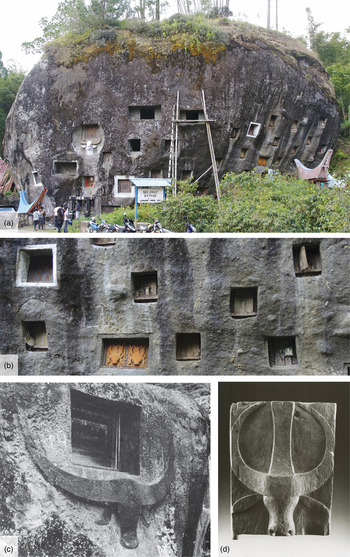
If real horns are displayed on houses, only their depictions are found on tombs across our three study areas. Noble Sa'dan Toraja are normally buried in rock-cut tombs (liang batu, ‘rock graves’), which are carved out of large boulders or rocky cliffs (Figure 8). Each tomb is referred to as the ‘house of the ancestors’ and is paired to a specific tongkonan kinship house. All members of the household have a right of burial in the monument (Koubi, Reference Koubi1982: 196; Waterson, Reference Waterson1995: 204–08). Tombs are accessed by a small rectangular opening and their interior consists of a small passage leading to a single square chamber. The access doorway on the cliff is closed by a wooden door on which a pa'tedong bucranium is often painted or engraved (Nooy-Palm, Reference Nooy-Palm1979: 193, 259–61). The tombs of the most influent families can be distinguished by their higher location on the cliffs (Koubi, Reference Koubi1982: 196) but also by larger types of motifs carved directly onto the rock surface immediately below the entrance of the tomb. Some modern examples include concrete kabongo’-style motifs (Figure 8), meaning that the owners of the tomb have held a very high-ranking funeral (R. Waterson and J. Koubi pers. comm. 2013).
Toraja rock-cut tomb cemeteries (Sulawesi, Indonesia). Only noble families are buried in these rock chambers, each of them corresponding to a tongkonan kinship house. The wooden shutters of the tombs (b and d) were traditionally decorated with a painted or carved pa'tedong-style bucranium. Some tombs have larger concrete motifs below their entrance (a and c) similar to house kabongo’, which seems to be a recent invention.

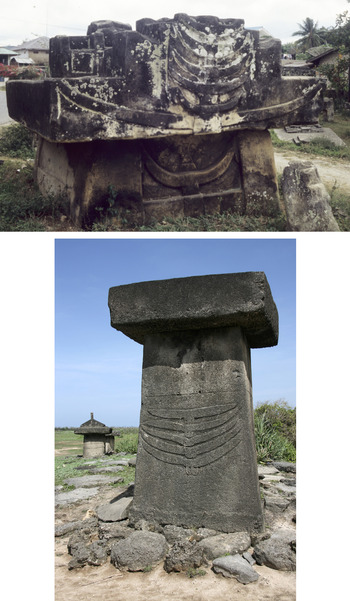
Wealthy individuals in West Sumba villages have built large megalithic tombs over the last few centuries and the tradition is still alive in this part of the small Indonesian island (Adams, Reference Adams, Calado, Baldia and Boulanger2010). Megalithic tombs are usually grouped into cemeteries in the middle of villages, or immediately next to them. They can be dolmens, i.e. a large slab standing on four stone ‘posts’, under which the remains of the dead are buried; or they can be large rectangular blocks hollowed out from the top and sealed by a capstone (Figure 9). The exterior surfaces of these megalithic tombs are decorated with carvings representing explicit symbols of wealth and status: mostly buffalo heads (either individual or multiple motifs, grouped into a vertical stack like real horns in houses), but also gold ornaments and sometimes horses (Verschoor van Nisse, Reference Verschoor van Nisse1926: 579–80; Keane, Reference Keane1990: 12–13). If the motifs explicitly refer to wealth, their execution on the tomb is also an indicator of wealth since specialist stone carvers demand high fees for this kind of work. Building a tomb is an expensive project in itself, and the (quite infrequent) presence of tomb decoration is an additional sign of the sponsor's wealth. The prestige impact of decorated tombs is not only visual (distinguishing it from other non-decorated tombs), it is also based on the knowledge that carving is a costly and exceptional additional expense (Adams, Reference Adams and Scarre2009: 85).
Megalithic tombs in Waikabukak (top) and Kodi (bottom), West Sumba (Indonesia), with stone-carved bucrania replicating stacks of horns displayed inside houses (see Figure 5).

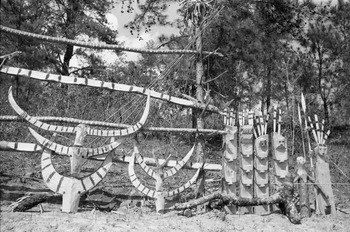
Traditional Naga graves are less monumental than Toraja and Sumbanese tombs. Monuments such as standing stones and platforms were erected for ceremonial purposes (including the commemoration of the dead), but the dead themselves were buried in simple graves with no permanently visible markers other than sometimes a small tumulus for men (Mills, Reference Mills1937: 196). Similarly, the commemoration of the deceased's achievements was not celebrated through hard, permanent material or structures, but through the display of wooden carvings replicating the wooden artwork on the houses (Figure 10). These were displayed in front of the corpse-platform and subsequently over the grave. They were probably kept in good condition by relatives as long as the influence of the deceased remained active among the living. This ephemeral tomb art included mithun bucrania as indexes of achievements, but also human heads (denoting success over enemies) and wild animals (symbolizing hunting prowess) (Mills, Reference Mills1926: 226, 281).
Grave of a high-status Naga man whose achievements in both feasting and killing enemies are celebrated and commemorated through wood-carved figures. Sculptures are small-scale replicas of wood-carvings normally displayed at the front of houses.

One important outcome of this overview is that, in the three regional groups, a strong conceptual connection between house and tomb decorations emerges; both are used to commemorate the wealth and achievements of their present and past occupants. However, as we shall see, the agency of bucrania in these ethnographic contexts is not limited to display and memory.
What Do Bucrania Do?
Having described the contexts in which bucrania are created and the architectural settings in which they are displayed, I would like to turn to the various human and non-human actors involved in these practices, the nature of their relationships, and how bucrania are used within these relationships.
Let us start with the different actions or effects attributed to bucrania by the Naga, Toraja, and Sumbanese people which have been reported in the ethnographic literature. These people create and place bucrania at specific locations on houses and tombs, sometimes on granaries and village gates, with the idea (explicit or not) that the motifs have a particular power and will achieve a special effect for them. What exactly are bucrania doing there?
The main observation is that bucrania do not have a single specific purpose but rather concentrate several types of cumulated actions. Their agency is multiple and cumulative. Firstly, bucrania involve commemoration. The main function of displaying buffalo horns and bucrania is to provide ostentatious and enduring evidence of expensive animal sacrifices at past feasts, to remind the village community and beyond of these distinctive events and of the wealth, generosity, prestige, status, and influence of the sponsor(s) of these feasts (Simoons, Reference Simoons1968: 198–203; Waterson, Reference Waterson1990: 139–40). The accumulation of horns or motifs on house fronts and individual tombs is intended to sum up, concentrate, and preserve the history and memory of an individual's belongings and achievements, or those of a single social group, at the same place. As Janet Hoskins was told by a Sumbanese informant, ‘if you want to see my life, the lives of my ancestors, the things that they did, look at the row of horns in front of my house. The greatness of the past can be measured there, the size of our feasts and spread of our name’ (Hoskins, Reference Hoskins1993b: 202). The exclusive use of a permanent material (stone) for tomb construction and bucrania carvings in West Sumba, as opposed to organic material for houses, is part of that strategy of long-term commemoration (Keane, Reference Keane1997: 208–23).
Alongside commemoration, horns and bucrania involve competition. The public, permanent display of bucrania not only establishes and reinforces past and recent social promotions as part of the competitive strategy of an individual or family (Hoskins, Reference Hoskins, Barbier and Newton1988: 135), it also challenges the status of others, ‘wound [their] pride’ (von Fürer-Haimendorf, Reference von Fürer-Haimendorf1939: 22) and, consequently, encourages emulation among prominent individuals and families within the community (Jacobs et al., Reference Jacobs, Macfarlane, Harrison and Herle1990: 127–29). The public enduring visibility of bucrania is a key factor here, and the ‘visual impact’ (Adams, Reference Adams and Scarre2009: 87) of house and tomb decoration a central aspect of competitive strategies among wealthy members of village communities.
Bucrania have important social effects or actions, but they also act on a magical level. For example, bucrania are also considered to be powerful apotropaic agents and are therefore used for protection in South-East Asia. The ethnographic record from the three study areas describes how images of buffalo/mithun heads are placed on doorways and windows to ward off evil influences and prevent them from penetrating houses, granaries, and tombs. This is why the stylized pa'tedong bucrania are repeatedly carved or painted on wooden doors and window shutters of houses, rice-barns, and rock-cut tombs in Sulawesi (Nooy-Palm, Reference Nooy-Palm1979: 193–94, 240). Such a magical agency is related to the buffaloes’ reputation for courage, pugnacity, violence, and aggression. Bucrania on doors are described as ‘guardians’ and ‘defences against evil’ (Kis-Jovak et al., Reference Kis-Jovak, Nooy-Palm, Schefold and Schilz-Dornburg1988: 42–43). Doorways and windows are ‘vulnerable spots, where evil spirits might enter the house’ and they require efficient protection (Nooy-Palm, Reference Nooy-Palm and Newton1999: 97). One finds very large engravings of bucrania on the massive wooden gates of Naga villages for the same reasons: they would ward off both bad spirits and human enemies (Kauffmann, Reference Kauffmann1955: 85, 94).
Finally, the ethnographic literature shows that the bucrania's range of actions also includes fertility: as recognized signs of wealth and prosperity they are thought to attract agricultural and social prosperity to the people living in (or associated with) the houses on which they are displayed. Bucrania are propitiatory agents. In Naga villages, the skulls of sacrificed mithun automatically bring ‘aren’ (prosperity and favour of the spirits) and will ensure good crops and many children to the household (Mills, Reference Mills1926: 205, 257; Hoskins, Reference Hoskins1993b: 237–38). Carvings of mithun heads on the morung men's houses are believed to make their members wealthy (Odyuo, Reference Odyuo2013: 16).
The diversity of the social interactions that are created and negotiated through bucrania is of great interest. If the sponsors of bucranium displays usually belong to a single social category (wealthier members of a village community), the ethnographic review shows that the targeted audience and the intended effects of bucrania are diverse. For example, the most obvious social interaction is between wealthy individuals and the other members of the village community: bucrania are created by the former in order to state or promote their status. But the bucrania's agency also serves other forms of social interactions, beyond the village and the community of the living: by protecting the inhabitants of the houses from evil spirits, bucrania play a role in the relationships between the living (the village community as a whole) and supernatural forces. At some Sumba ceremonies, buffalo horns are arranged to form a ‘ladder’ which is used as a medium to transfer words and messages to the spirit world (Hoskins, Reference Hoskins1993a: 161–62). Bucrania are most often used as a barrier between humans and spirits, but sometimes they also permit communication between both.
Relationships with the ancestors are crucial throughout South-East Asian traditional societies. Dead ancestors are responsible for the fertility of the soils and crops: they can grant prosperity to their descendants but also withhold it from them. Success or failure of the crops depends largely on the favour of the dead, and the living must make sure that the dead are happy and at peace with them. This requires regular cycles or rites dedicated to the ancestors. The role of bucrania in keeping the relationship good is not central (the main media for routine communication with the ancestors are ritual speaking and small animal sacrifices inside houses—W. Keane pers. comm. 2013) but the holding of feasts and the ritual display of bucrania are a way to show the ancestors (who are constantly watching the living) that the appropriate ritual sacrifices have been made according to the tradition and their wishes (Mills, Reference Mills1926: 288; Waterson, Reference Waterson1988: 57; Hoskins, Reference Hoskins1993b: 237–38). By displaying such evidence, the living also expect gratitude from their kin dead or ancestors in return, for example in the form of good crops (J. Koubi pers. comm. 2013).
Finally, bucrania are also created to intervene in an ancestor-to-living relationship. The main function of a tomb in West Sumba is to perpetuate the memory of the sponsor of the monument. Wealthy individuals build impressive megalithic tombs with the explicit objective to ensure that, once they are dead and buried inside the monument, their descendants and future generations of the whole village community will remember the feast that was organized for the tomb's construction. Most importantly they will remember their renown and ‘repeat their name’ as long as possible (Hoskins, Reference Hoskins1986). The rare and expensive addition of engraved art on tombs, including bucrania, is part of this strategy (Hoskins, Reference Hoskins, Barbier and Newton1988: 136).
Discussion: Bucrania and Society in Neolithic Sardinia
The systematic review of ethnographic evidence of bucranium ‘art’ from houses and tombs in South-East Asia shows the complexity and diversity of social uses of such material culture in contexts of dwelling, death, and rituals. But how is this useful for the study of Neolithic art in Europe? How can this help us improve our approach to and our understanding of the motifs that were sculpted and painted on the walls of Late Neolithic rock-cut tombs in Sardinia?
One important outcome of the ethnographic review is to show that ‘art’, in both houses and tombs, is not merely a passive decoration nor really a representation of ideas or beliefs (Jacobs et al., Reference Jacobs, Macfarlane, Harrison and Herle1990: 129). Bucrania are active agents playing key roles within various social relationships. Consequently, thinking and interpreting such art solely in terms of meaning is both inappropriate and restrictive. If one asks the ethnographic record ‘what do bucrania mean?’ the answer will be short and simple: ‘Bucrania represent animal remains from feasts and are symbols of wealth.’ But if one asks ‘what do bucrania do?’ the reality surrounding this particular tradition of material culture becomes much more detailed and interesting. The main implication is that when interpreting Neolithic art we should wonder what it did for people, not only what it meant to them (Robb, Reference Robb2015).
The ethnographic review also reveals that bucrania do not have a single meaning and agency; they have several, cumulated effects across different spheres (from the routine of daily life to conspicuous ritual activities), at different scales of action (from doorway steps to entire villages), and different temporalities (from immediate to eternal). One bucranium can be created and displayed to serve multiple, additional intentions and to affect different audiences. So, what were bucrania in Neolithic tombs created for? I shall consider two main possible uses for the motifs: as agents in death rituals and as agents for social demonstration.
Neolithic bucrania as ritual strategy
In a recent work (Robin, Reference Robin2016), I have shown the strong relationship between bucrania and liminality within the elaborate architectural space of Sardinian rock-cut tombs: cattle heads and horns are repeatedly associated with doorways and transitional spaces and are used to mark important thresholds such as the entrance of the tomb or the passage from the antechamber to the main chamber. What did bucrania do at such liminal points within the monuments? Were they protecting entrances as bucrania do in South-East Asian architecture? Archaeologists have often suggested that bucrania were apotropaic symbols protecting the tombs and the remains of the dead (e.g. Taramelli, Reference Taramelli1909: 452; Lilliu, Reference Lilliu1963: 117; Contu, Reference Contu and Barreca1965b: 39; Tanda, Reference Tanda1984: vol. 2, 75–76). Similarly, doorways framed by large horn motifs have been described as propitiatory structures: passing through them (including the symbolic doorways for the spirit of the dead) was like passing through the divine bull itself and therefore brought protection and purification to both the dead and the living as part of death rituals (Contu, Reference Contu1965a: 252–55; Tanda, Reference Tanda1984: vol. 2, 64, 75–76). However, such suggestions have always been based on the interpretation of bucrania as representations of a divinity. The ethnographic record shows that an image does not need to be a religious symbol to have protective or propitiatory properties: buffaloes and mithuns in South-East Asia are prized as animals for such values as maleness, virility, violence, wealth, fertility, etc., which are all crystallized in the horns. This part of the animal body does not need to be associated with supernatural forces to be valued; horns are only valued because of the social interest they concentrate. During the Neolithic, cattle horns may have been the focus of a similar social interest and led people to place depictions of them at key, ‘vulnerable’ points of their spatially complex tombs in order to make the rituals performed inside them safer from external pollution and eventually more successful.
As apotropaic agents, bucrania may have played an important role within Neolithic death rituals inside tombs (see Robin, Reference Robin2016, for further discussion) but this leads us to another, yet unresolved, question: if bucrania were important for death rituals, why were only a minority of rock-cut tombs decorated with the motif? Why was it not standard in all Sardinian tombs? There may be various factors explaining the absence of art inside tombs in general, such as geology (porphyritic rock being unsuitable for carving reliefs), regional variation (a few areas in Sardinia have only undecorated tombs), or changes in tradition (some tombs may have been created before or after parietal art was the norm). Some forms of decoration, particularly painted, may not have survived either. Yet, this leaves a very large number of tombs, architecturally similar to the decorated tombs and often located next to them, which were deliberately not decorated even though there is no obvious reason for leaving them undecorated. My hypothesis is that protection was not the only function of the bucrania, nor death rituals their only arena of action. As in South-East Asia, displaying representations of horns may have been a restricted privilege and part of complex social strategies concerning primarily the living.
Neolithic bucrania as social demonstration
After the ethnographic review presented above, it is tempting to apply similar ideas of social demonstration to explain the origin and function of bucrania in Neolithic Sardinia. Did the motifs have some role in the broader social sphere of village communities? Did they play an active role in competitive strategies between their prominent members? To explore this hypothesis I shall address the question by dividing it into different elements.
Feasting constitutes the first aspect. If bucrania were indexes of wealth related to feasting practices, the latter should be archaeologically visible in some way. How much archaeological evidence of feasting is there in Late Neolithic and Copper Age Sardinia to support this? What was the place of cattle in Sardinian Neolithic societies? Were cattle consumed on special occasions and were the remaining skulls and horns subsequently used for conspicuous multiple displays or depositions (see archaeological signatures of feasting as suggested by Adams, Reference Adams2005: 187)? Unfortunately the scarcity of excavations means that faunal remains for the period in Sardinia are quite scarce: only twelve sites have produced information; they include five caves (Filiestru, San Michele di Ozieri, Grotta del Guano, Grotta Rifugio, Grotta Verde di Alghero), four open-air settlement sites (Contraguda, Pabaranca, Monte d'Accoddi, Su Coddu) (Wilkens, Reference Wilkens2012; Zedda et al., Reference Zedda, Lepore, Mura, Balzano, Gadau and Farina2012), and three rock-cut tombs (Santa Caterina, Padru Jossu, and Scaba’ e Arriu) (Ugas, Reference Ugas1982; Cocco & Usai, Reference Cocco and Usai1989; Usai, Reference Usai1998). Sheep, goat, pig, and cattle were the principal domesticates that were consumed during the Late Neolithic and Copper Age at these sites, with sheep and goat dominating the faunal assemblages (Wilkens, Reference Wilkens2004, Reference Wilkens2012). This is consistent with the general pattern for Neolithic Italy (Robb, Reference Robb2007: 137–42). Kill-off patterns in Sardinia indicate that cattle, unlike sheep, were kept for meat rather than milk or labour (Wilkens, Reference Wilkens2004: 185, Reference Wilkens2012: 83–86; but see Zedda et al., Reference Zedda, Lepore, Mura, Balzano, Gadau and Farina2012). In the small-scale village societies of Neolithic Italy, and considering the amount of meat that an ox or cow can provide, cattle were probably too valuable to be consumed casually by a single household: rather, they were killed and shared at some larger collective events, perhaps feasts (Robb, Reference Robb2007: 142–48).
There is no real evidence of large cattle consumption events (or of any other animal) in Late Neolithic and Copper Age Sardinia, as known from northern and northwest European sites (Marciniak & Pollard, Reference Marciniak, Pollard, Fowler, Harding and Hofmann2015). Nor is there evidence of conspicuous multiple depositions or displays of cattle heads and horns in either settlements or burials like those recorded in France (Hachem et al., Reference Hachem, Guichard, Farruggia, Dubouloz, Ilett, Edmonds and Richards1998), England (Davis & Payne, Reference Davis and Payne1993; Pollard, Reference Pollard, Serjeantson and Field2006; Thomas & McFadyen, Reference Thomas and McFadyen2010), or Orkney (Fraser, Reference Fraser2015) for the same period. The extremely limited number of excavations and representative faunal remains from Sardinia is a serious handicap here and it is quite difficult to use such scarce evidence to argue one way or another.
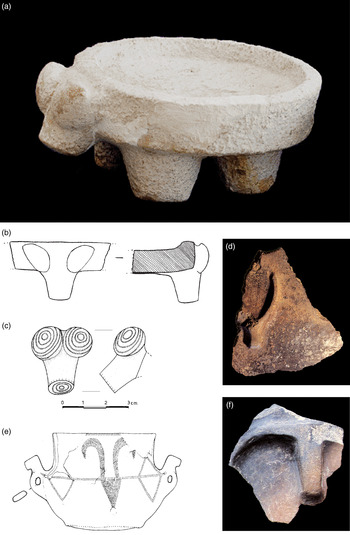
Material culture, particularly decorated vessels (Figure 11), constitutes another range of potential evidence of feasting. A small number of Middle–Late Neolithic vessels were decorated with figurative motifs and the bucranium is interestingly one of the most frequent motifs alongside human figures (Lilliu, Reference Lilliu1999). Most appear on ceramic vessels with impressed or appliqué head-and-horns motifs stylistically very similar to those found inside the domus de janas (Tanda, Reference Tanda2015: 353–60), and are found in caves (Grotta Rifugio, Monte Majore, Sa Ucca de su Tintirriolu, Grotta dell'Inferno, San Michele di Ozieri). Other vessels have modelled three-dimensional representations of bucrania and are found in settlement contexts (pottery at Puisteris, marlstone vessel at Ludosu) and even in one domus de janas (Bingia Eccia). The last example is a beautiful limestone plate with four feet and a head: in effect a cow serving food! The exact use and function of these vessels are not known but their form and decoration suggest some connection between cattle and cooking, serving or consuming food.
Sardinian Middle and Late Neolithic vessels with bucranium decoration: (a) limestone vessel found in the rock-cut tomb of Bingia Eccia in Dolianova; (b) fragment of marlstone vessel from the settlement site of Ludosu in Riola Sardo; (c) fragment of a clay modelled bucranium (probably part of a vessel) and (f) pottery sherd from the settlement of Puisteris in Mògoro; (d) pottery sherd from the cave of Monte Majore in Thiesi; (e) complete vessel from the cave of Grotta Rifugio in Oliena (not to scale).

A second aspect to consider is house display. Were bucrania in Sardinian tombs modelled on actual horn displays affixed to Neolithic houses? This seems quite probable. The domus de janas tombs themselves are known to be stone-carved imitations of houses, featuring roof beams, door lintels, and pillars in their decoration (Tanda, Reference Tanda1985, Reference Tanda2015: 119–76; Melis, Reference Melis and Gheorghiu2010). They may be representations of individual houses, but also of collective buildings similar to the Naga morung men's houses, the Toraja tongkonan kinship houses, or the Sumba ancestral houses. These collective houses are the focus of horns or bucrania display in South-East Asia and, in the latter example, vertical stacks of horns are often tied to the main pillars supporting the roof inside the main room, a pattern that is frequently found in Sardinian tombs (see Figure 2). Similarly, stylized versions of bucrania (Figure 1: (c); Figure 3: (b), (c)) may have replicated non-realistic wood-carved or plastered motifs inside Sardinian houses. We know that some Neolithic ‘houses’ across Europe were decorated with cattle skulls, as evidenced in exceptionally well-preserved settlement contexts in Macedonia, Serbia, or Switzerland (Treuil & Darcque, Reference Treuil and Darcque1998; Chapman, Reference Chapman2000: 217; Crnobrnja et al., Reference Crnobrnja, Simić and Janković2009; Hofmann, Reference Hofmann, Hofmann and Smyth2013: 206–08), and by house clay models from South-East Europe (Nanoglou, Reference Nanoglou, Fowler, Harding and Hofmann2015: 628). Although preservation conditions in Sardinia are likely to be less optimal, it would not be surprising to find similar evidence in future excavations.
A tradition of house display in Sardinia would also explain why bucrania inside the tombs are so often found in compositions grouping several motifs. Vertical arrangements of carved horns on walls and pillars inside domus de janas are visually very reminiscent of the ethnographic stacks of horns. It seems quite plausible that they proceed from the same idea of commemorating and displaying accumulated value, rather than increasing the protective effects of a god-associated symbol (e.g. Lilliu, Reference Lilliu1963: 54). Visually, house structures with conspicuous multiple displays of cattle skulls and horns provide the best analogy for carved bucrania in domus de janas tombs.
When looking at the way compact groups of bucrania were made, it appears that the majority were created as single, uniform projects rather than in successive episodes of carvings or paintings. However, in the same way that additional cells were further created inside existing tombs to accommodate new burials (Contu, Reference Contu1997: 127–28; Robin, Reference Robin2016), it is probable that entire groups of bucrania were added throughout the use life of the tombs (Tanda, Reference Tanda2015: 274). This is evidenced at the Tomba delle Clessidre in Ossi, where only one of the two chamber pillars is decorated with bucranium reliefs (Figure 2: (a)): the undecorated pillar has a much larger section, suggesting that both pillars were originally the same size and that decoration was added to one of them after the tomb was completed, but also that further reliefs could have been added to the undecorated pillar later on if needed. The dynamics of tomb carving through time is one of the many aspects that call for further investigations.
If cattle horns were so important to Neolithic people, why did they not place real ones in tombs? Why did they use stone-carved and painted stylized ‘replicas’? The ethnographic review shows that in the three South-East Asian contexts, actual horns are never displayed permanently in burials and tombs; they are kept in houses and communal buildings with the living, where they would be used regularly for specific rituals associated with reproduction. Bucranium motifs in tombs refer to the horns in houses but are intended to be immovable and durable. There is thus a strong conceptual connection between houses and tombs, the latter replicating the decoration of the former, but their materiality and life dynamics are opposed (soft organic/perishable/renewable/mobile vs solid stone/permanent/fixed). A similar relationship might have existed in Neolithic Sardinia, with houses probably built in wood and daub rather than stone, although the lack of architectural evidence for houses (Hayden, Reference Hayden, Brück and Goodman1999; Melis, Reference Melis and Gheorghiu2010) makes this difficult to demonstrate.
Our third point relates to social status. If Sardinian bucrania were indexes of wealth and status, can this be archaeologically corroborated with other contextual and material information? Do we have correlations between the number or size of bucrania and other evidence of wealth and status inside tombs? Answering these questions would require a careful, comprehensive review and statistical analysis, comparing the decoration of the tombs with the internal volume of the chambers and the content of the tombs when possible, which has not so far been undertaken. However, a rapid overview of tomb complexes that include both decorated and undecorated tombs provides some interesting patterns. It is important to recall here that only c. 7 per cent of tombs across the island (250 out of 3500) have art, and only 3.3 per cent of all tombs (46 per cent of decorated tombs, i.e. 116 tombs) contain bucrania. Even if these figures are smaller than originally because of the uneven preservation of the art, they suggest that the display of art and bucrania was strongly restricted, probably following social or economic criteria, or both. Bucranium art was not a norm but a privilege.
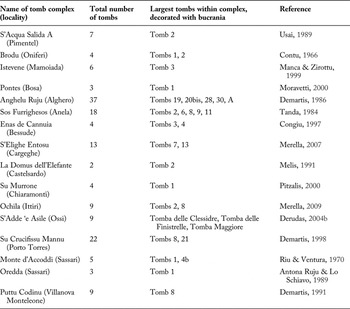
A simple but relevant parameter to be considered here is the size of the tomb. Ethnographic work among the Toraja show how long and expensive it is to cut tombs out of the rock, with specialist artisans calculating fees in terms of living buffaloes per cubic metre (Waterson, Reference Waterson1995: 207). The larger the tomb, the more expensive and the more prestigious. Tomb building in Late Neolithic Sardinia may not have been carried out by specialist craftspeople as in Indonesia but it certainly was onerous. While the number of side cells may be related to the use life of the tomb (Tanda, Reference Tanda1985: 78–81; Robin, Reference Robin2016), the volumes of the main standard spaces (antechamber and central chamber) are indexes of the workforce mobilized (and therefore socio-economic power) at the time the monument was first created. Tombs within domus de janas complexes have quite diversified sizes and volumes, probably reflecting social differences if one considers each tomb to be related to a specific social unit within a given community. A quick review of bucranium presence/absence in relation to tomb size shows that, within individual groups, tombs decorated with bucrania are those that have the largest chambers (see Table 1).
Large domus de janas complexes with carved or painted bucrania. The motifs are in the largest tombs within each complex.

Of course there are some exceptions to this general trend. The most notable is Montessu, a large complex of thirty-five tombs in Villaperuccio in south-eastern Sardinia (Tanda, Reference Tanda2015). Conspicuous groups of bucrania are found in only two small tombs (nos. 2 and 34) while monuments with extremely large chambers (e.g. tombs 7, 10, 33) are not decorated at all. Other exceptions, although less spectacular, are Santu Pedru (Alghero; Contu, Reference Contu1964) and Calancoi (Sassari; Melis, Reference Melis2009).
The size and typology of bucrania should also be considered. Two main types of bucrania are found in Sardinian tombs: small (c. 40–100 cm wide) naturalistic cattle head motifs with a V-shaped outline, and large (1–6 m wide) abstract horn motifs with a horizontal linear outline (Figure 1: (c), (d)). The latter, which I would call the ‘monumental’ type, is generally found on the back wall of substantial chambers such as Monte Siseri 1 (Demartis, Reference Demartis1992), Tanca Bullittas, Tanca Calvia 1, Su Murrone 1, or Sos Furrighesos 2 (Tanda, Reference Tanda1985). In tomb complexes where both categories of bucrania are found, such as Sos Furrighesos (Tanda, Reference Tanda1984) and Sa Pala Larga (Solinas Reference Solinas2003; Usai et al., Reference Usai, Sartor and Costanzi Cobau2011), the ‘monumental’ types occur in the tombs with larger chambers while small types are found in tombs with smaller chambers (the exception here being Mesu ‘e Montes; Derudas, Reference Derudas2004a). The morphological diversity of the bucranium motif has generally been regarded as representing distinct chrono-stylistic periods (Tanda, Reference Tanda1977, Reference Tanda, Balmuth and Tykot1998), but there is no real dating evidence to support this (see Robin, Reference Robin2016). Motifs from different types or categories are actually found all over the island and were sometimes combined inside the same monuments (e.g. Su Montiju ‘e Sa Femina, Mesu ‘e Montes tomb 2, Sa Pala Larga tomb 3, Sas Concas, Enas de Cannuia tomb 4). This suggests that they were used at the same time across Sardinia and within communities, potentially with different specific meanings and functions. The ethnographic review shows that motifs of different types are often hierarchized and refer to distinct ranked achievements: the Toraja large kabongo’ motifs commemorate particularly expensive buffalo sacrifices at funerals, while simple horns and pa'tedong motifs, despite their connexion with wealth and status, are of lesser significance and social impact (Waterson, Reference Waterson1988: 49; Nooy-Palm, Reference Nooy-Palm and Newton1999: 97). Among the Naga, only those who have achieved the ultimate sacrifice of the ranked series of feasts of merit are entitled to display large ‘gable horns’ on the top front of their house (Mills, Reference Mills1937: 62–63). Such a codified hierarchy of signs, based on size, form, and location of motifs, may have been used in Sardinian Neolithic villages in relation to ranked levels of prestige achievements, publicly commemorated through house and tomb decoration.
The final point to consider is the visibility of Sardinian bucrania. Public visibility and visual impact are key elements within display strategies in South-East Asia. Stacks of horns are typically displayed on the outside of the houses (front façade or veranda) facing the central area of the villages, and tombs decorated with bucrania are positioned along the main paths just outside the villages (if not right in the middle, like in West Sumba) rather than in remote and secret places (Smith, Reference Smith1925: 105). Buffalo horns and bucranium carvings are made to be seen by as many people as possible and for as many generations as possible. This is the main contrast between the ethnographic contexts and the archaeological examples. Unlike in South-East Asia, bucrania in Sardinia are rarely found on the outside of the tombs: most of the motifs are located in the antechamber (37 per cent) and the main chamber (55 per cent). Only six per cent are located in the open-air portal and dromos areas (Robin, Reference Robin2016). It is possible that such bucrania, placed on the outside, and thus publicly visible, did exist but did not survive. Indeed, most domus de janas were cut into soft limestone and their outer parts and wall surfaces are rarely intact today. In addition, now-vanished wood-carved bucrania may have been displayed instead of versions in stone, such as on door shutters or on façade planks along the dromos. Nevertheless, the evidence currently available suggests that the targeted audience of bucrania in Sardinian tombs was rather limited: due to the small size of the monuments, only five to eight visitors could probably fit into a tomb at the same time. The public visual impact of bucrania was consequently quite modest: people would have had to look into the antechamber from the door step or enter the internal spaces of the monuments; in that case, they probably would have had to use artificial lights to see the motifs. Display and audience strategies seem to be different in Sardinia and South-East Asia.
This major difference has interesting implications. Sardinian bucrania were not intended to impress all passers-by as in South-East Asia, but to remind a small group of insiders, suggesting that the Late Neolithic islanders were considerably less stratified and wealth-based than the Naga, Toraja, and Sumba people. Additionally, bucrania may have been intended primarily for the dead rather than the living. If one considers the domus de janas as the houses of the dead, bucrania may have been placed there by the living in a way that the ancestors could see them and feel honoured properly, ensuring good relations between the two communities.
If bucrania were also intended for the living, only small groups of people could access and see the bucrania at the same time: but to what extent was the access to the tombs’ interiors permitted or restricted? Who, in Late Neolithic Sardinia, could and did visit the tombs? Were the tombs private spaces restricted to a kin group? Or were they public, communal spaces that any member of a given community could visit? Perhaps each monument integrated both a public space and a more restricted locus. Rock-cut tombs are complex and multi-spaced monuments. Those decorated with bucrania are almost all based on a template that combines an antechamber with a main chamber. This recurring architectural template and the specific function of both spaces have so far not been satisfactorily interpreted. The spatial division they create can be seen as a way to emphasize experiences of liminality and transition as part of sequenced death rituals (Tanda, Reference Tanda, Anati and Mohen2007; Robin, Reference Robin2016), but we can also see it as a public/private bi-partition of the tomb's space. Houses in South-East Asia frequently include an open interior space at the front (as opposed to a more private space at the back), where bucrania and other prestige items are displayed and proudly explained to guests (Waterson, Reference Waterson1990, 183–91; Hoskins, Reference Hoskins1993b: 202–03). Since Sardinian domus de janas are structurally and decoratively imitating ‘houses’, they may have replicated such public interior spaces in the form of the antechamber of the tombs, from where nearly all bucrania could be seen. The antechamber of the tombs would have played a social role, being more publicly accessible than the main chamber, the latter being used for body deposition and principal ritual activities (Contu, Reference Contu1964), and therefore socially restricted to close relatives of the tomb's owner(s).
Conclusion
The ethnographic record shows that bucrania had multiple specific ‘tasks’ (sensu; Robb, Reference Robb2015). They refer to feasts and are used by high-ranking families and individuals for public statement of wealth and status. As signs of economic success, they celebrate and further attract fertility and reproduction both in agriculture and the household. Associated with the buffaloes’ qualities of power, violence, and maleness, bucrania are used to protect the entrances of villages, houses, tombs, and granaries against evil spirits or hostile visitors.
Bucrania in Sardinian rock-cut tombs may well be directly associated with the importance of cattle as a highly valued animal, although limited evidence in the island makes this idea difficult to test in detail. Cattle may have had a particular significance in social transactions as well as in ceremonies, and the possession and display of cattle may have been the main index of wealth and status. Cattle heads resulting from feasts or ceremonial events could have been displayed inside and outside houses as a form of competitive strategy between village households, and thus commemorated inside kinship house-like tombs in a long-lasting format: stone-carved bucrania. Inside the tombs, and probably inside the houses too, bucrania may have had apotropaic properties and were therefore preferably located over or next to entrances and doorways, explaining the pattern in the tombs we can still see today.
Why was it so important for Neolithic Sardinians to create tombs that resembled houses? Very little is known about the settlements, house architecture, and social structure of Neolithic Sardinia (Hayden, Reference Hayden, Brück and Goodman1999). Future bioarchaeological studies of human bones found inside the domus de janas may tell us more about kinship and whether it was based on descent groups or lineages. The evidence discussed here, however, suggests that the decoration of the tombs had a significant role in perpetuating ‘houses’. Were Sardinian Late Neolithic societies house-based societies? One feature of Levi-Strauss’ ‘house societies’ consists of the transmission of the name, titles, and material and immaterial wealth of the household (Joyce & Gillespie, Reference Joyce and Gillespie2000): if cattle heads were displayed inside Sardinian houses as indexes of wealth, their reproduction in the form of bucrania inside the tombs may have played a significant role in perpetuating households through generations.
In Neolithic studies across Europe, similarities in plan between houses and tombs have long been discussed (e.g. Childe, Reference Childe1949; Hodder, Reference Hodder and Hodder1992; Laporte & Tinevez, Reference Laporte and Tinevez2004) but the role of art within such relationships has been largely ignored. A significant number of ‘passage tomb art’ motifs has recently been found within Late Neolithic stone houses in Orkney (Thomas, Reference Thomas2016), which opens up new perspectives. Painted zigzags and pairs of breasts in clay have also been found on the daub walls of Alpine lake dwellings (Schlichtherle, Reference Schlichtherle and Röder2014): can they be paralleled with similar motifs inside the Late Neolithic gallery graves (see Shee Twohig, Reference Shee Twohig1981, for France and Müller, Reference Müller, Beinhauer, Cooney, Guksch and Kus1999, for Germany)? There certainly are exciting perspectives for house-tomb research in Sardinia and Europe in relation to the current debate on Neolithic ‘house societies’ (e.g. Borić, Reference Borić and Jones2008; Thomas, Reference Thomas2013; Richards & Jones, Reference Richards and Jones2016). I hope that the study presented here can contribute to this debate by investigating the active role of architectural art within the social life of the living and the dead.
Acknowledgments
I am extremely grateful to John Robb for supervising this project and to Alain Testart, Roxanna Waterson, Janet Hoskins, Webb Keane, Jeannine Koubi, Ron Adams, and Dimitri Tsintjilonis for helpful discussions on the ethnographic material. Valuable information on Neolithic Sardinia was provided by Luca Lai and Laura Manca. Florian Soula, Laura Manca, John Robb, and Maria Grazia Melis provided helpful comments and suggestions on an earlier version of this article, as did four anonymous reviewers. Of course, none should be held responsible for errors or opinions expressed here. This research was funded by the Marie Curie IEF project ADINE as part of the European Commission Seventh Framework Programme.