Sculptor Jon Edgar was made aware of the carved stone ten years ago when it was used as a planter in a West Sussex garden. Petrological analysis indicates that the stone derives from limestone deposits in the Seine basin, Northern France. Since this stone-type has been found at several other Roman sites in South-East England, it is unlikely that the sculpture is a more recent import from, for example, the Mediterranean area. Two other sculptures with a similar mythological narrative give weight to this carving being a first- or second-century a.d. column fragment which has been hollowed more recently.
FORM AND SUBJECT
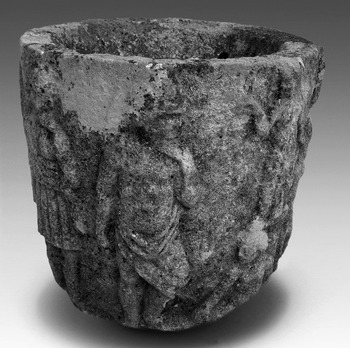
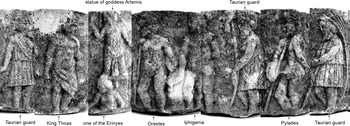
The stone ( fig. 1) was discovered in Fittleworth, West Sussex, approximately 7 km from Bignor Villa. It is approximately cylindrical, with a diameter of c. 295 mm tapering to 265 mm at its lowest point. It can most probably be assigned to the top of a column just below or forming part of the capital. A sculpted frieze ( fig. 2) occupies its vertical face, which survives to a carved depth of c. 12 mm. Martin Henig identified the figured scene as an episode from the story of Iphigenia in Tauris; Ernest Black performed a detailed appraisal.
General view of the sculpture showing King Thoas and the goddess Artemis.

The eroded sculpted frieze, exploded view and annotated.

The main clue to this identification of the scene is the statue-base on which stands a statue of the goddess Artemis holding a bow in her right hand. The goddess is clad in a full-length tunic with bare arms, so probably a peplos, though it may only be fastened at the left shoulder. There is a girdle round her waist and a fold of drapery hangs down between her legs. The myth is best known from Euripides' play Iphigenia in Tauris, produced shortly before 412 b.c. Iphigenia's brother Orestes had come to the land of the Tauri with his companion Pylades in order to steal the statue of Artemis. Orestes had been told by Apollo's oracle that if he brought the statue back with him to Greece he would be freed from the pursuit of the Erinyes (Furies), some of whom still followed him to avenge the matricide of Clytemnestra. In Euripides' play Iphigenia had not, in reality, been sacrificed to Artemis at Aulis by her father Agamemnon, as everybody thought, but the goddess had substituted a deer and had brought Iphigenia to the land of the Tauri to be her priestess. The Tauri lived remote from Greece beyond the Clashing Rocks and there the custom was to sacrifice foreign travellers to Artemis. Iphigenia ritually prepared such victims by purifying them with water, though she did not perform the sacrifice herself.
Among representations of the story of Iphigenia in Tauris is a wall-painting from the House of the Citharist in Pompeii, which provides assistance in identifying the figures on the Fittleworth stone.Footnote 1 To the left of a garlanded altar two male figures with their hands bound must be Orestes and Pylades, who in Euripides' play were captured soon after their arrival in the country of the Tauri and brought to Artemis' temple. To the right of the altar sits King Thoas of the Tauri, bearded and holding a sword, with a guard or attendant standing behind him. In the backgound, on the raised platform of Artemis' temple, stands Iphigenia herself with the statue of Artemis and a second altar to her left.
On the Fittleworth stone three bearded figures in pleated tunics, one to the left and two to the right of the statue of Artemis, are generic figures rather than individuals in the story and represent guards or attendants, corresponding to the attendant accompanying King Thoas in the wall-painting. The second male figure standing to the left of the statue will be King Thoas himself. To the right of the statue stand a nude male figure, then a female, then the two Taurian guards flanking a second nude male. The female is Iphigenia and the male between her and the statue is her brother Orestes, while the nude male between the guards is Pylades.
Although differing considerably in detail, the wall-painting from the House of the Citharist and the Fittleworth stone portray the same episode, an encounter between King Thoas and Orestes and Pylades or between Thoas and Orestes and Iphigenia. In Euripides' play there is no scene where King Thoas confronts Orestes and Pylades; instead Thoas is met by Iphigenia outside the temple and tricked by her into letting her take the statue and the two captured Greeks (covered in cloaks to confine their pollution) to the sea-shore where their ship is concealed. These two portrayals seem to show another version of the story, perhaps one older than the version of Euripides. However, an Attic red-figure krater of c. 390–380 b.c., which shows Thoas seated to the right and Orestes reclining opposite him, also figures Pylades being handed a letter by Iphigenia for delivery to her brother.Footnote 2 Since this letter is a feature of Euripides' play, a confrontation of Thoas and Orestes may have been an early artistic adaptation from it.
An additional figure on the Fittleworth stone, apparently female, is either emerging from or descending into the earth in front of the statue of Artemis. In Euripides' play, before he and Pylades were captured by the Taurians, Orestes suffered a visitation from the Erinyes who pursued him. On mid-second-century sarcophagi in Munich, Paris and Rome, this scene is shown with Orestes (who has collapsed) supported by Pylades and with one of the Erinyes above him brandishing a torch and a whip.Footnote 3 It seems very likely that the figure on the Fittleworth stone is that of a such a Fury and a reference to the ultimate cause of Orestes' troubles.
SCULPTURAL CONTEXT
Mythological figures in sculpture seem largely to be confined to two particular types of monument in the North-West provinces of the Roman Empire. The first of these are the Jupiter Columns, well known from northern Gaul and Germany and also attested by elements found in southern Britain.Footnote 4 Most of the figures that appear on the capitals and more rarely on the column shafts are symbolic, such as the Seasons or Cupids harvesting grapes.Footnote 5 They represent the orderliness and the prosperity guaranteed by Jupiter. Only occasionally is there a narrative element, as on the Corinthian capital from Cirencester, which shows Ambrosia and Lycurgus as well as Bacchus and Silenus on its four faces.Footnote 6 Here the reference is to the attack on Ambrosia by Lycurgus armed with a double-axe, and her transformation into a vine which then strangled him. The defeat of the evil mortal Lycurgus by Bacchus echoed the supremacy of Jupiter who would have appeared enthroned at the very top of the column. A fragment of a column shaft from Hausen an der Zaber (Baden-Württemberg), which shows Ares, Hephaistos, Herakles and Zeus (Jupiter) battling against the Giants,Footnote 7 again emphasises the gods' victory over the forces of disorder.
The Fittleworth Iphigenia in Tauris would not fit easily with the symbolism found on Jupiter Columns. An alternative, much more likely, context for it would be as part of a funerary monument. Blocks re-used in the north wall of the fortress at Chester c. a.d. 300, and probably of third-century date, formed the decoration of one or more tombs and show Actaeon attacked by his hounds, Hercules rescuing Hesione and, probably, the death of Adonis.Footnote 8 While the first serves as a reminder that death can come unexpectedly and undeservedly, the other two scenes offer a hope of salvation from the power of death (Hesione) and even of immortality (since Adonis was restored to life for part of each year to be with Aphrodite). Although little mythological funerary sculpture survives from Britain, many more examples are known from North-West Europe with the tower-monument of the Secundinii at Igel near Trier providing an unparalleled corpus of material.Footnote 9 On the south side of the tower, which shows the members of the Secundinii family and the dedicatory inscription, there is a panel with Hylas and the Nymphs. In the story the beauty of the young companion of Hercules so attracted the water-nymphs that they pulled him down into the water so that he drowned. At the very top of the tower's roof are placed Ganymede and Jupiter's eagle. The two myths, of Hylas and Ganymede, seem to be complementary: Hylas met an early death without any compensation; Ganymede was raised to Mount Olympus and to immortality as the cup-bearer of the gods. The use of these mythological stories to create a contrast is quite deliberate. Scenes showing the failure of Thetis to preserve the life of her son Achilles on the east side of the monument are contrasted with the story of Perseus and Andromeda, whom he saved with Athena's aid, on the west side. The north side shows the apotheosis of Hercules, attended by Athena, forming a link with and a contrast to the fate of Hylas portrayed on the front of the tower. Iphigenia in Tauris, with its twin emphasis on the hardships undergone by Iphigenia herself and by her brother Orestes, from which they finally escape with the aid of Artemis, would seem in place as part of a figured column-shaft in a funerary monument. The sarcophagi, already referred to,Footnote 10 attest the employment of the myth in just such a context.
PETROLOGY
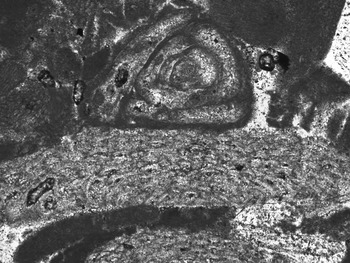
A 10 mm sample removed from an unobtrusive part of the sculpture was prepared and then analysed in thin-section. Petrological comparison was undertaken using Kevin Hayward's reference collection of 100 freestone thin-sections from southern Britain and northern France.Footnote 11 The limestone description for both the hand-specimen and thin-section was based on textural classifications of grain type and cement style.Footnote 12 Accompanying photomicrographs were taken using a Leica DM LP microscope and Leica DFC 320 Digital Camera in order to illustrate the textural similarities and differences ( fig. 3). Macroscopic examination of a fragment using a hand-lens (Gowland x10) shows the rock to be a white to cream-white (5YR 8/1), porous, even-grained powdery, shelly limestone, classified as Shelly Grainstone.Footnote 13
Photomicrograph of the Iphigenia sample (Field of View 1.2 mm; Plane Polarised Light), showing large Amphistegina foraminifera (centre) and Ditrupa wormcast (lower part of screen).

The prepared thin-section was identified as a Biopelsparite,Footnote 14 which shares a number of petrological similarities with a building stone sample of Calcaire Grossier from the Tertiary of the Paris Basin, and architectural fragments from Fishbourne and Richborough. Amphistegina foraminifera and Ditrupa worm casts characterise only Lutetian (Middle Eocene) limestones of the Paris Basin, Northern France.Footnote 15
PROVENANCE
Petrology and the anthropomorphic factors of art and ownership are considered here. The sculpture is carved from a fine shelly limestone Calcaire Grossier that can be sourced on its petrological texture, high porosity and distinctive microfossil (foraminifera) assemblage to the geologically young Tertiary limestone of the Paris Basin (Eocene). No limestone from the British stratigraphic column has this distinctive faunal assemblage. The stone-type has also been identified in rubble and architectural fragments from the monumental archway at Richborough,Footnote 16 ashlar from excavations at Chichester,Footnote 17 and in column bases and capitals from the later first-century a.d. phase of the Palace at Fishbourne,Footnote 18 which indicates that a site in South-East England cannot be excluded as the source for the Fittleworth stone.Footnote 19
Scenes from the story of Iphigenia in Tauris occur on a relief from Sens (France) and on a pedimental relief from Freinz-Lamersdorf (Germany).Footnote 20 The latter is assigned to a funerary monument and that from Sens, dated late first- or early second-century, may also have come from such a monument. If the dating of the Sens sculpture is correct, it indicates the use of the story of Iphigenia in Tauris in the North-Western provinces from an early date.
Jon Edgar was made aware of the sculpture's existence by its owner, a descendant of the antiquary A.J. Kempe (1785–1846),Footnote 21 who frequently reported on Roman finds. The stone has been in a Fittleworth, West Sussex, garden for at least ten years. It is possible that the stone passed down the family line, though equally it may have come from another source. The stone could also have reached the location where it was discovered at any point since the house was built in c. 1840. Both the proximity to Bignor Villa, and a documented visit there by KempeFootnote 22 with his antiquary brother-in-law Charles Alfred StothardFootnote 23 in 1813 are tempting clues to provenance, but completely circumstantial. All that can be surmised until further evidence arises is that the sculpture is highly unlikely to be a product of the Grand Tour, owing to its non-Mediterranean stone type, and that it probably originates from a Roman site in Sussex or South-East England, for there is little evidence of antiquarian collecting of sculpture from Northern France.Footnote 24
ACKNOWLEDGEMENTS
Thanks to the Kempe family, Francis Grew, Richard Hobbs and David Rudling.