INTRODUCTION
Symbioses with photosynthetic algae occur in many marine invertebrates, mostly in members of the Porifera and Cnidaria, but also of the Mollusca, Urochordata and Acoelomorpha (Trench, Reference Trench1993; Venn et al., Reference Venn, Loram and Douglas2008). The Acoelomorpha is a morphologically diverse group of free-living, small (0.5–10 mm long), and soft-bodied flatworms common in intertidal and shallow subtidal marine environments (McCoy & Balzer, Reference McCoy, Balzer and Seckbach2002). Acoel flatworms have historically been placed in the triploblastic phylum Platyhelminthes but recent molecular and morphological evidence has revealed this group to represent the most basic bilaterian triploblastic organisms, and it has been proposed to constitute the new phylum Acoelomorpha (Ruiz-Trillo et al., Reference Ruiz-Trillo, Ruitort, Littlewood, Herniou and Baguñà1999). Although symbioses between acoel flatworms and algae are uncommon, associations with three distinct groups of microalgae are known: green algae (prasinophytes Tetraselmis spp. in Symsagittifera (=Convoluta) spp.), diatoms (Licmophora spp. in Convoluta convoluta (Abildgaard 1806)) and dinoflagellates (Amphidinium spp. in Amphiscolops spp.; e.g. Douglas, Reference Douglas and Reisser1992; McCoy & Balzer, Reference McCoy, Balzer and Seckbach2002; Venn et al., Reference Venn, Loram and Douglas2008).
One of the most well-studied symbiotic acoels is Symsagittifera roscoffensis (Graff, 1891), a flatworm that lives on north-eastern Atlantic sandy shores, where it can form large populations easily noticeable as dark green patches. The green colour of the flatworms is due to the presence of numerous microalgae of the species T. convolutae (Parke & Manton) Norris et al. in their tissues, which can reach densities up to 2–7×10⁴ endosymbionts per animal (Doonan & Gooday, Reference Doonan and Gooday1982). As with other acoelomorpha, adult S. roscoffensis do not ingest food and live autotrophically, depending entirely on the photosynthate produced by the endosymbiont (Boyle & Smith, Reference Boyle and Smith1975; Holligan & Gooday, Reference Holligan, Gooday, Jennings and Lee1975; McCoy & Balzer, Reference McCoy, Balzer and Seckbach2002). Despite this remarkable feature, most studies on the photosynthesis of this symbiosis have been centred on the kinetics of photosynthate production and their use by the host (Muscatine et al., Reference Muscatine, Boyle and Smith1974; Taylor, Reference Taylor1974; Kremer, Reference Kremer1975; Meyer et al., Reference Meyer, Provasoli and Meyer1979), and only a few studies have addressed the quantitative characterization of its photosynthetic performance (Nozawa et al., Reference Nozawa, Taylor and Provasoli1972; Doonan & Gooday, Reference Doonan and Gooday1982).
A long-noticed feature of S. roscoffensis is its vertical migratory behaviour. During daytime, the flatworms appear at the surface of the sand soon after the tide has receded, and migrate downwards just before the flood. This rhythmic behaviour has been interpreted as a way to expose the algal symbiont to light, and thus to allow the production of the photosynthates (Nozawa et al., Reference Nozawa, Taylor and Provasoli1972; Doonan & Gooday, Reference Doonan and Gooday1982; Douglas, Reference Douglas and Reisser1992). Although the search for light at the surface may allow photosynthetic production, it may also be potentially damaging to the photosynthetic apparatus, as the direct exposure to supersaturating irradiances (e.g. during the middle of the day) is a common source of photoinhibition of photosynthesis in intertidal photoautotrophs (e.g. Gévaert et al., Reference Gévaert, Créach, Davoult, Migné, Levavasseur, Arzel, Holl and Lemoine2003; Serôdio et al., Reference Serôdio, Vieira and Cruz2008).
One possible strategy to cope with the prolonged exposure to sunlight is to undergo changes in photophysiology that optimize photosynthesis under high light and confers photoprotection against elevated irradiances (high light-photoacclimation). Microalgae acclimated to high light are known to withstand better the exposure to high irradiances, showing a reduced susceptibility to photoinhibition (Lavaud et al., Reference Lavaud, Rousseau, van Gorkom and Etienne2002; MacIntyre et al., Reference MacIntyre, Kana, Anning and Geider2002; Behrenfeld et al., Reference Behrenfeld, Prasil, Babin and Bruyant2004). However, considering the high motility of flatworms, the possibility to migrate to subsurface layers of the sand under conditions of high solar irradiances can be envisaged as a complementary form of photoprotection (Doonan & Gooday, Reference Doonan and Gooday1982). This behavioural photoprotection would reduce the need to undertake physiological acclimation to high light levels and allow flatworms to flexibly and rapidly control the endosymbiont photosynthesis by regulating light exposure.
To our best knowledge, neither the photoacclimation status nor the photobehaviour of S. roscoffensis have ever been studied on natural populations. The purpose of this study is thus: (i) to characterize the photoacclimation status of S. roscoffensis individuals grown under natural conditions, as well as their photophysiological tolerance to high light; (ii) to characterize the photobehaviour of this symbiosis regarding light preferences and high light avoidance; and (iii) to assess the relationship between light preferences (optimum irradiance for photoaccumulation) and photoacclimation status (optimum irradiance for photosynthesis). The photophysiology of S. roscosffensis was studied using pulse amplitude modulated (PAM) fluorometry, which allows for the non-destructive study of the photosynthetic performance of single individuals. The photobehaviour was studied by characterizing the patterns of distribution of the flatworms under a light gradient, using a custom-made photoaccumulation chamber.
MATERIALS AND METHODS
Specimen collection
Specimens of Symsagittifera roscoffensis were collected at Praia da Vagueira (40°33′52″N 8°46′07″W), a sandy beach located in the central west coast of Portugal, in June and September 2009. The animals were collected on patches formed at the sand surface in the upper intertidal zone. Samples were collected using a spatula to remove the upper layers (~0.5 cm) of sand, and were transported immediately to the laboratory in 1 l glass flasks filled with seawater collected in the same location. In the laboratory, the animals were maintained in shallow plastic trays with sand collected at the sampling site covered by 2–3 cm of 1 µm filtered and UV irradiated natural seawater. The specimens were kept in a growth chamber (Growth Cabinet, Sanyo, Japan) at 20°C on a 12:12 hour L:D regime (fluorescent lamps, FL40SS w/37, Sanyo), 150 µmol m−2 s−1, until the beginning of the experiments, which were carried out in the following two days.
PAM fluorometry
EXPERIMENTAL SETUP
The photosynthetic activity of the flatworms was studied non-destructively using PAM fluorometry (Schreiber et al., Reference Schreiber, Schliwa and Bilger1986). Chlorophyll fluorescence was measured using a fluorometer constituted by a computer-operated PAM-Control Unit (Walz, Effeltrich, Germany) and a WATER-EDF-Universal emitter-detector unit (Gademann Instruments, Würzburg, Germany) (Serôdio et al., Reference Serôdio, Cruz, Vieira and Brotas2005). Measuring, actinic and saturating light were provided by a blue LED-lamp (peaking at 450 nm, half-bandwidth of 20 nm), delivered to the specimens by a 6 mm-diameter fluid light guide fibreoptics bundle or by a 1.5 mm-diameter plastic fibreoptics.
Fluorescence measurements on single individuals were carried out by carefully placing one flatworm in the centre of the well of a concave microscope slide (15 mm diameter well, 0.5 mm deep), filled with seawater and covered with a coverslip, as described by Vieira et al. (Reference Vieira, Calado, Coelho and Serôdio2009). The fluorometer fibreoptics (6 mm-diameter) was positioned perpendicularly to the microscopy slide, and all measurements were made at a fixed distance of 1 mm, controlled by a micromanipulator (MM33, Märtzhäuser, Germany). Due to the animal movements inside the concave well, the microscope slide had to be continuously moved horizontally to maintain the specimen exactly below the fibreoptics. The small dimensions of the animals (<5 mm length) allowed the entire body to remain inside the area monitored by the fibreoptics. The fluorometer was zeroed using the concave microscopy slide (with the coverslip) filled only with seawater.
Due to the continuous movements of the animals and the need for prolonged light exposures (>90 minutes), it was found impracticable to perform the light stress experiments (see below) on single individuals. These experiments were thus carried out using a large number of individuals (> 200) placed in a fluorescence cuvette (KS-101, Walz, Effeltrich, Germany). The fluorometer was zeroed using the cuvette filled only with seawater.
MAXIMUM PSII QUANTUM YIELD
The animals were dark-adapted for 30 minutes, after which one saturation pulse (0.6 seconds) was applied to determine the minimum and the maximum fluorescence levels, F o and F m, respectively. Fluorescence levels F o and F m were used to determine the maximum quantum yield of photosystem II (PSII), F v/F m (=(F m- F o)/F m) (Schreiber et al., Reference Schreiber, Schliwa and Bilger1986). To evaluate the intra-population variability in photophysiological status, F v/F m was measured on a total of 20 individuals selected haphazardly.
LIGHT RESPONSE CURVES
The photoacclimation status of the flatworms was characterized by quantifying their photosynthetic light response through the construction of light-response curves of relative electron transport rate of PSII, rETR. Light curves were generated as described in Serôdio et al. (Reference Serôdio, Cruz, Vieira and Coelho2006b), by exposing each animal to 8 increasing levels of actinic light, from 54 to 920 µmol m−2 s−1. Each light level was applied for 10 seconds (rapid light curves (RLCs) after which a saturating pulse was applied, and the fluorescence levels F s (steady-state fluorescence) and F m′ (maximum fluorescence of a light-adapted sample) were measured. Light curves were constructed by calculating rETR for each level of actinic light E, from the effective quantum yield of PSII, ΔF/F m′ (Genty et al., Reference Genty, Briantais and Baker1989) as such:

and

Light curves were started only after allowing the photosynthesis to reach a steady-state. This was confirmed by exposing each specimen to a constant irradiance of 54 µmol m−2 s−1 until a steady-state in F s and ΔF/F m′ was reached (typically within 5 minutes). For each individual, 3–4 replicated RLCs were determined.
The light-response of S. roscoffensis was characterized by fitting the model of Platt et al. (Reference Platt, Gallegos and Harrison1980) to the rETR versus E curves and by estimating the parameters α (initial slope), rETRm (maximum rETR), and ß (photoinhibition parameter), as in Serôdio et al. (Reference Serôdio, Cruz, Vieira and Coelho2006b) The light-saturation parameter was calculated as E k = rETRm/α. The model was fitted iteratively to the replicated RLCs measured on each individual, using MS Excel Solver, by minimizing a least-squares function.
LIGHT STRESS EXPERIMENTS
The photoprotective capacity of the flatworms against high light-induced photodamage was tested by carrying out light stress experiments as commonly performed for free-living microalgae (e.g. Arsalane et al., Reference Arsalane, Rousseau and Duval1994; Olaizola & Yamamoto, Reference Olaizola and Yamamoto1994; Serôdio et al., Reference Serôdio, Cruz, Vieira and Brotas2005) and photosynthetic symbioses (e.g. Ralph et al., Reference Ralph, Gademann, Larkum and Kühl2002). In each of these experiments, the animals were sequentially exposed to a period of darkness (to establish a pre-illumination reference in F v/F m), a period of low light (to activate the photosynthetic apparatus), a period of exposure to high light, and a final period of darkness (to quantify the recovery of F v/F m). The kinetics of F v/F m recovery after high light exposure, as well as the comparison with the pre-illumination values, allowed the quantification the effects of photoprotective processes and the extent of photoinhibitory damage.
The specimens were dark-adapted for 30 minutes, after which F o and F m were measured, and F v/F m was determined by applying saturating pulses every 2 minutes during 20 minutes. The animals were then exposed to low actinic irradiance (44 µmol m−2 s−1) for 35 minutes and to high actinic irradiance (900 µmol m−2 s−1) for 35 minutes. During the exposure to high light, ΔF/F m′ was determined every 90 seconds. Actinic light was then switched off and saturating pulses were applied each 2 minutes during 30 minutes.
Photobehaviour
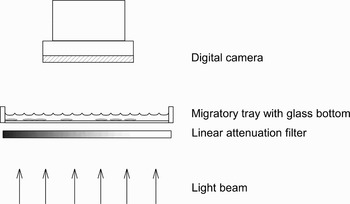
The photobehaviour of S. roscoffensis was studied in a custom-made photoaccumulation chamber (Figure 1), composed of a rectangular tray with a transparent glass bottom, where the animals were placed and were free to move (‘migratory tray’), set on the top of a variable attenuation filter (0–100% transmittance; Continuous Variable Density filter, Edmund Optics, UK). A homogeneous white light beam emitted from a light source placed below the set, passed through an attenuation filter and projected a linear light gradient on the bottom of the migratory chamber. The animals inside the migratory tray were thus exposed to a light gradient and their light preferences could be characterised by their distribution along this gradient and recorded using a digital camera placed directly above the tray. The bottom of the chamber was divided into 10 areas of equal width, arranged perpendicularly to the light gradient. The irradiance reaching each of these areas was measured before the start of the experiments using a PAR micro-sensor (Spherical MicroQuantum Sensor US-SQS/W, Walz, Germany). The irradiance at the bottom of the chamber varied linearly from 10 to 800 µmol m−2 s−1. The light source was a slide projector containing a halogen lamp (Quartzline DDL 150W, General Electric, USA). Light reached the attenuation filter after being reflected by a 45° mirror, to avoid heating the chamber.
Schematic view of the photoaccumulation chamber. A white light beam incides on the linear attenuation filter projecting a light gradient on the transparent glass bottom of the rectangular migratory tray (73 × 22 mm). The animals inside the migratory tray are thus exposed to a continuous light gradient and may freely move along the whole light gradient. The distribution of the animals is recorded using a digital camera placed directly above the tray. Light was provided by a slide projector, and was reflected by a mirror before reaching the chamber to avoid chamber heating (not shown). Components depicted are not to scale.

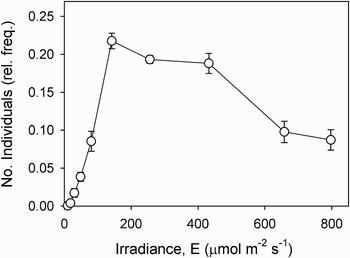
Experiments were carried out by placing 25 S. roscoffensis in the photoaccumulation chamber with the light turned off. After an initial period of 5 minutes, to allow the random dispersion of the animals throughout the chamber, the light was turned on. After 10 minutes of illumination the position of the animals along the light gradient was recorded every 2 minutes for a period of 100 minutes. This experiment was repeated 4 times with different sets of animals. A photoaccumulation curve was constructed from the histogram of the average relative frequency of individuals recorded for each irradiance level (corresponding to each of the 10 areas).
RESULTS
Photoacclimation status
The studied population of Symsagittifera roscoffensis showed a relatively low inter-individual variability regarding photophysiological status. The maximum PSII quantum yield, F v/F m, of recently-collected specimens averaged 0.709, a value near the maximum measured for chlorophytes, and varied by 9.6% (cv; N = 20).
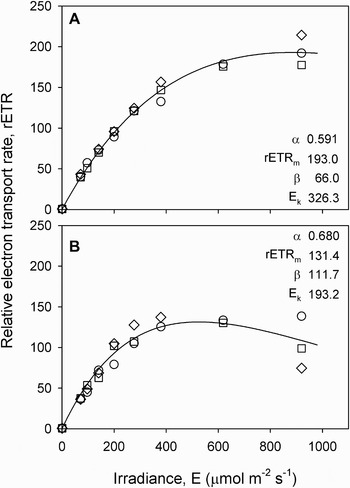
The fitting of the Platt et al. (Reference Platt, Gallegos and Harrison1980) model to RLCs was generally very good (r 2 ≥ 0.944). Figure 2 illustrates the range of variation in the light response of S. roscoffensis, showing two extreme cases of RLCs measured in the population. While similar values of α were determined in the two cases, significant differences were evident regarding the light-saturated part of the curves. In the individual of Figure 2A, the photosynthetic activity saturated at a higher irradiance level (high E k) and virtually no decline was observable within the range of irradiances applied (low ß). On the contrary, the specimen of Figure 2B appeared to be photoacclimated to a lower irradiance level (lower E k), with the associated consequence of withstanding less efficiently high irradiances and showing a distinct decrease under high light (higher ß).
Examples of rapid light response curves (RLCs) of rETR for two Symsagittifera roscoffensis individuals (A and B). RLC parameters as estimated by fitting the model of Platt et al. (Reference Platt, Gallegos and Harrison1980) (lines). Different symbols represent replicated light curves.

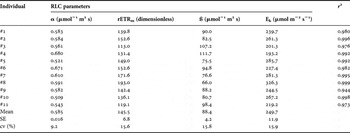
Despite the clear differences between extreme cases, low intra-population variability was generally recorded regarding the photoacclimation status. RLCs showed little variability in the light-limited phase of the curve, with the initial slope, α, averaging 0.585 µmol−1 m2 s and varying between 0.509 and 0.680 µmol−1 m2 s (cv = 9.2%; Table 1). The light-saturated part of the RLCs was found to be overall more variable, with a larger dispersion being found for all parameters characterizing this part of the curve, i.e. rETRm, E k, and ß. rETRm ranged from 113.0 to 193.0 (cv = 15.6%). This higher variability for the RLC parameters related to light saturation was associated to the increase in data dispersion for supersaturating irradiances (i.e. amongst the light-saturated part of the RLC replicates made on the same individual), likely caused by the higher error in the measurements of ΔF/F m′ under high light (and their multiplication by high E values to calculate rETR).
Summary of the light-response curves (RLCs) constructed for 11 Symsagittifera roscoffensis individuals. RLC parameters estimated by fitting the model of Platt et al. (Reference Platt, Gallegos and Harrison1980). For each individual, the model was fitted to 3–4 replicated RLCs. Individuals Nos 1–8 were collected in June, the remaining were collected in September.

Due to the low variability in α, the variation in rETRm was largely followed by a similar variation in the light-saturation parameter E k, resulting in the two parameters being significantly correlated (r 2 = 0.715, P = 0.001). E k averaged 249.7 µmol m−2 s−1, and was the RLC parameter that showed the highest variability, which nonetheless remained below 16% (cv). No significant differences were found between the parameters measured on individuals collected in June or September (t-test, P > 0.05).
Despite this overall low variability in the photophysiological parameters, some distinct patterns could be identified in the photosynthetic response of different individuals. Individuals with RLCs saturating at lower irradiances (lower E k) tended to be more susceptible to high irradiance exposure, displaying a larger decrease in rETR under high light (higher ß), as shown by the significant negative correlations between E k and ß (r 2 = 0.973, P < 0.001). On the other hand, the capacity to attain higher photosynthetic rates was associated to a larger capacity to withstand high irradiances, at least within the range of the levels tested in this work, with higher values of rETRm being followed by lower values of ß (r 2 = 0.653, P = 0.003).
Photoprotection
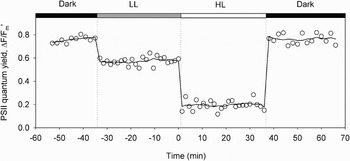
The results of the light stress experiments showed that the individuals of the studied population of S. roscoffensis had the capacity to withstand the exposure to high irradiance levels without any noticeable photoinhibitory effects. Figure 3 illustrates the typical pattern of response of ΔF/F m′ observed upon light activation (following dark-adaptation) and subsequent exposure to high light. Exposure to low light resulted in the rapid light activation of the photosynthetic apparatus, with ΔF/F m′ reaching a steady-state in less than 10 minutes, averaging 0.586. Exposure to high light caused ΔF/F m′ to decrease abruptly to an average value of 0.201, reached ~20 minutes after an initial period of large oscillations. Under high light, ΔF/F m′ remained relatively stable, not showing signs of cumulative negative effects. Of particular interest is the recovery kinetics of F v/F m upon return to darkness, as it is informative on the efficiency of the operation of photoprotective processes. Despite the large data dispersion observed in the final dark period, mostly associated to the continuous movements of the animals in the measuring cuvette, F v/F m was shown to recover very rapidly (98.6% after 10 minutes) to values close to those measured before the exposure to high light (0.767 and 0.756, respectively).
Response of the photosynthetic activity of Symsagittifera roscoffensis, as given by the effective PSII quantum yield (ΔF/F m′), to the sequential exposure to low (LL, 44 µmol m−2 s−1; grey bar) and supersaturating irradiance (HL, 900 µmol m−2 s−1; white bar), and subsequent recovery of the maximum PSII quantum yield in the dark (F v/F m). Vertical dotted lines indicate timing of changes in light conditions. Line given by a 5-point moving average for each light exposure period.

Photobehaviour
The photoaccumulation chamber used in this study provided a suitable form of characterizing the light preferences of S. roscoffensis. The flatworms maintained a continuous locomotory activity through all areas of the migratory tray during the experiment, but an overall tendency became clear after a few minutes. Most animals spent less time in the areas of extreme light conditions, and longer periods in those of intermediate light levels. Figure 4 shows the resulting photoaccumulation curve, constructed from the relative frequencies of individual presences in each section of the migratory tray, for which an average irradiance level was measured. The flatworms clearly avoided darkness or low light levels (<75 µmol m−2 s−1) and, although less markedly, also avoided the irradiance levels in the other extreme of the light gradient. A maximum of accumulation was found around 150 µmol m−2 s−1, with a plateau of high values for light levels up to 400 µmol m−2 s−1. The flatworms appeared to tolerate well irradiances above 400 µmol m−2 s−1, and up to 800 µmol m−2 s−1, as a moderate decline in the distribution frequency was observed in this light range.
Photoaccumulation curve of Symsagittifera roscoffensis, as given by the variation of the accumulation of individuals (relative frequency) along the light gradient. Mean of 4 replicated experiments. Vertical bars represent one standard error.

DISCUSSION
Photoacclimation status
Considering the direct exposure to sunlight experienced by Symsagittifera roscoffensis in its intertidal habitat, sampled specimens could be expected to display photophysiological characteristics of organisms photoacclimated to high light. In microalgae, acclimation to high light typically represents a series of phenotypical changes that result in an increased capacity for photoprotection. This is mainly achieved through the increase in carbon fixation rates under high light and the operation of efficient dissipation pathways of excess light energy (MacIntyre et al., Reference MacIntyre, Kana, Anning and Geider2002; Behrenfeld et al., Reference Behrenfeld, Prasil, Babin and Bruyant2004). The latter are mainly based on the activation of the xanthophyll cycle (in the chlorophytes, the reversible conversion of the pigment violaxanthin to zeaxanthin), that allows the dissipation into heat of the absorbed excess light energy (Müller et al., Reference Müller, Li and Niyogi2001). These processes, although efficiently protecting the photosynthetic apparatus from high light-induced oxidative stress, reduce the maximum photosynthetic rates and may thus reduce the amount of photosynthates made available to the host. Furthermore, high light-acclimation, by allocating cellular resources for optimizing photosynthesis under high light, generally results in lower photosynthetic rates under low light, which may represent a disadvantage in situations of low ambient irradiances (e.g. low tide during early morning or late afternoon).
On the other hand, considering that periods of light exposure are limited to diurnal low tides, thus being relatively short, and separated by prolonged periods of darkness (night, or burial in dark layers of sand during high tide), S. roscoffensis could be expected to show the diagnosing features of low light-acclimation. A low light-acclimated status could also be favoured by the flatworms' high motility and their ability to rapidly move to darker layers below surface under high light conditions (Doonan & Gooday, Reference Doonan and Gooday1982). Photoprotective, light avoidance behaviour is well-known for other motile photosynthetic organisms that are frequently exposed to high light (estuarine intertidal microphytobenthos; Serôdio et al., Reference Serôdio, Coelho, Vieira and Cruz2006a), and also for individual chloroplasts of land plants (Kasahara et al., Reference Kasahara, Kagawa, Iokawa, Suetsugu, Miyao and Wada2002), marine macrophytes (Sharon & Beer, Reference Sharon and Beer2008), or unicellular planktonic microalgae (Furukawa et al., Reference Furukawa, Watanabe and Shihira-Ishikawa1998). A photophobic behaviour that reduces exposure to high light has been referred for other animal/algae associations like the sacoglossan mollusc Elysia timida (Giménez-Casalduero & Muniain, Reference Giménez-Casalduero and Muniain2008). Acclimation to low light results in the allocation of cellular resources for optimizing photosynthesis under low light levels, mainly through the increase in the efficiency of light absorption, by the increase in pigment content or efficiency of light energy transfer between the light-harvesting complexes to the reaction centres. Having the advantage of being more efficient in using available light, low light-acclimated cells may be more susceptible to photodamage if exposed to high light (MacIntyre et al., Reference MacIntyre, Kana, Anning and Geider2002; Behrenfeld et al., Reference Behrenfeld, Prasil, Babin and Bruyant2004).
The results of this study indicate that the photoacclimation status of the studied population of S. roscoffensis is closer to that expected for microalgae acclimated to high light. This is supported by the high values of both α and rETRm, that resulted in values of the light-saturation parameter E k averaging 250 µmol m−2 s−1, and in the absence or in a small reduction in rETR under supersaturating irradiances (low values of ß). The observed values of E k can be considered as high, when compared to the maximum values measured for other photoautotrophs inhabiting temperate intertidal or shallow areas, like macroalgae (215 µmol m−2 s−1; Gévaert et al., Reference Gévaert, Créach, Davoult, Migné, Levavasseur, Arzel, Holl and Lemoine2003), macrophytes (278 µmol m−2 s−1; Silva & Santos, Reference Silva and Santos2003), or kleptoplast-bearing sacoglossa (180 µmol m−2 s−1; Vieira et al., Reference Vieira, Calado, Coelho and Serôdio2009). They are, however, considerably lower than those reported for estuarine intertidal microphytobenthos (427–619 µmol m−2 s−1; Serôdio et al., Reference Serôdio, Cruz, Vieira and Coelho2006b). Furthermore, recorded F v/F m are close to the maximum values measured for green algae (near 0.8; Hofstraat et al., Reference Hofstraat, Peeters, Snel and Geel1994), indicating that the endosymbiont algae are well adapted to the high light levels of the intertidal habitat and do not show any signs of photoinhibitory effects. The low inter-individual variability found for both F v/F m and the RLC parameters indicates a common photoacclimation strategy followed by different members of the population, likely as a consequence of their exposure to an identical light environment.
The only published data on the photoacclimation status of S. roscoffensis (Nozawa et al., Reference Nozawa, Taylor and Provasoli1972) indicated much lower values for E k, between 15 and 45 µmol m−2 s−1 (estimated by converting the published data, in units of foot-candle, to units of irradiance following Thimijan & Heins (Reference Thimijan and Heins1983)). However, these values were measured on individuals not photoacclimated to the natural light conditions but grown in the laboratory, under artificial illumination and lower irradiance levels (Nozawa et al., Reference Nozawa, Taylor and Provasoli1972). The use of cultured specimens using uniform laboratory conditions may also explain the higher inter-individual uniformity amongst the photophysiological parameters recorded in that study.
It can be argued that the exposure of flatworms to relatively low light in the growth chamber during the period between collection and fluorescence measurements may have induced changes in their photoacclimation status. Although this possibility cannot be completely ruled out, a significant underestimation of E k is unlikely, considering the fact that most RLC measurements were carried out on the first day after collection and that large changes in the photoacclimation status of microalgae typically take from several hours to days (MacIntyre et al., Reference MacIntyre, Kana, Anning and Geider2002).
Methodological limitations in photoacclimation status assessment
After its introduction for the study of land plants (Schreiber et al., Reference Schreiber, Schliwa and Bilger1986), PAM fluorometry has been increasingly applied to aquatic and marine organisms, including invertebrate/algal associations like ascidians (Schreiber et al., Reference Schreiber, Gademann, Ralph and Larkum1997), corals (Warner et al., Reference Warner, Fitt and Schmidt1996), anemones and clams (Ralph et al., Reference Ralph, Gademann, Larkum and Schreiber1999), as well as sacoglossan molluscs (Wägele & Johnsen, Reference Wägele and Johnsen2001). To our knowledge, this is the first application of PAM fluorometry to study the photobiology of S. roscoffensis, as this technique has only been applied to Convolutriloba retrogemma (Shannon et al., Reference Shannon, Hatch and Fitt2009). Despite the considerable advantages conferred by this technique, namely the possibility to study flatworms individually and in a truly non-invasive way, the present work showed that its application to S. roscoffensis is hampered by the high motility displayed by these flatworms. Although indices like F v/F m or ΔF/F m′ are not compromised (due to the very short time between the measurement of F o and F m, or between F s and F m′), problems may arise when specimens are required to remain exposed to a constant level of actinic light for a prolonged period of time. This is the case of the generation of the commonly used steady-state light response curves of rETR (LCs), in which rETR is allowed to reach a steady-state under each light level before it is determined (Schreiber et al., Reference Schreiber, Bilger, Neubauer, Shulze and Caldwell1994; White & Critchley, Reference White and Critchley1999).
The alternative to the construction of LCs followed in this study was the generation of RLCs which, by strongly reducing the duration of each light step, can be expected to minimize the errors introduced by flatworms' motility. This approach has already been followed for other motile photosynthetizers, such as benthic diatoms (Serôdio et al., Reference Serôdio, Cruz, Vieira and Brotas2005) or symbiotic sea slugs (Vieira et al., Reference Vieira, Calado, Coelho and Serôdio2009). However, RLC cannot be taken as equivalent to LCs, mostly due to the strong dependency on the photoacclimation status of the sample at the start of the light curve (White & Critchley, Reference White and Critchley1999; Perkins et al., Reference Perkins, Mouget, Lefebvre and Lavaud2006; Serôdio et al., Reference Serôdio, Cruz, Vieira and Coelho2006b). For the symbiotic sea slug Elysia viridis, the comparison between the parameters of RLCs and LCs (α, rETRm, E k) has shown that RLCs can yield good proxies for LC parameters, although the latter may be expected to be slightly underestimated (by less than 14%; Vieira et al., Reference Vieira, Calado, Coelho and Serôdio2009). In the case of S. roscoffensis, a systematic comparison between the two types of light response curves could not be done due to the difficulty of constructing reliable LCs. In this way, it is possible that the presented values of E k may underestimate, although not significantly, the values for steady-state light curves.
Photoprotection
Also consistent with a high light-acclimation status is the observed capacity of S. roscoffensis to withstand the exposure to high irradiance without significant signs of photoinhibition. The results of light stress experiments, showing a rapid and complete recovery of F v/F m following the exposure to supersaturating irradiance, suggest a high tolerance to high light. The decline of F v/F m upon light stress is a common indication of the occurrence of photoinhibition, that is, of irreversible or slowly-reversible damages to the photosynthetic apparatus (Falkowski et al., Reference Falkowski, Greene, Kolber, Baker and Bowes1994). The observed response to light stress, namely the rapid recovery of F v/F m, denotes the operation of efficient photoprotective processes, most likely the rapidly-reversible downregulation of PSII through the operation of the xanthophyll cycle (Müller et al., Reference Müller, Li and Niyogi2001).
The extent of the energy being dissipated through this process can usually be estimated using PAM fluorometry, through the determination of the non-photochemical quenching coefficient (NPQ; Schreiber et al., Reference Schreiber, Bilger, Neubauer, Shulze and Caldwell1994). The calculation of NPQ requires the comparison of absolute values of F m′ during light stress with the pre-illumination values of F m. However, the continuous movement of the flatworms during the various phases of the light stress experiments, and consequently the continuous shifts in the values recorded for both F m′ and F m, made it to impossible to calculate reliable NPQ estimates.
Photoacclimation and photobehaviour
The finding of E k values for S. roscoffensis significantly lower than those measured for microalgae living in nearby intertidal areas (diatom-dominated microphytobenthos; Serôdio et al., Reference Serôdio, Cruz, Vieira and Coelho2006b) suggest a photoacclimation status correspondent to lower light levels than those experienced from direct exposure to sunlight. The maintenance of these lower light-acclimation characteristics may be explained by the use of vertical migration within the sand photic zone to regulate the irradiance levels to which the algal endosymbionts are effectively exposed. Through this motility-mediated regulation of light exposure, the flatworms could remain at sub-surface layers during periods when surface irradiance is higher, avoiding the exposure to the higher range of irradiances, and thus preventing the physiological acclimation commonly undertaken under such conditions. The occurrence of this type of photoprotective behaviour in S. roscoffensis is supported by the results of the photoaccumulation experiments, which have shown a preference for light levels clearly lower than those expected for sand surface at most times of the day. Moreover, the close matching between E k and the optimum range for photoaccumulation further suggests a link between photobehaviour and photoacclimation status, as a combined form of optimization of photosynthesis. In fact, the photosynthetic activity of algal endosymbionts has been shown to affect the photophobic responses of the host in ciliate–chlorophyte associations (Reisser & Hader, Reference Reisser and Hader1984).
However, the coupling between host behaviour and symbiont photophysiology cannot be warranted on the basis of the available data, as the observed phototactic responses could have been visually-mediated and not dependent on algal activity. Although these may effectively provide protection against photodamage caused by high light, they may not be directly linked to the photophysiological requirements of the symbiont. The establishment of a relationship between host photobehaviour and symbiont photoacclimation status could be pursued through the comparison of the photobehaviour of flatworms containing algae with reduced physiological photoprotection, e.g. acclimated to very low light or treated with inhibitors of main photoprotective process (e.g. the xanthophyll cycle).
ACKNOWLEDGEMENTS
We thank Rui Rocha, Helena Coelho and Ana Ré for helping in the stocking of the specimens used in this study. J. Ezequiel is a recipient of a FCT—Fundação para a Ciência e a Tecnologia doctoral grant (SFRH/BD/ 44860/2008). We thank two anonymous referees for their critical comments on the manuscript.