Regulatory treaties do not impose binding obligations on non-members, so broad participation is essential for their effectiveness. Why are some some states eager to ratify such treaties, while others hold out? A burgeoning literature analyzes the determinants of treaty ratification,Footnote 1 but it mostly focuses on a limited range of macroeconomic and macropolitical factors, such as trade openness and domestic political institutions. To develop a more complete understanding of the politics of treaty ratification, it is essential to account for a richer variety of factors.
We contribute to the study of regulatory treaties by showing that technological innovativeness is an important determinant of treaty ratification. If a treaty regulates an industry, it also increases the global demand for new products that comply with the regulatory provisions. When innovative national industries can profit from developing these new products, they lobby governments for treaty ratification. From pesticide regulationFootnote 2 to the harmonization of regional and global telecommunications,Footnote 3 agreements that regulate state behavior create markets for new products. Technological innovativeness, we argue, is a central determinant of ratification for regulatory treaties that create global commercial opportunities. For states with innovative national industries, these commercial opportunities are a key impetus for treaty ratification.
We test this hypothesis against ratification data for two major multilateral treaties that regulate the use of pesticides: the Rotterdam Convention (10 September 1998) and the Stockholm Convention (23 May 2001).Footnote 4 The Rotterdam Convention requires exporters of hazardous pesticides to obtain Prior Informed Consent (PIC) from officials of the target nation prior to delivery, whereas the Stockholm Convention phases out hazardous substances.Footnote 5 Thus both treaties increase the global demand for alternative pest management strategies, including new pesticides and biotechnology. Our empirical analysis shows that national innovativeness in biotechnology, measured as the number of international patent applications, strongly influences the likelihood of that a country will ratify a regulatory treaty.
This article contributes to the burgeoning treaty ratification literature. Previous research has emphasized domestic political institutions,Footnote 6 structural economic factors,Footnote 7 constituency preferencesFootnote 8 and international pressures.Footnote 9 We contribute to this literature by showing how technological innovativeness shapes state preferences. If this finding can be generalized, the conventional wisdom on factors that influence regulatory treaty ratification may require substantial revision.
Another contribution pertains to the role of technology in international politics. With few exceptions,Footnote 10 scholars of international co-operation have not made technology a central element of their arguments. As Fritsch writes in a recent review of the literature, ‘only a few notable studies have investigated the … fundamental relationship between technology and global affairs’.Footnote 11 Future research should regard technology innovation as an integral influence on regulatory co-operation and investigate the influence of technological factors on international co-operation.
Treaty Ratification and Regulatory Co-Operation
While scholars of treaty ratification recognize the importance of domestic constituency preferences, they do not provide a systematic account of technological factors. Although the importance of business preferences and technological innovation has been recognized, their impact on treaty ratification has not been investigated. Our argument thus integrates these two literatures.
Treaty Ratification
Countries ratify treaties to participate in international institutions. To begin with, structural factors may influence a country's basic propensity to ratify treaties. Economic openness may increase a government's incentive to ratify treaties for reputational reasons,Footnote 12 while economic wealth may make countries willing to pay for the ‘luxury good’ of environmental co-operation.Footnote 13 Similarly, previous research highlights the importance of domestic political institutions. Institutional constraints, such as numerous veto players, may impede ratification,Footnote 14 and democracies have greater incentives to provide public goods to voters participating in international institutions.Footnote 15 In autocratic societies, treaty ratification may also be a small concession to domestic opposition.Footnote 16
Scholars have also recognized the importance of domestic constituency preferences. Nuanced studies of the strategy of treaty ratification emphasize the benefits that accrue to the government and influential domestic constituencies. For example, Simmons and Danner argue that while some governments ratify the International Criminal Court for ‘expressive’ reasons, others do so as a credible commitment to violence reduction.Footnote 17 Similarly, democratizing states sought ratification of the European Convention for the Protection of Human Rights and Fundamental Freedoms in the aftermath of World War II as a credible commitment to human rights and democratization.Footnote 18
Other studies examine the influence of organized interests. For example, trade agreements are largely shaped by their expected effect on companies’ profits.Footnote 19 In environmental politics, Bernhagen argues that influential business groups generally undermine the ratification of environmental treaties because they prefer to avoid new regulations.Footnote 20 Conversely, Spring and Vaahtoranta emphasize the importance of the net environmental benefits that a state would obtain from treaty co-operation.Footnote 21 Simmons has also argued that domestic activists often mobilize in support of ratifying human rights treaties, and thus induce the government to pay the sovereignty cost of participation.Footnote 22
International factors, such as competition and diffusion, are also important. Elkins et al. write that the ratification of bilateral investment treaties is driven by competition for capital,Footnote 23 while Von Stein emphasizes the importance of flexibility provisions for participation in climate treaties.Footnote 24 Another important factor is peer pressure. Neumayer finds, for instance, that regional peer pressure has influenced the ratification of the Second Optional Protocol to the International Covenant on Civil and Political Rights.Footnote 25 With regard to power politics, McLean and Stone argue that the European Union has exercised regional hegemony to induce Eastern European countries to ratify the Kyoto Protocol.Footnote 26 Drezner notes that regulatory convergence at the international level is most likely when major powers agree on what kind of regulation is in their best interest.Footnote 27
Regulatory Co-operation
Businesses usually oppose new regulations aimed at reducing negative externalities, such as pollution.Footnote 28 Since regulations require companies to make costly changes to their business practices, and such changes are costly,Footnote 29 most companies prefer to avoid them. This notion is widely accepted in the literature on global environmental governance, and many scholars have emphasized the importance of business opposition to environmental regulations in explaining policy outcomes.Footnote 30 Though most such studies are silent on treaty ratification, Bernhagen argues that business groups usually oppose environmental treaty ratification because such treaties generally ‘require firms to reduce emissions, increase recycling, pay more for energy, or switch to alternative, often more expensive, fuels and inputs’.Footnote 31
However, businesses may sometimes ally with activists who support new regulations because regulation creates rents for incumbents through barriers to entry.Footnote 32 In the international context, Vogel has argued that import competitors may benefit from regulations that implicitly discriminate against foreign producers.Footnote 33 According to Kono, democratic governments may use such standards to ‘obfuscate’ protectionist policies from the general public.Footnote 34 DeSombre also maintains that even if businesses initially oppose domestic regulations, they may ultimately accept them as a fait accompli and demand that the government induces other countries to adopt similar regulations.Footnote 35
While this literature has largely ignored technology innovation, there are some notable exceptions. BenedickFootnote 36 and ParsonFootnote 37 argue that a key reason why the United States supported the Montreal Protocol on ozone depletion was that the American chemical industry expected to be able to use inexpensive substitutes for ozone-depleting chemicals in production.Footnote 38 Clapp argues that industries may support the negotiation of environmental treaties when they do not compromise valuable intellectual property rights and create markets for new products.Footnote 39 However these studies do not take into account the effect of technology innovation on national ratification, or conduct empirical hypothesis tests.
Technology Innovation and Treaty Ratification: The Argument
We argue that technology innovation allows national industries to profit from regulatory treaties (international agreements that mandate new national regulations).Footnote 40 For example, the Kyoto Protocol imposes legally binding emissions reductions on industrialized countries. Regulatory treaties can be found in many issue areas. For example, the International Labour Organization has produced treaties that proscribe child labor and improve occupational safety regulations.
Global Regulation, Technology Innovation and Firm Profits
The effect of global regulation on profits depends on a firm's technological innovativeness. Global regulations restrict the use of existing products, with two effects. First, producers of inexpensive, simple products may lose their market share. Secondly, new opportunities emerge for marketing advanced products that comply with the global regulations.
The more that a firm's core competence lies in the production of inexpensive goods, the less able that firm is to exploit the new markets created by regulations.Footnote 41 Lacking the capacity to produce new technology, firms that mostly compete on price lose their competitive advantage as the simple products they were previously able to produce at low cost are banned.
Conversely, the more active a firm is in research, and the more it seeks to protect valuable new intellectual property through patents, the more it can profit from the new markets that regulations create.Footnote 42 As regulations prevent the use of existing products, whether for environmental or health concerns, the consumers of these products seek alternatives. Such alternatives must meet the new regulations, so product innovation is necessary. Firms with considerable innovative capacities invest in research and development (R&D). In doing so, they increase their market share because their competitors, which are not as innovative, cannot offer inexpensive alternatives to these new products, provided that intellectual property rights are adequately protected.Footnote 43
Incentives to innovate within the regulated industry are another key factor. As Levin et al. show in a major survey of multiple manufacturing industries, the importance of technology innovation, and the ‘appropriability’ of profits from it, varies substantially across industries.Footnote 44 Companies in relatively mature industries with slow technology innovation may not be in a position to develop highly profitable products in response to new environmental regulations, which may condition possibilities for corporate support of international regulation.
The Role of Treaty Ratification
If national industries expect profits from global regulation, what can the government do? A government's decision to ratify can help a treaty enter into force. Treaty ratification also puts normative and reputational pressure on other states, especially ‘peers’ with similar characteristics.Footnote 45 Ratification increases the cost of non-compliant behavior through reputational and other enforcement mechanisms.Footnote 46 By ratifying a regulatory treaty, officials can also participate in decision making on implementation, enforcement and monitoring. Additional ratifications strengthen regulatory treaties, so technologically innovative industries have incentives to support their ratification.
Governments are interested in a national industry's profits when this industry is economically important and politically influential. If the companies in the industry have similar interests, they can engage in collective action to shape policy; even if their interests diverge, a dominant company may succeed in lobbying. While many of the most advanced technology industries are now thoroughly transnational, many political channels of influence remain national – or regional in the case of the European Union.Footnote 47 Thus national legislatures have a key role to play in the politics of treaty ratification.
For multinational companies, the picture is also complicated by foreign subsidiaries. Subsidiaries with little innovation capacity may lobby on behalf of their innovative parents, so producers in one country may lobby for new regulations even if their own innovation capacities are limited. Even then, their interests are often aligned because the production of technologically advanced products calls for a highly skilled workforce, regardless of whether most of the R&D is conducted abroad. Thus subsidiaries have similar incentives as their parents unless the former do not participate in the production of advanced technology.Footnote 48
Industries can lobby for treaty ratification in several ways. Public communication allows industry associations to argue their case for or against treaties. For example, major biotechnology companies and trade associations initiated a public campaign to support the ratification of the Rotterdam and Stockholm Conventions. On 13 July 2004, Mr. Steven Goldberg of CropLife America, a biotechnology industry association, testified to the House Committee on Energy and Commerce, noting that the organization's ‘member companies develop, produce, sell and distribute virtually all the crop protection and biotechnology products used by American farmers’ and arguing that ‘the expedient US ratification and implementation of these treaties is vital to protect our country's interests’.Footnote 49
Policy makers respond to lobbying for several reasons. In addition to providing direct political support, such as campaign funding,Footnote 50 industries can play a useful role due to their informational advantage.Footnote 51 They hold private information regarding the economic consequences of regulatory treaties, and they do not have incentives to support a treaty that would reduce their profits. While the industry has its own incentives to misrepresent information, at the very least the government can trust that the industry offers political support for treaty ratification. If an innovative industry supports treaty ratification, it also has incentives to participate in the ratification and implementation process.
Empirical Implications
We expect that nations with substantial technology innovation capabilities have strong incentives to ratify multilateral environmental treaties.
Hypothesis: Countries with high technological innovation in a given industry are more likely to ratify a treaty regulating this industry than are countries with low innovation, ceteris paribus.
In addition to this primary hypothesis, our argument has empirical implications for institutional design. If regulatory treaties work when industries support them, it seems reasonable to expect that they are also designed to garner industry support. In particular, such treaties should create new markets for safe and sustainable products while otherwise imposing a limited regulatory burden on businesses.
Global Pesticides Regulation
We apply our theory to global pesticides regulation for two main reasons. First, the global regime for pesticides regulation comprises two important multilateral treaties – the Rotterdam and Stockholm Conventions – that exert considerable influence on national regulatory choices.Footnote 52 Given that there are two core treaties with a demonstrable influence on national regulations, the case cannot be dismissed as trivial ‘window dressing’. We can also test the same hypothesis for two mostly similar multilateral treaties. Secondly, new regulations create markets for sustainable products that innovators can sell at a high price.
While it would be a stretch to say that these two treaties are representative of the universe of environmental agreements, they do have much in common with other treaties. Similar to treaties such as the Cartagena Protocol, the two pesticide treaties constrain the use of certain products (pesticides and genetically modified organisms), thus creating profitable opportunities for substitutes (biological pest control and organic farming). The key difference is that the profitability of substitutes is higher in the case of pesticides, and so the Cartagena Protocol would not be a good application of our theory.Footnote 53 In general, the external validity of the argument is only high for treaties that ban mature technologies for which technologically advanced alternatives exist. In addition to pesticides, many health and agricultural regulations also appear suitable. Treaties such as the 1989 Basel Convention on hazardous waste also seem to fit, provided that nuanced data on the incentives of the recycling technology industry can be collected. Even climate treaties that create demand for renewable energy technology may qualify, though with appropriate modifications for macroeconomic costs.
Technology Innovation in the Pesticide Industry
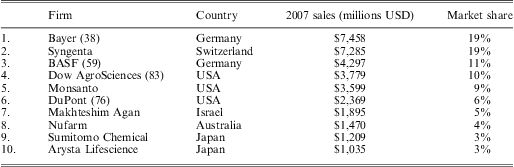
While the production of agrochemicals, including pesticides, is a genuinely global industry, the largest firms are clustered in a few countries. Table 1 lists the ten largest agrochemical firms, per 2007 sales revenue.Footnote 54 The U.S.-based chemical giants Dow and DuPont are the only other agrochemical firms to rank among the world leaders in R&D activity, though both rank lower than their German counterparts with respect to agrochemical sales and overall R&D activity.
The Ten Largest Agrochemical Firms in 2007

Note: numbers in parentheses denote the firm's rank on the IEEE's 2007 ranking of the world's 100 largest R&D firms (if applicable).55
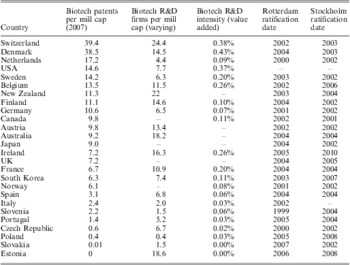
While detailed data on national industry characteristics are not available for many countries, it is nonetheless useful to examine the composition of national biotechnology industries in broad strokes. The Organisation for Economic Co-operation and Development (OECD) has collected recent data on biotechnology industries in twenty-six countries, as shown in Table 2. In addition to biotechnology patenting rates, the table shows (1) the number of firms with a primary focus on biotechnology per million inhabitants, (2) the biotechnology R&D intensity of the country and (3) ratification dates for the Rotterdam and Stockholm Conventions. If our argument is correct, then increases in the number of companies and R&D intensity should be negatively correlated with ratification delay.
Biotechnology Industry, Technology Innovation and Treaty Ratification in Select Countries

The data in Table 2 show that biotechnology patents are strongly correlated with the number of biotechnology firms and R&D intensity. First, the correlation between the number of patents and the number of firms is r = 0.51, while the correlation between the number of patents and R&D intensity is as high as r = 0.81. Secondly, the table shows a clear pattern: even within the set of mostly advanced industrialized countries, there is a strong positive association between biotechnology innovation and treaty ratification. With one notable exception (the United States), treaty ratification occurs faster in countries that have active biotechnology industries. As expected, the correlations between biotechnology patents and the year of ratification for the Rotterdam and Stockholm Conventions are negative: r = −0.22 and r = −0.23, respectively.
The Rotterdam Convention
The Rotterdam Convention was adopted on 10 September 1998 and entered into force on 24 February 2004. It requires exporting parties to obtain explicit consent from importing states before shipping hazardous substances (enumerated in Annex III). Parties must also notify the treaty secretariat whenever they impose significant domestic regulations on chemicals not already governed by the treaty (Article 5). If a new pesticide or chemical is regulated by parties from two different regions, that substance is forwarded to a review committee for possible inclusion in the treaty (Article 5). New substances may also be proposed for inclusion in the treaty at the request of a single developing country or economy in transition, if the party has experienced significant problems from the use of that substance (Article 6). However the ultimate decision about whether to include a new substance in treaty regulations is left to the Meeting of Parties to the Convention, which operates by consensus. While it is relatively easy to initiate the consideration of additional regulated substances, the treaty creates a number of veto points that may block such additions.
The requirement of consensus to add new chemicals is consistent with our theory of corporate preferences in international regulation. Industry may favor regulation if it creates markets for more profitable new products. However, industry will then have a strong incentive to protect those new products from potentially costly regulation. The design of the Rotterdam Convention reflects these incentives well. While it does not ban the production of older, ‘generic’ pesticides and chemicals, the PIC mechanism substantially increases transaction costs for firms that wish to sell such products internationally. The Rotterdam Convention also represents an implicit judgment that some pesticides and industrial chemicals are superior (at least environmentally) to their competitors. Thus the treaty may confer valuable reputational benefits for firms.
At the early stages, industry groups opposed a strong treaty. The Chemical Manufacturers Association (CMA), backed by a coalition including the United States, opposed an EC proposal to modify text referring to ‘acutely hazardous’ chemicals to simply ‘chemicals with severe environmental or health effects’.Footnote 56 Later in the meeting, the CMA unsuccessfully backed a proposal to keep legal liability on the side of importing countries, rather than with exporters. However as some of the uncertainties surrounding the form of regulation were resolved, industry opposition weakened. By June 1998, at the final preparatory conference prior to the Rotterdam meeting, the chemical industry was squarely behind the adoption of a legally binding agreement involving prior informed consent. Industry's main interest at this point, as expressed by the representative from the International Council of Chemical Associations (ICCA), was to restrict regulation to the twelve chemicals explicitly designated in the treaty text. The chemical industry favored relatively stronger requirements for the expansion of regulation to new chemicals, arguing in favor of ‘risk assessment’, rather than ‘precautionary’ criteria.Footnote 57 Per our theory, industry favored regulations that create new markets but opposed rules that could limit those markets in the future.
The provisions and negotiations undermine the claim that the Rotterdam Convention is an instance of shallow co-operation. Given that it allows the inclusion of new chemicals, ratification would not be an entirely ‘safe bet’ for a country that can easily comply with the initial provisions yet is not interested in deeper co-operation. Similarly, strong industry support for the treaty during the final negotiations is difficult to reconcile with the idea that the Convention is just a scrap of paper: if shallow co-operation is inconsequential, the chemical industry should be indifferent, not enthusiastic, about the treaty.
The Stockholm Convention
The Stockholm Convention was adopted on 22 May 2001 and entered into force on 17 May 2004. It involves commitments to eliminate or restrict the very production or use of persistent organic pollutants (POPs) (Article 3). Specifically, the Convention establishes three types of POPs, with varying degrees of regulation. Annex A to the Convention lists pesticides and industrial chemicals, the production and use of which are to be eliminated. Annex B lists POPs that shall be subject to greater restrictions. When the Convention text was adopted, this category consisted solely of DDT. Parties rejected an outright ban primarily because DDT has valuable applications in combating vector-borne diseases, such as malaria. Finally, Annex C lists pollutants that are produced as by-products of other industrial processes. Although the Convention provides for the eventual elimination of these substances, short-term restrictions are subject to feasibility concerns. The Convention also clearly establishes a procedure for including new pollutants in the future. The Stockholm Convention also includes a number of other notable provisions: measures designed to help developing countries enhance their regulatory capacity, including information exchange (Article 9), technological transfers (Article 12) and financial transfers (Articles 13 and 14).
The negotiation of the Stockholm Convention was less dramatic than that of the Rotterdam Convention. The most contentious issue throughout the five negotiating sessions was that of financial transfers to developing countries. The G-77 and China pressed for the creation of a separate multilateral fund dedicated specifically to building capacity for management of POPs. The majority of industrialized countries preferred to use an existing institution for this purpose – the Global Environment Facility (GEF) – so they could wield relatively greater influence. In the end, negotiating parties compromised by agreeing to use the GEF on an interim basis.
There was little disagreement concerning the initial list of pesticides and chemicals – the ‘dirty dozen’ – that would be subject to the Convention. Indeed, most of these had already been phased out by contracting parties. The ICCA, which participated in negotiations leading up to the adoption of the Stockholm Convention, emphasized its support for the Convention through negotiations. As with Rotterdam, industry's main concern centered on the procedure for including new substances in the Convention. The ICCA consistently argued that new substances should be evaluated by risk assessment, rather than a strict interpretation of the precautionary principle. At the first meeting of the Stockholm Convention negotiating committee, held from 29 June to 3 July 1998, the ICCA argued that ‘the scope of the convention should not be expanded beyond the [original twelve] POPs until science-based criteria’, since risk assessment had been established within the Convention.Footnote 58 Subsequently, the ICCA sought to nudge the bar higher for including new chemicals under the Convention. It reiterated its earlier position that the Convention should prioritize the substances that had already been identified, and suggested that ‘in-depth assessments’ must reveal ‘information that clearly indicates that the substance is of global concern’.Footnote 59
The final text of the Stockholm Convention reflects this preference. Article 8 establishes the Conference of Parties as the final arbiter for inclusion of new substances. Although Article 8 directs the Conference of Parties to act ‘in a precautionary manner’, it also specifically provides for risk management. Notwithstanding this compromise, the Conference of Parties uses a consensual decision rule. Consistent with our expectations, industry supports the regulation of unprofitable substances in order to create new markets for more profitable substitutes.
Neither the above provisions nor the negotiations are compatible with the shallow co-operation hypothesis. The Stockholm Convention allows the inclusion of new chemicals, and the strong industry support indicates that they perceived the treaty as highly profitable. If industry expected the treaty to be inconsequential window dressing, it would not have expended considerable effort to promote it.
The subsequent behavior of the agrochemical industry shows how technological innovativeness created support for global regulatory treaties. In 2007, only three years after the Stockholm Convention entered into force, BASF launched a major new commercial product in the long-lasting insecticide nets market sector. This product, ‘Interceptor’, is designed to replace the use of DDT as a means of controlling vector-borne diseases, the only application that remains permissible under the Stockholm Convention. Since developed countries have banned the domestic use of DDT, production of the chemical has shifted to developing countries. The eventual inclusion of DDT as a controlled substance under the Stockholm Convention represents one of the major remaining business opportunities for highly innovative manufacturers, and BASF's behavior indicates that this opportunity has not gone unnoticed.
The April 2011 addition of a highly toxic pesticide, endosulfan, to the Stockholm Convention provides further evidence of this dynamic. Endosulfan is not a new product. The German agrochemical firm Farbwerke Hoechst AG began selling it in the United States in the 1950s.Footnote 60 By the 2000s, however, concern over adverse health effects associated with endolsulfan led a number of OECD countries to consider bans on the production and use of the substance. Accordingly, major European producers such as Bayer CropScience began to shift their commerical portfolios away from endosulfan.Footnote 61 By the time endosulfan was approved for inclusion under the Stockholm Convention, over the initial opposition of India, global production had shifted from developed to developing country firms specializing in the production of non-patent-protected chemicals. The reason for India's reluctance to support the ban was not hard to discern; by 2011, Indian firms accounted for more than 60 per cent of the global production and use of endosulfan.Footnote 62
Research Design
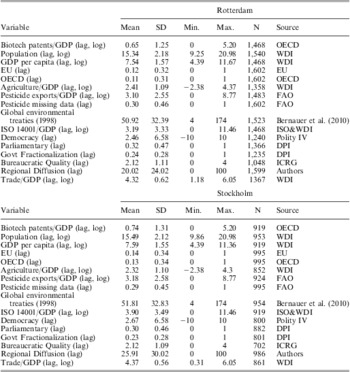
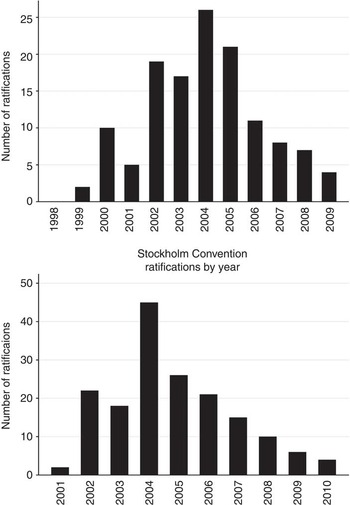
To provide a systematic evaluation of our hypotheses, we constructed two cross-national datasets for survival analyses of treaty ratification. The Rotterdam Convention dataset spans 130 countries and the years 1998–2009. Of these countries, eighty-five ratified the Rotterdam Convention during this time. The Stockholm Convention dataset spans 130 countries and the years 2001–2009. Of these countries, 102 ratified the Stockholm Convention during this time. We lose a number of small countries due to missing data.Footnote 63 Source information and descriptive statistics for these and all of our control variables are presented in Table 3. Global ratification patterns are shown in Figure 1.
Summary Statistics for the Rotterdam (above) and Stockholm (below) Conventions

Ratification events for Rotterdam and Stockholm

We analyze the duration of time before the ratification of the Rotterdam and Stockholm Conventions by estimating separate Cox proportional hazards models for each agreement. These survival models tell us the ‘hazard’ of a country ratifying a given convention at a given time. The empirical analysis of the ratification hazard is commonly used as a proxy for national treaty support,Footnote 64 and can be justified as follows. As national legislatures contemplate the ratification of a multilateral treaty, their decisions are influenced by multiple factors. Some of these factorsm are unobservable, so it would be impossible to accurately predict the exact timing of ratification. The timing of ratification itself is also meaningful to international co-operation. Earlier ratifications mitigate concerns over free riding and frequently contribute to entry into legal force. Thus empirical analyses should be based on estimated ratification probabilities at different times.Footnote 65 The Cox model allows us to estimate the effect of our main explanatory variable on this hazard. Our primary hypothesis indicates that the effect should be positive, sizable and statistically distinguishable from 0.
Our basic model for each convention is:
 $${{H}_i}{\rm{(}}t{\rm{)}}\, = \,{{h}_0}{\rm{(}}t{\rm{)}}{{e}^{{\rm{[}}\beta PATENT{{S}_{i,t}}\, + \,\gamma CONTROL{{S}_{i,t}}{\rm{]}}}} .$$
Here, Hi (t) represents the ‘risk’ of country i ratifying the convention at time t, given technology innovation capacity (PATENTS) and relevant control variables (CONTROLS). Thus β is the coefficient for innovation capacity and γ is a vector of coefficients for the control variables. The baseline hazard rate, h 0(t), is left unspecified.Footnote 66 This model is based on the assumption that the influence of one covariate relative to others remains proportional over time. To verify that the proportionality assumption holds, we use the Schoenfeld residuals test.Footnote 67 This facilitates interpretation greatly, as exponentiating the coefficient for a given variable yields the hazard ratio for that variable.
The dependent variable is the hazard rate of treaty ratification. For ratification, we coded whether a country has ratified the convention in focus during a given episode of time. We define episodes annually, since that is how our covariates are measured. The beginning and end of each episode are coded in terms of time elapsed since adoption of the treaty text. This information allows us to calculate the baseline hazard of treaty ratification: the effect of the passage of time on the probability of ratification, absent all other variables. We can then express the effect of our independent and control variables in terms of hazard ratios: changes to the underlying hazard rate per one-unit increase of a covariate.
The signature-ratification distinction is inconsequential for our purposes. Countries can only sign each multilateral treaty within one year of adoption in the negotiations, and signature does not commit a country to ratification. In addition, initial signature is not required for subsequent ratification. Indeed, many countries that ultimately did not ratify these treaties, such as the United States, signed them immediately. In a robustness check, we also consider initial signature of the treaty.
We estimate Huber-White robust standard errors clustered by country.Footnote 68 They allow us to account for heteroskedasticity and correlation of residuals for each country due to unobservable country characteristics. We cannot estimate direct calendar year effects for our Cox models, but as a robustness check we also estimate parametric models with various time effects included, and all our results remain unchanged.Footnote 69
Independent Variable
Our primary independent variable is Biotechnology Innovation Capacity, lagged by one year to avoid possible simultaneity bias. We measure biotechnology innovation capacity by the yearly number of biotechnology patent applications filed under the 1971 Patent Co-operation Treaty (PCT), by country of inventor. A PCT application is interpreted as an application for a ‘priority status’ that prevents other inventors from patenting a given invention in foreign markets. As such, it signals the inventor's intent to commercialize an invention in international markets. The data are from the OECD Patent Statistics database.Footnote 70 A major advantage of this dataset is that there are no missing data because the patent applications are centrally administered.
Biotechnology patents are particularly suitable for measuring commercial innovation. The biotechnology category is sufficiently broad to include not only direct biochemical substitutes for older pesticides and chemicals but also innovations in genetic engineering that may reduce the need for pesticides. It is defined by the OECD, so our own subjective biases cannot contaminate the measure. The patent category contains selected patents from five major classes: agriculture, health, organic chemistry, biochemistry and laboratory instruments. From each class, OECD researchers have selected more detailed sub-classes that specifically relate to biotechnology. While it is impossible to verify the exact number of patents that are somehow related to pesticides and other chemicals regulated by the Rotterdam and Stockholm Conventions, we investigated the description of each sub-class and found that all of them contain products that could be used in plant disease control. Additionally, only one of the five major classes specifically focuses on health, the other major use of biotechnology in modern societies, and each sub-class within the health category contains products that could also be used in plant control. As a robustness test, we also included all PCT patents for each country-year in the regression, and found that they do not predict ratification of either treaty, while biotechnology patents continue to exert a positive influence.Footnote 71
We normalized the number of patents by gross domestic product (GDP) to account for variation in the size of the economy.Footnote 72 Specifically, we divided the annual number of patents by GDP, measured in hundreds of billions of constant 2000 USD.Footnote 73 Without such normalization, large countries such as the United States and Germany would completely dominate over all other countries.Footnote 74 For example, Denmark is a small country with a population of 5.5 million in 2010, but it has a very innovative biotechnology industry. Without accounting for the size of the economy, the critical importance of biotechnology for the Danish economy would not be reflected in the data. For political lobbying, it is also the relative (not absolute) size of an industry within a country that matters.Footnote 75 As a robustness check, we also verified that all of our results hold without logarithmization.
The use of patents as a proxy for innovation capacity is established in the scholarly literature.Footnote 76 It yields a quantifiable intermediate measure of innovation output, and given our focus on commercial innovation, the fact that some technologies may not be patentable is a relatively minor concern. Indeed, studies of patenting practices highlight that the chemicals industry is unusually dependent on patents for intellectual property rights protection.Footnote 77 To be sure, using patents as a measure of innovation performance is not without disadvantages. As noted in the OECD Patent Statistics database, ‘the propensity to patent differs across countries’, and some patents ‘have no industrial application’.Footnote 78 The former problem is mitigated by our usage of international patent applications; the latter concern is minor because we focus on biotechnology innovations that require substantial R&D investments, and are thus rarely forthcoming unless they promise substantial commercial profits.
One issue concerning the use of international patents is the delay between the initial research investment and the patent application. A biotechnology patent filed in 2010, for example, often results from years of research and development. For our purposes, this delay does not present a problem. In all countries with high patenting rates, these rates either remained stable (United States) or increased somewhat over time (Denmark, Switzerland). If anything, the delay thus leads us to underestimate the importance of biotechnology innovation in key countries.
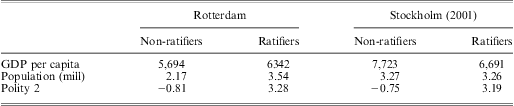
Perhaps the most important impediment to empirical inference is the possibility that biotechnology patents are correlated with other factors, such as GDP per capita or regime type. In addition to controlling for such factors, we conducted several additional tests to reject the spurious correlation hypothesis. First, we examined whether ratifiers and non-ratifiers are systematically different along these lines. As shown in Table 4, the only systematic difference that we found pertained to regime type. Yet when we exclude non-democracies from our dataset, our results remain unchanged. Secondly, we examined correlations between biotechnology patent rates and these variables. The only relatively strong correlation we found was between GDP per capita and biotechnology patent rates, r = 0.52. We thus estimated all our models excluding countries with a GDP per capita less than USD 5,000, and all our results remained unchanged. Finally, we excluded all countries from our dataset that did not produce any patents in any year. Again, our results remained unchanged.
GDP Per Capita, Population and Regime Type for Ratifiers Versus Non-ratifiers (by 2011)

Note: the values are for the first possible year of ratification.
Control Variables
We control for a number of additional variables that might influence ratification. The appendix introduces several additional control variables that we added to our main models to scrutinize the robustness of our empirical results. All control variables are lagged by one year to avoid possible simultaneity bias. Those that are not normally distributed are also logarithmized to prevent outliers exerting undue influence on our results.
Because domestic political factors may influence the speed of ratification, we control for the influence of domestic political institutions on treaty ratification. Since treaty ratification often requires legislative approval, we distinguish parliamentary systems from presidential ones, in which the legislature approving the treaty may be controlled by a different party than the executive, which controls the signature of a treaty. Given that the executive and legislative bodies are separated, presidential systems are likely to be slower to ratify treaties than parliamentary systems. Therefore we include in our models a dichotomous measure that distinguishes whether or not a country has a parliamentary system. We supplement this by controlling directly for fractionalization – a measure of divisions within the government, and thus the probability of ratification failure due to conflict – as measured in the Database of Political Institutions.Footnote 79 As a final robustness check, we apply a measure of ‘ratification difficulty’ from Simmons.Footnote 80 This variable captures institutional impediments to speedy ratification, and thus accounts for supply-side constraints on treaty participation.
We also control for the relative importance of pesticide production in the national economy. We use the value of pesticide exports because domestic production data are not available. Since both treaties limit the free trade and production of these commodities, countries will ratify more slowly if pesticide exports comprise a relatively large share of the national economy. We obtained yearly pesticide export data from the FAO in USD and normalized it by GDP, measured in billions of dollars.Footnote 81 We logarithmize these values to limit the influence of outliers, though all results also hold without logarithmization.Footnote 82 Since countries report these data voluntarily to the FAO, and selection effects may exist, we supplement export data with a dichotomous measure to distinguish whether or not a country fails to report pesticide exports.Footnote 83
Since this measure does little to capture the domestic demand for controlled substances, we also control for the importance of agriculture to a national economy, measured as the value of agriculture and normalized by GDP, as reported in the World Development Indicators. Countries with large agricultural sectors may ratify these treaties slowly due to the higher compliance costs.
The extant literature shows that economic openness promotes the ratification of environmental treaties.Footnote 84 We thus control for trade openness, or the total value of a country's trade divided by GDP.Footnote 85 Given influential outliers, we logarithmize this variable.
Since environmental preferences and treaty implementation capacity may depend on national wealth, we add logarithmized GDP per capita.Footnote 86 The purpose of this control variable is to account for possible wealth effects, such as increased preference for environmental quality among citizens, as immediate economic hardship is mitigated through enhanced productivity. The data are from the World Development Indicators and measured in constant 2000 USD.
Following the literature on democracy and environmental co-operation,Footnote 87 we control for democracy (Polity IV). According to the literature, democratic countries should be more likely to support environmental co-operation because their governments have a stronger interest in providing public goods for the citizenry. In some robustness checks, we also enter a dichotomous variable that distinguishes whether or not the national executive represents a right-wing political party, on the assumption that more conservative governments may be less interested in international environmental co-operation in general.Footnote 88 Another robustness check accounts for the presence of an environmental ministry.Footnote 89
Since countries may ratify regulatory treaties because they expect benefits from capacity building,Footnote 90 we include the bureaucratic quality variable from the International Country Risk Guide to account for this possibility. If countries are interested in capacity building, then bureaucratic quality should, all else equal, reduce the likelihood of ratification in any given year.
We control for the possible influence of membership in relevant international organizations by including dichotomous variables for OECD and EU membership. Since the EU expanded during the period that the Rotterdam and Stockholm Conventions were negotiated and ratified, and the acquis communautaire specifically incorporates environmental criteria, we expand our definition of EU members to include non-members during years in which they were formal applicants for membership. While we unfortunately do not have detailed data on prior pesticide regulations, the OECD variable helps address the shallow co-operation hypothesis. Given that OECD countries have much more stringent pesticide regulations than other countries, the OECD variable reflects the effect of prior regulation on ratification propensity.
Next, ‘green’ countries may have strong incentives to ratify multilateral environmental treaties. To account for this tendency, we add a variable measuring the number of multilateral environmental treaties that each country has ratified prior to 1998, the first year of our dataset.Footnote 91 Based on previous research,Footnote 92 one expects countries to ratify more environmental treaties if their citizens have a strong interest in environmental co-operation. This control variable accounts for this possibility. The data are from Bernauer et al.Footnote 93
To control for domestic environmental interest, we also include the ratio of International Organization for Standardization (ISO) 14001 standards to the country's GDP. ISO 14001 is a global management standard that companies can adopt. Recent research shows that they do so in order to signal their environmental commitment to customers.Footnote 94 This variable captures domestic environmental interest in another way and further strengthens the robustness of our empirical approach.
To control for norm diffusion, we include a variable measuring the proportion of other countries in each region that has already ratified. According to previous research on norm diffusion, regional ratification should have ‘neighborhood effects’ that promote ratification.Footnote 95 Finally, we control for the effect of population on the speed of treaty ratification.
Four robustness checks warrant a brief discussion. First, we consider an extended model with several regional dummies. Secondly, we include a binary variable that indicates whether a country was an original signatory of the convention in focus. Thirdly, we include US and EU foreign aid to account for possible foreign influence. Finally, we add another measure of the strength of the environmental civil society by counting the number of environmental non-governmental organization (NGO) headquarters located in each country.Footnote 96
Sample Selection
For robustness checks, we examined additional sub-samples for each dataset. First, we excluded all autocratic and anocratic country-years, as measured by a Polity IV score of less than +5. This ensures that our results are not driven by different causal processes in democratic and non-democratic countries. Secondly, we conducted outlier tests to investigate whether some countries had undue influence on our statistical estimates. For each treaty, we found several potential outliers, as described in detail in the appendix. When we excluded these outliers from our datasets, our findings remained unchanged. To ensure that our findings also hold among developed countries, as a robustness check we excluded all country-years with per capita GDP less than USD 5,000 (in constant 2000 dollars). Finally, we excluded all countries that had never filed a biotechnology patent application with the PCT. While the statistical significance levels decreased somewhat due to the smaller dataset, the main results continued to hold.
Findings
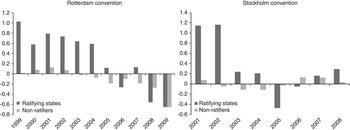
We find that international biotechnology patent applications are, controlling for other covariates of treaty ratification, positively associated with the ratification of each treaty. Before presenting the regression results, we provide a non-parametric graphical illustration of the main empirical findings. Figure 2 shows the (demeaned) value of our biotechnology patents measure for states that ratified at exactly time t versus all states that have yet to ratify by that time. For both conventions, the graphical pattern is clear: in almost all years, treaty ratifiers have had much higher biotechnology innovation capabilities than non-ratifiers. The effect is particularly strong for the early years, indicating that the most eager ratifiers have a very strong biotechnology advantage vis-à-vis other countries.
Biotechnology patents in ratifying Versus other states in a given year t. Note: positive (negative) values indicate that the state-year in focus has more (fewer) patents than the median state-year in the dataset.

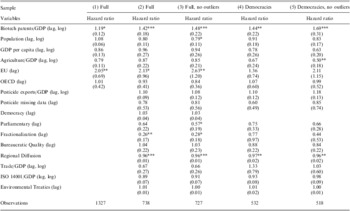
Results for the Rotterdam Convention are reported in Table 5. The table shows hazard ratios, so coefficients below 1 suggest a negative effect while coefficients above 1 suggest a positive effect. The first column presents a restricted model that focuses on our independent variable and a small number of controls. The second column presents our main model, with a full sample, while Model 3 excludes biotech patent outliers. Models 4 and 5 replicate Models 2 and 3, respectively, using a sample that is restricted to democratic countries. As the table shows, biotechnology innovation is a substantively powerful and statistically robust predictor of treaty ratification.Footnote 97 In the main model (Column 2), increasing the logarithmized patents per GDP value by one standard deviation prompts an increase of 60 per cent in the hazard ratio. If outliers are excluded, this increases to 70 per cent.
Ratification of the Rotterdam Convention

Note: (1) full sample, basic; (2) full sample, extended; (3) democracies; (4) full sample, excluding outliers; (5) democracies, excluding outliers. Robust standard errors in brackets.
***p < 0.01, **p < 0.05, *p < 0.1.
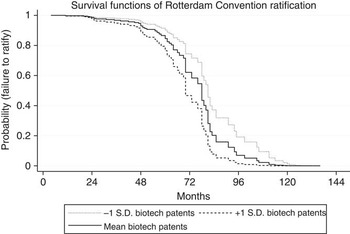
Figure 3 shows the baseline survival function for our main model, with all covariates held at their means. The dotted and dashed functions represent the effect of a one standard deviation decrease and increase in the value of our biotech patents measure. Initially, most countries were slow to ratify. Over time, however, the influence of biotechnology innovation becomes clear. At seventy-two months, an increase from one standard deviation below the mean to one standard deviation above corresponds to a change from a 25 per cent proability of ratification to a 45 per cent probability of ratification. At eighty-four months, this change in biotech innovation corresponds to a change from just over 60 per cent probability of ratification to just over 90 per cent probability of ratification. When the convention entered into force, high-innovation countries (>30 per cent probability of ratification) were more than twice as likely as low-innovation countries (15 per cent) to have ratified.
Survival functions for Rotterdam Convention ratification. Probability (failure to ratify)

Few other variables appear to have an effect on treaty ratification. EU membership appears to have a strong, positive effect on the probability of ratification in a given year, but this effect loses significance once we restrict the sample to democratic countries. We also find a statistically significant negative effect concerning regional ratification trends, suggesting that there was no regional ‘bandwagon effect’ in ratification of the Rotterdam Convention. Instead, it seems that laggards within regions continue to refrain from ratification despite diffusion processes. When we remove outliers from the full sample, we find significant and negative effects for population, fractionalization and, surprisingly, parliamentary government. None of these variables is significant in models restricted to democratic countries. When we remove similar outliers from our sample of democratic countries, we find a strongly negative, and statistically significant, effect for agriculture: large agriculture shares of GDP predict a substantially lower hazard of ratification in a given year. Thus we do find some support for the shallow co-operation hypothesis:Footnote 98 countries that pay a high cost are less likely to ratify. Remarkably, we found that neither of our measures of domestic environmental preferences – ISO 14001 adoption and ratification of other environmental treaties – had significant effects on ratification of the Rotterdam Convention.
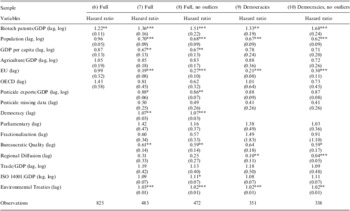
The results for Stockholm are reported in Table 6. Again, biotechnology innovation is a key predictor of treaty ratification. In the main model, the effect of a one-unit increase in the logarithmized patents measure on the hazard ratio is 53 per cent. When we exclude clear outliers, the effect increases to 76 per cent. As with the Rotterdam Convention, when we remove outliers from our sample of democratic countries the effect of biotech innovation is even stronger.
Ratification of the Stockholm Convention

Note: (6) full sample, basic; (7) full sample, extended; (8) democracies; (9) full sample, excluding outliers; (10) democracies, excluding outliers. Robust standard errors in brackets.
***p < 0.01, **p < 0.05, *p < 0.1.
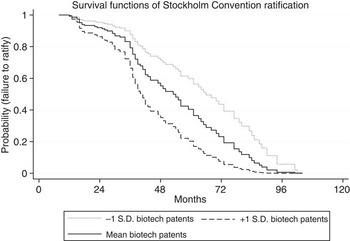
Figure 4 shows the survival functions for our main model, with all covariates held at their means. Again, the dotted and dashed functions represent the effect of a one standard deviation decrease and increase in the value of our biotech patents measure. Since the Stockholm Convention more directly creates opportunities for new products, we would expect the influence of biotech innovation to be even greater than it was for the Rotterdam Convention, which simply established a procedure of prior informed consent. Figure 4 shows that this is precisely the case. At thirty-six months, an increase from one standard deviation below the mean for biotech patents to one standard deviation above corresponds to a change from a 10 per cent proability of ratification to a 25 per cent probability of ratification. At forty-eight months, this change in biotech innovation corresponds to a change from a 25 per cent probability of ratification to just over 60 per cent probability of ratification. Finally, at sixty months, there was still only a 40 per cent probability of ratification among low-innovation countries, compared to a 80 per cent probability among high-innovation countries. This unambiguous difference between low- and high-innovation countries provides clear evidence in support of our theory.
Survival functions for Stockholm Convention ratification

As to control variables, we find that democracy has a modest, positive effect on treaty ratification. Unlike our main model for the Rotterdam Convention, we find that EU membership had a negative influence on ratification of the Stockholm Convention. This effect persists even when we restrict our sample to democratic countries. It is very possible that this results from our finding that participation in other environmental treaties was a strong and significant predictor of Stockholm (but not Rotterdam) ratification. We also find that bureaucratic quality had a significant, negative effect on Stockholm ratification. This is intuitive, because countries with limited bureaucratic quality may benefit from the capacity-building efforts of regulatory treaties such as the Stockholm Convention. Finally, as with the Rotterdam Convention, we fail to find any evidence of regional bandwagons in ratification. Some countries remained outsiders despite regional diffusion processes.
Illustrative Ratification Histories
To illustrate the quantitative findings, we now present three brief ratification histories. We chose one enthusiastic country (Germany), one laggard (India) and a seemingly failed prediction (the United States). This case selection allows us to illustrate the processes leading to different outcomes and examine why the statistical model failed to predict the important case of the United States. First, we analyze a positive observation, namely Germany's early ratification of each treaty. Consistent with our theory and empirical findings, the ratification of both conventions was entirely uncontroversial in Germany. It did not provoke any industry resistance, because the influential German Chemical Industry Association was a global leader in pesticides and biotechnology innovation, and thus expected to benefit from new pesticides regulations. Our theory can also explain why India tried to undermine the conventions during the negotiations, ratified it with much delay and has played an obstructionist role in the implementation of the treaties: the Indian pesticides industry does not have the technology innovation capabilities to compete with pesticides manufacturers from advanced industrialized nations, so it stands to lose from stringent pesticides regulations. Finally, we examine the case of the United States, a country with innovative biotechnology and pesticides industries that failed to ratify the two conventions. Ratification failed, largely for institutional reasons, despite strong industry support for the two multilateral treaties.
Germany
Germany was among the earliest ratifiers of both the Rotterdam and Stockholm Conventions. The Rotterdam Convention became available for ratification in September 1998 and Germany was the twelfth country to deposit its instrument of ratification in January 2001. The Stockholm Convention became available for ratification in May 2001, and Germany ratified it less than a year later in April 2002 (the fifth country to do so). Germany's early ratification is fully consistent with our theory. Germany has a very large agrochemical industry that is technologically among the most sophisticated in the world. This is reflected in international patents data. According PCT data, Germany had the second-most biotechnology patent applications in the world in 2001 (1,055), behind only the United States. Controlling for GDP, Germany's biotechnology patent application rate was eleventh highest in the world. Given the size of Germany's economy, this is a considerable achievement.Footnote 99
We conducted a systematic media search of English- and German-language newspapers, and found very little evidence of ratification controversies or industry opposition to either convention.Footnote 100 Indeed, our most important finding was that the ratification of neither treaty provoked any public controversy whatsoever. One of the few media articles that specifically addressed the global pesticides regime from September 2002 noted that in Germany, ‘the pesticides industry supports the Rotterdam Convention … members of the [agrochemical] industry association Agrar have already in 1989 voluntarily committed to the PIC principle’.Footnote 101 Consistent with the negotiation history and our theoretical argument, the article also notes that Agrar advocates science-based consideration of future changes in the list of pesticides subjected to PIC.Footnote 102
Indeed, the German pesticides industry's own rules prevent it from profiting from pesticides that either convention would proscribe. According to the industry association's website, the obligations of membership ‘include the responsibility to only export such pesticides to foreign countries that are legal in OECD countries and thus meet high environmental and security standards’.Footnote 103 Thus it is not surprising that the ratification of the Rotterdam and Stockholm Conventions did not provoke the usual industry backlash in Germany. Indeed, as discussed earlier, Bayer CropScience ceased sales of endosulfan in anticipation of its inclusion in the Stockholm Convention.
India
India is among the least co-operative countries with regard to pesticides. Despite the severe negative health effects of unregulated pesticides use for the rural poor, and chemical accidents such as the December 1984 Bhopal disaster, the Indian government has undermined the Rotterdam and Stockholm Conventions. It only ratified the Rotterdam Convention in May 2005 after it had already entered into force, and the Stockholm Convention in January 2006, also after it had entered into force. Even after ratification, India's national implementation policy has been weak. Industry opposition to both conventions has also been apparent. This is not surprising, given that India has a large but technologically primitive pesticides industry.Footnote 104 According to our theory, industries in countries like India have incentives to oppose new environmental regulations because they are not in a position to profit from stringent regulatory measures that open new markets for sustainable products. Instead, restrictions on pesticides use would undermine their competitive position vis-à-vis manufacturers from advanced industrialized countries such as Germany.
While Germany's ratification process attracted little media attention, India's behavior within the global pesticides regime has been carefully documented in the Indian and international media. Our media search of English-language newspapers and negotiation documents provided several important insights.Footnote 105 The Indian delegation appears to have been particularly active in the negotiations on the Stockholm Convention. In the first meeting of the Negotiating Committee, June–July 1998 in Montreal, ‘India … said due consideration should be given to the economic viability of alternatives to POPs for developing countries’ while ‘[t]he Indian Chemical Manufacturers Association (ICMA) noted that DDT is still in use for malaria control in India’.Footnote 106 In the second meeting, in Nairobi in January 1999, ‘India … stressed the need for differentiated timetables for phasing out POPs’.Footnote 107 In the remaining meetings, India actively but unsuccessfully led developing countries in demanding sizable financial transfers for the implementation of the Stockholm Convention.
The Indian chemical industry was also very active in delaying ratification of the Stockholm Convention. On 8 June 2003, a co-chairman of ICMA's international treaties expert committee, S. Ganesan, argued that ‘[i]f accepted at this juncture, the globally legally binding treaty would be detrimental to the health of the Indian chemical industry’.Footnote 108 The Indian chemical industry also tried to coax the government to select ‘conditional ratification’ of the Stockholm Convention that would allow it to opt out of any future decisions regarding chemical regulation. When the Indian government finally ratified the treaty three years later, the ICMA announced that it would ‘boycott’ the national implementation of the treaty.Footnote 109
While India's negotiation moves and ratification of the Rotterdam Convention did not provoke equally acrimonious public controversies, the Indian chemical industry nonetheless opposed the treaty. Within Indian industry, treaties such as the Rotterdam and Stockholm Conventions are perceived less as mechanisms for environmental co-operation and more as de facto efforts to promote European industry. As the chair of the Indian Chemical Council's Committee on International Treaties explained in a public press release, each time the international community has acted to regulate pesticides or industrial chemicals, ‘developing countries lose one widely used inexpensive generic chemical. Stopping its production, sale and exports [results in] in significant loss of invested capital, revenues (including export revenues) [and] loss of employment to developing countries’. The distributional consequences are far different in European countries, where such such regulation ‘involves no cost (but only gains)’, since the EU ‘nominates a chemical to POPs list only after banning its production within EU and after developing substitute chemical’.Footnote 110
Even after ratification, the Indian delegation has adopted negotiation positions to undermine the expansion of the PIC principle. Perhaps most importantly, it has opposed the inclusion of endosulfan, a powerful pesticide used in cotton farming, in the Rotterdam and Stockholm Conventions. For example, in the fourth meeting of the Conference of the Parties for the Rotterdam Convention, in October 2008 in Rome, India (supported only by Pakistan) exploited the consensus decision rule to prevent the inclusion of endosulfan in Annex III of the Convention.Footnote 111 In December 2010, the Pesticides Manufacturers and Formulators Association of India and the Endosulfan Manufacturers and Formulators Association argued that the planned ban of endosulfan, actively promoted by the EU, was intended ‘to destroy 70 per cent of the world exports of the product from India … arguments put forward by an international committee for imposing the ban was not based on scientific evidence, but by the brute display of voting power by the members’.Footnote 112
United States
The United States is a particularly interesting case for our purposes. In 2001, the number of US biotechnology patent applications filed with the PCT (5,869) was more than five times that of Germany, its closest rival.Footnote 113 The American delegation was also active in the negotiations of both treaties, and despite the replacement of the Democratic Clinton administration with the Republican Bush administration in 2001, the executive continued to support the ratification of both treaties. Nonetheless, the United States failed to ratify either of them. This case, thus, seems to contradict our argument. However we use process tracing to show that the biotechnology industry supported the ratification of these treaties, while the ratification failure was caused by the anti-regulatory preferences of some Republicans in the Senate, combined with the requirement that sixty-seven of the 100 Senators must vote ‘yea’ for a treaty to be ratified.
While the United States opposed the precautionary principle in the negotiations on both treaties, it was ultimately satisfied with the final texts. Moreover, the executive wing has supported the ratification of both treaties. In April 2002, the Bush administration made a public commitment to ratify the Rotterdam and Stockholm Conventions as soon as possible.Footnote 114 Consistent with our theoretical argument, this decision was strongly supported by the main industry association, the American Chemistry Council (ACC). According to ACC website, ‘The US chemical industry – which participated in the negotiations along with environmental organizations – agrees that the new global rules represented by the treaties are an appropriate step in enhancing health and environmental protections’.Footnote 115 Similarly, the Alliance for the Responsible Use of Chlorine Chemistry – a major coalition of chemicals manufacturers and chlorine users – argued in September 2003 for ratification, noting that ‘ARCC support of the Stockholm Convention and related treaties is based on achieving three goals: consideration of the legitimate interests of America's workers and companies; identification and adoption of global environment protections; and the promotion of economic growth for both developed and developing nations’.Footnote 116
Why, then, did the United States fail to ratify the two treaties under both the Bush and Obama administrations? The reason seems to be opposition in the Congress – the Senate in particular – to allowing the Environmental Protection Agency to incorporate international rules into decision making on chemicals. According to Kristin S. Schafer, ‘[t]he primary barrier to ratification has been a reluctance to establish a reasonable domestic system for taking action when new chemicals are added under the treaty’.Footnote 117 While even key Republicans supported the principles underlying the conventions, they were concerned about conflicts between domestic and international law.Footnote 118 Thus attempts to formulate domestic implementing legislation that would allow ratification have continued to fail, despite unusually strong support from environmental, consumer and industry groups. The ratification failure of the United States can be ascribed to domestic political institutions, not industry opposition.
Additional Evidence
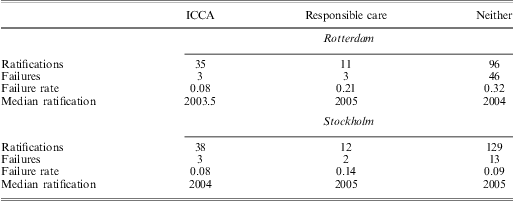
Another set of evidence pertains to national membership in the ICCA,Footnote 119 an international NGO that admits national chemical industry associations as members. Given that the ICCA was created to advance the interests of the American and European chemical industries, its members are generally technologically innovative. One would expect countries with an ICCA chemicals industry to ratify the Rotterdam and Stockholm Conventions, because a key goal of the ICCA is to create new markets for chemical products. In addition to its regular members, the ICCA also has a Responsible Care program that focuses on voluntary actions to improve the environmental and health sustainability of chemicals production through safer products.Footnote 120 The demand for such products increases as participation in the Rotterdam and Stockholm Conventions increases. Thus one would also expect Responsible Care members that are not regular ICCA members to ratify the Rotterdam and Stockholm Conventions.
Table 7 provides a ratification analysis.Footnote 121 It shows that ICCA members are the most likely to ratify – and to do so faster than others. For the Rotterdam Convention, Responsible Care members are also much more likely to ratify than others. For the Stockholm Convention, non-ratification is relatively rare, but Responsible Care members have an earlier median ratification date than non-members. While these findings are not conclusive, they are consistent with our theoretical argument.
Ratification by ICCA and Responsible Care Membership

Conclusion
Multilateral treaties are an important part of global governance. We have identified technological innovation as a powerful rationale for why industries support the ratification of regulatory treaties. If regulations constrain the use of existing products, they also create opportunities for the commercialization of more sustainable products. Based on this argument, we have hypothesized that countries with sizable, technologically innovative industries should be the most likely to ratify regulatory treaties. Our empirical analyses of the association between biotechnology patents and the ratification of the Rotterdam and Stockholm Conventions have provided robust support for this hypothesis.
These findings have several important implications for the study of international regulatory co-operation. First, they underscore an important source of political support for the formation and implementation of multilateral treaties: profit opportunities for influential industries. While previous research has highlighted factors such as domestic political institutionsFootnote 122 or institutional design,Footnote 123 and some scholars have argued that businesses usually oppose regulatory co-operation,Footnote 124 we have found that robust business support has underpinned the ratification of two effective multilateral treaties that form the core of the global pesticides regime. These findings imply that future empirical studies of international regulatory co-operation should incorporate variables that measure technology innovation and commercialization into their theoretical and empirical models. In particular, environmental scholars should not assume that businesses generally oppose environmental regulations in the absence of a compelling rationale for doing so.
Secondly, our results indicate a previously undertheorized obstacle to international regulatory co-operation more generally: lack of business support. Classical co-operation theory emphasizes international enforcement issuesFootnote 125 and distributional conflict,Footnote 126 and several recent studies emphasize the importance of domestic institutionsFootnote 127 and constituency preferences.Footnote 128 Our findings contribute to this literature by highlighting the central importance of organized and motivated businesses.
Thirdly, the results also indicate the need for future research that explicitly incorporates technological innovation and change into the analysis. Although some scholars have argued that technology is central to international co-operation,Footnote 129 the field suffers from a paucity of rigorous and empirically falsifiable theories of how technological factors condition the success or failure of international regulatory co-operation. Our study shows how empirical analyses can be improved by including carefully chosen measures of technology innovation in the equation.
This study may also contain useful insights for policy makers. If business support is an important determinant of successful regulatory co-operation, and technology innovation opportunities may help garner business support, then policy makers may consider designing international regulatory institutions in view of commercialization opportunities. For example, if policy makers can increase the effect of multilateral environmental treaties on the profitability of technology innovation, it would be easier to bring them into force and perhaps to implement them. A note of caution is in order, however. This strategy produces treaties that are biased towards industry interests and against future change. Yet in some circumstances thisit may be a ‘second-best’ solution that could open new opportunities for deeper regulatory co-operation.