Introduction
Entomopathogenic nematodes (EPN) are a group of nematode families which are insect parasites and possess many attributes that enable their commercial use as biocontrol agents (Kaya & Stock, Reference Kaya, Stock and Lacey1997). They are promising candidates for biocontrol of insects due to their ability to search for hosts, safety to non-target organisms and the environment, high reproductive potential, capacity to be mass produced and ability to be used with other agricultural chemicals (Koppenhöfer, Reference Koppenhöfer, Lacey and Kaya2000). Only the infective third-stage juveniles (IJ) of these nematodes are found free living in soil and non-feeding stages, under diverse ecological conditions and in all kinds of habitats (Hominick et al., Reference Hominick, Reid, Bohan and Briscoe1996), being able to survive in soil for extended periods, until they find a suitable host. EPN are distributed worldwide, and include more than 16 species of Heterorhabditis and at least 60 species of Steinernema (Nguyen & Hunt, Reference Nguyen and Hunt2007). They are obligate parasites of insects that form complex, highly virulent symbiotic relationships with enterobacteria, Xenorhabdus–Steinernematidae and Photorhabdus–Heterorhabditidae (Boemare, Reference Boemare and Gaugler2002). As parasites of insects, they have a wide range of hosts (Kaya & Gaugler, Reference Kaya and Gaugler1993) being used in crop protection in Australia, Europe, USA and Asia (Georgis et al., Reference Georgis, Koppenhöfer, Lacey, Bélair, Duncan, Grewal, Samish, Tan, Torr and van Tol2006).
The study of their genetic diversity is extremely important because new species and/or isolates may be useful as biological control agents against agriculturally important pests (Stock, Reference Stock, Stock, Vandenburg, Glazer and Boemare2009). The detection and identification of indigenous EPN isolates is of major importance, due to differences in strain virulence against natural and local insect pests, environmental conditions that may affect their survival and reproductive potential (Stock, Reference Stock, Stock, Vandenburg, Glazer and Boemare2009). Several surveys on EPN have already been conducted in Mediterranean countries, namely Egypt (Shamseldean & Abd- Elgawad, Reference Shamseldean and Abd-Elgawad1994), Greece (Menti et al., Reference Menti, Wright and Perry1997), Italy (Triggiani & Tarasco, Reference Triggiani and Tarasco2000), Israel (Glazer et al., Reference Glazer, Liran and Steinberger1991), Palestine (Iraki et al., Reference Iraki, Salah, Sansour, Segal, Glazer, Johnigk, Hussei and Ehlers2003), Spain (García del Pino, 2005; Campos-Herrera et al., Reference Campos-Herrera, Escuer, Labrador, Robertson, Barrios and Gutiérrez2007) and Turkey (Hazir et al., Reference Hazir, Keskin, Stock, Kaya and Özcan2003). Recently, surveys have been conducted in several European countries, such as Austria (Hozzank et al., Reference Hozzank, Wegensteiner, Waitzbauer, Burnell, Mráček and Zimmermann2003), Belgium (Midituri et al., Reference Midituri, Waeyenberge and Moens1997), Bulgaria (Shishiniova et al., Reference Shishiniova, Budurova and Gradinarov2000), Czechoslovakia (Mráček et al., Reference Mráček, Bečvár and Kindlmann1999), Denmark (Nielsen & Philipsen, Reference Nielsen and Philipsen2003), France (Emelianoff et al., Reference Emelianoff, Le Brun, Pages, Stock, Tailliez, Moulia and Sicard2008), Germany (Sturhan & Ruess, Reference Sturhan and Ruess1999), Poland (Bednarek, Reference Bednarek1998), Russia (Ivanova et al., Reference Ivanova, Danilov and Ivakhnenko2000), Slovakia (Sturhan & Liskova, Reference Sturhan and Liskova1999), Switzerland (Steiner, Reference Steiner1996) and United Kingdom (Gwynn & Richardson, Reference Gwynn and Richardson1996). Entomopathogenic nematodes show significant variation in behaviour, host range, infectivity, reproduction and tolerance to adverse environmental conditions and therefore it is of major interest to fully characterize natural populations (Stock, Reference Stock, Stock, Vandenburg, Glazer and Boemare2009).
Studies on the genera Steinernema and Heterorhabditis have been conducted using molecular methods, such as random amplification of polymorphic DNA (RAPD) (Liu & Berry, Reference Liu and Berry1996) and restriction fragment length polymorphism (RFLP) (Reid et al., Reference Reid, Hominick and Briscoe1997). After several tested methods, sequencing of different regions of the genome has become the most suitable approach, not only for assessing phylogenetic relationships, but also for species delimitation (Stock, Reference Stock, Stock, Vandenburg, Glazer and Boemare2009). Among nuclear genes, ribosomal genes have been used extensively at different taxonomic levels. Ribosomal genes include the 18S rRNA gene, the internal transcribed spacers (ITS1 and ITS2), the 5.8S and the 28S rRNA genes, which contain variable and conserved regions (Stock, Reference Stock, Stock, Vandenburg, Glazer and Boemare2009). The 5.8S rRNA gene is a highly conserved region, contrary to the ITS1 and ITS2 regions, which evolve at a higher rate than the 18S and 28S rRNA genes, making them ideal for phylogenetic studies at species and population levels (Nguyen et al, Reference Nguyen, Maruniak and Adams2001; Spiridonov et al., Reference Spiridonov, Krasomil-Osterfeld and Moens2004; Stock, Reference Stock, Stock, Vandenburg, Glazer and Boemare2009). Sequences of the D2D3 expansion region of the 28S rRNA gene were used by some authors to characterize EPN populations (Stock et al., Reference Stock, Campbell and Nadler2001) and may yield more information than the ITS region. On the other hand, mitochondrial cytochrome c oxidase subunit I (COXI) and cytochrome b (cytb) genes evolve more slowly, being better suited for deeper lineage phylogenies (Stock, Reference Stock, Stock, Vandenburg, Glazer and Boemare2009). Mitochondrial DNA sequences may be more useful in genetic diversity studies (Edgington et al., Reference Edgington, Buddie, Moore, France, Merino, Tymo and Hunt2010).
The genus Steinernema is divided into five phylogenetic groups based on the D2D3 expansion region of the 28S rRNA gene and infective juveniles’ length (Nguyen & Hunt, Reference Nguyen and Hunt2007): ‘bicornutum-group’, ‘carpocapsae-group’, ‘feltiae-group’, ‘glaseri-group’ and ‘intermedium-group’.
Earlier reports of EPN in Portugal were conducted in the Azores archipelago (Simões et al., Reference Simões, Laumond and Bonifassi1994; Rosa & Simões, Reference Rosa and Simões2004), where several surveys have been undertaken as part of a wide programme to find endemic biological agents to control insect pests of pastures. These previous studies described the presence of Steinernema carpocapsae, S. glaseri and Heterorhabditis bacteriophora in the Azores (Simões et al., Reference Simões, Laumond and Bonifassi1994; Rosa & Simões, Reference Rosa and Simões2004). Until 2006, there were no studies on entomopathogenic nematodes from continental Portugal. The first published report was on the identification of three isolates (I1, I8 and H9) of S. feltiae based on ITS sequence (Valadas et al., Reference Valadas, Boyle, Vieira, Kakouli-Duarte and Mota2007). Later, three other isolates (I3, R7 and X7), were identified as H. bacteriophora using both ITS sequence and morphological characterization (Valadas et al., Reference Valadas, Vieira, Oliveira and Mota2009). More recently, three other species, S. intermedium (isolate 2B), S. kraussei (isolate 20F) and Steinernema sp. (isolates 59F and 15G) have been described (Valadas et al., Reference Valadas, Mráček, Oliveira and Mota2011), using morphological and molecular data.
It is known that EPN distribution depends on temperature and precipitation and is closely related to vegetation type and presence of insect hosts. Soil type and texture are also very important parameters which influence EPN distribution (Campos-Herrera et al., Reference Campos-Herrera, Johnson, El-Borai, Stuart, Graham and Duncan2011; El Borai et al., Reference El-Borai, Stuart, Campos-Herrera, Pathak and Duncan2012). Continental Portugal has a wide diversity of crops, such as fruit trees, cereals and vegetables, and natural habitats, such as conifer forests and grasslands. These habitats are subject to insect pests which every year cause significant losses in agricultural production.
The major objectives of this research were to determine the distribution of EPN in continental Portugal and to characterize the different species using several molecular markers.
Materials and methods
Survey zones and sampling procedures
Between 2006 and 2009, 791 soil samples were haphazardly collected across continental Portugal, divided into five NUTS (Nomenclature of Territorial Units for Statistics): Norte, Centro, Lisboa e Vale do Tejo (herein designated as Lisboa), Alentejo and Algarve (http://www.igeo.pt/atlas/Cap3/Cap3f_1.html) (see Table S1, available online).
According to Köppen's climate classification (Köppen & Geiger, Reference Köppen and Geiger1928), continental Portugal is divided in two regions: one temperate with rainy winters and dry, hot summers (Csa) and another temperate with rainy winters and dry, cool summers (Csb). Vegetation is affected by climate and, thus, continental Portugal has three kinds of influence: Atlantic, Continental and Mediterranean, Atlantic being predominant. Soil samples were collected from both cultivated and non-cultivated areas, covering the two climatic regions of continental Portugal, including different vegetation types, such as irrigated land, forests, grasslands and cultivated fields, among others. Three to four subsamples were collected at 0–20 cm and used to create a single sample representative of 200 m2. Soil samples were properly dated and identified with GPS (Global Positioning System) (Garmin, Olathe, Kansas, USA) location.
Soil and vegetation types were mapped with ArcGIS software version 10.0 (ESRI; http://www.esri.com/) using Food and Agriculture Organization soil classification (FAO, 2006) and Coordination of information on the environment (CORINE) land cover classification (Caetano et al., 2009). Temperature and precipitation data were obtained from ‘PORDATA, Base de Dados Portugal Contemporâneo’ (http://www.pordata.pt).
Nematode recovery, propagation and identification
EPN were recovered from soil samples using the baiting technique, described by Bedding & Akhurst (Reference Bedding and Akhurst1975). Before processing, samples were homogenized and then baited with ten last instar larvae of Galleria mellonella placed inside a perforated metal tea bag, partly filled with soil which was embedded in the soil sample. Soil samples were stored in the dark at 25°C and dead G. mellonella were removed and replaced every 4 days for a total of 12 days of baiting. Collected G. mellonella were transferred to White traps (White, Reference White1927) and IJ recovered for the 5–12 following days. IJ were stored in distilled water at 10°C. To establish new cultures, emerging nematodes were pooled for each sample and used to infect new G. mellonella larvae. Only IJ collected during the week after the first emergence from the insect cadavers were used to establish new cultures. The colour of G. mellonella cadavers, which ranges from cream to brown (Steinernema spp.) or red (Heterorhabditis spp.) within 24–48 h after nematode penetration, was used for preliminary determination of EPN genera. Further identification of the genera of all 53 isolates was carried out by the method of Nguyen & Hunt (Reference Nguyen and Hunt2007) and by sequencing the rRNA ITS region (Nguyen et al., Reference Nguyen, Maruniak and Adams2001).
Sequencing of ribosomal regions and mitochondrial genes
For each isolate, genomic DNA was extracted from a suspension of 50 μl with more than 10,000 nematodes. Total DNA was extracted with the JETQUICK Tissue DNA Spin Kit extraction kit (GENOMED, Löhne, Germany), according to the manufacturer's protocol. DNA was used for sequence analysis of ribosomal ITS regions and D2D3 region of the 28S rRNA gene, and mitochondrial genes cytb and COXI. Nematode DNA was kept at − 20°C for further use.
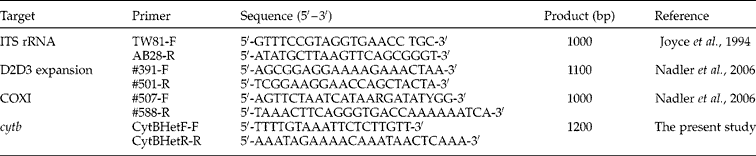
Polymerase chain reactions (PCR) containing 1 × PCR buffer (Fermentas, Vilnius, Lithuania), 1.5 mm MgCl2 (Fermentas), 200 μm of each deoxyribonucleoside triphosphate (dNTP) (Fermentas), 0.4 μm of each primer (with the exception of cytb primers, which were used at a concentration of 1 μm each) (Stabvida, Caparica, Portugal), 2.5 units of Taq DNA polymerase (recombinant) (Fermentas) and 5 μl template DNA (10–20 ng) were used (total volume 50 μl). Primers and PCR amplification conditions for each region and gene are presented in table 1.
Primers used for sequencing reactions of ribosomal regions and mitochondrial genes.

All PCR products were analysed by electrophoresis in 1% agarose gels with Tris-borate buffer, stained in ethidium bromide, purified with GFX PCR DNA and Gel Band Purification Kit (GE Healthcare, Uppsala, Sweden) and sequenced at Stabvida, Portugal.
Phylogenetic analysis
Multiple sequence alignments of ITS, D2D3 region of the 28S rRNA gene, COXI and cytb sequences were assembled using the ClustalW algorithm as implemented in BioEdit version 7.1.3.0 (Hall, Reference Hall1999), under default alignment parameters. The best-fitting evolutionary model of nucleotide substitutions was determined, using MEGA5 version 5.05 (Tamura et al., Reference Tamura, Peterson, Peterson, Stecher, Nei and Kumar2011) and phylogenetic relationships among isolates were reconstructed by neighbour-joining (Saitou & Nei, Reference Saitou and Nei1987) and maximum likelihood (ML) methods. Gaps or indels were treated using the complete deletion option. Bootstrap analysis was performed with 100 replicates (Felsenstein, Reference Felsenstein1985). Sequences were compared with those from reference organisms/strains available in the GenBank database.
Data analysis
Statistical analysis was performed using PASW Statistics 18 release 18.0.0 software (SPSS Inc., Chicago, Illinois, USA). Relationships between species and NUTS, vegetation or soil types were determined using the chi-square test of association. Results are presented as the test statistic (χ2), degrees of freedom (df) and probability of equal or greater deviation (P). Correspondence analysis (CA) was used as an explorative method to study associations and to reveal interdependencies between each two of the above-mentioned variables. Visualization using CA is based on representing chi-square distances among species and NUTS, vegetation or soil types.
Results
Data analysis
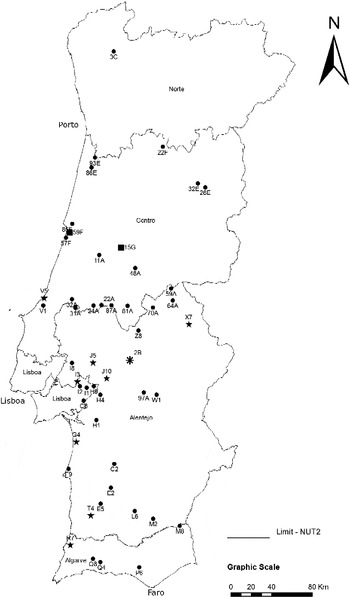
EPN were recovered from 53 of the 791 sampled sites (6.7%) (fig. 1). Nine soil samples (17%) were positive for the occurrence of heterorhabditids and 44 (83%) for steinernematids, identified as described. Nematodes isolated from the positive samples were further identified to the species level based on ITS sequences.
Entomopathogenic nematode distribution across the five NUTS (Nomenclature of Territorial Units for Statistics) of continental Portugal. Each point is marked with the name of the isolate and the corresponding species. Map based on the CAOP (Carta Administrativa e Oficial de Portugal; http://www.igeo.pt). Steinernema sp., ■; S. feltiae, ●; S. kraussei, ▲; S. intermedium,
 ; Heterorhabditis bacteriophora,
 .

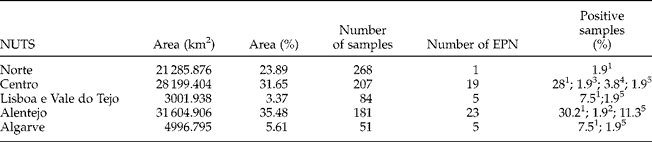
Although there is no association between species and NUTS (P > 0.1) (table 2), the CA biplot revealed that H. bacteriophora isolates are more abundant in the Alentejo region. The nine positive samples for H. bacteriophora were recovered from sites below the altitude of 400 m. Steinernema feltiae was detected from 40 sites (75.5%) in locations where the altitude varies between 13 and 878 m. No association was found between species and climate (P > 0.05).
The occurrence of entomopathogenic nematodes in continental Portugal using NUTS (Nomenclature of Territorial Units for Statistics) (CAOP; http://www.igeo.pt), relative to total area covered and the proportion of EPN species recovered.

1 Steinernema feltiae;
2 S. intermedium;
3 S. kraussei;
4 Steinernema sp.;
5 Heterorhabditis bacteriophora.
Habitat and soil types
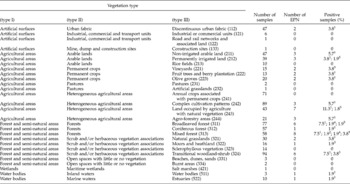
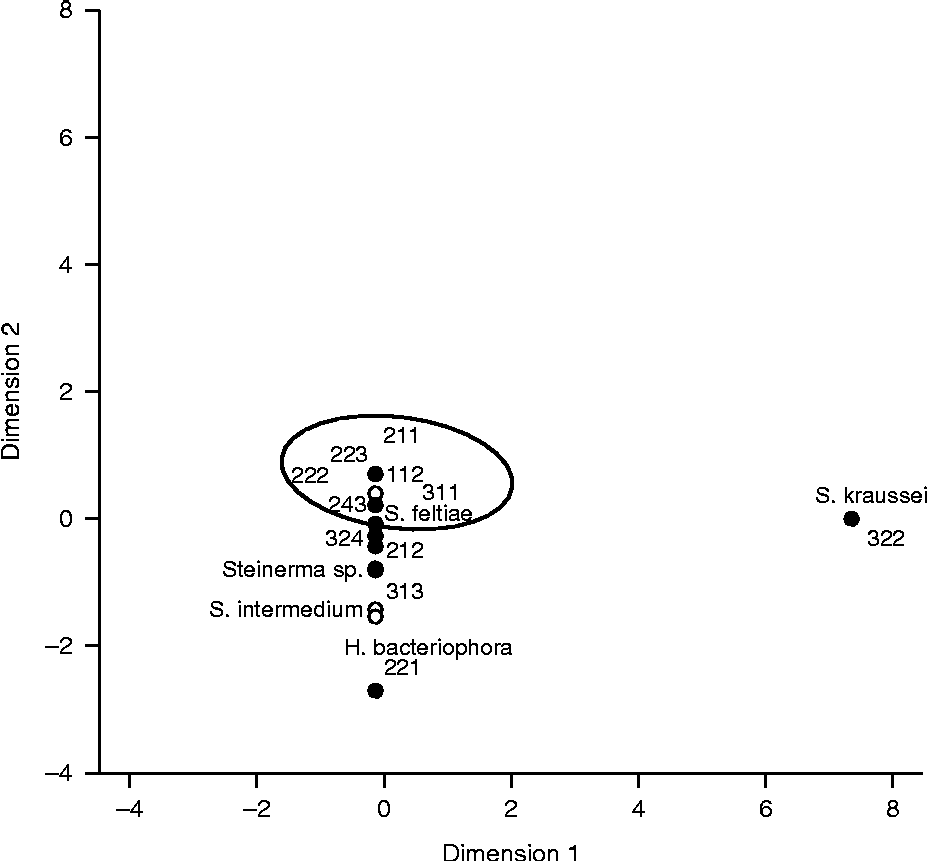
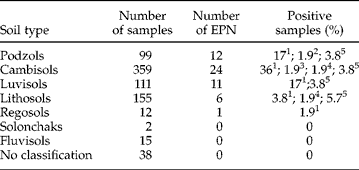
Positive samples were most commonly found in mixed forest, land occupied by agriculture with natural vegetation, broadleaved forest and transitional woodland-shrub (table 3). Heterorhabditis bacteriophora was found in a wide range of habitats including: mixed forest, transitional woodland-shrub, vineyards, broadleaved forest, land occupied by agriculture with natural vegetation and permanently irrigated land (table 3). Steinernema feltiae was present in all kinds of habitats containing EPN, being more abundant in land occupied by agriculture with natural vegetation, broadleaved forest, mixed forest, transitional woodland-shrub, agro-forestry areas, complex cultivated patterns and non-irrigated arable land (table 3). Steinernema intermedium was found in a mixed forest and S. kraussei in moors and heathland habitat (table 3). The Steinernema sp. isolates were found in a broadleaved forest and in a mixed forest (table 3). There is an association between species and vegetation type (χ2= 83.438, df = 60, P > 0.05) (fig. 2). Furthermore, the CA biplot showed that the most abundant species, S. feltiae, is present mainly in land occupied by agriculture with natural vegetation, broadleaved forest, fruit trees and berry plantations, olive groves and non-irrigated arable land (fig. 2). Steinernema feltiae was found in almost all soil types, namely cambisols, podzols, luvisols, lithosols and regosols, whereas H. bacteriophora was only found in lithosols, podzols, cambisols and luvisols (table 4). The Steinernema sp. isolates were found in a lithosol and a cambisol. Steinernema kraussei and S. intermedium isolates were found in a cambisol and a podzol, respectively (table 4).
The occurrence of entomopathogenic nematodes in the study, relative to the three classes of vegetation based on the ‘Land Cover Nomenclature’ (Caetano et al., 2009).

1 Steinernema feltiae;
2 S. intermedium;
3 S. kraussei;
4 Steinernema sp.;
5 Heterorhabditis bacteriophora.
CA biplot of the relationship between species and (a) NUTS (Nomenclature of Territorial Units for Statistics), (b) vegetation type, (c) soil type. Note: some dots are overlaid. Species, ○; vegetation type, ●.

The occurrence of entomopathogenic nematodes, relative to soil types (FAO, 2006).

1 Steinernema feltiae;
2 S. intermedium;
3 S. kraussei;
4 Steinernema sp.;
5 Heterorhabditis bacteriophora.
No association was found between species and soil type (P > 0.1). However, the CA biplot indicates that the two most abundant species are not randomly distributed by the different soil types: S. feltiae was mostly recovered from luvisols, but also from cambisols and regosols; H. bacteriophora is more abundant in lithosols. Heterorhabditis bacteriophora was found in soil samples with pH values between 4.37 and 7.92, whereas S. feltiae was present in soils with pH values between 4.02 and 8.11. Steinernema intermedium and S. kraussei were found in soils with pH 4.17–5.34. Steinernema sp. isolates were recovered in soils with pH values of 4.90 and 6.23. No association was found between species and the soil's physical and chemical characteristics (P > 0.05).
Phylogenetic analysis of ITS, D2D3, COXI and cytb
Nematodes isolated from the positive samples were identified based on ITS sequences as S. feltiae (40 isolates), S. intermedium (one isolate), S. kraussei (one isolate), Steinernema sp. (two isolates) and H. bacteriophora (nine isolates) (fig. 3). Because S. feltiae and H. bacteriophora were the two most abundant EPN species, D2D3 region of the 28S rRNA gene, COXI and cytb genes were used to further evaluate the genetic diversity of the populations. Repeated attempts to amplify and sequence some genes for some isolates were unsuccessful, thus justifying the discrepant number of isolates in the different phylogenies.
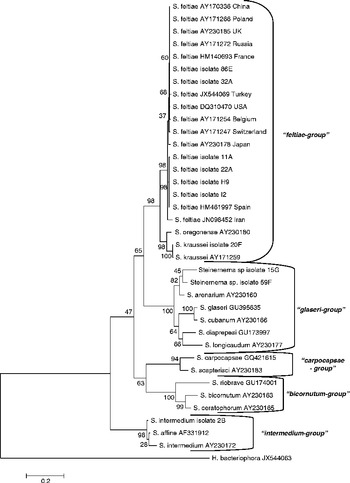
Maximum likelihood ITS phylogenetic trees using Tamura 3-parameter model (Tamura, Reference Tamura1992), based on nucleotide sequences of Steinernema spp. and reference strains (alignment length 768 bp). Percentage bootstrap is indicated on internal branches (100 replicates); scale bar indicates 0.2 substitutions per site.

ITS phylogenies of S. feltiae and H. bacteriophora
For 37 S. feltiae and eight H. bacteriophora Portuguese isolates, a PCR product of approximately 1000 bp, containing the partial sequence of ITS1 and ITS2, and the whole 5.8S rRNA gene, was obtained and sequenced. Heterorhabditis bacteriophora was included as outgroup (fig. 3).
Three sequence types were obtained with six S. feltiae isolates being used for phylogenetic analyses, namely isolate 11A, which also represents 24A; isolates 32A and 86E, representing 93E, I1 and Z8; and isolates I2, 22A and H9 representing the remaining isolates.
Comparing the six Portuguese with foreign S. feltiae isolates, few polymorphisms were found. All Portuguese and foreign S. feltiae isolates group in the same cluster, together with the other species from the ‘feltiae-group’ (S. oregonense and S. kraussei) sharing sequence identities between 94 and 100% (fig. 3). Steinernema feltiae Portuguese isolates showed some genetic diversity, which is represented by isolates 11A, 22A, H9 and I2, together with S. feltiae from Spain, which share sequence identities between 99.6 and 99.8%. Portuguese isolates 86E and 32A, together with the remaining S. feltiae foreign isolates, share sequence identities between 94 and 99.8%. Other species belonging to the ‘feltiae-group’, S. kraussei and S. oregonense, as well as S. kraussei isolate 20F, share sequence identities between 56 and 95% with foreign and Portuguese isolates. Isolates 15G and 59F share the highest identity with species of the ‘glaseri-group’ (75–85%), suggesting that Steinernema sp. belong to this group (fig. 3). Grouping with the major cluster are species belonging to ‘carpocapsae-group’ and ‘bicornutum-group’.
The most distant group includes the two species from the ‘intermedium-group’, S. intermedium and S. affine, and the Portuguese isolate 2B of the species S. intermedium. Species from the ‘intermedium-group’ share identities between 93 and 99% and have 57–86% sequence identity with species from the ‘feltiae-group’ (fig. 3).
ITS sequences indicate that all Portuguese Heterorhabditis isolates belong to the species H. bacteriophora. The eight Portuguese isolates of H. bacteriophora are 100% identical in sequence and all group together with foreign H. bacteriophora isolates (with bootstrap support of 98%), sharing identities of 98–100% (data not shown). Heterorhabditis zealandica also groups inside this cluster, sharing 96–97% identity with H. bacteriophora isolates. The most distant species from H. bacteriophora are H. indica, H. floridensis, H. amazonensis and H. baujardi, sharing 70–72% identity with H. bacteriophora isolates (data not shown). Heterorhabditis marelatus and H. megidis are more similar to H. bacteriophora (sequence identity between 74 and 79%) than the previous species.
S. feltiae and H. bacteriophora D2D3 phylogenies
The D2D3 expansion region of the 28S rRNA gene sequences confirms the previous identification of EPN isolates as S. feltiae and H. bacteriophora.
For 27 S. feltiae and seven H. bacteriophora Portuguese isolates, a PCR product of approximately 1100 bp, containing the partial sequence of the D2D3 region of the 28S rRNA gene, was obtained and sequenced. From the 27, only five representative isolates were used in the phylogenetic analysis, because the others share 100% sequence identity with these isolates (isolate 3C represents isolates 11A, 22A, 22F, 24A, 57F, 59A, 70A, 85F, 87A, C8, E2, F9, H1, H9, I2, I8, L6 and P6; and isolate 32A stands for isolates 86E, 93E, V1 and I1) (fig. 4). Globodera pallida was included as outgroup, considering that the D2D3 H. bacteriophora sequence was too close to species from the ‘carpocapsae-group’ to serve this purpose.
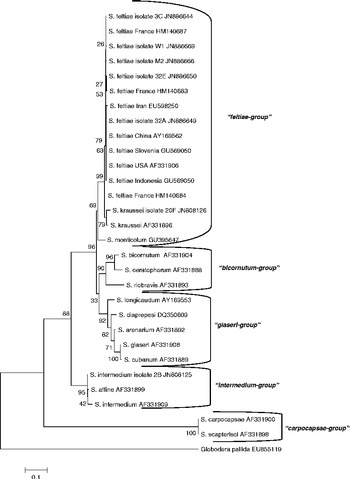
Maximum likelihood D2D3 phylogenetic tree using Kimura 2-parameter model (Kimura, Reference Kimura1980), based on nucleotide sequences of Steinernema spp. and reference strains (alignment length 469 bp). Percentage bootstrap is indicated on internal branches (100 replicates); scale bar indicates 0.1 substitutions per site.

Comparing the five Portuguese isolates of S. feltiae with foreign S. feltiae, only a few polymorphisms were found. All Portuguese and foreign S. feltiae isolates group in the same cluster sharing 99–100% sequence identity with 99% bootstrap support, showing no genetic diversity between isolates (fig. 4). Steinernema feltiae isolates group with species from the ‘feltiae-group’ (S. monticolum and S. kraussei) sharing sequence identities of 92–98% (bootstrap support 77%). Regarding the D2D3 phylogeny, no polymorphisms were found among H. bacteriophora Portuguese isolates. One major cluster was obtained, which contains all Portuguese isolates and the reference strains of H. bacteriophora (bootstrap support 98%). All H. bacteriophora isolates are 100% identical in sequence (data not shown). The closest species to H. bacteriophora is H. megidis, sharing a sequence identity between 91 and 93%; the most distant is H. indica, with a sequence identity of 90%.
S. feltiae COXI gene phylogeny
From the 23 Portuguese S. feltiae isolates, only 16 representative isolates were used for phylogenetic analysis (isolate 3C represents 87A; isolate 11A represents 22F and 70A; isolate H9 represents F9; isolate 24A represents P6; isolate I2 represents H1 and I8). Heterorhabditis bacteriophora was included as outgroup. A PCR product of approximately 1000 bp, containing the partial sequence of the COXI gene was obtained and sequenced for the Portuguese isolates.
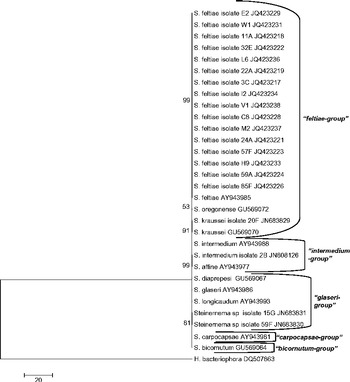
There is a large cluster that includes all S. feltiae Portuguese isolates, together with the reference species of S. feltiae, sharing sequence identity values between 94 and 100% (bootstrap support of 99%) (fig. 5). Inside this major cluster there is some diversity between Portuguese isolates (sequence identity values of 97–100%), in some cases supported by bootstrap values that vary between 36 and 95% (fig. 5). For example, isolates 59A and 85F form a group sharing a sequence identity of 99.5%, grouping also with isolate H9, with whom they share a sequence identity of 99%. All S. feltiae Portuguese isolates share high sequence identity values (98–100%). This major cluster groups with S. kraussei and S. oregonense, both species of the ‘feltiae-group’ sharing identities of 85–87% (fig. 5). The entire previous clade clusters together with species belonging to the ‘intermedium-group’, the ‘bicornutum-group’, the ‘glaseri-group’ and the ‘carpocapsae-group’ (fig. 5). The Steinernema sp. isolates 15G and 59F, group together sharing similarities of 92%. These isolates seem to represent a putative new species inside the ‘glaseri-group’, with whom they share 87–90% sequence identity (fig. 5).
Maximum likelihood COXI phylogenetic tree using the HKY model (Hasegawa et al., Reference Hasegawa, Kishino and Yano1985), based on nucleotide sequences of Steinernema spp. isolates and reference strains (alignment length 566 bp). Percentage bootstrap is indicated on internal branches (100 replicates); scale bar indicates 20 substitutions per site.

H. bacteriophora cytb gene phylogeny
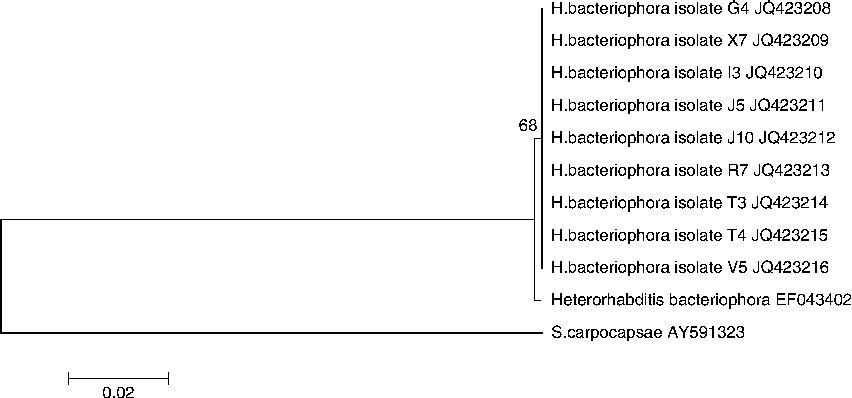
For nine H. bacteriophora Portuguese isolates, a PCR product of approximately 1200 bp, containing a partial sequence of the cytb gene was obtained and sequenced. Steinernema carpocapsae was included as outgroup. No polymorphisms were found among Portuguese isolates (100% identical). One major cluster (bootstrap value of 68%) was obtained, which contains all Portuguese isolates sharing 100% sequence identity (fig. 6). Portuguese isolates share 99.7% sequence identity with the reference strain of H. bacteriophora and 81.6% with S. carpocapsae (fig. 6).
Maximum likelihood cytb phylogenetic tree using Tamura-Nei model (Tamura & Nei, Reference Tamura and Nei1993), based on nucleotide sequences of H. bacteriophora isolates and reference strains (alignment length 749 bp). Percentage bootstrap is indicated on internal branches (100 replicates); scale bar indicates 0.02 substitutions per site.

Discussion
Even though national surveys already undertaken provide valuable data on EPN distribution (García del Pino & Palomo, Reference García del Pino and Palomo1996; Kary et al., Reference Kary, Niknam, Griffin, Mohammadi and Moghaddam2009; Edgington et al., Reference Edgington, Buddie, Moore, France, Merino, Tymo and Hunt2010; Khatri-Chhetri et al, Reference Khatri-Chhetri, Waeyenberge, Spiridonov, Manandhar and Moens2010; Ma et al., Reference Ma, Shulong, Zou, Xiuhua, Richou, De Clercq and Moean2010), species habitat preferences are still poorly understood. The present study aimed at understanding the natural occurrence of EPN in continental Portugal, representing the most systematic and extensive survey made for the first time in the country to evaluate indigenous species of EPN.
The survey covered all NUTs, the different climatic regions and a wide variety of vegetation and soil types. Positive soil samples were analysed with the additional information collected, namely temperature and precipitation values, altitude and soil type. Although EPN were recovered at a low rate (6.7% of sampling sites) in our study, five different species were isolated from the entire country: S. feltiae (75%), H. bacteriophora (17%), S. intermedium (1.9%), S. kraussei (1.9%) and Steinernema sp. (3.8%). Steinernema feltiae and H. bacteriophora were the two most abundant species found in the country. One reason for the low recovery rate obtained in the present study, could be the fact that only one insect, G. mellonella, was used as trap insect, and it may not be the appropriate host for all EPN species (Kary et al., Reference Kary, Niknam, Griffin, Mohammadi and Moghaddam2009). Also, the fact that just one temperature value (25°C) was used for soil baiting samples may represent a limitation. The use of just one baiting temperature may not cover all the requirements for other EPN species (Mráček et al., Reference Mráček, Bečvár, Kindlmann and Jersáková2005). Furthermore, the choice of sampling sites may contribute to differences in EPN recovery percentage (Mráček et al., Reference Mráček, Bečvár, Kindlmann and Jersáková2005). However, this low recovery percentage is not unusual, and it has already been reported from other surveys (Rosa et al., Reference Rosa, Bonifassi, Amaral, Lacey, Simões and Laumond2000; Hazir et al., Reference Hazir, Keskin, Stock, Kaya and Özcan2003; Kary et al., Reference Kary, Niknam, Griffin, Mohammadi and Moghaddam2009). Furthermore, the low H. bacteriophora recovery rate compared to Steinernema spp. may be due to the fact that this species, as mentioned by Emelianoff et al. (Reference Emelianoff, Le Brun, Pages, Stock, Tailliez, Moulia and Sicard2008), is preferentially located in beaches, which were habitats not sampled in the present study. In addition, H. bacteriophora is highly mobile, responding to chemical signals from the host, and being adapted to infect less mobile insects that are found in lower soil layers (Ishibashi, Reference Ishibashi and Lee2002). Since our samples were collected from the upper soil layer, this could explain the low recovery and genetic diversity of H. bacteriophora found in continental Portugal.
Steinernema feltiae, S. intermedium and H. bacteriophora are considered to be the most common EPN species in Europe, having been detected previously in southern France and in northern Spain (Hominick, Reference Hominick and Gaugler2002). The recovery rates of both Steinernema spp. and H. bacteriophora are similar to those of other studies in the Mediterranean area: 1.3% Heterorhabditis and 22% Steinernema in Catalonia (García del Pino, 2005), and 5.3% Heterorhabditis and 8.5% Steinernema in Italy (Tarasco & Triggiani, Reference Tarasco and Triggiani1997).
In other studies, the percentage recovery of EPN species has varied from 0.7 to 70.1% (Mráček & Becvár, Reference Mráček and Becvár2000; Bruck, Reference Bruck2004). The 6.7% recovery detected in continental Portugal is within the interval of the expected values (3.3–23%) obtained in Spain, which has similar climatic conditions and types of soil and vegetation to continental Portugal (De Doucet & Gabarra, Reference De Doucet and Gabarra1994; García del Pino, 1994, 2005; García del Pino & Palomo, Reference García del Pino and Palomo1996; Campos-Herrera et al., Reference Campos-Herrera, Escuer, Labrador, Robertson, Barrios and Gutiérrez2007). Other Mediterranean countries also have similar recovery rates: Greece, 5% (Menti et al., Reference Menti, Wright and Perry1997); Egypt, 10% (Shamseldean & Abd-Elgawad, Reference Shamseldean and Abd-Elgawad1994); Mediterranean Turkey, 5.8% (Kepenekci, Reference Kepenekci2002); and Italy, 5–15.5% (Ehlers et al., Reference Ehlers, Deseo and Stackebrandt1991; Tarasco & Triggiani, Reference Tarasco and Triggiani1997; Triggiani & Tarasco, Reference Triggiani and Tarasco2000). On the other hand, EPN seem to occur more frequently in northern European countries: Sweden, 25% (Burman et al., 1986); Czechoslovakia, 37% (Mráček, Reference Mráček1980); Finland, 37% (Vänninen et al., Reference Vänninen, Husberg and Hokkanen1989); Germany, 1.2% (Ehlers et al., Reference Ehlers, Deseo and Stackebrandt1991); Britain, 48.6% (Hominick & Briscoe, Reference Hominick and Briscoe1990); Scotland, 2.2% (Boag et al., Reference Boag, Nielson and Gordon1992); and Ireland, 10.5–14% (Downes & Griffin, Reference Downes, Griffin and Smits1991; Griffin et al., Reference Griffin, Moore and Downes1991). The EPN abundance, distribution and habitat preference are related to host–parasite relationships, environmental conditions and soil characteristics (Nielsen & Philipsen, Reference Nielsen and Philipsen2003; Püza & Mráček, Reference Püza and Mráček2005; Campos-Herrera et al., Reference Campos-Herrera, Escuer, Labrador, Robertson, Barrios and Gutiérrez2007).
Our results show that natural habitats present a higher percentage of positive samples, compared to agricultural ones, probably due to chemical control of insect pests in agricultural regions, which partially reduces the abundance of natural biocontrol agents. Stock et al. (Reference Stock, Al Banna, Darwish and Katbeh2008) also claimed a higher abundance of EPN in natural habitats such as forests. EPN were recovered from soils with high sand content, which favour their mobility and survival, such as cambisols, podzols, luvisols followed by lithosols and regosols. Observing the soils’ physical and chemical characteristics, no clear relationship was found. Abiotic factors, such as altitude, temperature or rainfall, do not influence the distribution of EPN species. No correlation was observed between genetic diversity of S. feltiae isolates and any of the biotic or abiotic parameters that were analysed for these isolates.
Steinernema kraussei and S. intermedium were each found at only one site, in moors and heathland and mixed forests, respectively. The reason for the low recovery of these two species is not known. Steinernema kraussei and S. intermedium are common in Europe, with S. intermedium showing a preference for tree habitats (Nguyen & Hunt, Reference Nguyen and Hunt2007). Steinernema sp. was recovered from only two sites, in mixed forests and broadleaved forest habitats.
The species nature of the genus Steinernema is a result of its longer evolution history (Adams et al., Reference Adams, Peat, Dillman, Nguyen and Hunt2007) and its reproductive patterns (amphimictic and hermaphroditic), making this genus more capable of occupying a wide range of habitats than Heterorhabditis (Edgington et al., Reference Edgington, Buddie, Moore, France, Merino, Tymo and Hunt2010). The geographical and habitat preferences of EPN species in continental Portugal may also reflect the chances of dispersal events as well as feeding patterns. However, EPN diversity determined in this study is similar to the diversity reported in previous studies in northern Spain and southern France, which constitute the closest area already sampled and also most similar in terms of climate and soil (García del Pino & Palomo, Reference García del Pino and Palomo1996; Campos-Herrera et al., Reference Campos-Herrera, Escuer, Labrador, Robertson, Barrios and Gutiérrez2007; Emelianoff et al., Reference Emelianoff, Le Brun, Pages, Stock, Tailliez, Moulia and Sicard2008). Steinernema feltiae and H. bacteriophora, the two most abundant EPN species in continental Portugal, are also considered to be the two most common species in Europe, having also been found in southern France and northern Spain (Hominick, Reference Hominick and Gaugler2002). However, conclusions regarding diversity and biogeography of EPN must be reached with some caution, since the results, in part, reflect searching effort and sampling technique rather than actual numbers and/or habitat preferences of EPN.
The major objectives of this study were to determine the indigenous species present in continental Portugal and evaluate the genetic diversity of isolates. For H. bacteriophora and S. feltiae, the two most abundant species found in continental Portugal, genetic diversity was assessed based on different molecular markers: ITS, D2D3 expansion region of the 28S rRNA gene and two mitochondrial genes, COXI and cytb. There were no indications of a molecular and geographical intraspecific variation of either S. feltiae or H. bacteriophora.
According to our results, H. bacteriophora isolates show no differences concerning the cytb gene, ITS and D2D3 expansion region of the 28S rRNA gene. Furthermore, no genetic diversity was observed among S. feltiae isolates using the D2D3 expansion region of the 28S rRNA gene. However, the ITS region and COXI gene revealed some genetic diversity among S. feltiae isolates. The diversity found among S. feltiae isolates using ITS and COXI sequences has no correlation with the physical and chemical parameters that characterize soil samples, nor with NUTS, soil or vegetation type.
In conclusion, this survey shows that five EPN species are known to be present in Portuguese soils. Furthermore, the occurrence of S. feltiae and H. bacteriophora as the two most abundant species in continental Portugal, suggests the potential role of these nematodes in natural regulation of insect populations. Further research on host ranges and characterization of these nematodes in view of possible use in biological control should be undertaken to minimize the use of chemical pesticides.
Supplementary material
To view supplementary material for this article, please visit http://dx.doi.org/10.1017/S0022149X13000217
Acknowledgements
The authors kindly thank Ms Inácia Ferreira for technical assistance. We would also like to thank Mr José Carlos Garcia dos Santos for helping with the ArcGIS software. This communication is a portion of the PhD dissertation of the first author, who was supported by a doctoral scholarship from ‘Fundação para a Ciência e a Tecnologia’ (SFHR\BD\22086\2005). This work is funded by FEDER Funds through the Operational Programme for Competitiveness Factors–COMPETE and National Funds through FCT (Fundaçäo para a Ciência e Tecnologia) under the Strategic Project PEst-C/AGR/UI0115/2011.