INTRODUCTION
Elasmobranch fish are generally top-level predators in most marine ecosystems (Wetherbee & Cortés, Reference Wetherbee, Cortés, Carrier, Musick and Heithaus2004). Their abundance is relatively small compared to groups situated in lower trophic levels. However, their life history parameters such as being long-lived, with delayed maturity and low reproductive rates, make them particularly sensitive to increased mortality above natural levels (Musick, Reference Musick and Musick1999).
The historically low economic value of elasmobranchs products compared to teleost fish has resulted in generally a lower priority for research and conservation of these species (Barker & Schluessel, Reference Barker and Schluessel2005). However, in more recent years there has been an increased demand for elasmobranchs and their derivative, which has significantly increased their economic value and simultaneously driven a growing global concern about shark conservation and management (Musick et al., Reference Musick, Burgess, Cailliet, Camhi and Fordman2000).
In the Mediterranean, elasmobranchs are generally declining in abundance, diversity and range, and are possibly facing a worse scenario than chondrichthyans populations elsewhere in the world (Walker et al., Reference Walker, Cavanagh, Ducrocq, Fowler, Fowler, Cavanagh, Camhi, Burgess, Cailliet, Fordham, Simpfendorfer and Musick2005). This decline can be attributed to a number of factors, mainly the intense fishing activity throughout the coastal and pelagic waters of the basin, such as the Gulf of Lions (Aldebert, Reference Aldebert1997), the Tyrrhenian Sea (Ferretti et al., Reference Ferretti, Myers, Sartor and Serena2005) and the Adriatic Sea (Jukic-Peladic et al., Reference Jukic-Peladic, Vrgoc, Krstulovic-Sifner, Piccinetti, Piccinetti-Manfrin, Marano and Ungaro2001). In addition, an overall dramatic decline in the abundance of large predatory sharks over the last two centuries in the Mediterranean has been recently demonstrated (Ferretti et al., Reference Ferretti, Myers, Serena and Lotze2008). Moreover, the lack of biological information and appropriate fisheries databases limit the assessment and management plan of elasmobranchs in this area (Cavanagh & Gibson, Reference Cavanagh and Gibson2007).
In Tunisia, the capture of elasmobranchs began in the mid-1980s using artisanal bottom-set gill-nets targeting smoothhound, Mustelus mustelus. In recent years, elasmobranch species, which were considered by-catch, have become the object of directed artisanal longline fisheries, based on their seasonal abundance (Bradai et al., Reference Bradaï, Saïdi, Enajjar, Bouaïn, BaşUsta, Keskin, Serena and Seret2006). In the Gulf of Gabès (central Mediterranean, southern Tunisia), two types of longline gear are used to capture elasmobranch species: pelagic and bottom longlines. These fishing gears were initially used to target swordfish and groupers, respectively, but the decline in catches has resulted in a shift in target to some elasmobranch species. Although elasmobranchs are a significant component of the Gulf of Gabès longline fisheries, there is no quantification of the discard portion, which is never accounted for in the official fisheries statistics.
Because of the unregulated nature of most longline fisheries, the information describing their operational characteristics and associated by-catch is limited in the Mediterranean Sea. This study is the first assessment of the impact of the longline fleet operating in the Gulf of Gabès on elasmobranch species. To improve the understanding, conservation and management of exploited elasmobranch populations in the Gulf of Gabès, a two-year study was undertaken during 2007–2008 to describe the extent and activities of the longline elasmobranch fishery. Specific objectives of this project were: (1) to determine the catch composition, catch per unit effort (CPUE) and discards of elasmobranch species; (2) to provide biological information (size composition and sex-ratios) for the species captured; and (3) to recommend measures to increase management-relevant information on species characteristics, abundance and distribution.
MATERIALS AND METHODS
During June–September in 2007 and 2008, a total of 41 randomly-chosen fishing trips, 21 (48 sets) with pelagic longline and 20 (38 sets) with bottom longline, were investigated on-board two commercial traditional longline boats. The two boats were selected randomly from among the 72 vessels between 10 and 14 m in length which belonged to the ports of Zarzis and Djerba (south of the Gulf of Gabès), where 80% of the longline Tunisian fleet fishing is based. The two boats were 12 m in length and had a gross tonnage (GT) of 11.45, and a gross register tonnage (GRT) of 10.80.
The length of a monofilament polyamide mainline of pelagic longline varied from 20 to 50 km and comprising 500–2500 hooks (size 12/0 ‘J’ hook: 111 mm long and 57 mm wide; and 11/0 ‘J’ hook: 98 mm length and 51 mm width) attached to the branchlines separated by an average distance of 40 m. The pelagic longline was set close to the water surface using a buoy after every two hooks. The baits used were mackerel (Scomber scombrus) and pieces of rays (Dasyatis sp.). Setting began around 18:00 h and hauling occurred around 07:00 h on the following day. Bottom longline consists of a 10–12 km mainline anchored to the bottom, suspended by a series of monofilament polyamide branchlines separated by a distance of about 7 m, each branchline is 1 m long and 2 mm in diameter, terminating with a single baited ‘J’ hook. The number of hooks ranges from 1200 to 1800 and the hook sizes are 78 mm long and 41 mm wide. Frozen round sardinella (Sardinella aurita) or common cuttlefish (Sepia officinalis) are the baits mainly used. The geographical bottom longline was deployed at any time in daylight, and retrieval could start immediately or after a few hours.
During the fishing operations, on-board observers recorded the date, geographical coordinates at both the beginning and the end of the hauling of the gear, fishing depth, information concerning the fishing operation (number of hooks, gear setting and hauling times, time of every catch), hooking location (internal hooking = oesophagus or deeper; external hooking = mouth) and physical condition of specimens. All individuals were identified and their total length (TL) and disc width of batoids (DW) (to the nearest millimetre) were recorded. The discarded individuals were processed on-board and returned to the sea. The maturity status and stage (juveniles and mature) of specimens was determined based on studies conducted in the study area (Capapé, Reference Capapé1974; Capapé et al., Reference Capapé, Hemida, Seck, Diatta, Guélorget and Zaouali2003; Hemida et al., Reference Hemida, Seridji, Ennajar, Bradai, Collier, Guelorget and Capapé2003; Saidi et al., Reference Saïdi, Bradaï, Bouaïn, Guéorget and Capapé2005, Reference Saïdi, Bradaï and Bouaïn2008, Reference Saïdi, Bradaï and Bouaïn2009; Enajjar et al., Reference Enajjar, Bradaï and Bouaïn2008, Reference Enajjar, Bradaï and Bouaïn2012).
For longline, the standard unit considered was 1000 hooks and the resulting standard catch rate was CPUE 1: number of specimens per 1000 hooks. To estimate total elasmobranchs catch from the total fishing effort, another catch rate, CPUE 2 (number of specimens per fishing trip), was calculated. Total catch was estimated by applying CPUE 2 to the total fishing effort, H (number of trips during the two study years: Source DGPA: General Directorate of Fishing and Aquaculture). The difference in size between males and females was evaluated using two-tailed non-parametric Mann–Whitney U-tests (Zar, Reference Zar1998). Additionally, the assumption of equal sex-ratios (1:1) was tested using χ2 analysis with Yates correction for continuity (Zar, Reference Zar1998).
RESULTS
Species composition and catch rates
A total of 48 pelagic longline sets were carried out, corresponding to 35,950 hooks deployed. A total of 581 elasmobranchs and four swordfish specimens were caught. The sandbar shark, Carcharhinus plumbeus, was the primary species, accounting for 94.14% of the elasmobranch catch number. The spinner shark, Carcharhinus brevipinna (3.78%) and the pelagic ray Pteroplatytrygon violacea (2.06%) were minor components of the capture.
A total of 402 grouper individuals belonging to two species and 392 elasmobranch specimens corresponding to four sharks, one skate and two guitarfish species were recorded in the 38 bottom longline sets (48,020 hooks). Among elasmobranch species, the blackchin guitarfish, Rhinobatos cemiculus, was the most abundant (31.7%) followed by C. plumbeus, (21.17%), the smoothhound, Mustelus mustelus, (15.81%) and the blackspotted smoothhound, M. punctulatus (13.52%).
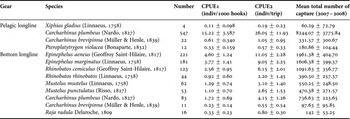
The numbers of individuals per species captured and corresponding CPUE values are summarized in Table 1. The CPUE values reached a maximum level for C. plumbeus captured with pelagic longline, while for the bottom longline, catch rates of different elasmobranch species were nearly similar.
Catch rates and total captures estimated with longline fishery in the Gulf of Gabès during 2007–2008.

Taking into account the mean annual total fishing effort with pelagic (316.5 trips) and bottom longlines (177.5 trips) and catch rates (CPUE2), the mean total annual captures were estimated in the two study years (Table 1).
Hooking locations and survival
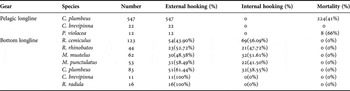
For pelagic longline captures, hooking locations did not vary among species: all specimens were hooked externally, hooks tended to lodge in the jaw. Elasmobranch mortality rate at haulback varied considerably among species. In contrast to the spinner shark, which had 0% mortality, C. plumbeus and P. violacea had 41% and 66.66% mortality at retrieval, respectively.
The proportion of internal hooking was high with the bottom longline: 56% for R. cemiculus, 51.6% for M. mustelus, 47.7% for R. rhinobatos, 41.5% for M. punctulatus and 38.5% for C. plumbeus. However C. brevipinna and Raja radula, specimens were hooked externally. All specimens captured were alive (Table 2).
Hooking location and mortality of captured species.

Retained and discarded species
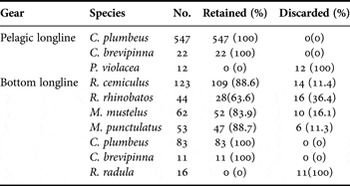
The main fraction of individuals caught was retained (92.4% by number). Elasmobranchs discarded represented 2% and 15.81% of the total number of individuals caught with pelagic and bottom longlines, respectively (Table 3). The main reasons for discard were the lack of commercial value (37.38%) and size (62.16%). Species with a high commercial value, such as Rhinobatos cemiculus, R. rhinobatos, M. mustelus, M. punctulatus, C. brevipinna and C. plumbeus, were usually retained, while species with low or no commercial value, such as Raja radula and P. violacea were always discarded.
Discards and retained portion of catches.

Biological information
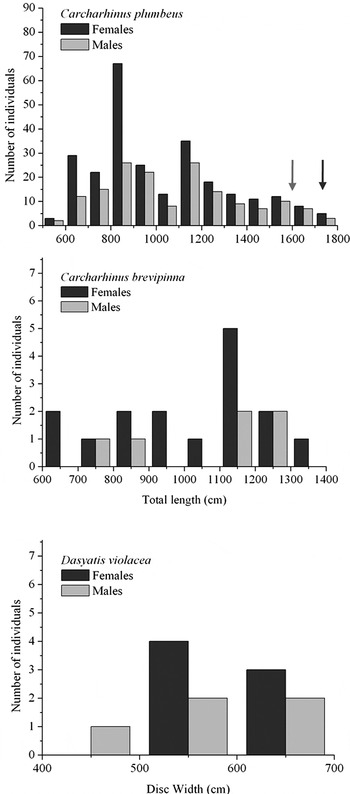
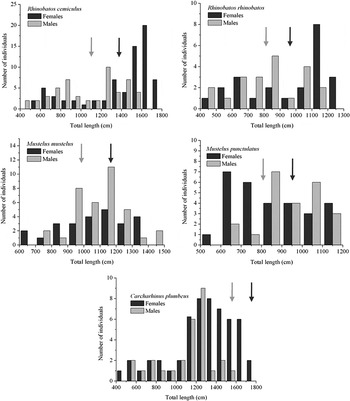
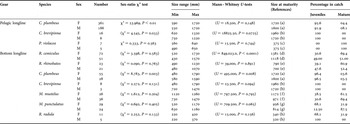
Specimens were often examined at retrieval. Size–frequency distribution and sex composition were available for each species (Table 4; Figures 1 & 2).
Length–frequencies distribution of elasmobranch species caught with pelagic longline in the Gulf of Gabès during 2007–2008 (size at maturity of males ( ) and females (
 )).

Length–frequencies distribution of elasmobranch species caught with bottom longline in the Gulf of Gabès during 2007–2008 (size at maturity of males () and females ()).

Size composition of elasmobranch species sampled from longline fishery in the Gulf of Gabès during 2007–2008: (a) Saidi et al., Reference Saïdi, Bradaï, Bouaïn, Guéorget and Capapé2005; (b) Capapé et al., Reference Capapé, Hemida, Seck, Diatta, Guélorget and Zaouali2003; (c) Hemida et al., Reference Hemida, Seridji, Ennajar, Bradai, Collier, Guelorget and Capapé2003; (d) Enajjar et al., Reference Enajjar, Bradaï and Bouaïn2012; (e) Enajjar et al., Reference Enajjar, Bradaï and Bouaïn2008; (f) Saidi et al., Reference Saïdi, Bradaï and Bouaïn2008; (g) Saidi et al., Reference Saïdi, Bradaï and Bouaïn2009; (h) Capapé, Reference Capapé1974.

In pelagic longline captures, females were more common than males (Table 4). However, size composition of females and males did not differ significantly (Table 4). Juveniles, including specimens with umbilical scars, dominated capture (Figure 1).
In bottom longline captures, about half of Rhinobatos cemiculus males were mature and 69% of females were pregnant carrying near term embryos or post-partum. More than 96% of C. plumbeus and all C. brevipinna individuals caught were juveniles. The majority of Mustelus species were mature: 69% of males and 61% of females for M. mustelus and 87% of males for M. punctulatus (Table 4; Figure 2).
DISCUSSION
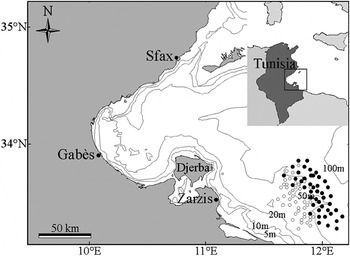
In the Gulf of Gabès, during 2007–2008, longline fishing effort was considerable, and eight elasmobranch species were recorded among 43 species reported in this area (Bradai et al., Reference Bradaï, Saïdi, Enajjar, Bouaïn, BaşUsta, Keskin, Serena and Seret2006). However, several other species such as Isurus oxyrinchus and Carcharodon carhcarias, Prionace glauca, Squalus blainvillei and Pteromylaeus bovinus observed in longline landings were not encountered in our study. Species captured in this study were the most abundant in the area and were landed throughout the year as by-catch and target species (Bradai et al., Reference Bradaï, Saïdi, Enajjar, Bouaïn, BaşUsta, Keskin, Serena and Seret2006). The variation in species composition between the two types of fishing activities can be attributed to species behaviour and fishing area. Generally, bottom longline fishing sites were closer to the coast compared to pelagic longline ones (Figure 3).
The Gulf of Gabès. Pelagic longline sets (●), bottom longline sets (○).

The sandbar shark, Carcharhinus plumbeus, is the primary component of pelagic longline elasmobranch fisheries in the Gulf of Gabès. This species was the most abundant species landed in this area, where it was caught mainly between April and September (Bradai et al., Reference Bradaï, Saïdi, Enajjar, Bouaïn, BaşUsta, Keskin, Serena and Seret2006). The spinner shark, C. brevipinna is rarely reported. This may be due to the competition pressure from its sympatric species C. plumbeus (Capapé, Reference Capapé1989). This interspecific competition pressure, corroborated by recent investigation (Saidi et al., Reference Saïdi, Bradaï, Bouaïn, Guéorget and Capapé2005), suggests that C. plumbeus is able to establish definitively in the area, whereas C. brevipinna migrates northward (Capapé et al., Reference Capapé, Hemida, Seck, Diatta, Guélorget and Zaouali2003). According to catch statistics from Zarzis fish market, which is the main landing port for shark fishery in Tunisia, annual landings by artisanal fisheries of C. plumbeus is about 350 t (European Commission, 2009). In the Mediterranean, C. plumbeus was described as an endangered species (Cavanagh & Gibson, Reference Cavanagh and Gibson2007). This species was previously regularly seen on fish markets of southern Sicily during the summer months but has not been observed recently (Cigala-Fulgosi and Vacchi, personal observations 2003). A similar situation is apparent in the eastern Adriatic Sea (Lipej et al., Reference Lipej, Makovec, Soldo and Ziza2000). Given the high biological vulnerability of this species to exploitation, the declines observed in other Mediterranean areas and continuing unregulated fishing pressure in the Gulf of Gabès, it is strongly suspected that this stock is declining. Investigation on stocks assessments and elasmobranch fisheries surveys in the area are urgently needed.
The importance in numbers and catch rates of smooth-hound and guitarfish species compared to the grouper ones show that these species, which were classified as by-catch in the past, were actually targeted. Rhinobatids were not recognized as common in longline capture. The importance of guitarfish species in our study is that longliners target these species during their reproductive aggregation season, mainly when the primary targeted species (groupers) are caught in small quantities. The abundance of smooth-hound and guitarfish species in the Gulf of Gabès compared to the northern coasts of the Mediterranean, where they are considered to be locally extirpated (Aldebert, Reference Aldebert1997; Jukic-Peladic et al., Reference Jukic-Peladic, Vrgoc, Krstulovic-Sifner, Piccinetti, Piccinetti-Manfrin, Marano and Ungaro2001; Ferretti et al., Reference Ferretti, Myers, Sartor and Serena2005), reflects their abundance in the fishing area. Indeed, specific elasmobranch fisheries already subsist, showing an important exploitation potential. In addition, their abundance suggest that these species find favourable conditions to reproduce in the Gulf of Gabès (Bradai et al., Reference Bradaï, Saïdi, Bouaïn, Guelorget and Capapé2005).
The main reasons for discarding commercialized species are: (a) undersized fish that usually have low or negligible market value; (b) regulation demands on minimum landing sizes; and (c) the market value of species caught. It should be mentioned that in the Mediterranean it is difficult to distinguish between the different types of discarded products, and especially between unmarketable and low quality/price species. In the Gulf of Gabès, discards of target species in this fishery are very scarce. But species discarded could be a good indicator of the impact of the fishery on threatened species and the ecosystem. Nevertheless, choice of fishing ground and reduction of the soak time may reduce discards (Gonçalves et al., Reference Gonçalves, Stergiou, Hernando, Puente, Moutopoulos, Arregi, Soriguer, Vilas, Coelho and Erzini2007). Despite its importance, long-term monitoring of the discarded yield is difficult, because of the need for special effort and financing. Consequently, it is important to investigate methods that correlate discarding practices with the landings, thus minimizing the necessary sampling (Hall, Reference Hall1999).
The size distribution shows that, for carcharinids species, juveniles dominate captures while mature specimens dominate in smoothhound and guitarfish. The capture of neonate and young elasmobranch species in the Gulf of Gabès indicates that juveniles of these species utilize nearshore waters during their first few years of life. The presence of neonate, post-partum and ovulating females indicates that fishing efforts occur in pupping or primary nursery areas (Heupel et al., Reference Heupel, Carlson and Simpfendorfer2007). In the Gulf of Gabès, artisanal fisheries are related to the seasonal occurrence of these species, which is an annual event linked to the reproductive cycle (Bradai et al., Reference Bradaï, Saïdi, Enajjar, Bouaïn, BaşUsta, Keskin, Serena and Seret2006). Mature females of some species, such as C. plumbeus, M. punctulatus, M. muselus, R. cemiculus and R. Rhinobatos, move to nearshore water to give birth in a nursery area with advantageous environmental conditions (Bradai et al., Reference Bradaï, Saïdi, Enajjar, Bouaïn, BaşUsta, Keskin, Serena and Seret2005; Saidi et al., Reference Saïdi, Bradaï, Bouaïn, Guéorget and Capapé2005). The capture of mature individuals of exploited species reduces their productivity and resilience and the sustainability of populations (Kokko et al., Reference Kokko, Linsdstrom, Ranta, Reynolds, Mace, Redford and Robinson2001; Smith et al., Reference Smith, Cailliet and Cortés2008). Simpfendorfer (Reference Simpfendorfer and Musick1999) suggested that, for some shark species, sustainable exploitation may be possible if the youngest age-classes are targeted and older ages are left unfished.
This study represents the first detailed, quantitative information on the longline elasmobranch fisheries in the Gulf of Gabès. Captures of elasmobranchs were substantial during the survey years and probably represent a considerable source of mortality for exploited populations. The increasing domestic demand for elasmobranch fishing permits, coupled with the lack of regulatory actions, poses a threat to the elasmobranch stocks harvested in Tunisian waters.
Successful management and conservation measures need to be accompanied by complementary tools that promote the meeting of their assumptions. In that respect, gear modifications are expected to be one of the most effective and inexpensive tools (Madsen et al., Reference Madsen, Tschernij, Hansen and Larsson2006; Fonteyne & M'rabet, Reference Fonteyne and M'Rabet1992; Brewer et al., Reference Brewer, Eayrs, Mounsey and Wang1996; ).
Implementing Marine Protected Areas (MPAs) for species that show some site fidelity may be a useful approach in certain cases (Bonfil, Reference Bonfil, Seret and Sire1999; Garla et al., Reference Garla, Chapman, Shivji, Wetherbee and Amorim2006a, Reference Garla, Chapman, Wetherbee and Shivjib). However, for species thought to be fished at unsustainable rates, MPAs must be coupled with reductions in fishing capacity to avoid simply displacing effort to other sites (Fogarty & Murawski, Reference Fogarty and Murawski1998). In addition, size limits may be beneficial as a way of protecting neonates and actively breeding individuals (i.e. maximum size limits that are less than the size at maturity) (Simpfendorfer, Reference Simpfendorfer and Musick1999). Nurseries designated for protection should be refined in accordance with more substantial criteria (Heupel et al., Reference Heupel, Carlson and Simpfendorfer2007), allowing managers to prioritize nurseries that contain higher neonate and young juvenile populations, have longer residency periods and are repeatedly used across years.
The successful conservation and sustainable use of this fishery resource requires the following actions: (1) continue the collection and survey of species-specific information on catches and landings, by number and weight; (2) improve statistical data collection at the species-specific level; (3) delineate nurseries areas in the Gulf of Gabès; (4) assess the impact of fishing mortality on juveniles and gravid females in elasmobranchs/nursery areas; and (5) conduct socio-economic studies of the coastal artisanal fisheries.
ACKNOWLEDGEMENTS
We wish to thank all the fishermen who allowed us to operate on their boats, all the crews, as well as all the scientists and on-board observers who have participated in this work. We thank anonymous referees for their insightful comments, which led to a much-improved manuscript.