Although the threat posed by bioterrorism to the United States has been recognized for decades, the dissemination of anthrax through the US postal system in 2001 heightened awareness of our vulnerability to bioterrorism and reinforced the need for preparedness. The Public Health Security and Bioterrorism Preparedness and Response Act1 was signed into law in June 2002 and reauthorized in 2006.2 This law aims to improve the ability of the United States to prevent, prepare for, and respond to bioterrorism and other public health emergencies.
A crucial aspect of bioterrorism preparedness at the state and local levels is the ability of hospital and emergency department clinicians to recognize the common signs and symptoms of infection with bioterrorism agents. The recognition of such infections may be the first line of defense in a bioterrorist attack because people will likely present to a hospital or emergency department soon after the onset of symptoms. Of particular importance is the recognition of clinical signs and symptoms in patients exposed to the more lethal bioterrorism agents, referred to as Category A agents: Bacillus anthracis (anthrax), Clostridium botulinum (botulism), variola major (smallpox), Francisella tularensis (tularemia), Yersinia pestis (plague), and certain filoviruses (eg, Ebola) and arenaviruses (eg, Lassa) that cause viral hemorrhagic fevers. Category A agents are considered to be a risk to national security because they can be disseminated or transmitted easily from person to person, result in high mortality rates and have the potential for a major impact on public health, may cause public panic and social disruption, and require special action for public health preparedness. What is especially disconcerting is that a number of the initial symptoms associated with infection with many Category A agents are nonspecific, such as fever, myalgias, and respiratory ailments, and may be easily mistaken for routine community-acquired infections.Reference Cosgrove, Perl, Song and Sisson3 Infections with Category A agents often require specific laboratory testing of clinical or autopsy specimens to identify the etiologic agent.Reference Nolte, Lathrop and Nashelsky4 Therefore, clinicians must maintain a high level of suspicion when encountering patients with presentations that could be related to a Category A agent.Reference Alexander, Larkin and Wynia5
Because one of the fatal cases associated with the 2001 anthrax attacks was that of a Connecticut resident,Reference Griffith, Mead and Armstrong6 we believed that Connecticut physicians would have a heightened awareness of the potential for additional cases of Category A agent–related infections. To examine this theory, we conducted a population-based study to identify unexplained deaths of possible infectious etiology among community-dwelling Connecticut residents who were hospitalized at the time of death; identify the subset of decedents who presented with signs and symptoms consistent with the early stages of inhalational anthrax, botulism, smallpox, or inhalational tularemia; and assess the extent and completeness of the work-up received by these patients to make or rule out one of these diagnoses.
This study was undertaken as part of Connecticut's response to the federal government's 2002 Public Health Preparedness and Response for Bioterrorism Cooperative Agreement7 and was built on the existing infrastructure of the Connecticut Emerging Infections Program's population-based surveillance for unexplained deaths and critical illnesses due to possibly infectious etiologies protocol.Reference Hajjeh, Relman and Cieslak8
METHODS
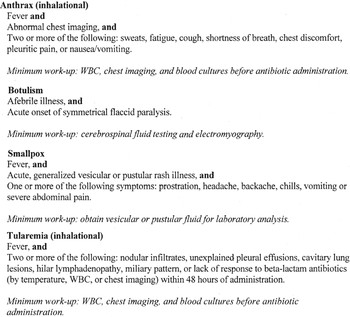
A case was defined as a community-dwelling Connecticut resident who was admitted to and died in a Connecticut acute care hospital from an apparent infectious disease without a defined etiology. Cases had to demonstrate evidence of acute flaccid paralysis or one or more of the following hallmarks of an infectious disease: histopathological evidence of an acute infectious or inflammatory process, peripheral white blood cell [WBC] count of <4000 or >15,000 cells/mm3, inflammation of a normally sterile fluid (cerebrospinal fluid >5 WBC/mm3, urine >20 WBC/high-power field, pleural, pericardial, bronchoalveolar, synovial, or ascitic fluid >10,000 WBC/mm3), or imaging studies consistent with an acute infection or inflammation and have a clinical presentation compatible with early signs and symptoms of infection with ≥1 of the 4 specified Category A agents: Bacillus anthracis (inhalational anthrax), Clostridium botulinum, variola virus, or Francisella tularensis (inhalational tularemia) (Fig 1).
Case definitions and minimum work-up criteria for possible cases of infection from Category A agents

Potential cases were excluded if they met any one of the following criteria: predisposing condition (eg, AIDS, malignancy other than nonmelanoma cutaneous malignancy, indwelling catheter, solid organ or bone marrow transplant recipient), death within 24 hours of admission, or nosocomial infection (onset of infectious disease signs/symptoms <1 week after discharge from previous hospital stay or >48 hours after current hospital admission).
These inclusion and exclusion criteria were adopted from the unexplained deaths and critical illnesses due to possibly infectious etiologiesReference Hajjeh, Relman and Cieslak8 protocol. Although immunocompromised individuals may be more susceptible to a variety of infectious diseases, including infections with Category A agents, our study focused on previously healthy individuals without predisposing medical conditions in an effort to reduce the chance that unusual presentations of common pathogens would be misclassified as unexplained deaths. Cases that died <24 hours after admission were excluded because physicians would not have had sufficient time to assess, order, and perform the necessary work-up under evaluation.
To determine the extent and completeness of the clinical work-up to rule in or rule out the possibility of infection with ≥1 of the 4 select Category A agents, we developed clinical case definitions with minimum diagnostic work-up criteria (Fig 1). The case definitions and minimum work-up criteria were based on consensus statements published by the Working Group on Civil BiodefenseReference Arnon, Schechter and Inglesby9–Reference Inglesby, O'Toole and Henderson12 and clinical descriptions from the infectious disease literature.Reference Ketai, Alrahji, Hart, Enria and Mettler13, Reference Penn14 Cases fulfilling these definitions were considered to have met the minimum work-up criteria.
Case Finding
Electronic death certificate data on all Connecticut deaths between January 1, 2002 and December 31, 2003 were obtained from the Connecticut Department of Public Health Master Consolidated Death File. The electronic death certificate data included decedent demographics, date of death, location at which the death occurred, International Statistical Classification of Diseases and Related Health Problems, 10th Revision (ICD-10)–coded causes of death including underlying causes, and cause of death text fields as completed by the certifier.
We generated a list of 200 ICD-10 inclusion codes indicative of an unexplained death of a possibly infectious nature. This list included codes that described signs and symptoms suggestive of infection with the 4 selected Category A agents under review. A second list of 1378 ICD-10 exclusion codes indicative of a known infectious etiology or exclusionary underlying condition was generated. Electronic death certificate data were screened using the lists of inclusion and exclusion codes. Deaths of interest were selected based on having at least one of the ICD-10 inclusion codes and no ICD-10 exclusion codes listed among the coded cause of death fields. Selected deaths were further excluded based on manner of death (accident, suicide, or homicide) and location of death (out of hospital, nonacute care facility, death location other/unknown, and state residency). The remaining deaths were considered to be possible unexplained infectious deaths and were flagged for further review.
Possible unexplained infectious deaths underwent a medical record review by trained medical record reviewers. Inclusion and exclusion criteria were applied to each possible unexplained infectious death based on information from the medical record. Those meeting all of the inclusion criteria without any exclusion criteria were considered to be unexplained infectious deaths. The unexplained infectious deaths were further classified as cases if they met one of the case definitions for inhalational anthrax, inhalational tularemia, smallpox, or botulism. Detailed clinical information was abstracted from the medical records of cases using a standard data collection instrument and was used to determine whether the case met the minimum work-up criteria for the Category A agent of interest. Data abstracted from the medical records were reviewed by a physician (A.N.S.) to verify the classification of cases.
During the medical record review, exclusion criteria were applied in the following hierarchical manner: nursing facility resident, predisposing condition, death within <24 hours after admission, noninfectious, nosocomial infection, and known etiology. Data abstraction was halted as soon as one of the exclusion criteria was identified.
To identify factors associated with incomplete minimal diagnostic evaluation among people who died of a possible infection with a Category A agent, we compared those not meeting the minimum work-up criteria to those meeting the minimum work-up criteria for demographic factors, presence of underlying medical conditions, and type of hospital at which they received care. Hospitals were classified in 2 ways: by whether or not they were formally associated with a medical residency program and by size.
Data were entered into a database created using EpiInfo 2002 (Centers for Disease Control and Prevention, Atlanta). Analyses were both descriptive and analytic. Means and medians for continuous data and counts of categorical data were calculated. Between-group comparisons were performed by calculating odds ratios and by chi-square tests using SAS version 9.1 (SAS Institute Inc, Cary, NC). Connecticut population data from the 2000 US Census15 were used to calculate crude rates.
The study protocol was reviewed and approved or deemed exempt from review by the Human Investigation Committee of the Yale University School of Medicine and the Connecticut Department of Public Health. We sought participation of all 32 acute care hospitals in Connecticut. The study protocol was reviewed and approved by institutional review boards at 25 of the 32 acute care hospitals; 7 acute care hospitals declined to participate in the study.
RESULTS
During the 24-month period from January 1, 2002 to December 31, 2003, there were 59,971 deaths recorded in Connecticut. According to the US Census Bureau, the 2002 year-end population estimate for Connecticut was 3,472,983. Thus, the crude mortality rate was 863.4/100,000 population per year.
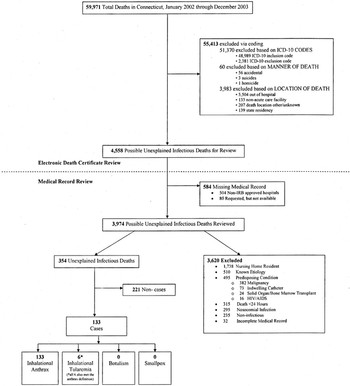
Of the 59,971 deaths, 4558 (7.6%) were identified as possible unexplained infectious deaths and were flagged for medical record review. Of the remaining 55,413 deaths, 51,370 (86%) were excluded based on ICD-10 codes (48,989 no inclusion codes, 2381 presence of exclusion codes), 3983 (7%) based on manner of death, and 60 (0.1%) based on location of death (Fig 2).
Electronic death certificate and medical record review to identify unexplained infectious deaths possibly due to infection with Category A agents among Connecticut residents, 2002–2003

Of the 4558 possible unexplained infectious deaths, 584 (13%) were unavailable for review. Of the remaining 3974 possible unexplained infectious deaths, 354 (9%) fulfilled all of the inclusion criteria and had no exclusion criteria and were considered unexplained infectious deaths. Of these, 133 (38%) met at least 1 of our 4 case definitions, 127 (95%) met the case definition for inhalational anthrax, and 6 (5%) met the case definition for both inhalational anthrax and inhalational tularemia. None of the cases met the smallpox or botulism case definitions (Fig 2).
Cases were identified at 23 of the 25 participating acute care hospitals in Connecticut with no more than 12% of the cases presenting at any particular hospital. The most frequent ICD-10 code listed on the electronic death certificate among the cases was for J18.9 (pneumonia, unspecified). However, the positive predictive value of this ICD-10 code for identifying a case was only 4.8%.
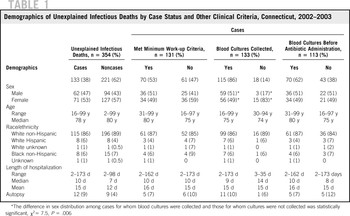
Among the 354 unexplained infectious deaths, cases and noncases were similar by sex, age, and race/ethnicity. Although not statistically significant, cases and noncases differed in length of hospitalization, with mean and median lengths of stay slightly longer for cases than for noncases (15 and 10 days vs 12 and 7 days, respectively). Among cases, significantly fewer women had blood cultures collected (79% vs 95%, χ2 = 7.5; P = .006) and a smaller percentage of women met minimum work-up criteria than men. The autopsy rate among cases was 6% and remained similar among the cases regardless of their hospital work-up (Table 1).
Demographics of Unexplained Infectious Deaths by Case Status and Other Clinical Criteria, Connecticut, 2002–2003

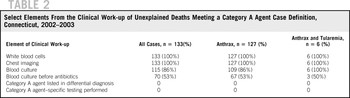
To assess the clinical work-up received by our patients, we examined the testing that was performed within the first 48 hours of hospitalization for all 133 cases. Minimum work-up criteria for inhalational anthrax or inhalational tularemia were determined to include a WBC count, chest imaging, and blood cultures before antibiotic administration. This minimum work-up was performed on 70 (53%) of the cases. All 133 cases had WBC count and chest imaging performed within the first 48 hours of hospitalization; 115 (86%) had blood cultures drawn within the first 48 hours of hospitalization. Of the 115 cases having blood cultures collected, time of antibiotic administration during hospitalization was noted for 113 (98%), of whom 70 (62%) had blood cultures drawn before antibiotics were administered. The remaining 43 cases had antibiotics administered before the blood cultures were collected, limiting the sensitivity of the blood culture. In addition, none of the cases had inhalational tularemia or inhalational anthrax listed in their differential diagnosis, nor did they have Category A agent–specific testing performed. There were no significant differences in hospital work-up between cases meeting the inhalational anthrax case definition or those meeting both the inhalational anthrax and inhalational tularemia case definitions (Table 2).
Select Elements From the Clinical Work-up of Unexplained Deaths Meeting a Category A Agent Case Definition, Connecticut, 2002–2003

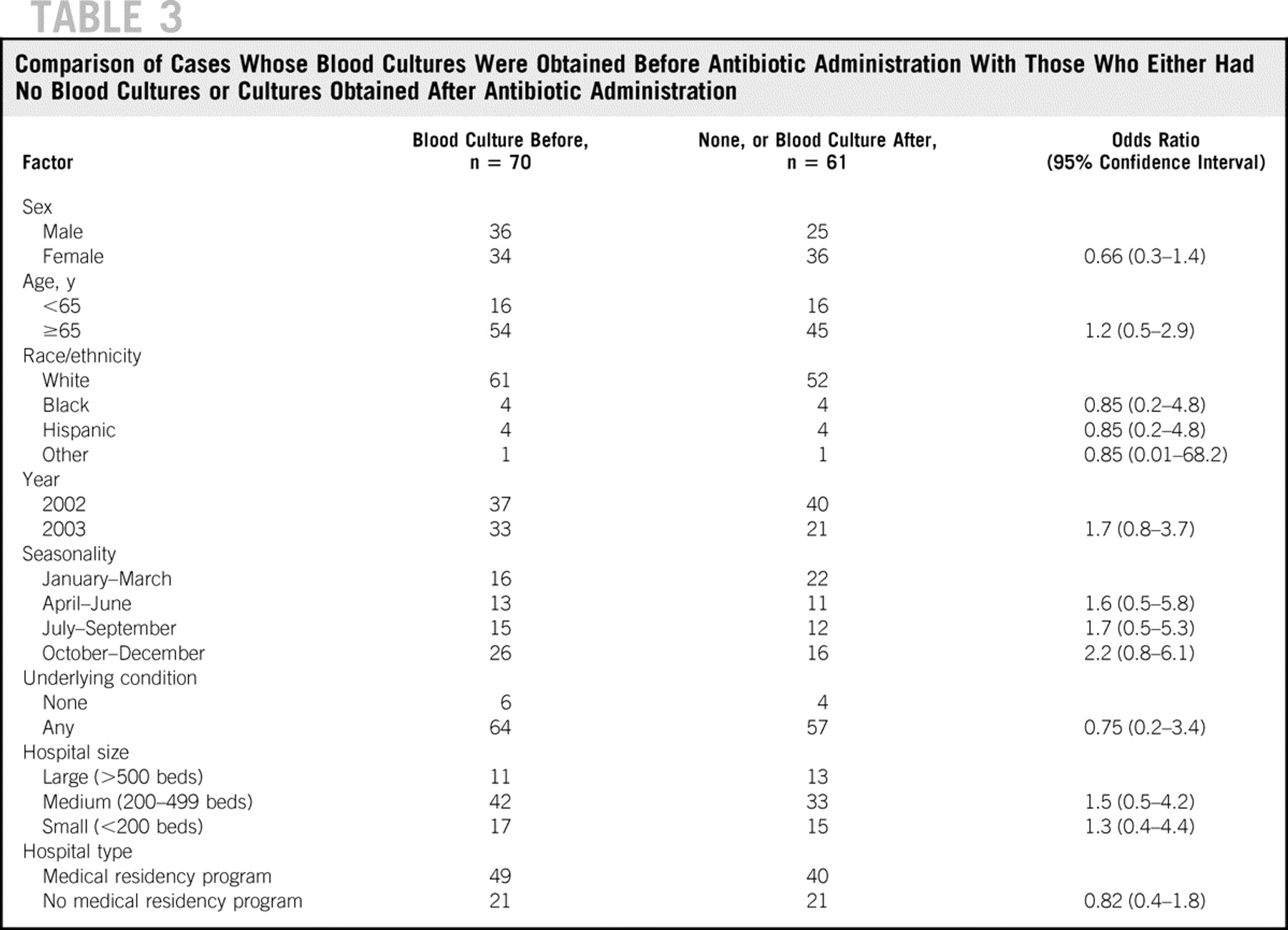
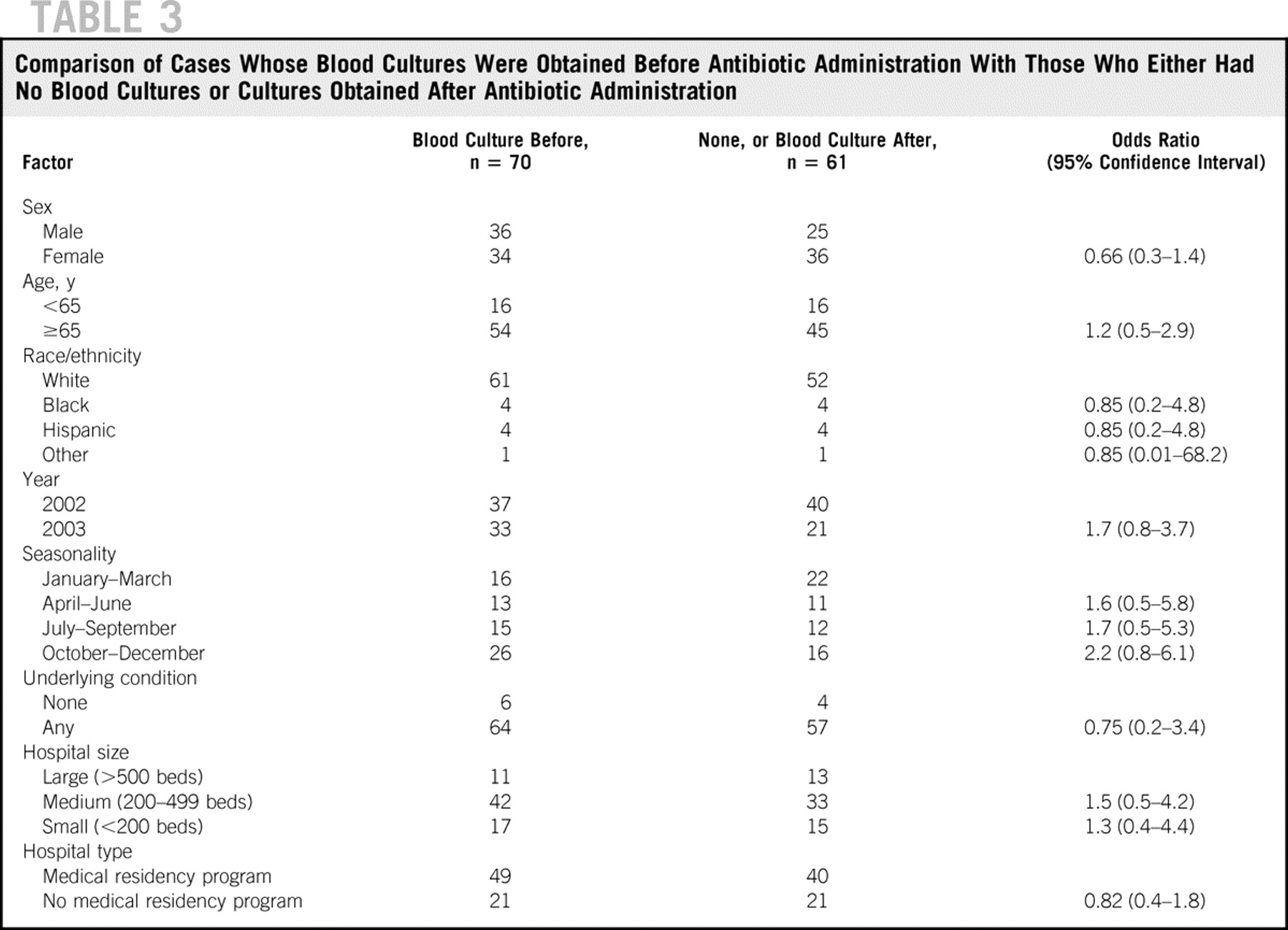
We further examined the demographic, clinical, seasonal and hospital characteristics associated with cases that had blood cultures drawn before antibiotic administration (n = 70) and cases that had either no blood cultures or blood cultures drawn postantibiotic administration (n = 61). No significant differences were noted (Table 3). Notably, there were no important differences between hospitals with and without teaching programs or between larger and smaller hospitals.
Comparison of Cases Whose Blood Cultures Were Obtained Before Antibiotic Administration With Those Who Either Had No Blood Cultures or Cultures Obtained After Antibiotic Administration
DISCUSSION
Ours is the first population-based study to estimate the proportion of unexplained deaths of possibly infectious etiology in Connecticut and to describe the epidemiology and evaluation of these deaths having clinical characteristics consistent with inhalational anthrax or inhalational tularemia. This study puts into perspective the background rates of fatal infections that could have been missed cases of these diseases.
Of the 59,971 deaths that were reported in Connecticut during 2002 and 2003, only 133 were classified as having a clinical presentation consistent with infection with 1 of the 4 Category A biological agents of interest. All of these were consistent with inhalational anthrax, a small number (6) were consistent with inhalational tularemia, and none were consistent with smallpox or botulism. However, there was no evidence of clinician awareness for these potential diagnoses because none of the 133 cases had anthrax or tularemia listed in the charted differential diagnosis or had Category A agent–specific testing performed. In addition, only 53% of cases had blood cultures performed before the administration of antibiotics, limiting the potential to even incidentally diagnose bioterrorism-related bacteremia that could have been due to anthrax.
Given these disappointing findings during the critical years 2002 and 2003, when awareness of both anthrax and smallpox should have been high, safety-net strategies are needed to increase the potential for diagnosis of Category A bioterrorism agents.
In our study, anthrax was the most common potential diagnosis. Although not specifically examined, many of the infectious deaths presenting with pneumonia could also have been caused by plague. One safety-net strategy for both of these diseases is blood culture. It is concerning that, in a state in which there was a documented case of bioterrorism-related inhalational anthrax in 2001,Reference Cosgrove, Perl, Song and Sisson3 no clinician listed anthrax in the differential diagnosis of any of these cases, and that in 47% of cases, blood cultures were not taken before the administration of antibiotics. In the 2001 anthrax attacks, no positive anthrax blood cultures were obtained from anyone who had been given antibiotics, even among those whose initial blood cultures were positive for gram-positive rods.Reference Jernigan, Stephens and Ashford16 Recent data suggesting the limited cost-effectiveness of obtaining blood cultures in patients with community acquired pneumonia could further decrease the likelihood that patients with these illnesses will be diagnosed.Reference Campbell, Marrie, Anstey, Ackroyd-Stolarz and Dickinsin17 It is clear that education of both clinicians and administrators as to the importance of obtaining blood cultures is needed. Physicians, particularly those in settings where such patients are most likely to present (eg, emergency or critical care departments) need education and reinforcement of prior education that the timing of obtaining blood cultures is important.2 We hypothesized that cases presenting at teaching hospitals and larger hospitals would have been more likely to have had blood cultures collected before antibiotic administration because of the greater number of training programs and specialists available at these hospitals. However, no significant differences were found between hospitals with or without teaching programs or between larger and smaller hospitals in regards to collection of blood cultures.
Although not a focus of this study, a safety-net strategy that has been put into place in Connecticut is the reporting to public health authorities of all blood cultures that grow gram-positive rods.Reference Begier, Barrett, Mshar, Johnson and Hadler18 This strategy maximizes the potential for the diagnosis of individual cases of inhalational anthrax by minimizing the potential for laboratory error or delay in recognition of anthrax in blood cultures.
No deaths that may have been due to smallpox or botulism were found in our study, suggesting that lethal diseases mimicking these are rare. The relative rarity of syndromes consistent with these diseases makes it possible to establish syndromic surveillance to detect severe individual cases of compatible illnesses and monitor them individually. Such a safety-net diagnostic strategy has been put into place in Connecticut in the form of a hospital admission syndromic surveillance system to identify individuals admitted to the hospital with a syndrome of fever and rash.Reference Hadler, Siniscalchi and Dembek19
Another strategy is to augment rates of autopsy on cases of unexplained pneumonia or meningoencephalitis with attention to organism-specific and not just anatomical diagnoses. Such organism-specific diagnoses will provide useful clinical and epidemiological information to both clinicians and public health officials.Reference Nolte20 If the unexplained deaths with unexplained pulmonary and/or neurological syndrome in our study population were autopsied, this would have amounted to 2845 autopsies statewide over a 2-year period, or 27 autopsies per week. This would equal about 1 additional autopsy for each Connecticut hospital per week.
Our study has several limitations. First, as a retrospective chart review, our conclusions are based only on charted information, which may not accurately reflect the clinical thinking of the responsible physicians. Second, with the older age and high percentage of comorbidities of our cases, physicians may have been more likely to consider the usual community-acquired pathogens in their differential diagnosis; the low rate of autopsy in this cohort may, in part, reflect this conclusion. In addition, these factors also may have limited the degree to which diagnostic tests were performed. The low specificity of our study's clinical case definitions, especially for inhalational anthrax and tularemia, may have resulted in classification error (ie, unexplained deaths inappropriately classified as cases), reducing the proportion of cases judged to have received an adequate work-up. This low specificity, along with the lack of true Category A–related cases during this time period, do not allow us to draw conclusions about the positive predictive value of our inclusion criteria.
Except for anthrax, few unexplained deaths in Connecticut could possibly be due to the bioterrorism agents studied. In 47% of deaths from illnesses that could be anthrax, the diagnosis likely would have been missed. As of 2004, Connecticut physicians were not well prepared to intentionally or incidentally diagnose initial cases of anthrax or tularemia. More effective clinician education and surveillance strategies are needed to minimize the potential to miss initial cases in a bioterrorism attack.
Acknowledgments
The authors are indebted to Sarah A. Harma, who collected and entered data for the purposes of this study.
This work was supported by funding from the Connecticut Emerging Infections Program cooperative agreement (5 U01 CI000307) and the Connecticut Public Health Preparedness and Response for Bioterrorism cooperative agreement (U90/CCU116996-03), both from the Centers for Disease Control and Prevention (CDC). Its contents are solely the responsibility of the authors and do not necessarily represent the official views of CDC or the Connecticut Department of Public Health.
Authors' Disclosures None of the authors report any conflict of interest.