Implications
Selective grazing alters the botanical composition of pasturelands, risking sustainability of livestock production systems. We explored the possibility to train sheep to be less selective by conditioning preference for low-quality foods (LQFs) in early life. A LQF was offered simultaneously with energy and protein supplements. In the conditions of our study we did not success. Continuous comparisons between the LQF and the high-quality supplements during early exposure may have depressed the reinforcing value of the former food. Ongoing research is exploring alternative conditioning procedures in early life to increase intake of and preference for LQF in adulthood.
Introduction
When confronted with a choice of foods, ruminant have the ability to select the most nutritious alternatives (Provenza, Reference Provenza1996; Berteaux et al., Reference Berteaux, Crete, Huot, Maltais and Ouellet1998; Villalba and Provenza, Reference Villalba and Provenza2000). In grazing conditions this behavior leads to persistent selection of plant species of high nutritional quality, thus altering the botanical composition of pasturelands and limiting subsequent selection by animals (Milchunas et al., Reference Milchunas, Sala and Lauenroth1988; Provenza et al., Reference Provenza, Villalba, Dziba, Atwood and Banner2003). Hence, increases in dietary breadth through the development of preferences for species of low nutritional quality may help to overcome those problems.
The transition from monogastric to ruminant digestion represents a sensitive period for the development of dietary habits in ruminants (Provenza and Balph, Reference Provenza and Balph1987; Squibb et al., Reference Squibb, Provenza and Balph1990). During this period, adaptive modifications occur in physiology, morphology and neurology, which subsequently influence food acceptance (voluntary intake of a given food) and preferences (choices among food alternatives) (Provenza and Balph, Reference Provenza and Balph1988). Goats early exposed to a food high in phenols subsequently showed higher acceptance than inexperienced animals, and this was associated with a higher capacity to detoxify phenols in the early exposed group (Distel and Provenza, Reference Distel and Provenza1991). Similarly, sheep early exposed to low-quality roughage subsequently showed higher acceptance for this type of forage, which was associated with a higher capacity to recycle nitrogen (Distel et al., Reference Distel, Villalba and Laborde1994 and Reference Distel, Villalba, Laborde and Burgos1996). However, the mere exposure to some particular food does not necessarily imply the development of a preference for it, particularly with low-quality foods (LQFs). To increase preference for LQFs, animals should be induced to ingest them with higher quality foods, in order to improve post-ingestive consequences and facilitate learning of the potential benefits of combining complementary nutrients or toxins (Provenza et al., Reference Provenza, Villalba, Dziba, Atwood and Banner2003). For example, lambs experiencing the same plant secondary metabolite under different nutritional contexts manifested different patterns of preference (Baraza et al., Reference Baraza, Villalba and Provenza2005).
In this study, we hypothesized that early experience of sheep with a LQF in a nutritionally enriched context (offered simultaneously with energy and protein supplements) increases preference for this type of food in adulthood. From this hypothesis, we predicted higher proportional consumption of LQF in experienced lambs (EL) than in inexperienced lambs (IL) in choice situations involving the LQF and alternative foods. Additionally, we determined intake of LQF by both groups of lambs at different levels of high-quality food (HQF) availability. Availability of HQF was shown to interact with sheep previous experience in determining intake of LQF (Shaw et al., Reference Shaw, Provenza and Villalba2006). To help in interpretation of the results, we also determined digestibility and nitrogen retention in EL and IL when fed LQF only.
Material and methods
The study was conducted at the ‘Centro de Recursos Naturales Renovables de la Zona Semiárida’ (CERZOS) located in Bahía Blanca (38° 44′S; 62° 16′W), Argentina, from July 2007 to June 2008.
Animals and housing
Twenty-four 1-month-old Corriedale lambs (Ovis aries L.; 12 females and 12 castrated males) and their dams (3- to 6-year-old) were randomly assigned to two experimental groups balanced by sex, and placed in contiguous experimental yards (200 m2) separated by a black canvas in order to preclude visual and physical interaction among groups. Each yard was provided with an automatic water dispenser, two mineral salt bunks and 10 plastic feed bunks (25 l). Feed bunks were placed under a 40 m2 shelter, an area large enough to allow lambs and mothers to protect themselves from sun exposure and adverse weather.
Exposure period
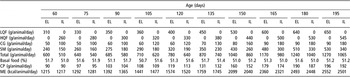
Lambs were exposed to the early experience treatments from 60 to 210 days of age, a time period encompassing the sensitive phase for the development of food preferences in sheep (Squibb et al., Reference Squibb, Provenza and Balph1990; Provenza et al., Reference Provenza, Villalba, Dziba, Atwood and Banner2003); during the first 30 days of this period they were exposed to the treatments with their dams. Along the exposure period all lambs consumed a basal food, which represented more than 50% of their daily intake (Table 1). The basal food was either mature oat hay (LQF; metabolizable energy (ME): 1.8 Mcal/kg, CP: 6.1% and NDF: 69.3%) or vegetative alfalfa hay (HQF; ME: 2.2 Mcal/kg, CP: 15.1% and NDF: 44.4%), both chopped into segments 2 to 3 cm in length. Lambs fed LQF as their basal food were regarded as EL (n = 12), whereas lambs fed HQF as their basal food were regarded as IL (n = 12). Lambs from both treatments had also simultaneous access to restricted amounts (see Table 1) of sunflower meal (SM; ME: 2.0 Mcal/kg, CP: 28.4% and NDF: 45.2%) and corn grain (CG; ME: 3.4 Mcal/kg, CP: 8.5% and NDF: 25.1%), as protein and energy supplements, respectively.
Amount of oat hay (LQF), alfalfa hay (HQF), CG (energy supplement), SM (protein supplement), total food, CP and ME fed to EL (early exposed to LQF) and IL (early exposed to HQF) at 15-day intervals from 60 to 210 days of age. The basal food is represented by LQF (EL) or HQF (IL), and is expressed as percentage of the total diet

LQF = low-quality food; HQF = high-quality food; CG = corn grain; SM = sunflower meal; ME = metabolizable energy; EL = experienced lambs; IL = inexperienced lambs.
Each food type was provided daily in separate feed bunks (four bunks for the basal food and three bunks for each supplement) at 0900 h; food position was daily randomized. There was enough trough space for all the lambs to eat at one time either the basal food or the supplements. During the time the dams were present (first month of exposure) feed bunks were on a creep feeding arrangement to avoid competition for food between dams and lambs; however, dams and lambs were feed with the same type of food and social interactions may have facilitated food learning in lambs. We did not measure individual food intake by lamb during the exposure period. Lambs had also free access to a mineral salt premix (calcium 11%, phosphorus 5%, magnesium 2%, copper 0.05%, iron 0.12%, manganese 0.05% and sodium chloride 50%; Daasons Ltd., Argentina), and they were injected with a vitamin complex (vitamin A, D3 and E; Pfizer Ltd., Brazil) at 60 and 150 days of age. They were also vaccinated with a polyvalent clostridial vaccine (CDV Ltd., Argentina) at 90 days of age, and dewormed with ivermectin 1% w/v (Ivomec®, Merial Saúde Animal Ltd., Brazil) at 180 days of age.
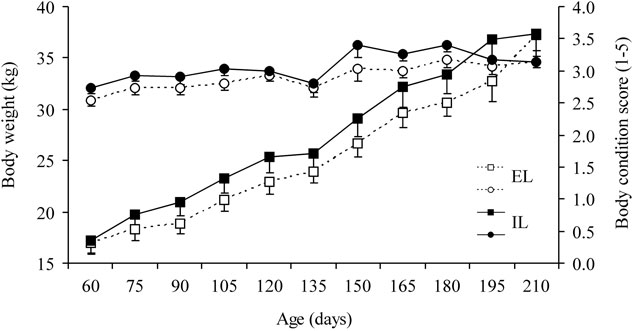
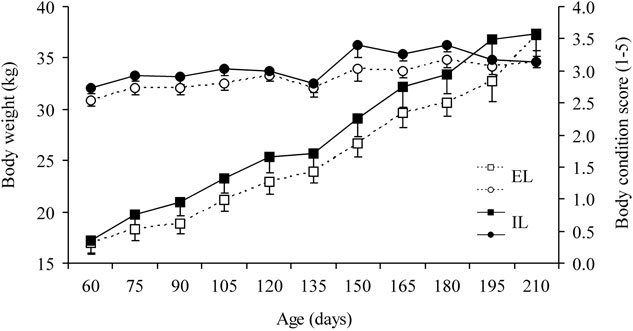
BW and body condition score (Russel, Reference Russel1991) of EL and IL were measured at 15-day intervals (Figure 1), to evaluate diet adequacy and to adjust the amount and proportion of each foodstuff in each treatment according to sheep nutrient requirements (NRC, 1985). This procedure allowed achieving both an intake of basal food slightly over 50% of total daily intake in each experimental group, and similar nutrient profiles in EL and IL (Table 1). Differential nutrient and/or toxin intake early in life can change animal digestive physiology (Distel and Provenza, Reference Distel and Provenza1991; Distel et al., Reference Distel, Villalba and Laborde1994 and Reference Distel, Villalba, Laborde and Burgos1996), which could obscure the influence of early learning on later food preference.
Body weight (squares) and body condition score (circles) of experienced lambs (EL; early exposed to low-quality food) and inexperience lambs (IL; early exposed to high-quality food), at 15-day intervals from 60 to 210 days of age. For each variable, individual ANOVA tests showed no difference (P > 0.05) between treatment means. Values are average of 12 animals. Error bars denote ± 1 s.e.
Offered foods were sampled (100 g) at 15-day intervals for the determination of dry matter (DM) content. Dry samples were then grounded to pass through a 1 mm screen (Wiley Mill, Thomas Scientific, Swedesboro, NJ, USA), and analyzed for CP by the Kjeldahl procedure (AOAC, 1990) and for NDF by the detergent system (Goering and Van Soest, Reference Goering and Van Soest1970). Metabolizable energy estimates for all foods were obtained from tabulated composition data (NRC, 1985), checking for similarities between tabulated and current foods in CP and NDF contents.
Post-exposure period
Following the exposure period, EL and IL were daily fed 400 g of LQF, 400 g of HQF, 300 g of SM and 100 g of CG per animal over a period of 30 days. Thus, HQF was included in the diet of EL and LQF in the diet of IL when the lambs were 210 days old, that is, outside the sensitive period for the development of food preference in sheep (Squibb et al., Reference Squibb, Provenza and Balph1990). Exposure to foods that were not experienced early in life was implemented in order to minimize neophobia (see Provenza et al., Reference Provenza, Lynch and Cheney1995) in subsequent feeding trials.
Preference trials
These trials were conducted in order to determine daily and intra-day patterns of food intake of EL and IL in choice situations involving alternative foods.
Immediately after the post-exposure period, EL and IL were weighed and placed into individual pens (3 m2) under shelter. Each pen was provided with an automatic water dispenser and three plastic feed bunks (20 l).
Three consecutive trials were conducted by exposing animals to a choice of freely available LQF (oat hay), HQF (alfalfa hay) and CG (Trial 1); LQF, SM and CG (Trial 2); or LQF, HQF and SM (Trial 3). Foods were offered from 0840 h to 1800 h, in amounts enough to allow at least 20% refusals. Each preference trial lasted for 15 days. The first 12 days were for animals to become familiar with the alimentary context, and the last 3 days for data collection. We decided on the same succession of choices for all animals, rather than a more complex design, because we expected an early experience effect strong enough to override possible carryover effects between trials. Even so, we allowed for a 12-day adjustment period between successive choices, which would be expected to minimize possible carryover effects.
Food position in the feed bunks was daily randomized. Daily intake was determined as the difference between offered and refused food, whereas the intra-day pattern of intake was determined by systematically weighing leftovers at 80-min intervals along the daily feeding period. Preference for each food was assessed on a ratio basis.
Individual samples of offered and refused foods were daily collected and oven dried at 65°C to constant weight to determine DM content.
High-quality food progressive depletion trial
This trial was conducted in order to determine intake of LQF by EL and IL along a progressive depletion of HQF availability.
This trial had five consecutive periods of 10 days each. The first 7 days of each period were for animals to become familiar with the experimental conditions, and the last 3 days for data collection. In the first period animals received a simultaneous offer of LQF and HQF in individual feed bunks from 0900 h to 1800 h, in amounts enough to allow at least 20% refusals. During this period we determined individual ad libitum intake of HQF. In the following periods animals received a simultaneous offer of freely available LQF and 75%, 50%, 25% or 0% of their ad libitum intake of HQF (periods 2, 3, 4 and 5, respectively). Offered and refused foods were weighed in order to determine daily intake. Food position in the feed bunks was daily randomized.
We calculated the substitution rate of LQF at each level of HQF availability (100%, 75%, 50% and 25%) as:

where LQFI0 = LQF intake at 0% HQF availability; LQFIi = LQF intake at i% of ad libitum intake of HQF; HQFIi = HQF intake at i% of ad libitum intake.
Individual samples of offered and refused foods were daily collected and oven dried at 65°C to constant weight to determine DM content.
Low-quality food digestion and nitrogen retention trial
This trial was conducted in order to determine in vivo DM digestibility and nitrogen retention in EL and IL lambs fed with LQF.
Five randomly selected male lambs from each group were placed into metabolic cages provided with a frontal feed bunk (10 l) and a water dispenser. Cages had also individual containers that allowed us to collect urine and feces separately. The trial lasted 12 days; the first 9 days were for animals to become familiar with experimental conditions, and the last 3 days for data collection. Animals were fed LQF every day from 0900 h to 1800 h, in an amount that allowed 20% refusals. Offered and refused foods were weighed in order to determine daily food intake. Feces and urine were collected daily and weighed at 1000 h. We added 200 ml of a hydrochloric acid solution (5 ml/l) into the urine recipients to prevent NH3 volatilization.
Intake and total fecal output data were used to calculate the apparent DM digestibility of LQF as:

Daily samples of offered food, refused food, urine and feces, were individually collected, pooled and stored at −18°C until laboratory analyses. Food and fecal samples were oven dried at 65°C to constant weight to determine DM content, and then ground to pass through a 1 mm screen. Food, fecal and urine samples were then analyzed for nitrogen content by the Kjeldahl procedure (AOAC, 1990). Nitrogen retention was calculated as:

Statistical analysis
Intake data was expressed as grams of DM consumed per kilogram of BW (g/kg BW) in all feeding trials.
Each preference trial and each period of the depletion trial was analyzed separately. Data on food intake and substitution rate of LQF by HQF were analyzed as a repeated measures design with the PROC MIXED procedure of SAS (SAS Institute Inc., Cary, NC, USA). The statistical model included early experience (EL or IL), day, and their interaction (early experience × day) as fixed effects. Daily consumption was the repeated measure, and animals were the experimental unit and the only random term of the model. The statistical model for the analysis of the intra-day pattern of intake included the 80-min intervals and the interaction of early experience × interval as fixed effects. The within-animal covariance matrix was modeled as compound symmetric, which provided the best fit for the data in all tests according to the Schwarz’s Bayesian criterion (Littell et al., Reference Littell, Henry and Ammerman1998).
LQF intake, apparent DM digestibility, and nitrogen retention data were analyzed using one-way ANOVA (SAS Institute Inc, Cary, NC, USA), with early experience (EL or IL) as the fixed effect of the model.
Results
Preference Trial 1: Oat hay, alfalfa hay and CG
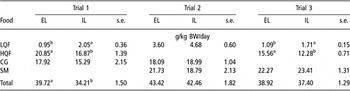
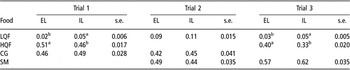
Intake of (Table 2) and preference for (Table 3) LQF (oat hay) was higher (P = 0.049 and P = 0.042, respectively) in IL (lambs that experienced HQF in early life) than in EL (lambs that experienced LQF in early life), whereas intake of and preference for HQF (alfalfa hay) was higher (P = 0.037 and P = 0.045, respectively) in EL than in IL. There was no significant effect of early experience treatment on CG intake (P = 0.258) and preference (P = 0.311). Total food intake was higher (P = 0.020) in EL than in IL.
Intake of oat hay (LQF), alfalfa hay (HQF), CG (energy supplement) and SM (protein supplement) by EL (early exposed to LQF) and IL (early exposed to HQF) in preference trials

EL = experienced lambs; IL = inexperienced lambs; BW = body weight; LQF = low-quality food; HQF = high-quality food; CG = corn grain; SM = sunflower meal.
Each value represents the mean of 12 animals. Within trials, values in a row with different superscript letter differ significantly (P < 0.05).
Preference of EL (early exposed to LQF) and IL (early exposed to HQF) for oat hay (LQF), alfalfa hay (HQF), CG (energy supplement), and SM (protein supplement) in three food trials

EL = experienced lambs; LQF = low-quality food; IL = inexperienced lambs; HQF = high-quality food; CG = corn grain; SM = sunflower meal.
Preference for a particular food is calculated as the intake of that food divided by total food intake.
Each value represents the mean of 12 animals. Within trials, values in a row with different superscript letter differ significantly (P < 0.05).
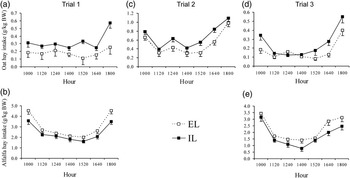
Average intake of LQF at 80-min intervals was higher (P = 0.017) in IL than in EL (0.323 v. 0.172 g/kg BW, respectively, s.e. = 0.052; Figure 2a), whereas average intake of HQF was higher (P = 0.026) in EL than in IL (2.940 v. 2.389 g/kg BW, respectively, s.e. = 0.159; Figure 2b). There was no significant interaction between early experience and time intervals throughout the day for both LQF (P = 0.312) and HQF intake (P = 0.141).
Daily intake of oat hay (low-quality food (LQF)) and alfalfa hay (high-quality food (HQF)) by experienced lambs (EL; early exposed to LQF) and inexperience lambs (IL; early exposed to HQF) at 80-min intervals from 0840 to 1800 h, during Preference Trial 1 (a, b), Preference Trial 2 (c) and Preference Trial 3 (d, e). Values are average of 12 animals. Error bars denote ± 1 s.e. BW stands for body weight.

Preference Trial 2: Oat hay, SM and CG
Intake of (Table 2) and preference for (Table 3) LQF, SM (SM) and CG did not differ between EL and IL (P = 0.210, P = 0.351 and P = 0.543 for intake, and P = 0.261, P = 0.409 and P = 0.631 for preference, respectively). Total food intake was not influenced (P = 0.707) by the early experience treatment.
Average intake of LQF at 80-min intervals was higher (P = 0.009) in IL than in EL (0.681 v. 0.517 g/kg BW, respectively, s.e. = 0.040; Figure 2c). There was no significant interaction between early experience and time intervals throughout the day for LQF intake (P = 0.748).
Preference Trial 3: Oat hay, alfalfa hay and SM
Intake of (Table 2) and preference for (Table 3) LQF was higher (P = 0.051 and P = 0.039, respectively) in IL than in EL, whereas intake of and preference for HQF was higher (P = 0.004 and P = 0.022, respectively) in EL than in IL. There was no significant effect of early experience treatment on SM intake (P = 0.512) and preference (P = 0.431). Total food intake was not influenced (P = 0.414) by early experience treatment.
Average intake of LQF at 80-min intervals was higher (P = 0.002) in IL than in EL (0.247 v. 0.163 g/kg BW, respectively, s.e. = 0.017; Figure 2d), whereas average intake of HQF at 80-min intervals was higher (P = 0.004) in EL than in IL (2.22 v. 1.75 g/kg BW, respectively, s.e. = 0.103; Figure 2e). There was no significant interaction between early experience and time intervals throughout the day for both LQF (P = 0.151) and HQF (P = 0.248).
High-quality food progressive depletion trial
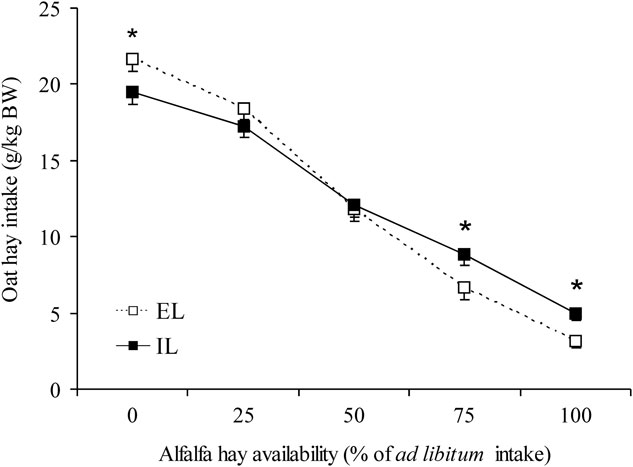
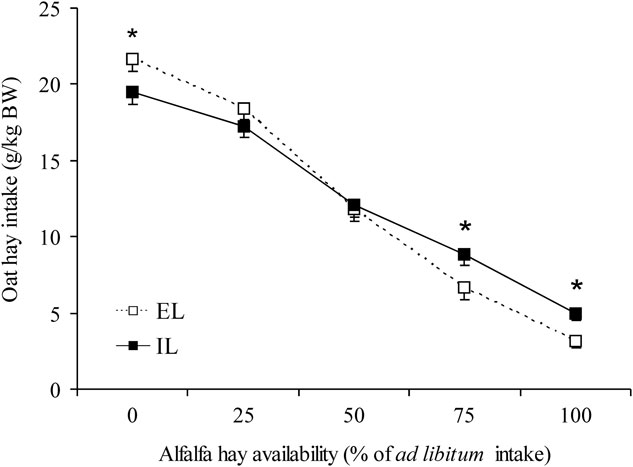
Intake of LQF by EL and IL along the progressive depletion of HQF availability is shown in Figure 3. In the first period of the trial (ad libitum availability of HQF) intake of LQF was higher (P = 0.022) in IL than in EL, whereas intake of HQF (not shown in Figure 3) was higher (P = 0.045) in EL than in IL (29.38 v. 25.62 g/kg BW, respectively, s.e. = 1.124). When the availability of HQF was restricted to 75% of ad libitum intake, intake of LQF was still higher (P = 0.030) in IL than in EL, whereas when it was restricted to 50% and then to 25% of the ad libitum intake there was no significant difference (P = 0.812 and P = 0.263, respectively) in LQF intake between EL and IL. Finally, when HQF was not available, intake of LQF was higher (P = 0.039) in EL than in IL.
Daily intake of oat hay (low-quality food (LQF)) by experienced lambs (EL; early exposed to LQF) and inexperience lambs (IL; early exposed to high-quality food (HQF)) under different levels of alfalfa hay (HQF) availability. Values are average of 12 animals. Error bars denote ± 1 s.e. Within each level of alfalfa hay availability, * denote significant difference between means (P < 0.05). BW stands for body weight.
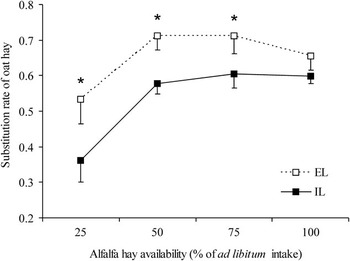
The substitution rate of LQF when EL and IL were exposed to decreasing levels of HQF availability is shown in Figure 4. When animals had ad libitum availability of HQF, the substitution rate of LQF did not differ (P = 0.200) between treatments. But, when the availability of HQF was restricted to 75%, 50% and 25% of ad libitum intake the substitution rate of LQF was higher (P = 0.040, P = 0.016 and P = 0.025, respectively) in EL than in IL.
Substitution rate of oat hay (low-quality food (LQF)) by experienced lambs (EL; early exposed to LQF) and inexperience lambs (IL; early exposed to high-quality food (HQF)) under different levels of alfalfa hay (HQF) availability. For each level of alfalfa hay availability, the substitution rate of oat hay is calculated as the intake of oat hay when no alfalfa hay is available minus current intake of oat hay divided by current intake of alfalfa hay. Values are average of 12 animals. Error bars denote ± 1 s.e. Within each level of alfalfa hay availability, * denote significant difference between means (P < 0.05).

Low-quality food digestion and nitrogen retention trial
Intake of LQF did not differ (P = 0.750) between EL and IL (14.29 v. 13.87 g/kg BW, respectively, s.e. = 0.615). Early experience did not affect either the apparent DM digestibility of LQF (52% v. 50% for EL and IL, respectively, s.e. = 1.614, P = 0.210) or nitrogen retention (3.15 v. 3.01 g/animal/day for EL and IL, respectively, s.e. = 0.577, P = 0.540).
Discussion
We hypothesized that a positive experience with LQF (mature oat hay) early in life, induced by allowing animals to mix the LQF with supplementary sources of energy (CG) and protein (SM), increases preference for LQF in adulthood. Consequently, we predicted that lambs experiencing such a nutritional environment (EL) would show higher intake of LQF than IL when exposed to choice situations. However, contrary to expectations, intake of LQF was similar or lower in EL than in IL, regardless of the alimentary context. In previous studies, goats (Distel and Provenza, Reference Distel and Provenza1991) and sheep (Distel et al., Reference Distel, Villalba and Laborde1994) early exposed to low-quality forages subsequently showed increased preference for that type of forage. In these earlier studies, lambs and goats experienced the low-quality forage in a poor nutritional context, and the effects of early experience were associated to changes in physiological processes, which increased the animals’ capacity to digest fiber, to recycle nitrogen or to detoxify toxins (see also McEachern et al., Reference McEachern, Eagles-Sith, Efferson and Van Vuren2006). Contrarily, in this study, EL experienced LQF in a rich nutritional context and early experience treatments did not affect digestive capacity or nitrogen utilization, probably due to similar nutrient intake in EL and IL during exposure.
We also expected a higher intake of LQF in EL than in IL at different levels of HQF (alfalfa hay) availability. However, intake of LQF was lower or similar in EL than in IL, except when the HQF was not available. When HQF availability was set to 75%, 50% or 25% of ad libitum intake, EL showed a higher substitution rate of LQF than IL. These results suggest that EL were motivated to replace higher amounts of LQF per unit of HQF consumed, compared to IL. Thus, while animals substitute foods for nutritional reasons mainly (Moore et al., Reference Moore, Brant, Kunkle and Hopkins1999), past food experiences could modulate the response. On the other hand, when forced to consume LQF (no HQF available), EL ingested 10% more than IL. Similarly, Distel et al. (Reference Distel, Villalba, Laborde and Burgos1996) found a higher intake of mature sorghum hay (Sorghum bicolor, a low-quality forage) by sheep early exposed to low-quality forage, relative to sheep early exposed to high-quality forage, only when alfalfa hay was not available in the choice. The development of acceptance for a low-quality forage through early experience with this type of forage has been attributed to increases in digestion capacity (Distel et al., Reference Distel, Villalba and Laborde1994). However, in this study, we did not find differences in apparent digestibility of LQF between EL and IL. Ingestion of a high-fiber food (i.e. mature oat hay) during the exposure period may have increased reticulo-rumen capacity in EL (Milne et al., Reference Milne, Macrae, Spence and Wilson1978; Distel and Provenza, Reference Distel and Provenza1991), which may have contributed to their increased acceptance of LQF.
Despite the fact that our results did not support the hypothesis, early experience with a LQF in a nutritionally enriched context led to persistent changes in preferences by lambs. In all choice situations involving freely available LQF and HQF, preference for LQF was higher in IL than in EL, whereas preference for HQF was higher in EL than in IL. These patterns of preference were also observed when intake was analyzed at 80-min intervals throughout the day. On the other hand, although during the early exposure period the amount of CG offered was lower and the amount of SM offered was higher for EL than for IL (see Table 1), there were no differences between EL and IL in the consumption of these supplements across trials. Altogether the results suggest that the amount of early experience is not a sufficient condition for the development of food preferences, and that behavioral processes such as the relative reinforcing value of each food can affect the process of learning food preferences.
One possible explanation for the observed lower preference for LQF in EL than in IL, is that the alimentary context in which animals experienced LQF during the exposure period (i.e. simultaneous exposure to sources of energy and protein) negatively affected the relative value that EL assigned to LQF as a desirable food source. The reinforcing value that an animal assigns to a given food is not only determined by its post-ingestive consequences, but also by other foods present in the alimentary context (Flaherty, Reference Flaherty1996). Bergvall et al. (Reference Bergvall, Rautio, Tuomas and Leimar2007) and Bergvall and Balogh (Reference Bergvall and Balogh2009) observed that fallow deer (Dama dama) showed a decreased intake of a food containing 1% tannin when it was presented immediately after a preload meal with the same food but containing 0.25% tannin (higher quality alternative), relative to when it was presented after a preload of the same 1% tannin food. This phenomenon, known as ‘simultaneous negative contrast’, occurs when as a result of comparisons made among foods of different quality, animals show an exaggerated decrease in the intake of the lower quality options (Flaherty, Reference Flaherty1996). Simultaneous negative contrasts have been argued to play an important role in the foraging behavior of mammalian herbivores, since when foods of different quality appears in the alimentary context they can elicit searching behavior or make the animal wait for a more profitable food option, biasing diet selection to higher quality alternatives (Flaherty et al., Reference Flaherty, Blitzer and Collier1978 and Reference Flaherty, Troncoso and Deschu1979; Pellegrini and Mustaca, Reference Pellegrini and Mustaca2000; Bergvall et al., Reference Bergvall, Rautio, Tuomas and Leimar2007). Thus, EL devaluation of LQF (oat hay) in this study may have resulted from the continuous comparisons that lambs made between LQF (low quality alternative) and the energy (CG) and protein (SM) supplements (high quality alternatives) simultaneously offered during the early exposure period. Even when all foods were offered simultaneously during exposure, EL ate LQF only after all CG and sunflower supplements were consumed. The large differences in quality between the LQF and the energy and protein supplements may have accentuated the devaluation of the former food during the exposure period; and may help explain the relatively low values of LQF intake by EL during the preference trials. Similarly, Nolte et al. (Reference Nolte, Provenza and Balph1990) observed that lambs early exposed to wheat grain and mountain mahogany (Cercocarpus montanus, shrubby species of relatively low-nutritional quality) failed at developing a preference for the latter species. These authors observed that during exposure lambs ate wheat from the beginning but were reluctant to eat mountain mahogany, which can be interpreted as a negative contrast effect between foods.
In summary, our results suggest that mere exposure early in life to a LQF, even in a positive nutritional environment, does not necessarily increase its preference by sheep in adulthood. During early life stages, learning processes are highly efficient (Provenza and Balph, Reference Provenza and Balph1987), and the information animals extract from their alimentary environment could determine the nutritional knowledge that will persist into adulthood. Further research on the development of food preference in ruminants should focus on what they specifically learn about foods when start foraging early in life, and how relevant this learning is in determining adult ingestive behavior.
Acknowledgements
This research was supported by the Agencia Nacional de Promoción Científica y Tecnológica (ANPCyT) de la República Argentina, through the Fondo para la Investigación Científica y Tecnológica (FONCyT, PICT 170 BID 1728/OC-AR). The author specially thanks to Daasons Ltd for contributing with the mineral salts, and Juan Carlos Steffen (Glencore SA) and Roman Torres for supplying sunflower meal. A fellowship from the Consejo Nacional de Investigaciones Científicas y Técnicas de la República Argentina (CONICET) to F. Catanese is acknowledged. Nilda Didoné did the chemical analyses of the foods.