“To many, perhaps to most people [. . .] ‘Celtic’ of any sort is [. . .] a magic bag into which anything may be put, and out of which almost anything may come [. . .] Anything is possible in the fabulous Celtic twilight” (Tolkien Reference Tolkien1963: 29–30; quotation reproduced at the entrance of the exhibition).
Controversies about the ‘Celts’ have constituted an ongoing debate over the last few decades, with postures ranging from blank scepticism and denial, to critical revisions, but also to the maintenance of more traditional approaches. After a lively and overall useful debate in the pages of Antiquity between 1996–1998 (principally with articles by Vincent and Ruth Megaw vs Simon James and John Collis), Simon James's controversial volume The Atlantic Celts. Ancient people or modern invention? (Reference James1999) attracted considerable attention, both among scholars and the wider public, encouraging discussions about the relationship—if any—between modern Celtic identities and the ancient Celts. A major milestone was reached with the publication of John Collis's monograph The Celts. Origins, myths and inventions (2003), which is probably the best historiographical review about the construction of the concept and the different sources involved from Antiquity to modern times. One of his main points is that classical sources never referred to the presence of Celts on the British Isles and that the use of the term for the populations of ancient Britain was mainly an invention of the modern era (see also Morse Reference Morse2005, How the Celts came to Britain). From a rather different perspective, new approaches based mostly on linguistics emphasise the crucial role of the Atlantic façade in the development of Celtic languages (Cunliffe & Koch Reference Cunliffe and Koch2010).
Although initially a mostly British phenomenon, critical Celticism—called ‘Celtoscepticism’ by authors such as Patrick Sims-Williams, or ‘New Celticism’ by John Collis himself—has also found a growing echo in Continental European archaeology, with important contributions by leading scholars such as Gonzalo Ruiz Zapatero (Reference Ruiz Zapatero, Almagro-Gorbea, Mariné and Álvarez-Sanchís2001) in Spain, or Sabine Rieckhoff (Reference Rieckhoff, Karl and Leskovar2007) in Germany. The idea of a homogeneous Celtic culture and society with a core area in Central Europe and a subsequent expansion during the Late Iron Age as part of the spread of the La Tène Culture has now been abandoned, or at least revised, within academic circles. It still represents, however, the dominant narrative in numerous museums, books and media documentary across Europe. In addition, we have to acknowledge the existence of a strong ‘popular Celticism’ or ‘public use’ of the Celts with very heterogeneous manifestations (see Karl et al. Reference Karl, Leskovar and Moser2012), from Celtic re-enactment groups to invented esoteric traditions, writers of ‘fringe archaeology’, or modern political identity constructions. In the so-called ‘Celtic nations’ of the Atlantic fringe, the idea of a Celtic past has been particularly influential in order to support present-day purposes, from political discourses to music festivals and tourist promotions.
The current exhibition, ‘Celts: art and identity’, represents the first time that many of the new ideas developed within the framework of ‘New Celticism’ have been presented to the British audience in the form of a large museum attraction. It has been developed in partnership between the British Museum and National Museums Scotland, and will run in London from 24 September 2015–31 January 2016, before moving to Edinburgh—in a slightly different version under the name ‘Celts’—between 10 March and 25 September 2016. The fact that it represents the first major British exhibition about the Celts in more than four decades—it is 45 years since the last, broad-based exhibition on Early Celtic art was mounted in Edinburgh and London (Piggott Reference Piggott1970)—explains the considerable impact that it has already generated in newspapers and magazines, and on television and social media. ‘Celts: art and identity’ can be seen as the British counterpart to a long list of major exhibitions on the Celts that have taken place during the last 15 years in places such as Ávila (Spain, 2001), Bern (Switzerland, 2009) and, more recently, Paris (France, 2012) and Stuttgart (Germany, 2012–2013)—duly reported in the pages of Antiquity (e.g. Megaw Reference Megaw2010, Reference Megaw2013). The strong emphasis on art and the weight given to later periods makes it probably more comparable to the Bern exhibition (Müller Reference Müller2009), although with a distinctive narrative and a major focus on the British Isles.
The exhibition is accompanied by the publication of a richly illustrated volume edited by two of the curators, Julia Farley from the British Museum and Fraser Hunter from National Museums Scotland (2015; see book review by Vincent Megaw 2016 (this issue): 245–48), and by a smaller book from Ian Leins (Reference Leins2015). Moreover, there is an extensive programme of complementary events that includes entertainment and activities such as cinema, songs, poetry, interdisciplinary panel discussions, events for children and families, and lectures by leading scholars.
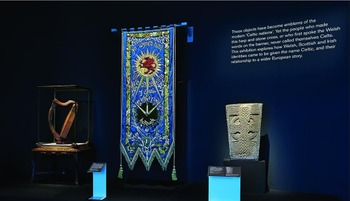
The British Museum exhibition is organised into six main thematic sections, distinguished in the display by different colours: 1) ‘Who are the Celts?’; 2) ‘The first Celts’; 3) ‘The impact of Rome’; 4) ‘A new Christian world’; 5) ‘The Celtic revival’; and 6) ‘Being Celtic today’. As the headings imply, it covers not only the evidence from the Iron Age and early medieval period, but, on the contrary, continues to the present, a feature that distinguishes it from the above-mentioned Continental exhibitions (Figure 1). Broadly speaking, we can distinguish two main blocks: the ‘ancient Celts’ and the ‘modern Celts’, whereas the transition between the two (illustrated by sections three and four on the impact of Rome and early Christianity) represents the weakest part of the exhibition.
Introduction to the exhibition ‘Celts: art and identity’ at the British Museum: Queen Mary's harp, National Museums Scotland; national Eisteddfod banner, Gorsedd of the Bards, Wales; Christian cross slab, Invergowrie, National Museums Scotland; © The Trustees of the British Museum.

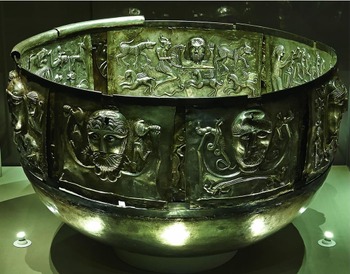
The exhibition includes over 250 remarkable objects borrowed from 16 UK institutions and 10 international lenders. Most of the material comes from the British Isles, but there are also numerous Continental pieces—both from the British Museum's own collections and from foreign institutions—including some exceptional items such as a copy of the stone sculpture from Glauberg, the grave goods from the women's graves of Kleinaspergle and Waldalgesheim, and, for the first time in such an exhibition, that chef d'oeuvre amongst the British Museum's treasures of early Celtic art: the unique pair of flagons from Basse-Yutz; the Gundestrup cauldron is also present, albeit that this last entry is hardly a product of Celtic craftsmanship (see Taylor Reference Taylor1992; Figure 2). Local highlights from the River Thames include the Waterloo helmet and the famous Battersea shield, which also serves as an iconic image included in the catalogue cover and in several exhibition flyers.
Gundestrup Cauldron. Silver, The National Museum of Denmark; © The Trustees of the British Museum.

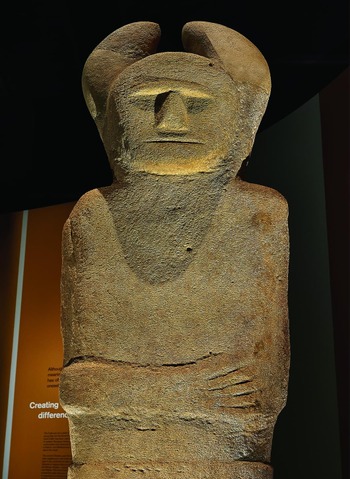
Section one (‘Who are the Celts?’) masterly summarises the main and changing meanings of the word ‘Celts’ from Antiquity to the present. It includes maps showing the ‘Celtic geographies’, a video with a ‘Celtic timeline’ from c. 500 BC to the early twenty-first century and a selection of objects ranging from the impressive Iron Age statute of Holzgerlingen to a medieval harp. This rather small introductory section reflects current trends within ‘New Celticism’ and provides the right background for the rest of the exhibition.
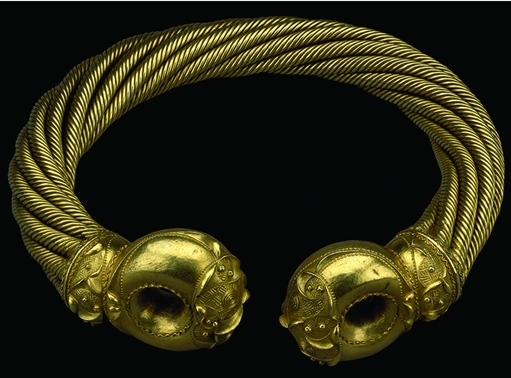
The second section—‘The first Celts’ (we could also say ‘the Iron Age Celts’)—is by far the largest of the exhibition, comprising the period from around 500 BC to the Roman conquest (Figure 3). It is structured around several thematic topics such as ‘Farmers and artisans’, ‘Warriors in life and death’, ‘Dress codes’, ‘Horse power’, ‘The art of feasting’ and ‘Gifts to the gods’. The amount and the quality of the displayed finds is overwhelming and represents a fine selection of many of the masterpieces of Celtic art, from the decorated shield from the River Witham (Lincolnshire) to the stone statue of Euffigneix and the aforementioned finds (Glauberg, Basse-Yutz, Kleinaspergle, Waldalgesheim, Waterloo, Battersea), a wide sample of Iron Age torcs, a replica of a chariot from East Yorkshire and the Deskford carnyx—with a recorded performance on a reconstructed horn. Special mention should be made of the impressive Snettisham hoards containing hundreds of gold and silver torcs; the exhibition of these Snettisham finds is accompanied by explanations about ritual depositions but also new, ground-breaking scientific analysis that reveal the high technological skills of the metalworkers (Figure 4). Overall, section two provides an excellent insight into Late Iron Age art in Temperate Europe, although I would have expected a bit more explanation on the genesis of the La Tène style and the different influences involved, including the appearance of Mediterranean motifs such as palmette forms and lotus flowers.
Double-faced sandstone sculpture from Holzgerlingen (500--400 BC) at the beginning of section two, ‘The first Celts’, height 2.3m; Wüttembergisches Landesmuseum, Stuttgart; © The Trustees of the British Museum.

The Snettisham Great Torc (100–50 BC); gold-silver alloy; © The Trustees of the British Museum.

The following section, ‘The impact of Rome’, is mostly centred on Roman Britain, thereby having a much more limited geographic focus. In fact, whereas the first two sections aim to cover the entire Celtic world, sections three–five are mostly restricted to the British Isles. In section three, the emphasis is on hybridisation, cultural interaction and the development of a Romano-British culture, rightly emphasising that being Roman in Britain was very different from living in Rome. Local styles of Celtic art were used to decorate Roman-style artefacts. The sample of objects shown in this section is rather limited in number, but it includes—among other elements—several coins and decorated mirrors, brooches, a Roman helmet with Celtic motifs, and some epigraphic evidence for Romano-British deities. The exhibition further, and rightly, integrates Scotland and Ireland into the picture, showing how people's lives in these territories were transformed by Roman contact, despite being outside the political boundaries of the Empire.
With section four—‘A new Christian world’— we move into the early medieval period. The main focus is on the local forms of worship that developed in the territories of the Atlantic fringe and the incorporation of pre-Christian styles and traditions. Important finds include a Pictish silver hoard, an inscribed stone from Wales (with Ogam script), some richly decorated brooches and crosses and an elaborately illustrated gospel book. A clear distinction is drawn between the Celtic-speaking populations of Ireland, as well as northern and western Britain, and their Germanic-speaking Anglo-Saxon neighbours. The exhibition text does, however, properly acknowledge that the former never called themselves ‘Celts’.
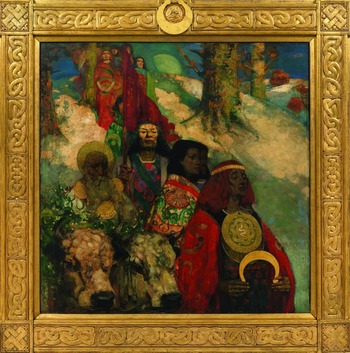
This last point directly connects to the following section, the ‘Celtic Revival’, which constitutes the largest part of the exhibition after the Iron Age section on ‘The first Celts’. During the Renaissance, the meaning of the word Celtic was reinvented to refer to the languages, peoples and traditions of Ireland, and of northern and western Britain, regions where it had never been applied before. The label Celtic acquired a new political significance, leading to the development of the concept of ‘Celtic nations’ in the Atlantic fringe. The exhibition incorporates a representative selection of different creations in art and literature related to the ‘Celtomania’ of the eighteenth, nineteenth and even early twentieth centuries (Figure 5).
The druids: bringing in the mistletoe by George Henry and Edward Atkinson Hornel (1890); © CSG CIC Glasgow Museums Collection.

Finally, the sixth and last section discusses the controversial topic of ‘Being Celtic today’. It acknowledges the powerful meaning that the notion of a shared Celtic heritage has among people of the so-called Celtic nations and members of the diaspora, but also the broader significance of the Celts in global popular culture, from Asterix to spirituality movements. Again, the exhibition provides a rigorous approach that takes into account different sensitivities.
The exhibition is followed by the inevitable shop, which here shows an interesting mix between scholarly publications and rather weird items of ‘popular Celticism’, such as books on ‘Celtic mandalas’ or ‘Celtic art therapy’. This may send contradictory messages to visitors, but it also reflects the reality of popular perceptions about the Celts.
Overall, the exhibition manages masterly to build bridges between new academic trends and widespread popular perceptions (and misunderstandings). Lighting is perfect, texts have the ideal length and are presented in nice display panels, the information is accurate and the sections and objects well chosen. Visitors will not only enjoy looking at the vast array of fabulous art objects, they will also learn about the changing meanings of the term ‘Celts’ and how it has been used and redefined over time. The exhibition certainly acknowledges the main points of ‘New Celticism’, challenging some of the preconceptions traditionally associated with the Celts, but it does so in a balanced and easily comprehensible way, presenting a ‘middle ground’ between diversity and heterogeneity, regionality and connectivity. This is a must-see exhibition that will continue on to Edinburgh, doubtless with a Scottish flavour.