


Introduction
As encroachments on our personal online data have become increasingly ubiquitous in today’s society, they are also receiving attention in public discourse and as subjects of legal inquiry (Ryan and Riekeles Reference Ryan and Riekeles2025; Solove Reference Solove2025; Talesh Reference Talesh2025). Yet discussions of online data privacy typically focus on regulation and on how governments and private organizations shape and challenge privacy protections, often treating consumers themselves as passive or uninterested (Zuboff Reference Zuboff2019). As a result, less attention has been paid to how ordinary citizens – those whose data are being used – make sense of different uses of their online personal data.
A well-established body of scholarship by privacy psychologists does closely examine people’s attitudes and behaviors toward privacy encroachments, with studies focused on how privacy attitudes and behaviors are shaped by people’s social position and immediate social environment (Acquisti et al. Reference Acquisti, Brandimarte and Loewenstein2020; Gerber et al. Reference Gerber, Gerber and Volkamer2018). Research on biometric privacy similarly demonstrates that people’s comfort with and trust in data collection vary across institutional actors, purposes, and social contexts (Katsanis et al. Reference Katsanis, Claes, Doerr, Cook-Deegan, Tenenbaum, Evans, Lee, Anderton, Weinberg and Wagner2022). However, these analyses do not fully explain the meaning-making processes shaping privacy attitudes and behaviors. Thus, our understanding of how people interpret encroachments on data privacy, which is then reflected in their privacy attitudes and behaviors, remains underexplored.
We build on the legal consciousness framework to develop a more in-depth understanding of people’s meaning-making of privacy encroachments (Patricia and Silbey Reference Ewick and Silbey1998; Sarat Reference Sarat1990; Silbey Reference Silbey2005). In particular, we examine how widely circulating beliefs that are endemic to a political-economic system, including but not restricted to beliefs about law (henceforth always understood as legality), shape people’s meaning-making of privacy encroachments. We refer to this process of macro-level cultural beliefs shaping how people make sense of their daily experiences with privacy encroachments by invoking or not invoking law as the legal consciousness of data privacy. We ask how widely circulating cultural beliefs shape people’s legal consciousness of data privacy; that is, when and how do people invoke or not invoke the law – along with other cultural beliefs – to make sense of encroachments on their data privacy in their everyday lives? We also explore what implications the invocation of certain cultural beliefs over others has for the legitimacy of macro-level political-economic structures.
In pursuing this inquiry, we emphasize the relational nature of legal consciousness (Abrego Reference Abrego2011; Chua and Engel Reference Chua and Engel2019; Hernandez Reference Hernandez2024; Young and Chimowitz Reference Young and Chimowitz2022). Building on prior relational legal consciousness scholarship, we highlight how people make sense of encroachments on their privacy based not only on similar past encounters, but also by drawing on other domains of their lives. Adopting a relational legal consciousness framework allows us to identify cultural resources that may shape how Americans interpret privacy encroachments and whether those experiences translate into everyday demands for privacy protection.
From a socio-legal perspective, such insight is critical because formal privacy protections are unlikely to be fully mobilized unless individuals conceive of data privacy as a right and make rights-based claims (Berrey Reference Berrey2017; Epp Reference Epp1998; Felstiner et al. Reference Felstiner, Abel and Sarat1980; Patricia and Silbey Reference Ewick and Silbey1998). Since understandings of what constitutes a right are largely culturally determined (Epp Reference Epp1998), we must examine Americans’ meaning-making of privacy encroachments to determine how beliefs about law coexist with other widely circulating cultural beliefs, and when these meanings are interpreted through a rights-based lens.
To examine these processes, we conducted a survey experiment in which 600 Americans evaluated 5 vignettes describing privacy encroachments. We manipulated the type of encroacher (government or private corporation) and its motive (self-interest or social benefit). The quantitative evaluations of perceived acceptability of these encroachments, together with open-ended explanations of participants’ judgments, provide insight into both variation in privacy attitudes and the cultural meanings underlying them.
Results show that the acceptability of privacy encroachments varies systematically, not only based on whether the encroachment is by a private business organization or government organization but also based on whether it is undertaken for self-interest or social benefit. Interpretive analysis of participants’ open-ended responses shows that widely circulating cultural beliefs about law, including and extending beyond those pertaining to formal law, shape how Americans make sense of these situations. At the same time, participants draw on broader cultural beliefs about data commodification, market exchange, and the perceived inevitability of privacy loss in a technology-driven society as well as beliefs about institutional trust, harm minimization, and anticipated social benefits. However, market- and commodification-based narratives that are expected to be central to the functioning of the political economy of informational capitalism (Cohen Reference Cohen2019) were not the dominant interpretive frameworks in participants’ responses. More commonly, participants evaluated privacy encroachments in terms of consent, legality, institutional trust, perceived harm, and anticipated individual or social benefits. We argue that these cultural beliefs related and unrelated to law work relationally with each other, and function as a resource through which individuals interpret and evaluate privacy encroachments. In doing so, these beliefs normalize and legitimate aspects of data collection practices characteristic of informational capitalism (Cohen Reference Cohen2019) while also providing grounds from which the same practices and uses of personal data may be challenged.
This study makes two important contributions. First, we extend existing accounts of relational legal consciousness by showing that the legal consciousness of data privacy is constituted through the coexistence and interaction of beliefs about law with widely circulating cultural beliefs unrelated to law. Individuals’ legal consciousness is therefore relational not only because it may reflect their perceptions of how others in their immediate social environments interpret and engage with law (Headworth Reference Headworth2020; Young Reference Young2014), but also because meanings about the law coexist and interact with broader cultural beliefs circulating within the macro-level political-economic environment. Individuals draw on both beliefs related and unrelated to the law in varying combinations, depending on the institutional actor and motive behind a privacy encroachment.
Second, we demonstrate that this relational process has implications for the political economy of informational capitalism. Participants draw not only on narratives of commodification, market exchange, and technological inevitability commonly understood to support informational capitalism (Cohen Reference Cohen2019), but also on beliefs about consent, legality, harm, social benefit, institutional trust, and institutional overreach. Depending on how these beliefs are combined and applied, they can normalize or conditionally legitimate particular data practices while also providing grounds for contesting them. Our findings therefore broaden the existing framework of informational capitalism’s cultural foundations by showing that its practices may be supported or challenged through cultural beliefs that do not explicitly invoke markets, commodification, or capitalism.
Seminal work on legal consciousness established that law’s legitimacy is undergirded by individuals’ deployment of multiple and sometimes contradictory visions of legality in their everyday lives (Ewick and Silbey Reference Ewick and Silbey1998). Building on this insight, we suggest that legal consciousness scholars also attend to forms of meaning-making in which individuals might be expected to invoke formal law but instead draw on cultural beliefs unrelated to law, either in place of or alongside beliefs about law. Examining social processes in which the invocation of law is absent – or when it is intertwined with cultural beliefs unrelated to law – provides insight into the emergence and absence of rights consciousness in individuals’ meaning-making. It also highlights how the cultural construction of legal consciousness is implicated in maintaining or challenging the practices and institutional arrangements of a political-economic system.
The relational nature of legal consciousness
Legal consciousness refers to the process through which individuals employ available ideas about law (understood as legality) to make sense of, and guide their behavior with respect to, their everyday experiences (Merry Reference Merry1990; Ewick and Silbey Reference Ewick and Silbey1998; Sarat Reference Sarat1990). Understanding law as legality implies that “law” refers to both formal law and collective narratives that invoke legal language, ideas, and authority without necessarily reflecting existing formal law. A vast body of scholarship examines how legal consciousness varies across social positions and situations (Boittin Reference Boittin2013; Hull Reference Hull2016; Lageson Reference Lageson2017; St‐Pierre Reference St‐Pierre2019). For example, St‐Pierre (Reference St‐Pierre2019) shows how elite lawyers’ specialized legal knowledge shapes their legal consciousness, while Hull (Reference Hull2016) demonstrates how marginalized LGBT individuals invoke law differently across domains such as parenting and partnership.
Importantly, legal consciousness also encompasses situations in which law is not invoked. As Chua and Engel (Reference Chua and Engel2019: 336) highlight, legal consciousness involves “the extent to which people do not invoke or think about the law at all – or perceive it to be irrelevant” (emphasis ours; see also Kostiner Reference Kostiner2003). Thus, legal consciousness of data privacy consists of processes through which individuals invoke the law to interpret and respond to privacy encroachments, as well as instances in which they refrain from invoking the law even when legal ideas could be relevant.
As people employ legal consciousness to navigate everyday experiences, they likewise “participate in constructing legality” (Ewick and Silbey Reference Ewick and Silbey1998: 45). This underscores Ewick and Silbey’s (Reference Ewick and Silbey1998: 45) observation that “legal consciousness is a cultural practice and … a participation in the construction of social relations that keeps alive the tension between structure and agency, constraint, and choice.” In this sense, legal consciousness is not a static state but a relational process through which individuals interpret and respond to everyday experiences (Chua and Engel Reference Chua and Engel2019; Young and Chimowitz Reference Young and Chimowitz2022). The reciprocal relationship between the production of legal consciousness and the production of legality therefore highlights the role legal consciousness plays in channeling law’s power to either legitimate – or generate cracks in – political-economic structures and relations (Silbey Reference Silbey2005; Young Reference Young2014).
Building on these insights, recent socio-legal scholarship has theorized more explicitly the relational dimensions of legal consciousness and their connection to the legitimacy of law. One line of research focuses on what scholars call second-order legal consciousness (Headworth Reference Headworth2020; Young Reference Young2014). This work demonstrates that “a person’s beliefs about, and attitudes toward, a particular law or set of laws [are] influenced not only by his own experience, but by his understanding of others’ experiences with, and beliefs about, the law” (Young Reference Young2014: 500).
For example, Abrego (Reference Abrego2011) shows how documented members of mixed-status families develop legal consciousness partly through the experiences of undocumented relatives. Similarly, Hernandez (Reference Hernandez2024) finds that incarcerated individuals’ understandings of innocence emerge through interactions with legal authorities, peers, and prison personnel. These studies illustrate second-order legal consciousness in action, i.e., how legal consciousness is co-constructed through individuals’ understandings of the encounters of others with law. Young (Reference Young2014) conceptualizes second-order legal consciousness as one form of a broader construct of relational legal consciousness. Whereas second-order legal consciousness refers to “how Person A’s legal consciousness is shaped by Person A’s perceptions of Person B’s or Group B’s legal consciousness”, relational legal consciousness as an umbrella term to conceptualize any way that Person A’s legal consciousness is shaped by their relationships to another person or group. This might include group membership, family dynamics, culturally constructed legal beliefs, and so on (Young and Chimowitz Reference Young and Chimowitz2022: 243).
Young (Reference Young2014) also explicitly links relational legal consciousness to socio-legal scholarship on the legitimacy of law and law’s legitimating effects on the social order in which it is embedded. Questions of legal legitimacy have long been central to the legal consciousness literature and to socio-legal scholarship more broadly (Stryker Reference Stryker1994; Tyler Reference Tyler2006; Weber Reference Weber1978). As Young’s (Reference Young2014) discussion of the Hawaiian cockfight illustrates, second-order legal consciousness shapes the meanings that participants attribute to fight behavior and also structures the cockfight itself, thereby contributing to group-level social order. As Young explains:
Examining legal consciousness from a second-order perspective also underscores that notions of legitimacy are constantly created and recreated. Recognizing legitimacy’s inherently relational nature helps us understand how experiences of law are synthesized into beliefs – for example, when an unusual police action directed toward a subgroup of fighters compromised the law’s legitimacy for them. (Young Reference Young2014: 99)
In sum, relational legal consciousness may reproduce or generate cracks in law’s legitimacy and is therefore consequential for legitimating or delegitimating the broader political-economic order in which legality is embedded. Although Young and Chimowitz (Reference Young and Chimowitz2022) make explicit Young’s (Reference Young2014) earlier argument that relational legal consciousness extends beyond second-order legal consciousness to encompass a wide range of processes shaping individuals’ legal consciousness, recent scholarship remains focused primarily on second-order legal consciousness (Abrego Reference Abrego2011; Headworth Reference Headworth2020; Hernandez Reference Hernandez2024). As a result, limited attention has been paid to how legal consciousness is shaped by broader cultural beliefs.
Cultural beliefs and legal consciousness
A small but growing body of scholarship has begun to address this gap, with scholars such as Young and Billings (Reference Young and Billings2020), Young and Chimowitz (Reference Young and Chimowitz2022), and de Sa e Silva (Reference de Sa E Silva2022) foregrounding the broader cultural foundations of relational legal consciousness. In their seminal work on the relationship between legal consciousness and cultural capital, Young and Billings (Reference Young and Billings2020) connect legal consciousness to cultural capital, showing that differences in cultural schemas and resources shape how individuals navigate police encounters. Specifically, they find that individuals with greater cultural capital are more likely to draw on a sense of entitlement and assert legal rights during such interactions.
Young and Chimowitz (Reference Young and Chimowitz2022) similarly show how parole commissioners assess the remorse of incarcerated individuals through the latter’s demonstration of having adopted the social and moral logic of the carceral system to make sense of their punishment. The findings from this study demonstrate how system-level cultural values become intertwined with individual-level legal consciousness. de Sa e Silva (Reference de Sa E Silva2022), meanwhile, shows how legal consciousness can be co-produced through online interactions between prosecutors and members of the public, with these exchanges helping generate cultural schemas that undermined rule-of-law values and supported Bolsonarismo in Brazil.
Together, these studies suggest that legal consciousness is shaped not only through interpersonal relations but also through cultural schemas operating beyond immediate encounters. Building on this work, we propose that widely circulating cultural beliefs, including those associated with macro-level political-economic structures, play an important role in constructing individual-level legal consciousness. We thus extend existing work on the cultural production of legal consciousness in multiple ways.
First, Young and Billings (Reference Young and Billings2020) note that the same status presumptions shaping how individuals with high cultural capital interact with police officers also appear in how children from families with greater cultural capital engage with teachers and authority figures. The authors propose that “cultural capital’s associations with different patterns in legal consciousness may be due to an analogous – perhaps quite unconscious – thought process” (Young and Billings Reference Young and Billings2020: 53) and call for further research to better understand these processes. We suggest that widely circulating cultural beliefs often operate as taken-for-granted assumptions in the background of people’s thinking, helping to explain such unconscious – or partially conscious – processes. Thus, the entitlement beliefs documented among individuals with higher cultural capital in Young and Billings (Reference Young and Billings2020) study may partially reflect widely circulating cultural beliefs about relative status and worth within the United States’ highly liberal, market-oriented political economy (see, e.g., Steensland Reference Steensland2006; Stryker and Wald Reference Stryker and Wald2009)
Second, and closer to our research, Young and Chimowitz (Reference Young and Chimowitz2022) highlight the central role that system-level values play in shaping second-order legal consciousness. However, their analysis focuses primarily on values associated with a specific institutional sector – the U.S. carceral system. We extend this premise by examining how macro-level cultural beliefs associated with a broader political-economic system, rather than with a specific institutional sector within that system, shape legal consciousness.
Third, de Sa e Silva (Reference de Sa E Silva2022) shows how the co-construction of legal consciousness through communication on online platforms can influence order and change within a political-economic system. Thus, he demonstrates the role of legal consciousness in the rise of Bolsonaro’s autocratic regime in Brazil. By investigating how cultural beliefs associated with a given political-economic system shape individuals’ legal consciousness and its implications for legitimating the United States’ political economy, we build on de Sa e Silva’s (Reference de Sa E Silva2022) insight while also illuminating the reciprocal dynamics linking legal consciousness, legality, and the legitimacy of political-economic relations.
We do not mean to imply that widely circulating cultural beliefs rooted in a given political-economic order (which we also refer to as “political-economic narratives”) are the only cultural resources individuals draw upon when interpreting law-relevant experiences. Instead, we examine how beliefs about law co-exist and interact with a broader range of cultural beliefs unrelated to law in individuals’ meaning-making about everyday privacy incursions. We pay particular attention to political-economic narratives in this article because they are not necessarily tied to a particular social position or immediate interaction. Rather, they circulate widely and can function as cultural schemas and resources across diverse situations. In addition, our analysis remains attentive to non-law-related beliefs that do not explicitly invoke markets, commodification, or technology but may nevertheless have implications for the legitimacy of the practices and institutional arrangements associated with informational capitalism.
Accordingly, our central research question asks how beliefs about law coexist and interact with widely circulating cultural beliefs unrelated to law in individuals’ interpretations of privacy encroachments. More specifically, we ask: How do individuals draw on cultural beliefs related and unrelated to law, separately or in combination, when evaluating different types of encroachments on their data privacy? In addition, we also consider what implications this relational meaning-making has for the legitimacy of the practices and institutional arrangements associated with informational capitalism.
In addressing these questions, we extend the relational understanding of legal consciousness by demonstrating that legal consciousness is expressed not only through beliefs about law, but through the context-dependent interaction of these beliefs with non-law-related cultural beliefs that also circulate at the societal level. We further show that the political-economic implications of this relational meaning-making are not limited to explicit narratives of commodification, market exchange, or technological inevitability. Instead, beliefs about consent, harm, benefit, institutional trust, and overreach may also normalize, conditionally legitimate, or challenge the practices associated with informational capitalism. Whereas a robust rights consciousness might generate cracks in the legitimacy of a political-economic regime that fails to protect diverse rights (Stryker Reference Stryker, Bacharach and Lawler2000), our analysis reveals potential barriers to the emergence of such a robust rights consciousness in the domain of digital data privacy.
Informational capitalism and the legal consciousness of data privacy
Our conceptualization of political-economic narratives as widely circulating cultural beliefs through which people interpret, legitimate, or challenge macro-level political-economic structures draws on literature on welfare capitalism and informational capitalism. Scholarly discussion in the 1990s and 2000s focused heavily on the idea of diverse welfare state regimes, with the United States often treated as an exemplar of the liberal welfare regime and its associated liberal market economy, and Sweden as an exemplar of the social-democratic welfare regime and its associated coordinated market economy (Esping-Andersen Reference Esping-Andersen1989; Hall and Soskice Reference Hall and Soskice2001; Huber and Stephens Reference Huber and Stephens2001).Footnote 1 More recently, scholarship on the political economy of informational and surveillance capitalism, particularly in the United States, has supplemented earlier discussions of welfare capitalism’s political economy (Cohen Reference Cohen2019; Zuboff Reference Zuboff2019).
Cultural narratives about production, accumulation, and the appropriate relationship between governments and markets are central to discussions of both welfare capitalism and informational capitalism. However, while discussions of welfare capitalism have often invoked legitimating narratives about various types of rights that mitigate the risks associated with unfettered market processes (Esping-Andersen Reference Esping-Andersen1990; Marshall Reference Marshall1950),Footnote 2 discussions of informational capitalism tend to emphasize narratives about technology and the centrality of information as a commodity (Cohen Reference Cohen2019). As Cohen explains, the informational economy is characterized by “new algorithmic modes of profit extraction” (Cohen Reference Cohen2019: 25), in which data and algorithms are treated as forms of property subject to appropriation and enclosure. In this way, informational capitalism generates extensive business and government surveillance of everyday life, bringing issues of privacy – and the study of rights consciousness regarding privacy rights – to the fore. At the same time, the narratives emphasized in existing accounts of informational capitalism may not provide an exhaustive account of the cultural resources through which ordinary people interpret and evaluate these everyday data practices – a dimension we explore in this study.
As a theoretical starting point, we draw on Cohen’s (Reference Cohen2019) identification of several widely circulating cultural beliefs that facilitate and legitimize systems of surplus extraction and domination enacted through the use of information technologies. Among these are beliefs pertaining to the commodification of personal data, autonomous innovation, and neoliberal ideology.
First, identifying neoliberal ideology – sometimes referred to as the “neoliberal narrative” – as the overarching cultural framework underpinning the legitimacy of informational capitalism, Cohen (Reference Cohen2019) notes that “the neoliberal political orientation emphasizes not only market liberties but also a market-based approach to structuring political and social participation,” placing emphasis on “marketized feedback about efficacy and value” (Cohen Reference Cohen2019: 7; on neoliberalism see also Springer et al. Reference Springer, Birch and MacLeavy2016; Somers and Block Reference Somers and Block2005; Stryker Reference Stryker1998). Within the United States’ informational capitalism, such a widely circulating neoliberal narrative may provide one cultural resource through which Americans interpret the role of market processes in their everyday lives and the appropriate roles of the state and law in regulating market exchange.
Within this neoliberal narrative, state distributive and regulatory laws themselves are often infused with market principles. Examples include the use of cost-benefit analysis in U.S. environmental law (Yeager Reference Yeager1990), and competitive-individualist labor markets within U.S. employment discrimination law (Stryker Reference Stryker2001; Stryker et al. Reference Stryker, Docka-Filipek and Wald2012). At the same time, rights-centered narratives continue to circulate even within informational capitalist societies such as the United States, which historically have combined liberal welfare states with market-oriented governance (see Epp Reference Epp1998; Pedriana and Stryker Reference Pedriana and Stryker2017). Thus, meaning-making regarding incursions on data privacy in the United States may draw on both rights-based and market-based narratives.
Second, according to Cohen (Reference Cohen2019), the commodification of personal data is central to informational capitalism. Drawing on this, we use the term “commodification narrative” to refer to the cultural framing of personal data as a pool of resources available for use as inputs into economically productive activities. Personal data are also frequently framed as being “raw,” implying that they must be processed and refined into marketable commodities by “data refineries,” including data brokers and online platforms (Cohen Reference Cohen2019). This narrative, therefore, presents data refineries as innovators who add value to raw personal data through proprietary technologies, transforming it into valuable commodities. As a result, these firms are seen as possessing legitimate claims to the now “refined,” aggregated data and to the profits derived from them.
Finally, Cohen (Reference Cohen2019) identifies autonomous innovation as another narrative contributing to informational capitalism’s durability. Such innovation-centered narratives make some information harms appear logical, inevitable, or unavoidable. For instance, when the extraction of personal data is framed as innovative – and innovation as socially beneficial – surveillance can similarly appear inevitable or progressive. In everyday meaning-making, this narrative may appear as a belief that data collection, sharing, and monitoring are unavoidable features of technologically mediated life. Surveillance is thereby portrayed not simply as a necessary evil but as a source of economic and social progress.
We treat these accounts of commodification, market exchange, and technological inevitability as theoretically informed starting points rather than as an exhaustive catalog of cultural beliefs through which the practices of informational capitalism may be legitimated or contested. Other beliefs related and unrelated to law that are not conventionally identified as narratives of informational capitalism may nevertheless have political-economic consequences when individuals draw on them to evaluate practices characteristic of this form of political economy. Such beliefs may provide additional grounds for accepting, conditionally accepting, or challenging particular data practices.
In sum, Cohen’s (Reference Cohen2019) framework identifies the neoliberal narrative, together with related narratives of technological inevitability and the commodification of personal data, as important cultural narratives associated with informational capitalism. These narratives provide theoretically informed expectations about how individuals may normalize or challenge everyday incursions on their digital privacy. Building on legal consciousness scholarship, we argue that legal consciousness may be constituted through the coexistence and interaction of beliefs about law with a broader range of cultural beliefs unrelated to law. In conducting our interpretive analyses of meaning-making underlying Americans’ privacy attitudes, we therefore attend to the potential presence of cultural beliefs concerning the commodification of personal data, market exchange, technological progress, the technological inevitability of surveillance, as well as beliefs about law including rights. We also remain open to other cultural meanings emerging from participants’ responses and consider how these configurations of meaning may legitimate or challenge practices associated with informational capitalism.
Data and measures
To examine the role of cultural beliefs in shaping legal consciousness of data privacy, we adopted an experimental design embedded in a survey. The experimental manipulations allowed us to examine the causal effect of different types of privacy encroachments on Americans’ privacy attitudes and behaviors. We used an open-ended survey question to probe the meaning-making processes underlying this causal effect.
Experimental design
Our experiment uses a 2 × 2 between-subjects factorial design. We experimentally manipulate the type of organization encroaching on people’s privacy (government vs. private corporate organizations) and the encroacher’s motive for engaging in these encroachments (self-interest vs. social benefit). Thus, the survey experiment consists of a total of four experimental conditions: government encroachment for a self-interested purpose, corporate encroachment for a self-interested purpose, government encroachment for a social benefit, and corporate encroachment for a social benefit.
Across all conditions, participants read five vignettes in which individuals’ personal data, initially collected with consent, were used for a secondary purpose that had not been explicitly disclosed to the individual. Secondary uses involved the original organization either using the data for another purpose or the sharing or selling of the data to a third party. Within each experimental condition, encroacher type and motive were held constant across the five vignettes while the specific institutional actors and scenarios varied, reducing the likelihood that results were driven by any single vignette.
The vignettes reflect variation in real-world data practices and consent regimes. Since organizations are legally permitted to use or share personal data for secondary purposes without explicit consent in some situations, each vignette specifies how initial consent was obtained and how the data were subsequently used. We conducted two rounds of pretesting with undergraduate samples (N = 65 and N = 29) at a large Midwestern University to assess the clarity of the vignettes and comprehension of the experimental manipulations. We revised wording following the first round and confirmed improved comprehension in the second round before fielding the main study.
ProcedureFootnote 3
In each condition, participants read five vignettes in a randomized order. Within a given condition, the five vignettes were substantively similar and differed only in contextual details, with the type of encroaching organization (government or corporate) and the stated motive for the secondary use of data (self-interest or social benefit) held constant. To illustrate the experimental stimuli, we present below a sample vignette Footnote 4 representing a government encroachment motivated by social benefit. Except for the name of the hypothetical encroaching organization, the italicized text remains consistent across all five vignettes in the same experimental condition,
You use a popular online website, along with millions of other users, to regularly book flight tickets. The business organization that runs this website stores your travel history to provide you with improved services. You consent to the website’s privacy policy but do not notice a clause that permits the website to share your travel history with another entity. The Centers for Disease Control and Prevention (CDC) purchases your travel history within the U.S. in the past 2 years from this business organization, along with the travel history of other users. The CDC examines people’s travel history – along with airline masking and disinfection policies – to better understand the spread of Covid-19 and develop safer travel protocols. So, while your travel data is being collected by a private business, it is being used for an additional purpose without your knowledge by a government agency [CDC] for a social initiative that will benefit a large number of people.
In this vignette, the CDC is the encroacher because it uses individuals’ travel histories for a secondary purpose, i.e., tracking COVID-19, without informing the users of the website. The vignette therefore represents a government encroachment motivated by social benefit. All 20 vignettes are provided in the Supplemental Information.
After each vignette, participants reported its perceived acceptability on an 11-point scale, explained their judgment in an open-ended response, and completed two manipulation checks identifying the type of encroacher and their motive. After answering all five vignettes, participants completed measures of privacy-protection behavior, internet use, demographic characteristics, trust in the legal system, and other covariates. As the experimental conditions did not significantly affect privacy-protection behaviors, we focus on privacy attitudes and their underlying meaning-making in this article. Results from the analysis with the behavioral variables are reported in the Supplemental Information.
Participants
We administered the study to a sample of 600 American citizens aged 18 and older residing in the United States at the time of the survey. We recruited participants through the online research platform Prolific, and we randomly assigned each participant to one of the four experimental conditions. Although samples recruited from Prolific are not nationally representative of all U.S. adults, prior research suggests that the platform facilitates recruitment of more socio-demographically diverse samples than is typical of traditional experimental subject pools (Peer et al. Reference Peer, Brandimarte, Samat and Acquisti2017). We also oversampled older adults, Republicans, and Black and Latinx respondents to ensure sufficient statistical power for comparisons across these demographic groups. Each participant responded to 5 vignettes, yielding a total of 3,000 vignette-level observations. To reduce measurement error, we excluded vignette responses in which participants failed either of the two manipulation checks. This resulted in an analytic sample of 2,555 vignette-level observations contributed by 587 unique participants.Footnote 5
The analytic sample included participants aged 18–94 (M = 42.4); approximately 48% identified as men, 50% as women, and 2% as non-binary or declined to report gender. With respect to racial identity, 45% of respondents identified as White, 23% as Hispanic/Latinx, and 26% as Black. Other racial groups collectively comprised approximately 5% of the sample. The sample is politically diverse, though it includes a larger share of Democrats (52%) than Republicans (29%) or Independents (19%). Approximately 47% of respondents held at least a bachelor’s degree, while the remainder reported lower levels of formal education.
Dependent variable: perceived acceptability of privacy encroachments
Privacy attitudes are the primary dependent variable of interest in our quantitative analysis. After each vignette, participants were asked a closed-ended question assessing how acceptable they considered the privacy encroachment described in the vignette to be. We refer to this measure as the Perceived Acceptability of Privacy Encroachments. Responses were recorded on an 11-point scale anchored at −5 (Completely unacceptable), 0 (Neither unacceptable, nor acceptable), and 5 (Completely acceptable). For ease of interpretation, responses were recoded to a 0–10 scale, with higher values indicating greater perceived acceptability and the midpoint representing neutrality (i.e., “neither unacceptable, nor acceptable”). This measure captures participants’ evaluative judgments of privacy encroachments and serves as the primary outcome in our vignette-level analysis.
Legal consciousness of data privacy
After reporting their perceptions of acceptability, participants were asked to respond to an open-ended question asking them to explain why they considered the privacy encroachment under consideration to be acceptable or unacceptable to the stated extent. These responses allow us to examine how participants make sense of privacy encroachments, including the extent to which participants draw on ideas about the law/legality and various other non-law cultural beliefs for meaning-making.
Independent variables
Participants assigned to the government encroacher conditions read vignettes in which the final organization using their personal data is a government agency. In the corporate encroacher vignettes, the final organization using people’s personal data is a private corporation. With respect to motive, in the self-interest vignettes, the encroacher uses people’s personal data to assist the organization in performing its key functions. Since government agencies and corporate entities perform different functions, self-interest is conceptualized differently across the two types of encroachers. For government entities, we conceptualize self-interest as maintaining power and authority, whereas for corporate entities, we conceptualize self-interest as generating profits. In the social benefit vignettes, the encroacher uses people’s personal data to provide goods and services that benefit a community at large.
Control variables
Following recommended practice for survey experiments, we account for respondent characteristics associated with the outcome in our model to improve precision, although treatment estimates are usually substantively unchanged without these controls (Mize and Manago Reference Mize and Manago2022; Mutz Reference Mutz2011). Our controls include demographic variables such as age, gender, race, political affiliation, income, and education, as well as privacy- and law-related controls such as internet use anxiety, time spent online, prior privacy infringements, online self-efficacy, and trust in the legal system (Gerber et al. Reference Gerber, Gerber and Volkamer2018; Trepte et al. Reference Trepte, Teutsch, Masur, Eicher, Fischer, Hennhöfer, Lind, Gutwirth, Leenes and de Hert2015). Table A1 provides measurement details for each control variable.
Analytical strategy
We integrate quantitative analyses of vignette-level evaluations with qualitative analyses of open-ended responses to examine both patterns in the acceptability of privacy encroachments and the meaning-making processes through which participants interpret them. While the quantitative analysis estimates the effects of encroacher type and motive on perceived acceptability of the privacy encroachments, the qualitative analysis examines how participants invoke law, market logics, and other cultural meanings when explaining their judgments.
Quantitative analysis
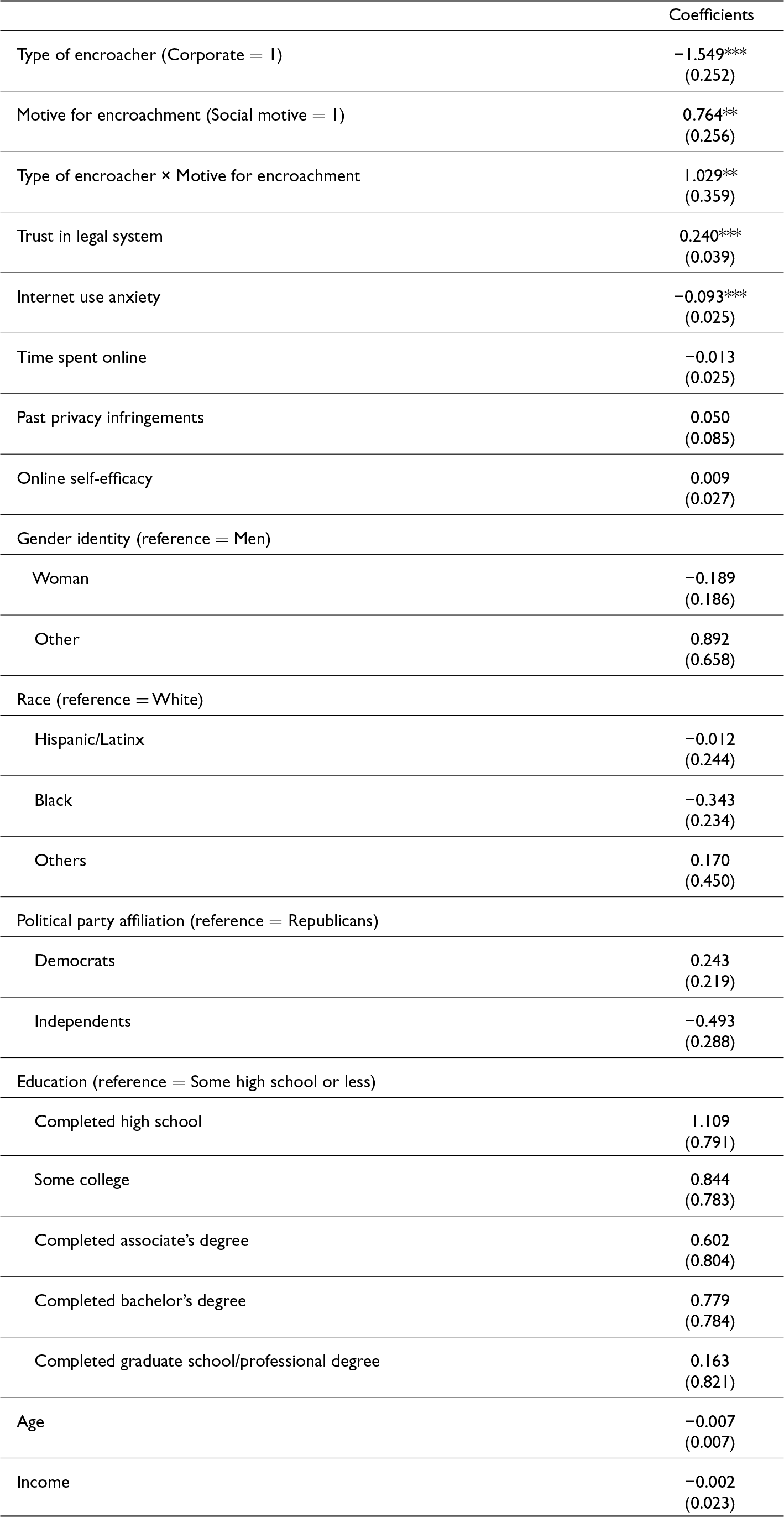
Because Perceived Acceptability of Privacy Encroachments is measured at the vignette level, with multiple observations nested within respondents, we estimate a mixed-effects model to account for the multilevel structure of the data (i.e., multiple evaluations of acceptability per participant). This approach allows us to examine the causal effects of experimentally manipulated features of the vignettes – specifically, the type of encroaching organization and the motive for data use – on participants’ perceptions of acceptability, while accounting for within-respondent correlation across vignette responses. All models include random intercepts for respondents and are estimated using vignette-level observations that pass the manipulation checks. Standard errors are adjusted to account for clustering at the respondent level.
To facilitate substantive interpretation, we use model-predicted values and average marginal effects (AMEs) derived from estimated coefficients rather than raw descriptive averages. Specifically, when we refer to “average” perceived acceptability, we are referring to the expected value of the outcome as implied by the statistical model – that is, the level of perceived acceptability predicted by the model for each experimental condition.Footnote 6 AMEs summarize differences in predicted acceptability associated with changes in a predictor. For categorical predictors, such as the experimental conditions, we predict perceived acceptability for each observation in the analytic sample under each category being compared, holding other covariates at their observed values. We then calculate the difference between these predictions for each observation and average those differences across the analytic sample. Thus, AMEs express average differences in points on the perceived acceptability scale. The models adjust for covariates and account for respondent-level clustering.
Analysis of open-ended items and legal consciousness of data privacy
We analyzed participants’ open-ended explanations about their evaluations of the vignettes using an iterative, primarily inductive content coding strategy (Schwartz-Shea and Yanow Reference Schwartz-Shea and Yanow2012; Stryker Reference Stryker1996). In our first round of coding, we examined how respondents invoked meanings related to: (a) law (understood as legality), including but not limited to legal rights; (b) market exchange, commodification, or profit; (c) the inevitability of technological progress; and (d) other emergent interpretive frames. We identified broad parent codes as well as more specific child codes within these categories. For example, within the broader “invocation of law” parent code, we identified child codes such as obtaining a warrant, informed consent, probable cause, and violation of rights.
We used the first round of coding to construct our coding scheme and to develop a set of coding rules that we could apply consistently across all four conditions. We then conducted a second and third round of coding to finalize the coding categories and rules, and to ensure that we applied these consistently throughout. Both authors independently coded responses over these multiple rounds, resolving discrepancies by refining coding rules until the scheme was finalized. Since responses could be assigned multiple codes, frequencies of the coding categories are not mutually exclusive. We then examined how cultural beliefs related and unrelated to law – including market exchange, technological inevitability, institutional trust, harm, benefit, and institutional overreach – varied across experimental conditions and contributed to the legitimation or contestation of data practices associated with informational capitalism.
Table A3 shows the codes, coding criteria, and illustrative examples for all codes informing this analysis.Footnote 7
Results
This section examines how participants evaluate and interpret privacy encroachments undertaken by different actors and for different motives. We first present quantitative differences in the perceived acceptability of privacy encroachments across the four experimental conditions. We then analyze the cultural beliefs participants draw on in the open-ended responses to make sense of these encroachments.
Our findings reveal two central patterns. First, legal consciousness of data privacy is relational: participants draw on multiple cultural beliefs to make sense of privacy encroachments, including beliefs about law, and the salience of these beliefs varies according to the institutional actor and motive involved. Second, these relational patterns of meaning-making have implications for informational capitalism. For instance, participants sometimes invoke commodification, market exchange, and technological inevitability to make sense of privacy encroachments, but they also draw on consent, everyday legality, and the importance of transparency to challenge their acceptability. Hence, these broader cultural beliefs enable Americans to normalize, conditionally legitimate, or challenge the data practices associated with informational capitalism.
Acceptability of different types of encroachments
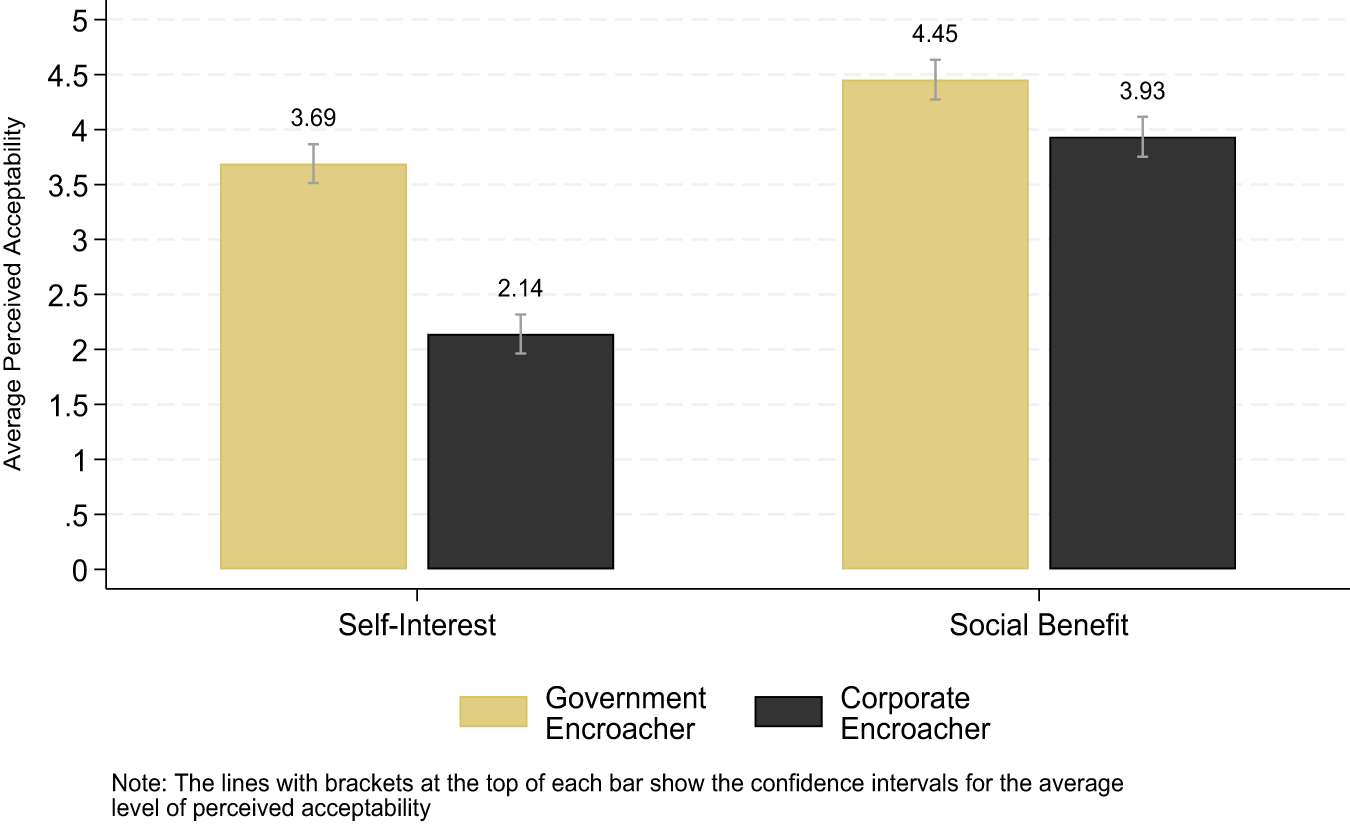
Figure 1 presents the acceptability of different types of privacy encroachments,Footnote 8 with average perceived acceptability shown on the y-axis. Perceived acceptability is measured on a scale from 0 to 10, where 0 represents “completely unacceptable,” 10 represents “completely acceptable,” and 5 represents neutrality. Average perceived acceptability differs significantly across conditions. Corporate encroachments for profit receive the lowest perceived acceptability (2.14), followed by government encroachments for self-interest (3.69), corporate encroachments for social benefit (3.93), and government encroachments for social benefit (4.45). Importantly, even the highest predicted value remains below the neutral midpoint of 5. Thus, although some types of privacy encroachments are viewed as relatively more acceptable than others, participants on average evaluate all four types as unacceptable, with lower scores indicating greater perceived unacceptability.
Perceived acceptability of privacy encroachments across experimental conditions.

Notwithstanding an American Bill of Rights focused on the rights people enjoy against the federal government,Footnote 9 and considerable scholarly literature highlighting Americans’ enthusiasm for markets and their distrust of government (Hall and Soskice Reference Hall and Soskice2001; Huber and Stephens Reference Huber and Stephens2001), Americans perceive government encroachments as significantly more acceptable than corporate encroachments irrespective of the motive. Within the self-interest motive, government encroachments are perceived as being significantly more acceptable than corporate encroachments (AME = 1.55, p < 0.001). Similarly, within the social benefit motive, the perceived acceptability of government encroachments is significantly higher than that of corporate encroachments (AME = 0.52, p < 0.05).
Motives also significantly affect perceived acceptability. Government encroachments undertaken for social benefit are perceived as more acceptable than government encroachments undertaken for self-interest (AME = 0.76, p < 0.01). Similarly, the perceived acceptability of corporate encroachments is higher when they are undertaken for social benefit compared to self-interest (AME = 1.79, p < 0.001). Hence, privacy encroachments undertaken for social benefit are, on average, perceived as more acceptable than those undertaken for self-interest.
Meaning-making across different types of encroachments
To better understand the patterns in perceived acceptability identified in the quantitative analysis, we examine participants’ responses to open-ended questions about the privacy encroachments described in the vignettes. This interpretive analysis illuminates how participants make sense of these encroachments and reveals the cultural beliefs they draw upon in doing so. In particular, the analysis shows where and how participants draw on cultural narratives associated with informational capitalism and law, as well as other cultural beliefs, when evaluating the legitimacy of privacy encroachments.
Tables 1 and 2 report the frequency with which different meanings appear in participants’ interpretations of the privacy encroachments described in the vignettes. Table 1 presents meanings articulated by participants who evaluated the encroachments as within the acceptable range (6–10) on the acceptability scale, while Table 2 presents meanings articulated by participants who evaluated them as within the unacceptable range (0–4). The meanings reported in these tables correspond to codes from our interpretive coding scheme described earlier and provided in Table A3. Across both tables, responses coded as “invocation of law” reflect either rights-based reasoning or references to everyday markers of legality. Responses coded as “commodity logic” reflect market-based narratives, while references to the “inevitability of data sharing or monitoring” reflect beliefs about technological inevitability.
Frequency distribution of dominant cultural meanings used to discuss the acceptability of different types of privacy encroachments

Table 1 Long description
Frequencies and percentages are listed for parent codes and their child codes across four conditions: Government Self Interest Security with N 268, Government Social Benefit with N 441, Corporate Self Interest Profit with N 116, and Corporate Social Benefit with N 321. Percentages for parent codes are shown relative to each condition N, and percentages for child codes are shown relative to their parent code totals. Parent code, Invocation of law totals 50 or 19 percent in Government Self Interest Security, 33 or 7 percent in Government Social Benefit, 14 or 12 percent in Corporate Self Interest Profit, and 31 or 10 percent in Corporate Social Benefit; within it, Explicit mentions of warrant appears only in Government Self Interest Security at 20 or 40 percent, and Without user consent is 8 or 16 percent, 11 or 33 percent, 4 or 29 percent, and 8 or 26 percent across the four conditions. Parent code, Commodity logic totals 11 or 4 percent, 33 or 7 percent, 12 or 10 percent, and 12 or 4 percent; within it, Privacy trade off is 5 or 45 percent in Government Self Interest Security, 24 or 73 percent in Government Social Benefit, and 2 or 17 percent in Corporate Self Interest Profit, while No profit or financial gain is 8 or 24 percent in Government Social Benefit and 9 or 75 percent in Corporate Social Benefit. Parent code, Inevitability of data sharing or monitoring totals 8 or 3 percent, 12 or 3 percent, 10 or 9 percent, and 3 or 1 percent. Parent code, Harmless totals 56 or 21 percent, 94 or 21 percent, 32 or 28 percent, and 58 or 18 percent; within it, Trust in encroacher is 41 or 73 percent in Government Self Interest Security and 38 or 40 percent in Government Social Benefit, and Publicly available information is 20 or 34 percent in Corporate Social Benefit. Parent code, Benefit totals 112 or 42 percent, 235 or 53 percent, 26 or 22 percent, and 179 or 56 percent; within it, Increases safety and security is 55 or 49 percent in Government Self Interest Security, Helps stop crime or illegal activities is 43 or 38 percent in Government Self Interest Security, Health or Public health benefits is 41 or 17 percent in Government Social Benefit and 41 or 23 percent in Corporate Social Benefit, Targeted advertisements are helpful appears only in Corporate Self Interest Profit at 11 or 42 percent, and Research or Knowledge production appears only in Corporate Social Benefit at 27 or 15 percent.
Notes: The N for each condition represents the total number of codes that were assigned to the acceptable responses in each experimental condition. The frequency percentage of each parent code is calculated as a proportion of the N of the given experimental condition. In addition to the three parent codes prefigured by the theorization of informational capitalism – Invocation of law, Commodity logic, and Inevitability of data sharing/monitoring – the table presents all other parent codes that constitute at least 10% or more of the N in at least one experimental condition. For instance, the parent code of “Risk/Harm” is not included in this table because it did not meet the 10% inclusion criteria, even though a small number of responses explaining quantitative ratings in the range of acceptability did signal some risks/harms. The decision to use this threshold for inclusion means that the sum of the Ns for all parent codes in a given condition is not equal to the total N for open-ended responses in that condition. The codes within each parent code are referred to as “child codes.” Their frequency percentage is calculated as a proportion of the total number of responses that fall under the given parent code.
Frequency distribution of dominant cultural meanings used to discuss the unacceptability of different types of privacy encroachments

Table 2 Long description
Frequencies and percentages are listed for parent codes and their child codes across four conditions: Government Self Interest Security with N 644, Government Social Benefit with N 564, Corporate Self Interest Profit with N 1,040, and Corporate Social Benefit with N 512. Percentages for parent codes are shown relative to each condition N, and percentages for child codes are shown relative to their parent code totals. For parent code, Invocation of law, totals are 278 at 43 percent, 197 at 35 percent, 261 at 25 percent, and 217 at 42 percent; within it, Without user consent is 144 at 52 percent, 125 at 63 percent, 172 at 66 percent, and 151 at 70 percent, and Demand for disclosure transparency regulation is 14 at 5 percent, 24 at 12 percent, 32 at 12 percent, and 35 at 16 percent. Risk harm totals are 65 at 10 percent, 100 at 18 percent, 192 at 18 percent, and 75 at 15 percent; within it, No control over data misuse of data unknown use of data is 26 at 40 percent, 43 at 43 percent, 46 at 24 percent, and 34 at 45 percent, and Safety security sensitive information is 12 at 18 percent, 21 at 21 percent, 55 at 29 percent, and 28 at 37 percent. Commodity logic totals are 25 at 4 percent, 25 at 4 percent, 193 at 19 percent, and 15 at 3 percent; within it, Data selling is 15 at 60 percent, 19 at 76 percent, 70 at 36 percent, and 5 at 33 percent, and Profit financial gain is 6 at 24 percent, 3 at 12 percent, 86 at 45 percent, and 3 at 20 percent. Inevitability of data sharing monitoring is 1 at 0.2 percent, 1 at 0.2 percent, 14 at 1.3 percent, and 6 at 1.2 percent. Encroacher overreach totals are 202 at 31 percent, 158 at 28 percent, 304 at 29 percent, and 130 at 25 percent; within it, Invasion of privacy implicit references is 32 at 16 percent, 38 at 24 percent, 105 at 35 percent, and 62 at 48 percent, and Immoral unethical behavior is 29 at 14 percent, 21 at 13 percent, 82 at 27 percent, and 19 at 15 percent.
Notes: The N for each condition represents the total number of codes that were assigned to the acceptable responses in each experimental condition. The frequency percentage of each parent code is calculated as a proportion of the N of the given experimental condition. In addition to the three parent codes prefigured by the theorization of informational capitalism – Invocation of law, Commodity logic, and Inevitability of data sharing/monitoring – the table presents all other parent codes that constitute at least 10% or more of the N in at least one experimental condition. For instance, the parent code of “Benefits” is not included in this table because it did not meet the 10% inclusion criteria, even though a small number of responses explaining quantitative ratings in the range of unacceptability did signal some benefits. The decision to use this threshold for inclusion means that the sum of the Ns for all parent codes in a given condition is not equal to the total N for open-ended responses in that condition. The codes within each parent code are referred to as “child codes.” Their frequency percentage is calculated as a proportion of the total number of responses that fall under the given parent code.
In this section, we examine how participants draw on beliefs about law alongside a broader range of cultural beliefs unrelated to law when interpreting and evaluating privacy encroachments. Three relational patterns emerge across participants’ explanations: contextual activation, in which different beliefs become more or less salient across institutional and motivational contexts; conditionality, in which the legitimacy of a practice depends on the presence of particular safeguards, purposes, or terms; and combination, in which participants invoke beliefs related and unrelated to law within the same evaluation. These patterns are not equally prominent across evaluations: conditionality emerges primarily in explanations of acceptability, whereas combination emerges most clearly in explanations of unacceptability. We consider how these relational patterns normalize, conditionally legitimate, or challenge particular privacy practices and, in doing so, reinforce or generate cracks in the legitimacy of U.S. informational capitalism.
Cultural beliefs legitimating privacy encroachments
Participants’ explanations for why their evaluations of privacy encroachments fall within the acceptable range reveal two principal relational patterns: contextual activation and conditionality. Participants draw on beliefs about benefits and limited harm across all four conditions, but the specific content of beliefs varies by actor and motive. Institutional trust is frequently invoked in evaluations of government practices, economic necessity and technological inevitability appear most often in the corporate-profit condition, and collective-benefit reasoning appears most often in the social-benefit conditions. Acceptance is also sometimes conditional: explanations of acceptability are sometimes accompanied by concerns about consent, transparency, false accusations, or the encroacher’s sale of or profit from user data. These concerns suggest that legitimacy is contingent rather than absolute.
Conditional tolerance and trade-offs
Invocation of law is relatively limited in participants’ explanations of acceptability (7–19%). When it does appear, however, it reveals conditions under which participants consider data practices legitimate. Across all four experimental conditions, participants draw on their perceptions of whether a given practice would be considered legal (child code: “legalese”: 19–40% of parent code invocation of law) to explain their evaluations of acceptability. References to warrants appear most frequently in the government-security condition, where 40% of the invocation of law codes invoke the presence of a warrant as an indicator that the surveillance practice is legitimate. The relatively frequent invocation of warrants in this condition demonstrates contextual activation: formal legal authorization becomes especially salient when government surveillance is undertaken for security purposes.
Participants also invoke legal language to emphasize the importance of consent, transparency, and regulatory safeguards (child codes: “demand for disclosure/transparency/regulation” and “without user consent”). Hence, law functions not simply as a source of legitimacy but also as a benchmark for appropriate data governance. This pattern of meaning-making highlights the conditional nature of participants’ acceptance, suggesting that privacy encroachments are viewed as legitimate only when accompanied by appropriate legal protections. For example, while explaining the acceptability of a privacy encroachment in the government-security condition, a participant noted:
I think it is mostly acceptable because the information was obtained with a warrant so a judge had to sign off on it. I might not like it but I find it acceptable. (Vignette 2: A local law enforcement agency using a warrant to obtain a database of students’ personal information for a high-profile case)
Participants’ use of commodity logic also reveals conditionality, despite appearing in only 4–10% of acceptable responses. In the social benefit conditions, some participants contrast data uses undertaken for social good with those undertaken for profit and explicitly indicate that they would be less accepting if the same data were used for commercial gain. As one respondent explained:
If my data were to be used simply for [the] profit motive, I wouldn’t be ok with that at all, but in this case, it’s used to help others to provide a greater societal benefit, which makes me more understanding and amenable to my personal data being used. (Vignette 19: A fitness tracking app sharing users’ personal information with medical schools to facilitate research)
Here, the absence of a profit motive is not simply another reason for acceptance; rather, it establishes a boundary on the kinds of data use the participant is willing to tolerate.
A different form of conditionality appears when participants weigh privacy against other competing considerations. In the government-security condition, participants sometimes acknowledge a loss of privacy but deem the encroachment acceptable when they view the anticipated increased security as sufficiently important. For example, one participant explained their perceptions of acceptability by noting how a government-security encroachment:
… takes away some privacy but it is worth it to have that extra layer of security. (Vignette 1: A travel booking website selling users’ flight data to assist with a criminal investigation)
Similar reasoning appears in the government-social benefit condition, where respondents accept privacy incursions when they perceive the broader social benefit as outweighing the costs. For instance, in their evaluation of a government-social benefit encroachment, one participant explained how:
Sharing personal data like this can pose some ethical considerations, but in this scenario the good would outweigh the bad. (Vignette 8: The local DMV/BMV shares people’s fingerprints with the Department of Social Services to facilitate access to food stamps)
These responses reveal that acceptance does not require participants to view the privacy encroachment itself as unproblematic. Rather, acceptance can coexist with the recognition of a privacy cost when the importance of another valued objective outweighs that of the cost. Notably, this explicit trade-off reasoning appears only in the two government conditions.
Market normalization and technological inevitability
Two forms of meaning-making distinguish evaluations of corporate-profit encroachments that fall within the acceptable range. First, only in this condition do participants explicitly justify privacy encroachments as economically necessary (child code: “companies require revenue”), portraying data collection as part of the business model of the digital economy.
Second, 9% of the explanations for evaluating corporate-profit encroachments as within the acceptable range characterize data collection as an unavoidable consequence of participation in a technologically mediated society (parent code: “inevitability of data sharing/monitoring”). Although beliefs about the inevitability of data sharing or monitoring appear in other conditions, they occur most frequently in explanations about the acceptability of corporate encroachments for profit. Together, these meaning-making processes normalize corporate data extraction by situating it within broader economic and technological structures.
Benefits, harm minimization, and institutional trust
Beliefs about the perceived benefits of different practices are the most frequently used justifications for privacy encroachments rated within the acceptable range, appearing in 22–56% of responses. The content of these benefits varies systematically based on the type of encroacher and its motive: responses to government-security encroachments emphasize crime prevention and safety (39% and 49% respectively of the benefits parent code), corporate-profit responses emphasize the usefulness of targeted advertising (42%), and social-benefit responses emphasize benefits that accrue to the broader community (37–40%).
Privacy encroachments are also evaluated as being within the acceptable range when their harm is perceived as minimal (parent code harmless: 18–28% of responses). However, perceptions of harmlessness vary across institutional contexts. In the government-security condition, harmlessness is frequently tied to trust in the encroacher (child code “trust in encroacher”: 73% of the harmless parent code). In contrast, explanations portraying corporate encroachments as harmless rely less on institutional trust and more on assessments of whether the information collected is anonymized (10–25% of the harmless parent code), already publicly available (34%), or unlikely to cause personal harm (16–19%).
Summary
Taken together, the explanations for evaluating privacy encroachments as falling within the acceptable range draw on a broad repertoire of cultural beliefs, related and unrelated to law, whose significance varies across institutional actors and motives. Participants legitimate data practices by drawing on beliefs about benefits, limited harm, institutional trust, legal safeguards, privacy trade-offs, and – less frequently – economic necessity and technological inevitability. Importantly, such legitimacy is often conditional: some respondents tolerate privacy encroachments only when appropriate legal protections are present, profit extraction is limited, or competing benefits are judged sufficiently important to justify the privacy cost.
Cultural beliefs delegitimating privacy encroachments
Explanations of evaluations falling within the unacceptable range (0–4 on the acceptability scale) reveal a broad repertoire of cultural beliefs used to delegitimate privacy encroachments (Table 2). As in explanations of acceptability, these critiques demonstrate contextual activation. They also provide the clearest evidence of combination, particularly when consent-based critiques converge with objections to commodification and profit extraction in the corporate-profit condition. More generally, the grounds for delegitimation vary by context: government-security encroachments more readily evoke rights-, surveillance-, and authority-centered concerns; corporate-profit encroachments evoke economic and moral objections; and the remaining conditions more often foreground consent and appropriate data governance.
Law as a dominant and uneven frame
Law, especially everyday perceptions of legality, emerges as the most prominent frame through which privacy encroachments are delegitimized. Invocation of law (parent code: invocation of law) accounts for 25–43% of all explanations for why encroachments are perceived as unacceptable across all four conditions. Most responses invoking law rely on everyday perceptions of legality, particularly concerns about the use of personal information without user consent (child code “without user consent”: 52–70% of the invocation of law parent code).
At the same time, law is invoked across the four experimental conditions in different ways. Responses in the government-security condition rely more heavily on legalistic and rights-based reasoning than those in the other conditions. These evaluations include more frequent use of language concerning rights and justice, as well as references to what respondents perceive to be legally permissible (child codes: “violation of rights/freedom” and “legalese”), while also expressing concerns about being treated like criminals, unjust targeting, or the possibility of false accusations.
By contrast, meaning-making around the unacceptability of government-social benefit encroachments focuses more on whether appropriate governance mechanisms and consent structures are in place. These responses emphasize the need for disclosure, transparency, or regulation (12% of invocation of law parent code), with some highlighting the importance of having the option to opt out of government use of personal data (4%). A similar pattern characterizes both corporate conditions as well. For instance, in the corporate-profit condition, explanations about the unacceptability of these encroachments emphasize the absence of disclosure, transparency, and regulation (12% of invocation of law parent code), as well as the lack of user choice (66%). Additionally, some responses also highlight the importance of opt-in or opt-out mechanisms (5%). A similar pattern appears in the meaning-making around corporate encroachments undertaken for a social benefit. These similarities across the social-benefit conditions suggest that when data practices are framed as serving broader societal goals, meaning-making relies less on rights-based reasoning and more on expectations of consent and institutional safeguards.
Taken together, these patterns suggest that U.S. relational legal consciousness in the domain of data privacy is context-sensitive, with different types of encroachers and motives activating law-related reasoning in distinct ways.
Market extraction and the commodification of data
Another important source of delegitimation centers on concerns about the commodification of personal data (commodity logic parent code), particularly for the corporate-profit condition where it accounts for 19% of the responses as opposed to 3–4% in other conditions.
Examining the internal composition of this meaning-making category in the corporate-profit condition reveals critiques of companies generating profits from personal data (child code: “profit”; 45% of commodity logic code), objections to the sale of personal data (child code: “data selling,” 36%), and corporations profiting from personal data without compensating users (child code: “no user payment”; 14%). These critiques reflect different stances toward commodification: some participants reject treating personal data as a commodity, whereas others object primarily to the terms of the exchange.
Importantly, critiques highlighting commodification concerns are primarily concentrated in the corporate-profit condition and thus demonstrate contextual activation particularly clearly: commodity-based critiques become salient primarily when organizational type and motive combine to present data collection as an explicitly profit-seeking practice.
Converging legal and market critiques
Explanations for quantitative ratings that fall within the unacceptable range highlight how critiques grounded in law and critiques of commodification occasionally converge, most frequently in the corporate-for-profit condition. Here, the invocation of law and commodity logic codes co-occur in 12% of responses, compared with only 0–4% in the other conditions.
For example, in evaluating Vignette 11, one participant invoked the need for consent alongside a critique of profit extraction:
Whilst it is public data that is being used, the least the social media company could do is ask permission first to use this kind of data in the first place, as it is still people’s information that they are using for their own profit. (Vignette 11: A social media company selling users’ personal data for targeted advertising)
Another participant evaluating Vignette 14 similarly stated:
The company is selling your personal information like your name and birth date which is private for profit. Even though the clause permits it, the company should have an opt in policy of allowing them to do this with their customers information. (Vignette 14: A popular fitness app sells users’ personal data to advertisers).
In these responses, legal norms – particularly norms surrounding informed consent that have seeped into everyday perceptions of legality – are invoked alongside economic critiques centered on profit extraction, illustrating how the legal consciousness of data privacy can comprise multiple types of cultural beliefs. These responses provide the clearest evidence of combination in our analysis: beliefs about law do not merely appear alongside objections to profit extraction but alter how respondents evaluate the economic exchange. Profit extraction becomes especially objectionable when it occurs without meaningful consent, while formal disclosure is regarded as inadequate when it authorizes the sale of personal information without an affirmative choice.
However, this convergence of critiques related and unrelated to law remains relatively limited, even in the corporate-profit condition. Most responses explaining quantitative ratings in the unacceptable range rely on either consent-based legal critiques or objections to profit extraction rather than using them simultaneously. Resistance to the commodification of personal data therefore remains fragmented and does not coalesce into a broader rights-based critique. Some respondents emphasize failures of legality and consent, while others focus on the unfairness of profit extraction or the unequal distribution of its benefits. In fact, objections to the failure of encroachers to compensate users for their data may well reflect dissatisfaction not with commodification itself, but with the unfair distribution of its benefits.
Institutional overreach: beyond critiques rooted in commodification or legality
Table 2 shows how privacy encroachments are frequently framed as instances of institutional overreach (parent code encroacher overreach) to demonstrate their unacceptability. Across conditions, between one-quarter and one-third of total responses in each condition reference concern about the encroacher exceeding appropriate boundaries. These critiques are neither exclusively legal nor exclusively economic. Instead, they draw on overlapping beliefs about privacy, morality, trust, harm, and appropriate institutional conduct.
Additionally, the content of these critiques varies by actor. Government data practices are more often described as forms of surveillance, spying, or intrusive monitoring than corporate data practices (15–21% of the encroacher overreach parent code for government encroachments; 6–4% for corporate encroachments). They also attract more skepticism, highlighting concerns about potential abuse of institutional authority (12–17% of encroacher overreach responses in the government conditions, compared with only 4–8% in the corporate conditions). In contrast, corporate data practices – especially those motivated by profit – are more often characterized as immoral or unethical (27% of the encroacher overreach parent code in corporate-profit, compared with 13–15% in the other conditions). Hence, profit motive and corporate identity activate moral evaluations that differ from the authority- and surveillance-centered concerns directed toward government actors.
Additionally, explicit or implicit references to invasion of privacy (child codes: “invasion of privacy-explicit” and “invasion of privacy-implicit”) appear across all four conditions but are most prominent in the corporate-social benefit condition, where they collectively constitute 66% of the encroacher-overreach codes, compared with 38–51% in the other conditions. These patterns indicate that framing data practices as serving social benefits does not insulate powerful actors in U.S. informational capitalism from concerns about invasion of privacy. Yet such concerns rarely crystallize into explicit rights-based claims, suggesting a potential opening for the emergence of a more robust rights consciousness surrounding digital data privacy.
Summary
Taken together, participants’ explanations for why their evaluations of privacy encroachments fall in the unacceptable range reveal several patterned forms of delegitimation. Beliefs about law are especially prominent, but the form these critiques take varies across contexts: government-security encroachments more often elicit rights-based, surveillance-related, and authority-centered concerns, whereas corporate-profit encroachments more often elicit objections to commodification, profit extraction, and unethical conduct. Across the other conditions, consent, disclosure, user choice, and procedural safeguards figure prominently in assessments of illegitimacy. Participants also frequently invoke institutional overreach and invasion of privacy, often without translating these concerns into explicit rights claims. Overall, these findings show that delegitimation is context-dependent and draws on a broad repertoire of cultural beliefs related and unrelated to law, with occasional combinations of these beliefs – most clearly where consent-based critiques converge with objections to profit extraction.
Discussion and conclusion
This study examined how Americans interpret and evaluate everyday privacy encroachments undertaken by different actors and for different motives, and what these interpretations reveal about the legal consciousness of data privacy. Quantitatively, we find that evaluations of privacy encroachments vary systematically by both actor and motive: government encroachments are perceived as more acceptable than comparable corporate encroachments, while encroachments undertaken for social benefit are perceived as more acceptable than those undertaken for self-interest. Yet even the most favorably evaluated condition falls below the neutral midpoint of 5 on our 0–10 acceptability scale, meaning that participants on average still evaluate every type of encroachment as unacceptable.
Our interpretive analyses help explain these patterns by showing that participants draw on a broad repertoire of cultural beliefs related and unrelated to law when making sense of contemporary data practices. These include beliefs about law (understood as legality), consent, commodification, technological inevitability, institutional trust, harm, anticipated benefits, and institutional overreach. The importance and content of these beliefs vary across institutional and motivational contexts, demonstrating contextual activation in explanations of both acceptable and unacceptable ratings. In explanations of ratings within the acceptable range, participants also expressed conditionality by indicating that their tolerance of privacy encroachments depended on their purpose, procedural safeguards, or economic terms. In explanations of ratings within the unacceptable range, combination emerged occasionally when participants invoked beliefs related and unrelated to law within the same account.
Our first contribution is therefore to scholarship on relational legal consciousness. Existing work shows that legal consciousness is relational because it emerges through interpersonal relationships, perceptions of others’ legal consciousness, group membership, and institutionally situated cultural schemas (Abrego Reference Abrego2011; Headworth Reference Headworth2020; Young Reference Young2014; Young and Billings Reference Young and Billings2020; Young and Chimowitz Reference Young and Chimowitz2022). We extend this insight by showing that the relationality of legal consciousness also lies in how beliefs about law coexist and interact with widely circulating cultural beliefs unrelated to law. In the context of data privacy, we find that participants do not rely on a singular or stable orientation toward law. Instead, their interpretations draw from multiple cultural resources whose relevance depends partly on the institutional actor and motive involved.
Three relational processes are especially visible in our findings. First, contextual activation occurs when different actors and motives bring different cultural beliefs to the foreground. Government-security encroachments more readily elicit beliefs about warrants, rights, surveillance, institutional authority, safety, and security. Meaning-making about corporate-profit encroachments draws more heavily on beliefs about commodification, profit extraction, economic necessity, and technological inevitability. Social-benefit encroachments, in contrast, frequently foreground anticipated collective benefits as well as expectations surrounding consent and appropriate data governance. The cultural beliefs constituting legal consciousness are thus not deployed in an undifferentiated manner; their importance in the meaning-making process varies with the characteristics of the privacy encroachment individuals encounter.
Second, conditionality emerges when the acceptability of privacy encroachments is contingent on the presence of specific features instead of being absolute. Legal authorization provides one such boundary: some respondents tolerate government surveillance because a warrant is present even while expressing discomfort with the practice itself. The purpose for which personal data are used also provides a boundary for acceptability. For instance, participants often acknowledge that privacy is being sacrificed but consider the loss acceptable when they perceive another objective – such as security or broader social benefit – as outweighing the privacy cost. Hence, under conditionality, accepting a particular data practice does not necessarily entail endorsing that practice irrespective of its purpose, procedural safeguards, or economic terms.
Third, combination occurs when cultural beliefs related and unrelated to law are invoked in the same interpretation. Although relatively uncommon, this pattern is clearest in the corporate-profit condition, where consent-based critiques intersect with objections to profit extraction in explanations of why privacy encroachments fall within the unacceptable range. However, such combinations are not ubiquitous – consent- and commodity-based critiques more commonly remain separate than converge. Thus, relational legal consciousness need not entail the simultaneous invocation of law-related and non-law beliefs in every response. Relationality is also evident when diverse beliefs related and unrelated to law are differentially activated across institutional and motivational contexts, and when participants establish boundaries on the acceptability of privacy encroachments based on their purposes, procedural safeguards, or economic terms.
This relational perspective also provides insight into the form that law takes in Americans’ legal consciousness of data privacy. Across conditions, participants rarely rely primarily on constitutional doctrine or explicit privacy-rights claims. Instead, law most commonly enters their interpretations through everyday expectations concerning consent, permission, disclosure, transparency, and user choice. Consent plays a particularly important role in meaning-making since its absence is widely recognized as an indicator of improper organizational behavior, even when the organization is not violating a formal legal right. Thus, we demonstrate the importance of studying everyday legality in a domain where, in the United States, the formal law is in its nascent stages of development. We also find that despite widespread concerns about invasion of privacy, people’s apprehensions rarely crystallize into explicit rights claims. Even when participants object strongly to secondary uses of personal information, they more commonly articulate their objections through consent, institutional boundaries, harm, unfairness, or procedural safeguards. Participants therefore often recognize and contest privacy incursions without translating those grievances into rights-based language, potentially limiting the emergence of a more robust privacy-rights consciousness in the United States (Epp Reference Epp1998; Felstiner et al. Reference Felstiner, Abel and Sarat1980).
Our second contribution concerns the relationship between legal consciousness and the political economy of informational capitalism. Existing accounts emphasize cultural narratives surrounding commodification, market exchange, autonomous technological development, and the inevitability of data extraction as important sources of informational capitalism’s legitimacy (Cohen Reference Cohen2019; Zuboff Reference Zuboff2019). We find evidence that participants draw on these narratives, but they do not dominate everyday interpretations of privacy encroachments. Beliefs about technological inevitability are relatively uncommon, and commodity-based reasoning is concentrated largely in the corporate-profit condition, where it frequently serves to contest rather than legitimate data extraction.
Therefore, we demonstrate that the cultural foundations through which the practices of informational capitalism are supported or challenged are broader than narratives explicitly concerned with markets, commodities, or technology. Participants legitimate privacy encroachments through a diverse repertoire of beliefs such as anticipated benefits, limited harm, institutional trust, and legal authorization, while challenging encroachments by invoking beliefs about consent, harm, institutional overreach, morality, and everyday legality. These beliefs are not uniquely associated with the political economy of informational capitalism. Yet when used to make sense of practices characteristic of informational capitalism such as privacy encroachments, they can contribute to the normalization, conditional legitimation, or contestation of those practices. This broadens our understanding of the cultural foundations of informational capitalism by showing that its legitimacy may depend partly on cultural beliefs whose content is legal, moral, institutional, or grounded in assessments of benefit and harm rather than explicitly economic.
The distinction between legitimation and conditional legitimation is especially important here. Our findings do not suggest that Americans have simply internalized a stable ideological commitment to contemporary systems of data extraction. Participants who evaluate a practice as acceptable may nevertheless express discomfort with the loss of privacy, require legal authorization or consent, distinguish between socially beneficial and profit-seeking uses, or regard the privacy cost as justified only because another objective is perceived to be more important. Contestation is similarly fragmented. Some participants attribute their opposition to privacy encroachments to profit extraction itself, others to inadequate consent, and still others to unequal terms of exchange. These critiques only occasionally converge into a broader rights-based challenge. Informational capitalism may therefore be sustained not through uniform acceptance of its data practices, but through a combination of conditional tolerance for particular practices and multiple, fragmented forms of resistance that challenge specific practices without necessarily coalescing into opposition to the broader political-economic arrangements of informational capitalism that produce them.
These insights identify both resources for and barriers to the development of a stronger rights consciousness in the domain of data privacy within the United States. Expectations concerning consent, transparency, control, and appropriate limits on institutional authority could provide cultural foundations for stronger demands for privacy protection. Yet because these expectations are only occasionally articulated as explicit rights – and because critiques concerning legality, commodification, harm, and overreach often remain separate – the translation of dissatisfaction with particular data practices into broader rights-based challenges is not automatic. Future research should therefore examine when everyday expectations surrounding privacy become transformed into explicit claims-making and collective demands for regulation.
These findings also have implications for privacy governance. Participants’ emphasis on consent, disclosure, transparency, and meaningful opportunities for user choice indicates that the current practice of formal notice through lengthy privacy policies may not satisfy people’s expectations of legitimate data use. At the same time, consent alone cannot address concerns about institutional power, harm, profit extraction, and overreach. Effective privacy governance in the United States therefore requires attention both to meaningful consent and to substantive limits on how powerful institutions can collect, share, and profit from personal information.
Several limitations inform interpretation of our findings. First, our behavioral measures were separated from the vignette scenarios. Although this design allowed us to measure broader behavioral tendencies rather than vignette-specific behavioral intentions, it may also have contributed to the null effects observed for privacy-protection behaviors. Second, the approximately 30-minute survey may have generated participant fatigue, and although the survey materials were pretested, their reading demands may have contributed to failed manipulation checks among some respondents. Reassuringly, our substantive quantitative conclusions remain unchanged when vignette responses failing the manipulation checks are included.
Third, our experimental manipulations distinguish between government and corporate actors but do not vary whether these actors are domestic or foreign. We therefore cannot assess whether Americans’ legal consciousness would differ when similar practices involve foreign governments or firms. Future research should examine this transnational dimension, particularly as concerns about data governance increasingly intersect with geopolitical tensions and debates over foreign ownership of digital platforms.
Finally, our interpretive analyses identify patterned cultural resources within respondents’ explanations but cannot establish how these beliefs developed or the direction of causal influence among them. Future research could examine how these cultural repertoires emerge over time, how they differ across social groups and political-economic contexts, and when particular combinations of legal and non-legal beliefs become sufficiently durable to support collective claims-making.
Our analysis conceptualizes relationality primarily in terms of how cultural beliefs related and unrelated to law become differentially salient, condition one another, and sometimes combine in individuals’ interpretations. It does not, however, trace the relational processes through which these cultural beliefs themselves are produced, circulated, and sustained. Future research could examine how legal consciousness emerges through networks of interpersonal and institutional relations, as well as through interactions with the technological artifacts and infrastructures through which data practices are experienced. Different relational approaches – including network analysis, assemblage perspectives, and work on human–technology relations – may offer distinct analytic tools for examining how macro-level cultural meanings become available for, and acquire force within, everyday legal consciousness.
By demonstrating how beliefs about law coexist and interact with broader cultural beliefs in Americans’ interpretations of digital data privacy, this study expands the relational legal consciousness framework beyond its predominant focus on interpersonal relationships and immediate institutional settings. Legal consciousness in this domain is relational because the cultural resources through which individuals make sense of privacy incursions are contextually activated, can condition acceptance, and occasionally combine within the same evaluation. These relational processes also illuminate how everyday meaning-making helps stabilize or challenge political-economic arrangements: data practices associated with informational capitalism are neither uniformly normalized nor uniformly rejected; instead, they are supported, conditionally tolerated, and contested through a heterogeneous cultural repertoire.
Supplementary material
The supplementary material for this article can be found at https://doi.org/10.1017/lsr.2026.10128.
Acknowledgements
We thank Trenton Mize, Swati Srivastava, Spencer Headworth, and Linda Renzulli for their helpful feedback on earlier versions of this manuscript. We are also grateful to the discussant and participants at the 2023 Law and Society Association Annual Meeting for their comments on an earlier draft. Finally, we thank the Law & Society Review editors and anonymous reviewers for their detailed and constructive feedback.
Funding Statement
This research was supported by a Law and Science Dissertation Grant (LSDG), funded through an award from the Law and Science Program at the National Science Foundation to Arizona State University (SBE #2016661).
Conflicts of Interest
The authors declare no competing interests.
Vasundhara Kaul is a Postdoctoral Research Associate in the Department of Sociology at Purdue University and a Research Social Scientist at the American Bar Foundation. Her research lies at the intersection of the sociology of law, science and technology studies, and social psychology. She uses experimental, qualitative, and computational methods to examine legal consciousness, data privacy, surveillance, artificial intelligence governance, and the social consequences of emerging technologies.
Robin Stryker is a Distinguished Professor of Sociology at Purdue University. The winner of many scholarly awards and fellowships, she writes on law, politics, and inequality; legal and political legitimacy; legal consciousness; social science in anti-discrimination law; institutional and organizational change; theory and methods; political incivility; and the social psychology of identity. Among her recent publications is “Democracy Under Siege: The Demise of Successful US Campaign Finance Reform” (with Olivia Neff) in Studies in American Political Development (2026).
Appendix
Description of control variables

Table A1 Long description
Columns are Variable Name, Description, and Measurement. Age is participant age at the time of the survey, measured from 18 years to 92 years old. Gender identity is self reported, with Man coded 0, Woman coded 1, and Non binary coded 2. Racial and Ethnic identity is self reported, with Non Hispanic, White coded 0, Hispanic or Latinx coded 1, Non Hispanic, Black coded 2, and Others coded 3. Political party affiliation is coded Republicans 0, Democrats 1, and Independents 2. Income is annual household income in the previous financial year, with ranges starting from Less than 1,000 dollars and ending at 170,000 dollars or above. Education ranges from Some high school or less coded 0 through Completed Graduate School or Professional Degree coded 5, including Masters, PhD, MBA, and LLM. Internet use anxiety uses three items on a 7 point scale from Strongly Disagree coded 0 to Strongly Agree coded 6. Time spent online is daily time on online activities, with ranges from Less than 1 hour to 23 to 24 hours. Past privacy infringements covers four types, coded No 0 and Yes 1. Online self efficacy uses three items on a 7 point scale from Strongly Disagree coded 0 to Strongly Agree coded 6. Trust in legal system is trust in the U. S. legal system, measured on an 11 point scale from No trust at all coded 0 to Complete trust coded 10.
Mixed-effects model predicting perceived acceptability of privacy encroachments

Table A2 Long description
Coefficients from a mixed effects regression model predict perceived acceptability of privacy encroachments, with standard errors in parentheses and significance marked by asterisks. Three asterisks denote significance at p less than 0.001, two denote significance at p less than 0.01, and one at p less than 0.05. Type of encroacher, corporate coded as 1, has a coefficient of minus 1.549 with three asterisks and standard error 0.252. Motive for encroachment, social motive coded as 1, has a coefficient of 0.764 with two asterisks and standard error 0.256. The interaction of type of encroacher and motive for encroachment has a coefficient of 1.029 with two asterisks and standard error 0.359. Trust in legal system is 0.240 with three asterisks and standard error 0.039, and internet use anxiety is minus 0.093 with three asterisks and standard error 0.025. Time spent online is minus 0.013 with standard error 0.025, past privacy infringements is 0.050 with standard error 0.085, and online self efficacy is 0.009 with standard error 0.027. Gender identity uses men as the reference, with woman at minus 0.189 standard error 0.186 and other at 0.892 standard error 0.658; race uses white as the reference, with Hispanic or Latinx at minus 0.012 standard error 0.244, Black at minus 0.343 standard error 0.234, and others at 0.170 standard error 0.450. Political party affiliation uses Republicans as the reference, with Democrats at 0.243 standard error 0.219 and independents at minus 0.493 standard error 0.288; education uses some high school or less as the reference, with completed high school 1.109 standard error 0.791, some college 0.844 standard error 0.783, completed Associates degree 0.602 standard error 0.804, completed Bachelors degree 0.779 standard error 0.784, and completed graduate school or professional degree 0.163 standard error 0.821. Age is minus 0.007 standard error 0.007, and income is minus 0.002 standard error 0.023.
Notes: (a) *** is p < 0.001, ** is p < 0.01, and * is p < 0.05; and (b) Entries report coefficients from the mixed-effects regression model predicting perceived acceptability of privacy encroachments. Standard errors are in parentheses. Figure 1 in the main text presents predicted margins derived from this model for the experimental conditions. Thus, the values in Figure 1 represent predicted levels of acceptability rather than regression coefficients and therefore differ in scale from the estimates reported here.
Description and illustration of thematic codes

Table A3 Long description
Two columns, Code Description and Illustrative Quotations, pair thematic codes with definitions and example quotes made by respondents. Parent code Invocation of law includes child codes for opting in or out, violation of rights or freedoms, without user consent, legalese, demand for disclosure transparency regulation, absence of probable cause, treated like a criminal, falsely charged, legal warrants, and miscellaneous invocation of law. Parent code Commodity logic includes data selling, profit or financial gain, no user payment, no profit or financial gain, privacy trade off, companies require revenue, and miscellaneous. Parent code Inevitability of data sharing or monitoring appears as a single code with a description and two quotations. Parent code Harmless includes general references, publicly available information, trust in encroacher, encroacher did not hide anything, data is anonymized or protected, no personal harm, and no invasion of privacy. Parent code Benefit includes benefit to community society for the social good, benefit to vulnerable communities, educational benefits, for a good cause motive, health public health benefits, helps stop crime illegal activities, increases safety security, personal benefit, research knowledge production, targeted advertisements are helpful, and miscellaneous. Parent code Risk harm includes harm to children other vulnerable populations, harmful even though data is publicly available, identity theft, no control over data misuse of data unknown use of data, safety security sensitive information, unwanted advertisements, and miscellaneous. Parent code Encroacher overreach includes absence of trust skepticism in encroacher, immoral unethical behavior, invasion of privacy explicit references, invasion of privacy implicit references, spying on tracking manipulating persecuting, undermining trust, and miscellaneous.
Notes: The codes are not mutually exclusive. Since respondents drew on various beliefs in their responses, multiple codes associated with these beliefs were often assigned to each response. Hence, the quotations provided in the table not only illustrate the code they have been assigned to, but sometimes also other relevant codes. In the table, we underline the part of the quotation illustrating the code under consideration.