Introduction
Lettuce (Lactuca sativa L.) is an economically important leafy vegetable used for human consumption on a worldwide scale. According to the Food and Agricultural Organization of the United Nations, the world lettuce production in 2005 reached 22.4 million metric tons on a harvested area of 1.0 million hectares (Mou, Reference Mou, Prohens and Nuez2008). Many new lettuce cultivars are released by public and private breeding institutes, particularly from the United States and Northwest Europe. For example, nearly 700 lettuce varieties per 5-year period are introduced in the European Common Catalogue (van Treuren et al., Reference van Treuren, van Hintum and van de Wiel2008; van Treuren and van Hintum, Reference van Treuren and van Hintum2009). Lettuce breeding efforts are largely directed towards quality characters and improvement of pest and disease resistance.
Improvement of resistance to downy mildew (Bremia lactucae Regel) is a continuous effort in lettuce breeding because of its devastating effects worldwide on annual lettuce production and both increased public concern and stricter governmental regulation on the use of pesticides. Although sometimes described as a fungal pathogen, downy mildew is an oomycete. It quickly overcomes newly introduced resistances and use of pesticide protective measures (Reinink, Reference Reinink, Lebeda and Krístková1999). The impact of downy mildew on European lettuce production resulted in the 1998 establishment of the International Bremia Evaluation Board (IBEB), a joint effort between European lettuce breeders and variety registration authorities to identify and nominate new downy mildew races (Guenard et al., Reference Guenard, Cadot, Boulineau, de Fontanges, Lebeda and Krístková1999; van Ettekoven and van der Arend, Reference van Ettekoven, van der Arend, Lebeda and Krístková1999; van der Arend et al., Reference van der Arend, Gautier, Guenard, Michel, Moreau, de Ruijter, Schut, de Witte, Hintum, van, Lebeda, Pink and Schut2003; van der Arend et al., Reference van der Arend, Gautier, Grimault, Kraan, van der Laan, Mazet, Michel, Schut, Smilde and de Witte2006). The interaction between lettuce and downy mildew is based on a gene-for-gene system, with lettuce Dm resistance genes corresponding to avirulence genes of the pathogen (Crute, Reference Crute1992a). Currently, the IBEB differential set contains 24 identified Dm genes and R-factors coding for race-specific reactions to downy mildew in lettuce. Due to the rapid loss of resistance, breeders are continuously searching for new Dm genes. In addition, research is also focused on identification of alternative resistance forms considered to be more durable, such as field- or race-non-specific and non-host resistance (Lebeda et al., Reference Lebeda, Ryder, Grube, Doležalová, Krístková and Singh2007; Mou, Reference Mou, Prohens and Nuez2008). For lettuce breeding, the wild lettuce gene pool is known to constitute a useful source of new downy mildew resistances (Lebeda et al., Reference Lebeda, Pink, Astley, Spencer-Phillips, Gisi and Lebeda2002; Zhang, Reference Zhang2008).
One of the main objectives in managing plant genetic resources collections is to stimulate the use of genebank material to promote food security and sustainable agricultural production. Availability of characterization and evaluation data should enhance germplasm use because it facilitates selection of accessions with the characters of interest more efficiently. In addition to formation of core collections, specific trait data combined with collection site information enables development of alternative approaches for detecting novel diversity, such as the Focused Identification of Germplasm Strategy, which proved useful in identifying new powdery mildew resistance alleles in wheat (Bhullar et al., Reference Bhullar, Street, Mackay, Yahiaouia and Keller2009). While genebanks are generally in a position to generate characterization data of their accessions, large-scale evaluation programmes are more difficult for them to carry out due to the need for specific technical know-how, special experimental facilities and high financial inputs (Engels and Visser, Reference Engels and Visser2003). An option is to develop evaluation programmes through collaboration with the user community, where the data can be exploited exclusively by the involved parties for an agreed time period before the data are made publically available.
To find novel traits for introgression into elite germplasm, plant breeders preferably focus on the cultivated gene pool to avoid potential crossing difficulties and linkage drag resulting from the use of wild relatives. However, genetic bottlenecks during crop domestication and genetic erosion due to modern cultivar replacement of landraces are considered to have diminished crop genetic diversity (van de Wouw et al., Reference van de Wouw, Kik, van Hintum, van Treuren and Visser2010a). In modern breeding, new lettuce varieties are often ‘derived’ from a variety possessing a highly valued trait, such as a specific resistance, resulting in high levels of genetic similarity among elite material, where the desired variation may not always be present, or difficult to find, in the cultivated gene pool.
Based on a survey of the taxonomic literature, about 100 wild Lactuca species have been reported (Lebeda et al., Reference Lebeda, Doležalová, Feráková and Astley2004b). While taxonomic studies conducted so far have failed to reach consensus about species relationships within the genus Lactuca (Feráková, Reference Feráková1977; Koopman, Reference Koopman2002), the primary gene pool of lettuce is generally believed to consist of cultivated lettuce and the sexually compatible species L. aculeata, L. altaica, L. azerbaijanica, L. dregeana, L. georgica, L. scarioloides and L. serriola. The secondary gene pool comprises L. saligna and L. virosa, though the latter species can be assigned to the tertiary gene pool due to the much more complicated crossing barriers with cultivated lettuce. The tertiary gene pool includes L. acanthifolia, L. aurea, L. longidentata, L. orientalis, L. quercina, L. sibirica, L. taraxacifolia, L. tatarica, L. viminea and L. watsoniana. The remaining Lactuca species either fall outside the lettuce gene pool or their position remains to be determined. Taxonomic issues within the genus Lactuca are discussed in more detail by Lebeda et al. (Reference Lebeda, Ryder, Grube, Doležalová, Krístková and Singh2007). Among the wild Lactuca species, L. saligna, L. virosa and L. serriola, in particular, are the most widely used species in lettuce breeding due to their widespread occurrence in Europe and corresponding larger availability in genetic resources collections.
The international Lactuca database currently holds the data of 11,643 available accessions belonging to 30 different collections mainly from the United States and Europe (ILDB, 2010). Wild crop relatives are represented by only 1306 accessions (11.2%), of which 1011 (77.4%) are maintained by the Centre for Genetic Resources, The Netherlands (CGN) alone. Difficulties in collecting samples from their natural distribution areas, especially in case of less widespread species and remote regions, and maintenance problems under ex situ conditions have probably contributed to the generally poor representation of wild Lactuca species in genebanks (Lebeda et al., Reference Lebeda, Doležalová and Astley2004a).
Since establishment in 1985, CGN has distributed an average of nearly 1000 Lactuca accessions each year, partly in the context of joint operations with plant breeding companies aimed at obtaining more detailed trait data. This study on downy mildew resistance resulted from such collaboration. Increased knowledge about variation for relevant traits contributes to an improved structuring of collections by curators and facilitates a more efficient selection of accessions by users to identify material with the characters of interest. In this study, downy mildew resistance data were analysed in relation to accession taxonomical and geographical information to obtain insight into the distribution of resistances within the collection.
Materials and methods
Study material
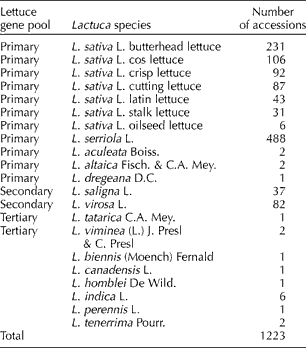
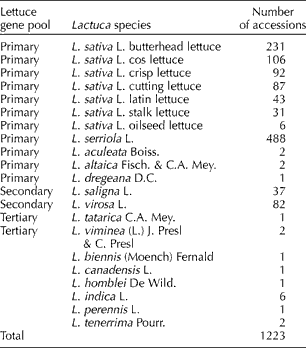
A total number of 1223 accessions (Table 1) were investigated, constituting a cross-section of approximately 50% of CGNs lettuce collection (CGN, 2010). The study material included 596 accessions of L. sativa and 615 accessions belonging to eight wild species assigned to either the primary, secondary or tertiary lettuce gene pool (Koopman, Reference Koopman2002). In addition, 12 accessions from six Lactuca species outside the lettuce gene pool were examined. Investigated accessions of cultivated lettuce included all generally recognized crop types, i.e. butterhead, cos, crisp, cutting, latin, stalk and oilseed lettuce (Krístková et al., Reference Krístková, Doležalová, Lebeda, Vinter and Novotná2008; Mou, Reference Mou, Prohens and Nuez2008). Concerning population type, the group of cultivated lettuce comprised 431 cultivars, 114 landraces, four accessions of research material and 47 accessions with unknown status.
Number of investigated accessions per Lactuca species, presented separately per crop type for L. sativa. The position assigned to the species within the lettuce gene pool is indicated by primary, secondary or tertiary
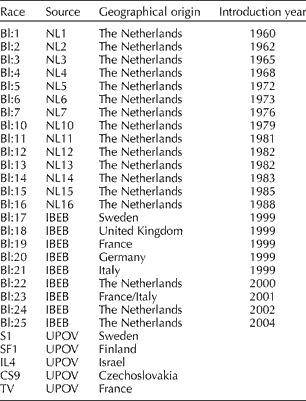
The accessions were investigated in four separate batches of broadly similar size during the period 2000–2005. Accessions were tested for the downy mildew races Bl:1–7, Bl:10–25 and the historical International Union for the Protection of New Varieties of Plants (UPOV) set S1, SF1, IL4, CS9 and TV (Table 2). The races Bl:1–7 and Bl:10–16 originate from the Netherlands and were formerly denoted as NL1-7 and NL10-16, respectively, while Bl:17–25 and the UPOV races originate from a much wider geographical area (van der Arend et al., Reference van der Arend, Gautier, Grimault, Kraan, van der Laan, Mazet, Michel, Schut, Smilde and de Witte2006). The Bl races form a chronological identification series, spanning a time period of nearly 50 years (Jönsson et al., Reference Jönsson, Forsberg, Hägnefelt, Paaske and Svedelius2005). Resistance to Bl:3, Bl:11 and Bl:19 was not tested for all batches, because during the experimental period these races were no longer detected nor available, and were therefore discarded by the IBEB. Bl:25 was only investigated for the fourth batch, as it was nominated by the IBEB in 2004. The UPOV races were only tested for the first three batches.
Investigated downy mildew races with their source, geographical origin and year of introduction

Screening methods
Each accession–race combination was independently investigated by two different breeding companies, the consortium consisting of Agrisemen (Breda, The Netherlands), Enza Zaden (Enkhuizen, The Netherlands), Nunhems ('s-Gravenzande, The Netherlands), Rijk Zwaan (De Lier, The Netherlands), Seminis (Wageningen, The Netherlands), Syngenta (Enkhuizen, The Netherlands) and Vilmorin (Beaufort-En-Vallee, France). Tests were performed on 30 seedlings per accession using the standard UPOV protocol of the Community Plant Variety Office (CPVO, 2010). The IBEB differential EU-A set (van der Arend et al., Reference van der Arend, Gautier, Grimault, Kraan, van der Laan, Mazet, Michel, Schut, Smilde and de Witte2006) was included in each resistance screening test to certify that results across batches and companies were fully comparable. Screening results were summarized in five potential classes. Resistant reactions were denoted as ‘ − ’, almost resistant reactions with some sporulation on necrotic reactions as ‘( − )’, segregating or mixed reactions as ‘%’, almost susceptible reactions or intense necrotic reactions with a high level of sporulation as ‘(+)’ and susceptible reactions as ‘+’ (van der Arend et al., Reference van der Arend, Gautier, Grimault, Kraan, van der Laan, Mazet, Michel, Schut, Smilde and de Witte2006).
Data analysis
To facilitate screening result processing, resistance scores were transformed to the numerical values 1 (‘ − ’), 3 (‘( − )’), 5 (‘%’), 7 (‘(+)’) and 9 (‘+’). Results from the duplicated measurements were then combined into a single score per accession by averaging the numerical values, unless the tests showed a difference of more than two resistance classes, in which case the data were discarded. The total dataset contained 18% missing values, 3% being due to conflicting test results. The embargo on the screening results has expired for the first three batches, and consequently the data have been made publically available via CGN's website (http://documents.plant.wur.nl/cgn/Website/downloads/DownloadCnr06.htm). The embargo on the data of the fourth batch will expire in August 2011, after which also these data will be placed in the public domain.
To combine the screening results for groups of accessions, group test scores for each of the Bremia isolates were expressed as the probability of resistance. For this purpose, the numerical scores of accessions were averaged, after which the resulting value, ranging from 1.0 to 9.0, was transformed to a scale ranging from 0.0 (fully susceptible) to 1.0 (fully resistant) using the equation (9-x) × 0.125, where x denotes the average numerical score. To analyse potential effects of geographical collection site on the probability of resistance, L. serriola accessions were grouped according to their region of origin using the United Nations classification system (UN, 2010), with the exception that the Russian Federation was assigned to Northern Asia instead of Eastern Europe.
To investigate the relationship between the year of release of cultivars and the probability of resistance, the investigated cultivars with documented origin year were grouped into 25-year periods. The average numerical test score for the set of 28 downy mildew races was calculated per cultivar and transformed to the resistance probability using the aforementioned equation, and the mean value of the cultivars was calculated per time period and presented in a bar diagram.
To investigate the relative importance of the wild Lactuca gene pool as a source of downy mildew resistance genes and to examine the effect of past breeding activities on resistance levels, resistance probabilities were analysed in relation to the introduction date of the Bl races. For each of the downy mildew Bl races, resistance probabilities were calculated for the group of cultivated lettuce and the group of wild Lactuca accessions, respectively, using the aforementioned methods. Subsequently, the resistance probability ratio of cultivated lettuce versus the wild Lactuca accessions was plotted against the chronologically ordered Bl races, and a trend line was added following a linear regression analysis. All calculations were performed using MS Excel.
Results
Historical developments in cultivars
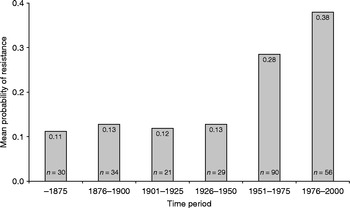
Resistance probabilities for the entire set of 28 investigated downy mildew races are presented for lettuce cultivars relative to known release date (Fig. 1). Resistance probabilities were fairly constant until 1950 at relatively low levels, ranging from 0.11 to 0.13, whereas after 1950, resistance probabilities increased markedly, doubling during the 1951–1975 and tripling during the 1976–2000 time periods. Thus, coinciding with the rise of modern plant breeding, cultivars released after 1950 have acquired higher overall levels of downy mildew resistance.
Mean probability of resistance for lettuce cultivars released during six different time periods. Resistance probabilities were based on the entire set of 28 investigated downy mildew races. The number of examined cultivars per time period is denoted by n.

Cultivated lettuce versus wild Lactuca species
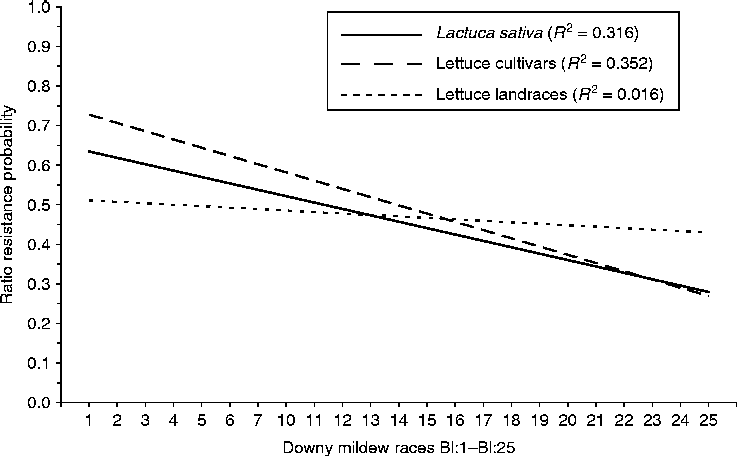
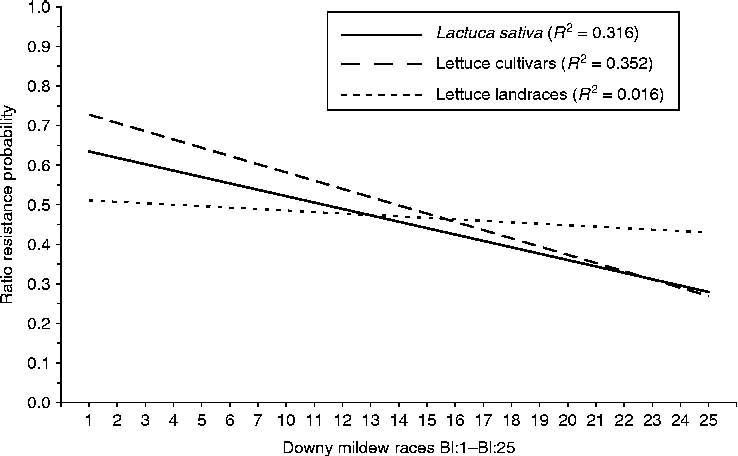
Resistance probabilities of cultivated lettuce versus wild Lactuca species were determined for the chronological-based series of 23 downy mildew Bl races (Fig. 2). For the entire L. sativa accession group, the resistance probability ratio was below 1.0 for each of the 23 downy mildew Bl races, emphasizing the wild Lactuca gene pool importance as a resistance source. The ratio declined markedly relative to increasing Bl number, which may indicate increased levels of resistance to older Bremia races due to past breeding activities. This hypothesis was confirmed by the separate analyses carried out for the respective cultivar and landrace groups (Fig. 2). While a similar trend was observed for the cultivar group, the trend was not present for landraces. Because landraces should overall be unaffected by modern plant breeding, the trends of the cultivated lettuce and cultivar groups are due to varietal improvement of resistance to older downy mildew races. Combined with the increasing virulence level of newer Bl races, this trend reflects the continuous boom-and-bust cycle (Crute, Reference Crute1992a) from using hypersensitive response genes to breed Bremia-resistant lettuce varieties.
Linear regression analysis of the resistance probability ratio of cultivated lettuce versus wild Lactuca species against the chronological series of 23 downy mildew Bl races over all L. sativa accessions, over all lettuce cultivars and over all landraces.
Distribution of resistances among Lactuca species
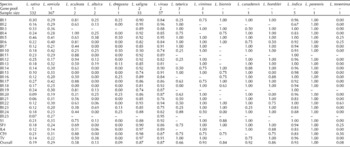
Table 3 summarizes resistance probabilities for L. sativa and the 14 investigated wild Lactuca species to each of the 28 examined downy mildew races. In agreement with the aforementioned findings, L. sativa values were relatively low compared with the majority of wild Lactuca species. L. sativa values ranged from 0.07 for Bl:25 to 0.46 for Bl:5, with an overall resistance probability of 0.19. Nevertheless, for each of the 28 investigated downy mildew races, fully resistant reactions could be observed for individual L. sativa accessions (results not shown). Compared with L. sativa, resistance probabilities of the wild primary lettuce gene pool species L. serriola and L. aculeata, in particular, were relatively high, and relatively low for L. altaica and L. dregeana, the three latter species represented by a low number of accessions, however. As with L. sativa, fully resistant reactions for each of the downy mildew races were observed for individual L. serriola accessions (results not shown). For all species of the primary gene pool, race-specific interactions were implied as the basis for the observed variation in resistance probabilities among the downy mildew races.
Probability of resistance to each of the 28 downy mildew races for 15 Lactuca species. Species are arranged according to their position in the lettuce gene pool. The average number of accessions examined and the average resistance probability per downy mildew race are denoted by ‘sample size’ and ‘overall’, respectively. Resistance probabilities may range from 0 (fully susceptible) to 1 (fully resistant)

Compared with the primary gene pool, resistance probabilities for other Lactuca species were considerably higher. The only exception was L. tenerrima, which showed fully susceptible reactions to the majority of downy mildew races (Table 3). A similar overall value of 0.87 was observed for L. saligna and L. virosa, which constitute the secondary lettuce gene pool. The low level of variation in resistance probabilities across the downy mildew races for these two species suggest race-non-specific reactions. Results for L. viminea and L. indica also indicated race-non-specificity, while L. perennis was the lone species for which only fully resistant reactions were apparently observed. Accessions from other species showing only fully resistant reactions included two L. serriola populations collected from Hungary and Azerbaijan, an L. saligna population from Georgia, an L. virosa population of unknown origin and an L. indica population originating from China (results not shown). It should be noted that species from the tertiary gene pool and Lactuca species not belonging to the lettuce gene pool were only represented by a low number of accessions.
Resistance relationship with geographical origin in L. serriola accessions
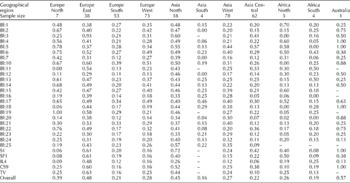
The wild Lactuca species L. serriola contained the highest number of examined accessions in this study and is of prime interest to lettuce breeders as a downy mildew resistance source. The relationship of L. serriola-based resistance with geographical origin is shown in Table 4. Accessions with documented origin data were primarily from Europe and Asia. Considerable variation was observed within regions for resistance probabilities to downy mildew races. This was most pronounced for accessions collected from Northern Europe, where reactions varied from fully susceptible for Bl:11 and IL4 to fully resistant for Bl:19. In addition, marked resistance probability differences were found between regions. For example, Bl:16 resistance probability detection was nearly eight times as high for Eastern Europe populations compared with material from Central Asia. Fair-to-high resistance probabilities for each of the investigated downy mildew races were observed for populations from Eastern Europe and North Asia, ranging from 0.29 to 0.93 and from 0.26 to 0.72, respectively, with overall values of 0.48 and 0.45, respectively.
Probability of resistance to each of the 28 downy mildew races per geographical origin of L. serriola accessions. The average number of accessions examined and the average resistance probability per downy mildew race are denoted by ‘sample size’ and ‘overall’, respectively. Resistance probabilities may range from 0 (fully susceptible) to 1 (fully resistant)

Discussion
In this study, the wild Lactuca gene pool was found to be a much richer source of downy mildew resistance relative to the cultivated lettuce gene pool. This was most pronounced for cultivars released up until 1950 and the landraces. Exploitation of the wild gene pool only started to become more commonplace after 1950 as a component of more modern plant breeding practices, and thus old lettuce cultivars and landraces would be expected to display only limited introgression from the wild gene pool. These findings for downy mildew resistance in cultivated lettuce are in line with the results of a meta-analysis of genetic diversity trends in 20th century crop cultivars, which found a reduction in genetic diversity until 1960, followed by a gradual increase thereafter that was likely due to the increased use of exotic germplasm in cultivar development (van de Wouw et al., Reference van de Wouw, van Hintum, Kik, van Treuren and Visser2010b). In lettuce, genes from wild Lactuca species, and in particular L. serriola, have increasingly been used since the mid 20th century by breeding programmes for the development of downy mildew resistant varieties (Lebeda et al., Reference Lebeda, Ryder, Grube, Doležalová, Krístková and Singh2007), which has resulted in newer varieties resistant to an increasing number of Bl strains. Regardless, the need for novel resistances in cultivar development continues, as newly introduced race-specific resistance genes are overcome by new downy mildew isolates (Lebeda, Reference Lebeda1989; Crute, Reference Crute1992b; van Ettekoven and van der Arend, Reference van Ettekoven, van der Arend, Lebeda and Krístková1999). Our results suggest that these novel resistance genes can be provided by the wild gene pool and are in line with several other studies, demonstrating the presence of unexploited resistance gene variation in wild Lactuca species (Sicard et al., Reference Sicard, Woo, Arroyo-Garcia, Ochoa, Nguyen, Korol, Nevo and Michelmore1999; Lebeda and Zinkernagel, Reference Lebeda and Zinkernagel2003; Beharav et al., Reference Beharav, Lewinsohn, Lebeda and Nevo2006).
In contrast to L. serriola, L. saligna and L. virosa, other wild Lactuca species are severely underrepresented in genetic resource collections currently available to users (Lebeda et al., Reference Lebeda, Doležalová and Astley2004a). As a consequence, the majority of these less common wild species evaluated in this study were represented by only one to a few accessions, which prohibited intra-specific variation analysis. Particularly in the case of L. aculeata, showing relatively high resistance probabilities among the primary gene pool species examined in this study, larger samples need to be evaluated in order to determine their potential relevance in breeding programmes in addition to L. serriola. The two L. aculeata accessions examined in this study are currently the only samples of this species available to the user community. While a more comprehensive collection of L. aculeata has been reported, the samples are currently only maintained as a working collection (Beharav et al., Reference Beharav, Lewinsohn, Lebeda and Nevo2006, Reference Beharav, Ben-David, Doležalová and Lebeda2010).
Resistance probabilities in L. saligna and L. virosa were high, which could point at race-non-specific reactions. However, it should be noted that the tested Bremia races were all isolated from L. sativa. The Bl races, in particular, were isolated and maintained because of their virulence on the main varieties cultivated at that time (Guenard et al., Reference Guenard, Cadot, Boulineau, de Fontanges, Lebeda and Krístková1999; van Ettekoven and van der Arend, Reference van Ettekoven, van der Arend, Lebeda and Krístková1999). Therefore, these races may not fully represent the virulence spectrum that can be found when sampling B. lactucae isolates from the entire genus Lactuca. Particularly in the case of L. virosa, virulence may be underrepresented as resistance genes from this species have not been used in cultivated lettuce varieties until recently (Lambalk et al., Reference Lambalk, Faber, Bruijnis, Conijn, de Witte, Nieuwenhuis and de Jong2000). Results for L. virosa contrasted with previous studies reporting either race-specific reactions (Lebeda and Zinkernagel, Reference Lebeda and Zinkernagel2003) or strong differences between accessions in overall level of resistance (Bonnier et al., Reference Bonnier, Reinink and Groenwold1992). The latter aspect has been attributed to existence of both horizontal and vertical L. virosa resistance genes (Maisonneuve, Reference Maisonneuve, Hintum, van, Lebeda, Pink and Schut2003). The existence of L. virosa-based vertical resistance was confirmed recently with new Bremia races (IBEB, unpublished) tested against cultivated varieties harbouring L. virosa-introgressed resistance. Considering the origin of the tested Bremia races as well as the results from previous studies, the high resistance probability observed for L. virosa in this study should not be used as proof for race-non-specificity.
L. saligna results were overall in agreement with previous studies supporting this species as a non-host to downy mildew (Jeuken et al., Reference Jeuken, Pelgrom, Stam and Lindhout2008; Zhang, Reference Zhang2008). The observation that L. saligna failed to show only fully resistant reactions (Table 3) may have been due to performing tests on seedlings. L. saligna was previously found to show varied resistance when tested on seedlings, whereas leaf disc tests displayed full resistance (Bonnier et al., Reference Bonnier, Reinink and Groenwold1992). Non-host resistance combined with cultivated lettuce sexual compatibility makes L. saligna an important resource for introgression of more durable resistances. L. saligna can also serve as a source of vertical resistances, including R36 (Moreau, Reference Moreau1994; van Ettekoven and van der Arend, Reference van Ettekoven, van der Arend, Lebeda and Krístková1999), R37 (van Ettekoven and van der Arend, Reference van Ettekoven, van der Arend, Lebeda and Krístková1999; Rijk Zwaan, unpublished) and an additional new R-gene (Zonneveld et al., Reference Zonneveld, de Lange, Briggs and Segura2011). Our observation that R36- and R37-breaking Bremia races, including Bl:17, Bl:21 and Bl:25, do not show lower resistance probabilities for L. saligna supports this species being a non-host to Bremia. Broad susceptibility to the range of investigated downy mildew races was observed for a single L. saligna accession collected in Uzbekistan that was originally classified as an L. serriola accession, but then reclassified as L. saligna following a morphological field trial (van Treuren and van Hintum, Reference van Treuren and van Hintum2009). Whether the observed resistance profile of this accession challenges the generally accepted non-host resistance mechanism of L. saligna or is due to taxonomic misclassification needs further investigation.
High resistance probabilities were also observed for tertiary species and Lactuca species not considered part of the lettuce gene pool. However, because of inherent crossing barriers with cultivated lettuce their usefulness in plant breeding remains to be determined.
Due to inter-fertility with cultivated lettuce, L. serriola is the most important species explored for detection of novel resistances to downy mildew. The high number of L. serriola accessions included in the collection enabled us to relate resistance data to accession geographical origin, demonstrating high resistance values for material collected from Eastern Europe and North Asia (Russian Federation). Recently, a study using ten downy mildew isolates against L. serriola sampled from 50 natural populations along a transect stretching from the United Kingdom to the Czech Republic similarly showed an unequal distribution of race-specific resistances among European regions. Diversity in that study increased from west to east, while high disease incidence and high overall resistance were found only in populations from the Czech Republic (Petrželová and Lebeda, Reference Petrželová and Lebeda2011). Diversity patterns on downy mildew resistance were in line with the results of molecular studies for L. serriola, revealing increasing levels of diversity from Western to Eastern Europe (Lebeda et al., Reference Lebeda, Kitner, Dziechciarková, Doležalová, Krístková and Lindhout2009; van de Wiel et al., Reference van de Wiel, Sretenović Rajičić, van Treuren, Dehmer, van der Linden and van Hintum2010). Based on the extensive genomewide diversity and variation of the RGC2 disease resistance gene cluster in East-Turkish and Armenian populations, this geographical region has been associated with the centre of origin of L. serriola. It has been suggested that the high diversity levels result from high abiotic and biotic stresses of this region, and that only a subset of the variation was dispersed during expansion of the species westwards into Europe (Kuang et al., Reference Kuang, van Eck, Sicard, Michelmore and Nevo2008). From a biogeographical study, it was concluded that due to climatic changes and increased occurrence of disturbed habitats, L. serriola has expanded from high diversity areas into north-western Europe over the last two centuries (D'Andrea et al., Reference D'Andrea, Broennimann, Kozlowski, Guisan, Morin, Keller-Senften and Felber2009). These dispersal patterns are in agreement with the high resistance probabilities observed in this study for L. serriola accessions from Eastern Europe relative to other European regions.
In addition to the group of East European populations, the group of North-Asian populations also showed a high overall resistance probability for L. serriola. These populations originated from Dagestan, Ingushetia and Alania, all located in the North Caucasus, close to the centre of origin of L. serriola suggested by Kuang et al. (Reference Kuang, van Eck, Sicard, Michelmore and Nevo2008). One of the two L. serriola samples showing only fully resistant reactions originated from Azerbaijan, a neighbouring country of Armenia in the South Caucasus. The single L. saligna population displaying only fully resistant reactions was collected in Georgia, which neighbours both Armenia and Azerbaijan. Thus, it seems that the Caucasus area constitutes a rich source of resistances against lettuce downy mildew. L. georgica and L. azerbaijanica, members of the primary lettuce gene pool, have their major distribution in the Caucasus (Lebeda et al., Reference Lebeda, Doležalová, Feráková and Astley2004b). Samples from these two species are missing from the genetic resources collections available to users, and therefore their usefulness as a source for novel downy mildew resistances remains to be determined.
Ex situ collections of Lactuca have proven a rich source of novel genes for incorporation by breeding programmes and development of new lettuce varieties (Lebeda et al., Reference Lebeda, Ryder, Grube, Doležalová, Krístková and Singh2007; Michelmore and Ochoa, Reference Michelmore and Ochoa2009; Michelmore et al., Reference Michelmore, Truco and Ochoa2009). The improvement of collection composition provides breeding programmes with a wider representation of the crop gene pool, and organization of evaluation programmes for identification of useful characteristics will continue to play an important role in the genetic resources management.
Acknowledgements
This study was carried out as a collaborative project between CGN and Plantum NL, which is the Dutch branch organization to which the involved lettuce breeding companies are affiliated. The involvement of CGN was partly funded by the Dutch Ministry of Economic Affairs, Agriculture and Innovation. The authors are grateful to Ron van der Laan, Richard Michelmore, Oswaldo Ochoa, Jeffrey Skinner, Arnaud Thabuis and an anonymous reviewer for their comments on an earlier version of the manuscript.