Introduction
Nutritional deficits pose a serious public health problem and affect more than half of the world's population, particularly in developing countries. The last 160 years witnessed an unprecedented increase in wheat yield which was accompanied by an equally rapid decrease in the micronutrient content of grain (Fan et al., Reference Fan, Zhao, Fairweather-Tait, Poulton, Dunham and McGrath2008). The mineral content of grain, including copper, iron, magnesium, manganese, phosphorous, selenium and zinc, has decreased significantly in modern wheat cultivars (Murphy and Jones, Reference Murphy and Jones2006). Dietary Zn deficiency affects many regions of the world. Various micronutrient supplements, food fortification and crop biofortification methods are used to address nutritional deficiencies (Pataco et al., Reference Pataco, Mourinho, Oliveira, Santos, Pelica, Ramalho, Leitão, Scotti Campos, Lidon, Reboredo and Pessoa2015). Food fortification with selected elements, such as iodine, brings the desired results (Zimmermann, Reference Zimmermann2009), but fortification with other nutrients, such as Fe, is not always effective (Verhoef et al., Reference Verhoef, Teshome and Prentice2018). Biofortification, a process that increases the concentrations of bioavailable micronutrients (Singh et al., Reference Singh, Praharaj, Chaturvedi, Bohra, Singh, Praharaj, Singh and Singh2016), offers a better solution to malnutrition which is also known as hidden hunger (White and Broadly, Reference White and Broadly2009). Plant breeders are constantly searching for new genetic sources of minerals that are essential in human nutrition. The mineral profile of grain can vary across geographic locations (Pandey et al., Reference Pandey, Khan, Hakki, Thomas, Hamurcu, Gezgin, Gizlenci and Akkaya2016). The relevant research involves cereal species that are related to modern crops, including the most widely cultivated common wheat (Triticum aestivum L.). Durum wheat (T. durum Desf.), a relative of common wheat, is the most important tetraploid wheat with genomes A and B. The popularity of T. durum is on the rise in Central Europe due to relatively high grain prices and growing pasta consumption. The health benefits of durum wheat have been widely recognized by nutritionists (Fagnano et al., Reference Fagnano, Fiorentino, D'Egidio, Quaranta, Ritieni, Ferracane and Raimondi2012). According to Cubadda et al. (Reference Cubadda, Aureli, Raggi and Carcea2009) and Ficco et al. (Reference Ficco, Riefolo, Nicastro, De Simone, Di Gesu, Beleggia, Platani, Cattivelli and De Vita2009), durum wheat grain is a valuable source of minerals, in particular Se, Cu, Mg and Zn. Other wheats that attract the interest of producers and breeders, including T. polonicum L. (Polish wheat), are classified as ‘minor cereals’. Polish wheat is grown on a small scale in southern Spain, southern Italy, Algeria, Ethiopia and Asia (Wiwart et al., Reference Wiwart, Suchowilska, Kandler, Sulyok, Groenwald and Krska2013). The quality of Polish wheat grain remains insufficiently investigated, and studies of Polish wheat are generally scarce in the literature. Simonato et al. (Reference Simonato, Curioni and Pasini2015) analysed the nutritional value of pasta made with the flour from T. durum, T. dicoccon (Schrank) Schübl. and T. polonicum grain and concluded that Polish wheat grain can be highly recommended for the production of pasta. The pasta made from Polish wheat flour had higher protein content than the products made from emmer and durum wheat flour. The starch in T. polonicum grain was characterized by the lowest digestibility, and the resulting products had the lowest glycaemic index. Polish wheat grain can be a valuable resource in the production of health-promoting foods. This is one of the reasons for the renewed interest in other Triticum species.
The aim of study was to compare the macronutrient and micronutrient profile of T. polonicum versus T. durum and T. aestivum grain.
Materials and methods
Field experiment
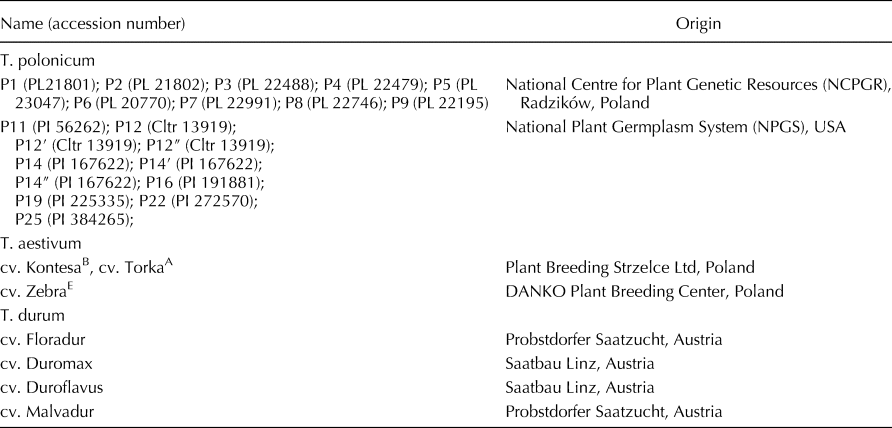
The experimental material comprised 27 spring forms of wheat, including 20 accessions of T. polonicum, three cultivars of T. aestivum and four cultivars of T. durum (Table 1).
The experimental material used in the study

A – quality wheat, B – bread-making wheat, E – elite wheat (Polish National List of Agricultural Varieties, 2013).
All lines and cultivars were reproduced at the Department of Plant Breeding and Seed Production of the University of Warmia and Mazury in Olsztyn, Poland. A 2-year field experiment in a randomized complete block design with three replications was performed at the Experimental Station in Bałcyny (53°36′N latitude, 19°51′E longitude). Plot area was 10 m2. The preceding crop was winter rape. A single N/P/K fertilizer treatment (40/25/80 kg/ha) was applied before sowing. The wheats were manually harvested at the over-ripe stage BBCH 92 (Witzenberger et al., Reference Witzenberger, Hack and Van den Boom1989), and grain was stored in polypropylene tubes at −20°C in a freezing chamber until analysis.
Experimental design
Reagents and standard solutions
Water was purified successively by reverse osmosis and in the ELGA LabWater/VWS PURELAB® Ultra water purification system (High Wycombe, UK). HNO3 (69%) TraceSELECT®, single-element spectroscopy standard solutions (1 g/l Al, As, B, Ba, Cd, Ce, Co, Cr, Cu, Fe, Hg, In, La, Mn, Mo, Na, Ni, Pb, Rb, Se, Sr, Tl, V, Y and Zn in 2% HNO3 and 1 g/l Sb and Sn in 10% HCl), MgSO4·6H2O, KH2PO4, CaCO3 and CaCl2·4H2O of Suprapur® quality (for trace analysis) were purchased from Fluka, Sigma-Aldrich, (Steinheim, Germany), CPI International (Amsterdam, The Netherlands) and Merck (Darmstadt, Germany). An internal standard (IS) solution with 40 µg/l Sc, 20 µg/l In and 20 µg/l Tl in 0.5% HNO3 was used to prepare calibration standards, dilute digestion solutions and produce aspirated test samples containing 20 µg/l Sc and 10 µg/l In and Tl. The calibration standards had the following concentrations: (0.020/0.074/0.27/1.00) μg/l Cd, Ce Co, Cr, Hg, La, Pb, Sb, Sn, V, Y; (0.10/0.37/1.36/5.00) μg/l As, Se, Ni; (1.0/3.7/13.6/50.0) μg/l Al, B, Ba, Cu, Mo, Rb, Sr; (4.0/14.8/54.5/200) μg/l Fe, Mn, Zn; (0.020/0.074/0.27/1.00) mg/l Na; Ca (0.81/1.42/2.44/.06) mg/l (0.61/1.07/1.83/3.05) mg/l Cl; (2.0/3.5/6.1/10.1) mg/l Mg; (2.7/4.7/8.0/13.3) mg/l S; (8.9/15.6/26.7/44.6) mg/l K and (7.0/12.4/21.1/35.3) mg/l P in 1.5% HNO3.
Digestion procedure
Samples were digested in a High Pressure Asher (HPA; Anton Paar Graz, Austria). Samples of (500 ± 20) mg wheat kernels were transferred to 30 ml quartz vessels and 2 ml HNO3 was added. The vessels were sealed with Teflon tape and quartz disks, and they were placed inside the HPA. The vessels were initially filled with nitrogen to 100 bar pressure, and the following temperature programme was run: heating to 80°C over 15 min, 110°C over 15 min, 240°C over 10 min and 240°C over 90 min. Clear digestion solutions were obtained after cooling, and the samples appeared to be completely mineralized. The digestion solutions were transferred to pre-weighted 50 ml polystyrene tubes and diluted with ultra-pure water to 50.0 g. Prior to inductively coupled plasma mass spectrometry (ICP-MS) measurements, aliquots of 3 ml were mixed with 3 ml of the IS solution. Thus, the dilution factor was 1:200 for the samples and 1:50 for HNO3 for digestion. The sample solutions were stored at room temperature until ICP-MS analysis.
ICP-SFMS (inductively coupled plasma sector field mass spectrometry) measurements
The elements were determined with the Finnigan ELEMENT2 double-focusing sector ICP-MS (Thermo Electron Corporation, Bremen, Germany) with a CETAC ASX-520 autosampler (CETAC Technologies, Omaha, Nebraska, USA). The instrument was equipped with a cyclonic spray chamber (Jacketed Cinnabar Cyclonic, 20 ml) and a conical nebulizer, both made of borosilicate glass and manufactured by Glass Expansion (West Melbourne, Australia), connected to a 700 µl/min self-aspiration capillary (0.5 µm I.D.; AHF Analysentechnik, Tübingen, Germany). The flow rate of cooling argon (Ar 4.6, 99.996%) was 16 l/min, and auxiliary (plasma) gas and sample (nebulizer) gas flows were optimized daily before each measurement series to obtain maximum signal intensity, the former typically at 0.70 l/min and the latter at 1.00 l/min. RF power was 1185–1195 W. The following nuclides were measured in low-resolution mode, R s = 300, 10% valley definition: 11B, 45Sc, 89Y, 97Mo, 115In, 118Sn, 121Sb, 139La, 201Hg, 205Tl, 206Pb and 208Pb. 23Na, 24Mg, 27Al, 35Cl, 44Ca, 45Sc, 51V, 52Cr, 55Mn, 56Fe, 59Co, 60Ni, 63Cu, 66Zn, 88Sr, 111Cd, 115In, 118Sn, 137Ba and 140Ce were determined in medium-resolution mode, R s = 4000, whereas 31P, 32S, 39K, 45Sc, 75As, 77Se and 85Rb were measured in high-resolution mode R s = 10,000. To compensate for changes in signal intensity during measurement, Sc, In and Tl were used as internal standards. Quantitative analysis of the samples was performed by external calibration.
Results
The ICP-SFMS method supported the identification of 39 nuclides. The results were analysed, and successive analyses focused on 16 nuclides (11B, 23Na, 24Mg, 27Al, 31P, 32S, 39K, 44Ca, 55Mn, 56Fe, 63Cu, 66Zn, 85Rb, 88Sr, 97Mo and 137Ba) present in the grain of all evaluated wheat forms. The vast majority of the identified 39 nuclides were present only in selected samples and in very small quantities. The above applies particularly to toxic heavy metals.
The results of the 2-year experiment were processed by ANOVA which did not reveal a significant interaction between the experimental year and the studied minerals. The experimental year exerted a significant (P < 0.05) effect only on the content of Mo, Rb, B and Mn, and wheat species exerted a significant effect on Mo, B, Ba, Al, Fe, Zn Mg, S and P. These findings indicate that despite significant differences in the content of selected elements between 2 years of the study, the experimental year differentiated the studied species in a similar manner.
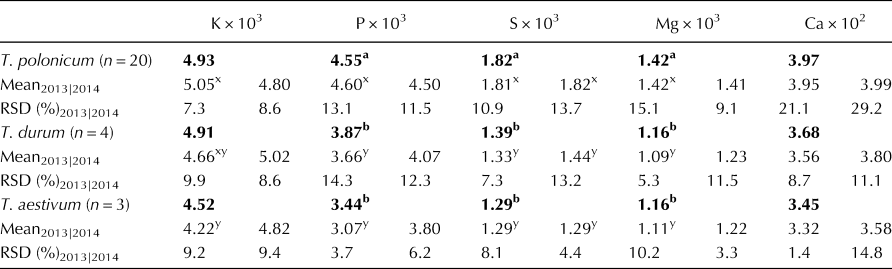
Polish wheat grain was characterized by the significantly highest content of P (4.55 g/kg), S (1.82 g/kg) and Mg (1.42 g/kg) relative to the grain of T. durum and T. aestivum (Table 2). Magnesium is particularly important in human nutrition. The relatively high values of relative standard deviation (RSD) in both years of the experiment (15.1 and 9.1%) point to considerable differences between the studied accessions and indicate that selection for high Mg content of grain is possible. The analysed species did not differ significantly in the concentrations of potassium and calcium, which were highest in the grain of T. polonicum.
Mean macronutrient concentrations (mg/kg) in the grain of studied lines and varieties of T. polonicum, T. durum and T. aestivum in 2 years of experiment. Mean values for the two years of experiment have been bolded.

RSD, relative standard deviation (%). Mean values followed by the same letter do not differ significantly at P < 0.01.
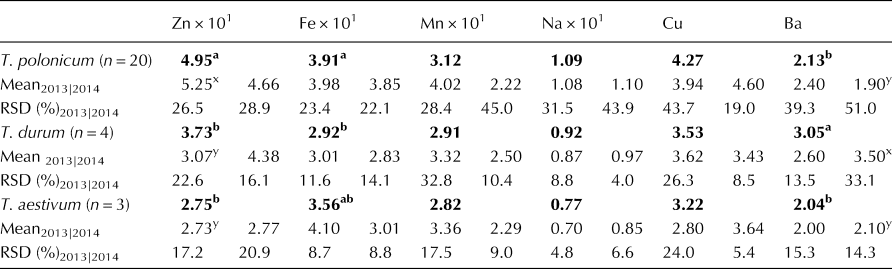
It should be noted that Polish wheat grain was characterized by the significantly highest content of Zn (49.5 mg/kg) and Fe (39.1 mg/kg) as well as a low content of Al (only 1.04 mg/kg). The Zn content of the evaluated durum wheat cultivars was 1.4-fold higher than in common wheat (by 37.2 and 27.5 mg/kg, respectively), but the noted difference was not statistically significant (Table 3). Polish wheat grain was also most abundant in boron (0.56 mg/kg), and its boron content was significantly higher than in T. durum (0.44 mg/kg).
Mean concentrations (mg/kg) of Zn, Fe, Mn, Na, Cu and Ba in the grain of T. polonicum, T. durum and T. aestivum in 2 years of experiment. Mean values for the two years of experiment have been bolded.

Mean values followed by the same letter within columns do not differ significantly at P < 0.01.
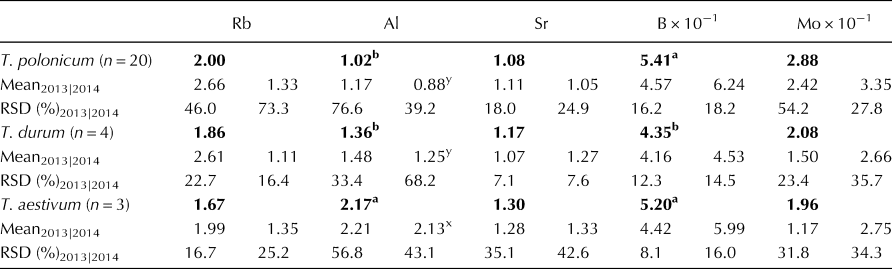
The analysed lines of T. polonicum were characterized by relatively small differences in the macronutrient content of grain, but considerable variations in micronutrient levels (Table 4). The variations in the macronutrient and micronutrient content of Polish wheat grain, expressed in RSD values, were higher than in T. durum and T. aestivum. The above indicates that some of the investigated accessions of T. polonicum are particularly abundant in nutrients and could undergo selection for this trait. These lines could constitute valuable source material for breeding wheat varieties with high micronutrient content.
Mean concentrations (mg/kg) of Rb, Al, Sr, B and Mo in the grain of T. polonicum, T. durum and T. aestivum in 2 years of experiment. Mean values for the two years of experiment have been bolded.

Mean values followed by the same letter within columns do not differ significantly at P < 0.01.
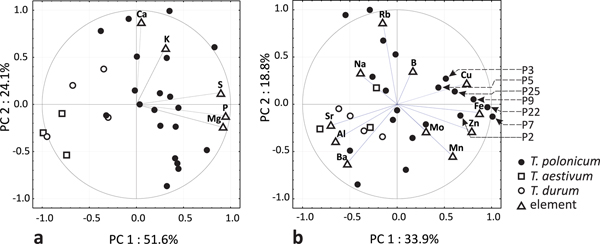
Principal component analysis (PCA) strongly discriminated all of the evaluated wheat lines and cultivars (Figs. 1(a) and (b)). The results were presented in a biplot to illustrate the strength and direction of the correlations between the variable and the principal component (PC). Variables (elements) situated closer to the circle with radius 1, which corresponds to the maximum absolute value of the correlation coefficient, had higher discriminative power. The macronutrient profile of most T. polonicum lines differed completely from that of common wheat and durum wheat. In Fig. 1(a), PC1 and PC2 explained 76.2% of total variance. Magnesium and phosphorus had the highest discriminative power, and potassium had the lowest discriminative power. Micronutrients had lower discriminative power (in Fig. 1(b), PC1 and PC2 explained 54% of total variance), but they supported the discrimination of seven Polish wheat lines with a desirable micronutrient profile: P2, P3, P5, P7, P9, P22 and P25. The grain of these lines was characterized by the highest content of Cu, Fe and Zn, and the lowest content of undesirable Sr, Al and Ba. The grain of the following seven lines was characterized by average micronutrient content, two lines had a similar micronutrient profile to common wheat and durum wheat, and four lines were highly abundant in Rb, B and Na.
Biplots presenting the results of PCA, including all macronutrients (a) and micronutrients (b) detected in the studied lines of T. polonicum and cultivars of T. durum and T. aestivum.

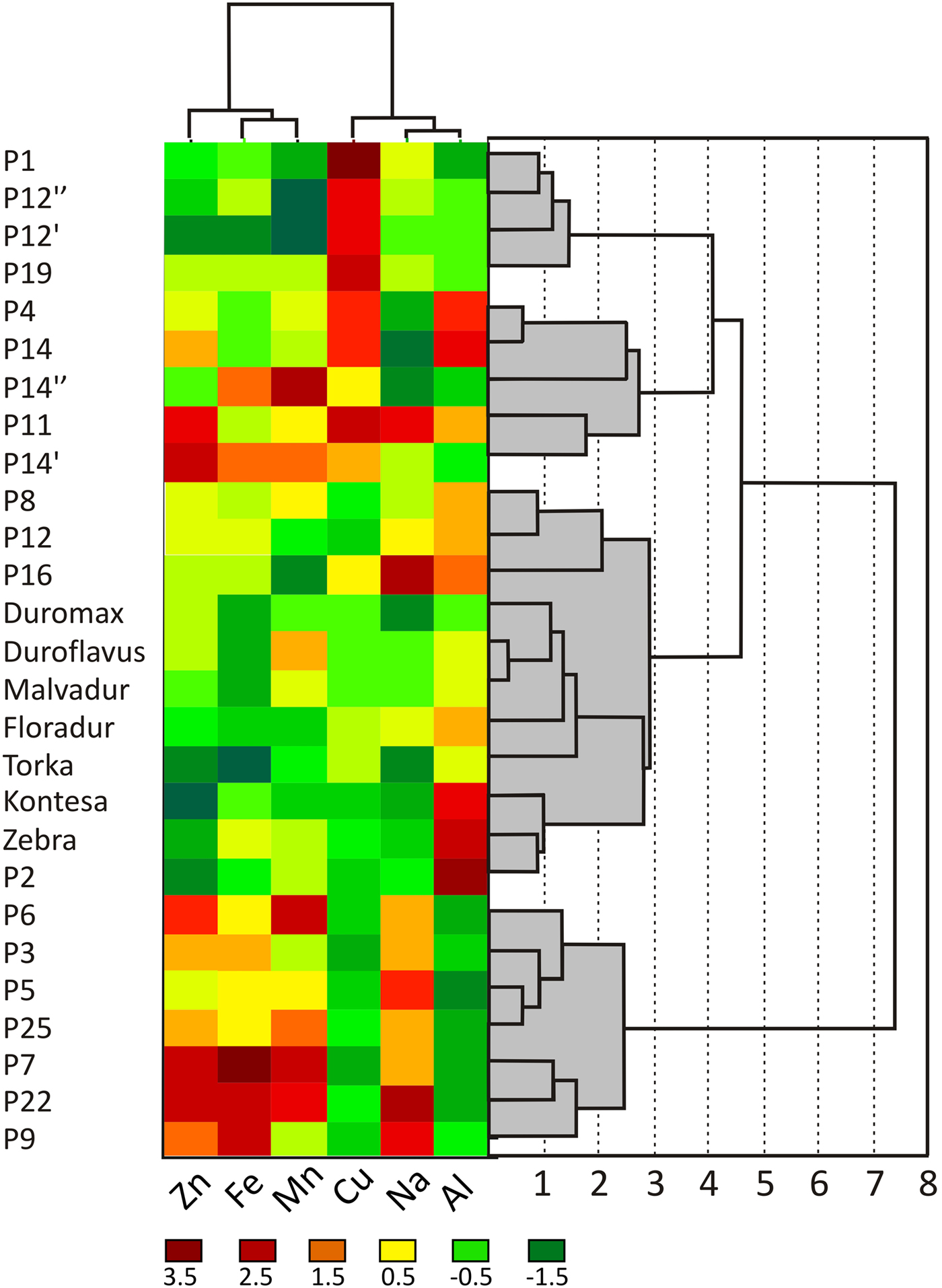
The hierarchical clustering of six essential dietary nutrients supported the identification of two major clusters. The first cluster grouped seven lines of T. polonicum that clearly differed from the remaining wheats in terms of very low Al and Cu content and a high content of Zn, Fe and Mn (Fig. 2). These lines could constitute valuable source material for breeding new varieties. The second major cluster was composed of three minor clusters. The largest minor cluster grouped all durum wheat and common wheat cultivars and four Polish wheat lines with a varied content of Zn, Fe, Cu, Mn Na and Al. The second minor cluster was formed by lines with varied concentrations of Al and Na, and relatively high Cu content. The third minor cluster was composed of lines with a very high content of Cu and a low content of Al and Zn.
Heat map and the results of a cluster analysis of the concentrations of the main micronutrients (Mn, Cu, Zn, Fe, Na and Al) in the grain of the studied T. polonicum lines (P1…P25), durum wheat (Duromax, Duroflavus, Malvadur and Floradur) and common wheat (Torka, Kontesa and Zebra) cultivars.

Discussion
Wheat is the main source of calories for 1.5 billion people (Reynolds et al., Reference Reynolds, Rajaram and Sayre1999). Therefore, it is a particularly important source of essential nutrients in the diet. Dietary Zn deficiency affects more than 30% of the global population in various regions of the world, and programmes promoting the biofortification of food products with Zn are becoming increasingly popular (Cakmak, Reference Cakmak2009, Velu et al., Reference Velu, Ortiz-Monasterio, Cakmak, Hao and Singh2014). Research efforts are also being made to find the genetic sources of high-Zn concentrations in wheat grain (Pandey et al., Reference Pandey, Khan, Hakki, Thomas, Hamurcu, Gezgin, Gizlenci and Akkaya2016). Makarska et al. (Reference Makarska, Kowalczyk and Rachoń2001) and Rachoń et al. (Reference Rachoń, Pałys and Szumiło2012) reported higher Zn levels in durum wheat than in common wheat. In the current study, the Fe content of Polish wheat was only somewhat higher than that of common wheat, but nearly 30% higher than in the analysed cultivars of T. durum. A biofortification study by Ciccolini et al. (Reference Ciccolini, Pellegrino, Coccina, Fiaschi, Cerretani, Sgherri, Quartacci and Ercoli2017) produced interesting results. The authors investigated two common wheat varieties: a modern high-yielding, semi-dwarf variety and an ‘old’ variety with normal stem length, which had been cultivated in the early 20th century. Biofortification with Zn and Fe increased the content and bioavailability of zinc in flour, but did not increase the concentration or bioavailability of iron. Interestingly, the ‘old’ variety was characterized by a higher content and bioavailability of iron than the modern variety. The authors concluded that decisions regarding biofortification should be made in view of current breeding trends which aim to increase the mineral content of grain. Amiri et al. (Reference Amiri, Bahraminejad, Sasani, Jalali-Honarmand and Fakhri2015) demonstrated that the content of protein, iron and zinc in grain decreases with a rise in productivity, in particular in water-stressed environments. In a review article, Tabbita et al. (Reference Tabbita, Pearce and Barneix2017) discussed the results of research into the GPC-B1 gene in various Triticum species. The GPC-B1 gene is localized on chromosome 6B, and it is responsible for higher protein, iron and zinc concentrations in grain. The above authors concluded that the GPC-B1 gene has the potential to increase the nutritional value and end-use quality traits in a wide range of modern cultivars and environments, and they discussed the possibilities for its application in wheat breeding. GPC-B1 alleles are found in both hexaploid (T. aestivum, T. spelta) and tetraploid (T. dicoccum, T. dicoccoides) species. To the best of our knowledge, the relevant research has never been conducted in T. polonicum. In the current study, the grain of the studied accessions of T. polonicum was characterized by the highest (but not statistically significant) content of Mn, Na and Cu in comparison with the remaining species. A high content of boron is also desirable in the grain of Polish wheat. Sodium is not a desirable mineral in the human diet, but copper plays an important metabolic role, in particular in regions with copper-deficient soils (Kumari and Platel, Reference Kumari and Platel2017). Aluminium levels were more than twice lower in the grain of T. polonicum than in common wheat, which could also have implications for human health. There is scientific evidence to indicate that dietary aluminium increases the risk of Alzheimer's disease (Tomljenovic, Reference Tomljenovic2011), amyotrophic lateral sclerosis, Guillain–Barré disease and other neurological disorders (Bishop et al., Reference Bishop, Morley, Day and Lucas1997; Chen et al., Reference Chen, Miah and Aschner2016). Boron is also an essential dietary component which supports mineral metabolism, immune responses and endocrine functions (Nielsen, Reference Nielsen1997; Kabu and Akosman, Reference Kabu and Akosman2013). Ancient wheat species have high nutritional value and deliver health benefits. Some relict species of the genus Triticum that had not been genetically modified or improved through breeding have been reintroduced in the past decade. The popularity of alternative cereals is on the rise due to growing levels of consumer awareness about healthy eating (Bordoni et al., Reference Bordoni, Danesi, Di Nunzio, Taccari and Veronica2017). According to Savin et al. (Reference Savin, Abugaliyeva, Cakmak and Kozhakhmetov2018), relict species and species related to T. aestivum can constitute valuable material for breeding varieties whose grain is more abundant in micronutrients, in particular zinc and iron. Similar conclusions were formulated by Guzmán et al. (Reference Guzmán, Medina-Larqué, Velu, González-Santoyo, Singh, Huerta-Espino, Ortiz-Monasterio and Peña2014) who analysed many lines developed from a cross between modern cultivars of T. aestivum and Mexican landraces, spelt accessions and synthetic wheat lines, as well as lines developed from T. dicoccum × Aegilops tauschii hybrids. They found that the grain of high-yielding hybrid lines was characterized by 10–90% higher micronutrient content as well as more desirable processing quality traits than the grain of popular commercial varieties. Our previous findings indicate that the grain of three hulled wheat species (T. spelta, T. dicoccum and T. monococcum) contained significantly more Zn (from 34 to 54%), Fe (from 31 to 33%) and Cu (from 3 to 28%) than common wheat (Suchowilska et al., Reference Suchowilska, Wiwart, Kandler and Krska2012). In the current study, the content of Zn, Fe and Cu in the grain of T. polonicum was similar to that in the grain of hulled wheats. The above could suggest that the grain of T. polonicum has health-promoting properties. However, the mechanisms responsible for those traits remain largely unknown, and only a limited number of genotypes have been studied. According to Shewry (Reference Shewry2018), the nutritional value of cereals should be researched with the use of various combinations of both ancient and modern wheat species. Polish wheat remains insufficiently investigated, and it has attracted considerable interest from breeders, genetics researchers and food technology experts only recently. Polish wheat has hull-less grain, which is also a very important consideration in breeding practice. The above implies that potential T. durum and T. aestivum hybrids should also have hull-less grain, which significantly facilitates harvesting and processing. Greater emphasis had been placed on the tetraploid Khorasan wheat, commercially known as Kamut, a form of T. turanicum which is closely related to T. polonicum (Piergiovanni et al., Reference Piergiovanni, Simeone and Pasqualone2009; Sofi et al., Reference Sofi, Whittaker, Cesari, Gori, Fiorillo, Becatti, Marotti, Dinelli, Casini, Abbate, Gensini and Benedettelli2013; Dinelli et al., Reference Dinelli, Di Silvestro, Marotti, Bosi, Bregola, Di Loreto, Nipoti, Prodi and Catizone2014). Previous research investigating the responses of Polish wheat to Fusarium pathogens which cause Fusarium head blight revealed that Kamut is more abundant in essential dietary nutrients than common wheat. Nutrient concentrations increased in grain inoculated with Fusarium pathogens (Wiwart et al., Reference Wiwart, Suchowilska, Kandler, Sulyok, Groenwald and Krska2013), which could be attributed to the fact that the grain of infected plants is smaller and that the seed coat has a higher share of kernel weight. However, our previous study focused on host plant responses to pathogens, rather than variations in the elemental composition of Polish wheat grain. The experimental material used in the current study was selected from a collection of more than 100 accessions of different origin. Accessions with the most desirable agronomic traits (resistance to lodging, early ripening, resistance to pathogens) were selected for the study as valuable resources for breeding new varieties. The high variability of the analysed lines of T. polonicum can be attributed to low commercial interest in the species and the absence of breeding efforts to narrow down its gene pool (Eticha et al., Reference Eticha, Belay and Bekele2006).
The grain of several analysed accessions was highly abundant in Zn, Fe and Cu. Polish wheat grain contained 33% more zinc than durum wheat and 80% more zinc than common wheat on average. The average iron content of T. polonicum was nearly 34% higher than in durum wheat and 10% higher than in common wheat, and its copper content was 21 and 32% higher, respectively. According to Cakmak and Kutman (Reference Cakmak and Kutman2018), genetic biofortification of wheat with Zn through breeding or transgenic strategies might be risky in terms of grain Cd concentrations, especially if it is not complemented with agronomic biofortification through optimized Zn fertilizer application. The results of this study indicate that Polish wheat could be used for genetic biofortification of durum wheat and common wheat.
Acknowledgments
This research did not receive any specific grant from funding agencies in the public, commercial, or not-for-profit sectors.
Supplementary material
The supplementary material for this article can be found at https://doi.org/10.1017/S1479262118000394.