Structural heart disease in children comprises a wide spectrum of congenital and acquired pathologies. Cyanotic CHDs manifest early in life, while acyanotic congenital defects often remain latent throughout childhood and adolescence. Acquired heart disease during childhood is predominantly rheumatic in origin. The prevalence of rheumatic heart disease is distributed unequally across and within regions of socio-economic development. Reference Rothenbühler, O’Sullivan and Stortecky1 We aimed to quantify the burden of acquired relative to congenital structural heart disease among children and adolescents in Nepal.
Methods
Study design and data collection
Children and adolescents between the ages of 5–16 years attending randomly selected public and private schools in urban and rural areas were prospectively enrolled into a cross-sectional echocardiographic screening programme in the Sunsari district in Nepal. The study was originally designed to detect evidence of latent rheumatic heart disease. Details of the sampling frame, sampling strategy, eligibility criteria, and informed consent have been reported previously. Reference Pilgrim, Kalesan and Karki2,Reference Karki, Uranw and Bastola3 In brief, cluster random sampling stratified by the location (rural or urban) and administration (public or private) of schools applied to reflect the socio-economic demographic distribution in the district. All children attending selected schools underwent screening echocardiography by use of a battery-operated portable ultrasound machine (Samsung Medison MySonoU6). Children suspected to have structural heart disease underwent independent confirmation at B.P. Koirala Institute of Health Sciences in Dharan, Nepal. The study was approved by the institutional review board of the B.P. Koirala Institute of Health Sciences and the Nepal Health Research Council. Children and their parents or primary caregivers had the opportunity to opt out of the study. The study protocol conforms to the ethical guidelines of the 1975 Declaration of Helsinki as reflected in a priori approval by the institution’s human research committee. The protocol for data acquisition, confirmation, electronic data capturing, and central monitoring has been outlined previously. Reference Pilgrim, Kalesan and Karki2,Reference Shrestha, Karki and Mahto4
Definitions
The primary outcome of the present analysis was the prevalence of congenital or acquired structural heart disease. Acquired heart disease consisted of definite or borderline rheumatic heart disease defined according to the World Heart Federation criteria for individuals 20 years or younger. Reference Reményi, Wilson and Steer5 CHD included incidentally detected structural heart disease present since birth with the exception of bicuspid aortic anatomy, which was not systematically assessed.
Statistical analysis
Baseline characteristics and clinical findings are presented as numbers and frequencies (%) for categorical variables and as means (± standard deviation) for continuous variables. Categorical variables were compared by means of the Fisher’s exact or Chi-squared test and continuous ones by two-sample Student’s t-tests. All statistical analyses were performed with Stata software (version 14.2).
Results
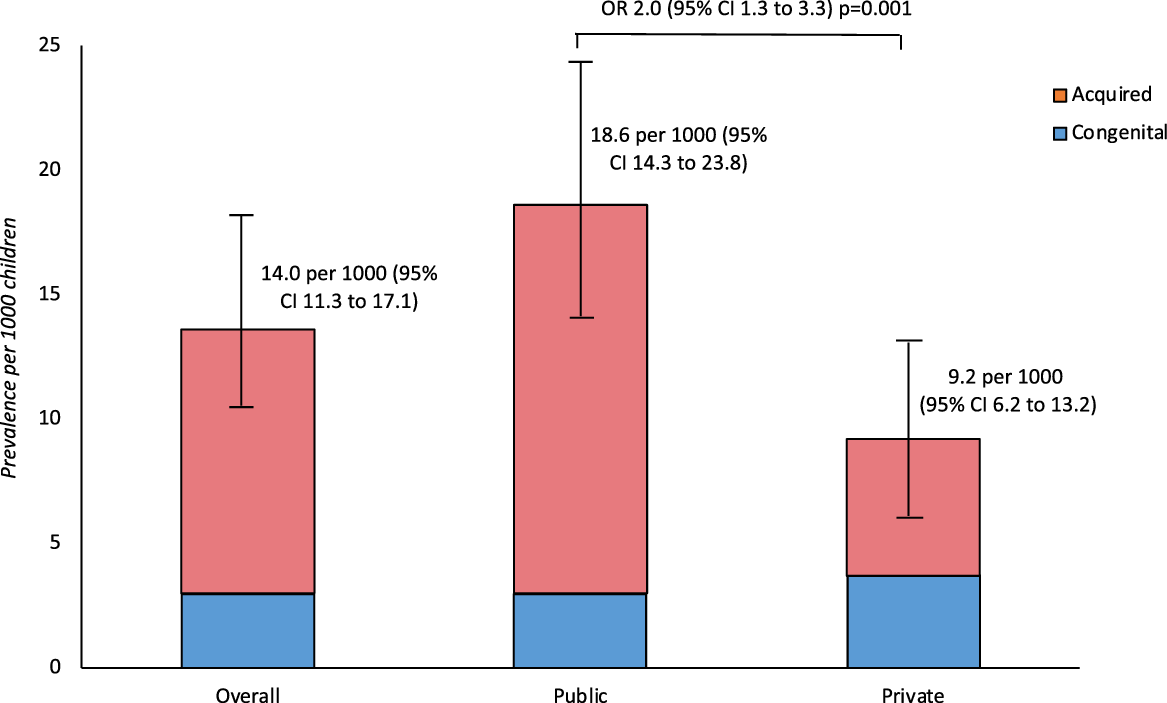
Between December 2012 and January 2019, 6573 children from 41 randomly selected schools underwent echocardiographic screening. The mean age of the children was 10.6 ± 2.9 years and 48.5% were girls; 50.6% attended public and 49.4% of children attended private schools. Latent structural heart disease was detected in 92 children (14.0 per 1000, 95% CI 11.3–17.1) and was congenital in 22 (3.3 per 1000, 95% CI 2.1–5.1) and acquired in 70 (10.6 per 1000, 95% CI 8.3–13.4). Among the children with CHD, 18 children had an ostium secundum atrial septal defect, four children were found to have a ventricular septal defect, and one child had Ebstein’s anomaly. Among children with acquired valvular heart disease, 38 children had definite and 32 children borderline rheumatic heart disease according to the World Heart Federation criteria.
Prevalence of structural heart disease was more common among children attending public (18.6 per 1000, 95% CI 14.3–23.8) as compared to private (9.2 per 1000, 95% CI 6.2–13.1) schools (OR 2.0 (95% CI 1.3–3.3, p = 0.001) (Fig 1). The difference was driven by higher rates of rheumatic heart disease in children attending public (15.6 per 1000, 95% CI 11.7–20.4) as compared to private (5.5 per 1000, 95% CI 3.8–8.8) schools (OR 2.8, 95% CI 1.6–5.2, p = 0.0001). The prevalence of CHD was comparable in children attending public (3.0 per 1000, 95% CI 1.4–5.5) or private (3.7 per 1000, 95% CI 1.9–6.5) schools (OR 0.8, 95% CI 0.3–2.1, p = 0.6256).
Prevalence of congenital (blue) and acquired (red) structural heart disease in Nepali schoolchildren from public and private schools.

Discussion
Our findings indicate a substantial burden of latent structural heart disease among children in Nepal. In 3 out of 4 cases of structural heart disease, or in 1 out of 100 children, there was an acquired valvular defect consistent with rheumatic heart disease. The burden of acquired but not CHD was higher in children attending public schools as compared to those attending private schools, indicating a gradient of socio-economic disparity within a region with an endemic pattern of rheumatic heart disease. Children diagnosed with definite rheumatic heart disease according to the echocardiographic criteria of the World Heart Federation were started on secondary antibiotic prophylaxis. Children with CHD were offered medical care as clinically indicated. Longitudinal follow-up of children with rheumatic heart disease has been reported previously. Reference Shrestha, Bruelisauer and Uranw6
Our findings need to be interpreted in light of several limitations. First, as a consequence of dismal survival of newborns with cyanotic heart defects in a region with limited healthcare resources, we found no children with cyanotic structural heart defects in our cohort of schoolchildren. Second, the number of children in our study represents less than one per 1000 of all schoolchildren in Nepal. 7 However, cluster random sampling was stratified according to location and administration of schools in order to yield a representative sample. Reference Pilgrim, Kalesan and Karki2 Third, the present study included only children attending school; our findings are therefore not representative for out-of-school children. 7 And finally, numbers are small to reflect robust prevalence estimates of rare structural defects.
Acknowledgements
None.
Financial support
This study was funded by a dedicated research grant from the UBS Optimus Foundation, Switzerland.
Contributions
TP conceived the study. TP, NRS, and PK had responsibility for the design of the study. NRS, SU, KS, RM, SD, KA, KG, and NP were responsible for acquisition of the data. MR did the analysis and interpreted the results in collaboration with TP. TP wrote the first draft of the report. All authors critically revised the report for important intellectual content and approved the final version.
Conflicts of interest
TP reports research grants to the institution from Boston Scientific, Biotronik, and Edwards Lifesciences, personal fees from Biotronik, Boston Scientific, and HighLife SAS outside of this study.