

Do political institutions matter to the development of quality assurance systems in health care?
Health care policy-making is a politically contentious area in times of economic downturns in ageing societies. Universal welfare provision is under great strain in contemporary industrially advanced democracies. The three main actors – the state as the principal financier of health care, the public as recipients of health care services, and the medical professions as the service providers – have to negotiate constantly and strike a balance between various policy goals such as equity, cost-effectiveness, and quality of care (Harrison et al. Reference Harrison, Hunter and Pollitt1990; Moran and Wood Reference Moran and Wood1993; Döhler Reference Döhler1995; Salter Reference Salter1999; Lægreid et al. Reference Lægreid, Opedal and Stigen2005).
Quality assuranceFootnote 1 of health care has become a widely-used policy tool in most advanced economies (Pollitt Reference Pollitt1987; van den Heuvel et al. Reference van den Heuvel, Koning, Bogers, Berg and van Dijen2005). It is accepted as useful for both medical professionals and patients for comparing the performance of different health care providers, in that the former can learn about and emulate best practice, and the latter can make informed decisions regarding hospital choice (OECD 1993; WHO 2000). Following the rise of new public management in the 1980s (Dunleavy and Hood Reference Dunleavy and Hood1994; Pollitt and Bouckaert Reference Pollitt and Bouckaert2004), governments began to see quality assessment as a potentially valuable policy instrument for reforming the public sector by enhancing competition, accountability and freedom of choice through the measurement of performance. In some cases, the development of performance indicators in the health sector was linked to the determination of budgetary allocations (OECD 1994).
However, this global trend has not yet been transformed into a unified method of measuring clinical outcomes and processes: not even a common definition of quality exists, and the way in which the results are disseminated to the public varies greatly across countries. This paper asks do political institutions matter to the development of quality assurance systems in health care? It explains why the variations persist by examining how different health care governance structures affect the levels of public attention on the issue of quality assurance and how certain types of public debate can trigger government involvement. The question is when and how each government responds to changing public mood and demand, which may potentially be at odds with the interests of medical professions.
Under the universal health care system, government is increasingly faced with dual imperatives between cost containment and service improvement for the entire population. As the principal financier of health care systems, government uses the tool of quality assessment for controlling medical professions' behaviour and to contain cost. As a regulator, government also sets and monitors the standard of services and encourages constant improvement of quality. In order to achieve these two goals, government needs to collaborate closely with medical professionals who cherish their professional autonomy. On top of these two imperatives, government needs to perform a third function, namely to advocate patients' rights and provide information about quality, with increased freedom of choice for the service recipients. While transparency of information is welcomed by general public, the use of information as a policy instrument may have a detrimental effect on the level of mutual trust between government and the medical services.
As a result of the complex interactions between government, the medical professions and the general public, it is highly difficult for government to satisfy demands from the medical profession and the general public. In constructing national quality assurance systems, ‘the emergence of a previously unappreciated issue into a stable policy-making system’ has played a significant role (Jones and Baumgartner Reference Jones and Baumgartner2005: 68). Depending on the occurrence of prominent events or constant public interest in the policy, issue saliency may change, and the performance of government can be challenged. Therefore, sensitivity to blame and public discourses form a crucial part of the dynamics for deciding when and how governments respond and engage in the policy area. In addition, in health care, historically cultivated power relationships among major stakeholders and organisations, as well as wider institutional arrangements, also need to be taken into account (Immergut Reference Immergut1992; Wilsford Reference Wilsford1994: Hacker Reference Hacker1998; Tuohy Reference Tuohy1999).
Policy responsiveness has attracted scholarly attention (Hobolt and Klemmemsen Reference Hobolt and Klemmemsen2005; Stimson Reference Stimson2004; Wlezien Reference Wlezien2005; Schumaker Reference Schumaker1975; Jennings Reference Jennings2009). One school of thought adopts the view that governments' responses to pressures tend to be reflexes (Breyer Reference Breyer1993), while another has carried out comparative studies by examining differences in the manner in which different institutions respond to external pressure, and how their choices are constrained by institutional set-ups (Alink et al. Reference Alink, Boin and 't Hart2001; Lodge and Hood Reference Lodge and Hood2002; Wood Reference Wood1991). Quality assurance movements in the health care sector constitute a very interesting case for the exploration of this question, that is, the impact of institutions on the responsiveness of government and subsequent policy changes.
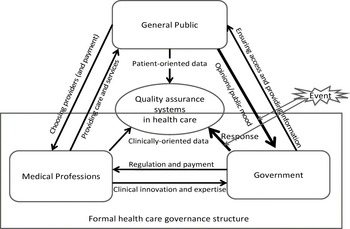
Figure 1 shows a simplified model for describing the interactions between the three actors (the government, the medical profession and the general public) and the quality assurance system as a policy outcome. The model is intended to underscore the key factors such as public opinions, salient events, government responses and the formal health care governance structure. In the figure, government includes relevant ministries, local government and agencies, while medical professions encompass professional societies, medical associations and academic groups. Regulation by governmental bodies includes standard setting and evaluation of performance, and can be conducted through legal, financial and administrative means.
Government-medical profession-public interaction in quality assurance system-building

As a policy outcome, broadly, two general types of quality assurance system were identified. One is a profession-driven system, which places greater emphasis on clinical processes and innovations for the medical profession. As it is designed primarily for the medical professions to compare practices and encourage innovations and improve their performances, the general publication of the results is normally considered to be of secondary importance. The other is a patient-oriented system, which is outcome-oriented and favours the simplification of clinical outcomes for users. The second type addresses patients' concerns, ensuring patient access to performance indicators and in some cases, leads to the publication of league tables.
Comparing England,Footnote 2 Sweden and Japan (all featuring universal health care in unitary states), the paper investigates the interaction effects of formal health care governance structures on health policy development and the relationship between public discourses and governmental response vis-à-vis entrenched interests (the medical profession). The next section describes the research design and how data were collected and analysed.
Research design and data
In order to tackle the question as to when and how government addresses the issue of quality assurance in health care and responds to demands from the general public, this article adopts a small-N case study method with a ‘most different systems’ design (Yin Reference Yin1989). The three selected health systems (England, Sweden and Japan) differ greatly in their modes of health care delivery (i.e. their respective public/private mixes of health delivery and degrees of political accountability at the central/local government levels), with some common features (all are unitary/parliamentary systems with universal health coverage). Such a tri-country comparative case study is conducive to detecting the interactive effects of each political system on policy development. It reveals whether government responses were knee-jerk responses or products of the interactions between the formal governance structures and public opinion. Although the importance of health care quality indicators for the general public has been emphasised (Klazinga et al. Reference Klazinga, Stronks and Verhoeff2001), the involvement of national government in developing quality assurance system(s) rarely attracts media attention, unlike immigration or environmental policy (Gouldson Reference Gouldson2004; Jennings Reference Jennings2009). Therefore, this article looks into three factors (changing patterns of issue saliency, the occurrence of prominent events and the levels of criticism of each government) as possible catalysts for government response, rather than relying on a single event factor.
This article uses the print media to demonstrate how the quality assurance systems in each of the three countries were framed. Given that the national quality assurance systems in the three countries began to feature prominently in the media from 1995 onwards, the period covered by this study primarily runs from January 1st 1995 to December 31st 2005. Views expressed in the print media (‘liberal’ broadsheet newspapers: the Guardian (TG) for England, Dagens Nyheter (DN) for Sweden and Asahi Shimbun (AS) for Japan) were employed: first, to gauge the volume of public attention paid to quality assurance systems in each of the three countries, and second, to highlight and compare dominant themes within the public debate and/or occurrences of prominent events which may or may not have instigated political interventions by each central government.
For capturing the first variable, i.e. issue saliency patterns, a manual search was undertaken of the online electronic databases of the three newspapers for all mentions of ‘quality’ and ‘hospital’ or ‘quality’ and ‘health care’. Then unconnected or irrelevant mentions of ‘quality’, ‘hospital’ and ‘health care’ were excluded. The main aims of this analysis were to trace the patterns of issue saliency and to identify opinions expressed in the press. Therefore, the emphasis of the analysis was placed upon articles mentioning government (or its agency), the medical professions and opinions expressed concerning quality assurance movements in health care.
For the second variable, i.e. occurrence of prominent events such as scandals, any relevant events that were linked to government responses in quality assurance were searched and highlighted. In some cases, a search of the print media was not sufficient for linking the occurrence of such events to government decisions. In order to complement this information, semi-structured interviews with senior civil servants, doctors and academics were also conducted to confirm the findings. In particular, a very limited number of samples were located in Sweden, partly due to its localised health care system. Therefore, the search in this case was extended to include other national and some local newspapers as well as TV reports.
For the third variable, i.e. public criticisms, whether the articles treat government and/or the medical professions in a positive or negative manner was counted, and the percentage of negative reports in total was calculated. In addition, there is one further category, i.e. neutral reports, with the mere function of informing the public of news and events. This three-way separation would be useful to identify who was deemed to be responsible for health care quality issues in public discourse. Although the proportion of negative results may be affected by different reporting styles in the press in the three countries, the comparative value of negative reports for each government and the medical profession enables us to measure the general trend of public opinion (as expressed in the print media). For this reason, the figures in the case study section only show the ratio of reports critical of the government and the medical profession together with the total number of articles. Unless otherwise stated, translations of the Japanese and Swedish are by the author. In order to ensure the reliability of the data, the three-way classification was re-examined by independent native speakers.
The following section will set out the basic health governance structures of the three countries prior to empirical analysis. As previously noted, this paper seeks to explore interactions between macro political environments and nationally-advocated quality assurance systems. The methods are therefore concentrated on capturing different degrees of political interference in the system by the three national governments, not encompassing different types of quality assurance schemes at local and hospital levels. It is also worth mentioning that this study does not aim to evaluate the success or failure of each scheme.
Basic health care governance structures in the three countries
The English National Health Service (NHS) is publicly run and centrally controlled, and hence the most institutionalised of the three systems considered here (Hollingsworth and Hanneman Reference Hollingsworth and Hanneman1984; Klein Reference Klein and Goodin1996; Moran Reference Moran1999; Freeman Reference Freeman2000). Due to a strong tradition of parliamentary accountability, the English government and parliament should be sensitive to popular demands and the perceived performance of local hospitals even after the quasi-market reforms, given the impact of such factors on elections, policy pledges and ministerial responsibility (Klein Reference Klein2001; Ham Reference Ham2004). Correspondingly, with its emphasis on democratic accountability at the local level (having county councils with tax-varying powers for hospitals), the Swedish system takes a decentralised approach, with the central government and parliament (the Swedish Riksdag) playing only a guarantor's role to ensure that the whole population has equal access to good-quality health care (Saltman and Bergman Reference Saltman and Bergman2005; Garpenby Reference Garpenby1989; Fredriksson and Winblad Reference Fredriksson and Winblad2008). The locus for policy-making is thus diffused across various levels of government and geared towards consensus-building among medical professionals, local politicians and central government agencies. On the other hand, health care in Japan, provided predominantly by private actors and based on social insurance schemes, is the most diffuse and least structured. The system does not hold politicians in parliament (the Japanese Kokkai) to account for delivery issues; instead semi-autonomous providers simultaneously have the discretion and carry the liability in this respect. However, with the bargaining for remuneration remaining at the national level, the government does ultimately retain leverage against private providers, who in turn have thus cultivated a special relationship with the (until recently) de facto single ruling party, the Liberal Democratic Party (LDP) as the protector of their privileges (Campbell and Ikegami Reference Campbell and Ikegami1998; Steslicke Reference Steslicke1973).
As for the autonomy of medical professionals, the creation of the NHS Management Executive in England in 1988 saw the introduction of managers with a business ethos into the health services (e.g. chief executives of the NHS trusts). In this role, they became the representatives of the government as well as the patients. In Sweden, the decentralised model signifies that democratically elected members of county councils have considerable discretion in deciding what measures are necessary for providing good quality health care for their local populations, although the central government and its agency, the National Board of Health and Welfare (NBHW) are responsible for overseeing and inspecting the quality and safety issues (Garpenby Reference Garpenby1997).
In sharp contrast to these two systems, and in the absence of a unified approach by the central government to service provision, doctors in Japan were accorded great autonomy out of respect for their noble vocation and expertise. The unique Japanese personnel management system,Footnote 3 organised in clinical departments in teaching hospitals, has not only contributed to the consolidation of collegial medical institutions but has also insulated itself from both government policy and general public scrutiny. In addition, the freedom of choice that patients enjoy has intensified the competition among providers. As a result, in exchange for the Japan Medical Association's electoral support for the LDP,Footnote 4 a beneficial package was agreed upon by both camps at the fee-schedule negotiations, and non-interference from the central government was also arranged (Campbell and Ikegami Reference Campbell and Ikegami1998; Kondo Reference Kondo2005).
In summary, at the national level, the prominence of managers in England as agents of the central government contrasts with the important arena of intermediate organisations at the county council level in Sweden. In Japan, the powerful interest group for private, office-based practitioners, the JMA, is the key negotiating partner for the government (the Ministry of Health and Welfare or MHW) if any policy is to be successfully implemented. Although the representation of the medical professionals in each political system displays great variety, the importance of expert knowledge and self-regulation within the medical profession can be emphasised in any national context. Therefore, in (decentralised) Sweden and (privatised) Japan, a nationwide quality assurance scheme appears to require an approach based on greater consensus with the medical professionals. The next three sections demonstrate policy developments related to quality assurance in the three countries over the ten-year period in question, and how they are interrelated with public discourses and political structures.
England: quality assurance as a policy instrument and easy-to-access performance ratings
In England, the development of a nationally established quality assurance system was rather slow until the mid-1990s, with professional self-regulation and government-driven efficiency checks existing side by side.Footnote 5 However, patients' dissatisfaction with waiting times and quality of care in NHS hospitals is critical in terms of the political impact of the NHS, and the Department of Health and the governing party were aware of the pressures (Day and Klein Reference Day and Klein1987; Appleby and Alvarez Rosete Reference Appleby, Alvarez-Rosete and Park2003; Ham Reference Ham2004). The introduction of quasi-market reforms in the early 1990s paved the way to more open debate about publishing the performance achievements of health providers. In 1994, the Secretary of State for Health, Virginia Bottomley, proposed a star rating system for hospitals, following the model of the school league tables (TG, June 21, 1994), which the Labour Party strongly opposed at the time (TG, June 23, 1994).
However, when the Labour Party came into power in May 1997, the government kept the existing ‘performance ratings’ and in fact sought to develop them further. The White Paper The new NHS – modern, dependable, published in December 1997 (Department of Health 1997), announced a radical breakaway from the traditional self-regulation of the health professions.
Following up on the White Paper, a number of announcements were made by the Secretary of State for Health, Frank Dobson, which included the possibility of legal action against failing hospital trusts and mandatory intervention in hospitals with high death rates and scandals such as cancer screening mistakes or excessive costs (TG, January 21/April 14, 1998). In addition, some scandals such as a malpractice case at the Bristol Royal Infirmary (BRI) acted as a further push for the central government to develop an independent monitoring agency (Department of Health 2000a; EN-2)Footnote 6. Following this, the quality issue became salient in the media. In July 1998, the government published the consultation document A First Class Service: Quality in the New NHS (Department of Health 1998a), which promised to establish new national standards, and better monitoring and assessment.
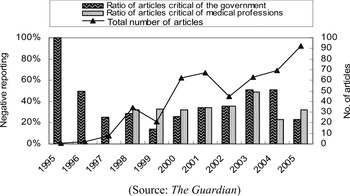
As Figure 2 demonstrates, the year of 1998 saw the increase of public attention on quality assurance as well as the start of reports criticising the medical professions. After 1998, the number of articles featuring quality issues never fell below 20. This escalation of their salience had an impact on further policy development. In June, Dobson announced the inclusion of mortality rates in the performance measurements, not waiting for the publication of a new set of indicators to which the NHS Executive had been committed since 1997. He also made it public that all hospital doctors would be required to participate in a national audit program endorsed by the Commission for Health Improvement (CHI). The supporting argument was simple and straightforward: the public had the right to know about the quality of their hospital care. In his introduction to the 1999 performance tables, Dobson claimed that he hoped that the indicators would be ‘helpful to people working in the NHS, such as GPs, to identify places doing really well and to help identify places which should be improving their performance’, but insisted that they were not to be used by patients to ‘shop around and travel for better treatment’ (Anderson Reference Anderson1999). It was also emphasised that the tables were not meant to be applied as league tables of hospitals (TG, June 17, 1999). While maintaining the preceding reforms, the Labour government softened its tone, rejecting any talk of market-led reforms in the NHS in favour of talk about patients' rights. Interestingly, public criticism of the medical professionals' self-regulation intensified as more articles began to deal with the issue.
Public attention concerning quality assurance in England, 1995–2005

With regard to performance ratings, strong intervention by the central government can also be observed. The 1999 White Paper Saving Lives: Our Healthier Nation announced that a new performance assessment framework would be set up (Department of Health 1998b). A set of indicators was developed in collaboration with the DH, NHS executive, clinicians and managers in order to bring performance and clinical indicators together in ‘a single, more accessible document’ (NHS Executive 2000: forward). Despite the heavy criticism of doctors implicit in all of this, the BMA's hesitant attitude towards the hospital league tables remained unchanged. The BMA report assessed the usefulness of the tables as ‘limited’, questioning the validity of the data collection and outcome measurements (BMJ 2000). In essence, the tables were criticised as being too complex for patients, and too simplistic for doctors. Nonetheless, the government, under the new Health Secretary Alan Milburn, further developed the scheme by simplifying the performance ratings, which were first published in 2001 for NHS trusts providing acute hospital services. The NHS plan: a plan for investment, a plan for reform (Department of Health 2000b), published in July 2000, proposed a radical shift from process-based Clinical Governance Reviews (CGRs) to a ‘traffic light’ system of performance ratings.Footnote 7 These indicators later became known as ‘star ratings’. Subsequently, they were expanded to cover assessments of other types of NHS trusts such as specialist, ambulance, mental and primary care, and lists of indicators were published in late 2002 and early 2003. According to the official document, the main purpose of this exercise was to ‘provide patients and the general public with comprehensive, easily understandable information on the performance of their local health services’ (Department of Health 2002). The real aim was to use the performance ratings as an instrument of direct control to tackle the problem of worsened waiting times, by naming and shaming the chief executives of underperforming NHS organisations (Bird et al. Reference Bird, Cox, Farewell, Goldstein, Bolt and Smith2005; EN-1).
As this star-rating exercise began to gain publicity, further criticism was simultaneously targeted at the government once the effects of the ‘targets-and-terror’ star rating systemFootnote 8 became apparent (Bevan and Hood Reference Bevan and Hood2006). There was also a further link to the old primary agenda of the government, namely performance. It was announced in 2002 that high performers would earn their autonomy and gain eligibility for foundation hospital status. In September 2002, Nigel Edwards, director of policy at the NHS Confederation, posed questions about Milburn's plan to create semi-autonomous foundation hospital trusts based on three-star performance ratings (TG, September 25, 2002). The argument was that performance ratings only created unfair and fierce competition and did not really help improve quality of care. Under these circumstances, performance ratings became heavily politicised, and the government became entangled in the details of the scheme. Scepticism was also on the increase regarding hospitals' fiddling with figures to achieve star ratings. St George's in London fell into a state of crisis over the cover-up of budget deficits which were a result of its goal of achieving and maintaining excellent star ratings (TG, January 9, 2003; April 19, 2003; April 24, 2003). This was followed by the accusation that Milburn had ‘forced the hospital serving Tony Blair's constituency to be upgraded’ in order to gain foundation status (TG, December 19, 2003; January 8, 2004). There was no response to this accusation except for the flat denial of such an act.
The establishment of regulatory agencies such as the CHI and its successor, the Commission for Healthcare Audit and Inspection (CHAI or Healthcare Commission), was given extensive media attention. Yet performance indicators remained politically controversial, and the blame for poor performance was still passed on to ministers. Upon his appointment as the head of the new Commission, Professor Kennedy (who had previously headed the public inquiry into the Bristol Royal Infirmary) quickly announced that star ratings should be replaced by new indicators, free from political interference, so that they would gain credibility (TG, December 19, 2003; July 21, 2004). This later generated a row between him and the new Health Secretary John Reid, who wanted to keep the star ratings, which he claimed were simpler for patients to understand (TG, November 29, 2004). Eventually, star ratings were scrapped in 2005, and replaced by the ‘Annual Health Check’ system in 2006. The new indicators have a broader scope, encompassing issues such as patient safety, the superbug MRSA, the hospital environment and the outcomes of operations. As a result, the earlier single yardstick was replaced by CHAI with a double grading, scoring trusts on a scale of A to E for their performance and one to five for leadership and the potential to improve. However small the actual changes made to the measurement system, it is worth highlighting the insistence of senior elected officials on retaining the ‘user-friendliness’ of the indicators. The intertwined nature of the development processes of the monitoring body and the performance assessment exercises it mandated demonstrates the essential feature of quality assurance in the English NHS as a policy instrument for the central government, which thus renders itself vulnerable to public criticism.
In the English case, amid constant scrutiny in media reports, the government's position on the user-friendliness and transparency of the performance indicators became tenacious, as ministers sought to champion patient voices against the medical profession in the formulation of performance indicators. The scheme was susceptible to political intervention and potential fiddling. Formal health care governance structures with strong ministerial accountability made the seemingly technical issue visible, and constantly held government performance in check. This case illuminated the highly responsive nature of the government to issue saliency.
Sweden: steady development of a profession-led scheme and resistance to hospital rankings
In Sweden, with its decentralised public delivery system, there is no single unified system for quality assurance to date. However, economic downturn in the early 1990s spurred quality improvements in various parts of the country and resulted in some innovative schemes at county level, most prominently in Jönköping and Stockholm. At national level, national quality registries have been gradually developed as spin-offs from medical profession initiatives that originated in the 1970s. Each registry is operated by the relevant specialised association (e.g. heart surgery, breast cancer, diabetes) on the basis of voluntary participation. Market mechanisms introduced as a result of the purchaser–provider split and activity-based financing spurred serious discussions about performance, efficiency and patient choice (Blomqvist Reference Blomqvist2004), although the profession-based quality assessment system was retained and expanded. The registries are based on industrial quality improvement models and are essentially a self-learning instrument for medical specialists. In 1990, the two main professional associations, the Swedish Medical Association and the Swedish Society of Medicine set up a joint body called the Medical Quality Council, which was designed to carry out quality assessments.
With the central piece of administrative regulation Quality Assurance in Health and Hospitals including Dental Care that took effect in January 1994, a quality assurance system (Kvalitetsregister) was launched. The directive says: ‘all licensed health care and hospital personnel should pursue continuous, systematic and documented quality assurance work including preventive measures, diagnosis, care and treatment’ (National Board of Health and Welfare 1993). In 1995, the NBHW stated that its initiative comparing the quality and results of each hospital would drive competition among the professions and replace economic means of control in the future (DN, November 24, 1995). Therefore it was publicised as a counter-market reform that put medical innovation first. This directive left significant room for health care professions to act independently at the local level’ as it emphasised that ‘quality assurance should be done and refers to the need for comparisons in health care, the basis for which should be national indicators drawn up within professional organizations’ (Garpenby Reference Garpenby1997: 197).
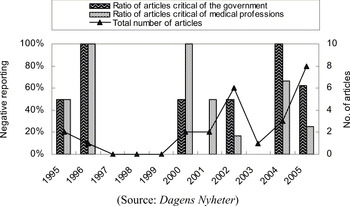
As Figure 3 indicates, media coverage of the registries was very limited. However, the loose control by government now in place, with considerable leeway for the professions, led to some criticism towards both government and the medical professions in 1996. In relation to the treatment of diabetes and preventive measures for complications suffered by diabetics, the need for mandatory participation in the registry and decisive action from the health care authorities in this regard were emphasised (Svenska Dagbladet, November 8, 1996; May 27, 1997). Another criticism was levelled at the potential for the system to be abused by doctors by concealing real data relating to malpractice or poor quality of care. The article complained that ‘even the responsible NBHW does not know which registry exists and which one does not’ (DN, June 18, 1996).
Public attention concerning quality assurance in Sweden, 1995–2005

However, managers of the quality registries backed the main purpose of the scheme, arguing that it consisted of quality improvement through organisational learning. The Federation of County Councils (FCC)Footnote 9 had originally adopted this idea from an industrial quality monitoring and assessment system, Total Quality Management. The key aim is supposed to be self-learning based on voluntary participation and collaboration rather than supervision and control (SALAR 2005; SW-1). It is noted that the registries cover both outcome and process measures, such as post-operative morbidity, complications and relapses, as well as e.g. the number of haemodialysis sessions per week for renal patients. The lack of strong enforcement and intervention were viewed very positively by representatives of the medical profession (SW-2). For the NBHW, the collaboration of the medical professions was the key to the success of the whole scheme, and the participation of the medical profession was therefore deemed to be imperative.
As this governmental stance in relation to the scheme was called into question, demands for a third-party accreditation system began to gain support. The Swedish health system had no accreditation body comparable to e.g. the JCAHO (Joint Commission on Accreditation of Healthcare Organizations) in the USA, although the NBHW and its six regional offices (Department of Supervision of Health Services, Tillsynsavdelningen) have been responsible for inspecting and monitoring service providers.Footnote 10 The reason for this was similar to that in the case of the NHS in England, where hierarchical control was in place in a predominantly public sector undertaking. The need to construct such a system in Sweden as well came with the introduction of an internal market. However, the idea of a third-party accreditation body was strongly opposed by the other major actors, i.e. the NBHW and the medical professions (Garpenby Reference Garpenby1999: 419). The government resolved to tighten its regulatory function by means of regulation (National Board of Health and Welfare 1996).
In 1999, another issue involving the registry surfaced on the national agenda, namely the possibility of ranking hospitals. Discussions had taken place between the then Social Democrat-led government and the NBHW with the aim of ranking hospitals across the country, but there was a mixture of enthusiasm and hesitation in both political camps. The Chief of the Medical Practice Unit of the NBHW, Claes Mebius, was quoted as saying that he was convinced that within a few years there would be a need for reviews of hospitals in Sweden, in light of the poor quality of care at that time (Svenska Dagbladet, April 29, 1999). Social Minister Lars Engqvist reacted the following day, making his stance clear on the ranking of hospitals. He argued that, from the patients' point of view, it was a natural development, and he was not convinced that visible differences between hospitals would do any harm to the current system, and therefore ‘believe[d] just like many other countries, the general public in Sweden will be able to use the quality list in a few years time’ (Svenska Dagbladet, April 29, 1999). However, he rejected an immediate shift towards rankings, underlining the fact that there was a huge gap between the largest opposition Moderate Party and all the other parties on the issue. He strongly argued that the Moderates were trying to introduce ‘the market-based American model’ through the introduction of a ranking system.
Despite some differences in the ultimate goals and ideas of the different actors, issues surrounding the ‘patient's right to know’ began to act as a catalyst for changes in the registries. The registries started to be seen as an alternative to rankings – in fact as a more credible form of quality indicator for individual hospitals. From 2000, the issue saliency gradually rose, as shown in Figure 3. Many articles pointed out some defects in the system, suggesting that there needed to be a comprehensive catalogue on the Internet to assist those trying to choose hospitals and doctors (e.g. DN, September 25, 2000), revealing the huge differences in surgery success rates or the survival rates of babies from hospital to hospital (DN, October 27, 2000; February 19, 2001). Accordingly, pressure began to be applied from various corners, including the Confederations of Swedish Enterprise, the Association of Private Care Providers, and a former SAP Minister of Finance, Kjell-Olof Feldt. Their campaigns for more open quality accounts and rankings of hospitals continued into the mid-2000s (Lindgren and Söderqvist Reference Lindgren and Söderqvist2004). In 2002, the publication of registry results led to further criticisms of the government's ‘silence’ (DN, January 11, 2002). Compounded with the ever-controversial issue of waiting lists, the lack of information was described as ‘Russian roulette’ (DN, November 18, 2002). Once this transparency issue was placed on the agenda, the government could no longer escape criticism over its loose grip on the situation.
In 2003, an investigatory TV programme entitled ‘Uppdrag granskning’ (Commission Review) featured the registries. Reporters asked all the hospitals reporting to the registry to provide information about their mortality rates, essential methods of diagnosis, and medications dispensed. The majority of hospitals, and the managers in charge of each registry in particular, declined to disclose the requested results. This stirred public outrage, and at the annual registry review in December of that year, a decision was made to disclose some of the registries' results (Levay and Waks Reference Levay and Waks2005: 11). Based on the results revealed, the same TV programme (in a segment aired on March 16, 2004) broadcast a follow-up report showing a list of hospitals with high mortality rates and unsatisfactory treatment outcomes. Around the same time Expressen, a tabloid newspaper, published articles on the issue, featuring the title ‘The most dangerous hospitals for heart-disease patients’ (Expressen March 16/17, 2004). One such hospital in Halmstad, in the county of Halland, responded swiftly in acknowledging its problems, and in fact received 30 million SEKFootnote 11 to tackle them (Hallandsposten, November 12, 2004). In contrast to the naming and shaming practice as it worked in England, worse-performing hospitals benefited from the report. However, the NBHW publicly requested more openness from each hospital about their data (DN, November 26, 2004).
In 2005, there was both good and bad news for government. In spring, the FCC published a report which demonstrated the first-class quality of Swedish hospitals in international comparison (DN, April 21, 2005). Quality improvement in Jönköping, with a particular focus on continued learning in the areas of organisational processes and the systems approach was lauded by both the NBHW and international scientific community (Davies Reference Davies and Baker2008). Later in the year, the spotlight shifted to ‘holes’ not covered by the registries. In reaction to the criticisms about the lack of registries in psychiatry and elderly care, Minister Ylva Johansson took the initiative and intervened to create registries in psychiatry (DN, October 14, 2005) and elderly care (DN, November 14, 2005). At the beginning of 2006, there were more than 60 registries in receipt of economic support through the Steering Committee, with a further 100 registries and several new competence centres applying for funding.
In the decentralised Swedish health care system, the central government played a guarantor role, taking the non-interference approach. The government indirectly supported the profession-led model and clinically-driven quality measures, which led to the gradual development of an existing monitoring system to complement various quality improvements at county level. The outcome showed that policy choice was consistent with the Swedish political structure, which emphasises consensus building and educative approaches (Jost Reference Jost, Dingwall and Fenn1992; Øvretveit Reference Øvretveit1994). The issue never became salient in the national press (less than 10 articles at the maximum), although as limited access to the registry outcomes met with criticism, demands for freedom of information rendered the government vulnerable to external pressure to show some responsiveness. The media played a major role in linking the quality issue to other aspects in health care such as patient choice and rights to know. However, government interventions did not change the original policy direction, which focuses on clinical innovation based on its decentralised health care model. Interestingly, the NBHW and SALAR published their first cross-county comparative data, Quality and Efficiency in Swedish Health Care: Regional Comparisons in June 2006.
Japan: A third-inspectorate and market-led hospital rankings
The Japan Council of Quality Health Care (JCQHC) came into being in July 1995, co-financed by the JMA and the MHW, and headed by the former chairman of the Central Social Insurance Medical Council (CSIMC).Footnote 12 The idea of third-party evaluation was adopted from the Japanese Hospital Quality Assurance Society (JHQAS), a voluntary research group consisting of several academics. The JHQAS first introduced the idea from the JCAHO in the United States (Ito et al. Reference Ito, Iwasaki, Nakano, Imanaka, Kawakita and Gunji1998: 361–362).
As an accreditation body independent of the government and all other public and private organisations, the JCQHC examines the quality of hospitals in more than 100 categories and puts them into one of five grades. Initially, it conducted around 240 on-site surveys annually. Yet, the first few years saw only a few hospitals applying for its inspection. Accordingly, scepticism regarding the effectiveness of the scheme started to be voiced from 1997. In particular, criticisms focused on the lack of openness around the results, and the unchanged club culture of the medical society. The Council only published the names of ‘good’ hospitals as they were accredited, but did not reveal names of ‘failed’ hospitals (AS, September 3, 1997). Yoshiko Tsujimoto, president of a non-profit organisation, the Consumer Organization for Medicine and Law (established in 1990), asked how ‘medical professionals in Japan, which had no tradition of even peer review, [could] conduct external reviews and assess hospitals critically?’ and added: ‘they should listen more to patients’ (AS, May 5, 1998). The differences between the JCQHC and the JCAHO in the US were also underlined. In America, hospitals with no accreditation cannot be incorporated into public insurance schemes (i.e. Medicare). As a result, ninety-eight per cent of providers are accredited. In contrast, the JCQHC lacks the tools to enforce its scheme. The government attempted to lure hospitals into the scheme by changing the existing incentive structures. The rules have since been amended and hospitals, once accredited, can notch up some bonuses in their billing of medical services, and also display their accredited status in their publicity material. However, the only units for which these bonuses are provided are palliative care units. Due to the consequent mushrooming of these units, the government has decreed that hospitals that wish to open these units must be accredited with the JCQHC.
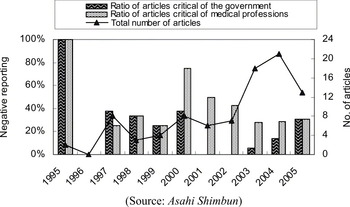
In 1999, just as severe criticism was being aimed at the government's scheme, a series of medical accidents occurred. These events intensified the pressure on the medical profession, and as a result, opened a window of opportunity for the government to intervene in the medical system. As part of the government's deregulatory policy, the MHW announced that the rules on the advertising of hospitals would be relaxed to infuse more competitive elements into the hospital sector (AS, December 16, 1999). Figure 4 clearly shows that the equal share of blame between government and the medical associations changed in 2000. A long-term alliance between the governing LDP and the JMA was also on the verge of collapsing, especially after Koizumi took power in 2001 and adopted adversarial attitudes towards the professions. As the MHW was merged with the Ministry of Labour to create one department (the MHLW), Koizumi's Cabinet Office was simultaneously strengthened, and took control of the overall direction of health policy, with its committees being headed by private sector leaders outside the sphere of influence of the JMA. Major reforms in public spending on health, and more private competition among providers began to be imposed upon the JMA (Kondo Reference Kondo2005: 55). The shifting balance of criticism from government to the medical profession in public discourse had an impact on the government–JMA relationship.
Public attention concerning quality assurance in Japan, 1995–2005

In 2000, the government's accreditation scheme had already been discredited because in the five years since its foundation, the JCQHC had certified only four per cent of the hospitals in the sector, and seventy per cent of its results had not even been published. A call for a clearer evaluation of both clinicians and hospitals' performance rang out. In 2001, three laws (the Medical Service Law, Physicians Law and Dental Practitioners Law) were all amended. In order to promote the skills and qualities of those in the medical profession, the internship scheme for clinicians was made obligatory, and rules were tightened for hospitals with insufficient staff members so that quality of care would be a central focus of hospital management (Ministry of Health, Labour and Welfare 2001). Along with this change, the rules on advertising hospitals were further relaxed, which allowed each hospital to publicise its own clinical performance from April 2002. This included information about whether or not clinicians at the hospital had been accredited by their specialty's board.
A senior officer of the Health Policy Bureau of the MHLW commented that ‘hospital managers'Footnote 13 willingness to share their records could also be a good indicator of the quality of care at a hospital, signalling how transparent the hospital aspires to be’ (AS, March 21, 2002). The Ministry also adopted financial incentives and the CSIMC changed the rules for setting fee schedules. After April 2002, hospitals were penalised for conducting operations (a thirty per cent reduction of the standard reimbursement) unless the regulated number of operations had been previously performed in each particular category.Footnote 14 This change was implemented as an instrument to further differentiate types of hospitals based on their functioning. The idea was that ‘the more operations that are carried out at a hospital, the more reliable and the more advanced the doctors of that hospital are’. Nonetheless, the MHLW decided not to announce publicly the names of sanctioned hospitals. Furthermore, this policy was later withdrawn in 2006, as the working group of the MHLW could not establish the implied relationship between the number of operations and the outcomes (Yomiuri, December 16, 2005). In contrast to the English case, this showcases the resilience of the formal close relationship between government and the medical professions.
However, the quality assurance system in Japan took a new turn with publication of hospital league tables. While the government attempted to make its own scheme more effective by supporting more applications for the JCQHC's accreditation scheme, patient demand pushed forward another trend in the market. Given patients' freedom to visit any hospital in Japan, a more accessible guide for patients was in great demand. In response, private companies embarked on data gathering to enable them to publish their own hospital rankings. A number of medical consultancy firms and weekly magazines (published by newspaper companies such as Sunday Mainichi and Nikkei Medical) were among the first to publish league tables. Oricon Medical, which grew out of Oricon Entertainment, Japan's leading music market data firm, carried out a large survey among patients and published its own ranking tables. The first edition of a book entitled Patients decide: Best Hospitals in Tokyo and neighbouring prefectures (Kanjya ga kimeta, Ii Byōin: Kantō-ban) sold 220,000 copies in 2003 (AS, December 15, 2004). Various leading newspaper companies followed suit and adopted different approaches in their publications. Japan's leading business daily newspaper, Nikkei, used mostly objective data supplied by larger hospitals, and published the most clinically-based rankings. Data on operations performed, outcomes and various processes aimed at ensuring patient safety were gathered and analysed. Nikkei Medical ranked all hospitals by asking fee-for-service doctors.Footnote 15
These undertakings by the media are essentially independent of any government schemes, but there was subsequently an interesting interaction between government, the medical professions and the public. As previously mentioned, the rules about setting the fee schedules were changed after 2002, which opened up access to information on the number of operations performed in each hospital. Although the government officially denied engaging in a naming and shaming exercise, the Asahi Weekly Magazine gathered the medical records relating to operations from Social Insurance bureaus throughout the country, making the most of new Freedom of Information legislation (enacted in 1999), and published them alongside their league tables. As proven by the increase of negative reporting towards the medical profession, popular rankings kept the focus of blame to the medical professions and took some pressure away from central government (JP-1).
This parallel development outside the government's scheme provided several streams of change, producing an unintended cycle of feedback on topics such as a patient's right to choose. The effectiveness of the slow accreditation activities by the Council was further questioned following an eruption of medical errors at leading teaching hospitals. By October 2006, accredited hospitals still accounted for only twenty-five per cent of all Japanese hospitals.Footnote 14 It was also questioned whether the Council provided fair, third-party assessments, or conducted only internal checkups within the medical professions. In 2004, the former JMA president Eitaka Tsuboi was appointed as the President of the Council amid some criticism, which clearly demonstrates how the medical policy-making style remains close-knit (JP-2).
The Japanese case demonstrates that while the government and the medical association were both essential actors that provided expert-driven policy change, the already existing pro-market institutional designs allowed a number of other players to enter the field and affect the course of change. Amidst the widespread mistrust of doctors after several malpractice cases, it was the media companies that launched the first publicly accessible rankings systems. Although the issue saliency was relatively low, the changing share of criticism between the government and the medical profession highlighted an interesting dynamic within the formal health care governance structures in Japan.
Discussion
Although quality assurance is seemingly a very technical area in the overall healthcare system, the respective governments have sought to demonstrate their responsiveness to public concerns. There are three factors at play in determining when and how each government intervenes. First, constantly high issue saliency affects government actions. The English case after 1998 clearly exemplified this. However, the patterns of issue saliency in each country suggested that the respective health care governance structures also influenced the volatility of public focus on the issue. The decentralised Swedish health care system had a very small number of newspapers featuring quality assurance in the national press. Volatility in the Swedish media was also remarkable. In contrast, the most centralised system, the English NHS, attracted by far the largest number of articles in the national media. However, these issue saliency patterns also could not fully explain the policy trajectories in the three countries. By further examining the newspaper reports with comments critical of government and/or the medical profession, the study was able to identify the shifting public moods in each country and investigate further whether each government intervention made was in tune with the mood expressed in the media. The results showed that despite its decentralised structure, the government agency at the national level in Sweden shared the blame with the medical profession when it seemed to be failing in its role as guarantor of care quality. The Japanese case also demonstrated that provision type (i.e. private in this case) does not always deflect blame from the government. The government was criticised for its lack of commitment to putting patients' interests first; even the accreditation system was run by a third-party body. It was not only the level of issue saliency but also the extent of the public discourses embedded in political institutions that were translated into pressure on each government (Kato and Rothstein Reference Kato and Rothstein2006; Selck Reference Selck2006).
Second, prominent events could push the issue of quality assurance higher up on the political agenda. In both England and Japan, a series of medical malpractice scandals raised various issues surrounding service quality and risks to patients, which led governments to reflect on skills of the medical profession and step up measures intended to raise the standard of care. Another feature was that each government was highly sensitive to the issue of public access to information. The refusal to disclose the registries' results by local hospitals in Sweden is a case in point. Overall, the agenda of patients' right to know provided powerful ammunition against government in all three countries. This ‘prominent event’ factor is in tune with the school of thought emphasising government responsiveness as ‘reflexes’ (Breyer Reference Breyer1993). However, it is worth noting that events in Sweden and Japan had only a short-term impact as catalysts for quick adjustments, rather than a change of direction from clinically-driven quality assurance system to patient-oriented one. The two governments maintained their non-interference approach to the medical profession, which allowed some innovative in-house developments.
Third, the balancing act of government between listening to the general public and prioritising the expertise and interests of the medical profession played a crucial part in the development of quality assurance systems. The most clear-cut case was the Swedish model, in which medical innovation was agreed as priority among most stakeholders. The idea of introducing hospital rankings was resisted even by the elected officials, who perceived ranking as a step towards marketisation. By contrast, the ranking system in Japan was, to a certain degree, welcomed by officials as a parallel mechanism of quality assurance. It is worth noting that by accepting the ranking system as being outside the government scheme, the government was spared direct intervention in its profession-friendly approach. In England, the elected officials' insistence on user-friendliness of the data was matched by their desire to perform as a public-spirited agent at the national level. However, there is a question about professional autonomy in the English case, where the plethora of regulatory agencies created a demand for professional input. The extent to which patient voices are driving those changes is questionable.
More than a decade has passed since the Swedish and Japanese schemes were first put in place. So far, both schemes have been spared from political scandals which have hit England such as fiddling with figures and cheating by target managers. However, with the increasing demands for government engagement in ensuring safety and quality, a move to a more centralised control system may be made in both Sweden and Japan. There is, however, also a concern that greater governmental involvement will shift the focus towards performance factors that are more politically expedient and more easily manipulated. Such a move would potentially create more risk as politicians seek to assuage public concerns as highlighted in the media, rather than those reflecting health professionals' inside knowledge (Currie et al. Reference Currie, Waring and Finn2008).
The paper has its limits in identifying various types of quality assurance systems, particularly at local and hospital levels, and the influence of other potentially important arenas (e.g. the international scientific community) where medical professionals and policy makers learn about best practice. However, this article has demonstrated that a government's sensitivity to the issues is mainly shaped by dynamic interactions between events, public discourses and existing health care governance structures at national level. It has also highlighted the dilemma in the politics of quality assurance system-building of choosing between satisfying public demands and respecting scientific expertise. In other words, the macro political environment matters to the development of such systems (Pollitt et al. Reference Pollitt, Harrison, Dowswell, Jerak-Zuiderent and Bal2010).
Due to the complex and technical nature of health system organisations such as hospitals, neither historical institutionalism (path-dependency) nor rational choice (based purely on the incentives of each actor) can solely account for the policy choices of the main political actors at various stages of policy-making. The types of prominent issues surrounding quality in the hospital sector and the capacity of governments to respond to public and/or professional concerns determine the levels of engagement of each actor in the building of quality assurance systems. Although the ultimate goal of installing the systems on the rhetorical level is similar across countries – that is, to ensure higher quality of care and services – the specific choices and decision-making processes around quality assurance systems will continue to differ. This also reveals the importance and impact of institutional arrangements and the way in which each national health system is increasingly politicised by interactions between public debates and a government wanting to demonstrate its responsiveness to its citizens.
Acknowledgements
I would like to thank three anonymous reviewers for their invaluable comments and feedback as well as those who assisted me with data collection and gave comments on earlier versions.