‘It is not always clear why a government sets up an inquiry at all or why it chooses one kind rather than another.’ (Gavin Drewry, ‘Judges and Political Inquiries’, p. 53)
‘There is no standard blueprint for the type of circumstances in which an inquiry might be needed.’ (The UK Government’s written evidence to the Public Administration Select Committee, 2005, p. 64)
A well-known trait in the aftermath of national crises is the appointment of ad hoc bodies of investigation to provide a credible source of information about the affair. A few notable examples are the Warren Commission into the Kennedy assassination (1963); the Widgery and Saville Inquiries into the Bloody Sunday incident (1972), the Scott Inquiry appointed following revelations of the sale of arms to Iraq by British companies (1992); the Netherlands Institute of War Documentation (NIOD) inquiry into the Srebrenica massacre (1995), and the 9/11 Commission in the United States. In such contested times, these ad hoc independent institutions are portrayed as possessing the unique capacity to provide impartial assessment, and bring certainty and closure in situations of doubt and conflict. Commissions of inquiry play an important role in the aftermath of crisis in many countries, by serving as instruments of accountability and policy learning.Footnote 1 Yet crises also involve a high-stake game of political survival, in which such accountability and learning rituals pose a serious threat to incumbent politicians. Blame avoidance motivation on their partFootnote 2 is thus likely to play a central role under such circumstances, as the appointing of an inquiry into a crisis not only sets in motion a learning process, but also embodies a series of explicit and implicit messages and moves in the ensuing blame game.Footnote 3 Hence, the political decision of whether to appoint a commission of inquiry after a crisis provides a unique prism for studying the intense conflict between politics, accountability and policy learning. This article addresses this question by providing a quantitative analysis of blame attribution as a predictor of elite behaviour.
Commissions of inquiry, whether willingly or not, play a political role by often providing critical information about issues of governance and responsibility, either through the course of their investigation, or in those reports and parts thereof that get publicized.Footnote 4 Moreover, notwithstanding the unique and deliberate feature of independence from political influences of these institutions, the decision of whether to initiate a commission of inquiry in the wake of such events lies in the hands of elected politicians. Despite their important role in public discourse, the research on commissions of inquiry has so far left unresolved the question of why politicians choose to appoint these ad hoc institutions in some cases and refrain from, or indeed resist demands to do so, in others.
This article presents an analysis of 132 government decisions whether to appoint or not to appoint an inquiry in the United Kingdom between 1984 and 2003, covering all forty-four appointed inquiries, and a random sample of eighty-eight non-inquired issues.Footnote 5 The findings show that three main political factors determine the choice of whether to establish a commission of inquiry: the politics of blame, the public agenda (issue salience), and government popularity. As predicted by blame avoidance theory, the pattern of inquiry appointment decisions suggests that inquiries are perceived by appointing office holders as incurring a short-term cost of ‘loss acknowledgement’ (rather than a long-term risk of a critical report). This cost plays a larger role when the problem is attributed to agents that are close to the appointing office holder. Yet, at a certain level of issue salience – when the problem becomes undeniable – this cost of appointment becomes a ‘sunk cost’. At this stage, a new equilibrium is formed as a potential benefit from ‘venue alteration’ by appointing an inquiry motivates the office holder to appoint, and increasingly so the more salient the issue is. This notion of post-crisis inquiries as a ‘costly’ response of crisis management for the government, rather than as a panacea, is also supported by the conditional positive relationship between electoral support and the propensity to appoint an inquiry. The implications of these findings for policy learning and accountability are further discussed in the concluding section. The article adds strong empirical support to the claim that the politics of blame acts to restrict the realization of policy learning after crisis,Footnote 6 and the theoretical model can also account for the typically intense debate over inquiries’ terms of reference observed in the literature.Footnote 7
The United Kingdom is an ideal case for this research for several reasons. First, it has a strong executive with a parliamentary system of government. This entails that decisions whether to appoint inquiries are in the hands of the government, while the legislature has limited capacity to engage in politically contested investigations.Footnote 8 Secondly, single-party government is the rule in the United Kingdom (applicable to all the governments included in this study). Therefore, the decision whether to appoint an inquiry need not be the outcome of an inter-party bargain. In the United Kingdom, as in many other countries (e.g., Australia, Canada, Israel and the Netherlands), constitutional norms prescribe, yet do not mandate, the appointment of formal investigations after crises, disasters and scandals.Footnote 9 These characteristics facilitate the ability to draw inferences from the observed behaviour of inquiry appointment decisions to the underlying political considerations and motivations in the wake of a crisis.
Inquiries and blame avoidance
Commissions of Inquiry
The term commission of inquiry (henceforth: ‘inquiry’) is defined as: (1) An ad hoc institution (i.e., established for a particular task, and once concluded, it is dissolved); (2) formally external to the executive; (3) established by the government or a minister; (4) as a result of the appointer’s discretion (i.e., not mandated by any formal rule); (5) for the main task of investigation; (6) of past event(s).Footnote 10 Yet, more selectively, this study concentrates on the particular cases in which the office holder, with the power to decide whether to set up an inquiry or not, is at least potentially responsible for the negative event to be investigated, or in other words – it had happened ‘on her/his watch’. Such a condition excludes events which occurred under a previous government.Footnote 11 These events or inquiries are termed ‘historical’ and considered here to be distinct from ‘current’ cases, since the considerations in appointing them are expected to differ substantially, as they are not dealing with an existing crisis that may influence current political evaluations, but rather with ‘setting the record straight’.
Whether an inquiry should be appointed – as a normative question – has received far more attention in the literature than explaining when and why politicians decide to set them up in practice.Footnote 12 Previous attempts to understand this political choice are mostly based on a single case or a limited number of cases,Footnote 13 and do not account systematically or quantitatively for all instances.Footnote 14 More importantly, nearly all this research is based on cases in which an inquiry was established, ignoring the cases where the decision was negative. This underlying case selection potentially renders the attempts to infer the causes of inquiry appointment flawed, due to selection bias.Footnote 15
Formal documents provide only normative guidelines to the appointment decision, and do not help much in clarifying the political dynamics of this decision.Footnote 16 Although some formal reports include guidelines,Footnote 17 these provide only optional considerations, and we remain lacking in empirical knowledge as to the actual factors which govern these decisions.Footnote 18 The literature on the politics of inquiries tends to be divided between those who argue that politicians are averse to inquiries,Footnote 19 and those who suggest that these ad hoc bodies are sought by politicians in times of crisis.Footnote 20 However, no model has been suggested to account for the reality in which inquiries are voluntarily appointed by ministers in some cases, and fiercely resisted in others.
A common claim found in a number of countries is that the appointment of an inquiry acts to reduce the level of public interest in the affair.Footnote 21 Yet, despite the prevalence of this claim, no empirical support was found for any mitigating effect of inquiry appointment on media salience in recent studies.Footnote 22 A more nuanced argument, suggested by Elliott and McGuinness, posits that the appointment of an inquiry can be attractive to office holders as it facilitates non-engagement on their part, even in the face of great public attention.Footnote 23 It is widely accepted as legitimate to refrain from addressing the issue while these ad hoc institutions are investigating. This enables ministers to regroup, conduct consultations, learn the situation and consider alternative options – all of which require time, and a relative pause in the pace of events. This is facilitated not by an agenda effect of the inquiry, but rather by the nature of the inquiry process and norms associated with it.Footnote 24 We may therefore understand the appointment of inquiries as a venue alteration exercise – replacing one volatile critical audience (the media, the opposition and the public) with a much slower-moving and predictable audience – the inquiry commission. Such a move can be seen as a unilateral modification of the rules of the game Footnote 25 in order to attain a political setting that is more likely to facilitate successfully coping with the crisis. This analysis leads to the venue alteration hypothesis: A positive association is expected to be found between the salience of the issue in question and the appointing office holder’s propensity to appoint an inquiry.
Still, it has been argued that ‘no government wants inquiries; they are usually in circumstances where the government is in trouble … They are not popular things for governments’.Footnote 26 A similar account can also be inferred from the tendency of governments to favour limited terms of reference (scope) of inquiries, practically entailing that ‘less of the issue’ will be inquired into.Footnote 27 Such a preference suggests a reserved attitude towards inquiries. As can be expected, direct evidence regarding the reasons to avoid inquiries, or the weighing of various considerations in inquiry appointment decisions, is rare, and if at all, becomes available many years after the fact. One such rare example vaguely points to the possible underlying calculus of this decision. The 1955 Cabinet’s deliberations over the decision of whether to appoint an inquiry into the question of how Guy Burgess and Donald Maclean continued to spy undetected were released in 1985 by the British Public Record Office under the ‘30-year rule’. A secret memorandum by Foreign Secretary Harold Macmillan noted his agreement that something had to be done to placate public opinion, but ruled out a tribunal of inquiry as too dangerous.Footnote 28
Blame Avoidance
How should we understand this reported aversion to inquiries? Given the highly contested nature of post-crisis situations, it is suggested that blame avoidance presents a potentially theoretical basis. In his 1986 article, Kent Weaver argued that among three policy motivations – ‘good policy’, ‘credit claiming’ and ‘blame avoidance’ – the latter is the dominant one.Footnote 29 This argument rests on the assumption that at least some voters employ retrospective voting;Footnote 30 and on the notion of ‘negativity bias’ – the greater likelihood of losers to notice and act on their grievance, than gainers are to act on the basis of their improved state.Footnote 31 In essence, Weaver’s claim is that under negativity bias, a rational policy maker is expected to be dominantly blame-avoiding.
The notion of blame avoidance motivation has served in a range of studies,Footnote 32 and the role of blame attribution has been extensively studied in political science.Footnote 33 Yet, rarely has blame attribution been used as a quantitative predictor of elite behaviour.Footnote 34 If indeed blame accounts for an office holder’s behaviour, variations in this behaviour should be associated with the degree of blame attributed to that particular office holder. This research estimates the effect of blame attribution on an office holder’s choice, thereby enabling us to infer the effect of blame avoidance motivation.
Loss Acknowledgement and the Risk of Critical Report
How does blame avoidance relate to the political decision to appoint inquiries? It is suggested that appointing an inquiry sends an implicit and often explicit message that acknowledges the existence of a problem (though leaving open the question of responsibility). Such a move drastically (if not wholly) diminishes the potential of defensive activities that aim to deny, conceal or reframe a problem. These may include argumentative strategies such as justifications,Footnote 35 and such policy strategies as ‘throwing good money after bad’.Footnote 36 This hypothetical short-term cost of appointing inquiries is referred to here as ‘loss acknowledgement’. The notion of avoiding loss acknowledgement provides a theoretical framework for the political aversion to appointing inquiries, and also appears to conform to the tendency of governments to prefer limited terms of reference when choosing to appoint an inquiry, thereby minimizing the extent of an acknowledged loss. Moreover, setting up an inquiry does not end there. It entails a long process, which typically culminates with the publication of a report. Office holders’ reluctance to appoint inquiries may also stem from the desire to avoid the long-term risk of a critical report.
If blame avoidance indeed plays a role in the proclivity of ministers to set up crisis inquiries, then the gravity of both the short-term spectre of loss acknowledgement and the long-term risk of a critical report are expected to increase, the closer blame attribution is to the appointing office holder. This relationship can be specified as the blame avoidance hypothesis: the proximity of blame attribution to the appointing office holder is negatively related to her/his propensity to appoint an inquiry.
To summarize, the political choice of whether to appoint an inquiry is expected to entail a short-term cost of ‘loss acknowledgement’ and/or a long-term risk of a critical report, while it also offers an option for venue alteration in the short term. Counteracting the blame-avoidance motivation to resist an inquiry is the need to address public pressure (issue salience) – a need that may be relieved by short-term venue alteration.
Disentangling Short-Term and Long-Term Considerations
Considering both the short-term and long-term implications in the appointment decision constitutes an intertemporal choice – among current and future consequences.Footnote 37 The risk posed by the inquiry report will potentially materialize at a later time than the appointment’s effect. However, owing to the particular institutional structure of inquiries, the long-term risk has to be assessed at the time of appointment. This rests on the premise that appointing an independent body of investigation involves surrendering at least a measure of control over the investigation process, particularly its outcome. Conventional norms severely restrict the possibility of aborting the inquiry at a later stage. This restriction on future choice is implied by the notion of ‘independence’, and provides a crucial characteristic of the appointment decision.
Relying on behavioural economics literature, one can expect that future consequences will be discounted.Footnote 38 Studies have shown that people tend to exhibit much higher levels of impulsiveness when faced with choices in the near future, as opposed to choices with utilities that will materialize further in the future.Footnote 39 Yet, beyond a time horizon of about a year, there is no evidence that discount rates continue to decline.Footnote 40 A notable example of intertemporal policy choice is provided by the political business cycle literature.Footnote 41 The crux of the political business cycle is the notion that the time-lagged negative consequences of present expansionary policy are heavily discounted at the time of choosing the policy (election period), since they are expected to occur after the elections, while retrospective voting renders present outcomes (soon to become short-term past) highly important.Footnote 42 Combining this insight with negativity bias suggests a relatively stronger blame-avoidance motivation close to the end of an electoral cycle.Footnote 43 Hence, the electoral cycle is associated with varying time horizons of elected officials: Short-term considerations greatly outweigh long-term ones the closer we are to the next elections, thereby producing a different pattern of intertemporal choices, compared with non-election periods.
These insights are utilized in the analysis of inquiry appointment decisions, by providing a predictable relationship between political timing and the degree of impulsiveness (i.e., the relative weight of short-term and long-term considerations). This relationship enables disentangling short-term and long-term considerations by developing more specific hypotheses regarding the effect of blame attribution on the propensity to appoint inquiries. If the short-term consideration of loss acknowledgement is the dominant reason for an office holder’s aversion to appointing inquiries, then the loss acknowledgement hypothesis predicts that the negative effect of blame attribution on the propensity to appoint an inquiry increases in election periods, compared with non-election periods. However, if the long-term spectre of a critical report is the dominant factor, then the critical report hypothesis predicts that the negative effect of blame attribution on the propensity to appoint an inquiry decreases in election periods, compared with non-election periods.
The predictions of the three hypotheses can be estimated with the following logistic equation where the probability of inquiry appointment is modelled as a function of blame attribution, media salience and electoral cycle. More formally, the model is as follows,

where Logit(Inquiryi) is the log odds of an inquiry appointment into a particular issue i; Blamei is an ordinal scale for the proximity of blame attribution to the appointing office holder for the issue; MediaSaliencei is a measure of issue media salience; ElectionPeriodi is a dummy variable indicating whether the issue was during an election period. The interaction term involving Blamei and ElectionPeriodi indicates whether the effect of blame attribution differs in election periods and non-election periods; and Controls represents a set of political control variables.Footnote 44 The detailed analyses are reported in the following section.
Empirical evidence
The focus of this study is the political decision of whether to appoint an inquiry. In order to allow adequate variation in this dependent variable, the analysis should include instances where an inquiry was ordered as well as those in which it was not – jointly referred to as ‘inquiry issues’. Identifying all inquiry issues for the period from January 1984 until the end of 2003 in the United Kingdom relied on systematic yearly-based searches in the British national press using the Lexis-Nexis media database. For each year, a sample of two national broadsheets was used.Footnote 45 An ‘inquiry issue’ was defined as an issue that resulted in a call for the appointment of an inquiry (and was published in the national press).Footnote 46 From the set of inquiry issues, those cases where an inquiry was appointed within a month from the call were coded ‘inquiries’, and if not as ‘non-inquired’. This case selection method thus (1) identifies all the positive cases (inquiries); (2) draws a line between negative and irrelevant cases that is adequate to the lack of existing ‘eliminatory variables’, and (3) introduces a ‘scope condition’ by excluding ‘historical’ inquiries.Footnote 47
Many non-inquired issues (and a few inquiries) have led to repeated calls for the appointment of an inquiry or, in some cases, for a second inquiry.Footnote 48 In a substantial proportion of the cases, repeated calls were made when new information emerged about the issue, or when similar events occurred. Other examples are anniversary dates (as in the Marchioness and Lockerbie disasters). This study included repeated calls for an inquiry as additional inquiry issues, if more than a month had passed since the previous call, and were coded as such and controlled for in the analysis. This approach is consistent with the basic premise that the phenomenon studied is a social construct. Real-world events do not directly affect the appointment of an inquiry; rather, their influence is mediated by social and political factors. Hence, a repeated call for an inquiry represents a potential case in which the issue is (again) an object for social and political interest. Including such cases also increases the number of decision instances in the study.
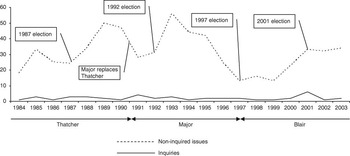
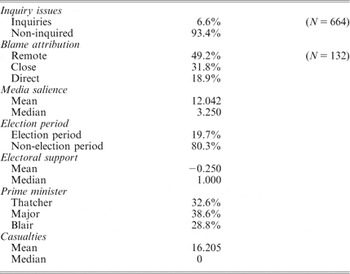
This data gathering resulted in a set of 664 (after excluding historical issues), which includes forty-four inquiries – 6.6 per cent of all inquiry issues. Figure 1 presents the distribution of inquiries and non-inquired issues between 1984 and 2003.Footnote 49
Inquiries and non-inquired issues between 1984 and 2003 (N = 664)

For reasons of data collection efficiency, sampling followed a case-control design, in which all inquiries were selected (44), and a random sample of twice this number of non-inquired issues (88). This method optimizes the trade-off between the number of observations and the quality of variables.Footnote 50 Case-control studies do not allow one to estimate the incidence of cases in the population. To do that, one would have to know the number of all cases and the number of the entire population of interest.Footnote 51 As noted above, since the case-control design involves selecting on Y = 1 (inquiries), the resulting sample-probability of inquiries in this study (0.33) is larger than the fraction of inquiries in the population – τ (0.066). This does not bias the regression coefficients, but requires correcting the regression constant based on prior information about τ. Where appropriate, this correction has been performed following the method suggested by King and Zeng.Footnote 52 Descriptive statistics for this sample are provided in Table 1.
Descriptive Statistics

Determining blame attribution – i.e., its proximity to the potentially appointing office holder – was based on the content analysis of newspaper articles (included in the salience measure below). Each inquiry issue was classified into one of three categories based on the agent/s to which blame was attributed: (0) Remote blame – individual citizens, private corporations, non-governmental organizations and local authorities; (1) Close blame – central government bureaucracy (for example, government agencies, military units); (2) Direct blame – cabinet members and/or the prime minister.Footnote 53 The content analysis included only articles that referred to blame/responsibility evaluations. A random sample of 128 articles (17 per cent of the total corpus) were coded independently by three coders, who received guidance and specific instructions on the coding process, and went through a training session based on coding thirty articles. Treating the coding data as ordinal showed an acceptable level of intercoder reliability (Krippendorff’s α = 0.7729, 95 per cent confidence interval: 0.7026–0.8378).Footnote 54 This measure thus provides an ordinal scale for the ‘closeness’ of blame to the appointing office holder.
The measure of salience used in this article relies on media salience for both substantive and practical reasons. The alternative measure of issue salience, based on public opinion polls, was not available for the great majority of inquiry issues. Most polls ask about general issues (such as the health system, economic conditions, sleaze), rather than about specific affairs.Footnote 55 A theoretically grounded reason for selecting media salience is that the issues included in this study are typically quick-onset unobtrusive issues, for which the media plays a central role in determining both public and policy agenda.Footnote 56 The measurement of media salience was based on the number of newspaper articles in the week before appointment (inquiries), or the week following a call for the appointment of an inquiry (non-inquired).Footnote 57 Measurement relied on a sample of two broadsheets for each inquiry issue that were averaged to provide the mean number of articles per newspaper per week. A test for the correlation between media salience in broadsheets and tabloids suggested that although the proportion of political stories is higher in broadsheets, salience co-varies in the two types of publications – indicating the validity of using broadsheets as a general measure of press salience.Footnote 58
In a considerable number of inquiry issues, the appointment of an inquiry came sooner than a week following the triggering event, and in some cases appointment was practically immediate.Footnote 59 These cases presented a problem for assessing pre-appointment media salience, since little or no press coverage preceded the appointment. The solution in such cases was to measure media salience for the week following the triggering event, even if the appointment came before the end of that week. This was based on the assumption that short-term media salience was due to the event and was not greatly influenced by the appointment of the inquiry (actual inquiry activity typically took much longer than a week to begin), and in the cases where the appointment came without any delay, measured media salience provides a proxy for office holders’ expected salience, assuming that politicians are good predictors of short-term salience. As the theoretical model which has been advanced in this study aims to describe a decision, expectations of short-term salience are equivalent to current salience. Indeed, the potentially most salient cases can be identified as such by politicians who may act upon these evaluations before the media channels have time to report them. Such decisions are guided by the expected salience, and coding them as zero would result in undue misrepresentation.Footnote 60 As noted above, the effect of inquiry appointment on consequent media salience has been shown to be negligible;Footnote 61 yet, in order to limit this potential bias, articles that mainly addressed the inquiry were omitted (for media salience coding protocol, see Appendix 2).
The electoral cycle was accounted for by including a dummy ‘election period’ measured as 1 when the inquiry issue is within twelve months of the next expected election, and as 0 otherwise. Determining this is not always straightforward in the British political context as prime ministers can call elections at will. Four general elections occurred between 1984 and 2003. Two of them (1992, 1997) at the end of the statutory term (2 and 1 months early, respectively), and two others (1987, 2001) were called early (by 10 and 11 months, respectively). For 1992 and 1997, the ‘election period’ was coded as such for the period starting a year before the scheduled compulsory elections, yielding ten and eleven month periods, respectively. For the early elections (1987, 2001), Smith’s analysis of election timing was consulted. His analysis indicates that throughout the six months preceding both election announcements (made one month before election in both cases), expectations of early elections existed.Footnote 62 Therefore, for 1987 and 2001, ‘election period’ was coded as such for the period starting seven months before the actual election date.
Since crisis management is part of general political rivalry,Footnote 63 it is expected that the state of the government’s electoral support will play a role in inquiry appointment decisions. According to the model of inquiry appointment suggested in this study, inquiries are essentially undesired by politicians, and are appointed as a minimax choice. Therefore, it is expected that electoral support will be positively related to appointment propensity. Given the United Kingdom’s single-member district, first-past-the-post electoral system, the measure of electoral support used was the current governing party’s lead over the main opposition party. For each inquiry issue, this figure was drawn from the most recently conducted MORI poll preceding it. Preliminary analyses suggested that the association of electoral support and appointment propensity was moderated by media salience,Footnote 64 and this was taken into account in specifying the appointment models reported next.
Given the centrality of the prime minister in the British system, her/his possible effect on the decision to appoint inquiries is controlled for by two indicator variables: ‘Thatcher’ and ‘Major’ coded as 1 for issues that occurred during Margaret Thatcher’s or John Major’s terms in office, respectively, and as 0 otherwise (the condition in which both are 0 represents Tony Blair’s term in office).Footnote 65 As noted above, the analysis included repeated calls for an inquiry as additional inquiry issues, if more than a month had elapsed since the previous call. It is expected that previous unanswered calls may have consequences for a later appointment decision, either for reasons of preference consistency, status quo bias,Footnote 66 or ‘impression management’.Footnote 67 This is accounted for in the analysis by including a dummy variable ‘previous refusal’ coded as 1 when the inquiry issue was preceded by an earlier one, and as 0 otherwise.Footnote 68
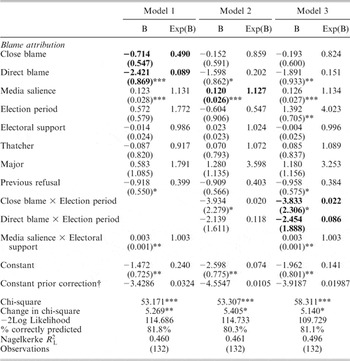
The three hypotheses presented above were tested in three logistic regression models reported in Table 2. The blame avoidance hypothesis was tested by estimating the main effect of blame attribution on the propensity of ministers to appoint inquiries in Model 1. The venue alteration hypothesis was tested by estimating the main effect of media salience in Model 2. And the loss acknowledgement hypothesis and critical report hypothesis were tested by estimating the interaction effect of blame attribution and election period in Model 3.
Logistic Regression Estimates of Blame Attribution Effects on Inquiry Appointment Probability

Notes: Standard errors in parentheses: *significant at 10%; ** significant at 5%; ***significant at 1%.
† . (See King and Zeng, ‘Logistic Regression in Rare Event Data’, p. 144.)
The chi-square statistic for all three models allows us to reject the null hypothesis that the independent variables do not improve the prediction of an inquiry appointment probability. The Nagelkerke pseudo R 2 ( ) values (0.460–0.496) suggest that the models account for the variation in the dependent variable moderately well. The percentage of correctly predicted classification by the full model is 81.1 per cent, an improvement compared to the 66 per cent accuracy attained by assuming that all cases are non-inquired issues. Model 1 shows that the closer the blame (as attributed by the media) is to the appointing minister, the less likely the appointment of an inquiry is. This decrease in appointment propensity is not significant between remote and close blame (p = 0.192), but it clearly is when comparing remote and direct blame (p = 0.005). For example, the probability of an inquiry appointment when blame is remote is 7.98 per cent; it decreases to 4.07 per cent when blame is close; and reaches 0.76 per cent when blame is direct.Footnote 69 These findings support the blame avoidance hypothesis. Moving to Model 2, the significant positive association of media salience supports the venue alteration hypothesis. The average probability of an inquiry appointment when three newspaper articles per week cover the issue is 5.12 per cent; it increases to 6.41 per cent for five articles a week, and to 11.10 per cent for ten.Footnote 70 Finally, comparing Models 3 and 1, the addition of blame attribution × election period interaction terms significantly improves Model 3’s performance based on the likelihood ratio test, and increases the model’s chi-square, indicating significant interaction. Analysis of this interaction provides support for the loss acknowledgement hypothesis over the critical report hypothesis.
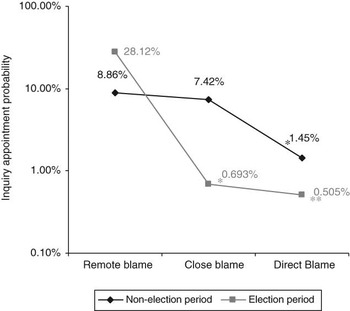
A graphical demonstration of the blame attribution × election period interaction is depicted in Figure 2. The X axis represents the three proximity levels of blame attribution, and the Y axis presents a logarithmic scale of inquiry appointment probability, computed from Model 3, using the corrected regression constant based on the fraction of inquiries in the population (τ = 0.066).Footnote 71 The two lines show a similar trend – a decrease in appointment probability the closer blame attribution is to the appointing minister – yet they differ in their slopes. The overall steeper slope of the curve for election periods suggests a stronger negative effect of blame avoidance compared with its effect in non-election periods. Given that elected officials give greater weight to short-term considerations in election periods, this finding is consistent with the hypothesis that the content of the blame avoidance motivation in the political choice to appoint inquiries is a short-term one – avoiding loss acknowledgement. Had it been the fear of a critical report, we would have expected to find a more moderate effect of blame attribution in election periods – as the report would be likely to be delivered after the elections.
The relationship between blame attribution and inquiry appointment probability, across election and non-election periods Note: For median media salience (3.25), mean government lead over the opposition (−0.25), modal prime minister (Major), and modal previous refusal (0).

The electoral cycle was not found to have an overall association with inquiry appointment propensity, though an insignificant positive association can be seen in Model 1. However, when separating the electoral cycle’s effect across blame attribution levels, it appears to have a positive effect on appointment propensity for remote blame issues. When blame is directed away from the appointing office holder, election periods are times of increased propensity for inquiry appointment. This finding conforms to the theoretical model advanced here. As blame becomes remote, so does the consideration of avoiding loss acknowledgement. This leaves a greater relative weight to the short-term prospect of venue alteration, while the long-term risk of a negative report is heavily discounted (compared with remote blame issues in non-election periods). In short, under conditions of remote blame and approaching elections, the appointment of an inquiry appears to provide a relatively low-cost choice for venue alteration.
Issue Severity or Media Salience?
A competing explanation to the venue alteration hypothesis is that, rather than media salience, it is the inherent severity of the issue that governs the appointment decision. Indeed, normative claims regarding the role of inquiries posit issue severity as a central factor in their employment. In the absence of comprehensive and systematic public opinion data on the severity of all the cases, the number of casualties attributed to each event/issue can serve as such a measure. While severity is a broader concept than could be fully captured by the number of casualties (such as economic crises), still while severity may rise for reasons other than casualties, it is highly unlikely that the number of casualties will rise without a corresponding rise in severity. In other words, casualty number is a sufficient yet unnecessary predictor of severity.
An important distinction between issue severity and media salience facilitates the assessment of these competing yet linked explanations. Unlike media salience, issue/event severity is a constant attribute of the issue over time. Moreover, it has been shown that issue severity is a predictor of media salience.Footnote 72 Given these assumption, three statistical tests were employed to assess whether inherent severity is driving the decision to appoint rather than media salience: (1) The relationship between casualty number and inquiry appointment propensity; (2) The stability of this relationship over time; and (3) Path analysis for assessing whether casualty number has a direct effect on appointment propensity or is it mediated by media salience.
In order to assess the relationship between casualty number and appointment propensity, the number of casualties in each case was added as an independent variable to Model 3, and media salience was omitted (as well as the interaction term involving it). No significant association was found between the casualty number of appointment propensity (p = 0.198). Next, an interaction term ‘casualty × previous refusal’ was added to the model. This specification allows estimating whether this association significantly differs between ‘first call’ instances and ‘repeating inquiry issues’ (at least one month from the first instance). The interaction term was significant (p < 0.05), suggesting that the association between casualty number and appointment propensity is sensitive to time. The number of casualties was found to have a significant positive association with appointment propensity in ‘first calls’ that typically take place right after the event (odds ratio = 1.026, p < 0.05), but no association in repeating (later) cases (p = 0.568). These findings suggest that while inherent severity of an issue is a stable attribute, its statistical association with appointment propensity is not.
This result suggests that the effect of issue severity on appointment propensity may not be direct, but rather mediated by media salience. To assess this further, the association between casualty number and media salience was estimated in a linear regression analysis. A positive significant effect of casualty number on media salience was found only in first instances (b = 0.335, p < 0.001) and no significant effect was found for later inquiry issues (p = 0.721).Footnote 73 Lastly, in order to assess whether casualty number has a direct effect on appointment propensity, or whether its effect is mediated by media salience, the Sobel test was employed.Footnote 74 The results support the existence of mediation (Sobel test statistic = 3.286, p = 0.001). To conclude, the number of casualties has an effect on inquiry appointment propensity only in ‘first instances’, yet this effect is mediated by media salience.Footnote 75
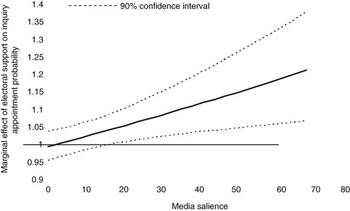
Turning now briefly to the results on the effect of electoral support, the media salience × election period interaction was found to be significant, suggesting that the marginal effect of electoral support on appointment propensity varies across issue salience levels. Figure 3 graphically demonstrates this finding. As can be seen, in low issue salience, electoral support has no effect on the appointment decision. Yet the effect increases, and at a salience level of sixteen articles a week per newspaper this positive effect becomes statistically significant. Therefore, non-salient issues do not appear to involve electoral considerations in the appointment decision, while salient issues increasingly do.
The marginal effect of electoral support on inquiry appointment probability, across issue salience levels

The identity of the prime minister was not found to have a significant effect on the propensity to appoint an inquiry. Finally, issues that have been previously raised had a smaller chance of inquiry appointment, by an odds ratio of 0.384.
Assessing the Robustness of the Findings with a ‘Salient’ Subset
As noted above, the ‘possibility principle’ prescribes careful distinction between ‘negative’ and ‘irrelevant’ cases.Footnote 76 In order to assess the robustness of the findings, an additional set of analyses was conducted under more restrictive criteria for selecting ‘negative’ (non-inquired) cases. A subset of inquiry issues with at least four broadsheet articles per newspaper per week was selected, providing the 47 per cent most salient cases of the sample (n = 62). The three logistic regression models were fitted to this data. The chi-square statistic for all three models (26.94–31.65, p < 0.01) allows us to reject the null hypothesis that the independent variables do not improve the prediction of an inquiry appointment probability. The Nagelkerke pseudo R 2 values (0.473–0.508) suggest that the models account for the variation in the dependent variable moderately well. Model 1 shows that the closer blame is to the appointing minister, the less likely the appointment of an inquiry is. Again, this decrease is not significant between remote and close blame (odds ratio = 0.379, p = 0.214), but it clearly is when comparing remote and direct blame (odds ratio = 0.108, p = 0.016). Fitting Model 2 results in a significant positive association between media salience and appointment propensity (odds ratio = 1.106, p = 0.005). Fitting model three yields a negative significant interaction between blame attribution and election period (p < 0.1). These results attest to the robustness of the findings across both methods of ‘negative cases’ selection.
To summarize the results: the closer the target of blame is to the appointing office holders, the less likely they are to appoint an inquiry into that issue. This effect was found to increase during election periods, suggesting that short-term loss acknowledgement consideration accounts for this finding better rather than the long-term risk of a critical inquiry report. Issue (media) salience was found to have a strong positive effect on the appointment propensity, providing support for the venue alteration hypothesis. This hypothesis also appears to fit the data better than the competing account, which assumes that issue severity is at the heart of an inquiry appointment decision. Issue severity (casualty number) has an effect on appointment propensity (and media salience) only in the short term, and its effect in these selective instances was found to be mediated by media salience. The government’s electoral support was found to have a positive relationship with inquiry appointment propensity, yet only for relatively high-salience issues. Lastly, the similarity between the results under the more restrictive subset of salient inquiry issues and those under the more inclusive sample suggests that these findings are robust, in the sense that they do not appear to be sensitive to variations in the research design.
Conclusion
This research has shown that when things go wrong, the interplay of the politics of blame, public agenda (issue salience) and government popularity determines the choice of whether to establish a commission of inquiry. Unlike previous studies of post-crisis inquiries, the model advanced here incorporates observations of firm resistance to appoint, even in the face of public pressure, with the reality that politicians indeed sometimes set up inquiries at their own discretion. It confirms that inquiries are fundamentally ‘negative goods’ for elected executives. Their appointment carries with it an acknowledgement of a problem – the immediate cost of appointment – which is exacerbated by the fact that the appointment is at the discretion of ministers. Yet, at a certain point, this cost of appointment may become a ‘sunk cost’ – when the problem is undeniable. Following the predictions of the blame avoidance theory, this threshold of resistance, determined by loss acknowledgement, is lower when blame is directed away from the appointing office holders, and rises when they ‘feel the heat’.Footnote 77 At this stage, a new equilibrium is formed as potential benefit from venue alteration by appointing an inquiry motivates the office holder to appoint, and increasingly so the more salient the issue is. These findings provide credence to the claim that despite their intended a political nature, these ad hoc institutions represent ‘a continuation of politics by other means’.Footnote 78
It is interesting to reflect on these findings against the historical origins of the modern British independent inquiry. The Marconi scandal of 1912 and the investigations that ensued are identified as a constitutive event that led to a widespread belief that political scandals could not credibly be investigated by political inquiries, and therefore served as a catalyst in the process of legislating the Tribunal of Inquiry (Evidence) Act 1921.Footnote 79 While the 1921 Act removed politically contested adverse failings from the realm of political investigations, it had left the decision of whether to appoint an independent inquiry in the hands of politicians. It is perhaps not surprising that the blame avoidance motivation, clearly evident in the partisan manipulation of the Marconi investigation, had migrated into the more restricted political choice of whether to appoint independent inquiries.
As noted earlier, a typical element of the politics of post-crisis inquiries is an intense debate over the inquiry’s terms of reference.Footnote 80 The findings suggest that the drive to limit the scope of current acknowledged loss fits the data better than an attempt to limit the risk of a future critical report. Hence, it appears that this struggle can be better understood as one between competing versions of perceived loss over the chosen acknowledged loss entailed by the terms of reference.
The reasons for appointing, and especially not appointing, an inquiry are typically covert, and – in the unlikely event that they are articulated by office holders – unreliable. Inasmuch as the findings of this study adequately represent inquiry appointment decisions, they can also be utilized to derive some inferences for unobserved political conditions, when a decision has been taken (by backward induction). For example, when the issue is salient and the possibility of (or demand for) an inquiry has been introduced into the public agenda; a resistance to appoint may indicate possible high-level blame, even when publicly available information does not indicate it. This is obviously a probabilistic inference; yet, as in other situations of limited information, it may provide a lead for a closer examination in a particular direction.
Contrary to what could be expected and prescribed, this research suggests that the inherent severity of an issue or event does not directly affect the decision to appoint an inquiry, but is mediated by media salience and therefore short lived. These findings provide a framework for understanding perhaps the most unexpected non-inquired event – the 1988 Lockerbie disaster; 270 people died in the explosion of Pan American Flight 103 – the largest number of casualties in a single UK disaster during this twenty-year period – yet no inquiry was appointed. An interesting aspect of this case is that only on 15 March 1989, nearly three months after the event, did calls for a public inquiry into this disaster appear in the national press. These came following allegations that a warning of a terrorist attack was issued by the US Federal Aviation Authority just before the disaster. Blame was directed at Paul Channon, the Transport Secretary, including calls for his resignation.Footnote 81 While this is a seemingly surprising case, analysing it with the model provided here yields an expected probability of an inquiry of only 3.3 per cent. Had blame been attributed to non-state agents (for example, terrorists or the airline), computed probability would have gone up to 22.2 per cent. Thus, despite the clear severity of this event, the lack of public pressure for an inquiry in the early stages after the event allowed the government to avoid an inquiry, followed by a natural attenuation in media attention over time. Moreover, directing blame at the Transport Secretary, at this late stage, reduced the likelihood of an inquiry to a level that was half the prior probability.
In the aftermath of a crisis, after taking care of its operational aspects, governments are expected to engage in policy learning – to draw lessons from the failure in order to reduce the likelihood of reoccurrence.Footnote 82 As noted above, establishing a commission of inquiry in such circumstances is viewed as the most appropriate way for promoting and facilitating learning. This study has found strong empirical support for the hypothesis that the politics of blame acts to restrict the realization of this prescription.Footnote 83 Moreover, the need for learning is not expected to be associated with the direction of blame attribution. If anything, a positive relationship would be expected. Ignoring blame avoidance for a moment, issues that give rise to remote blame could be expected to be investigated by private bodies, by local authorities or by the more mundane organizations such as the police, while close and direct blame can be expected to be investigated by more independent bodies set up by the central government. If one accepts this counterfactual thinking, then this study’s finding of a negative relationship between blame attribution and inquiry appointment propensity may actually represent an underestimation of the true effect of blame on the proclivity of elected officials for post-crisis learning.
While the findings of this study show that inquiries are products of political considerations, they should not be regarded as derogating from the value of commissions of inquiry as informative and important vehicles of accountability and learning in a democracy. Moreover, they do not necessitate the conclusion that further restrictions on the discretion of elected office holders are required in the processes of post-crisis learning and accountability. Additional research is needed in order to understand better the implications of inquiries and alternative procedures for the quality of public policy, political knowledge and prudent leadership. As in many other domains, and perhaps more so in the political sphere, a central question that requires further attention pertains to the appropriate balance between learning and blaming. This research contributes its share to this aim by pointing to some of these uneasy relationships.
Appendix 1: Coding protocol for blame attribution
At the end of each article, you are asked to identify the main target of blame/criticism in the article by its proper name (e.g., Devon Police), and assign it to one of four categories:
1. Individual citizens/private corporations/NGOs (non-governmental organizations)
2. Local authorities/institutions
3. Central government bureaucracy
4. Ministers/prime minister
Category 1 includes private individuals (for example, a person who committed a criminal or negligent act); private corporations (e.g., when a private airline company is blamed for an aerial accident); or non-profit organizations (e.g., a sports club). Note the difference between private individuals and office holders who are referred to in person (bureaucrats, ministers, local officials…). The latter should be categorized according to their official function under Categories 2–4.
Category 2 includes local authorities such as local municipalities, local social services, local hospital, local police, local transport authority (e.g., London Underground), and any other authority that has only limited jurisdiction – as opposed to a national (entire United Kingdom) jurisdiction.
Category 3 includes central government bodies such as ministries/departments, government agencies, the military, intelligence agencies, and any other authority with a national jurisdiction, except those included in Category 4.
Category 4 includes government ministers and the prime minister.
Write your answers (target of blame and coding category) in the lines provided after each newspaper article on file. If a number of agents are targeted in the article, for example, both a business corporation (Cat. 1) and a government agency (Cat. 3), select the higher category addressed by the article (Cat. 3) for the article coding. Some events are referred to by a number of articles. It may be necessary to code different articles about the same event differently, since the coding pertains to the responsibility attribution made by each article.
Some affairs resurfaced over time, and are addressed separately in each instance. For example, the Lockerbie disaster resurfaced several times following the actual disaster, when new evidence was found. Since attribution of responsibility for the event and/or aspects of it may change over time and context, the coding may change, too.
Even if you know or have an opinion about issues of blame and responsibility regarding an event, try to decide on the coding based on the content of the articles only. The idea is to represent the attribution of responsibility that is understood from the text, regardless of its justification, correctness, etc.
Appendix 2: Coding protocol for media salience
Counting the number of articles on a particular event included: (1) specifying the time unit; (2) the newspapers searched; (3) the keyword/s used. This information was recorded for each case included in the analysis. Furthermore, the number of articles is not merely the database search result. All articles were checked for relevance, and the proportion of relevant articles from the automated search was also recorded.
The relevance was assessed by the following questions:
(1) Is the article about the event/issue?
(2) Is the article before or after inquiry appointment? If before – jump to (3)
If after: is the article about the event/issue or mainly about the inquiry that was appointed into it? (A guideline: if more than one-third of the article is about the inquiry=about the inquiry). If the article is about the inquiry – omit it from the valid number of articles.
(3) Count the number of articles on the event/issue.
Thus, the measurement of media salience for each event was based on the number of articles from the automated search, subtracting irrelevant articles and articles about the inquiry.
Appendix 3: Electoral support
Electoral support is the government’s percentage point lead over the main opposition party, reported by Mori from answers to the question: ‘How would you vote if there were a General Election tomorrow?’