Introduction
In every contested election there are inevitably winners and losers, both
among the candidates and among the voters. Some candidates will take
their seats as elected officials, and others will not. Some voters will
be happy with the outcome, others will not. Here I seek to better
understand the relationship between whether a voter casts a ballot for
the winning candidate in U.S. House elections and that voter's
evaluations of her representative. I build on a burgeoning literature on
the relationship between voters and their elected governments to derive
and test a theory about this connection. The data will show that voters
whose preferred candidate wins a seat in the House of Representatives
are systematically happier with their representative than those voters
whom did not vote for the winning candidate. While this finding is not
especially groundbreaking, the implications for the way in which we draw
congressional and state legislative district lines are quite
provocative. Specifically, since district lines in the House are
necessarily an artificial construct, I argue that map makers ought to
“pack” districts with as many like-minded partisans as possible. Trying
to draw “competitive districts”1
Throughout this paper “competitive districts” refers to a
district drawn with relatively equal numbers of voters that
favor the two major parties. This is to say there is some
probability that the general election will be relatively
competitive (although it is certainly not a guarantee of
competitiveness).
effectively cracks ideologically
congruent voters into separate districts, which has the effect of
increasing the absolute number of voters who will be unhappy with the
outcome and dissatisfied with their representative. I discuss the
benefits of fundamentally rethinking the way in which we draw
congressional and state legislative districts, as well as address likely
concerns that might be raised about drawing districts this way.
Winners and Losers
A developing literature suggests that voters' evaluations of government,
including overall trust in government, is directly related to whether
they cast a ballot for the winning candidate. Anderson and LoTempio
(2002) show that citizens who voted for
the winning presidential candidate have significantly higher levels of
overall trust in government relative to voters whose candidate lost the
election (even after controlling for other factors that affect trust).
Thus, evaluations of the government depend, in part, on election
outcomes. However, Anderson and LoTempio find no relationship between
votes for congressional candidates and overall trust in government,
although this is likely because voters are more likely to think about
the president than Congress when asked how much trust they have in the
federal government.2
They tested both
voting for the winning candidate in an election and voting for
the party that wins a majority in Congress; neither model
yielded statistically significant results.
Clarke and
Acock (
1989) show that voting for the winning
candidate in American elections increases voter efficacy as well.
These results are not unique to the American case. Anderson and Guillory
(1997) demonstrate that a similar
relationship exits in other advanced industrial democracies. Clarke and
Kornberg (1992) show that winning voters in
Canada have more positive evaluations of their members of parliament in
terms of responsiveness to voters. This “winning effect” extends not
only to voters, but also to the candidates who stand for election.
Bowler and Donovan (2002) demonstrate that
elites' attitudes toward electoral institutions are, in part, dependent
on whether they win the election. Winning candidates, who have been
delivered to parliament by the current electoral arrangement, are much
more satisfied and committed to these institutions than are losing
candidates.
Theory and Data
The theory driving this investigation is simple: citizens who vote for
the winning candidate in a House election will be systematically more
likely to have higher evaluations of said candidate relative to voters
who vote for the losing candidate. Similarly, “winning” voters will have
more positive and fewer negative things to say about their
representative than “losing” voters. I test this proposition using the
American National Election Study (ANES) cumulative file with survey data
from 1948–2000, although the multivariate analysis only includes data
from 1980 on, as some of the variables utilized in the analysis were not
part of the survey until that time.
Empirical Results
Using these data I test to see what effects voting for the winning
candidate in a U.S. House of Representatives election has on evaluations
of that representative, as well as voter evaluations of Congress as an
institution. First, I examine the relationship between which candidate a
respondent has voted for and that voter's affect toward the
representative. In the National Election study, respondents are asked
the following open-ended question: “Is there anything in particular that
you liked about [U.S. House incumbent candidate] What is that? Anything
else?” They are also asked if there is anything that they dislike about
the incumbent representative. The survey records up to four responses
for both likes and dislikes. Affect for a candidate is simply measured
as the number of likes minus the number of dislikes. So if a voter has
four positive and one negative things to say, the result is an affect of
+3. This variable ranges from +4 to −4. Table
1 presents the results of a cross tabulation of affect for
the incumbent and whether the respondent had voted for this candidate or
an opponent (same party, different party). Clearly, the results indicate
that when people vote for the winner, their affect for their
representative is significantly more positive. The percentage of people
who voted for the losing candidate and had more negative than positive
things to say (i.e., their affect score is negative) is 22.3%; that same
measure for winning voters is only 5.3%. Similarly, voters for the
winning candidate are far more likely to have more positive things to
say about their incumbent representative than are losing voters. Over
65% of the people that voted for the winner had more positive than
negative things to say.3
Of course this is
not all voters, but rather the sub-sample of voters who answered
this question.
presents the multivariate analysis
with the affect variable as the dependent variable. Even after
controlling for other variables that influence how a voter might feel
about his or her incumbent representative, the “Vote for Winner”
variable is positive and statistically significant at beyond the .001
level. Other variables that influence the number of likes and dislikes
include age, education, income, party identification, and responses to
the congressional thermometer question.
Relationship between Voting for Winning Candidate and Likes Minus
Dislikes for the Incumbent Representative
Explanatory Model for Affect toward the Incumbent
Table 3 displays the relationship between
voting for the winner and voter approval of the incumbent. Only 4.8% of
winning voters disapproved of the incumbent, while fully 21.9% of losing
voters disapproved of the incumbent representative. Over 82% of winning
voters express approval of the elected official. These results are not
surprising—people who vote for the winning candidate are happier than
people who voted for the losing candidate—and they fit with much of the
other literature on the subject of how attitudes toward government are
conditioned by how people cast their ballots. People are more satisfied
with the government (or its component parts) when the candidates that
they vote for are elected.
Relationship between Voting for the Winning Candidate and
Approval of Incumbent
The relationship between winning and losing also moves beyond how a voter
feels toward a specific representative. Election outcomes also influence
the ways in which citizens connect with Congress as an institution. For
instance, Table 4 is a cross-tabulation of a
respondent's overall rating of Congress and whether the person they
voted for in the House election won. Roughly the same percentage of
people rate Congress as doing a “very poor job” in the winning and
losing voter columns, so even among voters whose candidate is victorious
a substantial number of people remain highly skeptical of our
legislature. However, more losing voters rate Congress as doing a “poor
job” and more winning voters rate Congress as doing a “good job.” While
the differences are not as large as those we saw in previous tables,
they are statistically significant and any increase in satisfaction with
our representative institutions is surely a positive development.
Relationship between Voting for the Winning Candidate and
Approval of Congress
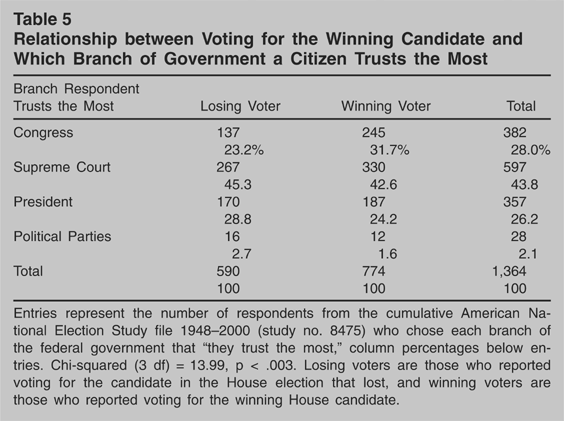
The relationship between voting for the winning candidate and which
branch of government the respondent trusts most (Congress, the Supreme
Court, the president, or political parties) is presented in Table 5. The biggest difference between winners
and losers is related to voting for the winning House candidate. More
than 23% of the voters on the losing side versus nearly 32% of voters
whose candidate won chose Congress as the most trusted branch of the
federal government. Thus, winning voters are much more likely than
losing voters to choose Congress as their most trusted branch of the
federal government.4
This relationship
remains positive and statistically significant in a multivariate
model.
Relationship between Voting for the Winning Candidate and Which
Branch of Government a Citizen Trusts the Most
People who vote for the winning candidate are systematically more
satisfied with their representative and with Congress as a whole. But
the underlying story is not merely one of winning or losing, but rather
ideological distance. The greater the distance between the
representative and the voter, the more likely the voter will be
dissatisfied.5
See Buchler (2005) for a formal treatment of this
relationship.
Implications
Based on these results, and since congressional districts are necessarily
artificial constructs, there are clearly reasons to draw districts in
such a manner as to increase efficacy and happiness with our government,
particularly since Congress almost always has significantly lower
approval ratings than the president, the Supreme Court, and state
governments (see Hibbing and Smith 2001; Hibbing and Theiss-Morse 1995). Packing
districts with like-minded partisans makes a great deal of sense, as
long as both major political parties are packed to similar degrees.
Drawing competitive districts or systematically “cracking”6
Cracking refers to the art of drawing districts
that are close to being competitive but give one party the edge
in an election. For instance, if the Democrats control the
redistricting process they are likely to draw districts that
lean toward the Democratic candidate—55% Democrat, 45%
Republican. Although map makers need to be careful not to draw
these too competitive as small swings in the vote could then
reverse these districts and instead of a Gerrymander you end
with what Grofman and Brunell (2005)
call a Dummymander.
one party or the other is not
beneficial and ought not be present in redistricting plans. Thus, what
we think of typically as competitive districts (those with roughly equal
numbers of Democrats and Republicans) provide negligible benefits and
come with significant costs. One of the most significant benefits from
drawing a legislative map with packed districts is that it makes it
significantly more difficult to effect a map that constitutes a partisan
gerrymander. Districting plans that dilute one party's vote must use a
combination of packing and cracking to create a map that contains
significant levels of partisan bias (i.e., where one party might win the
statewide vote for the House, but still end up with fewer seats).
Preserving communities of interest is one of the main principles guiding
map makers. Among these principles, preserving communities of interest
is certainly the most ephemeral. What really constitutes a community of
interest? Is any American city or county, really a community of
interest? Sometimes—depending on the issue. A city is a unified
community of interest when the issue is non-partisan, for example if the
issue is obtainment of federal funds to repair bridges and roads, but it
is not if the issue involves anything with ideological disagreement.
Properly conceived, I argue, communities of interest should be composed
entirely of either Democrats or Republicans (liberals or conservatives)
in reflection of the primary cleavage in American politics (Poole and Rosenthal 1991). On controversial
issues, ideological communities of interest will typically face issues
in unison, increasing the likelihood that their representative will vote
on legislation in Congress in congruence with the vast majority of their
constituents. Citizens living in knife-edged districts cannot expect
this kind of representation. Drawing districts to increase
competitiveness in the general election only optimizes the number of
voters that will be upset with their representation. Thus, not only do
competitive districts not provide a social “good,” they actually
increase dissatisfaction and make it less likely that voters'
preferences are represented in government.
Drawing competitive districts also increases the volatility of the
electoral system. If every district is a “50–50” district, then any
small change in the voting behavior of the electorate could produce
enormous changes in the partisan distribution of seats. While it is
true, and oft-cited, that the Founders intended for the House to most
closely mirror the wishes of the public, it is not reasonable to assume
that they expected the institution to be hyper-sensitive to relatively
small changes in the partisan leanings of the people. Districting this
way also delivers a disproportionate share of the voting power to
independents and moderate swing voters.7
For instance if a district is 45% Republican, 45% Democratic
and 10% Independent, the only votes that matter are those from
the smallest group. These independents will only be able to
choose from either a Democrat or a Republican in the election,
but nonetheless, they become the votes that really
count.
A district that packs voters from both major parties
equally into districts (i.e., the average district is either 80%
Republican or 80% Democratic) has the added benefit of sending
congressional delegations to the House that closely mirror the overall
distribution of partisans in that state. A plan with many competitive
districts can easily send a delegation to the House that is truly
unreflective of the underlying partisan divisions in a state.
Some states, like Arizona,8
Proposition
206, passed by Arizona voters in 2000, requires: “To the extent
practicable, competitive districts should be favored where to do
so would create no significant detriment to the other goals”
(sec 14, subsection F).
have passed laws or referenda
specifying that a districting plan ought to maximize the number of
competitive districts. This is not particularly surprising since the
common wisdom among most voters and certainly among the media is that
the House of Representatives does not have enough competitive districts
currently, and that an increase in the number of competitive elections
or in the amount of turnover in Congress will somehow enhance
representation. There is absolutely no evidence that this is the
case.
9 I highly suggest reading the
exchange between Issacharoff (2002)
and Persily (2002) on the topic of the
utility of competition in congressional elections. As both are
also law professors they also touch on legal issues and the
proper role of courts in regulating elections.
In fact,
maximizing competitive districts is harmful rather than beneficial in
many respects. The most obvious effect of drawing cracked or competitive
districts is to maximizes the number of voters who are dissatisfied with
their representation.
10 In fact
competitive districts are optimal in this sense.
Second, a state that draws all or most of its districts in this
knife-edged fashion increases the likelihood that small swings in voting
behavior translate into large swings in the percentage of seats that one
party can win in a single election. This can result in statewide
representation that is widely incongruent with statewide partisanship,
which, in turn, leads to voting behavior in the legislature that does
not accurately represent the views of the constituents.
From a utilitarian perspective, the ideal congressional district is one
populated entirely by people with the same political preferences. Such a
constituency would see its wishes effectively translated into votes by
their representative and this type of district assures that the
representative will remain faithful to the voters through the threat of
a primary challenge. Minimizing the ideological distance between the
average voter and the likely representative fosters more effective
representation and makes it easier for elected officials to discern our
preferences, thus strengthening the bonds between the represented and
representatives. Buchler (2005) develops this
idea more formally and finds that homogeneous non-competitive districts
“do a better job than competitive districts in achieving representative
outcomes.” Further, these districts “produce legislators that are closer
to their district medians and more representative of everyone in their
district” (457).
The House of Representatives ought to be the closest of our national
institutions to the people. We want the connection between the
representative and the represented to be a close and faithful
connection. The delegate theory of representation “posits that the
representative ought to reflect purposively the preferences of his
constituents” (McCrone and Kuklinski 1979,
278). Research on the connection between elected officials and the
people that they represent has a long tradition in our discipline.
Miller and Stokes's (1963) seminal piece on
this subject called into question the ability of the representative to
know what her constituents want, as well as the ability of the
constituents to know and understand how the elected official is voting
in Washington.
For example, Miller and Stokes (56) conclude: “The Representative has
very imperfect information about the issue preferences of his
constituency, and the constituency's awareness of the policy stands of
the Representative ordinarily is slight.” While other scholars have
pointed out some methodological concerns with the original Miller and
Stokes study and have questioned the validity of some of their
conclusions (see Erikson, Luttbeg, and Holloway
1975; Erikson 1978), there is very
little doubt that these connections between the representative and the
constituency could be much stronger. Creating packed ideological
districts will necessarily strengthen these bonds. If a Democrat is sent
to Congress from a district heavily populated by like-minded partisans,
she will have little doubt as to how her constituents prefer her to vote
on policy proposals. Similarly, creating more “winners” out of voters
alleviates some of the uncertainty with respect to how the
representative votes on their behalf. This will also serve to encourage
representatives to be more responsive to constituent needs.
Elections serve as the main catalyst for keeping representatives faithful
to their constituents. The threat of being replaced in a popular
election incentivizes elected officials to respond to what their
constituents want. A districting plan that maximizes the number of
winners would clearly affect election outcomes. Most obvious is the
likelihood that general election outcomes would not be particularly
close. Districts packed with 80% or more of one party will deliver
general election victories to the majority party in the district.
Redistricting is already the oft-accused suspect of the decline of
competition and turnover in the House of Representatives (Cox and Katz 2002; Hirsch
2003) and this type of plan may not help the current public
image of this process. However, it is critical to keep in mind that
general election competitiveness is neither a necessary nor sufficient
condition for ideal representation. First, we utilize a two-stage
process for electing members of Congress, where citizens are given the
ability to choose, via a primary election, which candidate will
represent their party in the general election.11
In terms of incentives for challengers, the opportunity
structure of a packed district makes it objectively more
attractive for challengers from the dominant party to emerge.
One only has to win the primary election in order to take the
seat, whereas in a 50–50 district one could face the daunting
prospect of hard fought elections in both the primary and
general elections.
Therefore, even in an 80–20
district, the incumbent can easily be removed if he fails his
constituents. This type of districting plan encourages
intra-
rather than
inter-party competition. By no means do homogeneous
districts spell an end to electoral competition or responsiveness on the
part of our elected officials. Increasing the relevancy of primaries may
have other beneficial effects: turnout in primary elections might
increase, the organized political parties may be more apt to get
involved at the primary election stage, and more qualified candidates
may choose to run against an incumbent in a primary. Another reason that
incumbents, even in the absence of tough general election competition,
will remain faithful to their constituents is that the specter of losing
the next election is always prevalent in the minds of incumbents; this
implied threat is what keeps our elected officials responsive.
There exists, I argue, sufficient uncertainty among elected officials
with respect to their ability to win the next election which keeps them
from behaving in ways that might contribute to a loss. My argument is
not novel. David Mayhew wrote in 1974 that:
“It is possible to conceive of an assembly in which no member ever comes
close to losing a seat but in which the need to be reelected is what
inspires members' behavior. It would be an assembly with no saints or
fools in it, an assembly packed with skilled politicians going about
their business” (37). In Unsafe at any Margin Thomas Mann
(1978) argued that congressional elections
were becoming less nationalized and election outcomes depended heavily
upon what the voters in each district thought of their representative.
“Candidate saliency is a double-edged sword for incumbents; while it can
mean an enormous advantage in visibility over challengers, it can also
spell disaster if the voters come to believe that their representative
has some personal failing” (103).
The lack of turnover in the U.S. Congress should not be used as an
indication that our federal institutions are failing as components of a
democracy. While I am not arguing that stagnation is the signature of a
perfectly health democracy, I do not see rapid replacement of incumbents
as a necessary part of a truly representative institution. Indeed, if we
want rapid turnover in our legislature, then term limits are a vastly
more effective method of producing this outcome than drawing competitive
districts. Many 50–50 districts end up with an incumbent who can use the
perks of the office to leverage what might have been a competitive
district in one election into a very safe seat for many successive
elections.
One common objection to this method of districting is that it would add
to the polarization in Congress by creating overwhelmingly Republican
(Democratic) districts that are more likely to elect very conservative
(liberal) members. This is an empirical question that is easily
addressed. The question is whether members who win by large margins are
more extreme than their colleagues who win by relatively small margins.
Figure 1 plots member ideology by vote
percentage for the years 1952–2000. The x-axis represents the Democratic
proportion of the vote, so very small values indicate Republican victors
by very large margins. The closer one moves toward the vertical line at
.5, the more competitive the elections. The data on the far right side
of the graph (those data points near 1.0) are districts in which the
Democrat won by very large margins. The solid line is the predicted
values from a quadratic regression and the shaded regions represent the
95% confidence region. If so-called safe seats elected more
ideologically extreme members we would expect the predicted lines to
slope downward for the Democrats as we move along the x-axis toward 1.
The line is more or less straight with a slight upward slope (driven
mainly by uncontested elections). For the Republicans we would expect
the line to be much higher (i.e., more conservative NOMINATE scores) for
values close to 0 relative to values close to .5. The predicted line
here is completely flat. Thus, as the margin of victory increases for
members to the U.S. House, we seen no real change in the ideology of the
members who are elected.12
Thus, there is no
reason to expect that packing districts on the basis of ideology will
have any influence on the ideology of the House as a whole.
The Relationship between Margin of Victory and Ideology in the
House
Example
Imagine a state with sufficient population for two congressional
districts. The state is perfectly segregated from east to west in terms
of partisanship with all Democrats living in the western half of the
state and all Republicans living in the eastern half. Further assume
that the number of Democrats and Republicans is exactly equal. Given the
restrictions of equal population, contiguity, and compactness there are
still many different ways in which to cut the state into two districts.
Consider three different scenarios.
The first is a line bisecting the state from east to west creating two
50–50 districts. If a state preferred “competitive districts” this would
be the most efficient method. From the outset, it is non-controversial
to say that this state should elect, and is best represented by, one
Democrat and one Republican. But by creating two competitive districts
this significantly increases the odds that one party can sweep the state
even with just a very small shift in voting behavior. If the Democrats
run a particularly effective campaign and swing 1% of the vote
statewide, this leaves nearly half the state with no ideological
representation in the House. Furthermore, even if the election outcome
delivered one seat to each party, this still leaves roughly half the
state unsatisfied with their own representative because of the way in
which the districts were drawn.
Second, we draw two districts, each of which is 75% one party and 25% the
other. This would create districts that are beyond the bounds of
“competitiveness” insofar as the favored party ought to have little
trouble electing a candidate of their choice. The overall representation
will mirror the statewide breakdown, but this districting plan also
leaves a quarter of the state unsatisfied with their representative and
less likely to feel efficacious with respect to electing members of
Congress.
Last, we bisect the state from north to south, creating two homogeneous
partisan districts. Here too the state's representation will mirror the
overall partisanship of the state, and all citizens end up voting for a
representative that they like and are more likely to highly value the
job that their Representative does in the House. These districts will
elect people neither less responsive to the wishes of the electorate,
nor more extreme in their partisan leanings than any other configuration
of districts.
Impact on Traditional Redistricting Principles
The decennial task of redrawing district lines for U.S. House elections
is always a bitterly partisan affair. Since redrawing the maps is done
at the state level, district lines depend in large part upon which party
controls the state legislature and the governorship. However, many
districting plans, regardless of the partisan composition of the state
government, end up being litigated over a variety of issues.
The first principle used to guide map makers is equal population. Courts
have often tossed out maps that have even the slightest deviation in
population across districts within a state (the original federal
district court decision in the Vieth v. Pennsylvania is a good
example). This stems from the one person-one vote principle outlined in
two 1964 Supreme Court decisions (Reynolds v. Sims and
Wesberry v. Sanders). Packing districts with partisans
would not violate this guideline.
Second, districts must be contiguous, which is to say that every point in
the district must touch an adjacent point. Districts cannot be made up
piecemeal across the state. Again, contiguity could easily be preserved
with the method outlined in this paper.
Third, districts are supposed to be compact. Compactness is, at least in
part, in the eye of the beholder. A compact district tends to be one
whose shape is pleasing to the eye, which is to say, a reasonably shaped
polygon. However, oftentimes a district may look like a bug splat on the
windshield of a car. Compactness is rarely an issue in court, although
it can be, depending upon the judge or judges involved. Creating packed
partisan districts may tend to involve drawing districts that are less
pleasing to the eye and less compact, although this is a relatively
small price to pay for the benefits of having districts in which most
voters are winners.
Fourth, map makers strive to “preserve communities of interest.” This may
be the single most fleeting guideline in district drawing. What
constitutes a community of interest? A city? A county? Any geographic
region marked by even the slightest bit of partisan diversity is not a
community of interest. A county with a significant population cannot
really be thought of as a community of interest on any issue other than
one that affects the community directly in a clearly positive or
negative way (i.e., putting a nuclear storage facility in the county, or
a federal grant to the county to improve roads). Typically in court,
competing maps try to quantify the preservation of communities of
interest by counting the number of city and county splits or segments
(Plan A splits four of the 26 counties into separate districts, Plan B
splits six of the 26 counties, etc.). In court, protecting communities
of interest generally devolves into a beauty contest to see which map
can keep as many counties and municipalities whole. As I argued above,
communities of interest are better thought of in terms of overall
ideological congruence among citizens, rather than in geographic
considerations. Thus, the overall compactness of districts, at times,
will be sacrificed if this method were used, but again, geography should
not be a sacred cow in the redistricting process.13
If a city or county does also happen to be an
ideological community of interest then it ought to be kept in a
single district.
Lani Guinier is a vocal critic of the single-member district system
widely used in American elections. Guinier and I agree that using
geography as one of the central principles for drawing districts is
often harmful rather than beneficial. She writes:
Winner-take-all territorial districting imperfectly distributes
representation based on group attributes and disproportionately
rewards those who win the representational lottery. Territorial
districting uses an aggregating rule that inevitably groups
people by virtue of some set of externally observed
characteristics such as geographic proximity or racial identity.
In addition, the winner-take-all principle inevitably wastes
some votes. The dominant group within the district gets all the
power; the votes of supporters of nondominant groups or of
disaffected voters within the dominant group are wasted. Their
votes lose significance because they are consistently cast for
political losers. (Guinier 1993)
Where Guinier and I depart company is the necessity of wasting votes in a
single-member district system. I advocate that we minimize the number of
wasted votes, which makes her distinction between dominant and
nondominant groups less important as the nondominant group is redrawn
from several districts into their own district in which they are
dominant (and a new nondominant group is not created). Her underlying
concern is identical to mine—“votes lose significance because they are
consistently cast for political losers.”
The Voting Rights Act implicates all the states under Section 2 and many
of the states under Section 5 in terms of election law. The
Thornburg v. Gingles decision ruled that districting plans
must take care to ensure that minority votes are not systematically
diluted, although subsequent decisions have held that race cannot be
used as the predominant factor in drawing districts (Shaw v. Reno;
Bush v. Vera). Packing districts on the basis of ideology would
not interfere with districting plans satisfying the requirements of the
Voting Rights Act. In fact, using ideology rather than race, but still
preserving the ability of protected minorities to have a reasonable
opportunity to elect a candidate of their choice, would be relatively
easy to accomplish.
Discussion
Conventional wisdom suggests that drawing competitive legislative
districts is beneficial to our system of government. In fact, drawing
districts with relatively equal numbers of Democrats and Republicans
maximizes the number of losing voters (also known as wasted votes). A
voter on the losing side of an election is systematically more likely to
be unhappy with his representative and with Congress as an institution.
Further, the assumption that competitive general elections make
representatives more responsive is also wrong. The implied threat of
competition, especially at the primary level, is sufficient to keep our
elected officials faithful to our opinions. Furthermore, this method of
districting is not the end of electoral competition; rather it refocuses
the nexus of competition from inter to intra-party. Even if a voter, in
a packed district, casts a ballot for the candidate that ends up losing
in the dominant party's primary, she still has the opportunity to cast a
ballot for the winning candidate in the general election.
Maximizing the number of competitive districts vastly increases the
likelihood that very small changes in the partisan leanings of voters
nationwide get translated into very large swings in congressional seats.
While political analysts oftentimes fall into the trap of trying to
gauge the relative health of American democracy through the amount of
turnover, or the lack thereof, in the U.S. Congress, this is not at all
an appropriate method of estimating how well our democratic institutions
are functioning. Volatility in Congress is not a goal we ought to be
striving for when we draw legislative maps. If the American people truly
pine for turnover even drawing competitive districts is no guarantee,
rather we should institute term limits.14
This should not be taken as an endorsement of term limits,
but rather a much more effective method of effecting turnover in
Congress than drawing knife-edged districts.
While
turnover and volatility may decrease using this method, the critical
aspect of the plan to keep in mind is that the overall distribution of
seats will closely mirror the distribution of preferences in each state
and nationwide. The goal of redistricting is not to maximize the number
of seats that switch from one party to the other every two years; rather
the goal of redistricting is for the House to pass legislation in such a
way that policy preferences among the electorate are reflected in policy
outputs. Drawing districts on the basis of ideology satisfies this goal,
while drawing competitive districts does not.
Drawing districts packed with either like-minded partisans maximizes the
numbers of winning voters in legislative elections. Packing districts
with ideologically like-minded individuals will not elect more extreme
candidates and ought to strengthen the bonds between the representatives
and their constituents. Inferring how the electorate wants a
representative to vote on an issue will be much simpler when one's
district is significantly more homogeneous. If this type of districting
plan were put into effect it may also stimulate more competition in
primary elections. While general elections to the House of
Representatives would surely be a largely unexciting affair, primary
elections could rise in importance and become the more likely mechanism
for replacing members. Organized political parties often seek to
suppress competition at the primary election stage largely because they
do not want to reduce their party's chances of winning the general
election. If the likelihood of winning the general election is
overwhelmingly in favor of one party or the other, this risk is
alleviated and ought to remove this barrier.
Packing partisans also significantly reduces the ability of map-makers to
effect a significant partisan gerrymander. It is through the combination
of packing and cracking that one party can effectively dilute the votes
of their opposition. As long as districts are packed with nearly equal
proportions in terms of the two major parties, the overall
representation ought to closely mirror the distribution of partisanship
statewide. This does not mean that both parties have equal numbers of
districts—if the Democrats outnumbered Republicans 2 to 1 in the state,
there will still be more Democratic districts—the critical component is
that the ratio of the majority party to the minority party in each
district be roughly equal across the state.
This method is probably best thought of as functionally equivalent to
state-based proportional representation.15
It would differ from a proportional representation system
insofar as we would still have a two-party system, whereas PR
systems tend to increase the effective number of
parties.
One of the positive attributes of proportional
representation is the absence of “wasted votes” (i.e., people that vote
for the losing candidate in the general election). Single-member
district systems, especially those with many competitive districts, end
up wasting the votes of millions of people. If we pack districts, the
number of wasted votes would be at a minimum, while still keeping the
single-member district system to which Americans have grown accustomed.
Lani Guinier is a vocal critic of the single-member district system used
in the House. One of her most powerful criticisms is that the
redistricting process will inherently result in a gerrymander because
“in essence [redistricting] is the process of distributing wasted votes”
(
Guinier 1993). Guinier's fears are rather
well founded given the traditional districting process, however much of
her concerns generally about single-member districts and the redrawing
of their lines disappear using the method outlined in this paper.
For instance, Guinier alludes to the possibility of creating homogeneous
districts:
Districts could be made more homogeneous to reduce the number of
wasted votes. But this alternative demonstrates the second way
that winner-take-all districting wastes votes. When more people
vote for the winning candidate than is necessary to carry the
district, their votes are technically wasted because they were
unnecessary to provide an electoral margin within the district
and they could have been used to provide the
necessary electoral margin for a like-minded partisan in another
district. In other words, packing voters in homogeneous
districts wastes votes because it dilutes their overall voting
strength jurisdiction-wide.
This is an important point insofar as a gerrymander is only possible when
the combination of packing and cracking districts is utilized. However,
if all districts are packed then the real problem Guinier addresses
above is solved. Votes in packed districts are not effectively wasted
because all districts are packed, and the overvotes could not be used to
help a like-minded partisan in another district.
District lines are artificial and we ought to use this distinction to
serve our collective advantage. Let us create more winners out of voters
and increase the satisfaction with our members of Congress and Congress
as an institution by rethinking the way in which we draw these lines.
Map makers ought to be less concerned with keeping counties or
municipalities whole, and concentrate on keeping ideologically
like-minded individuals in the same district. This change would fortify
the bonds between voters and elected officials and transfer the locus of
competition in congressional elections from inter- to intra-party.
Lastly, it is clear that we cannot rely on the courts to strike down
gerrymandered redistricting plans.16
Recently the Supreme Court (Vieth v. Jubuleier,
2003) nearly declared partisan gerrymandering nonjusticiable,
which would have made it impossible for courts to declare
gerrymandered maps unconstitutional in the future. It remains
unclear what standards will be used in the future by judges to
decide gerrymandering cases.
By instituting the method
advocated in this paper, the likelihood of a significant partisan
gerrymander by either political party is greatly reduced.
Biography
Thomas L. Brunell is associate professor of political science in the
school of social sciences at the University of Texas at Dallas. His
research interests include Congress, elections, redistricting, political
parties, and interest groups.