

Introduction
The social investment perspective, that is, “the notion that social policy should be applied as a tool to enhance the productive capacity of families” (Parolin & Van Lancker, Reference Parolin and Van Lancker2021, p. 297), has become influential in calling for reforms and increased investments in work-care policies across Europe (Morel, Palier, & Palme, Reference Morel, Palier and Palme2012), particularly in early childhood education and care (ECEC) and parenting leaves.Footnote 1 The propensity of the European Union (EU) to that end became particularly visible with the introduction of the Social Investment Package in 2013, recalling a need to invest in ECEC in line with the Barcelona targets – asking member states to provide childcare to at least 90 per cent of children aged three to compulsory school age and 33 per cent of children under three (European Commission, 2013) – to intensify further with the European Pillar of Social Rights (EPSR) in 2017. “Work–life balance” and “Childcare and support to children” are among the key principles of the EPSR (European Commission, 2020) and Work–Life Balance Directive, asking for improvements on the gender dimension of parenting leaves, among the first initiatives resulting from the EPSR (de la Porte, Larsen, & Szelewa, Reference de la Porte, Larsen and Szelewa2020). The directive has also revived the gender dimension of the EU agenda, more explicitly but still timidly challenging the assumption that care work is women’s responsibility (Chieregato, Reference Chieregato2021; Matero, Reference Matero2021).
While these initiatives provide an important legitimising source for increased investments in work-care policies in (potential) member states and have strengthened gender equalising policies (de la Porte, Larsen, & Szelewa, Reference de la Porte, Larsen and Szelewa2020), the EU approach is not without criticism. This criticism points out an ambiguous and often too narrow character of both the social investment agenda (eg. Cantillon & Van Lancker, Reference Cantillon and Van Lancker2013) and the gender equality agenda (eg. Saraceno, Reference Saraceno2015) that might hamper social progress for all. It also reveals the complex nature of adoption and implementation of the EU’s requirements that may result in “compliance gaps” and increase disparities among (potential) member states (Dobrotić, Matković, & Zrinščak, Reference Dobrotić, Matković and Zrinščak2013; Kazepov & Ranci, Reference Kazepov and Ranci2017; Schimmelfennig & Sedelmeier, Reference Schimmelfennig and Sedelmeier2005; Soyaltin-Colella & Süleymanoğlu-Kürüm, Reference Soyaltin-Colella, Süleymanoğlu-Kürüm, Süleymanoğlu-Kürüm and Cin2021). The latter may be particularly the case in former socialist countries, such as the Western Balkan countries (WBCs). WBCs are marked by deep complexity in their transition from socialist to capitalist regimes, coupled with state- and nation-building as well as a high uncertainty about future political developments (including their EU membership prospects), weak legitimacy of the gender equality agenda and weak fiscal capacities (Deacon & Stubbs, Reference Deacon and Stubbs2007; Dobrotić, Matković, & Zrinščak, Reference Dobrotić, Matković and Zrinščak2013; Dobrotić & Obradović, Reference Dobrotić and Obradović2020; Kotevska, Reference Kotevska2019; O’Brennan, Reference O’Brennan2014; Stubbs & Zrinščak, Reference Stubbs, Zrinščak, An, Chubarova, Deacon and Stubbs2019).
Against this backdrop, this article explores work-care policy development in WBCs (Bosnia–Herzegovina, Kosovo, Montenegro, North Macedonia and Serbia), contributing to the debates on the capacity of the EU policy framework to (re-)shape these countries’ work-care policies. The examination of WBCs – all potential EU member states – is particularly illuminating as these countries are not only low social spenders on family/children function (see Eurostat, 2021a) but have aimed to reinforce traditional, familistic policies with the onset of transition, shifting the responsibility for care to the private sphere (Dobrotić & Obradović, Reference Dobrotić and Obradović2020; Shiffman, Škrabalo, & Subotić, Reference Shiffman, Škrabalo and Subotić2002). At the same time, their “policy dialogue” with the EU through their Economic Reform Programmes has led to growing demands to focus more on employment-enabling policies, particularly those that would have a capacity to tackle the relatively low labour market participation of women in the region (European Commission, 2019, 2021b). Yet within the context marked by conservative backlashes and uncertainties about EU membership prospects, the question remains whether and to what extent the EU could serve as a “window of opportunity” for a strengthened gender equality agenda.
The article first highlights critical aspects of the EU’s “one-size-fits-all” approach to work-care policies development, such as employment first imperative, adverse distributive effects (ie. the Matthew effect) and weak feminist potential of policies. Following this, developments in work-care policy in WBCs are analysed to understand better the potential of the EU policy framework to (re-)shape WBCs’ work-care policy priorities and facilitate gender equality in employment and care. Two policy measures at the centre of the EU agenda are in focus – parenting leaves and ECEC availability. Addressing the complex nature of adoption and implementation of the EU’s requirements in (potential) member states, the article’s findings show that the EU policy framework may provide an important push factor towards introducing gender-equalising policies. However, the analysis also identifies “risks” that may hamper progress towards more gender-equal (and inclusive) work-care policies in WBCs stemming from the EU’s ambiguous work-care policy framework, weak legitimacy of gender equality agenda and weak fiscal capacities in the region, and uncertainties about EU membership prospects. It calls for the need to focus more on effective implementation of EU policies in (potential) member states (rather than just policy adoption), but also to critically assess the EU’s work-care policy framework to better respond to multiple and intertwined inequalities across Europe and improve all parents’ opportunities to engage in employment and care.
Work-care policies, EU’s gender equalising role and inequalities
In the last decade, work-care policies have gained new momentum at the EU level. More precisely, the parental leave directive has been revised twice. First, the 2010 Parental Leave Directive extended parental leave from 3 to 4 months per employed parent and introduced 1 month of non-transferable leave (cf. Council of the European Union, 1996; Official Journal of the European Union, 2010). Second, the 2019 Work–Life Balance Directive – aiming to strengthen the gender dimension of leave policies in Europe – extended the non-transferable parental leave from 1 to 2 months (out of four) per employed parent and introduced ten working days of paternity leave. The novelty is also that both rights should be compensated at the level determined by the member state; however, the minimum floor of “at least at the level of sick pay” is set for paternity but not parental leave (Official Journal of the European Union, 2019). The EU has also boosted investments in ECEC across Europe through its funds (Eurydice, 2014), while the EPSR action plan foresees a revision of the Barcelona targets to foster an upward convergence in ECEC attendance rates across member states (European Commission, 2021a). Furthermore, the Child Guarantee initiative was launched, calling member states to guarantee free and effective access to ECEC for children in need and, as part of a strategic framework for cooperation in education and training, a new EU-level target was set asking member states to achieve a target of 96 per cent of children aged three to compulsory school age participating in ECEC by 2030 (Council of the EU, 2021).
The EU’s prioritisation of children is seen as a positive policy development (Rigby, Reference Rigby2020), as well as its strengthened role as a “gender equalising regulatory welfare state,”Footnote 2 that is, “a welfare state that creates new regulations to promote gender equality” (de la Porte, Larsen, & Szelewa, Reference de la Porte, Larsen and Szelewa2020, p. 85). Yet some critical aspects have been raised concerning the EU’s “one-size-fits-all” approach centred around employment-oriented work-care policies (Kazepov & Ranci, Reference Kazepov and Ranci2017; Saraceno, Reference Saraceno2015). The first set of concerns stresses the ambiguous and too narrow character of both the social investment and gender equality agenda, which primarily benefits those already better off (Cantillon & Van Lancker, Reference Cantillon and Van Lancker2013; Saraceno, Reference Saraceno2015). One critical aspect in this regard relates to “the employment first imperative and […] a narrow construction of work-family conciliating policies as purely instrumental – to push or pull more women into the labour force, while not discouraging fertility” (Saraceno, Reference Saraceno2015, p. 261). There is concern that these developments risk devaluing other legitimate policy goals (eg. acknowledgement of the costs of children, right to care and gender inequalities within the household) and rendering societal priorities secondary to employment, human capital and fertility, which may particularly affect households with weak employment opportunities and low human and social capital, and expose them to increased risk of (in-work) poverty and adverse gender equality outcomes (Saraceno, Reference Saraceno2015).
Within the context of the deregulation of labour markets (Perišić & Vidojević, Reference Perišić and Vidojević2015; Spasova et al., Reference Spasova, Bouget, Ghailani and Vanhercke2017), the latter point is closely connected to another critical aspect underlining the adverse distributive effects of social investment policies (ie. the Matthew effect), particularly in relation to policy measures granted on an underlying logic of (stable) employment (Cantillon & Van Lancker, Reference Cantillon and Van Lancker2013; Dobrotić & Blum, Reference Dobrotić and Blum2020). In this regard, it is emphasised that economically disadvantaged families are less likely to benefit from paid parenting leaves and ECEC of good quality, while a socially stratified pattern of their use is present also in countries having the most equalising policy designs (Blum & Dobrotić, Reference Blum and Dobrotić2021; Ghysels & Van Lancker, Reference Ghysels and Van Lancker2011; Pavolini & Van Lancker, Reference Pavolini and Van Lancker2018). However, the Matthew effect is not addressed by the Work–Life Balance Directive built on an image of “average worker,” which continues to provide a space for an increasing number of non-standard workers (eg. self-employed and platform economy workers) to fall outside the scope of the directive, as well as for those in unstable employment who face difficulties in meeting tenure-related eligibility criteria (Chieregato, Reference Chieregato2020; Dobrotić & Blum, Reference Dobrotić and Blum2020).Footnote 3 While recent EU activities envisaged in ECEC (eg. Child Guarantee) could address some of the concerns related to the Matthew effect, the final implementation is in the hands of member states.
The Work–Life Balance Directive made a step forward in addressing gender imbalance in care by accentuating fathers’ rights; however, concerns about the weak “feminist potential” of the EU’s work-care policies are not fully overcome, leading to another critical aspect. Namely, leave policy literature emphasises that only well-paid leaves earmarked for fathers demonstrate a potential to challenge the gendered division of care work (Doucet & McKay, Reference Doucet and McKay2020), while the decision on the level of payment for earmarked parental leave months is entirely left to member states. That opens a space for minimum compliance, leaving gender inequalities in the private sphere further unchallenged. That may be particularly the case in countries with weak gender equality agenda coupled with political and societal tensions that may arise with the introduction of fathers’ leave entitlements (eg. violation of “families’ right to choose”) or countries with considerable fiscal constraints having limited space for new investments in leaves (de la Porte, Larsen, & Szelewa, Reference de la Porte, Larsen and Szelewa2020; Dobrotić, Matković, & Zrinščak, Reference Dobrotić, Matković and Zrinščak2013; Kazepov & Ranci, Reference Kazepov and Ranci2017), both conditions being present in WBCs (Deacon & Stubbs, Reference Deacon and Stubbs2007; Dobrotić & Obradović, Reference Dobrotić and Obradović2020; Stambolieva, Reference Stambolieva2016). In addition, general economic liberalisation, coinciding with “neoliberal policy orthodoxy” (Stambolieva, Reference Stambolieva2016, p. 2) requiring “less state” and cost-containment (Deacon & Stubbs, Reference Deacon and Stubbs2007; Stubbs & Zrinščak, Reference Stubbs, Zrinščak, An, Chubarova, Deacon and Stubbs2019), could further slowdown improvements in leave entitlements.
The second set of concerns is therefore associated with the very transfer of the EU policy framework into (potential) member states. There is a complex nature of adoption and implementation of the EU’s requirements across Europe, including a potential tension between EU regulation and the institutional context in member states (de la Porte, Larsen, & Szelewa, Reference de la Porte, Larsen and Szelewa2020; Dobrotić, Matković, & Zrinščak, Reference Dobrotić, Matković and Zrinščak2013; Schimmelfennig & Sedelmeier, Reference Schimmelfennig and Sedelmeier2005; Soyaltin-Colella & Süleymanoğlu-Kürüm, Reference Soyaltin-Colella, Süleymanoğlu-Kürüm, Süleymanoğlu-Kürüm and Cin2021). This could be seen in the previous postsocialist enlargement waves: although the EU’s agenda offered an important “window of opportunity” to put gender equality topics onto the political agenda (including non-binding issues), the results were limited, as reflected in the resistance to the implementation of transposed legislation due to a range of country-specific circumstances (eg. neoliberal and conservative actors; nationalism; the church; weak capacity of the women’s movement; anti-gender movements and populism) and the limited learning through Europeanisation (Dobrotić, Matković, & Zrinščak, Reference Dobrotić, Matković and Zrinščak2013; Lendvai-Bainton, Reference Lendvai-Bainton, An, Chubarova, Deacon and Stubbs2020). Similar challenges were also observed in other areas of social policy and regions, bringing about partial (or even selective), uneven and often limited implementation of the EU social policy framework across the member states and pointing out the limits to effective implementation imposed by both the EU (eg. constraints coming from economic and monetary governance) and domestic factors (eg. lack of political will, budgetary constraints and weak implementation capacity) (cf. de la Porte & Natali, Reference de la Porte and Natali2014; Gómez Urquijo, Reference Gómez Urquijo2017; Vanhercke et al., Reference Vanhercke, Ghailani, Spasova and Pochet2020). All these circumstances have facilitated an uneven implementation of policies across Europe, contributing to an increase in disparities between member states (Kazepov & Ranci, Reference Kazepov and Ranci2017).
Therefore, while recent EU developments have expanded the scope of work-care policies, particularly in relation to their gender equalising potential, and put new requests in front of (potential) member states regarding both parenting leaves and ECEC services, outcomes will largely depend on the domestic processes. In other words, in WBCs, EU-driven reforms could bring growing compliance with employment-oriented work-care policies informed by social investment and, to some extent, gender equality perspective; however, the final outcome will also be informed by other perspectives specific to the region such as neoliberalism or pronatalism (Deacon & Stubbs, Reference Deacon and Stubbs2007; Dobrotić & Stropnik, Reference Dobrotić and Stropnik2020; Stambolieva, Reference Stambolieva2016). While these perspectives partially overlap and may accentuate similar work-care policy instruments, there are important differences between them.
Both the perspective of gender equality and social investment aim to facilitate female employment, asking for increased state investments in employment-enabling policies (eg. shorter leaves for employed parents, ECEC); however, gender-equality-oriented reforms would put a much stronger focus on income inequalities and the unequal division of unpaid work (eg. asking well-paid fathers-only leaves) as well as the recognition of care work (eg. asking universal care payments, higher valorization of care work; see Auth & Martinek, Reference Auth, Martinek, Auth, Hergenhan and Holland-Cunz2017). Similarly, while the “employment-first imperative” is a characteristic of both social investment and neoliberalism, reforms inspired by neoliberal logic would ask for minimal state responsibility (eg. unpaid leaves, private ECEC; cf. Blum, Formánková, & Dobrotić, Reference Blum, Formánková and Dobrotić2014; Saraceno, Reference Saraceno2015). Finally, an adequate level of fertility is an integral part of the social investment perspective (Auth & Martinek, Reference Auth, Martinek, Auth, Hergenhan and Holland-Cunz2017; Saraceno, Reference Saraceno2015); however, pronatalism as a stand-alone perspective known in the region would primarily seek policy instruments (financially) “rewarding” parents with more children, accentuating familistic measures (eg. long leaves and cash-for care benefits) targeting families with three (or more) children (cf. Dobrotić & Stropnik, Reference Dobrotić and Stropnik2020; Shiffman, Škrabalo, & Subotić, Reference Shiffman, Škrabalo and Subotić2002).
Following this framework, the next section first analyses the development and character of work-care policies in WBCs since the 1990s. Yet a brief insight into the socialist legacy is also provided, given its importance for understanding later developments. The analysis focuses on the development of parenting leaves and ECEC services, considering indicators such as the duration of leaves, leave benefits level, the gender distribution of leaves and ECEC availability, which are crucial to gaining insight into policy design aspects of current EU interest. As the institutional context in each country, and in particular the fit–misfit with the EU framework, is among the crucial factors shaping (potential) member states’ compliance patterns (de la Porte, Larsen, & Szelewa, Reference de la Porte, Larsen and Szelewa2020; Soyaltin-Colella & Süleymanoğlu-Kürüm, Reference Soyaltin-Colella, Süleymanoğlu-Kürüm, Süleymanoğlu-Kürüm and Cin2021), this is an essential step towards the section presenting a critical assessment of the potential of the EU’s work-care policy framework to challenge the policies adopted in WBCs and boost gender equality in employment and care.
Work-care policies development in WBCs
To better understand the institutional context in the WBCs, into which the EU inserts its requirements, first their history of work-care policies will be briefly addressed. Like other postsocialist countries, WBCs have a long tradition of maternity leaves, which, following the 1919 ILO convention on maternity protection, started to be introduced in the 1920s (Dobrotić & Stropnik, Reference Dobrotić and Stropnik2020). However, early social insurance programmes were underdeveloped and inconsistently implemented (Stambolieva, Reference Stambolieva2016), and more comprehensive employment-oriented systems began to be developed in the socialist period after the Second World War. In that period, maternity leaves became a vital area of intervention as they were seen as necessary for women’s participation in the labour market (Dobrotić & Obradović, Reference Dobrotić and Obradović2020; Dobrotić & Stropnik, Reference Dobrotić and Stropnik2020). Until the late 1980s, Yugoslav labour market legislation thus gradually extended the right to well-paid maternity leave (100 per cent of previous earnings) from an initial 2.8 to 9 months (Dobrotić, Reference Dobrotić2019).
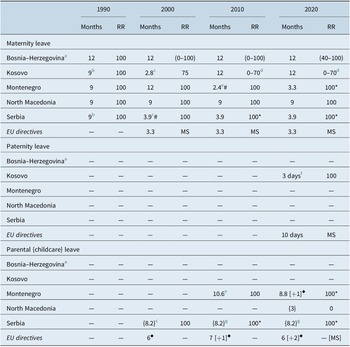
Yet, there were differences between the republics starting from the 1970s, and some developed more extensive leave policies. This practice was less pronounced in southern republics, and among these only Bosnia and Herzegovina made progress towards that goal, together with Croatia and Slovenia, by introducing a well-paid 1-year maternity leave, exceeding the general Yugoslav minimum (Table 1). The leave policy development of WBCs also differed from other socialist countries as they did not resort to the practice of introducing extended, typically 3-year long and poorly paid “childcare leave” on top of short and well-paid maternity leave (Dobrotić & Stropnik, Reference Dobrotić and Stropnik2020). It also differed from western European countries, which were frontrunners in introducing parental and paternity leaves, bringing more gender-sensitive leaves (Daly & Ferragina, Reference Daly and Ferragina2018), both entitlements still largely absent in WBCs (Table 1).
Parenting leaves in the Western Balkans, 1990–2020 (first child; employment-based rights if eligibility criteria are met).

Notes: Maternity leave must start 28 days before childbirth. RR, replacement rate (% of previous earnings); [], non-transferable leave; {}, childcare leave, that is, leave introduced in addition to maternity leave, defined as primarily mothers’ right transferrable to fathers; *, there is a ceiling on leave benefit (in 2020: two average wages in Montenegro and three average wages in Serbia); #, redistribution of leave rights between maternity and childcare/parental leave; ♦, parental leave is an individual right; MS, benefit level is defined by member states (in the case of paternity leave it cannot be lower than sick pay).
a Leave benefits’ decentralisation in the 1990s;
b In 1992–1996 period, leave duration was 12 months only for the first and second child, 24 months for the third child and 9 months for fourth and every subsequent child; in the 1997–2001, period leave duration for the third child was 24 months;
c 2001 data;
d 6 months of leave is paid 70% and 3 months of leave 50% of previous earnings, while 3 months of leave are unpaid;
e 2011 data;
f Fathers are also entitled to 2 weeks of unpaid leave;
g Since 2005 leave for the third and every subsequent child is 20.2 months (since 2018 available only to parents in “standard” employment, that is, self-employed and occasionally employed or farmers are not entitled).
ECEC systems also started to develop in the socialist period; however, services remained underdeveloped, providing access to affordable ECEC primarily to dual-earners in more developed (ie. urban) areas (Dobrotić, Reference Dobrotić2019). Only 23 per cent of children aged 3–6 participated in the ECEC programs in Yugoslavia in 1990, much less than 75 per cent in the Czech Republic and Slovakia or 85 per cent in Hungary (Zrinščak, Reference Zrinščak2002). The enrolment rates also varied among the republics; for example, estimates based on 1990 data show that these ranged from only 7.7 per cent of children aged 0–6 in Bosnia–Herzegovina to 19.9 per cent in Serbia (Dobrotić, Reference Dobrotić2019).
Post-1990 reforms favouring pronatalist and cost-containment measures
After 1990, WBCs’ policies further diverged, clearly reflecting the circumstances each country has been facing after the dissolution of Yugoslavia and in the process of state- and nation-building. Two abrupt shifts challenged their employment-oriented work-care policies inherited from the socialist period. First, a societal re-traditionalisation – a “return” to the “traditional and hetero-normative, patriarchal pre-socialist past” (Pavasović Trošt & Slootmaeckers, Reference Pavasović Trošt, Slootmaeckers, Sremac and Ganzevoort2015, p. 158) – often supported by explicit pronatalist agenda interwoven with an explicit (ethnicised) nationalist discourse (Shiffman, Škrabalo, & Subotić, Reference Shiffman, Škrabalo and Subotić2002), which has triggered reform proposals aimed at women’s redomestificaton (Dobrotić & Obradović, Reference Dobrotić and Obradović2020; Kotevska, Reference Kotevska2019; Perišić & Vidojević, Reference Perišić and Vidojević2015). Second, a process of transition from a socialist to a capitalist regime coupled with penetration of neoliberal ideas (Stambolieva, Reference Stambolieva2016), which only aggravated a wide range of social problems, and growing demands to reform most of the social policy areas became quickly faced with limited state capacities to address them. Moreover, in countries strongly affected by the 1990s wars the state’s limited (re)distributional capacities only exacerbated due to a need to take care of a large population of refugees and displaced persons and address newly emerging demands of large groups of war veterans requesting various social rights (Deacon & Stubbs, Reference Deacon and Stubbs2007; Stubbs & Zrinščak, Reference Stubbs, Zrinščak, An, Chubarova, Deacon and Stubbs2019).
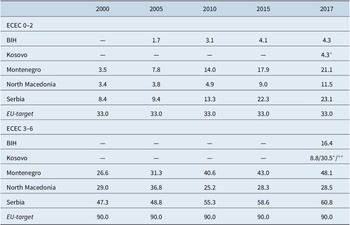
Under these circumstances, the focus was primarily on political and economic reforms backed up by international financial organisations (eg. World Bank; International Monetary Fund), which demanded “less state” and lacked a gender perspective (Bracewell, Reference Bracewell2000; Deacon & Stubbs, Reference Deacon and Stubbs2007; Dobrotić, Matković, & Zrinščak, Reference Dobrotić, Matković and Zrinščak2013; Mustafa, Reference Mustafa2021). In a newly set conservative and liberal market discourse, the official socialist gender equality agenda of “facilitating women’s (secondary) participation in the labour market” (Dobrotić & Stropnik, Reference Dobrotić and Stropnik2020, p. 496) became questioned, including the dual-earner norm embedded in the socialist policy design. When put on the political agenda, “inherited” work-care policies were primarily connected with pronatalist goals, with a policy response to negative socio-demographic trends being seen in familistic measures such as extended maternity leaves and/or cash-for-care benefits, especially for families with more children, while investments in new ECEC capacities were marginalised (Dobrotić, Reference Dobrotić2019; Dobrotić & Obradović, Reference Dobrotić and Obradović2020; Shiffman, Škrabalo, & Subotić, Reference Shiffman, Škrabalo and Subotić2002). More visible progress regarding ECEC availability could be seen in Montenegro and Serbia (Table 2), primarily driven by recent international organisations’ organisational and financial support (Perišić & Pantelić, Reference Perišić and Pantelić2021; Prica, Čolić, & Baronijan, Reference Prica, Čolić and Baronijan2014). Still, ECEC capacities remained underdeveloped in all WBCs, with children of parents with weak attachment to the labour market and of lower socioeconomic status as well as those living in less developed areas (typically rural and depopulated) being typically left out of the system (Prica, Čolić, & Baronijan, Reference Prica, Čolić and Baronijan2014; UNICEF, 2012).
ECEC enrolment rates in Western Balkan countries 2000–2020.

* 2019/2020 data;
** Short school preparatory programs are included (see Mustafa, Reference Mustafa2021).
In the end, due to limited fiscal capacities but also a lack of political will for comprehensive reforms (eg. Obradović, Reference Obradović2021), WBCs kept most of the characteristics of policy design inherited from the socialist period. Post-1990 reforms primarily affected parenting leaves, layering them with pronatalist and cost-containment policy elements. Most WBCs have been “experimenting” with different pronatalist measures aiming to postpone or limit women’s participation in the labour market; however, these were of more limited character than initially foreseen as they were subject to often revisions or withdrawal due to financial constraints (eg. 2-year maternity leave and a “lifetime monthly allowance” for mothers with three or more children in Montenegro, Dobrotić, Reference Dobrotić2019).Footnote 4 Currently, only Serbia provides both an extended, well-paid 2-year leave to employed – but not to self-employed or occasionally employed – parents with three or more children and a universal parental allowance for the third and fourth child paid through the period of 10 years (a flat-rate benefit amounting around 20 and 30 per cent of the average net salary per month, respectively; Dobrotić, Reference Dobrotić2021). Mothers of three or more children become entitled to extended maternity leave – until the child turns 18 months – also in Republika Srpska and District Brčko in Bosnia–Herzegovina (Dobrotić & Obradović, Reference Dobrotić and Obradović2020), while a parental allowance introduced in North Macedonia in 2010 (57.7 per cent of the minimum wage paid monthly through 10 years) that was initially conditioned only by the birth of the third child was redefined into a means-tested benefit in 2019 (Gerovska Mitev, Reference Gerovska Mitev2017; MISSCEO, 2021).
Cost-containment reforms (in)directly affecting leave benefits were prominent in all WBCs. Bosnia and Herzegovina and Kosovo were most affected due to a discontinuity with the rights inherited from the socialist period. More precisely, maternity leave benefits in Bosnia and Herzegovina were decentralised in the 1990s, and they ceased to exist in some cantons of the Federation of BiH, producing large territorial inequalities in fundamental maternity rights. Only some cantons continued to provide maternity benefits previously paid by the state, while others took almost 20 years to re-establish maternity benefits (eg. Posavski Canton in 2015, and Herzegovina-Neretva Canton in 2017). Also, maternity benefits levels in the Federation of BiH decreased with decentralisation, as nowadays they typically range from 40 to 80 per cent of the previous salary (Dobrotić & Obradović, Reference Dobrotić and Obradović2020). Similarly, after an even more radical break with the socialist legacy in Kosovo, re-established maternity leaves in 2001 were also less generous (Table 1; cf. Mustafa, Reference Mustafa2021).
While parenting leaves were not a subject of important reforms in North Macedonia (only unpaid “childcare leave” was introduced; Table 1), Montenegro and Serbia took a more indirect root of cost-containment. Both countries introduced a ceiling on leave benefits – five average salaries since 2002 in Serbia to drop at three in 2018 and two average salaries in Montenegro since 2013 – affecting higher earners. Also, they gradually introduced stricter eligibility criteria for full leave benefits. That is, in the early 1990s, it was sufficient to be in employment at the time of childbirth to be eligible for full leave benefit – 100 per cent of the previous salary. However, nowadays, only parents with 12 (Montenegro) or 18 (Serbia) months of continuous insurance before the leave starts are eligible for full benefit, which negatively affects a growing number of parents with a weak connection to the labour market. Namely, the post-1990 economic liberalisation, dovetailing with the deregulation in the labour market, contributed to an increase in precarious employment (Eurostat, 2021b; Perišić & Vidojević, Reference Perišić and Vidojević2015) and a growing number of parents being ineligible for (decently) paid leaves. The adverse outcomes of these reforms have been to some extent “buffered” in Montenegro through citizenship-based leave entitlements introduced in the early 1990s (ie. flat-rate leave benefits aimed at unemployed parents), which is not the case in Serbia where citizenship-based leave benefits were withdrawn in the early 2000s, as was the minimum leave benefit in 2018 (Dobrotić, Reference Dobrotić2019, Reference Dobrotić2021). Finally, both countries restructured leave policies in the early 2000s. However, only Montenegro aligned with the 2010 Parental Leave Directive and implemented an individual right to parental leave (Table 1), including 1 month of well-paid non-transferable parental leave having a gender equalising potential (Dobrotić & Stropnik, Reference Dobrotić and Stropnik2020).
Therefore, the EU employment-oriented work-care policy framework has met mother-centred and stratifying leave policies and underdeveloped ECEC network in all WBCs providing ample space for improvements in relation to gender imbalance in care and employment. Yet, there are also challenges associated with it, as discussed in the next section which addresses WBCs’ work-care policies fit (or misfit) with the EU policy framework as one of the crucial factors of accession compliance.
The Western Balkans’ work-care policies fit–misfit with the EU legal and policy framework
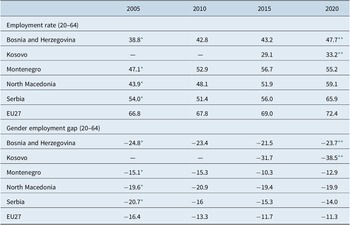
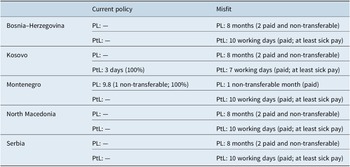
In assessing recent Economic Reform Programmes of WBCs, the European Commission raised the issue of the meagre participation of women in formal labour markets, that is, a persistent gender employment gap (Table 3), identifying low availability of childcare (and eldercare) services as one of the crucial obstacles to (higher) women’s participation in the labour market and calling for additional investments in the care sector. The structure of leave policies, including their gendering and stratifying character, has not been explicitly questioned (European Commission, 2019, 2021b). The latter is not surprising, as alignment with EU directives would primarily imply improved fathers’ entitlements (Table 4) and in earlier postsocialist enlargement waves, similar substantive compliance-related changes in normative areas – including gender issues perceived as those having a potential to interfere in the private sphere – were added to the EU negotiation agenda quite late, when they entered their final phase (cf. Dobrotić, Matković, & Zrinščak, Reference Dobrotić, Matković and Zrinščak2013). Therefore, the misfit with the EU legal framework (Table 4) may provide an important push factor towards introducing (and discussing) more gender-equalising leave entitlements in all WBCs, in particular by adding an individual right to non-transferable parental leave and paternity leave to their leave policy design, as was already the case in Montenegro (cf. Table 1), and in Slovenia and Croatia in their enlargement processes (Dobrotić & Stropnik, Reference Dobrotić and Stropnik2020). However, due to uncertainty about the EU membership prospects (O’Brennan, Reference O’Brennan2014), this could also imply a long road to introducing fathers’ entitlements with their attendant capacity to challenge inequalities in the private sphere and labour market.
Employment rate (20–64) and gender employment gap (20–64) in the Western Balkans (2005–2020).

* 2006 data;
** 2018 data.
Fit–misfit of paternity and parental leaves with the Work–Life Balance Directive.

Abbreviations: PL, parental leave; PtL, paternity leave.
Moreover, the gender-equalising potential of leave policy will largely depend on the compliance modality, which may be the subject of resistance to more substantive gender-equality-oriented developments. Namely, as pointed out earlier, the decision on the level of payment for earmarked months of parental leave is entirely left to member states, while paternity leave benefits may be subject to a ceiling. Nevertheless, adding paid paternity leave to the design of current leave policies, as well as the restructuring of current well-paid maternity and childcare leave provisions of moderate length as in the case of Montenegro (cf. Tables 1 and 4), could be a positive development. It could bring well-paid fathers-only entitlements and challenge current equality-impeding leaves, that is, mother-centred leaves that contribute to (maintaining) a gendered division of care work (Brighouse & Wright, Reference Brighouse and Wright2008; Dobrotić & Stropnik, Reference Dobrotić and Stropnik2020). Still, within a context marked by traditional gender norms, this solution, and particularly the incorporation of exclusive fathers’ entitlements (ie. two non-transferable leave months) within the already existing months of maternity leaves, may face resistance. For example, such resistance has occurred in two Yugoslav successor-states – Croatia and Slovenia – that have had stronger feminist movements than WBCs. It was stressed that this could reduce mothers’ rights (Dobrotić, Reference Dobrotić2012; Korintus & Stropnik, Reference Korintus, Stropnik, Kamerman and Moss2009).
In the end, both countries added exclusive fathers’ entitlements on top of already existing leave provisions – Slovenia a 1-month paternity leave and Croatia 2-month non-transferable parental leave. However, fathers’ entitlements are well-paid only in Slovenia, resulting in four-fifths of fathers taking around 15 days leave and over half taking on average 25 days of paternity leave (Stropnik, Reference Stropnik, Koslowski, Blum, Dobrotić, Kaufman and Moss2021). In contrast, in Croatia, fathers account for only 4.3 per cent of all parental leave taken (Ombudsperson for Gender Equality, 2020), bringing a considerable gap between legislative compliance and actual practices. A low ceiling on parental benefit is stressed as one of the main obstacles to fathers’ leave-taking, besides an unsupportive working environment and a dominant perception of fathers as “secondary carers” (Varga, Reference Varga2021). Importantly, all Croatian governments stressed fiscal constraints as an obstacle for improving fathers’ entitlements, which could be even more so in WBCs with their lower social expenditures (eg. 14.5 per cent of GDP in North Macedonia compared to 19.7 per cent in Croatia; Eurostat, 2021a).
There is also a risk of adverse effects such as deepening the so-called Matthew effect (Cantillon & Van Lancker, Reference Cantillon and Van Lancker2013) already inherent in the work-care policy design in WBCs favouring parents in stable employment (especially dual-earners). Namely, as pointed out above, the Work–Life Balance Directive primarily foresees better rights of parents in “standard” employment and with a stable attachment to the labour market, which may divert the policy focus away from the growing number of parents in precarious employment and, therefore, additionally reduce their access to adequate leave benefits and affordable ECEC services. This may also affect those parents not participating in the labour market who also face a lack of opportunities to engage in weak (formal) labour markets (Dobrotić, Reference Dobrotić2021).
While investments in public ECEC facilities, if further boosted through EU funds, may facilitate all parents’ (ie. mothers) opportunities to engage in the labour market; these would need to be of a larger scale to meet the substantial needs (cf. Table 2) and leave the practice of enrolment criteria favouring dual-earners that primarily improves the situation of those better off (Dobrotić, Reference Dobrotić2021; Mustafa, Reference Mustafa2021; Prica, Čolić, & Baronijan, Reference Prica, Čolić and Baronijan2014). Moreover, to address the Matthew effect, ECEC affordability – besides ECEC availability put at the centre of EU recommendations – would need greater attention which is also at odds in the region due to a growing practice of ECEC expansion relying on the (subsidised) market. For example, Kosovo’s recent experience of developing new ECEC capacities primarily via market-based provision clearly illustrates this risk, as this development mainly left social groups such as low-income families, or rural families without adequate access to affordable ECEC (Mustafa, Reference Mustafa2021). Finally, governance issues may also hinder progress towards better work-care policies in WBCs, as illustrated by the experience of Bosnia and Herzegovina with its territorially and functionally highly fragmented system, as well as other countries in the region (Dobrotić & Obradović, Reference Dobrotić and Obradović2020; Mustafa, Reference Mustafa2021; Obradović, Reference Obradović2021).
Conclusion
This article has explored the development of work-care policy in WBCs, providing insight into the potential of the EU policy framework to (re-)shape their work-care policy priorities and facilitate gender equality in employment and care. In their recent assessments of WBCs’ Economic Reform Programmes, the European Commission has explicitly raised an issue of very low female employment in those countries, calling for employment-enabling policies. While the EU may provide an important legitimising source for increased investments in work-care policiesFootnote 5 and strengthen their gender equalising potential, WBCs also face some severe challenges in developing effective policies in this area.
One set of challenges relates to the EU’s policy framework itself. Recent EU policy developments have been positive in different ways (see Chieregato, Reference Chieregato2020; Rigby, Reference Rigby2020), but are still primarily built on a “typical adult worker” blueprint. At the same time, there is growing evidence that policies built around an employment-first imperative are not working well for all parents (Cantillon & Van Lancker, Reference Cantillon and Van Lancker2013; Ghysels & Van Lancker, Reference Ghysels and Van Lancker2011; Pavolini & Van Lancker, Reference Pavolini and Van Lancker2018). They tend to exclude different groups of parents such as self-employed or precarious workers (Dobrotić & Blum, Reference Dobrotić and Blum2020). Besides, the issue of coherence between different policy instruments (eg. parenting leaves and ECEC) – crucial for a “sustainable relationship between care, employment and gender” (Moss & Deven, Reference Moss and Deven2020, p. 434) – is still unchallenged (eg. the childcare-gap). The same holds for coherence between different levels of provision (eg. state, regional and employers). Finally, the EU work-care policy framework continues to be ambiguous, opening a space for different compliance patterns in member states and producing different outcomes, not necessary equalising ones, among and within countries. The latter is not surprising as the history of the adoption of EU directives regulating parenting leaves has taught us how contentious changes can be and how reaching a consensus on minimum standards can be limited by various political, structural and normative factors inherent to member states (cf. de la Porte, Larsen, & Szelewa, Reference de la Porte, Larsen and Szelewa2020; Dobrotić, Matković, & Zrinščak, Reference Dobrotić, Matković and Zrinščak2013). Yet, it has also taught us that changes in the direction of more comprehensive common standards are possible. However, a more ambitious agenda is needed, including a critical assessment of the EU work-care policy framework, which should be more considerate of multiple and intertwined inequalities in employment and care (eg. differences among member states and regions, the proliferation of precarious forms of work among certain groups of women, see Spasova et al., Reference Spasova, Bouget, Ghailani and Vanhercke2017), and a more comprehensive approach to policy implementation (eg. a stronger focus on monitoring and supporting policy implementation).
The second set of challenges, related to meeting EU requirements and improving work-care policies independently, is related to WBCs themselves. First, gender equality-oriented policies have not been central in WBCs in recent decades, and gender inequalities associated with the division of work and care are not widely acknowledged. Moreover, these countries have been exposed to anti-gender narratives and a wave of re-traditionalisation, which has negatively affected the development of work-care policies. Second, the high degree of uncertainty about future political developments and the prospects for EU membership could also slow down the reforms in this field if substantive compliance-related changes in normative areas (typically faced with strong resistance) are added to the EU negotiation agenda in the final phases, as with previous postsocialist enlargement waves (see Dobrotić, Matković, & Zrinščak, Reference Dobrotić, Matković and Zrinščak2013). Third, weak fiscal capacities may also undermine the already weak legitimacy of the gender equality agenda.
While fit–misfit with the EU policy framework is notable, and this may challenge equality-impeding parenting leaves (see Dobrotić & Stropnik, Reference Dobrotić and Stropnik2020), it can also bring minimum adjustments (eg. poorly paid parental leaves) with only limited capacities to improve women’s position in employment and care. Besides, as the EU framework is doing little to challenge socially stratified patterns of use of different work-care policy instruments, there is also a risk that WBCs will continue to prioritise the support for dual-earner families in stable employment. In combination with weak fiscal capacities, but also the acceptance of neoliberal policies that open a growing space to the market in the care provision, this could lead to a neglect of the needs of vulnerable parents lacking resources or those who are unable to enter the fragile labour markets. In turn, this could hamper progress towards more inclusive work-care policies that would benefit all parents (see Dobrotić & Blum, Reference Dobrotić and Blum2020; Doucet, Reference Doucet2021).
Instead, what is needed is to create better opportunities for care and employment of different groups of parents by developing inclusive and degenderising work-care policies. In the face of growing non-standard employment, work-care policies “need to be disentangled, at least partially, from the labour market [… and approached] as both work and care policies” (Doucet, Reference Doucet2021, p. 234), providing all parents with well-paid leaves and affordable ECEC irrespective of forms or previous length of their employment, but also “citizenship, or other criteria based on family, gender, or further personal characteristics” (Blum & Dobrotić, Reference Blum and Dobrotić2021, p. 223). Besides, work-care policies aiming to bring substantive gender equality would put a stronger focus on well-paid fathers’ leave entitlements and similar measures addressing unequal redistribution of unpaid work and questioning an androcentric bias in the labour market.
Disclosure statement
The author declares none.
Notes on contributors
Ivana Dobrotić is an Associate Professor of Comparative Social Policy at the University of Zagreb and an Associate Member of the Department of Social Policy and Intervention at the University of Oxford where she recently completed a Marie Skłodowska-Curie Individual Fellowship. Her research interest is in the field of comparative social policy, with a particular interest in care and paid work, gender, social and spatial inequalities. She is a Steering Committee member of the ECPR Standing Group on Gender and Politics and co-editor of the Annual Review of Leave Policies & Related Research.
Acknowledgement
The research is part of the project that has received funding from the European Union’s Horizon 2020 research and innovation programme under grant agreement no. 786826.