Depression represents a substantial public health problem in the United States. The 12-month prevalence rate of depressive disorders ranges from 14% to 22% in youth and adults (Kessler, Petukhova, Sampson, Zaslavsky, & Wittchen, Reference Kessler, Petukhova, Sampson, Zaslavsky and Wittchen2012). Depressive symptoms, at subthreshold and full syndrome levels of severity, are associated with significant psychiatric and medical comorbidities, severe role impairments, and premature mortality (Haarasilta, Marttunen, Kaprio, & Aro, Reference Haarasilta, Marttunen, Kaprio and Aro2005; Rohde, Lewinsohn, Klein, Seeley, & Gau, Reference Rohde, Lewinsohn, Klein, Seeley and Gau2012; Whiteford et al., Reference Whiteford, Degenhardt, Rehm, Baxter, Ferrari, Erskine and Johns2013). Adolescence and emerging adulthood serve as high-risk developmental periods for the emergence and exacerbation of depressive symptoms (Kessler et al., Reference Kessler, Petukhova, Sampson, Zaslavsky and Wittchen2012). It is, therefore, crucial to focus on factors linked to depressive symptoms during adolescence and emerging adulthood, as the clinical implications have the potential to maximize public health benefits.
Coping and Depressive Symptoms
Coping is a multidimensional construct that broadly refers to how individuals respond to stressors. Stressors encompass physiological and psychological events that place an excessive demand on the body and its resources; the nature of stressors may be either negative (e.g., interpersonal conflict) or positive (e.g., promotion at work; Selye, Reference Selye2013). Coping with stressors often involves automatic biological responses, including activation of the autonomic nervous system (sympathetic and parasympathetic responses) or hypothalamus–pituitary–adrenal axis (Selye, Reference Selye2013). Coping also involves psychological responses that may be involuntary (e.g., attention biases) or voluntary and purposeful (e.g., seeking advice; Compas, Connor-Smith, Saltzman, Thomsen, & Wadsworth, Reference Compas, Connor-Smith, Saltzman, Thomsen and Wadsworth2001; Lazarus & Folkman, Reference Lazarus and Folkman1984; Selye, Reference Selye2013). For the purposes of the current study, coping has been operationally defined as intentional, effortful psychological strategies used to manage negative stressful events or problems and regulate related emotions, cognitions, and behaviors (Compas et al., Reference Compas, Connor-Smith, Saltzman, Thomsen and Wadsworth2001; Lazarus & Folkman, Reference Lazarus and Folkman1984). Intentional psychological coping strategies were the focus of this study because they are more readily modifiable and, therefore, may yield particularly potent clinical implications.
The experience of stressful events and related distress has been closely linked to depressive symptoms (Beardslee, Gladstone, & O'Connor, Reference Beardslee, Gladstone and O'Connor2012; Hammen, Reference Hammen2005; Hankin et al., Reference Hankin, Oppenheimer, Jenness, Barrocas, Shapero and Goldband2009; Liu & Alloy, Reference Liu and Alloy2010). As such, it is not surprising that coping has been a central tenet of many psychological conceptualizations of depression etiology, including diathesis–stress models (Abramson, Metalsky, & Alloy, Reference Abramson, Metalsky and Alloy1989; Ingram & Luxton, Reference Ingram and Luxton2005; Lazarus & Folkman, Reference Lazarus and Folkman1984), cognitive behavioral theories (Beck, Brown, Steer, Eidelson, & Riskind, Reference Beck, Brown, Steer, Eidelson and Riskind1987; Hayes, Reference Hayes2004), and emotion regulation models (Mennin, Holaway, Fresco, Moore, & Heimberg, Reference Mennin, Holaway, Fresco, Moore and Heimberg2007; Nolen-Hoeksema, Wisco, & Lyubomirsky, Reference Nolen-Hoeksema, Wisco and Lyubomirsky2008). There are model differences with regard to their emphasis on specific coping strategies and mechanisms through which coping impacts depressive symptoms. Yet, common to all approaches is the notion that the effective use of coping strategies serves as the primary means through which the adverse effects of stressors on mood can be amplified, reduced, or prevented. Individuals who use maladaptive or ineffective coping strategies to manage stressors are hypothesized to experience the onset or exacerbation of depressive symptoms. By contrast, those who use adaptive strategies or more effectively implement coping strategies in response to stress are hypothesized to experience reductions in their depressed mood or be protected from the onset or worsening of depressive symptoms.
Conversely, depression itself may give rise to stressors and influence the selection and use of coping strategies. There is consistent evidence in youth and adults to support the stress generation hypothesis (Liu & Alloy, Reference Liu and Alloy2010), which purports that individuals with elevated depressive symptoms have personal characteristics (e.g., negative inferential styles, excessive dependency, and reassurance seeking) that influence them to behave in ways that produce negative stressful events (Hammen, Reference Hammen2006). These cognitive and interpersonal vulnerabilities also have been shown to bias depressed individuals toward the use of maladaptive coping strategies over more adaptive ones, which then may result in additional stressors (Hamilton et al., Reference Hamilton, Stange, Shapero, Connolly, Abramson and Alloy2013; McLaughlin & Nolen-Hoeksema, Reference McLaughlin and Nolen-Hoeksema2012; Rose, Glick, Smith, Schwartz-Mette, & Borowski, Reference Rose, Glick, Smith, Schwartz-Mette and Borowski2016). Depressed individuals attempting to cope with heightened stress also may be more likely to use maladaptive coping strategies because they often require fewer personal resources to enact relative to adaptive strategies that are inconsistent with their depressed mood. Overall, depressive symptoms appear to elicit the selection of maladaptive coping strategies, which may then serve to exacerbate depressive symptoms further in a cyclical pattern.
Synthesizing the extant literature focusing on the relationship between coping and depressive symptoms is challenging because no consensus has emerged regarding the most theoretically and empirically appropriate method to distinguish among coping strategies (Compas et al., Reference Compas, Connor-Smith, Saltzman, Thomsen and Wadsworth2001; Fields & Prinz, Reference Fields and Prinz1997; Skinner, Edge, Altman, & Sherwood, Reference Skinner, Edge, Altman and Sherwood2003; Zimmer-Gembeck & Skinner, Reference Zimmer-Gembeck and Skinner2011). Coping often has been conceptualized in terms of broad dimensions with two or three factors, such as problem- and emotion-focused coping (Folkman & Lazarus, Reference Folkman and Lazarus1980) or active, internal, and avoidant coping (Seiffge-Krenke, Reference Seiffge-Krenke1995), among others. Coping dimensions may be useful for characterizing overarching stress responses. However, the reliance on broad dimensions is limited because it fails to capture the complexity of subtypes of coping strategies that may differ in their motivation, purpose, application, and outcome (Compas et al., Reference Compas, Connor-Smith, Saltzman, Thomsen and Wadsworth2001; Fields & Prinz, Reference Fields and Prinz1997; Zimmer-Gembeck & Skinner, Reference Zimmer-Gembeck and Skinner2011). Research focusing instead on the relationship between more specific, individual coping strategies and depressive symptoms, therefore, allows for a nuanced understanding of these processes and more targeted intervention recommendations.
The findings from prior studies that examine specific coping strategies identify a number of adaptive and maladaptive strategies related to depressive symptoms in adolescents and emerging adults (Aldao, Nolen-Hoeksema, & Schweizer, Reference Aldao, Nolen-Hoeksema and Schweizer2010; Cairns, Yap, Pilkington, & Jorm, Reference Cairns, Yap, Pilkington and Jorm2014). An excessive focus on one's emotions and their causes and consequences, which may manifest cognitively as rumination or behaviorally as venting to others, consistently has been associated with greater depressive symptoms with large effect sizes (Malooly, Flannery, & Ohannessian, Reference Malooly, Flannery and Ohannessian2017; Nolen-Hoeksema, Reference Nolen-Hoeksema2000; Schwartz-Mette & Smith, Reference Schwartz-Mette and Smith2016). These emotion-focused coping strategies have demonstrated the strongest links to depressive symptoms in comparison to other maladaptive and adaptive strategies (Aldao et al., Reference Aldao, Nolen-Hoeksema and Schweizer2010). Among the range of avoidance strategies, greater use of the cognitive suppression of unwanted thoughts or emotions (e.g., denial that a stressful situation has occurred) has emerged as a robust risk factor for elevated depressive symptoms and vice versa (Blalock & Joiner, Reference Blalock and Joiner2000; Mahmoud, Staten, Hall, & Lennie, Reference Mahmoud, Staten, Hall and Lennie2012; Sontag & Graber, Reference Sontag and Graber2010). Medium to large effect sizes in the associations between suppression and depressive symptoms consistently have been found in adolescents and adults (Aldao et al., Reference Aldao, Nolen-Hoeksema and Schweizer2010). In general, the relationship between maladaptive coping strategies and depressive symptoms has been more consistent and stronger in magnitude relative to adaptive coping strategies (Aldao et al., Reference Aldao, Nolen-Hoeksema and Schweizer2010; Cairns et al., Reference Cairns, Yap, Pilkington and Jorm2014).
Despite somewhat smaller effects than maladaptive strategies, the use of several adaptive coping strategies also has been associated with fewer depressive symptoms. Specifically, more frequent use of coping strategies oriented toward resolving stressful situations directly, which include both making plans to solve the problem and actively addressing the problem, have been linked to having fewer depressive symptoms (Aldao et al., Reference Aldao, Nolen-Hoeksema and Schweizer2010; Dunbar et al., Reference Dunbar, McKee, Rakow, Watson, Forehand and Compas2013; Sontag & Graber, Reference Sontag and Graber2010). The associations between these problem solving-oriented strategies and depressive symptoms generally exhibit medium to large effect sizes, and represent the most robust links with depressive symptoms relative to other adaptive strategies (Aldao et al., Reference Aldao, Nolen-Hoeksema and Schweizer2010; Cairns et al., Reference Cairns, Yap, Pilkington and Jorm2014). In addition, more frequent seeking out support from others for both emotional and instrumental reasons has been associated with fewer depressive symptoms with small to medium effect sizes observed (Cicognani, Reference Cicognani2011; Malooly et al., Reference Malooly, Flannery and Ohannessian2017; Rueger, Malecki, Pyun, Aycock, & Coyle, Reference Rueger, Malecki, Pyun, Aycock and Coyle2016). Finally, the greater use of humor to cope with negative stressful events has been associated with fewer depressive symptoms with generally small effect sizes (Erickson & Feldstein, Reference Erickson and Feldstein2007; Malooly et al., Reference Malooly, Flannery and Ohannessian2017).
These findings illuminate specific coping strategies that are closely linked to depressive symptoms among adolescents and emerging adults. Although most studies have been cross-sectional, there is some support for bidirectional effects between the use of these specific coping strategies and depressive symptoms (Cairns et al., Reference Cairns, Yap, Pilkington and Jorm2014; Liu, Reference Liu2013). Moreover, there are distinctions among coping strategies with regard to the magnitude and/or direction of their relationship to depressive symptoms. However, little is known about how the relationship between the coping strategies described above and depressive symptoms changes throughout these high-risk developmental periods.
Role of Developmental Factors
Coping is widely acknowledged to be an ongoing dynamic process that changes across the life span (Compas et al., Reference Compas, Connor-Smith, Saltzman, Thomsen and Wadsworth2001; Fields & Prinz, Reference Fields and Prinz1997; Zimmer-Gembeck & Skinner, Reference Zimmer-Gembeck and Skinner2011). Yet, there has been little theory devoted to elucidating developmental changes in the relationship between coping and psychological adjustment. An improved understanding of age-related differences in the association between specific coping strategies and depressive symptoms is important for providing insight into the evolving nature and effects of voluntary, psychological stress responses across adolescence and emerging adulthood. This knowledge also may encourage theories involving depression and coping to consider developmental factors, as existing models assume that underlying mechanisms involved in the relationship between coping and depressive symptoms remain static over time when this does not likely occur in reality. Finally, elucidating how the relationship between coping strategies and depressive symptoms changes across age has the potential to advance practice by facilitating the design of age-appropriate intervention strategies for coping with stressors and depressive symptoms.
Coping has been conceptualized as being highly flexible and continuously changing based on the unique demands of the stressful situation and resources available to the individual (Fields & Prinz, Reference Fields and Prinz1997; Lazarus & Folkman, Reference Lazarus and Folkman1984). Differences between adolescents and emerging adults in the primary sources of stress, social contexts, and controllability of stressors likely compels the use of different coping strategies (Ryan-Wenger, Reference Ryan-Wenger1992). In addition, changes in brain structure and function throughout adolescence and emerging adulthood may facilitate the more effective use of adaptive coping strategies that rely on more complex cognitive and emotional processes (Somerville & Casey, Reference Somerville and Casey2010). As a result of experience and developmental advances, adults also tend to use a wider variety of coping strategies and report greater flexibility in their application relative to adolescents (Fields & Prinz, Reference Fields and Prinz1997; Zimmer-Gembeck & Skinner, Reference Zimmer-Gembeck and Skinner2011). Although it seems likely that developmental age contributes to the differential effectiveness of specific coping strategies, empirical work is needed to formulate a more nuanced theoretical framework that expands upon these broad developmental tenets.
Little research has focused on examining how the association between coping strategies and depressive symptoms may change as a function of age across adolescence and emerging adulthood. The only known study directly investigating age differences between youth and adults is a meta-analysis involving cross-sectional studies of specific coping strategies and depressive symptoms (Aldao et al., Reference Aldao, Nolen-Hoeksema and Schweizer2010). Age group was found to significantly moderate the strength of two coping–depressive symptom associations, as studies involving adults (18+ years) exhibited significantly larger effect sizes than those involving children or adolescents (7–17 years) for problem solving and suppression. However, the positive association between rumination and depressive symptoms yielded similar effect sizes across both youth and adult studies. These findings provide preliminary support for the notion that at least some specific coping strategies may exhibit differential links to depressive symptoms as a function of age. However, the broad characterization of only two age groups (i.e., youth vs. adults), while a necessity to conduct the moderator analyses, did not allow for more nuanced investigations to be made across distinct developmental periods. Furthermore, the creation of age groups imposes artificial constraints on the continuous construct of age, and may mask the emergence and disappearance of age-related differences that occur within or across these broadly defined developmental periods. Future work also would benefit from including additional coping strategies.
Role of Gender
Attention to potential gender differences in the relationship between coping strategies and depressive symptoms is necessary, as robust gender differences in depressive symptoms emerge during early to middle adolescence and then persist throughout the life span (Hankin, Wetter, & Cheely, Reference Hankin, Wetter, Cheely, Abela and Hankin2008). Specifically, females are diagnosed more often with depressive disorders, report more overall depressive symptoms, and experience greater increases in depressive symptoms during adolescence relative to males (Hankin, Reference Hankin2009; Twenge & Nolen-Hoeksema, Reference Twenge and Nolen-Hoeksema2002). Coping may contribute to gender differences in depressive symptoms through either mediating or moderating mechanisms (Hyde, Mezulis, & Abramson, Reference Hyde, Mezulis and Abramson2008).
The mediation pathway suggests that gender differences in the frequency of using certain coping strategies account for the presence of gender differences in depressive symptoms. In support of the mediation hypothesis, studies consistently have found that females report more frequent use of rumination, venting emotions, avoidance, and corumination when seeking social support than males, which, in turn, predict greater increases in depressive symptoms among females (Calmes & Roberts, Reference Calmes and Roberts2008; Hankin & Abramson, Reference Hankin and Abramson2002; Malooly et al., Reference Malooly, Flannery and Ohannessian2017; Seiffge-Krenke & Stemmler, Reference Seiffge-Krenke and Stemmler2002). Less empirical support has been found for the moderation pathway, which proposes that the relative impact of certain coping strategies on depressive symptoms differs between girls and boys even if they have a similar frequency of use. Studies investigating the moderation pathway have presented mixed results across a broad range of coping strategies (Auerbach, Abela, Zhu, & Yao, Reference Auerbach, Abela, Zhu and Yao2010; Galambos, Leadbeater, & Barker, Reference Galambos, Leadbeater and Barker2004; Kelly, Tyrka, Price, & Carpenter, Reference Kelly, Tyrka, Price and Carpenter2008; Nolen-Hoeksema & Aldao, Reference Nolen-Hoeksema and Aldao2011). These equivocal findings may stem from the existence of more nuanced developmental differences, and therefore research is required to evaluate whether gender differences in the relationship between coping strategies and depressive symptoms differ by age.
Developmental shifts in social factors, stress sensitivity, and the nature of stressors experienced by females and males suggest that gender differences in coping–depressive symptom associations may be greatest during middle to late adolescence and then dissipate into emerging adulthood. Social pressure to conform to culturally prescribed gender roles is heightened during early to middle adolescence as youth enter a phase of identity formation and increased peer salience (Flannery & Smith, Reference Flannery and Smith2016). As a result of these socialization processes, adolescent girls may be more likely to engage in emotion-focused strategies, such as rumination or venting emotions, and social support seeking in comparison to adolescent boys. The negative association between emotion-focused strategies and depressive symptoms may be stronger for adolescent girls relative to boys because of girls’ heightened physiological stressor sensitivity and emotional reactivity (Domes et al., Reference Domes, Schulze, Böttger, Grossmann, Hauenstein, Wirtz and Herpertz2010; Oldehinkel & Bouma, Reference Oldehinkel and Bouma2011). The relationship between support seeking and depressive symptoms may be more robust for girls relative to boys during adolescence because girls demonstrate enhanced physiological and emotional responses to interpersonal stressors and the interpersonal nature of stressors experienced more often by adolescent girls may be more amenable to social support seeking (Oldehinkel & Bouma, Reference Oldehinkel and Bouma2011; Rose & Rudolph, Reference Rose and Rudolph2006). However, such gender differences may disintegrate during emerging adulthood as pressures to conform to gender roles decrease and females and males begin to report more comparable levels of distress and stressor types (Haan, Reference Haan2013; Skinner & Zimmer-Gembeck, Reference Skinner, Zimmer-Gembeck and Wright2015). Furthermore, gender differences may be diminished during emerging adulthood as individuals adopt a wider variety of coping strategies and possess greater flexibility in their application (Fields & Prinz, Reference Fields and Prinz1997; Zimmer-Gembeck & Skinner, Reference Zimmer-Gembeck and Skinner2011).
The Present Study
Although numerous prior studies have identified specific coping strategies linked to depressive symptoms in adolescents and emerging adults separately, it remains unclear as to how and when the association between coping strategies and depressive symptoms emerges and evolves across developmental ages. The use of time-varying effect modeling (TVEM; Tan, Shiyko, Li, & Li, Reference Tan, Shiyko, Li and Li2012) may be especially appropriate to address this research question. TVEM is a novel statistical approach that allows for the investigation of the ways in which relationships between variables change over the course of time. TVEM is an extension of linear regression. Rather than estimating a single regression coefficient that assumes time is static, TVEM models a large number of bivariate regression coefficients between predictors and outcomes as a continuous function of any time metric, such as developmental age, historical time, and minutes relative to an event (Tan et al., Reference Tan, Shiyko, Li and Li2012). When applied to research questions in developmental psychopathology, TVEM can estimate how regression coefficients between predictors and psychological outcomes differ across developmental ages. As such, TVEM can be used to address questions about how hypothesized risk and protective factors are differentially associated with psychopathology at distinct ages throughout the life span. To date, TVEM has been used to examine age-varying associations between depressive symptoms and several other risk behaviors across adolescence and young adulthood (Evans-Polce, Vasilenko, & Lanza, Reference Evans-Polce, Vasilenko and Lanza2015; Russell, Vasilenko, & Lanza, Reference Russell, Vasilenko and Lanza2016; Vasilenko & Lanza, Reference Vasilenko and Lanza2014), but it has yet to be applied to coping.
We must note that TVEM does not make any assumptions about the nature of how the relationship between variables (i.e., regression coefficients) changes over time, enabling researchers to examine unique, nonparametric regression coefficient functions across time (Tan et al., Reference Tan, Shiyko, Li and Li2012). When using TVEM, therefore, it is unnecessary to impose preconceived age groups or make potentially inappropriate assumptions about how coping–depressive symptom associations may change as a continuous function of developmental age. This statistical flexibility presents a major advantage to other parametric approaches that impose strong assumptions about how change between predictors and outcomes may occur across different ages (e.g., linear), which may not be accurate to the true nature of how the relationship changes. Prior developmental studies applying TVEM to examine how the relationship between depressive symptoms and risk behaviors differ across adolescence and young adulthood all have identified nonparametric functions (Evans-Polce et al., Reference Evans-Polce, Vasilenko and Lanza2015; Russell et al., Reference Russell, Vasilenko and Lanza2016; Vasilenko & Lanza, Reference Vasilenko and Lanza2014). It may be likely, therefore, that the age-varying relationships between coping strategies and depressive symptoms also are nonparametric. Given the lack of developmental theory and empirical research in this area, it is critical to not impose restrictions on how coping–depressive symptom relationships may change across age to allow for the generation of novel developmental hypotheses in addition to specific hypothesis testing.
Aims and Hypotheses
Adolescence and emerging adulthood represent two high-risk periods for the onset and exacerbation of depressive symptoms. Given the close relationship between coping and depression and the central role of coping in theories of depression, it is vital to elucidate critical age windows during which the associations between specific coping strategies and depressive symptoms are strongest and intervention may be of greatest benefit. Therefore, the primary objective of the current study was to utilize TVEM to examine how the associations between coping strategies and depressive symptoms change dynamically throughout adolescence into emerging adulthood (ages 14–24) in a large, diverse community sample. It is difficult to generate specific age-related hypotheses due to the lack of existing developmental theories and empirical work, so hypotheses will be generated across broad developmental periods.
Based on preliminary evidence (Aldao et al., Reference Aldao, Nolen-Hoeksema and Schweizer2010), we broadly expected that the strength of the associations between planning, active problem solving, denial, and instrumental support seeking and depressive symptoms would be greater during emerging adulthood than in adolescence. These hypotheses align with developmental advances in executive functioning abilities throughout adolescence and early adulthood (Best & Miller, Reference Best and Miller2010), which may enable emerging adults to better strategize and implement active cognitive strategies and behaviors to manage stressors relative to younger adolescents. Emerging adults also are more likely than adolescents to experience stressors perceived as controllable as a result of shifting social contexts (Amirkhan & Auyeung, Reference Amirkhan and Auyeung2007), which may be more amenable to the use of coping strategies geared toward directly resolving problems (Carver, Scheier, & Weintraub, Reference Carver, Scheier and Weintraub1989).
We also hypothesized that the strength of the association between depressive symptoms and the coping strategies of focusing on and venting emotions, emotional support seeking, and humor would be similar across adolescence and emerging adulthood. These hypotheses stem from preliminary research suggesting that the use of emotion-focused coping strategies exhibit a comparable magnitude of effects on depressive symptoms in both youth and adults (Aldao et al., Reference Aldao, Nolen-Hoeksema and Schweizer2010). The use of these coping strategies also has been shown to emerge in childhood and to be implemented consistently throughout the life span, likely because they do not require sophisticated cognitive, emotional, and social abilities (Zimmer-Gembeck & Skinner, Reference Zimmer-Gembeck and Skinner2011). As such, the relationship of these coping strategies to depressive symptoms may be unlikely to change throughout adolescence and emerging adulthood.
As a secondary objective, gender differences in the age-varying associations between specific coping strategies and depressive symptoms were investigated across adolescence and emerging adulthood. Based on gender differences in socialization processes, emotional reactivity, and stressor types that emerge during adolescence, we hypothesized that the associations between venting emotions, emotional support seeking, and instrumental support seeking and depressive symptoms would be stronger among females relative to males during the adolescent period (Flannery & Smith, Reference Flannery and Smith2016; Oldehinkel & Bouma, Reference Oldehinkel and Bouma2011; Rose & Rudolph, Reference Rose and Rudolph2006). We also expected that these gender differences would not be observed during the emerging adulthood period due to developmental advances in social functioning, identity development, and acquisition and application of these coping strategies (Haan, Reference Haan2013; Skinner & Zimmer-Gembeck, Reference Skinner, Zimmer-Gembeck and Wright2015). We did not expect to observe gender differences at any age for denial, active coping, planning, and use of humor when considering prior findings and theory.
Methods
Participants
Participants were drawn from a longitudinal study of psychological adjustment with a community sample of adolescents (N = 1,251) that were assessed annually for 4 years during high school and once during emerging adulthood. Participants were recruited from seven public high schools in the Mid-Atlantic region of the United States. All adolescents who were enrolled full-time in the 9th and 10th grades were eligible for the study. There were no additional exclusion criteria. The mean age of participating adolescents at each assessment time point was as follows: 15.05 (SD = 0.78) years at Time 1, 16.15 (SD = 0.75) years at Time 2, 17.18 (SD = 1.12) years at Time 3, 18.06 (SD = 1.04) years at Time 4, and 22.64 (SD = 0.69) years at Time 5. At baseline, 53% of the sample identified as female. The racial/ethnic breakdown of the sample was as follows: 58% non-Hispanic White, 23% African American, 11% Hispanic, 3% Asian, and 5% other. Adolescents reported their parents’ highest level of education completed as follows: less than high school for 4% of mothers, 4% of fathers; high school for 39% of mothers, 45% of fathers; 2 years of college for 20% of mothers, 18% of fathers; 4 years of college for 27% of mothers, 25% of fathers; and graduate/medical school for 10% of mothers, 8% of fathers.
The overall combined sample consisted of individuals who provided data about their coping strategies and depressive symptoms in at least one time point of data collection (N = 1,251). Measurement occasions that occurred when participants were younger than age 14.0 or older than 24.0 at the time of assessment were excluded from analyses (n = 40) because there were too few available participants to provide reliable estimates and conduct TVEM analyses. All remaining available data across time points were analyzed simultaneously, resulting in 5,651 measurement occasions. By combining all time points of data and considering age in terms of the nearest month, sufficient information was available for every possible month across the ages of 14.0 to 24.0 years to provide a continuous measure of time.
Procedures
Data were collected at five assessment time points. Adolescents completed self-report surveys in school during the spring of 2006 (Time 1), 2007 (Time 2), 2008 (Time 3), and 2009 (Time 4). Parents provided informed consent and adolescents provided assent for their participation until age 18, at which time participants provided their own informed consent. Trained research personnel administered surveys to assenting adolescents, which took 40 min to complete. Participants were given a movie pass once they turned in their survey. A Certificate of Confidentiality was obtained to further protect the privacy of the participants. All procedures were approved by the University of Delaware Institutional Review Board.
Participants were contacted 5 years later in the spring of 2014 (Time 5) using contact information provided at Time 4. Participants completed an online Qualtrics survey that took 30 min to complete. Participants were mailed a $15 gift card upon submitting their survey. Participants provided informed consent immediately prior to completing the survey. Procedures were approved by the Connecticut Children's Medical Center Institutional Review Board.
Measures
Demographic information
A demographic questionnaire assessed participants’ gender, race/ethnicity, and month/year of birth. Age (in months) was calculated for participants at each time point by subtracting the participants’ date of birth from the date they completed the survey.
Coping strategies
The Coping Orientation to Problems Experienced (COPE) Inventory (Carver et al., Reference Carver, Scheier and Weintraub1989) assessed the dispositional use of rationally and empirically derived coping strategies. A subset of the COPE subscales were administered, including focusing on and venting emotions (Cronbach αFootnote 1 = 0.82; sample item: “I get upset and let my emotions out”), denial (Cronbach α = 0.81; sample item: “I pretend that it hasn't really happened”), active coping (Cronbach α = 0.78; sample item: “I take direct action to get around the problem”), planning (Cronbach α = 0.86; sample item: “I try to come up with a strategy about what to do”), humor (Cronbach α = 0.89; sample item: “I laugh about the situation”), use of emotional social support (Cronbach α = 0.87; sample item: “I talk to someone about how I feel”), and use of instrumental social support (Cronbach α = 0.82; sample item: “I try to get advice from someone about what to do”). Each COPE subscale consisted of four items. For each item, participants rated what they usually did and how they usually felt in response to stressful situations, with responses ranging from 1 (I usually don't do this at all) to 4 (I usually do this a lot). The four item responses for each subscale were summed to create subscale score, with higher scores indicating greater frequency of using each coping strategy (range = 4–16).
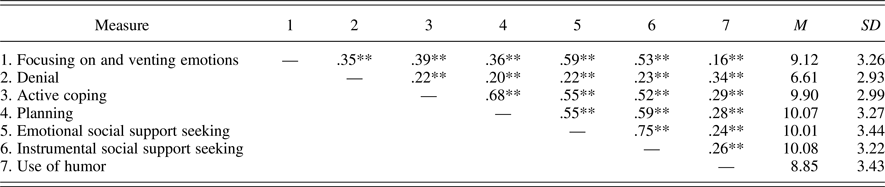
The COPE Inventory is a widely used measure of specific coping strategies and consistently has demonstrated good psychometric properties in adolescents and adults (Garcia, Reference Garcia2010; Kato, Reference Kato2015; Phelps & Jarvis, Reference Phelps and Jarvis1994). Each of the COPE subscales included in the present study previously has demonstrated adequate internal consistency and test–retest reliability. The COPE subscales in the current study demonstrated good internal consistency (Cronbach α = 0.78–0.89). The factor structure of the COPE subscales also has been replicated, and correlations among the COPE subscales (rs = .13–.69) suggest the presence of distinct coping constructs. In the current study, most of the COPE subscales exhibited small to moderate correlations with each other (see Table 1). Although stronger correlations were observed between the planning and active coping subscales (r = .68), as well as between the instrumental and emotional support seeking subscales (r = .75), they were not so robustly related as to indicate they were capturing identical coping constructs. The COPE also has demonstrated construct validity with other coping measures, as well as convergent and discriminant validity with measures of coping self-efficacy, perceived stress, and self-esteem (Garcia, Reference Garcia2010; Kato, Reference Kato2015; Phelps & Jarvis, Reference Phelps and Jarvis1994).
Correlations among COPE Inventory subscales

**p < .01.
Depressive symptoms
The Center for Epidemiological Studies Depression Scale (CES-D; Weissman, Orvaschel, & Padian, Reference Weissman, Orvaschel and Padian1980) assessed depressive symptoms. The CES-D is a 20-item self-report measure that asks participants to describe how they felt or acted during the past week. A sample item from the CES-D is “I feel sad.” Item response options range from 0 (not at all) to 3 (a lot). A total score is generated by summing the responses (range = 0–60). The CES-D is a widely used reliable and valid measure of depressive symptoms in adolescents and emerging adults (Garrison, Addy, Jackson, McKeown, & Waller, Reference Garrison, Addy, Jackson, McKeown and Waller1991). The Cronbach α coefficient was 0.91 in the current study, indicating excellent internal consistency.
Analytic plan
Analyses were conducted in SAS 9.3 (SAS Institute Inc.; Cary, NC) using TVEM, a novel statistical approach that utilized nonparametric spline regression to estimate dynamic associations between specific coping strategies and depressive symptoms as a continuous function of age (Tan et al., Reference Tan, Shiyko, Li and Li2012). All TVEMs in the current study used the p-spline estimation method, which automated the selection of the optimal regression coefficient functions and modeled within-subject effects for repeated measures data in a multilevel structure with measurement occasions (Level 1) nested within individuals (Level 2) to account for within-subject correlations of responses (Chiang, Rice, & Wu, Reference Chiang, Rice and Wu2001). The error variance also was allowed to vary across the time metric using the p-spline estimation method.
All measures were continuous and normally distributed, and therefore a normal, linear regression function was utilized in TVEMs. The time metric in all TVEMs was age calculated to the nearest month. Separate intercept-only TVEMs were estimated to examine the age trends in overall depressive symptoms and in the mean frequency of engaging in seven coping strategies. Subsequently, seven separate TVEMs were conducted to examine the age-varying associations between each coping strategy (predictors) and depressive symptoms (dependent variable in all analyses). In addition to these models with the full sample, comparable follow-up TVEMs were estimated for girls and boys separately to evaluate the presence of gender differences in the time-varying effects of coping and depressive symptom associations.
Gender was included as a time-invariant covariate in all models utilizing the full sample. Race/ethnicity also was considered as a time-invariant covariate, but it was not included as it did not significantly contribute to any models.
The SAS TVEM macro was used to fit the TVEMs (available for download at http://methodology.psu.edu; Brière, Janosz, Fallu, & Morizot, Reference Brière, Janosz, Fallu and Morizot2015). TVEM estimates a flexible, nonparametric function that provides regression coefficients between predictors and dependent variables that vary continuously across time. As such, results are best presented as figures due to the large number of regression coefficients and corresponding 95% confidence intervals (CIs) generated by TVEM (Evans-Polce et al., Reference Evans-Polce, Vasilenko and Lanza2015; Schuler, Vasilenko, & Lanza, Reference Schuler, Vasilenko and Lanza2015; Vasilenko & Lanza, Reference Vasilenko and Lanza2014). Regression coefficients were considered statistically significant when the 95% CIs did not overlap with zero. Furthermore, gender differences in follow-up TVEMs were considered statistically significant when the 95% CIs for the regression coefficients for females and males did not overlap with one another.
Results
Depressive symptoms across adolescence and emerging adulthood
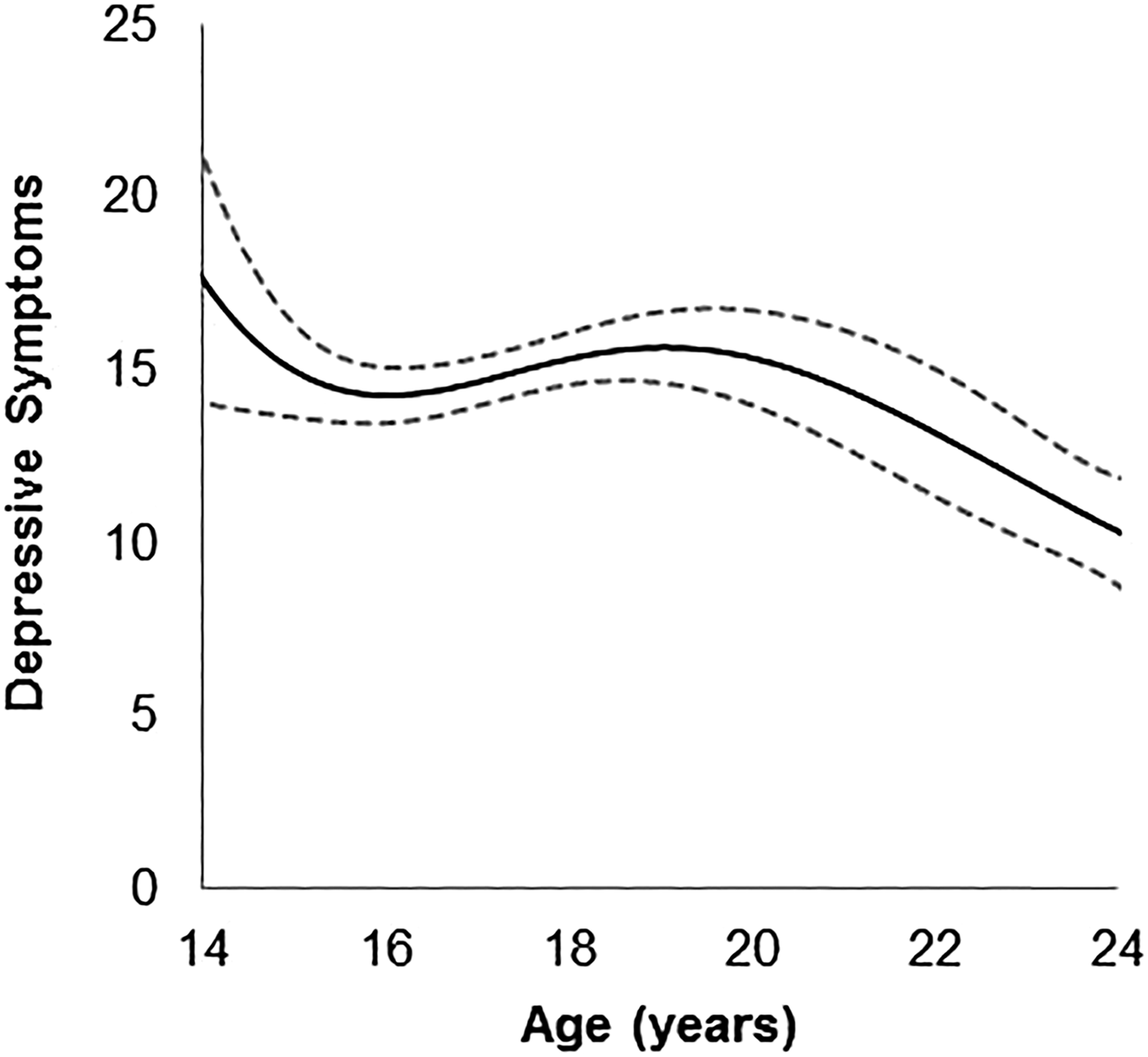
Figure 1 depicts the overall severity of depressive symptoms across ages 14.0 to 24.0, adjusting for gender. The severity of depressive symptoms peaked at age 14.0, M = 17.78, 95% CI = [14.09, 21.47]. Depressive symptoms initially decreased from ages 14.0 to 16.0 and then subsequently increased until age 19.1. Another decrease in depressive symptoms was observed between ages 19.2 and 24.0, at which time the lowest severity of depressive symptoms was observed, M = 10.35, 95% CI = [8.79, 11.91].
Mean depressive symptoms across ages 14–24. Gender was included as a time-invariant covariate. Solid lines represent the mean overall severity of depressive symptoms as assessed by the Center for Epidemiological Studies Depression Scale (CES-D). Dashed lines represent 95% confidence intervals.

Coping strategy use across adolescence and emerging adulthood
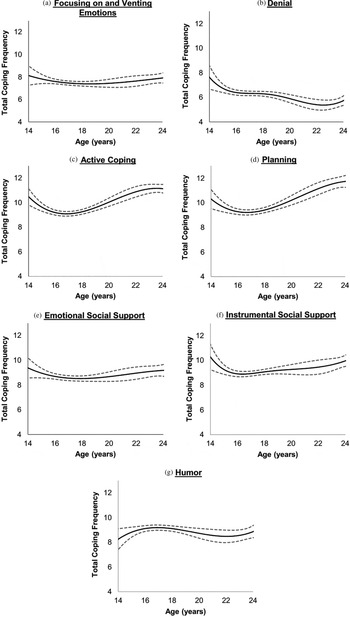
Figure 2 depicts the mean frequency of engagement in seven coping strategies across ages 14.0 to 24.0, adjusting for gender. All coping strategies exhibited curvilinear patterns of change in their relative use throughout adolescence and emerging adulthood.
Mean frequency of using coping strategies across ages 14–24. Gender was included as a time-invariant covariate. Solid lines represent the mean total frequency use score as assessed by the Coping Orientation to Problems Experienced Inventory. Dashed lines represent 95% confidence intervals.

Similar age-varying patterns were observed for venting emotions (Figure 2a) and denial (Figure 2b). Use of these strategies decreased initially (between ages 14.0 and 16.7 for venting emotions, and ages 14.0 and 16.0 for denial). Use of venting emotions to cope then remained relatively stable through late adolescence, followed by slight increases from age 20.6 onward. Use of denial was observed to decrease from ages 18.6 to 21.6 and then subsequently increase from age 21.7 onward. The use of venting emotions peaked at ages 14.0 and 24.0, and the use of denial peaked at age 14.0.
Relatively comparable age-varying patterns were observed for active coping (Figure 2c) and planning (Figure 2d). Use of these strategies decreased from ages 14.0 to 17.0 for active coping and ages 14.0 to 16.7 for planning, at which point the lowest frequency of use was observed for both strategies. Use of these strategies subsequently increased steadily until age 22.6 for active coping and age 23.2 for planning, reaching their peak frequency of use. Use of active coping decreased slightly from age 23.5 onward.
Use of both emotional support seeking (Figure 2e) and instrumental support seeking (Figure 2f) to cope remained relatively stable throughout adolescence and emerging adulthood. Decreases in the use of support seeking were observed between the ages of 14.0 and 16.2 for emotional reasons and ages 14.0 and 16.0 for instrumental reasons. Use of emotional support seeking was particularly stable between the ages of 16.3 and 19.0, followed by slight increases from age 19.1 onward. Use of instrumental support seeking, however, was observed to increase steadily from age 16.1 onward.
Use of humor to cope with stressors fluctuated across adolescence and emerging adulthood (Figure 2g). Use of humor increased between the ages of 14.0 and 15.7, and remained relatively stable from ages 15.8 to 17.5. Use of humor peaked at age 16.8, and then exhibited decreases between the ages of 17.6 and 22.0. Subsequent increases in the use of humor were observed from age 22.1 onward.
Age-varying associations between coping strategies and depressive symptoms
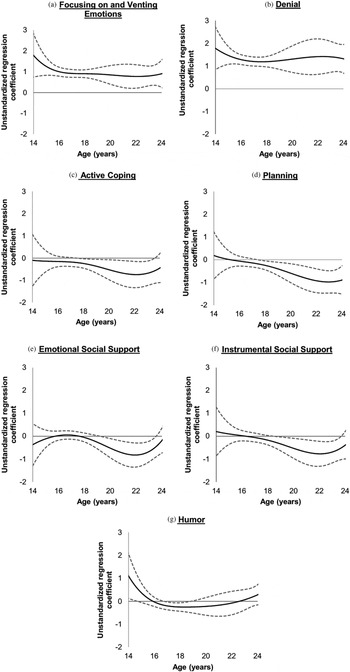
Figure 3 depicts the age-varying associations between engagement in seven coping strategies and depressive symptoms between the ages of 14.0 and 24.0, adjusting for gender.
Age-varying regression coefficient functions depicting the bivariate associations between use of coping strategies and depressive symptoms across ages 14–24. Gender was included as a time-invariant covariate. Solid lines represent the mean total frequency use score, and dashed lines represent 95% confidence intervals. Regression coefficients were considered statistically significant when the 95% confidence intervals did not overlap with zero.

For both venting emotions (Figure 3a) and denial (Figure 3b), there was a significant positive association with depressive symptoms that persisted throughout adolescence and emerging adulthood. That is, more frequent use of venting emotions and denial to cope was linked to greater depressive symptoms. The magnitude of the association between venting emotions and depressive symptoms initially decreased from ages 14.0 to 17.1, remained stable until age 22.7, and then continued to increase slightly through age 24.0. The positive association between denial and depressive symptoms decreased from ages 14.0 to 16.6, after which the magnitude of this association remained fairly stable until age 24.0. The effects were strongest at age 14.0 for venting emotions, b = 1.72, 95% CI = [0.74, 2.69], and age 14.0 for denial, b = 1.85, 95% CI = [0.78, 2.91].
A similar pattern of results was observed for active coping (Figure 3c) and planning (Figure 3d). No significant association with depressive symptoms was observed from ages 14.0 to 17.5 for active coping and ages 14.0 to 17.4 for planning. However, a small, but significant negative association with depressive symptoms emerged between ages 17.6 to 23.5 for active coping and ages 17.5 to 24.0 for planning. That is, more frequent use of active coping and planning to cope was linked to fewer depressive symptoms. The magnitude of these negative associations became continuously stronger from ages 17.6 to 22.1 for active coping and ages 20.9 to 22.9 for planning, peaking at age 22.1 for active coping, b = −0.73, 95% CI = [−1.32, −0.14], and age 22.9 for planning, b = −0.98, 95% CI = [−1.47, −0.49]. There was no association between active coping and depressive symptoms from age 23.6 onward.
A similar pattern was observed for emotional social support seeking (Figure 3e) and instrumental social support seeking (Figure 3f). There was no significant association with depressive symptoms when observed between ages 14.0 and 19.2 for emotional support seeking and ages 14.0 and 18.9 for instrumental support seeking. There was a significant negative association between social support seeking and depressive symptoms that emerged between ages 19.3 and 23.5 for emotional support seeking and ages 19.0 and 23.6 for instrumental support seeking. These findings indicated that more frequent use of support seeking for emotional and instrumental reasons was linked to fewer depressive symptoms. The magnitude of these negative associations peaked at age 22.0 for emotional support seeking, b = −0.82, 95% CI = [−1.35, −0.29], and at age 22.1 for instrumental support seeking, b = −0.77, 95% CI = [−1.31, −0.23]. However, there was no significant association with depressive symptoms between ages 23.6 to 24.0 for emotional support seeking and ages 23.7 and 24.0 for instrumental support seeking.
Overall, there was an inverse u-shaped function observed for the association between humor and depressive symptoms (Figure 3g). There was a significant positive association between humor and depressive symptoms from ages 14.0 to 14.6, such that the more frequent use of humor to cope was linked to higher depressive symptoms. However, the magnitude of this association decreased from ages 14.0 to 18.3. There was no association between humor and depressive symptoms between ages 14.7 and 16.7. A significant negative association was observed from ages 16.8 to 18.6, the magnitude of which peaked at age 17.8, b = −0.25, 95% CI = [−0.45, −0.05]. That is, the nature of this relationship was reversed during this age span, such that greater use of humor was linked to fewer depressive symptoms. Although the magnitude of the association between humor and depressive symptoms subsequently increased from age 18.7 onward, the association was not statistically significant at any time.
Gender differences
No gender differences were observed in the age-varying associations between coping strategies and depressive symptoms across adolescence and emerging adulthood. Specifically, the 95% CIs for estimates of the bivariate regression coefficients between all specific coping strategies and depressive symptoms in girls and boys overlapped at least partially across the entire age range of 14.0 to 24.0 (see online-only supplementary Figure S.1).
Discussion
Although prior studies have identified specific coping strategies linked to depressive symptoms in adolescents and emerging adults (Aldao et al., Reference Aldao, Nolen-Hoeksema and Schweizer2010; Cairns et al., Reference Cairns, Yap, Pilkington and Jorm2014; Compas et al., Reference Compas, Connor-Smith, Saltzman, Thomsen and Wadsworth2001; Zimmer-Gembeck & Skinner, Reference Zimmer-Gembeck and Skinner2011), the role of developmental age rarely has been considered in understanding these relationships. To address this critical knowledge gap, the objective of the current study was to apply the novel technique of TVEM to the examination of precisely how and when associations between specific coping strategies and depressive symptoms emerge and change across adolescence and emerging adulthood. The results indicated that both the magnitude and the direction of the association between specific coping strategies and depressive symptoms were age dependent. Findings underscore the theoretical and clinical utility of applying TVEM to investigate the dynamic associations between coping and depressive symptoms across developmental age.
The overall severity of depressive symptoms exhibited a curvilinear pattern across adolescence and emerging adulthood. Depressive symptoms peaked at age 14.0, which is consistent with prior research suggesting that depressive symptoms and disorders increase significantly after age 13 (Hankin & Abramson, Reference Hankin and Abramson2001). However, the only prior TVEM study examining depressive symptoms found that the severity peaked at approximately 16–17 years old (Schuler et al., Reference Schuler, Vasilenko and Lanza2015). Differences in the sample, study design, and measures may account for these discrepancies. Depressive symptoms decreased between ages 19.1 and 24.0, which aligns with studies demonstrating normative decreases in depressive symptoms from late adolescence into emerging adulthood (Pettit, Lewinsohn, Seeley, Roberts, & Yaroslavsky, Reference Pettit, Lewinsohn, Seeley, Roberts and Yaroslavsky2010; Schuler et al., Reference Schuler, Vasilenko and Lanza2015). Such decreases may result from the beneficial effects of psychosocial factors that accompany the transition to adulthood, such as increasing autonomy, establishing stable friendships, and solidifying identity development (Arnett, Reference Arnett2015).
The frequency with which specific coping strategies were used also generally exhibited distinct curvilinear patterns from adolescence through emerging adulthood. The use of venting emotions remained relatively stable across developmental age, which aligns with data on coping strategies also characterized by an excessive focus on one's emotions (Aldao et al., Reference Aldao, Nolen-Hoeksema and Schweizer2010). The continued use of venting emotions, a relatively simplistic strategy that emerges in childhood (Zimmer-Gembeck & Skinner, Reference Zimmer-Gembeck and Skinner2011), may persist due to a habitual reliance on this learned stress response. Although the use of denial was stable across late adolescence, there was a general trend for decreases in the use of this strategy. This pattern is consistent with studies in which less mature participants were more likely to utilize avoidance strategies to deal with stress (Amirkhan & Auyeung, Reference Amirkhan and Auyeung2007; Gelhaar et al., Reference Gelhaar, Seiffge-Krenke, Borge, Cicognani, Cunha, Loncaric and Metzke2007). Increases in use of coping strategies oriented toward problem solving were observed after approximately 16–17 years old, which may be precipitated by simultaneous developmental advances in executive functioning and metacognition (Best & Miller, Reference Best and Miller2010). It also is possible that developmental shifts in stressor type may elicit the simultaneous increases in problem solving-oriented strategies and decreases in avoidance-oriented strategies. The use of emotional social support seeking and humor to cope remained relatively stable throughout adolescence and emerging adulthood, which supports theories and data suggesting that the use of these strategies emerges early and persists across development (Amirkhan & Auyeung, Reference Amirkhan and Auyeung2007; Zimmer-Gembeck & Skinner, Reference Zimmer-Gembeck and Skinner2011).
The use of venting emotions and denial to cope with stressors appeared to be maladaptive across adolescence and emerging adulthood, as more frequent use was linked to elevated depressive symptoms from ages 14.0 to 24.0. Both strategies have been conceptualized as more automatic, unsophisticated responses to stressful events and negative emotions (Zimmer-Gembeck & Skinner, Reference Zimmer-Gembeck and Skinner2011). As such, the persistent relationships observed across adolescence and emerging adulthood may stem from their relative ease of implementation during periods of distress or depression compared to more complex coping strategies. Negative cognitive biases and inferential styles that maintain elevated depressive symptoms also may lead individuals to either focus on and vent their negative emotions excessively or use denial to avoid aversive, unwanted thoughts and emotions (Joormann & Quinn, Reference Joormann and Quinn2014). The strength of the associations between both coping strategies and depressive symptoms remained fairly stable across developmental age, although the relationship between denial and depressive symptoms strengthened somewhat from age 17.7 onward. These findings are consistent with a meta-analysis comparing the effect sizes of pediatric (ages 7–17) and adult (18+) studies involving rumination and suppression, which are similar constructs to focusing on and venting emotions and denial, respectively (Aldao et al., Reference Aldao, Nolen-Hoeksema and Schweizer2010). The magnitude of the relationship between denial and depressive symptoms may have increased from late adolescence into emerging adulthood because the ability to suppress unwanted thoughts or emotions improves with developmental advances in inhibitory and attentional control capabilities even when individuals are depressed or experiencing stressors (Best & Miller, Reference Best and Miller2010).
Consistent with prior research (Aldao et al., Reference Aldao, Nolen-Hoeksema and Schweizer2010; Cairns et al., Reference Cairns, Yap, Pilkington and Jorm2014), findings from the current study suggest that maladaptive strategies may be more strongly related to depressive symptoms than adaptive strategies that had weaker, less consistent effects. Adaptive coping strategies, such as those focused on problem solving, cognitive restructuring, and social support seeking, may contribute more to increases in positive affect, rather than direct decreases in depressive symptoms (Nolen-Hoeksema & Aldao, Reference Nolen-Hoeksema and Aldao2011). Furthermore, findings from the current study suggested that the relatively stronger links between maladaptive strategies and depressive symptoms in comparison to adaptive strategies is present across adolescence and emerging adulthood. Perhaps the implementation of maladaptive strategies is somewhat immune to developmental changes in social contexts and stressor types, whereas the use and effectiveness of more adaptive strategies are altered in response to these developmental shifts. It is notable that the associations between venting emotions and denial with depressive symptoms were strongest at age 14.0, perhaps due to a relative paucity of other adaptive strategies available to replace or counteract the effects of these maladaptive strategies that are present later in adolescence and emerging adulthood (Zimmer-Gembeck & Skinner, Reference Zimmer-Gembeck and Skinner2011).
The strength and significance of the associations for planning and active coping with depressive symptoms were observed to have comparable patterns of change across adolescence and emerging adulthood. Such parallels likely occurred because both planning and active coping are focused on problem solving in response to stressors and rely upon similar executive functioning skills (Amirkhan & Auyeung, Reference Amirkhan and Auyeung2007; Zimmer-Gembeck & Skinner, Reference Zimmer-Gembeck and Skinner2011). Consistent with findings from a meta-analysis comparing pediatric and adult studies (Aldao et al., Reference Aldao, Nolen-Hoeksema and Schweizer2010), the negative associations between both problem solving-oriented strategies and depressive symptoms did not emerge until late adolescence. That is, greater use of planning and active coping was linked to fewer depressive symptoms only after age 17.5, which may potentially be precipitated by a shift in the interplay between cognitive and motivational neural processes (Somerville & Casey, Reference Somerville and Casey2010). Adolescents demonstrate enhanced neural sensitivity to threats and rewards coupled with underdeveloped cognitive control circuitry, whereas adults exhibit relatively reduced neural reactivity to motivational cues and more mature cognitive control circuitry (Somerville & Casey, Reference Somerville and Casey2010). The neural imbalance between cognitive and motivational systems during adolescence may make it difficult to implement problem-solving strategies effectively. By age 17.5 and onward, however, adults may experience stressors as being less severe and possess the executive functioning abilities to plan and execute active behaviors to resolve problems and alleviate depressive symptoms.
The strengthening of the associations between these problem solving-oriented strategies and depressive symptoms between ages ~17.5 and 23.0 may stem from simultaneous advances in executive functioning (Best & Miller, Reference Best and Miller2010), as well as improved practice and flexibility with implementing these strategies across multiple stressor types and emotional states (Fields & Prinz, Reference Fields and Prinz1997; Zimmer-Gembeck & Skinner, Reference Zimmer-Gembeck and Skinner2011). Neural development and experience with problem solving may enable a more flexible, organized, and direct approach to coping with stressors. It also is conceivable that the types of stressors confronting emerging adults may be more amenable to the use of problem solving-oriented strategies relative to adolescents. Adolescents tend to experience more uncontrollable stressors because they often cannot select their environments and must answer to authority figures such as parents and school institutions (Amirkhan & Auyeung, Reference Amirkhan and Auyeung2007). However, emerging adults have the ability to assert autonomy over their circumstances, and therefore stressors tend to be perceived as more controllable (Amirkhan & Auyeung, Reference Amirkhan and Auyeung2007). Based on the transactional model of stress and coping (Carver et al., Reference Carver, Scheier and Weintraub1989), therefore, emerging adults may be more likely to engage in “approach” coping strategies such as planning and active coping. Overall, the use of planning and active coping may be more appropriate and effective during emerging adulthood than adolescence and have a greater positive impact on depressive symptoms as individuals transition into early adulthood.
Seeking social support for both instrumental and emotional reasons to cope with stressors was associated with fewer depressive symptoms only during emerging adulthood, between the ages of approximately 19.0 and 23.5. The lack of association between social support seeking and depressive symptoms during adolescence is inconsistent with the literature demonstrating that perceived social support is a robust protective factor for depression among adolescents (Rueger et al., Reference Rueger, Malecki, Pyun, Aycock and Coyle2016). It is possible that the act of adolescents seeking social support may not necessarily be effective in eliciting a perceived sense of support. Social support seeking may be more effective in ameliorating depressive symptoms among emerging adults relative to adolescents as a result of more mature neural circuitry supporting improved social cognition abilities that facilitate communication (Burnett & Blakemore, Reference Burnett and Blakemore2009). Adolescents’ ability to communicate their needs and determine the most appropriate source of support also may be adversely impacted by relatively underdeveloped executive functioning skills (Burnett & Blakemore, Reference Burnett and Blakemore2009), as well as a lack of social experience or use of maladaptive social support strategies such as co-rumination (Spendelow, Simonds, & Avery, Reference Spendelow, Simonds and Avery2016). Both adolescents and emerging adults report an increased reliance on peers (vs. family members) for support (Amirkhan & Auyeung, Reference Amirkhan and Auyeung2007; Gelhaar et al., Reference Gelhaar, Seiffge-Krenke, Borge, Cicognani, Cunha, Loncaric and Metzke2007). As such, adolescents may be more likely to seek support from same-age friends who also have relatively limited communication skills and experience with providing effective social support, which may limit the effectiveness of this coping strategy.
The findings suggested that the use of humor to cope with stressors may have differential associations with depressive symptoms depending on an individual's developmental age. Specifically, greater use of humor was linked to higher depressive symptoms from ages 14.0 to 14.6, which is consistent with theory conceptualizing humor as a maladaptive strategy intended to avoid problems and negative emotions (Dozois, Martin, & Bieling, Reference Dozois, Martin and Bieling2009). It also is possible that early to middle adolescents may be more likely to use aggressive humor (e.g., teasing) or self-defeating humor in response to stressors or when feeling depressed, which may promote and/or maintain depressive symptoms by exacerbating interpersonal problems or negative self-evaluations (Dozois et al., Reference Dozois, Martin and Bieling2009; Frewen, Brinker, Martin, & Dozois, Reference Frewen, Brinker, Martin and Dozois2008; Rnic, Dozois, & Martin, Reference Rnic, Dozois and Martin2016). By contrast, greater use of humor was associated with lower depressive symptoms between ages 16.8 and 18.8, which aligns with conceptualizations of humor as an adaptive form of cognitive restructuring that allows individuals to reframe a stressful situation in a more positive light (Kuiper, Reference Kuiper2012). Affiliative humor, which refers to making jokes to amuse others, foster relationships, and reduce interpersonal tension (Dozois et al., Reference Dozois, Martin and Bieling2009), also may be more common among late adolescents who possess more advanced social cognition and communication skills (Burnett & Blakemore, Reference Burnett and Blakemore2009). The use of affiliative humor by late adolescents, therefore, may alleviate depressive symptoms through facilitating social support and positive relationships (Frewen et al., Reference Frewen, Brinker, Martin and Dozois2008; Rnic et al., Reference Rnic, Dozois and Martin2016).
In contrast to prior research in emerging adults (He, Wu, Tang, & Hu, Reference He, Wu, Tang and Hu2015), humor was unrelated to depressive symptoms after age 18.9. However, it is conceivable that the use of humor in emerging adults may be adaptive or maladaptive depending on the stressful situation, which may neutralize each other and result in the apparent lack of relationship with depressive symptoms. The use of humor may be more adaptive in coping with mild, controllable stressors or daily hassles, but may not be as effective in managing distress and depressive symptoms when applying humor to cope with severe, major negative life events. The frequency of stressors and variety of stressor types experienced tends to increase from adolescence into adulthood (Skinner & Zimmer-Gembeck, Reference Skinner, Zimmer-Gembeck and Wright2015), which may enhance the likelihood that humor is being applied in simultaneously adaptive and maladaptive ways among emerging adults. Future studies would benefit from including a more nuanced assessment of humor that captures both coping motives (e.g., avoidance vs. reappraisal) and humor types (e.g., aggressive, self-defeating, and affiliative) to illuminate humor's relationship to depressive symptoms.
Contrary to hypotheses, no significant gender differences were observed for any associations between specific coping strategies and depressive symptoms at any developmental age assessed (14.0–24.0). These findings were surprising in light of research consistently demonstrating gender differences in the severity of depressive symptoms during adolescence and emerging adulthood (Hankin, Reference Hankin2009; Twenge & Nolen-Hoeksema, Reference Twenge and Nolen-Hoeksema2002). However, studies examining gender differences in the use of specific coping strategies have yielded conflicting or null findings (Gelhaar et al., Reference Gelhaar, Seiffge-Krenke, Borge, Cicognani, Cunha, Loncaric and Metzke2007; Malooly et al., Reference Malooly, Flannery and Ohannessian2017; Seiffge-Krenke, Reference Seiffge-Krenke2011). Furthermore, existing research has yielded mixed findings when examining gender differences in the magnitude of the relationship between coping strategies and depressive symptoms (Auerbach et al., Reference Auerbach, Abela, Zhu and Yao2010; Garnefski, Legerstee, Kraaij, Van Den Kommer, & Teerds, Reference Garnefski, Legerstee, Kraaij, Van Den Kommer and Teerds2002; Kelly et al., Reference Kelly, Tyrka, Price and Carpenter2008; Nolen-Hoeksema & Aldao, Reference Nolen-Hoeksema and Aldao2011). As such, gender differences in the association between coping and depressive symptoms may be neither robust nor consistent at any age during adolescence or emerging adulthood. It also is possible that gender may moderate the association between depressive symptoms and other specific coping strategies not assessed in the current study, such as co-rumination, disordered eating behaviors, and drug use (Bastin, Mezulis, Ahles, Raes, & Bijttebier, Reference Bastin, Mezulis, Ahles, Raes and Bijttebier2015; Ward & Hay, Reference Ward and Hay2015). Finally, gender could be examined only as a moderator within the context of TVEM analyses, and therefore it is possible that specific coping strategies may mediate, rather than moderate, the association between gender and depressive symptoms (Hyde et al., Reference Hyde, Mezulis and Abramson2008). Future studies should evaluate whether more complex mediation models involving gender, coping, and depressive symptoms differ as a function of age.
Strengths and limitations
The current study is novel in its application of TVEM to investigate dynamic changes in the associations between specific coping strategies and depressive symptoms across adolescence and emerging adulthood. TVEM possesses a number of advantages over more traditional analytic approaches typically used to evaluate how relationships between psychological predictors and dependent variables differ across developmental age, including the ability to investigate change as a continuous function of age, examine nonparametric functions, and incorporate multiple assessment time points across individuals into the models. The nature of the sample also represented a notable study strength, including the large sample size, recruitment of participants from the community, and diversity with regard to gender, race/ethnicity, and socioeconomic status. Moreover, the broad age range (14–24 years) allowed for the examination of age-related differences across multiple developmental periods during which risk for depression is particularly high. In addition, the assessment of numerous specific coping strategies, as opposed to broader coping dimensions, provided a nuanced evaluation of the impact of adaptive and maladaptive strategies on depressive symptoms.
Although the current study has significant strengths, there are several limitations worthy of consideration. TVEM provided cross-sectional regression coefficients as a continuous function of age, and therefore it is not possible to make inferences about causal effects or the direction of the relationship between coping strategies and depressive symptoms. As such, coping strategies may play a causal role in the etiology of depressive symptom, but it is also conceivable that individuals with elevated depressive symptoms may engage in maladaptive coping strategies more frequently and be less likely to use adaptive strategies. Regardless of the causal direction of the relationship, learning about when the links between certain coping strategies and depressive symptoms exist nonetheless has important implications for advancing developmental psychopathology theories and clinical practice. Despite the use of well-validated measures of coping and depressive symptoms, these questionnaires relied upon self-reports of participants only, and therefore shared method variance may have influenced the findings. As such, future TVEM studies would benefit from including biobehavioral paradigms to assess coping strategies as well as family and peer reports of coping and depressive symptoms. The use of self-report questionnaires, rather than a clinical interview, to assess depressive symptoms does not allow for generalizations to be made about depressive disorders or clinical populations.
Conclusions and implications
Findings from the current study demonstrate significant age-varying associations between specific coping strategies and depressive symptoms throughout adolescence and emerging adulthood. The magnitude, significance, and (at times) the direction of associations between specific coping strategies and depressive symptoms were shown to change from ages 14.0 to 24.0 in distinct ways. These findings emphasize the need for existing theories and treatment models of depression that involve coping to incorporate a developmental perspective, as they often assume the presence of universal mechanisms across ages. Theoretical models also need to be sensitive to developmental changes in neural circuitry, hormones, cognitive and emotional functioning, and social contexts, as chronological age is an inadequate marker for these complex processes as they influence the acquisition, implementation, and effectiveness of specific coping strategies. More coherent developmental theories of coping and depressive symptoms are required so that the vast extant literature can be translated more effectively to intervention.
Findings also yielded a number of clinical recommendations, specifically suggesting critical age periods during which specific coping strategies were linked to depressive symptoms. Maladaptive coping strategies, including the tendency to vent emotions and use denial in response to stressors, may serve as particularly good universal intervention targets due to their relatively larger relationship than adaptive strategies with depressive symptoms and their persistence of effects across adolescence and emerging adulthood. Mindfulness training, which teaches individuals to direct their attention to the present moment and observe negative thoughts and emotions in a nonjudgmental manner, may be warranted due to its effectiveness in reducing rumination, emotional avoidance, and depressive symptoms in adolescents and adults (Hofmann, Sawyer, Witt, & Oh, Reference Hofmann, Sawyer, Witt and Oh2010; Zoogman, Goldberg, Hoyt, & Miller, Reference Zoogman, Goldberg, Hoyt and Miller2015). Directly addressing cognitive vulnerabilities that lead to the use of maladaptive strategies among adolescents and emerging adults with elevated depressive symptoms also has the potential to reduce the persistence and cycle of depression. Cognitive vulnerabilities in depressed individuals often are automatic or involuntary and involve biased attention and memory toward negative information, as well as an inability to shift away from negative cognitions, emotions, and behaviors (Joormann & Quinn, Reference Joormann and Quinn2014). Computerized cognitive training programs, which target involuntary cognitive biases through the use of exercises or games to improve attentional control, working memory, and inhibitory control, have demonstrated effectiveness in reducing depressive symptoms and improving cognitive functioning in adolescents and adults with depression (Calkins, McMorran, Siegle, & Otto, Reference Calkins, McMorran, Siegle and Otto2015; Cristea, Kok, & Cuijpers, Reference Cristea, Kok and Cuijpers2015; de Voogd, Wiers, Zwitser, & Salemink, Reference de Voogd, Wiers, Zwitser and Salemink2016). Computerized cognitive training programs also may be advantageous because they can be readily tailored toward different developmental ages.
Findings suggest that it may not be useful for adolescents to rely on problem solving-oriented strategies to address stressful situations because the use of planning and active coping was linked to depressive symptoms only after age 17.5, perhaps because younger adolescents’ executive functioning abilities are not sufficiently mature enough to effectively implement these strategies. Cognitive behavioral problem-solving therapies generally have not been found to be efficacious among adolescents (Hoek, Schuurmans, Koot, & Cuijpers, Reference Hoek, Schuurmans, Koot and Cuijpers2012), but have demonstrated consistent positive effects for ameliorating depressive symptoms in adult samples (Eskin, Ertekin, & Demir, Reference Eskin, Ertekin and Demir2008; Malouff, Thorsteinsson, & Schutte, Reference Malouff, Thorsteinsson and Schutte2007). Given the effectiveness of interpersonal psychotherapy for improving social functioning and depressive symptoms among adolescents (Cuijpers et al., Reference Cuijpers, Geraedts, van Oppen, Andersson, Markowitz and van Straten2011; Young et al., Reference Young, Benas, Schueler, Gallop, Gillham and Mufson2016), it may be worthwhile to focus on teaching adolescents how to identify sources of social support, communicate their needs when seeking support, and minimize the use of maladaptive forms of social support. Emerging adults may be able to enhance the effectiveness of problem solving-oriented strategies and social support seeking for reducing depressive symptoms, or conversely learning to engage in these adaptive strategies when feeling depressed, by learning how to break down global stressors into specific coping tasks and tailor the application of certain strategies to different stressor types.
Future directions
Findings from the current study emphasize the utility of future developmental studies applying TVEM to investigate age-related differences in the associations between psychological factors. To provide more information about intentional, effortful coping and depressive symptom associations across the life span, it would be beneficial for TVEM studies to include age ranges spanning childhood to early adolescence and middle to older adulthood. Many specific coping strategies linked to depressive symptoms were not assessed in the current study, such as rumination, behavioral avoidance, and cognitive restructuring, among others (Aldao et al., Reference Aldao, Nolen-Hoeksema and Schweizer2010; Zimmer-Gembeck & Skinner, Reference Zimmer-Gembeck and Skinner2011), and should be investigated in similar TVEM studies. In addition, it is important to consider that coping represents a broad multidimensional construct that encompasses biological and psychosocial responses to stressors and involves both automatic and voluntary responses (Compas et al., Reference Compas, Connor-Smith, Saltzman, Thomsen and Wadsworth2001; Lazarus & Folkman, Reference Lazarus and Folkman1984; Selye, Reference Selye2013). As such, developmental differences in the relationship between biological and involuntary stressor responses and depressive symptoms are critical to investigate so that the understanding of how stressor responses change across the life span can be improved.
Although the current study's focus on dispositional coping allows for generalizability across stressor types, the implementation of coping strategies has been conceptualized as being in constant flux due to changes in the environmental demands and available individual resources (Fields & Prinz, Reference Fields and Prinz1997; Lazarus & Folkman, Reference Lazarus and Folkman1984). Therefore, the use of ecological momentary assessment to investigate the role of using specific coping strategies on state negative affect in response to different stressors would allow for TVEM to examine how these statelike associations change dynamically across age and other metrics of time (i.e., over the course of a day or several weeks). It would also be beneficial for future studies to examine how the age-varying associations between the use of coping strategies and depressive symptoms may differ as a function of distinct negative affective responses upon exposure to stressors, including irritability, aggression, anxiety, and anger. It also is important to conduct experimental and prospective research alongside TVEM studies to provide complementary information about causality and mechanisms of the relationship between coping and depressive symptoms at different developmental ages. Finally, the creation and evaluation of age-specific depression interventions that incorporate a developmental perspective on coping is crucial for providing recommendations about not only how clinicians should intervene but also when to encourage the implementation of certain coping strategies for maximal effectiveness on preventing or ameliorating depressive symptoms.
Supplementary Material
To view the supplementary material for this article, please visit https://doi.org/10.1017/S0954579417001183.