




No CrossRef data available.
Shifting Identities in the Life Histories of Working-Class Women in Socialist Hungary
Published online by Cambridge University Press: 06 December 2005
Abstract
This article explores how working-class women who belonged to the prize-winning Liberation Brigade of the Budapest Hosiery Factory in the 1970s represented their identities at different stages of their lives in oral-history interviews conducted with the author between 1998 and 2003. It argues that these identities had a deeply ambiguous relationship to those that the official discourse of the socialist era ascribed to them. Issues of consent, accommodation, and opposition are raised, which not only shaped identities under socialism, but continue to shape working-class memory of the period.
Information
- Type
- Research Article
- Information
- Copyright
- © 2005 The International Labor and Working-Class History Society
On April 1, 1970 the members of the Liberation Brigade of the Budapest Hosiery Factory waited nervously in the Hungarian parliament. They were in the building for the first time in their lives in order to receive the State Prize “in recognition of the performance their socialist brigade.”2
The State Prize was established in Hungary, copying Soviet practice, in 1963, as the most prestigious award that members of a socialist brigade could receive. Those who “conducted research, or engaged in research and development, or those who made a substantial contribution to the construction of socialism, or innovators, or those who introduced new methods of working, those who were recognized for their role in directing production, those who achieved exceptional individual performance in production, or in the curing of patients, or in the development of public health, childcare and education” could receive the State Prize. The State Prize was awarded to socialist brigades for the first time in 1965. By 1985 forty-four brigades had received the award, accounting for 4.7% of all awards made. MOL XIX-A-92. 13. d. Állami Díj bizottság. Jelölőlapok. 1970.; Darvas Pálné, Dr. Klement Tamás, Dr. Terjék József, eds., Kossuth-díjasok és Állami Díjasok almanachja. 1948–1985 (Budapest, 1988), 449; TVRGY. 1963/36. számú törvényerejű rendelet.
S. Vilmosné., Personal Interview, September 4, 2001.
The weather reports for March 31, 1970 suggest that the weather was temporarily overcast, punctuated by frequent showers and storms; on the April 1st it was cloudy and rainy, with the highest daytime temperatures reaching 15¼ C. Magyar Hírlap, March 31, 1970., 9., April 1, 1970., 8., K. Györgyné and K. Györgyné, Personal Interview, July 29, 2000.
E. Pálné, Personal Interview, October 27, 2000; T. Jánosné, Personal Interview, November 3, 1999.
The celebrations did not end with their visit to parliament; they were seated in the front row of the April 4th celebrations in their own factory, and received a special mention in the opening speech. The newspapers followed them for weeks and asked how they live their everyday lives. The articles that were written about them, however, focused on their socialist brigade in order to show how they had formed a “socialist community.”6
For some examples see “Állami Díjasok,” Nők Magazinja, 1970/4. 5. p., Zsigmondi Mária: “Kitüntetés és rang,” Nők Lapja, April 4, 1970., 2., György István: “Miért éppen a kilenc asszony?” Népszabadság, April 9, 1970., 4.
A Felszabadulás brigád naplója. 1969–1970. T. Károlyné gyűjteménye. T. Jánosné, Personal Interview, 3<+>rd November 1999.
Even with their lack of skills the women immediately found work in the city, assisted by relatives or natives of their home villages who lived in Budapest. Many of them took employment as domestic servants, and then at the first available opportunity went to work in the capital city's factories during the 1950s. Some of them married before entering factory employment, some immediately afterwards, mostly to skilled workers. In this period of their lives the greatest struggle was not in finding a satisfactory husband, but in getting an appropriate job. They worked for several decades, often together with their skilled-worker husbands, in the Budapest Hosiery Factory, founded in 1951.8
Imre Czeglédi, A Gyulai Harisnyagyár 75 éve. 1900–1975; A Budapesti Harisnyagyár Gyulai Gyára (Gyula, 1975.), 121.
State intervention in their lives was experienced most strongly in the workplace: they had to participate in labor competition, they were compelled to form a socialist brigade, and, in order to advance their positions at work, it helped for them to join the party, or for their husbands to join the workers' guard.9
The party-based paramilitary organization founded during the suppression of the 1956 Revolution and disbanded in 1989.
According to official discourse the socialist brigade was a collective organized according to political norms by members of one united social group; in their case the industrial working class. Despite this assumption of unity, when members of the brigade shared their life-stories and specific events that had been important to them, they would emphasize different experiences just as much as they would emphasize the common experiences of their fellow brigade members. Only ignoring the particularity of their individual life-histories they could construct a common history; instead they emphasized differences in their life experiences, and thus also constructed individual identities.10
This article is based in the first place on life-history interviews conducted several times with the brigade members between 1999 and 2003, as well as with their husbands, colleagues, and managers (a total of twenty-three people). In addition on one occasion I interviewed each person with family members who had never migrated to Budapest, and while among them there were many who temporarily had jobs in the capital, they tended to live their lives where they were born, and live there today (nine of them live in Túrkevé, Mezőtúr, and Zalaszentgrót). My interviewees belong to three age groups: the two oldest members of the brigade were born in the 1920s and were from working-class backgrounds, one from Budapest and from Abony; both had one older sibling. The members of the middle age-group were born between 1927 and 1934, and all came from large families who earned a living from agriculture and only went to Budapest after the Second World War. The members of the third, youngest age group were born around 1940, and came from working-class families. These were largely the supervisors of the semiskilled workers in the factory, and for this reason interviews with this group are used only to reveal the history of the role of the workplace played in shaping identities.
Personal identity is a social construction that shifts depending on the stage of the life-cycle.11
See Györgyi Bindorffer, Kettős identitás. Etnikai és nemzeti azonosságtudat Dunabogdányban, (Budapest, 2001), 18–34; Ferenc Pataki, Élettörténet és identitás, (Budapest, 2001)
Willem Doise, “Social Representations in Personal Identity” in Stephen Worchel et al. Social Identity (London, 1998), 23.
Stephen Worchel, “A Developmental View of the Search for Group Identity” in Worchel et al. Social Identity, 73; Darío Páez et al. “Constructing Social Identity: The Role of Status, Collective Values, Collective Self-Esteem, Perception and Social Behaviour” in Worchel et al. Social Identity, 213.
Erik H Erikson, Identity (1962).
The Role of Consumer Goods in Constructing Identities: the “Working-Class Car Owner”
Consumer goods played a central role in the construction of identities during the socialist era.15
Ina Merkel, Utopie und Bedürfnis: die Geschichte der Konsumkultur in der DDR (Weimar, 1999).
- Tibor Valuch, “A ‘gulyáskommunizmus,'” in Ignác Romsics, ed., Mítoszok, legendák és tévhitek a XX. századi magyar történelemről (Budapest, 2002), 361–390.
Árpád Tyekvicska, “Frizsiderszocializmus” in Beszélő évek. 1957–1968. A Kádár-korszak története I. rész (Budapest, 2000), 260–263.
In the life history interviews with the women of the Budapest Hosiery Factory different goods and artefacts played symbolic roles. There were some for whom a plot of land in the Buda Hills was important, for others it was factory-manufactured kitchen furniture or a rural house which served the needs of several generations of the same family. Here I want to examine in some detail the role that a Trabant car played in the identity construction of one of my interviewees. Mrs. T, at the time she bought the Trabant in 1970, worked as a quality control officer. After the death of her husband in 1968 she continued to look after her twenty-four and twenty-year-old sons. In the interviews she openly described herself as someone who fought for the interests of the workers. She often drew attention to the fact that in order to settle shop-floor conflict she would sometimes go straight to the director of the factory. At this time she tied her hair into a bun with a hair clip, which was regarded as fashionable in the workshop. She could often be seen in photographs of the brigade's social events playing a central role, either singing or dancing in the center of the photograph.
In 1971 a report about Mrs. T. and her new car appeared in the factory newspaper, illustrated with a photograph.18
“Munkás kocsitulajdonosok. I,” Harisnyagyári Dolgozó, December 23, 1971, 2.
In the same issue which had announced that the Liberation Brigade had won the state prize, the newspaper Brigade Life carried an article in the same issue that pointed to the curiosity of a female student who alongside her studies earned money as a driving instructor. The article pointed to legal equality between men and women: “Ide is betörtünk,” Brigádélet, April 1970.
It was not coincidental that Mrs. T's car became the object of “male pranks” in the factory.20
Paul Willis, A sracok. Iskolai ellenkultúra, munkáskultúra (Budapest, 2000), 88–94.
T. Károlyné, Personal Interview, March 12, 2001.
Why did Mrs. T's colleagues and friends regard her as such a successful woman? The reason was that she was able to get a car which many others desired without joining the long waiting lists. She used the moral and material recognition that the State Prize brought her, as a member of a decorated socialist brigade, to buy the Trabant. She wrote to the Minister of Light Industry, arguing that a decorated worker should not have to wait five years for her car as was common at the beginning of the 1970s, but that she should be able to get it as soon as possible from the garage.

5. Mrs. T with her first Trabant, 1971.
Source: Private collection of Mrs. T and Mrs. T.J.
In her interview with the journalist in 1970 Mrs. T. stressed two elements of her life. First, she represented herself as a successful, decorated woman who had been able to buy a car in a shorter time than many others. Second, she argued that she needed the car, as the daughter of a sick, elderly father, so that she could go often to her home town of Túrkevé to visit her parents. “I didn't even dream of winning a State Prize. I was delighted with the large amount of money, because I knew I could buy a car with it.22
In 1970 as a result of winning the State Prize every member of the brigade won 20,000 Forints. At that time Mrs. T's monthly salary was 1800 Forints. The downpayment on the Trabant was 9900 Forints.
This was Mrs. József Nagy.
“Munkás kocsitulajdonosok. I,” Harisnyagyári Dolgozó, December 23, 1971, p. 2.
In her interview Mrs. T. stressed her initiative and determination: it was her idea to write a letter so that she could get the car more quickly. Furthermore she revealed what had been left out of the newspaper article at the time. The car arrived more quickly than she expected so that she could not pay for it all instantly. An upcoming family wedding provided the solution: “The Trabant arrived so quickly that I didn't have the last 10,000 Forints for it. At that time the father of my son's fiancée loaned me the money. I paid him back, I worked day and night, I worked as a cleaner.”25
T. Károlyné, Personal Interview, October 3, 2001.
Getting the Trabant required exceptional effort; paying back the loan even forced her to take on a job regarded as beneath the dignity of an “hourly-paid worker.” In a difficult situation she used the connections provided by her extended family to be among the first manual workers in the factory to park her own car in the factory yard.
Among the stories told in connection with Mrs. T's Trabant are those which show how useful the ownership of a car was in daily life. With it she took her son to his allotment; she was able to make weekend excursions; she could visit her relatives in the country; she gave lifts to fellow brigade members so they could visit relatives; and every year she gave lifts to Soviet soldiers from their Óbuda barracks to the factory's celebrations of the October Revolution. She also drew attention to the fact that this allowed her to buy petrol at the rate of two Forints a liter from the Soviet troops, a rate which was “very cheap.” I asked her how she had come to this arrangement, and whether she had bought the petrol from the same soldiers whom she had taken to the factory celebrations or from others. She told me that she bought it both from those she had given lifts to and others, whom she had come to know while studying Russian. She arranged for the soldiers to bring the petrol to the caretaker of her apartment block, and he paid them from the money that Mrs. T. left him. This worked so well that when the caretaker decided to buy his own car, he bought his petrol in exactly the same way.26
T. Károlyné, Personal Interview, January 29, 2003.
Mrs. T. remained very attached to her first Trabant. She drove it 150,000 kilometers and even when she sold it, she paid close attention to what happened to the car. For this reason she chose a buyer who also worked in the factory. Even today she regrets that its new owner did not care for the car as much as she did. After buying it he took the car to Italy, where it was involved in a traffic accident and completely written off. In the life-history interviews of other brigade members such continuing interest in a car that had been sold was a recurring theme.27
K. Gyuláné & K. Gyulá., October 30, 2000; F. Józsefné & S. Józsefné., Personal Interview, November 23, 1999.
As a consumer good the Trabant acquired a symbolic meaning in Mrs. T's life cycle, for she bought three more in the following years. She was always able to gain enough money from selling her old car to be able to afford a new one. When she sold the last of her cars, just as with the first, she did not trust its future to chance. She sold it to her grandson, and it remained well cared for within the family. At the time of the interview, in 1999, this Trabant was still in good working order.

6. What was left out of the brigade's diary. A brigade party, 1967.
Source: Private collection of Mrs. T and Mrs. T.J.
For her the Trabant symbolizes the period in her life when she was fully fit, successful in her workplace, and an independent, self-sufficient woman. Her personal identity was closely tied to ownership of the vehicle: it both enabled her to identify with other drivers, and allowed her to take on roles that were defined as masculine. While the original Trabant no longer exists, she feels that some of the money invested in it was worthwhile, for the third Trabant is still riding up and down the country's roads.
“We've heard that we can occupy a flat:” Local Identities in Óbuda and Békásmegyer
Immediately after arriving in Budapest, the majority of my interviewees had settled in the suburb of Óbuda because of its plentiful employment opportunities. Óbuda, in the northwest of the city, maintained a quasi-rural character until the 1960s.28
Gábor Gyáni, “Tabán: falu a nagyvárosban” in his Bérkaszárnya és nyomortelep (Budapest, 1992), 139–146.
Nők Lapja, February 14, 1970., 5. In Óbuda the first high rises were built in the early 1960s as part of an experimental housing estate. These first housing estates were very different both in size and architectural style from those which came later. On the building of the estate see “Tágas horizont,” Nők Lapja, March 5, 1959.
Some of my interviewees placed greater importance on their place of residence than did others. The different stories they told involving their homes contained several common themes. One such recurring theme was the impact of the centralized system of flat distribution under socialism, and how one received a flat through this system.30
For the centralized flat distribution system in Hungary the classic text is Iván Szelényi & György Konrád, Az új lakótelepek szociológiai problémái (Budapest, 1969).
Mrs. S's path to her flat in Békásmegyer was more circuitous. As the eldest child of the family she was the first to move to Budapest. Initially she took work in the Óbuda Shipyards as an unskilled worker, and her colleagues helped her to find a room to rent. After marriage to a male colleague, they lived with his parents. Even though they submitted their request for a flat to the local council immediately after their marriage in August 1955, they only received one during the 1956 Revolution. During the months of the revolution, like some of my other interviewees, they simply squatted in a flat that was still being built near the factory: “We heard that we could just occupy an empty flat, because everybody was doing it. We went with my inlaws and we just took the flat. We occupied a ground-floor flat and there was already a tile stove, but they hadn't yet fitted the toilet, and there was no glass in the windows. We sorted out the windows in the factory, but the doors only came later. We didn't have any coal, and we couldn't heat it. Then we saw that people were carrying something around in sacks. We asked about it and discovered that they were coming from the Fuel Selling Enterprise site, next to the petrol station, and they were carrying coal. We went too. We stored the coal in the common toilet. Even though we had requested a flat, we still had to pay a 600 Forint fine. That was a lot of money in those days, a month's pay. We had to move to a one-room flat in exactly the same block.”31
S. Józsefné & F. Józsefné., Personal interview, March 1, 2001.
Mrs. S and her husband's recourse to squatting was a direct consequence of the operation of the socialist housing distribution system. They saw that there were others living in their neighborhood who had been waiting for years for their own flat. As they were a family with small children, they saw it as legitimate in the unusual situation created by the revolution to not wait to be given a flat by the state but to simply take the opportunity to acquire one for their family. Three members of the brigade squatted in flats in 1956 in the same area. In their interviews they sought to justify their actions by saying that others did exactly the same thing at that time, and that they had submitted an official application for a flat. Mrs. S. still expressed fear since after the 1956 Revolution she and her husband had to pay a fine and had to move to another, smaller flat. Mrs. S. believed that she had been right to occupy the flat.
Those who squatted in unfinished flats in 1956 made them habitable by mobilizing extended family and workplace networks. Mrs. S. and her husband fitted a lock that symbolized their occupation of the flat together, her husband connected the electricity and the gas with other families, while the windows and doors were made in the factory. They also stored their fuel together. A sense of common identity developed among those who squatted in 1956, since all of them got their homes in the same way. Numerous stories illustrated the intense neighborly relationships that developed; everyone knew who in the block had a lover. There were, however, some who reported their neighbors to the local council for fitting televisions to earn supplementary income. For others the friendships that developed derived from both living together and working in the same factory or workshop.
At around the time that Mrs. S. squatted, another of her younger sisters, Teréz, moved to Budapest and married Mr. S's younger brother. At first neither of them had their own home, they lived with her parents-in-law, and they all eventually moved to the rural town of Pilisvörösvár. Mrs. S. felt sorry for her sister because she had to commute to work and therefore suggested that the two families live together. They believed that if the two families applied together, they would improve their chances of getting a larger flat. This plan succeeded: the two families were able to move to “a beautiful, big flat” that was near both the factory and the market. The period of her life seen by Mrs. S. as ideal was brought to an end by the state's high-rise construction in Óbuda, because their block was scheduled for demolition to make way for the new flats. The authorities made several offers of replacements to the residents of the block. Some of their colleagues chose to accept an offer of financial compensation from the state, which they then used to build private houses in a village next to Budapest, while continuing to work in the factory. This early manifestation of suburbanization combined industrial wage labor with a strong link to a rural environment.
In this interview Mrs. S. described how she made a choice among the newly constructed flats offered to her. She participated in the socialist housing market as a consumer who viewed her flat as her own private property. She would use her own money to buy her new flat, because it was now possible to purchase a flat from the state. She did not accept offers of flats in other working-class suburbs of the capital like Újpest and Pesterzsébet. She deployed two constructions of identity to justify her decision. First, her husband was an “Óbuda native,” and had grown up there. Second, if she moved far from the factory where she had worked for years, she would have to change her job, something she did not want to do under any circumstances. In the meantime her daughter had married, and she now decided that she would apply for a flat together with the newly married couple.
Mrs. S. was grateful to the factory lawyer for helping her solve her accommodation problem, for his advice enabled her both to get a flat with her daughter and to stay in Óbuda. “We went to work, my husband was already the caretaker in the factory, and the lawyer was really nice. He asked my husband ‘Józsi, what's wrong?' I saw that he raised his head. And then he replied, that, just imagine, they don't want to give us a flat that the kids can live in. He then said ‘and what's the problem?' He replied ‘I want to live with them.' Then he asked ‘you don't want to give them the title (to the flat)?' He replied ‘why not?' And then he wrote a letter in which we gave up the title of the flat to our daughter, but that she wouldn't sell it without our consent.32
It is clear that the flat is in the daughter's name, but the parents have a legally guaranteed right to live there.
S. Józsefné & F. Józsefné., Personal interview, November 23, 1999.
The acquisition of the flat in Békásmegyer can be read as a story of Mrs. S's personal success, in that she was able to convince the local housing official with a small legal maneuver. Yet in her interviews she never considered the flat a status symbol. Official discourse propagated in vain the idea that the new high-rises were places of health, space, and comfort. Mrs. S. remembered the years in her previous, decidedly old-fashioned flat as the happiest period of her life. She would often list the problems that she faced as a resident in a new high-rise housing estate: she moved into the middle of a construction site in 1980, hers being the only block in the whole street that was complete. She was far from the shops and the suburban railway station: “We had to walk through so much mud. We could only go out in red, yellow, and green boots. Everyone on the estates went around in them . . . . We walked out in boots with our shoes in a bag; we only changed when we got on the train.”34
S. Józsefné & F. Józsefné., Personal interview, November 23, 1999.
When Mrs. S and her sister, Mrs. F., spoke about the high-rises, they spent most of their time complaining. Irén (Mrs. F.) had a degree of distance from them, as she lived in a family house, albeit one in the direct neighborhood of the blocks of flats. The sisters' favorite way of describing their relationship is through referring to the fact that they can see each other from their windows. In their stories critical of the high-rises they use a strain of local popular discourse which developed in direct opposition to official discourse and which expresses nostalgia for the world of bungalows that had characterized Óbuda until the mid-1960s. They viewed moving into new flats as a necessary but poor replacement.
Prior to moving into the high-rises many residents had lived in homogeneous neighborhoods with their workplace colleagues. The social privatization encouraged by the new flats made for very different social relations. In Mrs. S's stories newer residents of the flats appear as intruders. She sees them as evidence that the prestige of the area in which she lives is declining. In everyday life this means that she feels she has to be scared. She told many stories about “strange people” beating up the car park attendant, breaking into the flats; one break-in happened in the block during one of my visits. Yet her relationship to her home is not simply negative, somewhere she lives involuntarily. She said different things when I asked her about the high-rise estate in general, as to when she described her life there. She knows many people that live on the estate, and when we walked round it together, we would frequently stop to gossip with acquaintances. She has a key to her neighbor's flat. She and other residents take part in organized programs for local pensioners on the estate; balls and quizzes. Irén enthusiastically tells stories about the fancy-dress balls. Although Mrs. S. and her family could have sold their flat after privatization and bought a house in a village just outside the city, this was a step they did not take. Instead they built their lives around them in Békásmegyer where they were able to maintain close family ties, not only because Mrs. S. continued to live with her daughter's family after the death of her husband but also because of her proximity to her younger sister. She sees Irén every day and they participate together in social activities. In contrast to many of the stereotypes it seems possible to say that moving into high-rises did not destroy neighborly relations; these ties and kinship networks remained strong, especially where the new residents came from similar social groups.
“They called me movie-star”: Was “Working-Class Woman” a Specific Identity?
Female equality and unequivocal support for women going to work were central pillars of official discourse during the socialist era. Although the propaganda of the regime maintained that there was no unemployment, fluctuations of supply and demand in fact determined how many unskilled women worked in industry and what work they could get. In 1965 an article in Nők Lapja, the most popular women's weekly, described how unskilled women workers were laid-off in one factory. The article expressed sympathy for women affected, but did not dispute the “economic justification” for the lay-offs, and supported the official point of view. The author even suggested that those laid off had to go because they were unreliable and often absent—in short, not good workers. The director of the factory who was quoted by the journalist made no reference to official claims of gender equality, but instead articulated the primacy of men in the world of work. In deciding who should be laid off the director indicated the family status of the worker and, where a married couple worked in the factory, he sacked the woman rather than the man, because her wage was almost always the lowest. He regarded it as acceptable that a woman should earn less than a man for the same work, and explained that when a woman lost her job, she did not lose everything. She could go back to the family, which was how she defined her life. In fact, most women who were let go did not stay at home; according to the article most found jobs in the market-gardening unit of the local state farm.35
“Kétoldalú felelősséggel,” Nők Lapja, January 30, 1965, and “Nők a munkaközvetítőnél,” Nők Lapja, November 10, 1962.

7. The Liberation brigade with their immediate superiors, March 1970.
Source: Private collection of Mrs. T and Mrs. T.J.
In the official discourse of the socialist period the rhetorical promotion of gender equality and the integration of women into socialist labor appeared together with notions that stressed how female wage labor came second to the role of women within the family. The need to guarantee an adequate supply of female labor was regarded as an important function of the state. State control over labor was not only symbolized by the institution of workbooks, but also by the fact that official discourse represented working in the same factory and workshop over many years as a virtue in itself. The “core” of the long-term workforce received material rewards, and labor mobility was condemned.36
“A törzsgárda létkérdés,” Nők Lapja, July 17, 1969.
For example “Emlékezik a gyár,” Nők Lapja, May 2, 1981. The newspaper, Harisnyagyári Dolgozó (the newspaper of the hosiery factory) published a series of articles to celebrate the twenty-first anniversary of the factory's foundation, for example Harisnyagyári Dolgozó, December 19, 1974., 6.
The notion of being part of the “core” of the workforce appeared in several of my interviews. Perhaps because official discourse had stressed the connection between worker and workplace, a secure industrial job was held up as an ideal. Articles appeared frequently in the Hosiery Factory's newspaper about workers who had been there for decades. They paid special attention to the existence of “factory dynasties”: where not only a husband, wife, and children worked in the factory, but also brothers and sister-in-laws as well.38
Among my interview-partners there was a period when of the K. family the husband, wife, and three children worked in the factory. “Reggelenként együtt indulunk a gyárba,” Harisnyagyári Dolgozó, May 14, 1970., 2.
As a result, strong factory-based identities seem to have been adopted by my interviewees. Even today many regard it as a virtue that they remained loyal to their factory. One foreman described his feeling of being at home there by saying “we were all friends, we celebrated our name days together.” Many viewed the privatization and then the closure of the factory as a personal tragedy, including those who had already gone to work elsewhere. Admittedly, this uniform picture partly stems from my choice of subjects. I only interviewed workers who worked in the factory over several decades and who gained state awards for their work in the plant. I never interviewed those who spent only several months or even a year there and who were consequently stigmatized in official discourse as “wandering birds.”
In the life-histories of my interviewees there was never any opposition between work and family. All of them came from families where female labor outside the home was seen as entirely normal.39
On the childhood experience of girls in rural households see Judit Sz. Morvay, Asszonyok a nagycsaládban (Budapest, 1981), 92–101. Erzsébet Zakariás, Asszonyélet Erdővidéken (Marosvásárhely, 2000), 65–87.
Mrs. T., Personal Interview, November 9, 1999 and September 2, 2000.
Mrs. T., Personal Interview, September 2, 2002.

Mrs. T and Piri teach Manci to smoke in the moulding shop of the Budapest Hosiery Factory, 1960s.
Source: Private collection of Mrs. T and Mrs. T.J.
Another of my interviewees, Mrs. T.J., explained that it was not just for a job that she left her village next to the River Tisza for Budapest. What attracted her was the prospect of independence that living in the big city offered.42
Mrs. T.J., Personal Interview, May 1, 2002.
As far as Mrs. T.J. was concerned work did not end with the factory shift. This was not just because she saw it as her task alone to do the housework and bring up the children, with the occasional help of her husband, but because she sought earn as much as possible from her labor power. My interview partners often told stories about how they took on additional work outside the factory to improve their family's standard of living. This tended to happen during the points in their lives that were most difficult financially, especially when after childbirth they temporarily left the labor market. In one such period Mrs. T.J. became a wet nurse and took on the role of caretaker: “For me it was always work, work, so that I could earn. I was often so tired when my sons were small, and I took them around with one in the push-chair, one on top of the push-chair, the third in my tummy and my hands froze, because I didn't have anything for gloves, didn't have anything for anything.”43
Mrs. T.J., Personal Interview, May 1, 2002.
For others, like Mrs. T., the owner of the Trabant, the workplace was a space where they could define themselves as actors outside the family. They readily represented themselves as defenders of others, as working women who could stick up for themselves and their colleagues against the bosses. In 1973 the factory banned unskilled workers from working overtime, justifying this with reference to a ministerial directive. The factory newspaper argued that this measure protected the workers' interests, since they would spend less time in an unhealthy workplace. In fact the underlying purpose was economic; overtime was not needed. In the interview the women workers described this measure in different ways. Éva (Mrs. T.) argued that it was only then she could really fight for the interests of her colleagues, because she regarded the abolition of overtime as utterly unfair: “They then said we couldn't do overtime on Saturdays. I just said that my partner works for the television, and if this doesn't change, then one of his colleagues will come round to dinner over the next week, I'll tell him about it, and they'll make a program about this. A week or so later they asked me whether I'd said anything to the people at the television. I said I had. They replied that I shouldn't have said anything because I'll be able to do overtime.”44
Mrs. T, Personal Interview, April 13, 2000.
In this story Mrs. T. emerges as the successful defender of her rights. She could use a relationship not available to others in the workplace, and which really conferred power and prestige in the period. She had friends at the television company who could use their influence to address the complaints of women workers; her “friend at the television” was an assistant in the film factory. Yet what Mrs. T. and her coworkers experienced as unfair, the newspaper reported as a measure to defend their health.
Although my interviewees described differently their workplace and the everyday strategies they employed there, their accounts contained similar themes as well as collective stories. The process of finding their jobs initially, comparable to negotiating an obstacle course, is an example of this. Many were only able to secure factory jobs through the use of personal connections.
While their husbands proudly described themselves as “skilled worker” or “shift machine supervisor,” my female interview partners hardly ever called themselves “women workers,” except when referring to the fact that they had won the State Prize. Some of them even today refer proudly to the fact,45
“The really nice thing about it was that we were the first manual workers to get that award.” Mrs. S., Personal Interview, October 25, 1999.
The answer, it seems, is because belonging to a category of women workers has played less of a role in shaping their personal identities, than their social links with and loyalty to the factory, or the award they won together, which they experience today as both a form of recognition and a stigma.46
On how the members of the brigade represent the meanings they attach to the award see Eszter Zsófia Tóth, “‘Én nem istenítem Kádárt, de olyan ember volt.' Egy Állami Díj emlékezete munkásnők életútelbeszéléseiben,” in János M. Rainer, ed., Múlt századi hétköznapok (Budapest, 2003), 211–230.
“Rang-e munkásnőnek lenni?” Nők Lapja, November 9, 1968.
This was certainly the case in the 1950s, but it appeared less frequently in the official press. On ideal gender roles in the period see Sándor Horváth, “Párkapcsolatok Sztálinvárosban. ‘Itt nálunk Sztálin felé fúj a szél,'” Mozgó Világ (5) 2001., 69–87.
Today the work identity of the former brigade members has been eclipsed by other group identities, those that tie them to other consumers, the factory, or the home. The former head of the brigade has worked in a theatre now for around twenty years. Today she more readily talks about the actors and performances; in her glass cabinet there is a dedicated and autographed photograph of one actor. Of course the brigade is not uniform in this regard: Mrs. T.J. still has her medal displayed on the top of her cupboard. Mrs. T. has kept the diary of the brigade in order that her grandchildren can read about how they once lived.
In contrast, for the oldest member of the brigade, Mrs. E., it is the cinema that now plays a central role in her self-identification. She enthusiastically compares her husband, when describing their period courting, to the contemporary film star Pál Jávor: according to her account he sent her flowers and serenaded her to gypsy music.49
On the role of the cinema in working-class families see Anna Valachi, József Jolán, az édes mostoha. Egy önérvényesítő nő a XX. század első felében (Budapest, 1998), 19–22.
Mrs. E., Personal Interview, July 11, 2000; Mrs. E., Personal Interview, July 13, 2001.
Footnotes
This article is based on my PhD thesis “A munkásság életmódja Magyarországon 1930–1989 között. Egy Állami Díjas női brigád mikrotörténete” (Budapest, 2003). The interviews cited in the article were conducted by the author.
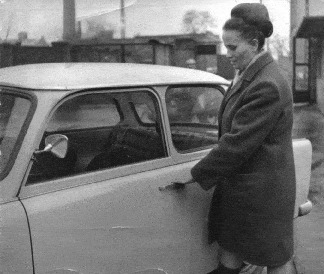
5. Mrs. T with her first Trabant, 1971.Source: Private collection of Mrs. T and Mrs. T.J.
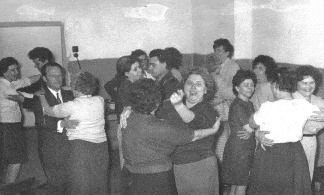
6. What was left out of the brigade's diary. A brigade party, 1967.Source: Private collection of Mrs. T and Mrs. T.J.

7. The Liberation brigade with their immediate superiors, March 1970.Source: Private collection of Mrs. T and Mrs. T.J.
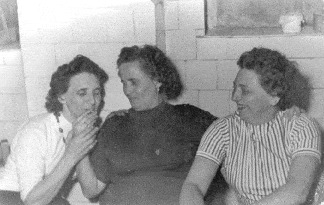
Mrs. T and Piri teach Manci to smoke in the moulding shop of the Budapest Hosiery Factory, 1960s.Source: Private collection of Mrs. T and Mrs. T.J.
 You have Access