Electric light begins life in Bangkok as ornament. The first time it is employed in the city is at the Chakri Maha Prasat Throne Hall at the Grand Palace. Thai army commander Chao Phraya Surasakmontri had been to Paris and was taken by the City of Light. Using 14,400 baht gained from the sale of inherited land, he purchased two electric generators from Britain. To demonstrate their power, he had electric lamps installed in the throne hall's reception room. In the evening of 20 September 1884, for the sixtieth birthday of King Chulalongkorn (r. 1868–1910), workers turned the generators on, causing light to emanate from the windows of the palace through the darkness of the tropical night.
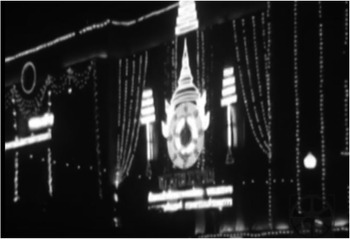
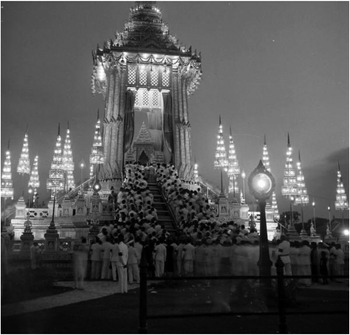
Electric light remained a novelty until the early twentieth century, when it became an increasingly common part of the monarchy's public life. In Bangkok, it was regularly employed to decorate buildings and other structures near the Grand Palace for royal celebrations. Documentary film footage from 1929, for example, shows a remarkable display of light on buildings and streets for the thirty-sixth birthday of King Prajadhipok (r. 1925–1935) (fig. 1).Footnote 1 When the king travelled outside the capital, the light followed him. In 1926, local officials hung hundreds of light bulbs over a gateway leading into the northern city of Chiang Mai in honour of Prajadiphok's visit.Footnote 2 Even after death, electric light does not leave the aristocracy's side. Figure 2 shows the mid-twentieth century funeral pyre of King Ananda Mahidol (r. 1935–46) lit by electric power. More recently, in May 2019, King Vajiralongkorn was crowned in a lavish ceremony. In the evenings during the event and for days afterwards, well-wishers were treated to a show in which colourful patterns and images were projected into the sky. In one particularly memorable sequence, lights were shone onto a wall of mist, creating a shimmering portrait of the king floating above the city.
Electric light show for King Prajadiphok's birthday, 1929. Still from untitled documentary film, Thai Film Archives.

Funeral pyre decorated with electric light bulbs, royal cremation of Ananda Mahidol (r. 1935–1946), 1950, public domain, https://upload.wikimedia.org/wikipedia/commons/1/1a/Government_officers_offering_of_sandalwood_flowers_%28Actual_royal_cremation_of_Ananda_Mahidol%29.jpg.

Under elevated expressways and in the narrow streets of the city's outer suburbs, the city is much dimmer. At night, these areas are lit by weak bulbs, flickering white fluorescent tubes strung on corrugated metal roofs, old Christmas lights, and the head lamps of passing cars and motorcycles. In the winding alleys of working-class neighbourhoods like Saphan Mai and Khlong Toei, these lights reflect off the glassy eyes of the feral dogs that run in packs and the glazed, sweaty faces of drunken men sitting on makeshift benches and steps. Satellite photographs of the kingdom taken at night capture the difference between light and dark clearly, while economists studying such images find a strong correlation between the intensity of light and wealth (as measured in terms of productivity).Footnote 3 It is no surprise, then, that inequality follows the contours of the electric power system.
In what follows, I explore the connection between electric light and inequality more closely. I do so by tracing the development of electric power from the late nineteenth to the early twentieth centuries. On one hand there is the production of the material system, the ‘infrastructure’ or ‘network’, that produces the energy for lighted displays. On the other, there are the displays themselves, which for the most part celebrate the authority of the state and serve the interests of capital. I argue that class formation in Thailand takes place through the development of these two phenomena; what began as (and continues to be) a speculative endeavour to generate profit has become a method to create and display social distinction. That is, as the electric power system took shape, it simultaneously transformed the city's fabric and social relations. The oft-noted messiness and dysfunction of Bangkok's electric infrastructure and the intractable inequality of Thai society are therefore not failures of urban development. They are the outcome, or ‘style’, of a system shaped by and for a narrow set of interests to produce privilege and then make that privilege visible.
Visible infrastructure
Electric light's main affordance is visibility. Light is, after all, the spectrum of electromagnetic energy that the human eye has evolved to see. Electric light also makes other things visible. Merchants, for example, can spotlight merchandise in their window displays and make them apparent to passers-by, even at night. Compare the visibility of electric light with the ensemble of technologies required to generate it. They are commonly conceptualised as infrastructure, ‘a system of substrates—railroad lines, pipes and plumbing, electrical power plants, and wires’.Footnote 4 Scholars invariably remark on the ‘substrate’ aspect of the term, noting how ‘infra’ means ‘under’ and as such, is largely invisible. Indeed, most people probably do not think about the network of pipes, pumps, and meters that are required for water to run when they turn on the tap in their kitchen sink. They may also not see or think about the wires, transformers, and fuel required to harness and channel current in cities in developed countries. These elements are usually distant from the industrial machines or home appliances that they power.Footnote 5 The hidden quality of infrastructure renders its ‘elements tangential to concerns of everyday life. As long as they continue to function, they remain part of an indifferently accepted perceptual background.’Footnote 6
In Bangkok, one might argue, only partly sarcastically, that the electrical infrastructure is, in fact, quite visible. The ubiquitous tangle of overhead wires that occasionally burst into flames or, worse, entangle and kill unsuspecting Bangkokians, along with the often inconvenient (and sometimes baffling) placement of utility poles in public thoroughfares are frequent, tangible reminders that the city is in many respects one large electric system.Footnote 7 The prominence of the electric power infrastructure in Bangkok's visible environment is not a recent phenomenon. In the early twentieth century, the wires and posts were so prevalent that they intruded into just about every photograph of Bangkok's streets from the period. In one image of the Barrow, Brown and Co. Ltd department store found in the National Archives of Thailand, the printer deliberately erased the lower portion of utility poles so that they did not obfuscate the view of the building.Footnote 8 This very visible infrastructure was also quite tangible, often becoming entangled with trees soon after installation.Footnote 9 When nature was not getting in the way of the new technology, humans were. City officials reported mischievous individuals cutting electric cable for fun in the 1920s. Ironically, the officers sent to investigate complained that because it was night-time it was too dark to see the perpetrators.Footnote 10 Electricity was also dangerous. In 1904, rumours that ‘a Chinaman was killed while painting electric light posts’ circulated in the city. In response, the manager of the electric company warned that ageing electrical wires were ‘getting more and more dangerous every day’. He then cautioned that the number of fatalities would likely increase because it would soon be kite flying season.Footnote 11
Indeed, a quick look through the state's archives show that the appearance of the electric power system emerged through the deliberate actions of historical agents operating with constantly evolving and sometimes competing desires, goals, and constraints. Decorative light posts, for example, were installed along Ratchadamnoen (literally, ‘the king's progress’) Avenue in the early twentieth century to help create a sense of grandeur along that street. When representatives of the company that ran the city's first electric power system suggested replacing old utility poles on other streets in the city, Prince Damrong, King Chulalongkorn's brother, agreed because he felt the old ones were not beautiful (mai ngam). He went on to say that those along Ratchadamnoen Avenue were already aesthetically pleasing.Footnote 12 In another instance, the head of the Krom Jao Tha (Maritime Department) asked for two concrete utility poles to be installed near the department's offices because they were more beautiful and neater (riap roi) than wooden ones.Footnote 13 Elements of the electric power system were thus not all meant to be hidden; some were installed to be visible and visibly beautiful according to the tastes of royalty.
The desire for visually appealing infrastructure was shared by the British engineers who helped design the system. For them, however, it led to different recommendations for different parts of the city. A. Odent, an engineer working for the Sanitation Department, wrote on the topic at length in 1906. In a letter to Phra Norasatsarakham, the head of the Sanitation Department, Odent opined that he did not recommend hanging lamps in the middle of roads in the Dusit Park neighbourhood, which included royal palaces, homes of royal family members, and state buildings. He said that hanging lamps over roads was fine in town because when fixing wires to houses, poles could be avoided and equal lighting given to both sides of street. However, he felt this could not be suitable in a park, ‘where the perspective must be taken into consideration during the day and night-time, and should contain the least number of poles and wires possible’. In addition, ‘lamps suspended over the roadway would increase the number of poles and the length of wires; the perspective in the avenues would thereby be broken up’. He complained about streets like Dang Dao, where ‘on a length of about 300 metres, in front of the royal palace, there are now standing no less than seventy-two posts of all kinds’. He suggested that the telegraph, tram, and electric poles and lines be consolidated to reduce their overall number. Too many competing elements distracted from one's view of the city, which for him clearly should not include the electric power system's various components. He felt that ‘the most suitable distribution [of electrical wires] should have been underground’, because this would have put them out of sight.Footnote 14 In other words, the city should be designed as a brightly lit panorama with nothing to block one's view of the aristocracy's new palaces, parks, and boulevards, making the electric power infrastructure truly ‘infra’.
Budgetary limitations, however, meant that Odent's recommendations were not followed even if his desire to mould the city into one large, electrified display would eventually come to fruition. After making his recommendations, Odent admitted that the cost of carrying out his plans would be prohibitive. Indeed, the expansion of the system was assessed primarily in financial terms: lengths of cables were expressed and evaluated in terms of baht, as were the number of bulbs and posts. This accounting practice converted the system into monetary units and allowed the government to base its decisions on financial considerations, which in some cases trumped, or transformed, aesthetic preferences.Footnote 15 In some locations, meters were installed to prevent the loss of money by allowing officials to detect leaks or excessive usage. This was the case for the Dusit area, where consumption was particularly high. In European and American cities, the installation of meters may have had the effect of inculcating modern economic rationality in consumers of current.Footnote 16 In Bangkok, it was a way to police the profligate use of electricity by the Royal Household.Footnote 17 The financial concerns of the government thus shaped the design and implementation of technologies for generating and distributing electric power; only royal areas of the city would be built to look good, be well-lit, and properly managed. The creation of the electric power system was the simultaneous development of a city of unequally lit spaces and class distinctions, points I will return to later.
For now, it is enough to note that the appearance of the electric power infrastructure in Bangkok was subject to and emerged from ‘non-technical’ factors like the aesthetic judgements of royals and the European engineers working for them. Design outcomes, in turn, followed the possibilities defined by cost and profit margins, among other factors. In some cases, such as the decorative lamp posts, the system was made to be seen and admired. In others, it was simply left out in the open—messy, unkept, and visible as part of the ‘ambient conditions of everyday life’.Footnote 18 Infrastructure is thus not inherently invisible; it is made so (or not) by design.
Visibility and meaning
Rather than an invisible material substrate that serves to facilitate various human activities, anthropologist Brian Larkin suggests that the material components of an infrastructure are a semiotic system. As such, an infrastructure may be intended to be seen because it is a sign vehicle oriented towards some set of addressees. He cites Tzvetan Todorov, who argues that in some situations infrastructure like factories are built to produce symbolic meaning rather than commodities. Infrastructure ‘emerges out of and store within them forms of desire and fantasy’ that can take on ‘fetish-like aspects’ quite removed from whatever practical function it is generally thought to perform.Footnote 19 In situations where this is the case, it should not be surprising to see a perfectly good factory building sit empty. Its existence as a visible part of the landscape is its main purpose.
In Southeast Asia, development projects from the late nineteenth and early twentieth centuries can be similarly explained in terms of their symbolic function. Colonial and local officials throughout the region commonly linked large infrastructure projects with concepts like modernity, progress, and enlightenment. Rudolf Mrázek describes how Dutch engineers and Javanese elites saw roads and other new technologies as means to bring modernity to the dirty, messy, and wet world of the tropics. The Dutch especially associated electric light with modernity in part because they thought it allowed them to make Java legible and thus manageable and safe.Footnote 20 In other locations under different political conditions, electric power materialised similar meanings. Lenin, for example, saw electric power and light as an important part of modernisation, equating it with enlightenment. This link was made not just in the Soviet Union, but also in its sphere of influence. David Sneath writes, ‘In Mongolia the electric light became a central symbol of modernism, and indeed of the particular political project of Leninist state socialism.’Footnote 21
In Siam, the railway was the technological system and symbol extraordinaire of modernity (samai mai) for the royal government. The first line was completed from Bangkok to the mouth of the Chao Phraya River in 1893. King Chulalongkorn stated that ‘the construction of railways has not only the greatest influence upon the development of a country but it also is the most striking evidence of that development. The railway wherever it goes carries with it enlightenment and encourages the growth of national feeling which is so important an element in the welfare of a country.’Footnote 22 To ensure the railway communicated modernity, particularly to a foreign audience, the government spent money to hire a designer from Italy to draw up the plan for a grand neo-Renaissance style central station at Hua Lamphong. The notion that infrastructure communicates symbolic meaning helps explain why the government chose to fund the railway over other proposed infrastructure projects that were arguably more critical for Siam's economy, like an irrigation system.Footnote 23 It also provides a reason why Prince Damrong and others in the Siamese government insisted on the decorative lamp posts mentioned earlier. They were meant to present the aristocracy's ideal of beauty to Bangkokians and Europeans alike, regardless of whether there might have been more functional or less expensive options available.
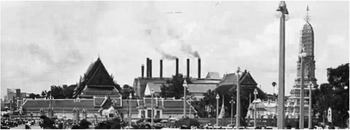
Unlike the railway network, however, the construction of an electric power system was not supported wholeheartedly by the government when it was first mooted. Instead of building one as a state-led modernisation project, the government allowed a group of Thai aristocrats to construct the kingdom's first electric power plant 1889 as a speculative endeavour. They obtained the backing and money of a handful of successful Chinese merchants and a couple of European investors to establish the Siam Electric Company (Borisat Sayam Fai Fa). The company set up a power plant next to Wat Ratchanaburana (Wat Liap), a Buddhist monastery in the southern part of the city's royal centre, Rattanakosin Island (fig. 3). There was a workshop, an office, and a building where the generator was housed. Power was converted from traditional fuel sources such as logs, oil, coal, and rice husks.Footnote 24 And unlike the central railway station, the power plant's buildings were not designed to showcase any particular message about progress even though they were quite evident in the city's landscape due to the smokestacks that expelled black soot into the air. What a comparison of Bangkok's electric power system and Siam's railway network demonstrate is that the association of an infrastructure with notions such as modernity, progress, or beauty, is, like the visibility or invisibility of infrastructure itself, crafted by particular groups in line with their various desires and beliefs.
Electric Power Plant near Wat Ratchaburana (foreground) in Bangkok, public domain, https://commons.wikimedia.org/w/index.php?curid=8098204.

The meaning an infrastructure conveys also depends on who is looking and what is being looked at. For long time, working-class Bangkokians, the system's wires may indeed form part of an unconscious ambient landscape. This might explain why they often become entangled in them. For these residents, the electric power system sends no particular message about modernity other than perhaps a daily reminder that whatever modernity is supposed to be, they are not part of it. People familiar with a less cluttered urban environment, on the other hand, immediately notice the thousands of dangling power lines and randomly placed poles, which are taken as a sign of urban planning failure. In 2016, for example, Bill Gates tweeted on the need to bury Bangkok's electrical wires to make it safer and less unsightly after coming across a picture of the city.Footnote 25 More recently, actor Russell Crowe sparked discussion online about the overwhelming presence of the city's power lines by tweeting images of them.Footnote 26 Like the British engineer Odent a hundred years earlier, Gates and Crowe understand the electrical power infrastructure as something meant to be hidden. Still others react to the sight of the system by highlighting it rather than suggesting it be covered up. Two Italian street artists known as Sten and Lex have covered an entire façade of a building on Charoenkrung Soi 30 in southern Bangkok with a series of lines meant to depict the city's thick web of electric cables.Footnote 27 It may be fruitful, then, to consider the electric power system as a visual ecology; the degree of visibility and meaning of an infrastructural system depends on the niche the observer occupies relative to it.
Form follows function
The question remains, what semiotic function do the messy elements of the electric power system in Bangkok convey if they are not symbols of modernity? One possibility is to think of them as signs of failure in city planning. Failure is an important notion in studies of infrastructure because it helps make visible the ways ‘the present landscape is a product of past projects and struggles’.Footnote 28 Visibility upon breakdown is, in fact, one of the nine aspects of infrastructure presented by Susan Leigh Star in her classic essay, ‘The ethnography of infrastructure’.Footnote 29 During a blackout, for example, those who rely on the electrical system are likely think about its material existence as well as its importance in their lives.Footnote 30 Along these lines, Stephen Graham and Nigel Thrift write that the ‘black box’ of technology is opened for inspection when it becomes inoperable.Footnote 31 In studies of Thailand, Eli Elinoff demonstrates this to be the case when he describes how failures related to large-scale infrastructure projects, particularly those involving concrete like the unsuccessful Hopewell multi-modal transportation system and the cracked runways at Suvarnabhumi Airport, have opened ‘Thailand's power structures for debate’ by ordinary Bangkokians.Footnote 32 Malfunctions can and do reveal insights about technology and society, but in Bangkok the fact that the electric power system is already apparent to many and today rarely experiences issues with supply suggests the need for a slightly different approach.Footnote 33
Rather than failure, I suggest unsightly and deadly clutter of wires, transformers, and utility poles reveal what might be considered a ‘technological style’. Thomas Hughes, who coined the term, writes, ‘Technological style can be defined as the technical characteristics that give a machine, process, device, or system a distinctive quality.’ He adds, this ‘distinctive style’ develops ‘out of local conditions’.Footnote 34 That is, factors specific to a place such as geography, religion, and politics influence the style of a technological system. This explains why there may be differences between cities, regions, and nations when it comes to the operation, use, design, and meaning of specific technologies. Local conditions, of course, do not operate in a deterministic fashion. There was nothing essentially ‘Thai’ that predetermined the aristocracy would become enamoured with displays of electric light or that elements of the power system would shape the visible environment so directly. Instead, the technologies that generate electric light constituted local conditions as they evolved into a system. They did this by offering a range of possibilities, from profit and convenience to entertainment and public safety. These possibilities took shape as such in combination with factors like individual predispositions, financial considerations, and the ‘state-of-the-art’ of various technologies.Footnote 35
In early twentieth century Bangkok, the individuals whose predispositions and financial considerations counted most in shaping the electric power system, and thus local conditions, were members of the royal family. Later they would be joined by eager merchants and entrepreneurs. These ‘system builders’, to continue with Hughes’ analytical terms, worked to configure various technologies to generate new opportunities and to ensure the benefits of those opportunities would accrue to themselves.Footnote 36 Their system building activities resulted in the connection between royal authority and light as well as an electric power system that appears to non-Thai observers today as a complete disaster.
As noted earlier, the Siam Electric Company was established not as a government modernisation initiative but as a speculative endeavour and its investors, including the royal government, expected to profit from their investment. The system's initial function was thus to generate dividends. Unfortunately, the Siam Electric Company failed in this purpose, to make money, and closed in just three years. A combination of poor management, lack of technical expertise, and shortage of capital doomed the company.Footnote 37 The royal government, who had become reliant on electric light, only reluctantly took over the power plant and all its equipment. It held control of the plant, operated at a loss, until 1897, when it sold the entire bundle in the form of a ten-year concession to an American man named L.E. Bennet. So eager was the government to offload the drain on the state's books that it agreed to a fee of just 100,000 baht, despite the total value of the plant and related equipment valued at over 300,000 baht. Bennet then quickly sold the concession to another group of investors for double his initial investment.Footnote 38
The new investors set up The Siam Electricity Company Ltd (TSEC), a business ‘of Danish origin in which Danish capital [was] principally employed’.Footnote 39 This time, the endeavour was a success in that unlike the original Siam Electric Company, TSEC turned a profit for most of the years it operated.Footnote 40 The royal government, while not keen to run the plant itself, did supplement the Danish group's private capital with a significant investment. The Royal Treasury (Krom Phra Khlang Khang Thi) spent approximately 258,000 baht to buy 3,225 shares of the company with expectations that it would produce dividends.Footnote 41 The purchase was, as with the first electric company, speculative rather than part of an effort to improve the lives of the general population; the introduction of an electric power system in Bangkok was a financial venture meant to generate economic benefit first and foremost.
Financial considerations were at play again in 1912, when the government tasked Chao Phraya Yommarat, the Minister of Local Government (Krasuang Nakhonban), with establishing a second power plant. Officials chose a site on Samsen Road, north of the palace and near the new royal compound at Dusit Park. The facility was completed and started commercial operations in 1914 under the name Royal Samsen Electricity Authority. This too was about money in that the government made the decision after noting TSEC's sustained profitability and its own very heavy consumption of current. The government felt that the Danish operation was charging them too much for its services and that their power plant was too far from the newly developed northern sections of the city.Footnote 42 The distance meant that the current the Danish plant generated could sometimes be unreliable and thus not able to power state facilities like the city's new water works and opium processing plant.
With control of its own generator, royal government officials could more effectively craft a system that suited their needs. One way they did this was by negotiating a deal with TSEC's Danish owners to create two territories for the provision of electric power and thus eliminate competition. TSEC would develop the system for areas south of the Banglamphu and Mahanak canals while the Royal Samsen Electricity Authority would cover Dusit Park where buildings owned by the royal family were clustered.Footnote 43 Around the same time, the government began to broach the topic of taking back the Danish-run plant even though it was never really theirs to begin with. The Minister of Local Government noted that in Japan the government had taken back all the ‘important things’, like utilities. Why shouldn't Siam follow suit, he asked? Having control of the power plant would mean that the government would no longer be at the mercy of foreign companies. In response, TSEC said it was willing to negotiate a lower rate for the government and that it had already voluntarily given up rights to the northern sections of the city as an indication of its goodwill.Footnote 44 The construction of a second power plant, the use of concessions, and the threat to revoke them moulded the system so that the affordances of electric power, like light, became bound to the government and the royal family. The connection between monarchy and electric light, or style, emerges through this infrastructure development.
TSEC, while not part of the state, worked in similar fashion to shape the city's power system. They not only supplied electricity for street lighting, house lights, and home appliances like fans, but also for the city's new tramways. The Danish ownership group that ran the power plant bought over ‘one-half of the tramways’Footnote 45 in the city in 1892 for 280,000 baht.Footnote 46 The system they took over included horse-drawn tram cars, which were expensive and inefficient to operate.Footnote 47 Aage Westenholz, the Danish investment group's leader, had them electrified in 1894. Seeing the benefits of the combination, he merged TSEC and the Bangkok Tramway Company Ltd. After that, profits evidently came from the tramways, which subsidised the electric power plant's operations.Footnote 48 The production of electric power in this combination thus became a secondary function to the operation of the trams. In combining the two companies, Westenholz joined mass transit technologies and electrical current in a single corporate entity that could both circulate Bangkokians through the city and capital between Europe and Siam. As described by Hughes, financial and organisational solutions (for example, vertically-integrated firms and state-sanctioned monopolies) to engineering problems (for example, slow and inefficient trams and an unreliable supply of current) are part of the ‘seamless web’ of any large technological system.Footnote 49 In Bangkok, the seamless web's form was crafted by Siamese royals and foreign entrepreneurs seeking profits.
Public good and private benefit
This may seem overly conspiratorial; it is true that in some instances, the government requested the expansion of the system to facilitate wider access to electric power. In 1898, for example, it mandated an overall increase in the number of points where the electric network was available in its concession agreement with TSEC. The company complied with zeal. In 1898, the number of lamps and motors connected to electrical power was 8,373. Of this, approximately, 2,622 of the bulbs were installed in government buildings and palaces and on city streets. Lamont Groundwater, a British engineer working for the Siamese government, reported that by 1907 the total number of lamps and motors was 42,910, representing a 348 per cent increase over just less than a decade. He also boasted that TSEC supplied ‘the whole of the city with electric light’.Footnote 50 In fact, if one looks only at the volume of current sold and of the number of posts and metres of wire installed, the only significant slowdown in the growth of the electric infrastructure took place in the last months of 1945, when Allied bombs damaged the city's two power plants.
This expansion was not, however, necessarily intended for the common good. Streetlight, for example, was not always used for public safety. There was in fact a policy to turn streetlights off during the evenings of certain months in the year. In June 1932, the year of the revolution which ended the absolute monarchy, some officials questioned the practice. They noted that by the early 1930s the movement of goods and traffic in the city had grown to such an extent that lights were required to facilitate it. The absence of electric lights meant danger at night for vehicular traffic. In a subsequent response, the Ministry of Commerce and Communication noted that TSEC had already been leaving the lights on at night within their territory and if they wanted the Royal Samsen Power Authority to provide power for lights in the northern sections of the city, then the Ministry of Interior (Krasuang Mahathai) and the power station could arrange for it.Footnote 51 In other words, street lighting was meant first to serve royal consumers and second to facilitate commerce into the night. When Groundwater stated that TSEC provided light to the entire city, he was only partially correct. It provided light for those with the means to purchase it and to those who could make money from it.
In the early twentieth century, those who could pay for or make money from electric light were primarily Siamese aristocrats, well-connected Chinese merchants, and European residents in the capital. The royal household and the government were, in fact, the chief customers of electricity after its introduction. In 1907, the palace used 28,114 units of current at a cost of 7,761 baht. In the same year, various government offices used 23,848 units, costing 5,962 baht and the collected buildings in Dusit Park used 60,608 units at a cost of 13,636 baht. Public street lighting, by contrast, used a total of 26,549 units at 4,466 baht.Footnote 52 In 1914, when the government opened its own plant at Samsen, the state remained the primary consumer. In 1916, the Samsen facility had only 206 private customers while the Phaya Thai Palace, constructed in 1906 as an alternate residence for King Chulalongkorn, alone racked up a bill of 59,757 baht.Footnote 53 Aside from the cost of current, the price of accessories required for light, such as glass bulbs, was also high. If a homeowner wanted to install 50 bulbs, something only wealthy families could think of doing, in his or her house, it would have cost 1,676 baht. Compare this to the average salaries for different groups of Bangkokians at the time: clerks in the civil service made about 10 baht a month, a mid-level civil servant made 20, judges received approximately 200, while foreign advisers earned between 600 to 800.Footnote 54 The average resident of the city could not purchase the basic equipment for electric light, much less pay a monthly fee for the current necessary to power it. All this is important to note because it indicates, again, that the system in its early days shaped and was shaped by the demands of its main consumer, the royal family and a government it largely controlled.
The ability to profit from the production of electric light was facilitated further in that the Samsen plant charged royal family members about 40 per cent less than other private customers. Companies associated with the state like the Siam Cement Company Ltd also received special discounts. The Siam Cement Company was an enterprise in which Yommarat, the official in charge of the Royal Samsen Electricity Authority, held a substantial share, and his son Sukhum served on the company's board.Footnote 55 Shocked at the price differences between the Royal Household and other consumers, a British consultant called in to audit the power station declared that the rates charged to ordinary customers amounted to ‘extortion’.Footnote 56 Worse, according to the auditor, Yommarat appeared to use the power station as a vehicle for his own benefit. He wrote that Yommarat showed a ‘tendency, gradually increasing from year to year, to regard the Samsen Power Station as the milk-cow of the family and personal interests’. In one instance, he was able to simply write off 49,437 baht of debt. In other instances, he used the plant's budget to purchase automobiles that he used as personal property.Footnote 57 The auditor reported also that Yommarat had a power line constructed to his house in Sala Daeng, in the southern part of the city all the way from the Samsen plant in the north rather than simply connecting to the TSEC system nearer his house. Yommarat did not pay for the power consumed through that line, very few other homes were attached to it, and it powered no street lighting at all. Like other cases of potential corruption in Thailand, however, nothing came of these allegations. The point here is that the city's electric infrastructure provided not only a novel source of lighting, it offered a small group of people new forms of privilege as they shaped the system to enhance and protect those benefits. As a result, the power station's main technical function was not necessarily to provide power or to usher in and symbolise modernity. It was a mechanism meant to generate money and convenience and then direct both to individuals fortunate enough to be plugged into the system.
The creation of the electric power system also afforded the Royal Household the opportunity to configure the emerging boundaries between public and private in ways that would benefit themselves. Beginning with the first Siam Electric Company, the Royal Household ran up very large electricity bills that they did not always pay. In 1904, Westenholz wrote to Krom Khun Bidyalabh, Minister of the Royal Household, stating that in the past, the Sanitation Department would pay for the Royal Household's electricity bills. At some point, however, the Department had stopped doing this because the Minister of the Sanitation Department felt it was inappropriate for a government department to pay for the royal consumption of current out of its budget. The Royal Household then instructed the Sanitation Department to pay the bills since not doing so would make the Royal Household look bad.Footnote 58 Instead of making the distinction between the Royal Household clearer to prevent problems like this from occurring again in the future, the government consolidated its control over the electric power system as the development of the Samsen station shows. As a result, the Royal Samsen Power Authority ran on debt, likely losing over 200,000 baht each year due to the low rates it was charging its special customers.Footnote 59 The system was created to transfer the costs of providing light to the royal household to the public.
Mike Anusas and Tim Ingold suggest that electric infrastructure can be thought of as ‘threads’ available for people to use to ‘weave’ together their world.Footnote 60 The weaving metaphor is also employed by writers like Abdou Maliq Simone to analyse infrastructure in regions with extreme inequality. He writes that ‘people are infrastructure’ because they string together disparate and disconnected parts of their environment, particularly in situations where traditional infrastructure might not be present or completely functional.Footnote 61 In studies of Bangkok, Claudio Sopranzetti, following Simone's lead, argues that the city's motorcycle taxi drivers are infrastructure because they ‘knit together’ systems that might not otherwise be connected.Footnote 62 The actions of people coping with the dysfunctional world they find themselves in thus produce new connections and facilitate exchange. In the process, they gain some semblance of agency over an otherwise hostile environment. In many ways, the case of the electric power system in Bangkok supports this view, that people weave, in sometimes quite creative ways, a world with the materials available to them. Unfortunately, in Bangkok some people have simply had much more yarn. Unequal access emerged as a key feature of the electric power system through the actions of its key consumers—the aristocracy and merchants—and expresses itself today in the built environment. The fact that the system is so visibly unsightly to foreign observers stems from the fact that it was woven together for the convenience and profit of a few. As such, the production of electric light in Bangkok makes a small group of people rich and large numbers poor. It then leaves that inequality out for all to see in both the displays of light and the mess of cables and poles that define the city's visual ecology.
Display space
In discussing technological style and local conditions, I noted how technology affords historical actors’ new possibilities and can lead to changes in desires, goals, and practices. Photography, for example, allowed King Mongkut (r. 1851–68) to present himself to the world in the form of photographic portraits.Footnote 63 Before photography, there was no tradition of portraiture in Siam and a general absence of representations of any king's likeness. In fact, monarchs did not show themselves to the public as a regular practice in Siam until the mid-nineteenth century when the monarchy ‘enthusiastically embraced’ the photographic medium.Footnote 64 This may have been because monarchs in other parts of the world had already done so. John Clark writes that kings Mongkut and Chulalongkorn used photography as a means of ‘breaking the taboo associated with representations of the king in a public, nonsacral space and in showing the image of his person to foreign rulers’.Footnote 65 Today, images of kings (especially Chulalongkorn and Bhumipol) are visible in just about every nook and cranny of the city.
Electric light, while not the same as photography, similarly transformed local conditions. From at least the beginning of the nineteenth century, the city's aristocracy were concerned with projecting social distinction in visible ways. Saran Thongpan writes that in the early nineteenth century, works of art and craftsmanship served as objects signifying the prestige, power, and merit of their owners. These objects, including gold jewellery and fine textiles were crucial in the competition for power among members of the nobility. This status competition intensified through the 1830s, when the lucrative junk trade with China, which the king and many royal family members indulged in, led to a general increase in the quantity and variety of imported luxury items.Footnote 66 The competition expanded to a larger group of people in the early twentieth century, a period that saw a proliferation of imported manufactured goods from Japan, Europe, and the United States. In this light, as Peter Jackson astutely notes, King Vajiravudh's (r. 1910–25) early twentieth century critique of the Siamese habit of imitating Western practices ‘was less about the fear of encroaching Westernization than it was about the loss of Euroamerican accoutrements as symbolic of a conspicuous consumption that would distinguish the power of Siam's new elite from the country's masses’.Footnote 67
Electric light changed the way status distinctions were performed. Compared to candles and gas lamps, which flickered and went out unpredictably, electric light was constant and manipulable.Footnote 68 It was also visible to many across long distances. This meant electric light could reshape the city and cultural practice in ways not previously possible. Wolfgang Schivelbusch writes, for example, that streetlights in European and American cities created outdoor ‘interiors’. Lit boulevards acted as well-defined spaces into which people could step into from the nebulous darkness of pre-industrial streets.Footnote 69 This was the case in Bangkok as well. In the early 1840s, for example, Bangkok at night was generally quiet according to European visitors like Frederick Arthur Neale.Footnote 70 And dark. Where there was public lighting, it emanated from dim oil lamps. Some were hung on overhead ropes over streets along the Chao Phraya River, per Anna Leonowens, the British governess to King Mongkut's children. Others were placed in the homes of wealthy men or on posts in commercial buildings, palaces, and government offices. Most people, though, just slept at night. D.E. Malloch, a British trader, wrote of his visit in the 1850s that Thais slept approximately fourteen hours a day.Footnote 71 When they slept, they barricaded themselves into their houses to prevent burglaries, particularly in the central plains and the suburbs of Bangkok.Footnote 72 Rates of violent crime including home invasions, assault, armed robbery, and murder were high in the region for much of the last decade of the nineteenth century into the first two decades of the twentieth.Footnote 73 In terms of night-time entertainments, there was gambling, opium smoking, and the occasional temple festival featuring shadow puppet shows (nang thalung), theatre, and dance performances. The night before electric light was a time and space made by and for the bandit, gambler, and drug addict, not the bourgeois flâneur of European modernity.
When speculating entrepreneurs installed the components for electric light, they were really weaving Bangkok's modern urban fabric into existence. Along with utility poles, overhead wires, and streetlights came electrified trams, fan-cooled hotels, restaurants, and bars, department stores with lighted display cases and shop windows, and cinemas. This new world allowed people to transform themselves through their participation in the new activities that light afforded. Phraya Saphakanhirankit, a manager at the Siam Commercial Bank, the kingdom's first Thai bank, for example, opened Samsen Park in 1907. This was the city's first commercial amusement park, located on 16,000 square wah (64,000 square metres) of land near Dusit Park. It contained a large grass field, 200 water pools, a sports field, a fountain, a lakhon (Thai drama performance) theatre, and a zoo. It also showed films on a large outdoor screen. From 7:00 am to midnight, Bangkokians with means could pay a fee and enter the park to watch people, films, or theatre. Earlier, the royal government had arc lights installed in Dusit Park. These lit the park at night, making it possible for nobles to walk about during the evening, when the weather was cooler. Electric light also made hosting parties at night feasible and fashionable for royals like Phrabat Somdet Phra Pinklao, or the ‘second king’, who was known for having events at his palace to celebrate birthdays, anniversaries, and other occasions. Around the same time, associations and societies began to appear in the late nineteenth century. Mostly these were for the nobility. In 1881, the first such association, the Ho Samut Vachirayan (Vachirayan Library), opened for members only. Others followed soon after. These included the literary club Thawipanya Samoson and Sayam Samakhom (The Siam Society). Importantly, they all held a variety of night-time events including meetings, social events, and lectures made possible by electric light for their exclusive circle of members.Footnote 74 Policing access to these new spaces, rather than access to imported accoutrements, then became a paramount concern of the state. Status performances evolved from individual displays of wealth seen at limited distances among a small group of people to much larger, far-reaching activities in the city's new public spaces of electric light.
To sum up, when the electric companies expanded the presence of the system in search of profits during the early twentieth century, they contributed to the creation of a visual ecology in which displays of social status could take place and be meaningful in different ways for different groups of people. In seeking to avail themselves of the convenience of light, the actions of members of the royal family shaped the style of the system just as the system made the monarchy into a visible part of the city. The local conditions that determined technological style were themselves fashioned by technological developments. Making light made money for the monarchy and then it made them visible. Electric light was never just a symbol of wealth or class—it helped create both.
Conclusion
Bangkok is not unique in its messiness. It ‘looks’ like what one might expect of a city in the Global South. It is different from other cities in Southeast Asia in that its messiness was brought about by a combination of aristocrats and merchants, rather than colonial officials, to create a world in which they could make money and themselves into modern subjects of that world. In this sense, the landscape of dysfunction that is Bangkok can be explained as an expression of the city's technological style, one with a distinct visual ecology. For other cities in the region, perhaps one key point to learn from this study is that the apparent disorder of the urban environment may not necessarily stem from failure, but rather the outcome of the way that historical actors have woven together their worlds. To analyse urban development and infrastructure historically in terms of style and ecology may thus help demonstrate how technology and social relations shape each other.