I. INTRODUCTION
Carbon aerogel was introduced in 1989 (Pekala) by carbonization of resorcinol-formaldehyde aqueous gels Reference Pekala1 ; they are highly porous materials with a three-dimensional microporous and mesoporous network. Carbon aerogels had been extensively studied by researchers due to its many excellent properties, such as a large surface area, a tunable, high porosity, and a low bulk density. Reference Schwan and Ratke2–Reference Al-Muhtaseb and Ritter13 Carbon aerogels are promising materials for hydrogen storage Reference Zubizarreta, Menéndez, Job, Marco-Lozar, Pirard, Pis, Linares-Solano, Cazorla-Amorós and Arenillas14–Reference Tian, Buckley, Sheppard, Paskevicius and Hanna17 and had been widely investigated as electrode materials for supercapacitors and electrochemical double-layer capacitors Reference Wencui Li and Fricke18–Reference Zu, Shen, Zou, Wang, Wang, Zhang and Yao22 because their high packing density and microstructure yield a good electrochemical performance. Metal-doped carbon aerogels are also used to remove poisonous gases. Reference Catalão, Maldonado-Hódar, Fernandes, Henriques and Ribeiro23,Reference Tian, Wu, Zhang, Yang, Li, Qi, Zhou, Qi, Zhao and Wang24 Carbon aerogels are also ideal super-black materials, Steven R. Meier, Michelle L. Korwin, and Celia I. Merzbacher measured the directional hemispherical reflectance (DHR) of carbon aerogels and found that the HDR is 1.0–1.2 ± 0.2% throughout the 2.5–14.3 µm infrared wave length region, when the incident angle changed from 8° to 30°, and the DHR increased by only 0.2%. Reference Meier, Korwi and Merzbacher25 They also found that low-density carbon aerogels have low reflectivity. Reference Merzbacher, Meier, Pierce and Korwin26 In general, researchers believe that the blackness of materials with low reflectivity has been attributed to strongly absorbing pigmentation alone. Vukusic, Sambles, and Lawrence found that the nanostructure of the butterfly wing contributes significantly to their black appearance. Reference Vukusic, Sambles and Lawrence27 Chen, Hubbard, Shields et al. fabricated the subwavelength silicon moth-eye structures and discovered that the fabricated nanocone array form a broadband antireflecting surface had an average reflection less than 3% in the spectral range from 400 to 1000 nm. Reference Chen, Hubbard, Shields, Liu, Allsopp, Wang and Abbott28 Qibin Zhao, Tongxiang Fan, Jian Ding et al. fabricated a super-black amorphous carbon film with 99% optical absorption in visible light, by borrowing the inverse V-type antireflection nanoarchitecture from the black wings of a butterfly. Reference Zhao, Fan, Ding, Zhang, Guo and Kamada29 Jiayi Zhu, Xi Yang, Zhibing Fu et al. fabricated a carbon aerogel with the density below 70 mg/cm−3, which showed enhanced antireflectance performance in the range of 400–2000 nm. Reference Zhu, Yang, Fu, Wang, Wu and Zhang30 These discoveries proved that the nanostructure contributes significantly to the black appearance of the material. In 2008, Zu-Po Yang, Lijie Ci, James A. Bur et al. fabricated a low-density nanotube array with a reflectivity of 0.03%, by a water-assisted chemical vapor deposition process, Reference Yang, Hsieh, Bur, Ci, Hanssen, Wilthan, Ajayan and Lin31 and this material is the darkest material according to reports in the literature. We discovered that carbon aerogels with a subwavelength structure, especially for the structures with the minimum size reduces the reflectivity efficiently Reference Sun, Du, Feng, Shen, Huang, Tang and Zhou32 ; the reflectivity of the material is also related to the effective refractive index, materials with high density have a high effective refractive index, and thus have high reflectivity according to Fresnel equations. The pore texture of both dried and pyrolyzed materials depends on the drying process, according to the drying method of organic aqueous gels; the dried materials are called “aerogels”, “cryogels”, and “xerogels” by supercritical drying, freeze-drying, and evaporative drying, respectively. Reference Job, Théry, Pirard, Marien, Kocon, Rouzaud, Béguin and Pirard12 Supercritical drying leads to the widest texture range and the highest pore volume; in this aticle, we used supercritical drying to obtain RF and corresponding carbon aerogels.
Because carbon aerogel is one of the super-black materials, we could use this powerful property to fabricate a carbon aerogel sleeve (CAS), which could absorb stray light. The function of CAS used in the optical system is like a dustbin that collects garbage, so we called CAS “optical dustbin”. We obtained twelve different CASs, by the sol–gel polycondensation of resorcinol (R) and formaldehyde (F) under the catalysis of sodium carbonate (C). We used scanning electron microscopy (SEM), transmission electron microscopy (TEM), and nitrogen adsorption–desorption isotherms to observe the microstructure of carbon aerogels; explained the reason why carbon aerogels with a subwavelength structure have high absorptivity across a wide spectral range; and constructed a simple optical system to measure the exit power from CAS in different directions. We used this system and proved that different CASs have different matting effects and all of these CAS have better matting effects than those of monolithic graphite that has higher reflectivity. Finally, To show the fine angular resolution ability of CAS, we measured the faculae from the reflected light of a compact disc and found that CAS with a clear aperture of 1.0 mm is the best. This work used the super-black carbon aerogel in the optical system for the first time, and the super-black CAS could be used in precision optical instruments for its high ability to eliminate stray light and its fine angular resolution ability. The CAS with a small and clear aperture is also a good prop to demonstrate diffraction of light.
II. EXPERIMENTAL
A. Materials
Resorcinol (≥99.5%, AR), formaldehyde aqueous solution (37–40%, AR), alcohol (≥9.7%, AR), and Sodium carbonate anhydrous (≥99.8%, AR) were purchased from Sinopharm Chemical Reagent Co., Ltd. (Shanghai, China). The monolithic graphite was purchased from Jusheng graphite products Co., Ltd (Foshan, China). All reagents were used without further purification.
B. Preparations of carbon aerogel sleeves
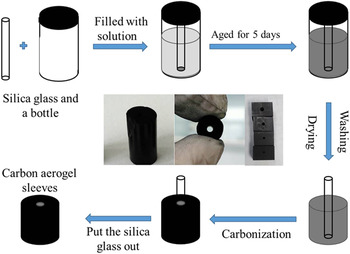
Carbon aerogels in this article were derived from the pyrolysis of resorcinol-formaldehyde aerogels (RF aerogels), by the sol–gel polycondensation of resorcinol (R) and formaldehyde (F) under the catalysis of sodium carbonate (C). The reflectivity of carbon aerogels is controlled by the microstructure, and the microstructure depends on the synthesis variables: (i) the amount of resorcinol and formaldehyde in the precursor solution (wt%) and (ii) the molar ration of resorcinol-to-catalyst (R/C). Reference Sun, Du, Feng, Shen, Huang, Tang and Zhou32 In the present work, as showed in Fig. 1. First of all, a certain amount of resorcinol is dissolved in the deionized water, add appropriate amounts of sodium carbonate solution and stir for 2 h at the rate of about 400 r/min. Then, add appropriate amounts of formaldehyde aqueous solution with another 2 h of stirring; the detailed content of all reagents is showed in Table SI (Supplementary Material). After further stirring, the precursor solution was poured into specially tailor-made columniform molds with a channel of different diameters, sealed, and aged in an oven for five days (30 °C for one day, 50 °C for one day and 90 °C for three days) to obtain wet RF gels. Wet RF gels were washed by alcohol for three days (three times a day) to remove residual water and solvents, then were subsequently dried using supercritical carbon dioxide (31 °C, 7.3 MPa) to obtaine RF aerogels. RF aerogels were pyrolyzed at 1000 °C under nitrogen atmosphere at a rate of 300 mL/min to obtaine carbon aerogels; the heating curve is shown in Fig. S1 (Supplementary Material). Finally, we put out the clubbed silica glass and polished the end face of CASs using 400 grit SiC paper, and CASs were obtained. We obtained twelve different CASs named by the form of CAS-R/C-wt%-clear aperture, for example, CAS-1000-30-2.0 is the CAS with the molar ration of resorcinol-to-catalyst of 1000, the amount of resorcinol and formaldehyde in the precursor solution of 30 wt%, and the clear aperture of 2.0 mm. To make a comparison with other carbon-based materials, we used a lathe and monolithic graphite, a fabricated graphite sleeve with a corresponding clear aperture, named as graphite-clear aperture. Photographs of CAS and graphite were also showed in Fig. 1.
Detailed steps to obtain CAS and photographs of the CAS-1000-30-2.0 and graphite sleeve.

C. Characterization and analysis
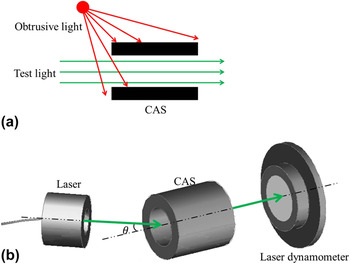
The density of CAS was calculated from weight and volume of the sleeve-like samples; we used SEM (Philips-XL30FEG, FEI, Hillsboro, Oregon) and TEM (Tecnai G2 F20 S-Twin, FEI, Hillsboro, Oregon) to observe the microstructure of carbon aerogels. The pore-size distribution of samples were obtained from nitrogen adsorption–desorption isotherms at 77 K by an N2 adsorption analyzer (TriStar 3000, Micromeritics Instrument Corp., Norcross, Georgia); all samples were out-gassed by heating at 120 °C for 12 h, and the pore size distribution was determined by modeling using the Barrett–Joyner–Halenda model. The reflectance spectra of samples were measured by a UV-vis/NIR spectrometer (Jasco V-570, Jasco, Tokyo, Japan) in the wave length range from 400 to 800 nm. Figure 2(a) showed the shading theory of CAS. CAS could absorb all of the nonaxial light, for the reason that carbon aerogel is a super-black material with high absorptivity across a wide spectral range and there is no transmission light. Figure 2(b) showed the measurement theory, a laser (MW-GL-532/300mW 15110012, Changchun Photoelectric Technology Co. Ltd., Changchun, China.) with a wave length of 532 nm, a laser dynamometer (VLP-2000-200mW, Changchun Photoelectric Technology Co. Ltd., Changchun, China.), and a one-dimensional turntable (R1R58C-O, Shanghai Lianyi Optical Fiber and Laser Instruments Co., Ltd. Shanghai, China) which were used to measure the exit power from CAS with different incident angles. This equipment was also used to measure the angular resolution.
(a) Shading theory of CAS; (b) The principle diagram of the test, we measured the power of exit laser in different incident angles by changing the location of the laser. A laser (532 nm), a one-dimensional turntable, and a layer dynamometer were used in this measurement.

III. RESULTS AND DISCUSSION
A. Microstructure and reflectivity
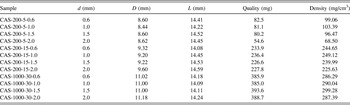
The density of different CASs is showed in Table I, samples with different wt% have different densities, samples with 30 wt% have the highest density of about 290 mg/cm3 and with 5 wt% have the lowest density of about 100 mg/cm3.
Density of different CAS.

d, D, and L represent the diameter of the clear aperture, diameter and length of CAS.
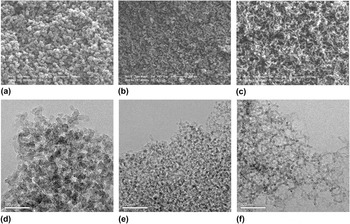
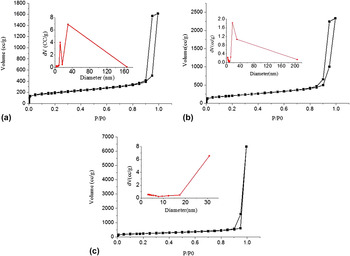
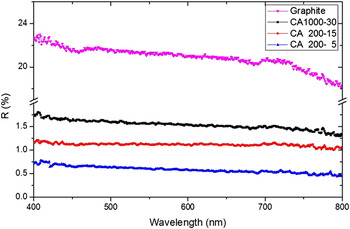
Carbon aerogels with different R/C and wt% having different microstructures, Scanning electron micrographs (SEM), and TEM of these three different carbon aerogels were showed in Fig. 3; Carbon aerogel with a small wt% had smaller skeleton nanoparticles and a smaller skeleton size. Sample CA-200-5 contains many hinged tiny skeletons, the skeleton of sample CA-200-15 was stronger than that of sample CA-200-5; for sample CA-1000-30, particles were the biggest, and had many nubbins. Nitrogen adsorption and desorption isotherms and pore-size distribution were also measured, as showed in Fig. 4; the loop of isotherms and pore-size distribution indicated that these three carbon aerogel samples were typical mesoporous materials, Reference Ganesan, Dennstedt, Barowski and Ratke33 but CA-1000-30 had more amounts of mesoporous than that of CA-200-15 and CA-200-5 with the least mesoporous; this conclusion matched well with SEM and TEM. We also measured the diffuse reflectance spectra (400–800 nm) of these three different carbon aerogels and graphite in the case of normal incidence, as showed in Fig. 5; the average reflectivity of graphite, CA-1000-30, CA-200-15, and CA-200-5 was 20.90%, 1.54%, 1.12%, and 0.58%, respectively. Usually, materials with high density have a high and effective refractive index, and according to Fresnel equations, a high effective refractive index leads to high reflectivity. For the super-black carbon aerogels with an artificial microstructure, the subwavelength structure is the main factor lending to low reflectivity. Reference Sun, Du, Feng, Shen, Huang, Tang and Zhou32
(a–c) Scanning electron micrographs of CA-1000-30, CA-200-15, and CA-200-5, respectively; (d–f) Transmission electron micrographs of CA-1000-30, CA-200-15, and CA-200-5, respectively.

(a–c) Adsorption and desorption isotherms and pore-size distribution (inset) of CA-1000-30, CA-200-15, and CA-200-5, respectively.

Reflectance spectra of graphite and different carbon aerogels. The average reflectivity of graphite, CA-1000-30, CA-200-15, and CA-200-5 was 20.90%, 1.54%, 1.12%, and 0.58%, respectively.

B. Matting effect
As showed in Fig. 2(b), to compare the matting effect of different samples, we used a layer dynamometer to measure the power of the exit laser in a different incident angle; the power (50 mW) of the incident laser never changed in this measurement.
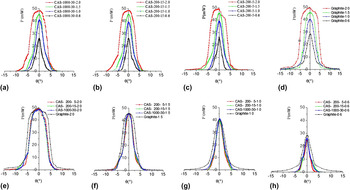
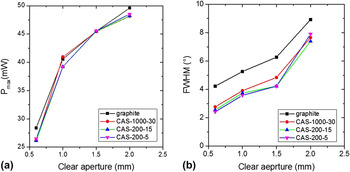
Results were showed in Fig. 6, peaks appeared during normal incidence because the effective aperture area is the biggest of all. For samples with the same reflectivity but different clear apertures [Figs. 6(a)–6(d)], they had a similar peak pattern, but the height of the peak was related to the clear aperture, as showed in Fig. 7(a), obviously, the sample with a bigger clear aperture had a higher peak because the effective aperture area is always kept big.
Exit power from CAS with different incident angles. (a–d) CAS with uniform reflectivity and different clear apertures; (e–h) CAS with a uniform clear aperture and different reflectivities.

(a) Height of peaks and (b) FWHM of peaks.

For samples with the same clear aperture but with a different reflectivity [Figs. 6(e)–6(h)], we found that there were nearly no differences between these CASs, and the peaks of graphite were broader than every CAS. This big difference between CAS and graphite is caused by the huge difference of reflectivity. The average reflectivity of graphite (20.90%) is about 14 times of carbon aerogel that has the maximal reflectivity, and if the stray light is reflected only once in the internal surface of the sleeve, about 20% of extra light will be detected than in the CAS; in other words, the super-black carbon aerogel had a better matting effect than that of graphite.
The FWHM of peaks were also calculated, as showed in Fig. 7(b); CAS with a minimized clear aperture has a small value of FWHM. However, monolithic graphite has bigger FWHM than each CAS; we can conclude that graphite has a bad matting effect. When the angle is larger than 5°, we almost could not detect the exit power, this suggested that CAS could absorb almost all of the nonaxial light; in other words, CAS with high a matting effect and all of the stray light could be eliminated. This acquired that carbon aerogel with high mechanical strength could be cut into different shapes and could be used for eliminating stray light in the optical system.
C. Fine angular resolution
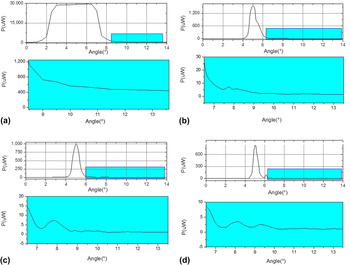
To show the fine angular resolution ability of CAS, we measured faculae from the reflected light of a compact disc (Fig. S2, Supplementary Material). The CD has a capacity of 50.6 MB. Every group of reflected faculae has many small faculae, in different sizes, with different brightnesses. We could prove that the CAS has a fine angular resolution, if we pick out these differences only by using CAS. We used a laser (with a wave length of 532 nm), a laser dynamometer, and a one-dimensional turntable to measure the third facula in a different detection angle. The power of the laser is 150 mW and never changed throughout the whole detection process.
While the laser dynamometer is used without CAS [Fig. 8(a)], almost all of the different faculae could have been detected by the laser dynamometer; although there is a peak from 2.0° to 8.0°, the curve is flat while the angle is increased from 3.0° to 6.5°; in other words, we could not recognize different faculae when the laser dynamometer was used alone. While put CAS1000-30-2.0 in front of the laser dynamometer [Fig. 8(b)], there was a sharp peak from about 4.1° to 6.5°, and the peak position was located at 5.0°; another peak is located at 7.7°, but the curve is not smooth, and the shape is strange. For CAS1000-30-1.5 [Fig. 8(c)], there is a legible peak located at 5.0°, two slight peaks are located at 7.8° and 8.9°, and the curve is smooth and symmetrical; that is to say, we could detect three different faculars by using the CAS with a clear aperture of 1.5 mm. For CAS1000-30-1.0 [Fig. 8(d)], there are two legible peaks located at 5.0° and 6.1°, two slight peaks located at 8.0° and 9.3°, and the curve is smooth; in other words, we could recognize four different faculars. Regretfully, for CAS1000-30-0.6, the light through the CAS is too weak to detect. The smaller the clear aperture, the greater are the number of peaks; the smaller the clear aperture, the sharper are the peaks, but the light is too weak to detect if the clear aperture is too small. We could recognize different faculae when CAS is used, in other words, CAS with fine angular resolution, especially for the CAS with a clear aperture of 1.0 mm. The super-black CAS can be used to block the useless light out of the detector when we want to detect a slight power change of light and the faculae.
Observed intensity distribution of the third facula use different CAS. (a) A laser dynamometer without CAS; (b–d) a laser dynamometer with CAS1000-30-2.0, CAS1000-30-1.5, and CAS1000-30-1.0, respectively.

We also did another CD experiment (Fig. S3). The CD has a capacity of 532 MB, it showed a better result. The CAS with a small clear aperture is also a good prop to demonstrate diffraction of light, the diffraction images were showed in Fig. S4 (Supplementary Material).
IV. CONCLUSION
In summary, we used easily acquired carbon aerogels, a super-black material with a subwavelength structure, manufactured an optical dustbin: CASs, explained the reason why different carbon aerogels with a subwavelength structure have different optical reflections, by tools of SEM, TEM, and nitrogen adsorption and desorption isotherms. Moreover, we constructed a simple optical system to measure the exit power from CAS in a different direction, and used this system, proved that different CASs with different matting effects, and all of these sleeves with a better matting effect than monolithic graphite that has higher reflectivity. Finally, we used CAS, distinguished different faculae of reflected light from compact disc, proved that different CASs have different angular resolutions; it is worth noting that not the smaller clear aperture the better result. The CAS with a small clear aperture is also a good prop to demonstrate diffraction of light. Most of all, these easily acquired materials could be cut into different shapes and can be used for eliminating stray light, detecting slight changes in the optical system, and used in precision optical instruments.
Supplementary Material
To view supplementary material for this article, please visit https://doi.org/10.1557/jmr.2017.347.
ACKNOWLEDGMENTS
We are thanks for the support from Key State Science and Technology Projects of China (2013BAJ01B01), Science and Technology Innovation Fund of Shanghai Aerospace, China (SAST201469).