Legislative institutions have codified rules because, among other benefits, they help legislators get re-elected,Footnote 1 solve principal–agent problems,Footnote 2 and provide information and resolve conflicts of interest.Footnote 3 But legislators also have different preferences over rules,Footnote 4 and rules can create winners and losers among those people involved in the institution.Footnote 5 If this is true, then what happens to the losers? Potentially, the losers under a particular set of institutional rules can opt to quit the institution altogether, in the sense of Hirschman,Footnote 6 rather than comply with the rules. Yet these exits also pose a threat to representative democracy if they occur within a legislative institution, because legislatures are meant to be representative of the people at large.Footnote 7 The characteristics that the institution does not value could be valuable indeed to the constituents the institution is meant to represent. Despite the potentially deleterious effects of the rules, assessing those effects is difficult because those who would fall foul of the rules may leave prior to ever having actually broken them. Rules that are never broken are perhaps the most powerful, but are also the most difficult to detect.
For example, it is possible for a legislative institution to maintain a strong partisan ideological litmus test when determining who receives a position of power, but to look exactly like one operating under a seniority rule. Rational legislators who know that they would fail an ideological litmus test exit the institution prior to that failure, leaving the position to a colleague who is more ideologically proximate to the party median but also is, not by coincidence, the most senior member.
To that end, the current project builds a model of rational institutional exit for ambitious members of a political institution, tracing how the mere threat of being jumped in the seniority queue may be enough to affect the identity of leaders, even if the exit of the institutional ‘losers’ means that that threat is never fulfilled. I then test the model on the career decisions of majority party members of the US House of Representatives, finding that those legislators who exited the US House to run for higher office were more ideologically distant from the party, thus allowing those who were more ideologically proximate to climb the leadership ladder more swiftly, despite the fact that seniority was virtually never violated. Next, I advance a theoretical model of institutional exit designed to explain this phenomenon.
A Simple Model of Institutional Exit
The formalization of the model illustrates the process by which individual legislators’ personal exit decisions affect the composition of the legislature. The extant literature provides guidance on the assumptions governing these individual decisions. For example, legislators take into account their own propensity towards risk,Footnote 8 their chances of winning a different election,Footnote 9 both currentFootnote 10 and potentialFootnote 11 leadership positions and their ideological distance from their party's mainstream,Footnote 12 along with other factors that might increase disaffection with the institutionFootnote 13 when deciding whether or not to leave the institution. The current model adds to this literature by depicting how these individual exit decisions affect the legislature as a whole. At the same time, though, the model is general enough to apply to any institution from which exit is an option. Hence, the model provides a more nuanced understanding of how institutions can affect the choices institutional actors make.Footnote 14
The decision of whether or not to remain in an institution is based both on the value and the cost of remaining in the institution. The value can be derived from the benefits of serving in that institution and can vary from person to person or from situation to situation within the institution. We can therefore describe the decision to remain in an institution as a simple decision theoretic model using the following equation, which is simply an iterated version of Black's explication:Footnote 15

where Vijt is the value of position j to actor i at time t, and Cijt is the cost of position j to actor i at time t. Rational legislators, then, should keep position j, meaning they should remain in the institution when U, the legislator's utility, is positive and quit the institution when U is negative. Note that legislators in the model consider both their current utility in the current period as well as their potential utility in any future time t when they are making their decisions.Footnote 16 The value of the position is a representation of how much utility the legislator derives from the position, which is likely to be higher as the level of authority associated with that position increases, particularly if the legislator who holds that position is ambitious. Similarly, we can think of the cost of the position both in terms of the effort the legislator must expend to keep the position, as well as the opportunity cost of keeping the position. A large portion of the opportunity cost will be based on the other opportunities the legislator must forgo in order to remain in the legislature. For example, we can think of a legislator with an excellent chance of winning a Senate seat (which we assume, ceteris paribus, to be more valuable than a rank-and-file House seat)Footnote 17 as having a higher opportunity cost for remaining than a legislator with no such prospect for a higher office. Furthermore, since each legislator i faces an individual quantity both for the value of the position and the opportunity cost, the model is robust to the assumption that legislators can differ on the relative values they place on a position in the Senate vis-à-vis the value of a position in the House. To reflect this reality, Cijt is drawn from a known distribution increasing in t with some known starting value  and some known maximum ci max. These assumptions take into account that legislators’ political prospects outside the institution are likely to increase as they remain in their current jobs, but also depict the reality that these distributions differ for different legislators. I now turn to the value of Vij.
Suppose that institutional rules provide a set of benefits only to members of the institution who have the most of some particular characteristic. These rules can affect a member's U by increasing the utility of remaining in the institution (Vijt), but the increase occurs only for those members who enjoy that characteristic. Using the US House example, parties can provide positions of institutional power to those legislators who are most ideologically proximate to their parties’ median voters’ ideal points, as defined by Downs and by Black.Footnote 18 That rule, then, affords a position of privilege to those whose ideological positions are most proximate to that of the party's median voter.
This level of privilege is based not only on a legislator's own characteristics, but also on the characteristics of the legislator's colleagues, since the benefit goes only to those who have the most of that characteristic. In other words, we need know only how many fellow legislators have more of the characteristic, not the particular value of the characteristic for any individual. I further assume that when any benefit becomes available, the legislator is in competition with other legislators for that benefit. In the case of seniority in the House, for example, legislators of the same seniority may be equally eligible for the benefit, in which case it would go to the legislator who is most ideologically proximate to the party.
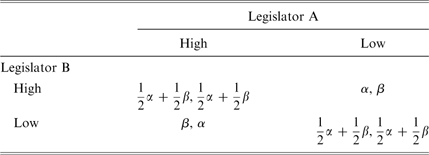
To see how this might work, assume that if two legislators are in competition for a single benefit, the legislator who has the most of the desired characteristic (i.e. ideological proximity) receives a benefit of α and the legislator who has less of a characteristic receives a benefit of β, where α > β is necessarily true. If the legislators have exactly the same amount of the characteristic, they toss a fair coin to determine who receives the benefit. When this is the case, payoffs for High and Low players, where High players have more of the characteristic, are governed by the values in Table 1.
Payoffs for High and Low Players, Based on Ideological Proximity to Party

Table 1 does not depict a strategic game, but rather the payoffs legislators receive when facing particular types of colleagues. We can think of these players in two ways. First, type may be inherent, and players are powerless to change it. For example, in this depiction, proximity to the party is based solely on the proximity of the legislators’ constituency to his party. Legislators can be no more or less proximate to the party than their constituency is. In another depiction, however, legislators could change their type. In the case of ideological proximity, this implies that legislators can change their ideology to please their political party if doing so allows them to be gifted with the benefit. Therefore, another way to think about how legislators behave in the game is that each legislator selects a position that is as close to the ideal point of the political party as possible without losing their election.Footnote 19 Since there are different limits to how close each legislator can get to the party, due to the different ideological constraints each district represents, each legislator, even under these assumptions, has his or her own inherent level of proximity to the party, about which he or she can do nothing.
Regardless of how one conceives the constraints of members of the institution under consideration, payoffs for each player are based on the proportion of each type in the legislature. Note that type is based on proximity to the party, but for any given legislator, the type of all other legislators falls into one of three categories: Those with less of the characteristic (for which the legislator earns EU = α), those with more of the characteristic (for which the legislator earns EU = β), and those with the same amount of the characteristic (for which the legislator earns EU =  α +
 β). Any legislator's expected utility is based on these values, as well as the proportions of types that the legislator faces. We will define pi as the proportion of legislators with less of the characteristic for legislator i, qi as the proportion of legislators with more of the characteristic than legislator i, and (1 − pi − qi) as the proportion of legislators with the same amount of the characteristic as legislator i. These assumptions imply the following proposition:
Proposition: For any pair i and j in the same legislature, such that pi > pj is true, then Vit > Vjt.
The proof of the proposition is straightforward. By assumption, legislator i receives more of α than does legislator j, whereas legislator j receives more of β and/or  α +
 β. Since both α > β and α >
 α +
 β are true by assumption, then any division of legislators offers greater utility to legislator i.
Therefore, legislators within a legislature who have more of the favoured characteristic always derive more utility than those who have less of the favoured characteristic, regardless of the composition of the legislature. But the value of Vit is not the sole determinant of who remains in the legislature and who leaves. Referring back to Equation 1, we see that the value of Vjt matters, but so does the value of −Cit. Put simply, legislators’ choices to stay are based on both the utility of leaving (Vit) and the utility (or opportunity cost) of remaining (−Cit). The current model, however, illustrates that those legislators who receive greater values of Vit are also more likely to have greater values of U, regardless of the composition of the remainder of the legislature. Furthermore, the value of the benefit of those closest to the legislature, as compared with the value for those further, plays an important role in the decision of whether or not to leave. Therefore, those legislators with the least of the characteristic will not all automatically leave the legislature at their first opportunity, but, over time, they will be more likely to do so than will those legislators with more of the characteristic. As Cit increases in t, though, so does the likelihood that Cit > Vit, and the legislator therefore departs, particularly if the legislator has a low value of Vit.
Legislators make a decision to remain in the institution, therefore, awaiting a spot on the first rung of the leadership ladder. Taking into account both current and future prospects in their current position, legislators leave when the utility of staying is lower than the utility of exiting: They do not remain actually to experience the lower utility they would receive from remaining. By this logic, counting seniority violations in an institution is a poor measure of the effect of the institutional rule. Instead, we may consider each legislator as having the opportunity to quit voluntarily at each period t. If the model is correct, we would expect those legislators who are ideologically distant from their party to be more likely to leave to run for another office than those who are more ideologically proximate to their party. These departures, then, make room for their more ideologically proximate colleagues to take their places on that first leadership rung.
I now turn to the explication of the case of the US House of Representatives, which I use to provide empirical evidence to support the general theory of institutional exit and where the first rung of the leadership ladder is the position of subcommittee chair. I begin with an illustrative anecdote before proceeding to the empirical analysis.
The Case of the US House of Representatives, 1982–94
When, in the early weeks of the 94th Congress in 1975, the US House of Representatives’ Democratic Caucus turned out three sitting chairmen, previously presumed to be entrenched by the inviolate seniority system, the death knell of the seniority system could putatively be heard throughout Washington.Footnote 20 The firings represented the first time the caucus had used a 1973 rule requiring committee chairs to stand for re-election before the entire caucus, rather than automatically receiving the chair by dint of their senior status.Footnote 21 Presumably, failing an ideological litmus test was grounds for being jumped in the seniority queue. ‘From now on, the sword of Damocles will be hanging over every chairman,’ Henry Reuss, a Wisconsin Democrat, said at the time.Footnote 22 ‘The days of the snarling chairmen who look through junior members are long gone,’ Rules Committee Chairman Joe Moakley said after the Democratic caucus removed two elderly chairs in 1990. But two years later, House liberals in the Democratic Study Group (DSG) mounted an effort to reign in chairs by making ‘responsiveness to the leadership and the caucus’, rather than seniority, the major criterion for committee chair selection.Footnote 23 Indeed, twelve members of the House co-sponsored a measure to allow the speaker alone to appoint committee chairs.Footnote 24 In the minds of the reformers, the paucity of the use of the rule – indeed, never for purely ideological reasons – indicated that the rule was ineffective. But if that was the case, why did the rule cause so much consternation among legislators themselves? The institutional exit model posited in the previous section provides a possible answer to this question. According to the model, the mere threat of being jumped in the seniority queue for ideological reasons is enough to decrease the utility ambitious members derive from remaining in the legislature. Less ideologically proximate legislators quit the legislature prior to the invocation of the rule, thus leading to the paucity of incidents of rule enforcement. Certainly, the theory itself applies to any legislative setting in which the rules in some way favour one set of legislators over another. This favouritism, over time, would cause the favoured group to be more likely to remain, with the less favoured group being more likely to leave. Yet because of the events of the early 1970s, and for reasons outlined below, the US House is an ideal setting for testing the theory empirically.
First, parties in the United States cannot control entry into the institution – primary elections do that – but parties control many of the resources that legislators need after they have entered the institution. Parties, then, cannot control entry into or exit from the institution, but they may be able to affect the utility of their members long enough to affect those members’ exit choices. Parties in legislative institutions other than the US House similarly affect the exit choices of their members, but the effect on career decisions is difficult to quantify if the party also controls entry, via the ballot. The US House, therefore, provides a cleaner test of the theory.
Secondly, two variables that are not easily measured in many legislative settings – who receives benefits and who is most compliant with the rule – are easily quantifiable in the US House. The distribution of party resources – who receives benefits – is easily visible in the US House, which is not true in many other legislatures. The presence of the ideological litmus test is common knowledge even outside the institution, as is the identity of legislators who receive positions of authority. This information may be private in other legislative settings in which the theoretical model applies. Furthermore, we can discern who receives even the smallest party prizes – subcommittee chairs – in the US House. Subcommittee chairs themselves are not nearly as powerful as committee chairs, thus allowing us to observe legislators on the very first rungs of the leadership ladder. This provides us with a very conservative test of the theory, something that would be impossible in other legislatures, where these first moves occur behind closed doors. At the same time, ideological proximity to the party – who is compliant with the rule – is easily quantified in the US House with the use of Nominate scores.Footnote 25 This allows us to measure party allegiance in a way that is not possible in legislatures that have few (or few meaningful) roll-call votes.
Lastly, the House is relatively large, at 435 members, and the membership has ample opportunity to pursue other political options in a visible manner, thus providing enough data to test the theory adequately. The US Senate, for example, has much in common with the House, and one would expect the theory to apply similarly there, which comports with the findings of Abramson, Aldrich and Rohde.Footnote 26 But one would expect fewer observable instances of these rational retirement decisions in the Senate, for two reasons. First, the Senate is roughly a quarter of the size of the House. Fewer careers to observe obviously would imply fewer measurable career decisions; but, secondly, Senators have fewer outside job prospects than do members of the House, since the Senate itself is a draw for members of the House. In terms of the theoretical model, then, the differential between the value of the current position and the value of some other position may be lower in the Senate than in the House, thus making rational exit decisions less likely.
Applied to the US House, then, the rational anticipatory exit model implies the following empirically testable hypothesis:
Hypothesis 1: Legislators who are ideologically close to the party are more likely to receive a subcommittee chair than to run for another office in any given period t.
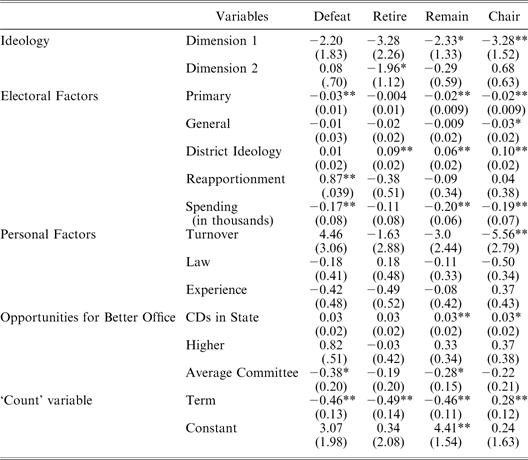
I test this key prediction of the theoretical model on data describing Democratic legislators who began their careers in the 98th through 103rd Congresses (1982–92). I have tracked those legislators’ career choices until 1994 (see Table 2). I have chosen this period because it provides enough time after the reforms of the 1970s to allow legislators to become accustomed to the new rules.Footnote 27 Furthermore, the majority did not change from Democratic to Republican during this period, which is important, since only majority party members may hold committee or subcommittee chairs. Duration analysis allows for the consideration of censored cases, which occur here because some legislators remain in the risk set even after the last observations in 1994. This could occur when a legislator has not yet left the legislature, nor yet been assigned a subcommittee chair. Democrats remained in power throughout this time, which is important, because only majority members are eligible for committee leadership positions.Footnote 28
Multinomial Probit with ‘Run for Higher Office’ as the Omitted Category (Democrats, 1982–94)

**Indicates significant at the 0.05 level, two-tailed. *Indicates significance at the 0.10 level. Values in parentheses are robust standard errors. Log-pseudo likelihood = −364.9. N = 579.
Since the aim here is to determine which factors cause a shorter or longer wait before the offer of a subcommittee chair is received, a duration statistical model is the appropriate estimation strategy. Yet several other outcomes must not be ignored if one wishes to create a complete model of career choices, since we know that jointly considering these multiple career decision choices is important in arriving at a properly specified statistical model.Footnote 29 A ‘competing risks’ duration model is, therefore, appropriate. Each legislator may lose an election, may retire from politics, may run for higher office, or may receive a chair, or nothing different may happen (i.e. that legislator remains in the rank and file in the House).
There are several methods of estimating a competing risks model.Footnote 30 Perhaps the most straightforward is the multinomial logit model advocated by Box-Steffensmeier and Jones.Footnote 31 One shortcoming of the multinomial logit model is that it makes the strong assumption of independence of irrelevant alternatives (IIA). Furthermore, the standard tests for IIA may be inappropriate in this context,Footnote 32 and therefore I have used the more general multinomial probit specification.Footnote 33 The multinomial probit model provides a series of linked probit estimations, calculating estimates comparing the probabilities of being in a given group with the probability of being in some arbitrarily chosen baseline category. Also, the model is somewhat complicated by the fact that the data include outcomes for the same legislators over different periods. Therefore, the proper estimation procedure calculates robust standard errors to account for clustering on each legislator.
The dependent variable indicates the outcome we observe for each legislator for each period at risk. Remember that the period is a Congress and the five outcomes are electoral loss, retirement, status quo, run for higher office (operationalized as a run for any state-wide office, including, but not limited to, senator or governor), or receipt of a subcommittee chair. Even beyond the fact that subcommittee chairs represent the first rung on the leadership ladder, considering subcommittee, rather than full committee, chairs makes sense for two reasons, one theoretical and the other methodological. First, considering subcommittee chairs ensures that the results are due to voluntary career choices rather than the explicit invocation of the rule. This is because subcommittee chairs do not face a similar vote before the entire party. The subcommittee chair selection process is based entirely on seniority, and therefore any systematic differences between those who receive chairs and those who do not are solely attributable to career choices. Secondly, receipt of a full committee chair is a very rare event – indeed, even among legislators with careers much longer than the ones considered here. The rarity of its observation would render statistical analysis nearly impossible. The major question of interest, therefore, is the differences between legislators who run for higher office and those who receive subcommittee chairs, making the baseline category the choice to run for higher office.Footnote 34 This allows comparisons of those who run and those who, for whatever reason, do not.
The central independent variable is ideology, which in this context is measured in two ways, both of which rely on the Poole–Rosenthal DW-Nominate scores. First, Dimension 1 is a measure of how far away the legislator's score is from the score of the median voter of the party on Poole and Rosenthal's first ideological dimension.Footnote 35 Secondly, Dimension 2 is a measure of how far away the legislator's score is from the score of the median voter of the party on Poole and Rosenthal's second ideological dimension. Remember that the Poole and Rosenthal score is broken into two dimensions. The first is the ideological dimension of party cleavage, and the second is the ideological dimension that cuts across party lines.Footnote 36 Given this understanding of the dimensions, then, Dimension 1, the dimension that matters to the party in general, is the one in use for this study. Dimension 2, however, is included for completeness and to avoid omitted variable bias. Both ideological variables have been transformed so that they vary from 0 to 1, where 0 is the most proximate to the party and 1 is the most distant from the party.
Obviously, the decision to leave an institution is not based entirely on ideological distance from the party. The analysis, therefore, includes several ancillary control variables. These variables are measures of four different factors that might affect career decisions: the electoral realities the legislator faces, personal characteristics of the legislator, opportunities for advancement within the state, and the value of the current seat. Detailed descriptions of each of these categories appear below.Footnote 37
First, electoral realities measure how easy it is to maintain the legislator's current seat. Those with tough races may be more likely to run for a different position. Those variables are:
— Primary: the percentage of the vote the legislator received in the last primary election, measuring how popular the legislator is with his or her constituents of the same political party.Footnote 38
— General: the percentage of the vote the legislator received in the last general election, measuring how popular the legislator is with all of the voters in his or her district, not just those of the same party.
— District Ideology: the percentage of the vote the presidential candidate of the same party as the legislator received in the last election, subtracted from the vote the candidate received nationwide, as a measure of support in the district for the legislator's political party that does not depend on that legislator's own electoral performance.
— Reapportionment: a dichotomous variable coded 1 if the legislator's district has been reapportioned since the last election, 0 otherwise, accounting for increased electoral difficulties of running in a potentially new district.
— Spending: a measure of how much the legislator spent in his or her last election, since legislators who are looking to run for higher office are likely to spend more money, as are legislators who are in less electorally favourable districts.
I also include three variables that account for the personal realities a legislator faces that might affect the choice of whether or not to run for re-election:
— Turnover: the amount of turnover there has been in the party's membership since the last election, as a measure of the level of competition for positions of power.Footnote 39
— Law: coded 1 if the legislator attended law school, 0 otherwise.
— Experience: coded 1 if the legislator served in a state legislature, 0 otherwise.
The next set of control variables are meant to measure the opportunities legislators have for higher office within their states and the value of the current seat.
— Districts in State: a dichotomous variable, coded 1 if the governorship or a Senate seat is up for election during the current period.Footnote 40
— Average Committee: a measure of the relative attractiveness of the legislator's entire package of committee assignments, based on the Groseclose and Stewart scale.Footnote 41
The variable Term is simply the number of terms the legislator has served in office. Therefore, the variable is a ‘count’ variable, keeping track of how much time has passed in the legislator's career. It is that variable that allows the use of multinomial probit as a competing risks model. Note that it is measured as terms in office, not terms on a committee. The reason for this is that we are interested in which legislators within Congress, not within particular committees, receive committee chairs most quickly. We now turn to the results of the statistical analysis.
Empirical Results
The results of the data analysis are presented in Table 2. The omitted outcome is ‘Run for Higher Office’, and therefore coefficients for each variable can be interpreted as differences from the higher office outcome. Supporting the main hypothesis, legislators who receive subcommittee chairs are ideologically more proximate to the party than are those who run for higher office, which is the baseline category in the regression. Indeed, those who run for higher office are further ideologically from the party in all cases, but significantly so only in the case of the decision to remain in the legislature. In other words, the most ideologically distant legislators are the ones who run for higher office. Legislators who are more proximate opt instead to remain in the House.
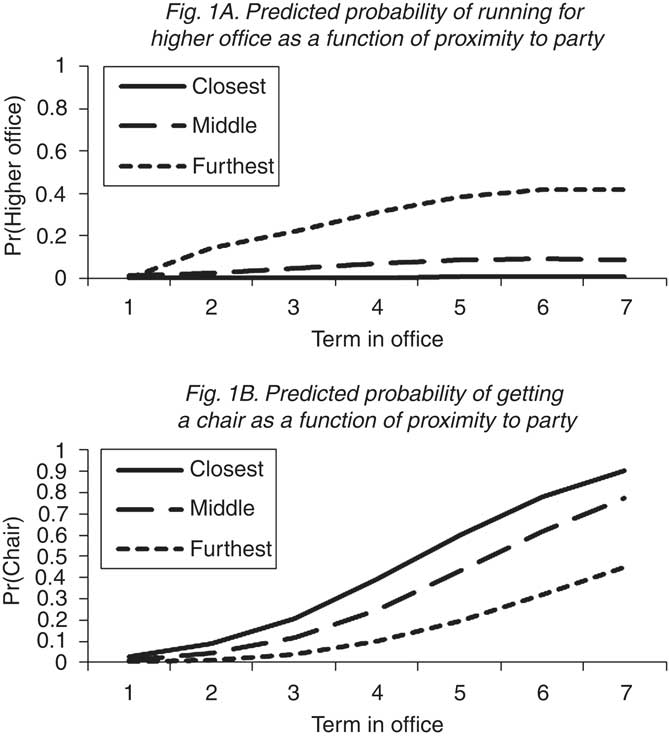
Multinomial probit coefficients are notoriously difficult to understand substantively. Furthermore, if the effect of ideology on career choices is minimal, the statistically significant results reported above may not be substantively important. To that end, Figure 1 allows us to understand better the substantive effects of the regression reported in Table 2. Figure 1 depicts the implied effects of ideological distance on the probability of running for higher office or achieving a subcommittee chair. These graphs were constructed using exactly the same regression as reported above, except that the Stay outcome was used as the omitted category. Statistically, the models are identical, but using Stay as the omitted category allows the estimation of coefficients for the Senate outcome.
The effect of ideology on career choices

The graphs in Figure 1 are meant to compare the fates of those legislators who are ideologically closest to the party (Dimension 1 = 0), those whose ideological distance from the party is at the mid-point (Dimension 1 = 0.5), and those whose ideological distance is the furthest from the party (Dimension 1 = 1). Remember that the Dimension 1 variable can take on only values from 0 to 1. This means, therefore, that the value used to construct these implied effects to indicate the furthest legislator is not simply some theoretical value, but represents the ideological position of an actual party member.Footnote 42
Figure 1A depicts the implied effects of ideological distance from the party on the probability of running for higher office. Making such a run in the first term is relatively rare for all three types of legislators, and therefore the differences between them are small. The probability of the most distant legislator running for another office in the first term is a minuscule 0.003, but the probability for the most proximate is an even more minuscule 0.0007. Yet the three types begin to diverge quickly in their expected probability of running for a higher office. By the seventh term, the probability of the most distant legislator running for higher office has risen dramatically to 0.41, whereas the probability of the most proximate legislator running for higher office has virtually stagnated, rising only to 0.006. By their second term, distant legislators are already more likely to run for higher office than proximate legislators are in their seventh term. Indeed, the probability of a most proximate legislator running for a higher office in the seventh term is roughly half of the probability of a most distant legislator running in the second term (0.013). In other words, through the course of a seven-term career, those most proximate to the party virtually never run for higher office, but those most distant do so with regularity.
How does this pattern translate to those who receive a subcommittee chair? Figure 1B shows that again the results are dramatic. Again, almost no legislators receive a subcommittee chair in their first term, which is reflected in the very low probabilities for all three types. Yet the differences again quickly appear as legislators’ careers progress. By their fifth term, most of the closest legislators can expect to have subcommittee chairs and by their seventh term, that probability is 0.90. In contrast, the furthest legislators’ probability of receiving a chair, even in their seventh term, is 0.45. The probability of close legislators receiving a chair in the seventh term, then, is about double the probability of a distant legislator doing the same. Indeed, those legislators furthest from the party never, even in their seventh term, have a chance of getting a subcommittee chair that is greater than the toss of a coin. In contrast, by their seventh terms, the closest legislators almost all have chairs.
Furthermore, considering the figures together allows us to compare the relative probabilities of each event occurring for members of each group throughout their careers. In the first term, those most proximate and those most distant are virtually indistinguishable – they almost never run for higher office and they almost never receive subcommittee chairs. Yet by the seventh term, the differences could scarcely be starker. The most distant legislators are about as likely to receive a subcommittee chair as they are to run for higher office. At the same time, though, their most proximate colleagues, by their seventh term, are virtually guaranteed a subcommittee chair and virtually never run for higher office. The effect, then, of ideology on legislative career paths is substantively quite dramatic.
Also lending credence to the notion from the extant literature that disaffected legislators are more likely to leave is the significant result on second-dimension proximity for legislators who opt to retire from politics altogether.Footnote 43 Remember that the second dimension comprises issues that are not part of the current party cleavage.Footnote 44 The party in power, in an effort to avoid splintering of the party, will often act specifically to block those issues coming to the floor of the House.Footnote 45 The result may indicate that legislators who find themselves in broad agreement with their co-partisans on second-dimension issues, but also find those issues blocked by party leaders, may be more likely to leave politics altogether. They see that although their concerns could be addressed, they will not be under the current partisan and political structure.
One potential alternative explanation for the results found here is that it is, in fact, candidates who run for higher office who shift away from the party, rather than those remaining in the House, who are closer to the party. In fact, there is evidence that legislators who are running for higher office both pay more attention to constituentsFootnote 46 and alter their behaviour in the short term.Footnote 47 Yet the extant research also indicates that these shifts are no more likely to be away from the party than towards the party,Footnote 48 thus indicating that these shifts by traditionally progressively ambitious legislators cannot be entirely responsible for the empirical regularity reported here.
What about the Republicans?
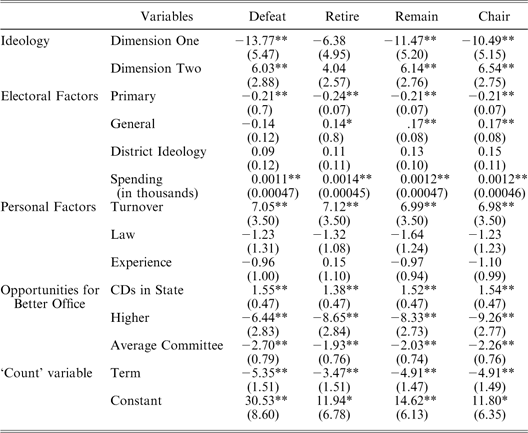
In 1994, the Republican party took the majority in the House of Representatives for the first time since 1952. At that time, newly-installed Speaker Newt Gingrich made it clear that he was scrapping the seniority system and would hand-pick committee chairs based on ideological proximity to Gingrich himself.Footnote 49 For this reason, committee assignments under Gingrich represent an easier test for our theory than do committee assignments under the Democratic party. Democrats did not announce such a litmus test and nor did they obviously violate seniority as Gingrich did. Under the Democrats, ideological differences between those who receive such chairs and those who leave the institution are, therefore, due to legislators’ career decisions alone. Under the Republicans, however, it should not be surprising if those who receive subcommittee chairs under Gingrich are more ideologically proximate to Gingrich than those who left: Gingrich was explicitly selecting on proximity for committee chairs. At the same time, though, evidence of a similar pattern in the Gingrich era would strengthen the claim that the theory is generalizable beyond the Democratic party at a particular time. Therefore, I now consider the empirical model as applied to the Republican party in the Gingrich era (see Table 3).Footnote 50
Multinomial Probit with Run for Higher Office as the Omitted Category (Republicans, 1994–2000)

**Indicates significant at the 0.05 level, two-tailed. *Indicates significance at the 0.10 level. Values in parentheses are robust standard errors. Log-pseudo likelihood = −118.47. N = 253.
As expected, those who receive committee chairs are significantly closer to Gingrich than those who opt to run for another office. This may lend credence to the theory presented here, but may also be simply an indication that Gingrich was selecting those legislators to serve in such positions on the basis of ideology. However, the significance of the ideological distance variable for those who opt to remain is rather telling: those who choose to remain in the House rather than run for another office, but do not receive a subcommittee chair, are also significantly more proximate to Gingrich. This indicates that those who were ideologically distant from Gingrich were more likely to leave the House, in keeping with what we would expect given the theory. This result is not attributable to Gingrich's selection process since these are the legislators Gingrich explicitly did not pick. Furthermore, the result is even stronger than that in the Democratic analysis, both in the magnitude and level of statistical significance. These results, then, indicate that much like their Democratic predecessors, Republicans in the majority consider their prospective fortunes within the institution when deciding whether or not to leave it. Gingrich's power, then, stemmed not solely from naming a loyal band of followers to powerful positions, but also from the fact that those not willing to toe his ideological line ‘voluntarily’ cut their House careers short.
Discussion
Witnessing an institution in action – for example, observing the enforcement of a rule – is not a satisfactory means of assessing either the effect or the effectiveness of the rule since properly constructed institutions may render actual enforcement of the rule to be superfluous.Footnote 51 This is why, for example, parties in the US House can both successfully delegate to committees and appear to be weaker than those committees at the same time.Footnote 52 Observing the enforcement of a rule may, in some senses, indicate a weakness in the rule, since its presence alone did not effectively deter the transgressor from the unwanted behaviour.Footnote 53
Assessing the effect of a rule, then, is difficult. Yet rules create an environment within an institution, and that environment can be more hospitable to some members than to others. We may see few observable manifestations of this in hospitability until the legislator opts to leave the institution altogether. Even then, that decision may be wrapped up in other considerations as well. This makes the task of determining the effect of the rule on any individual's behaviour nearly impossible.
By considering decisions to leave not as individual choices, but rather with the focus on their aggregate effect on the institution, the current project provides a means of assessing the effects of rules that favour those legislators who are more proximate ideologically to their parties. Specifically, those legislators who are further from their party are more likely to leave the US House of Representatives to satisfy their ambition elsewhere, thus providing room in the seniority queue for those who are more proximate to the party to receive positions of authority. This result has broad implications for legislatures beyond the US House. Indeed, given that the house has some of the lowest legislative turnover rates in the world,Footnote 54 the effect of rational retirement decisions may be greater in other legislative settings. For example, the prime minister's control over the distribution of preferments in Canada's parliament may affect the calculation of retirement decisions as Members of Parliament consider their future prospects of attaining such preferments when deciding the value of their current seats.Footnote 55 Similarly, the career decisions of Members of Parliament in the British House of Commons may have changed along with the norm of favouring Speaker candidates with experience as chairs of Ways and Means rather than those with experience as lawyers.Footnote 56
Legislative institutional rules, then, are a central – and an often overlooked – aspect of representation. Constituents send to legislatures those candidates they feel will best represent their political views.Footnote 57 Yet not all political views are created equal, since some legislators – those whose constituencies have views the rules favour – face better career prospects than do their colleagues who represent ideologically less favoured constituencies. Furthermore, the ideological link between legislators and their constituents is undermined if some groups systematically see their representatives quit the institution prior to achieving any real power within it. For example, this may provide at least one explanation of the US Congress's near-crippling party polarization at the same time as the American public shows little evidence of such a stark ideological divide.Footnote 58 Individual career choices made through the lens of institutional rules play a key role in determining the relationship between legislative activity and constituent preferences, a role that is greatest when its effect is most difficult to ascertain. The proper study of representation, then, must end not in the ballot box, but rather in the halls of the legislature itself.