Consociational theory posits that political elites in divided societies will show a stronger ‘spirit of accommodation’ than the groups they represent, and that this prudent leadership on behalf of the elites explains why divided societies hold together (Bogaards Reference Bogaards1998; Lijphart Reference Lijphart1977). Belgium has long been considered to be one of the best examples of such a consociational democracy (Lijphart Reference Lijphart1981). It has witnessed a peaceful transformation from a unitary state to a federal state, because consociational power-sharing forced the elites of both language groups to strike comprehensive package deals to reform the state (Caluwaerts and Reuchamps Reference Caluwaerts and Reuchamps2015; Deschouwer Reference Deschouwer2012).
However, this relatively peaceful accommodation of linguistic conflict does not mean that Belgian elites do not act out of identity considerations. As representatives of their group or community, they have put group interests on the political agenda, often accompanied by identity claims (Horowitz Reference Horowitz1985; Lijphart Reference Lijphart1979: 410). The literature on ethno-linguistic politics considers these identity-based cues to be the most prevalent motivators for elites to engage in institutional reform. That is why many divided societies are institutionally designed to reflect the identity-based divisions of the country, often thereby reinforcing these divisions themselves (Erk Reference Erk2008) and offering elites electoral incentives to pursue an agenda of identity purity. This can also be seen in Belgium, which has a party system segmented along linguistic lines and thus, in practice, two separate party systems. There are no longer any Belgian – that is, state-wide – parties; parties only field candidates on one side of the language border. Unlike most other divided societies, each linguistic group in Belgium has its own multiparty system.
Nonetheless, an account that focuses solely on identity crucially neglects the role of party political strategies in explaining the behaviour of political elites (Sinardet Reference Sinardet2012; Sorens Reference Sorens2009). Such a one-dimensional analysis runs the risk of underestimating other crucial dynamics at play. Even in divided societies, parties are also organizations that aim to gain and retain power. They may even try to exploit ethnic identities and interests in the pursuit of other partisan goals, such as gaining votes or access to office.
This raises the question of the elite’s capacity to act more prudently than the voters. This is of particular interest in Belgium, where the spirit of accommodation of prudent leaders has been questioned in previous research (Sinardet Reference Sinardet2010) and discussed publicly during the 2010–11 political gridlock, when some observers considered that electoral strategies had prevailed over considerations of identity. The question is therefore whether Belgian political elites are indeed less radical and hold less extreme views than voters, as suggested by consociational theory. To explore this, we rely on survey data from voters and members of parliament (MPs), gathered before (2009), during (2011) and after (2014) the historically long government negotiations of 2010–11 that eventually led to an agreement on the sixth reform of the Belgian state. This allows us to compare voters’ and MPs’ attitudes, while taking into account the potential impact of the political gridlock.
We focus on MPs’ views, instead of those of presidents of political parties, even though the latter are typically considered by consociational theory as the ‘elites’. Nonetheless while the party leaders are in charge of the negotiations on their members’ behalf, their position is closely aligned with the position of their MPs. Furthermore, in order to understand political parties’ attitudes on state reform, parties should not be considered as ‘monolithic blocks’ of total uniformity and therefore we should not focus exclusively on their leaders; instead, a closer study of the positions of relevant party members is necessary to observe intra-party diversity (Dodeigne et al. Reference Dodeigne, Gramme, Reuchamps and Sinardet2015) – this is why we surveyed all MPs. We should add one disclaimer: while the voter surveys covered only the Flemish and Walloon region – excluding the Brussels region – the MP survey included MPs of the three regions.
We first analyse how political elites can deal with federal reform in general, and how they dealt with it in Belgium in particular. In the following section, we present the data collected from Belgian MPs and discuss their attitudes on federal reform. Afterwards we compare these results with voters’ attitudes. The conclusion reflects on the impact of the findings for consociational democracy.
POLITICAL ELITES AND FEDERAL REFORM
Divided polities entrench identities. Their political structure institutionalizes the idea that subgroups are and should be autonomous in some areas. These institutions allow the groups to strengthen their regional identities and even give them a sense of legitimacy (Tierney Reference Tierney2009). This is why constitutional reform processes in federal political systems are often explained by identity variables. This is also why political parties’ preferences in such societies are essentially considered a reflection of the demands of their groups to further institutionalize their identities.
However, conducting an analysis entirely through the lens of identity can lead to forms of methodological nationalism (Jeffery and Schakel Reference Jeffery and Schakel2012): it would consider sub-state entities as natural and internally homogeneous entities, with single collective identities and interests. It would thereby give the discourse of sub-state nationalist parties a sense of scientific legitimacy.
Certainly, parties are also power-brokers. They have their own interests and strive to decide policy, be in office and win votes (Müller and Strøm Reference Müller and Strøm1999). They might even try to exploit regional or cultural identities in the pursuit of their own partisan goals, in which case analysing federal reform solely or mainly in terms of interests can play into those partisan strategies (Sinardet Reference Sinardet2012). Parties thus fulfil a dual role: they want to advance the demands and interests of those groups they represent, but they are also oligarchic organizations with strong tactical and strategic goals (Michels Reference Michels1971).
The literature on federalism has long been preoccupied with the role of identities (e.g. Burgess and Pinder Reference Burgess and Pinder2007; Elazar Reference Elazar1985; Livingston Reference Livingston1952; Smith Reference Smith1995). This strand of research, often characterized by structural approaches, focuses on sociological, economic and historical factors that explain the pressures for more congruence between the diversity of divided society and the institutional structure of the state. Yet, researchers have recently started to pay attention to the strategic interests and rationales behind parties’ positions on federal reform (O’Neill 2003; Sinardet Reference Sinardet2012; Sorens Reference Sorens2009).Footnote 1
In a recent contribution, Toubeau and Massetti (Reference Toubeau and Massetti2013: 302) isolated three logics of action defining the position of state-wide parties. Firstly, the ideological logic underlines the importance of principles and normative views for party positions on devolution. The economic dimension (left vs. right) and cultural dimension (liberal vs. conservative) of party competition remain important factors in explaining attitudes of state-wide parties (Toubeau and Wagner Reference Toubeau and Wagner2015). Secondly, the territorial logic stresses the ambition for state-wide parties to defend the interests of a territorial community. Finally, the electoral logic is the most relevant for this article as it analyses tactical considerations for the positioning of state-wide parties on the issue of devolution, in order to gain or maintain power.
Most research on ethnic conflict has often categorized parties’ preferences for federal reform under either the ideological or territorial logics, but others have shown that parties often adapt their positions on devolution as an electoral strategy to react to threats by regionalist political actors (Brancati Reference Brancati2006, Reference Brancati2007). This is the case for governing parties, which have a general tendency to adapt their positions to electoral evolutions, as well as for parties which have the most to fear from the success of regionalist parties (Meguid Reference Meguid2008). For instance, the success of the right-wing Northern League (Lega Nord) in 1990s Italy mostly led centre-right parties to become more strongly in favour of devolution (Massetti and Toubeau Reference Massetti and Toubeau2013), while the success of the left-wing Scottish National Party in the UK had a similar effect on the positions of the Labour Party, at first mostly in Scotland but increasingly also at the national level (Mazzoleni Reference Mazzoleni2009; Mitchell Reference Mitchell1998).
Besides the pressure of party competition, there is also another less analysed strategic reason that can determine parties’ positions. For parties whose electoral support at the sub-state level appears more secure than their prospects in national elections, devolution can represent a desirable strategy, as it maximizes electoral possibilities (O’Neill 2003). In other words: when parties have more electoral appeal at the sub-state level, they will strategically advocate federal reform. This has very little to do with ideology, but everything to do with parties’ extension of power.
At different times and in different contexts, national left-wing opposition parties have favoured devolution in order to create new political institutions in which they would have more chance of being in power. This was, for instance, the case in Italy in the 1960s, France in the 1970s and to a lesser extent also in Spain. In 1990s Italy, however, with the Northern League being very strong in the north, left-wing parties opposed devolution (Mazzoleni Reference Mazzoleni2009; Sorens Reference Sorens2009). The nationalist turn of Labour in Scotland during the Thatcher years (1979–90) can also be explained by the fact that Labour’s electoral situation in England – and thus in the UK – was very unpromising, while it continued to be the strongest party in Scotland (Mitchell Reference Mitchell1998). At the same time, this strategic manoeuvre has the advantage for state-wide parties in the opposition to distinguish themselves from their direct rivals at the national level (Masseti and Toubeau 2013: 305). Political parties thus have a strategic and electoral interest in favouring devolution, which can determine parties’ positions on federal reform much more strongly than identity-based arguments. We now investigate these dynamics in the specific case of Belgium.
FEDERAL REFORMS IN BELGIUM
Since the 1970s, Belgium has been caught in a process of federal reforms due to the ethno-linguistic tensions between the Dutch-speaking north and the French-speaking south of the country. This reform transformed Belgium from a unitary state into a federal state with two types of sub-states. These sub-states are the regions, which are ‘territorially’ based (Flanders, Wallonia and the Brussels-Capital Region) and are competent to deal with socioeconomic issues, whereas the communities, which are ‘culturally’ oriented (the Flemish, the French-speaking and the German-speaking communities), deal with issues such as language, culture and education.
Initially, federalism was not the intended outcome for this process of conflict resolution (Deschouwer Reference Deschouwer2012). The road to the current federal state was very incremental, with one gradual state reform after the other, and it reflects the complex interplay of territorial, identity and party politics in Belgium. The federalization of the country has been linked to the socioeconomic left–right divide, and to a lesser extent also to the philosophical divide between Catholics and liberals (Sinardet Reference Sinardet2012; Swenden and Jans Reference Swenden and Jans2006). Flemish sub-state nationalism has always been predominantly right wing and associated with Flemish Catholicism claiming cultural autonomy (through the community). Its Walloon counterpart was more secular and left wing, close to the Walloon labour movement seeking socioeconomic and territorial autonomy (through the region).
Simultaneously, the Catholic Party and the Socialist Party were always the leading political forces in respectively the Flemish and the Walloon region, which contributed to their positions on state reform being associated with those of Flanders and Wallonia as a whole. Consequently, in the north of Belgium, the Flemish Catholic Party and to a lesser extent also other right-wing parties have gone furthest in adopting positions in favour of regional autonomy, whilst the Flemish Socialists and Greens are generally more reluctant. The south shows a mirror image, with federal reform mostly being advocated by the Francophone Socialists – certainly in the 1970s and 1980s – and the Francophone Catholics being most reluctant (Reuchamps Reference Reuchamps2015). In both cases the dominant party advocated for regional autonomy, but for different reasons.
Moreover, in the north as well as in the south of the country, strong factions within both majority groups (Catholics in Flanders, Socialists in Wallonia) opposed the unitary status quo and found in regional and cultural ideas ‘new, more compelling instruments for the diffusion of their clerical/anti-clerical or socioeconomic blueprints’, as Huyse argues (1981: 124). This led to the conclusion that ‘the federalist idea became more attractive to more people in the 1970s not strictly for linguistic or cultural or ethnic reasons, but because it bears the promise of the ultimate achievement of socialism in Wallonia and of a sort of Catholic model of societal harmony in Flanders’ (Huyse Reference Huyse1981: 124). Decentralization thus fitted nicely with the divide-and-rule approach of the Flemish Catholic Party and the Walloon Socialist Party. It was a way of increasing their grip on society by splitting it up into two homogeneous groups, and of imposing their own Catholic or socialist ideologies on their respective groups.
Party political considerations were, however, not only important to the dominant parties. There are two reasons why the minority of Flemish socialists and of Francophone Catholics were more reluctant about federal reform. On the one hand, they had less to fear from the competition of sub-state nationalist parties as they were not fishing in the same ideological pond. Especially in Flanders, sub-state nationalist parties had a more right-wing profile and primarily competed with the hegemonic position of the Catholic Party, and thus not with the socialists (Erk Reference Erk2003). Secondly, they also had no interest in more federalization, as they were not electorally strong enough in their region to reap the benefits. A reluctance to engage in federal reform was thus inspired primarily by party political considerations, since their electoral positions would benefit considerably from not federalizing.
The main difference between the Belgian case and those of the aforementioned federal systems in other countries is that in Belgium both parties that were strong in their region were not in opposition at the national level. Quite the contrary: the Flemish Christian Democrats and the Francophone Socialists were very often governing together at the national level. However, it is not a coincidence that they became strong defenders of regionalization when their hopes of gaining an overall majority at the national level became quite unrealistic. Also, the consociational character of federalization in Belgium strengthened the logic that the regional balance of power would generally be respected in national coalition-making, turning a coalition of Christian Democrats and Socialists into the most ‘logic’ coalition for a very long time (Swenden Reference Swenden2002).
This consociational logic also reinforced the dominance of party politics (Sinardet Reference Sinardet2010). In a consociational system, parties are the prime actors that mobilize the different societal or cultural groups, aggregate their interests and recruit their elites. It is between these elites that the overarching consensus has to be found. In other words, parties notably ‘provide the two-way linking mechanism between the mass and the elite of the encapsulated sub-cultures’ (Luther Reference Luther1999: 6).
This raises the question of the link between parties and their voters. Deschouwer (Reference Deschouwer2013) convincingly argues that it is not so much voters’ demands that explain the high salience of state reform in political discussions, but rather the dynamics of party competition. This is especially prominent in Flanders, where the continuous relevance of ethno-regionalist parties in the Flemish party system has pushed the other parties to take a stronger stance on devolution. However, in the south of the country, party politics is also at play. For instance, the Francophone Socialist Party in Belgium has since the 1993 state reform become much more hesitant to advocate sub-state autonomy and later became downright hostile to further federalization. The Socialist Party was followed in this stance to a lesser or greater extent by all Francophone parties, which can be attributed to the fact that the socioeconomic and financial situation of the Walloon Region was such that it was not perceived as being in its interest to receive many more responsibilities. However, as shown by Sinardet (Reference Sinardet2012), the fifth Belgian state reform was also largely dominated by partisan interests, as the main lines of conflict were not only those between the two large language groups but also those between majority and opposition parties, between the different majority parties and even between factions within those parties.
Finally, in Belgium, analysing the role of political parties is thus essential for understanding political and societal evolutions and therefore also to understand federal reform. Political parties are often underestimated factors in historical accounts of evolution towards federalization of the country, but they remain crucial in explanations of specific institutional reforms at later stages and in the present.
SURVEY DATA ON MPS AND VOTERS
This article builds on three data sets: a survey conducted among members of all Belgian parliaments and two voter surveys. Our use of an MP survey means that we did not attribute motivations or rationales to the parties to explain their preferences, but rather asked the MPs for their opinions on the state reform.
With a standardized questionnaire, we surveyed representatives from each of Belgium’s six legislative assemblies: the two assemblies of the federal parliament (the House of Representatives and the Senate) and the four assemblies at the regional and community level (the Flemish Parliament, the Walloon Parliament, the Brussels Capital Parliament and the Parliament of the German-speaking Community).Footnote 2 The MPs were asked to fill out a 26-question web-based survey on the future of Belgian federalism, which included questions on identities, electoral reforms, policy transfers to the regional levels, inter- and intra-community relations, and the political gridlock. The 486 MPs were contacted by mail, email or telephone, and each MP received two reminders. In the end 247 participated in the survey, a response rate of 50.8 per cent. This rate differs between political partiesFootnote 3 and the different assemblies.Footnote 4 Considering the risk of bias regarding the different response rates between parties (for example, overrepresentation of nationalist MPs in the survey), all observations were calculated with post-stratification weights based on the parliamentary representation of political parties.
What is distinctive about this survey is the moment at which it was organized. The MPs were asked to fill out the questionnaire between June and September 2011. This was at the height of the political crisis in Belgium. Since the federal elections of June 2010, Belgium had been stuck in a deep political gridlock, leading it to break the world record for the longest period of government formation negotiations (Deschouwer and Reuchamps Reference Deschouwer and Reuchamps2013; Devos and Sinardet Reference Devos and Sinardet2012). During this period, most political analyses explained the enduring political crisis based on the deeply opposed visions between ‘the Flemish’ and ‘the Francophones’ – that is, in identity terms. The political elites of each linguistic group were portrayed by the media as homogenous ‘monolithic blocks’ facing each other along ethno-linguistic lines, and the main motivator for the elites’ behaviour was identity.
The two voter surveys organized by the research network PartiRepFootnote 5 provided insightful information to allow us to compare MPs’ and voters’ attitudes regarding the Belgian state reform. The first voter survey was conducted in three stages at the occasion of the regional elections of 2009, on a representative sample of 1,204 respondents living in Flanders and 1,127 in Wallonia. The second survey was also organized during election time, in the run-up to the 2014 federal, regional and European elections for the first stage and just after for the second stage. This time the representative sample was composed of 1,001 respondents in Flanders and 1,018 in Wallonia. Post-stratification weights were applied to all surveys based on official statistics in terms of age, gender and education.
ATTITUDES OF MPS AND VOTERS
One of the critical challenges in the long political negotiations on the sixth state reform was to strike an acceptable balance between increasing the self-rule of regions and communities and maintaining a more or less important degree of shared-rule at the federal level. For this reason, the Belgian MPs and voters were asked to position themselves on a ‘self-rule–shared-rule’ continuum. On this scale, ‘0’ meant an exclusive self-rule situation (‘the regions and communities should have all the powers’ – that is, the disappearance of the federal level) while ‘10’ implied that ‘the federal state should have all the powers’. The value ‘5’ indicated a preference for the status quo – that is, ‘being satisfied with the current situation’. Because MPs could only choose a single value, this scale reveals their chief preference – be it a form of increased regional autonomy, status quo or increased federal authority.
The opinions of parties and voters on to what extent competences should be maintained at the regional or federal levels were perceived to vary strongly between the linguistic groups, with the Dutch-speaking side advancing more demands for devolution than the French-speakers (Dodeigne et al. Reference Dodeigne, Gramme, Reuchamps and Sinardet2015).
Table 1 provides meaningful results regarding intra- and inter-linguistic group differences between MPs and voters. Firstly, the surveys found consistent differences across Dutch-speaking and French-speaking elites as well as voters. On the 0 to 10 scale, Flemish MPs presented an average score of 2.52, towards increasing self-rule, while Francophone MPs are much closer to the status quo situation, with a mean score of 4.4. This created a substantial difference of 1.88 between both groups of MPs. In comparison, differences between Dutch-speaking and French-speaking voters were less strong: in 2009 the difference was only 0.77, and 1.07 in 2014 (which is quite small on a 11-point scale). The means lie around the status quo option with Dutch-speaking voters being slightly on the side of devolution and French-speaking voters on the centralization side. This limited north–south difference in public opinion corroborates previous surveys (Baudewyns Reference Baudewyns2014).
MPs’ and Voters’ Preference on Devolution, Intra- and Inter-Linguistic Group Comparison

Source: MPs survey 2010 (authors) weighted by parliamentary representation, PartiRep voter surveys 2009 and 2014 weighted by age, gender and education.
This difference in voters’ and MPs’ responses suggests that the community conflict is mainly the product of the elites’ attitudes, of their acting more radically than their voters’ preferences. Even though this observation holds across both language groups, the gap was particularly notable in Flanders. At the peak of the 2010 crisis, when the elite survey was conducted, Flemish MPs’ preferences for more devolution were about 20 per cent higher than the average score of the Flemish voters (based on the 2009 survey). This gap remained close to 20 per cent (1.97) in 2014, after the adoption of the sixth state reform. Interestingly, the elite–voters difference was also present in the Francophone side of the country, with an elite generally more inclined to grant greater authority to the regional level, but it remained much closer to 10 per cent (in 2009, a distance of 0.73 which increases to 1.16 in 2014 after the adoption of the reform of the state).
Of course, there might also be some variation among MPs and voters within the same linguistic group. Indeed, in all surveys the standard deviation (SD) was about 20 per cent across MPs’ and voters’ preferences, demonstrating an absence of consensus within each community. Although Dutch-speaking MPs were more strongly in favour of self-rule than their French-speaking counterparts, there was also more variation among Dutch-speaking MPs, demonstrated by the larger standard deviation, which means that there was more disagreement between the parties on what the ideal institutional arrangement for Belgium should be.
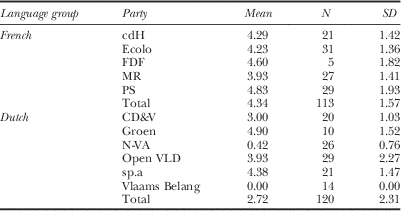
The polarization between parties promoting self-rule and shared-rule was most evident on the Flemish side, as shown in Table 2. In line with their political manifestos, MPs of the two Flemish nationalist parties, New-Flemish Alliance (Nieuw-Vlaamse Alliantie, N-VA) and Flemish Interest (Vlaams Belang, VB), support a future for Belgium in which regions and communities would control (almost) all powers. All Flemish Interest MPs and an overwhelming majority of the New-Flemish Alliance MPs defend exclusive self-rule – that is, independence. In the other parties, MPs largely adopted a position for increased regional autonomy but with a limited scope (values around 4). In contrast, many MPs of the liberal Open VLD, the Green (Groen), and the socialist sp.a (respectively 31, 40 and 19 per cent) supported the refederalization position. Actually, when nationalist MPs are excluded (Flemish Interest and New-Flemish Alliance), the mean score is 3.77 with a standard deviation of 1.85. Although the score remains lower compared with the score of Francophone MPs, it comes much closer (mean score of 4.4, difference of 0.63) and it substantially differs from the average score of 2.52 including all Flemish MPs (difference of 1.25).
MPs’ Preference for Federal Reform

Key for the political parties: in the French-language group, cdH = Christian Democrats, Ecolo = Greens, FDF = Regionalists, MR = Liberals, PS = Socialists; in the Dutch-language group, CD&V = Christian Democrats, Groen = Greens, N-VA = Right-wing Nationalists, Open VLD = Liberals, sp.a = Socialists, Vlaams Belang = Radical Right Nationalists.
Source: MP survey 2010 (authors), preference indicated on an 11-point scale where 0 represents ‘the regions and communities should have all the powers’, 5 represents ‘being satisfied with the current situation’, and 10 represents ‘the federal state should have all the powers’, broken down by party affiliation.
While the parties on the Dutch-speaking side had clearly distinct preferences, the differences between the French-speaking parties were not that obvious. In general, they advocated self-rule less strongly than the Dutch-speaking parties, and there was very little variation between the parties. One interesting finding is that the liberal MR seemed to be most in favour of self-rule, whereas the socialist PS, one of the traditional governing parties, most strongly supported shared-rule.
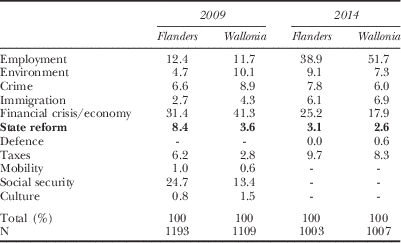
So far, we have mainly discussed the elites–voters gap through differences in terms of preferences on the issue of devolution. Although devolution has been at the top of the agenda for political parties, provoking the deepest and longest political crisis that the country had ever faced (2010–11), it remains to be seen whether or not federal reform constitutes a salient issue from the voters’ perspective. For that purpose, we rely on the 2009 and 2014 PartiRep surveys where voters were asked to define what was the most important issue motivating their electoral choice (‘Which of these themes would be the most important when casting your vote’). Although the list of items proposed differs between 2009 and 2014, most of them were similar (Table 3).
Voters’ Most Important Theme When Casting their Vote

Source: PartiRep 2009 and 2014 surveys weighted by age, gender and education. Values represent percentage of respondents who selected each theme in answer to the question ‘Which of these themes would be the most important when casting your vote?’
From Table 3, a striking observation is that state reform is clearly seen as a second-order issue for voters, irrespective of community lines. Although 8.4 per cent of Flemish voters said that they based their vote on this issue in 2009, the percentages hardly exceed 3.0 per cent in 2014, at a very similar ratio to percentages observed for Francophone voters in 2009 and 2014.
The low saliency of devolution in voters’ choice is enhanced by responses obtained to a second question. For each of the items presented to the previous question, voters were asked whether they consider them as ‘very important’, ‘important’, ‘neither important nor unimportant’, ‘not important’ or ‘not important at all’ in determining their party choice. Whereas six of the eight items listed were seen as very important or important by at least three-quarters of both Dutch-speaking and French-speaking voters in 2014, state reform was hardly considered as very important or important by a majority of voters from the south (55.8 per cent) and even a minority in the north of the country (43.8 per cent). The only other item to receive such low percentages was the theme of defence (48.6 and 31.1 per cent in the south and north respectively).
In conclusion, we have observed that at the voter level, Flanders is more pro-devolution than Wallonia, albeit marginally. Yet in both communities the salience of this issue is very low and voters only marginally take this issue into consideration when voting. In fact, the most important and evident gap is between elites and voters, particularly in Flanders. In opposition to the prudent leadership assumed in consociational theory, Flemish political elites were found to develop much more radical positions regarding devolution than voters from their own community. On this matter, we have also demonstrated that political elites are strongly divided within communities (particularly between nationalist MPs and other MPs) and within party (the standard deviation is generally high, where there are almost as many MPs supporting devolution as MPs defending refederalization of powers within the same political parties). In this context, where support for devolution is so diffuse across voters and elites, how can we explain that the issue triggered the longest political crisis that Belgium had ever faced? To answer this question, we must integrate strategic electoral/party interest with community factors.
EXPLAINING THE ELITES–VOTERS GAP
To explain the gap between voters and elites we found above, we need to look at the main drivers for parties’ behaviour. In particular, we must determine whether identity-based motivations or strategic motivations are the drivers of parties’ positions. If identity-based concerns are the primary motivators of the MPs’ behaviour, we would expect to find that the differences between the language groups are stronger than the differences between the parties. Conversely, if strategic considerations predominate, the differences between parties of each language group would be greater than the differences between the language groups overall.
In order to determine the relative strength of the effect of language group and political party affiliation on the MPs’ preferences for future state reform, we ran a one-way analysis of variance. Our analyses showed that both language group and party affiliation are significant (p<0.001) predictors of the MPs’ position on federal reform. However, the effect of language group (and thus identity-based motivations) is much weaker [F(1, 235)=38.297; p=0.000] than the overall effect of party [F(13, 223)=18.569; p=0.000]. This seems to indicate that strategic motivations play a stronger role in explaining the parties’ preferences for federal reform than identities.
We observed that support for increased sub-state powers clearly diverges among Belgian MPs. The standard deviations demonstrate that there are distinct – and sometimes opposing – positions on the future of Belgian federalism (Table 2 above). The fact that Flemish nationalist MPs and those of the Flemish Christian Democrats (CD&V) were the most enthusiastic proponents of extended regional powers is not surprising considering the positions of their parties in former constitutional reforms. This finding coincides with previous research that showed that parties which are dominant at the regional level tend to favour more autonomy (Sinardet Reference Sinardet2012). This has historically always been true for the Flemish Christian Democrats and is now still reflected in the positions of their MPs, based on our findings, even if they clearly hold a less radical position than those of the New-Flemish Alliance.
However, the results for the Flemish liberals, greens and socialists are more surprising as they clearly go against the general analysis of a Flemish consensus for more autonomy, as was reflected in five resolutions voted by the Flemish Parliament in 1999. We found that between one- and two-thirds of respondent MPs from these parties preferred a status quo or even less regional autonomy. To explain the difference within one party, the identity dimension seems to be the chief one. In fact, the parties where most MPs share a similar identity (such as a Flemish identity in the case of the two Flemish nationalist parties and the Flemish Christian Democrats) are also those that were found to have the highest internal cohesion. By contrast, the parties which had a large difference of opinion between their MPs are the parties where the MPs differ the most in terms of identity. Here we can see a clear interplay between identity politics and party politics.
On the Francophone side, contrary to the well-publicized rhetoric that they do not demand any form of federal reform, a large majority of liberals and green MPs and a majority of Christian Democrats opted for increasing regional autonomy. Although the Francophone parties’ positions have clearly evolved since 2010, this is not so apparent for the Francophone Socialist Party (PS). Overall, this is the only party in which a minority of MPs advocated increased regional autonomy. The position of the Francophone Socialist Party MPs is unexpected considering the strength of the Socialist Party in Wallonia and – to a lesser degree – in Brussels, as it does not align with the hypothesis that regional political dominance coincides with favouring more autonomy. Yet, it is less surprising once we take into account which competences are at stake: the state reform that was being negotiated was largely related to policy areas – such as social security – that could eventually result in the impoverishment of Wallonia, a region where the Socialist Party has been the dominant party almost continuously since it was created and where it is likely to keep a dominant position in the future.
Our survey was carried out during the summer of 2011, when Belgian political elites had been fruitlessly negotiating for more than a year. We therefore asked the MPs about the reason for this political crisis and the role of party interests in sustaining the crisis. This type of question is of course somewhat schizophrenic as politicians were asked to analyse their own role in a critical way, and we cannot exclude the possibility that their appraisal mostly concerns other parties and not necessarily their own party.
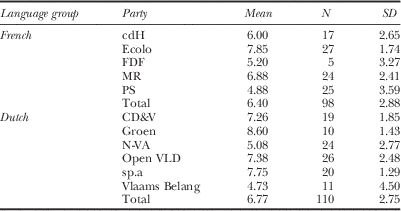
In an initial question, we asked the respondents quite bluntly whether they agreed, on a 0 to 10 scale, with the statement that one of the reasons for the political crisis was ‘because party interests are too much taken into account, instead of the general interest’. Overall, we found a striking agreement with this statement, and the agreement on both sides of the linguistic divide is equally strong [F(1, 206)=0.918; p=0.339]. This is remarkable because it means that MPs openly admitted that the crisis was the result of the fact that the parties were unable to set aside their own strategic conflicts, and that it was not due to an incompatibility between identity-based interests (Table 4).
MPs’ Position on Statement Concerning the Role of Party Interests in Explaining the Political Crisis

Key for the political parties: in the French-language group, cdH = Christian Democrats, Ecolo = Greens, FDF = Regionalists, MR = Liberals, PS = Socialists; in the Dutch-language group, CD&V = Christian Democrats, Groen = Greens, N-VA = Right-wing Nationalists, Open VLD = Liberals, sp.a = Socialists, Vlaams Belang = Radical Right Nationalists.
Source: MP survey 2010 (authors), position indicated on an 11-point scale where 0 represents totally disagree and 10 totally agree about the statement ‘because party interests are too much taken into account, instead of the general interest’ to explain the political crisis.
There is, however, some variation between parties [F(10, 197)=4.750; p=0.000]. Members of the leading party in both language groups, the French-speaking Socialist Party and the New-Flemish Alliance, think that party interests matter less. The relatively low score among MPs of these two parties can probably be explained by the fact that – as the two winners of the 2010 federal elections – they had taken the lead in the negotiations and were therefore often regarded as having the prime responsibility for the lack of agreement. This also explains the high score among other parties that have sometimes felt that they are the ‘victim’ of a situation caused by the two large parties. We can, however, conclude that an important majority of MPs consider that party interests have played a central role in Belgium’s political crisis.
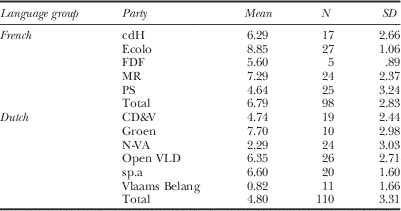
In order to verify whether the effect of party politics is indeed stronger than identity politics, we also asked the MPs about the electoral interests of the party, and whether they attributed the political crisis to the fact that ‘politicians only have to get elected by voters of their own community’, on a 0 to 10 scale (Table 5).
MPs’ Positions on Statement Concerning the Role of Community Electoral Rationale in Explaining the Political Crisis

Key for the political parties: in the French-language group, cdH = Christian Democrats, Ecolo = Greens, FDF = Regionalists, MR = Liberals, PS = Socialists; in the Dutch-language group, CD&V = Christian Democrats, Groen = Greens, N-VA = Right-wing Nationalists, Open VLD = Liberals, sp.a = Socialists, Vlaams Belang = Radical Right Nationalists.
Source: MPs survey 2010 (authors), position indicated on an 11-point scale where 0 represents totally disagree and 10 totally agree about the statement ‘because politicians only have to get elected by voters of their own community’ to explain the political crisis.
Here, again, an analysis of variance showed that party affiliation [F(10, 197)=16.421; p=0.000] and linguistic group [F(1, 206)=21.368; p=0.000] were significantly related to MPs’ attributions of reasons for the crisis, but the differences between the parties were far stronger than those between the linguistic groups. This indicates that strategic considerations outweighed identity considerations, and we found strong support for the statement in most parties. Only MPs from the Francophone Socialist Party, the New-Flemish Alliance and the Flemish Interest were not convinced that the specific electoral interests of the parties were conducive to the crisis. To a lesser extent, this also goes for the Flemish Christian Democrats. In any case, the marked approval for this statement can again be considered as an indication that party interests played an important role in the political crisis and above all in the federal dynamics in Belgium.
CONCLUSION
The so-called ‘spirit of accommodation’ is a key consociational feature used to explain the stability of divided societies in addition to a specific consociational design of the institutions. For a long time, Belgium has been considered a textbook example of a consociational democracy, where Dutch-speaking and French-speaking elites had been able to transform their country peacefully from a unitary state to become a federal state. Yet in this country the spirit of accommodation of prudent leaders has been increasingly questioned and discussed in the light of the two recent political gridlocks: following the 2007 elections and after the 2010 elections, which was followed by the longest coalition-formation negotiations ever. The question that this article sought to tackle was therefore whether Belgian political elites are indeed less radical and hold less extreme views than voters, as suggested by consociational theory, or if they are in fact more radical and hold more extreme views than voters, as suggested by the recent political gridlocks.
The comparison of an original survey of MPs’ attitudes, undertaken in the midst of the 2010–11 crisis, with two voter surveys gathered in 2009 and in 2014 confirmed what previous research had started to demonstrate (Deschouwer Reference Deschouwer2013; Reuchamps Reference Reuchamps2013): voters are less radical than MPs on the question of state reform in Belgium. What’s more, while we have observed that voters in Flanders were more pro-devolution than voters in Wallonia, the difference is more a difference of intensity rather than a difference of direction. The distribution in both language groups also shows a wide diversity of preferences from, at one end of the scale, full autonomy to the regions and communities to, at the other end, full powers (returned) to the federal government. In both groups, we found that the salience of this issue is low and voters from Flanders and Wallonia only marginally take into consideration this issue when casting their vote.
The most important gap is thus between elites and voters, particularly in Flanders. In contrast to the prudent leadership assumed in consociational theory, Flemish political elites develop much more radical positions regarding devolution than voters from their own community, and this can be explained by the strong regionalist stance of two parties, the New-Flemish Alliance and the Flemish Interest, partly followed by the historically largest party, the Flemish Christian Democrats. Nevertheless, our data revealed that political elites are strongly divided within communities and also within party. Neither communities nor parties are monolithic blocks. Under the surface of perceived homogeneous linguistic blocks there are fundamental differences between the parties of each language group on their preferences for the future of the country and the autonomy of the constituent entities. We also showed that MPs themselves acknowledge the important role of partisan interests in party positioning on federal reform issues. The exploration of the positions of the parties on the political crisis quite convincingly showed this. Our data thus nuanced the oft-assumed suma divisio between Flemish and Francophone parties but also between voters.
This can be traced back through the history of Belgian federalism. The road to federalism was quite erratic and there was never a consensus on a blueprint. Indeed, on the one hand, the ethno-linguistic cleavage in Belgian society interplayed with the interests of parties that were pressured by nationalist parties and therefore wanted to reinforce their power through granting autonomy to government levels where they had more power. This in turn led to the progressive regionalization and then federalization of the country. On the other hand, there were always divisions within each of the linguistic communities, depending on ideological left–right positions and/or party interests.
Additionally, regionalization and federalization have coincided with a process of consociationalization, organizing the new institutional architecture along the divide. Not only did such institutions freeze and exacerbate the socio-linguistic ‘wall’ between the two communities, but this divide also strongly promoted the role of political parties. There are no state-wide parties in Belgium any more, but two regional party systems with Flemish and Francophone parties in competition only within their own language community. These parties compete for voters of one community only, whose preferences dictate a divergence in what the political parties propose. What is at stake now, when looking to the future of federalism in Belgium, is thus how, and whether, the gap between political parties and voters will close or widen deeper.