Huangyan dialect ( , local name: [wɔ̤ɲjɛ˜̤wa̤]) is a variety of Taizhou dialect (
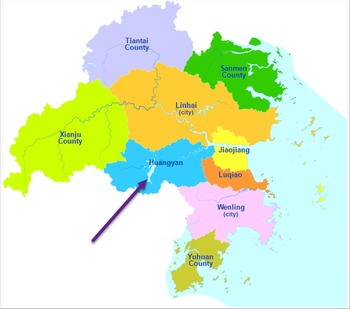
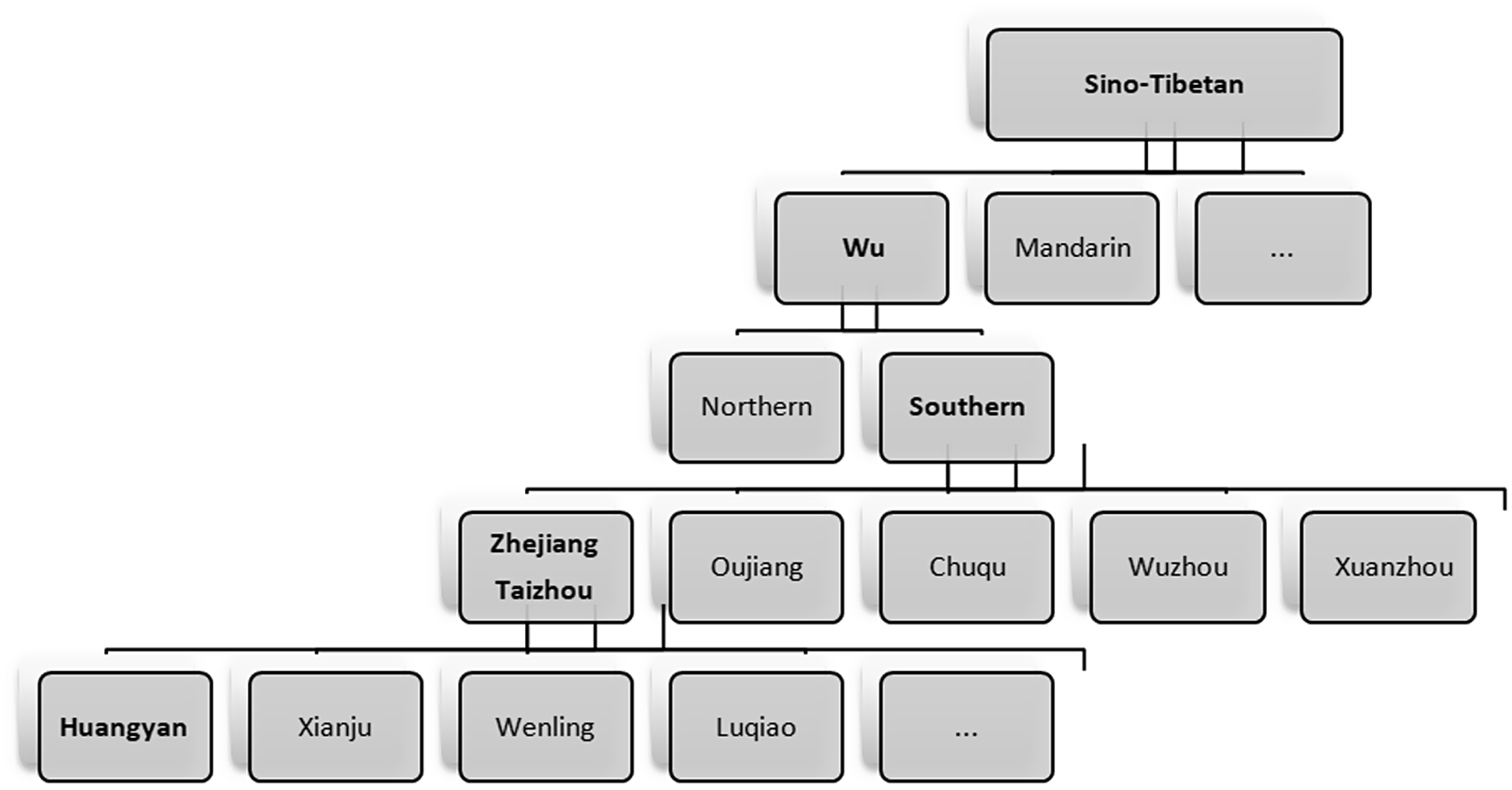
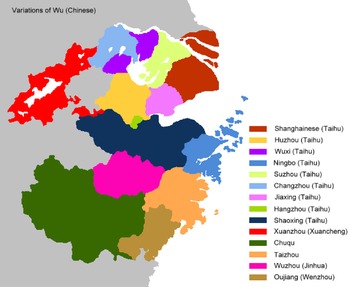
 ) as spoken in Zhejiang Province in ChinaFootnote 1 (see Figure 1).Footnote 2 Huangyan District had a population of 616,000 people in 2019.Footnote 3 The Zhejiang Taizhou dialect belongs to the Wu dialect group, which forms the second largest dialect group in China (after Mandarin). The language genealogy of Huangyan is presented in Figure 2. Wu dialects are spoken in the city of Shanghai, Zhejiang Province, southern Jiangsu Province and bordering areas (see Figure 3), an area with an estimated population of 80 million people in 2013 (Lewis Reference Lewis2009). The Wu dialects are not mutually intelligible with (Standard) Mandarin and often not even with each other (Norman Reference Norman, Graham and LaPolla2003, Wang Reference Wang2014).
The county of Taizhou (Zhejiang Province, China). The arrow indicates Huangyan.

Language genealogy of Huangyan.

Variations of Wu (ASDFGH at English Wikipedia; public domain, via Wikimedia Commons).

The Taizhou dialect consists of a number of varieties (see Figure 2), of which Huangyan has attracted the most attention – perhaps due the fact that Chao (Reference Chao1928), in his influential overview of Wu dialects, observed that Huangyan ‘has a sort of dyssyllabic [sic] Shaangsheng, that is, syllables of that tone class have a glottal stop in the middle of the vowel or between the vowel and a final nasal, thus giving the impression of two syllables. In connected phrases, the glottal stop is usually not present’ (Chao Reference Chao1928: xiv). This ‘glottal stop’ was reinterpreted as creaky phonation by Zhu (Reference Zhu2004). In our investigation, we also occasionally found such syllables in our data (see the section on tone below).
The examples in this Illustration are accompanied by recordings of a 24-year-old male Huangyan speaker from Ningxi Town in Huangyan District, where he lived until half a year before the recordings, when he moved to Shanghai. Huangyan is this speaker’s mother tongue; he speaks the dialect on a daily basis with his parents, other family members and friends. He has a strong positive attitude towards the dialect and uses it for all daily conversations, including study-related topics.
In this contribution, we aim to provide a phonetic description of present-day Huangyan Taizhou. We also draw attention to one particular characteristic of the dialect, namely co-articulation of consonant and the following vowel for the entire duration of the syllable, resulting in high, fricativized vowels /i y u/. Extreme consonant–vowel co-articulation of the type encountered in Huangyan is rare cross-linguistically. A comparable process, namely extreme nasal–vowel co-articulation, results in the syllabic nasals /m̩ n̩ Ŋ̍/. We will discuss these processes in the final section of this article.
Two registers
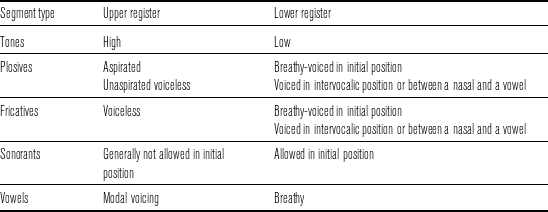
Wu dialects belong to the Chinese dialect groups which have two tonal registers, upper and lower (see e.g. Chao Reference Chao1928; Chen Reference Chen2000: 10; Yip Reference Yip2002; Duanmu Reference Duanmu2007: 229–232). In Wu dialects, register not only involves tone but also consonant and vowel phonation (see Table 1). Because register affects consonants, vowels, and tones, we start the Illustration by discussing register first. Plosives and affricates are distinguished by a three-way contrast, viz. aspirated, voiceless unaspirated, and breathy-voiced, while fricatives have a two-way phonation contrast (Chao Reference Chao1928). In the upper register, initial plosives and affricates may be voiceless unaspirated or voiceless aspirated; initial fricatives are voiceless; and the vowels have modal phonation. In the lower register, initial plosives and affricates may be breathy-voiced but are not aspirated or voiceless unaspirated, and fricatives also have breathy phonation (sometimes referred to as ‘murmured’, see e.g. Yip Reference Yip, Harry and Snider1993). Breathy-voiced consonants only occur in initial position and are often only truly voiced in intervocalic position or between a nasal and a vowel. Initial sonorants usually do not occur in the upper register, but there are exceptions (Chang Reference Chang1971: 194), such as Shanghainese (Sherard Reference Sherard1983: 193) and also Huangyan, in which initial sonorants may occur with a high falling tone, as in  ‘to tolerate’ (tones will be discussed in the next section).
Tones and segments that are typically allowed in upper and lower register in Wu dialects.

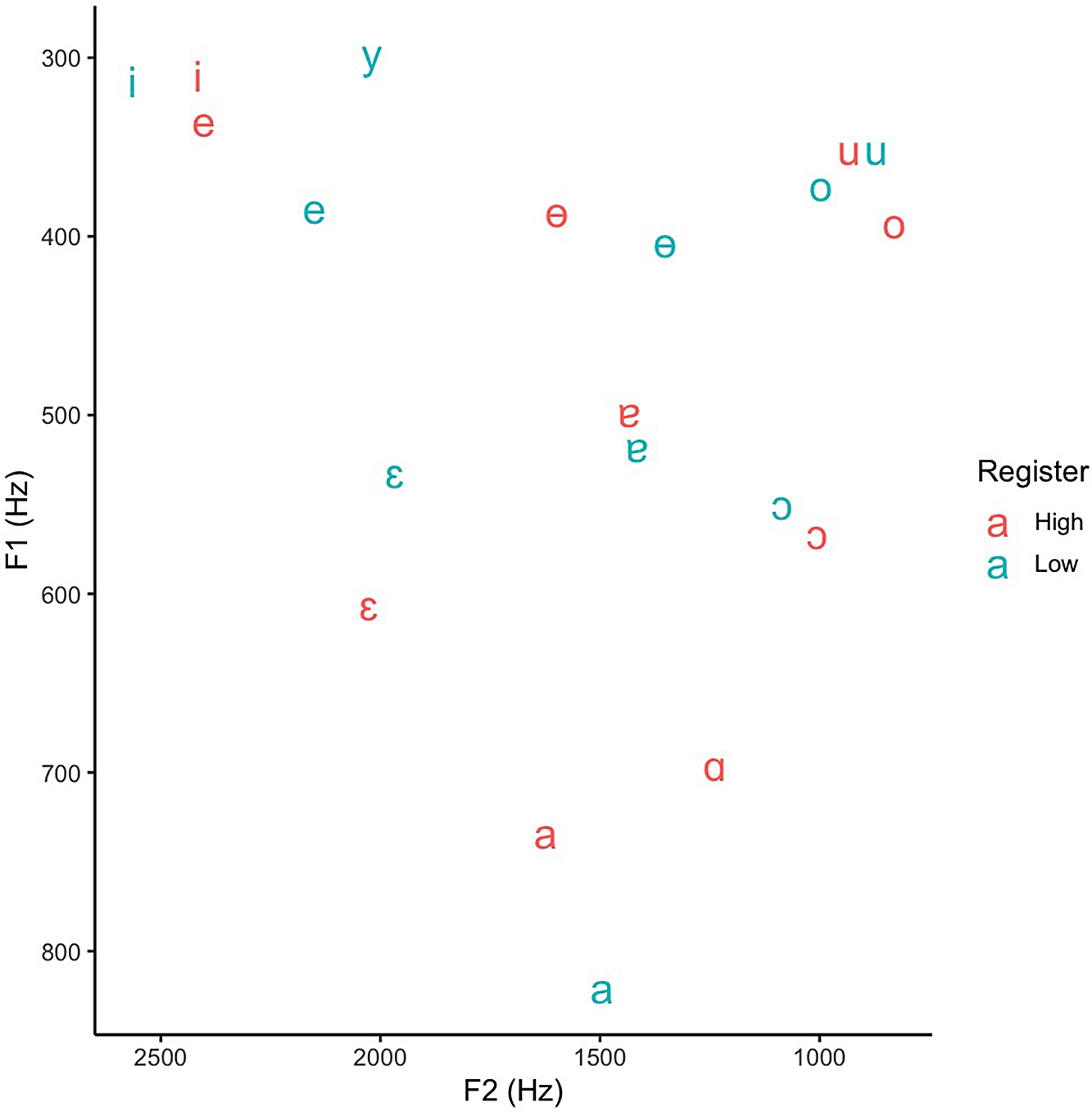
Vowels of Huangyuan Taizhou, divided across tonal register (high vs. low).

Vowels do not differ consistently in vowel quality in the different registers. This is shown in Figure 4, which shows F1 and F2 formant values for all available vowels tokens divided across register (see further below on vowels), disregarding fricative vowels (see below) and heavily coarticulated vowels such as nasalized vowels.
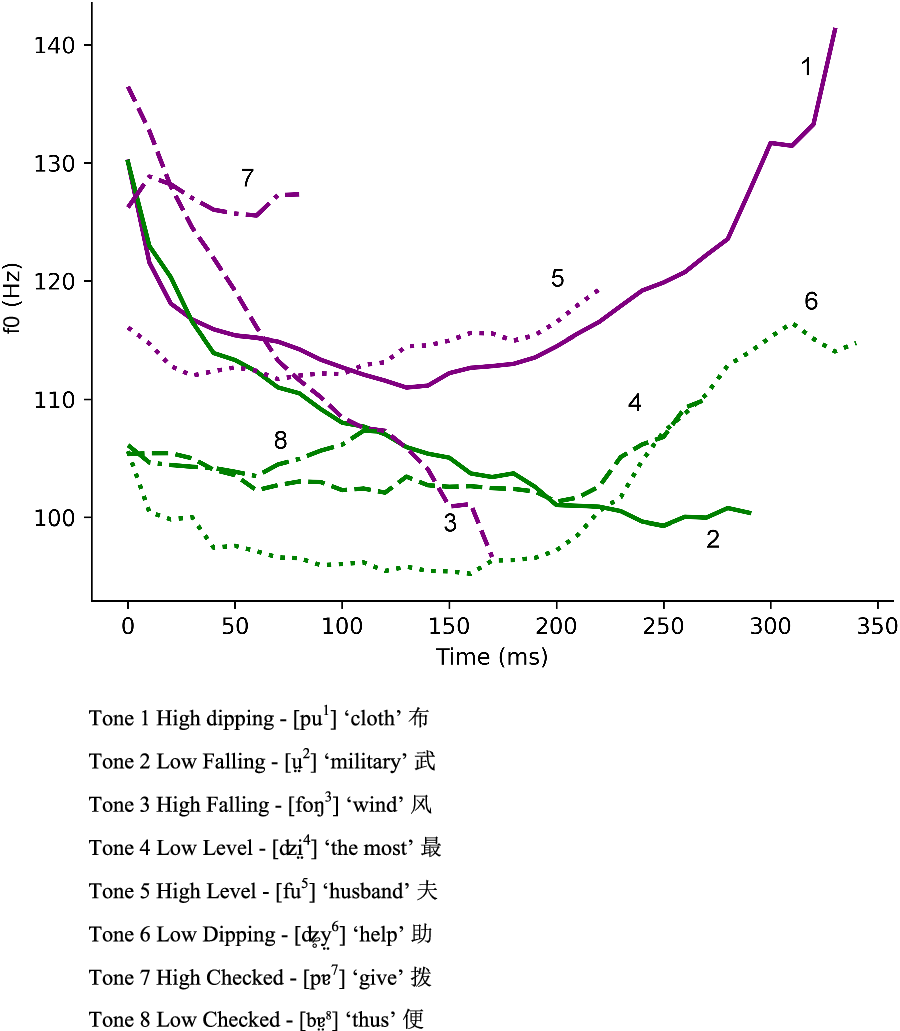
The eight lexical tones exemplified by the f0 tracks. The contours in red represent high-register tones and the contours in green represent the low-register tones.

Breathiness is typically realized on the vowel more than on the initial consonant (Ladefoged & Maddieson Reference Ladefoged and Ian1996: 64; Chen Reference Chen2000: 21; Chen Reference Chen2010,). In other words, breathiness is predictable from the initial consonant, but we will indicate it in the allophonic transcriptions in this paper because this ‘overspecification’ is phonetically informative. In this sense, Huangyan is a typical Wu dialect in which the low register is regularly accompanied by perceptible breathy voice.
Unlike most Chinese dialects with a register distinction, Huangyan Taizhou has a remarkably symmetrical tone system of four tonal contours that occur in both registers, to which we turn next.
Lexical tone
Huangyan has eight lexical tones, divided across two registers, of which two are checked tones (T7 and T8), which have a shorter duration than the other syllables. These sometimes give the impression of a glottal ending, but the waveforms show no trace of this. Like the other tones, the two checked tones appear in either the high or the low register. Figure 5 shows a high and a low falling tone, a high and a low dipping tone, and a high and a low long level tone. These representations are consistent with the phonetic variation in our data, in which the so-called level tones may be phonetically realized as slightly dipping, rising or falling.
The tones that cooccur with breathy-voiced onsets and vowels are T2, T4, T6, T8 (low register) and the other tones (T1, T3, T5, T7) cooccur with aspirated onsets and voiceless unaspirated onsets (high register). Since representing the exact contours of these tones by IPA diacritics is cumbersome, we indicate the tones by superscript numbers, following Chen & Gussenhoven (Reference Chen and Carlos2015). Thus, the tone numbers in the present article are motivated by the convenience of a synchronic description and do not match the traditional numbering of the tones. See Chao (Reference Chao1928), Qian (Reference Qian1992), and Zhu (Reference Zhu2004) for previous descriptions of the tonal system of Huangyan.
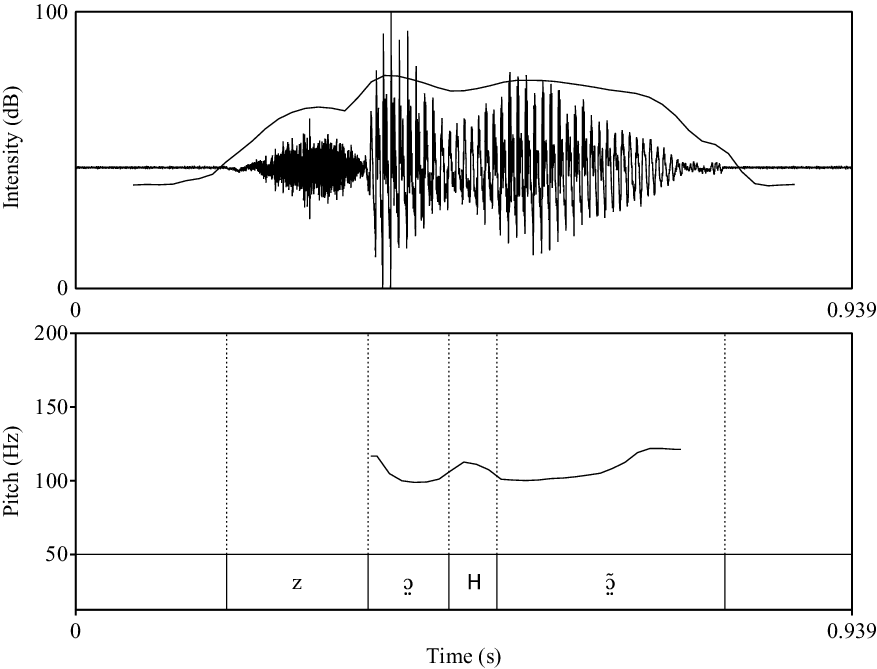
As noted in our introduction above, Chao (Reference Chao1928) described some syllables as pronounced with a glottal stop in between. His impression was ‘that the vowel is disyllabic’. Zhu (Reference Zhu2004) reinterpreted this as creakiness, which is common in Chinese dialects, but he hardly observed any creaky phonation in Huangyan. In our data, we find some syllables (all with the low dipping tone) that fit the original description by Chao (Reference Chao1928). This kind of pronunciation is optional, and the word can also be realized as unambiguously monosyllabic (without any dip in amplitude). However, the waveforms do show a dip in the amplitude just after the turning point of the dipping tone, leading to two sonority peaks. This indeed gives the impression of a disyllabic sequence, like Chao (Reference Chao1928) observed. The drop of amplitude between the sonority peaks acoustically results in a voiced glottal fricative [ɦ]. In nasalized vowels, nasalization of the vowel coincides with the part after the amplitude dip. Moreover, a low dipping pitch contour is followed by a peak. These aspects are illustrated in the forms below and in Figure 6.

Waveform, intensity contour, and pitch contour of  ‘on, upon’.

Consonants

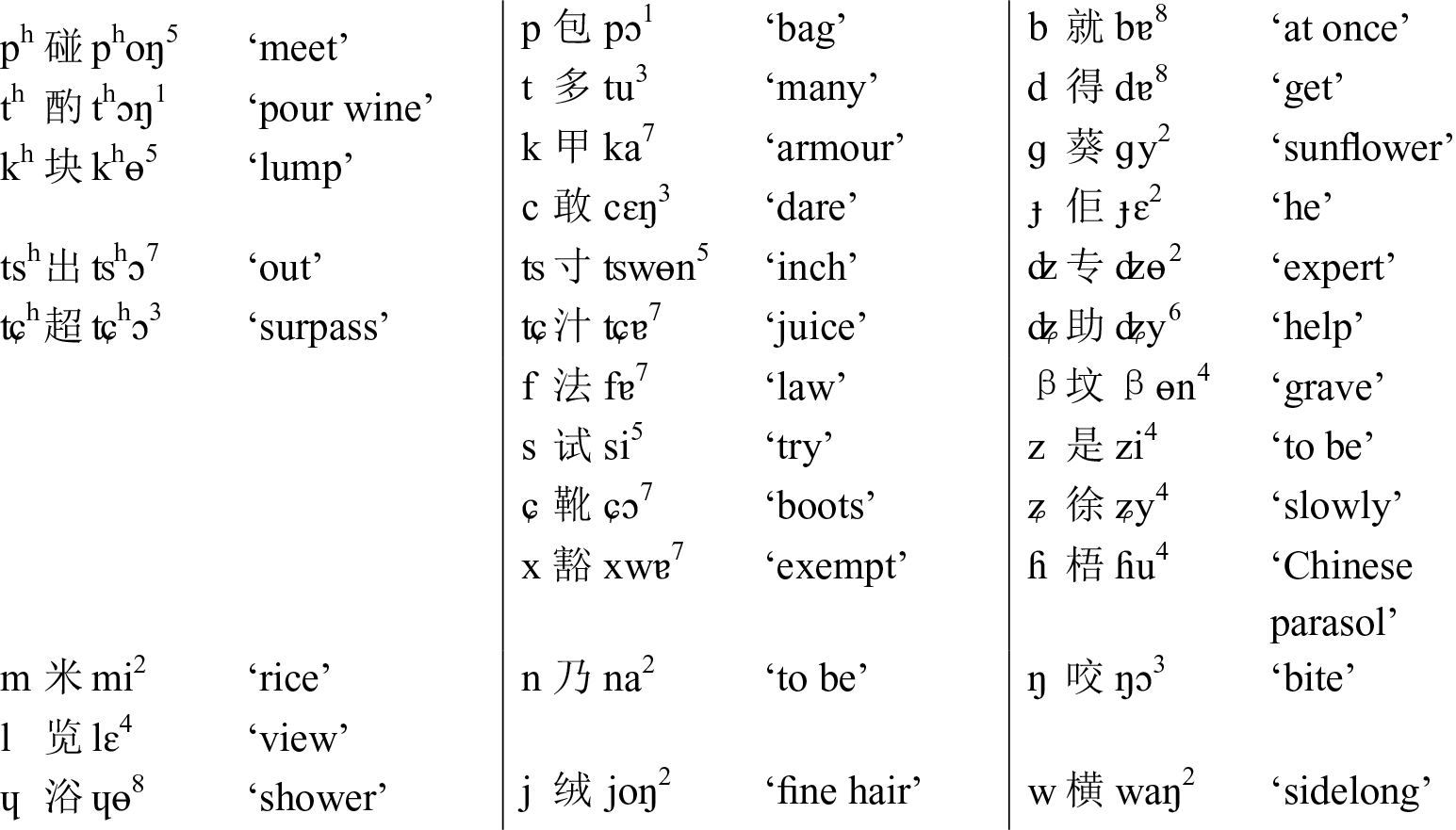
Obstruents
In initial position, breathy-voiced obstruents have the same voice onset time (VOT) as their voiceless unaspirated counterparts. That is, the vocal cords do not vibrate; breathiness occurs during the release (not during the closure), and this breathy release is co-articulated with the following vowel (see Ladefoged & Maddieson Reference Ladefoged and Ian1996: 64). Articulatorily, breathiness is a result of slack vocal cords, which results in less energy in the formants. In Huangyan dialect, breathy-voiced obstruents are only fully voiced in connected speech, as often occurs in the story ‘The North Wind and the Sun’ at the end of this Illustration. Voiceless unaspirated obstruents optionally undergo voicing in connected speech as well, as in the following example.

In the upper register, fricatives are voiceless. In the lower register, fricatives lack voicing. The bilabial fricatives are currently undergoing change to labiodental fricatives, e.g.  ‘blessing’ (Qian Reference Qian1992: 6). As for our speaker, we observed voiceless labiodental fricatives but breathy-voiced bilabial fricatives. The palatal plosives [c ɟ] are in free variation with their palatalized velar counterparts [kj ɡj], respectively (see Qian Reference Qian1992: 62).
Nasals
Nasals are the only consonants that occur in the coda. Coda nasals are often deleted with concomitant vowel nasalization – a pattern that is commonly observed in Chinese dialects (Chen Reference Chen1975). Four degrees of nasal deletion are distinguished: (i) nasal merger m > n > Ŋ, (ii) nasalization of the vowel, (iii) nasal deletion, (iv) denasalization of the vowel (Chen Reference Chen1975). All patterns are observed in Huangyan (and also in the neighbouring Taizhou dialect Wenling, see Hess & He Reference Hess and Suan1990). In these dialects, most nasals have merged into the velar nasal. However, retention of the original alveolar nasal occasionally occurs, as in  ‘warm’. In some words a bilabial coda nasal occurs as a result of syllable contraction when the second syllable is
 ‘what’. In such cases the vowel of /ma。/ is optionally deleted and the /m/ is resyllabified with the preceding syllable:

Second, vowel nasalization sometimes occurs and the coda is retained, as in  ‘taste’. Third, nasal deletion with nasalized vowels occurs frequently, as in
 ‘crazy’.
Nasalization and nasal deletion cross-linguistically tend to affect low back vowels most and high front vowels less so (Schourup Reference Schourup1972, Chen Reference Chen1975). This is expected because of the tendency to lower the velum in low vowels, inducing nasal airflow (see Hess & He Reference Hess and Suan1990 for Wenling Taizhou; see also Beddor (Reference Beddor, Huffman and Krakow1993: 185), Johnson et al. Reference Johnson, Marissa, Shosted and Sutton2019 and references cited there). Huangyan vowels show the same pattern. The low back vowel is almost always nasalized [ɑ˜]. High and central vowels are rarely nasalized, whereas much variation occurs in the low vowel /a/ and the back high vowels /o u/. Finally, denasalization occurs in e.g.  ‘bend’.
Nasals are subject to regressive place assimilation, which is a variable process. First, nasals in onset position may undergo palatalization before palatals, like in  ‘colour’. Furthermore, as we observed just above, nasals may be deleted phrase-finally with accompanying vowel nasalization; however, before plosives, the nasal is usually realized and undergoes assimilation to the place of articulation of the following consonant, as shown in the following examples:

Syllable structure and glides
Syllables consist of (C)(G)V(N), where G is a glide /j w ɥ/ and N is a nasal /n Ŋ/. Like in other Chinese varieties, the co-occurrence of consonants and glides is severely restricted. The glide /j/ occurs after labial consonants and after alveolar consonants:

The glide /w/ occurs after labials, alveolars and velars:

The glide /ɥ/ only occurs after alveolars and alveolo-palatals:

Vowel-initial words often start with a glottal stop, especially in hiatus.
Vowels


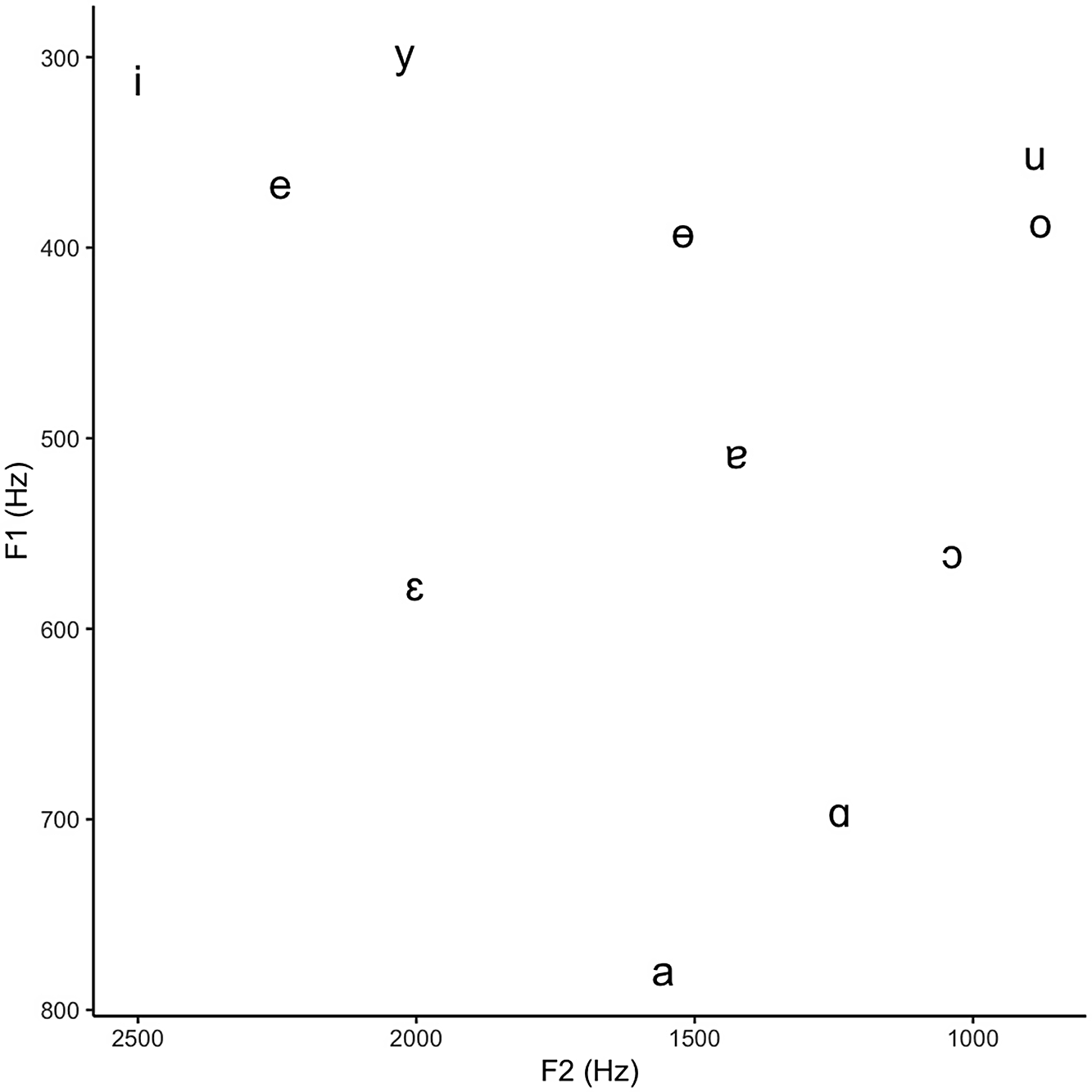
The vowel plot in Figure 7 is based on all available vowel tokens, i.e. it combines the vowels in the low and high register (recall Figure 4 above).
Vowel plot (F1 and F2 formant values) of all Huangyan Taizhou vowels (monophthongs).

All vowels are monophthongs, except for /iɛ/. The unrounded front high vowel /i/ has two allophones. The high front vowel /i/ becomes retracted if it occurs before coda /Ŋ/, irrespective of the onset, as in  ‘life’. Retraction of /i/ also occurs before an (assimilated) palatal nasal, like in
 ‘interest, desire to + yi’. After the alveolar sibilants /s z ₦ ʣ/, the /i/ is realized as ‘apical’, which is not uncommon in Chinese dialects (e.g. Zhang Reference Zhang2006: 53). This apical vowel has the same tongue position as the preceding consonant and is commonly transcribed as /ɿ/ in Chinese linguistics (Lee & Zee Reference Lee and Eric2003: fn. 6). This symbol is not a standard IPA symbol, and its exact phonetic realization and phonological status is subject to ongoing debate (Zhang Reference Zhang2006; Faytak Reference Faytak2018: 45–46). Based on the acoustic properties, Lee-Kim (Reference Lee-Kim2014) suggested to transcribe the apical vowel as the consonant [ɹ]. We will return to this in the next section. The mid-high front vowel /e/ is sometimes diphthongized to [eɪ], which in our data only occurs with the low dipping tone, as is
 ‘meeting’.
A restricted number of vowels occur with the checked tones: /ɵ ɐ a i ɛ o ɔ/, and the mid central vowel /ɐ/ occurs remarkably frequently with the checked tones and infrequently with other tones. A restriction like this, on the number of vowels that have a checked tone, is also observed for Shanghainese (Chen & Gussenhoven Reference Chen and Carlos2015).
Consonant–vowel co-articulation
Huangyan Taizhou shows extreme co-articulation, resulting in fricative vowels (Sloos, Ran & van de Weijer Reference Sloos, Ran, van de Weijer, Katarzyna, Jolanta, Agnieszka, Maciej and Daniel2018), and also like a recent description of another Wu dialect, Lili (Shi & Chen, published online 29 September Reference Shi and Yiya2020). We also regard syllabic nasals as involving extreme co-articulation, since in both cases vowel features are compressed, resulting in a consonant with syllabic characteristics. We discuss both cases in turn.
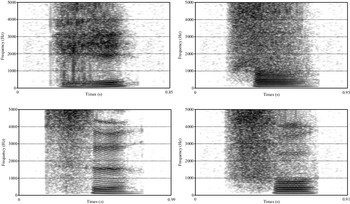
Narrow-band spectrograms of the fricative vowels  ‘for’ and
 ‘float’ (left panels) compared to their modal non-fricative counterparts
 ‘poem’ and
 ‘husband’ (right panels). The harmonics are clearer in the modal vowels than in the fricative vowels.

Fricative vowels
In Chinese languages, the apical and retroflex vowels typically share their place and manner of articulation with the consonant that precedes them. Through co-articulation of the consonant and vowel, the frication of the consonant may spread to the apical vowel (Ladefoged & Maddieson Reference Ladefoged and Ian1996: 313; Wiese Reference Wiese, Jialing and Norval1997; Lee-Kim Reference Lee-Kim2014). The duration of the frication on the vowel varies considerably across different languages and dialects; in fact, in Mandarin no inherent frication noise occurs during the vowel (Lee-Kim Reference Lee-Kim2014), but it is sometimes observed in dialects. Real fricative vowels are characterized by co-occurrence of frication and clear formant structure (Connell Reference Connell2007).Footnote 5 In addition, the place of articulation of fricative vowels is slightly different from their non-fricative counterparts (Connell Reference Connell2007, Lee-Kim Reference Lee-Kim2014, Hu & Ling Reference Hu and Feng2015). Vowels that are subject to fricativization are often apical, but in Suzhou (also a Wu dialect), a front rounded (non-apical) fricative vowel is observed (Chao Reference Chao1928; Ling Reference Ling2007; Faytak Reference Faytak2014, Reference Faytak, Dankmar, Hyman, Johanna, Guido and Thilo2021); see also Shi & Chen (published online 29 September 2020), who transcribe the Lili Wu fricative vowels as advanced (see their Figures 9 and 10). In Huangyan, both the front unrounded and front rounded vowel appear as fricative vowels after /z/; remarkably, the back rounded vowel /u/ also undergoes fricativization. Thus (unlike in Lili Wu) all high vowels can be realized as fricative vowels but only if they follow a homorganic and breathy-voiced consonant, i.e. the voiced alveolar fricative /z/ or the breathy-voiced labial fricative /β/, respectively. To capture this phonological relationship, we transcribe these fricative vowels as /zi̟ر zy̟ر βu̟ر/, indicating that the place of articulation of the fricative vowels is slightly advanced compared to their non-fricative counterparts, as also noted for Lili Wu. Like in Lili Wu (see again Shi & Chen (published online 29 September 2020), page 10), these fricated vowels have a lowered F2, which leads to a retracted quality in perception. Figure 8 presents narrow-band spectrograms for the pairs ‘for’ vs. ‘poem’ and ‘float’ vs. ‘husband’,Footnote 6 which show that the frication of the vowel is clearly retained for the entire duration of the vowel; by contrast, a clear boundary between consonant and vowel occurs if the fricative is voiceless.
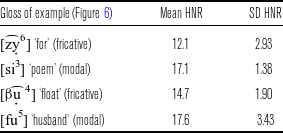
The harmonic-to-noise ratios (HNRs) for these two pairs of vowels are presented in Table 2 (computed by Praat script; Feinberg Reference Feinberg2018 and checked manually) and confirm the difference between fricative and modal vowels. As can be seen in the table, fricative vowels have lower HNRs than their modal counterparts, as expected.
Harmonic-to-noise ratios of fricative and modal vowels.

Syllabic nasals
Huangyan nasals can be syllabic, resulting in monosyllabic lexical words – a pattern that occurs in different southern Chinese languages (Shen Reference Shen2006). Syllabic nasals may also derive from extreme consonant–vowel co-articulation. The context in which this happens is similar to that of fricative vowels: a sequence in which the consonant (here: a nasal) is followed by a high vowel with the same place of articulation (Shen Reference Shen2006: 83). Huangyan has three syllabic nasals:

Transcription: ‘The North Wind and the Sun’
Orthographic version
The following Chinese version of ‘The North Wind and the Sun’ is based on Qian (Reference Qian1992: 1086), adapted in consultation with the native speaker. It is longer than the traditional version.


English translation
One day, the North Wind and the Sun were disputing which was the stronger, when a traveler came along wrapped in a warm cloak. They agreed that the first who succeeded in making the traveler take his cloak off should be considered stronger than the other. Then the North Wind blew as hard as he could, but the more he blew the tighter the traveler folded his cloak around him; and at last the North Wind gave up the attempt. Then the Sun shone out warmly, and immediately the traveler took off his cloak. And so the North Wind was obliged to confess that the Sun was the stronger of the two.
A few days later, the North Wind and the Sun met again. The Sun said to the North Wind, ‘dare you challenge me again today?’ The North Wind replied, ‘Let’s compete again. Look over there. Do you see the boat on the river? Whoever races the boat faster is the stronger.’ So the Sun spared no efforts to shine heatedly, so that the boatman put all his strength in rowing. But the more furiously it shone, the weaker the boatman became. Then it was the North Wind’s turn. The North Wind gusted, and the boatman shouted, ‘It’s tailwind. It’s high time to put the sails up!’ The white sails were put up, which put the boat into motion as the wind drove it. The harder the wind blew, the faster the boat raced. At this time, the Sun had to say, ‘Mr. Wind, you are stronger than me.’ Finally, the North Wind said, ‘We both have our strong points. There’s no need to argue who is stronger!’
Phonetic transcription (with allophonic details)


Acknowledgments
We would like to express our deep gratitude to the Taizhou speakers who provided the data for this study. Thanks to Yin Ruihua for different kinds of logistic help during the initial stages. We are very much obliged to Chen Zhongmin, Shi Menghui, and Zhu Lei for generously sharing their expertise on Wu varieties in general, and to others who commented on previous drafts. Many thanks are due to the JIPA reviewers and editors, whose constructive comments helped to improve this paper. Special thanks to Lin Yuhan, who helped with the technical aspects during the final stages. All remaining errors are our own.
Supplementary material
To view supplementary material for this article, please visit https://doi.org/10.1017/S0025100321000189.
 ) in Jiangsu Province.
 ‘affair’), the frication is limited to the first part of the vowel (compare modal vowel in
 ‘try, test’).