There was a tremendous acceleration in newspaper publishing between 1930 and 1941 despite the onset of the Great Depression. The period is remarkable for the enthusiasm with which literate Malays took to press activities but also for the marked change in the structure and content of newspapers. Through newspapers, new forms of developing public opinion – such as the editorial (a new form), increased participation in the media through letters to the editor and contributors' articles, public readings of newspapers, and the expansion of newspapers into classrooms – extended the reach of public discussions in ways not seen before. The Malay press was evolving into a site for discussing and debating the circumstances of Malay life in the 1930s. Opinions, commentaries, leading articles and editorials rather than news made up the bulk of column space in Malay newspapers and magazines of the 1930s. The typical publication was increasingly becoming a ‘viewspaper’ rather than a newspaper.
A.C. Milner's sophisticated work on the development of a political discourse through the emergence of a bourgeois public sphere among Malays has broadened our understanding of press activity as it operated among literate Malays.Footnote 1 However, it was not only the bourgeois class that was involved in newspapers. Certainly, they were by far the most active group by virtue of their literacy, but by the 1930s a wider range of Malays from different parts of the Peninsula had the ability to communicate with each other through the press. This included a community of writers and readers who helped spur the growth of newspaper and periodical publishing, but it is equally important to look at a hitherto forgotten group – the listeners to the Malay press – as equally contributing to the discussions within that press. The widening scope of participation in the press also contributed to the rise of new forms of public opinion making which saw newspapers increasingly filled with public views of the situation in Malaya, including Singapore.
This enlarged participation in a burgeoning Malay press was largely a response to what Malay writers perceived to be the changing circumstances of life in Malaya. Demographic changes that were reducing the Malays' majority status, as well as an increasing sense of vulnerability because of Chinese and Indian political demands, were given voice in the Malay press. Exacerbating the situation was the onset of the Great Depression, which created a heightened sense of consciousness about the relative weakness of the Malay community in the economic arena.
The trauma of the economic downturn made economic concerns all the more immediate and ensured that economic issues were at the forefront of public discussions across the different ethnic groups. The Depression meant different things to different communities. English-language newspapers such as The Straits Times and The Malay Mail carried news from Europe and America about the increasing desperation of people abroad in the face of this worldwide economic crisis. Locally, the European community was focused on protecting their businesses from further deterioration, but as a community they were intent on making sure that unemployed Europeans found jobs. Chinese and Tamil-language newspapers, while similarly concerned with the Depression in their respective homelands, were increasingly worried by governmental action in Malaya aimed at reducing unemployment through the repatriation of immigrant labour. Malay newspapers regularly published local and overseas stories about the Depression. It could have hardly been far from the mind of the newspaper reader, with daily reminders of troubled economic times found in the press. The tables of declining rubber, tin and agricultural prices published in the Malay language daily Warta Malaya stood as a reminder to the onslaught of the economic crisis. For Malays, the Depression created a great sense of introspection about their economic condition and their position in the economy, which prompted active and sustained discussions that filled the pages of a burgeoning press.
Changing circumstances of life in Malaya
There was an open immigration policy in the Straits Settlements, and by extension into the Malay Peninsula, until the early 1930s. As a consequence, between the initial British intervention in 1874 and the 1931 census, the population of Malaya increased nearly 300 per cent, growing from 1.5 million in 1874 to almost 4.5 million by 1931.Footnote 2 The open immigration policy addressed shortages in labour as the colonial economy expanded at a phenomenal rate, particularly in growth sectors like rubber and tin.Footnote 3 More importantly, the population growth changed the character of the Malayan population and created a racial heterogeneity on a scale not previously encountered in Malaya, to the extent that by 1931 the Chinese were a larger demographic group than locally-born Malays.Footnote 4 So dramatic were the changes that in 1931 Superintendent of the Census C.A. Vlieland noted that ‘Malaya is, in constitutional theory and political practice, the country of the Malay; demographically it is No-Man's Land….[having] produced a population the racial heterogeneity of which is probably unique in the world today’.Footnote 5
The influx of migrants meant that Malays were becoming a minority group in their own land. By 1931, it was clear just how visible a presence the ‘foreign races’ (bangsa asing) had become. In the three colonies of the Straits Settlements (Singapore, Penang and Melaka), the Chinese were the largest ethnic group, making up 59.6 per cent of the total population, while Malays and ‘Other Malaysians’ formed 25.6 per cent, and the Indians constituted 11.9 per cent. In three out of the four Federated Malay States (FMS) – Perak, Selangor and Negri Sembilan – the Chinese population outnumbered the Malay population. The exception was Pahang, which traditionally did not receive much immigration.Footnote 6
The Indians were the third major ethnic group in British Malaya but they were a far less visible presence in the Straits Settlements and the FMS, coming in a very distant second when compared to Chinese immigration, their population growth being slower than that of the Chinese. In the Straits Settlements, the Indian population grew by only 26.4 per cent between 1921–31, as compared to 33.1 per cent for the Chinese community. The rate of increase was similar in the FMS, where the Indian population grew by only 24.5 per cent while the Chinese population grew by 43.9 per cent in the same period.Footnote 7 The Indians made up only 22 per cent of the population, compared to 42 per cent for the Chinese.
The critical point here is not merely the influx of migrants but the fact that more were beginning to see Malaya as their home. Where previously the migrant had been only a sojourner – a temporary resident who eventually left for home after making enough money – he was now choosing to make his home in Malaya. There was an increasing trend towards permanent settlement among Chinese and Indian migrants. When taken together in the 1931 census, the percentage of locally-born Chinese and Indians was 51 per cent. The Chinese example is instructive here. In 1921, 20.9 per cent of the Chinese population was locally-born. By 1931, that figure had increased to 29.9 per cent, and by 1947 to 63.5 per cent. Similar increases were recorded for the Indian community: in 1921, 12.1 per cent of the Indian population was locally-born but by 1931, the figure had increased to 21.4 per cent, and by 1947 it had more than doubled to 51.6 per cent.Footnote 8 To appreciate these figures better, it helps to view them across the different administrative areas of British Malaya. By 1931, 38 per cent of the Chinese population in the Straits Settlements colonies was locally-born. In Perak, the figure was 31 per cent and in Selangor it was 32 per cent, while in Negri Sembilan and Selangor it was 20 per cent.Footnote 9 Aggregated, the locally-born Chinese population in 1931 in the Federated Malay States as a whole was 29 per cent, a 12-fold increase from the 1921 census report.Footnote 10
For the growing numbers of permanently domiciled Chinese and Indians, Malaya provided great opportunity, and for many of them it was the only home that they knew, often leading to growing tensions within Malayan society. The permanently domiciled Chinese community was beginning to become more assertive in its demands for a recognised place and position in Malaya.Footnote 11 Straits Chinese representatives to the Straits Settlements Legislative Council such as Tan Cheng Lock and Lim Cheng Yan were the most vocal and visible leaders articulating a message of increased political and administrative rights for the Chinese community. There was a series of escalating tensions that would be covered extensively in the Malay press: the Decentralisation proposals; the ‘Sons of Malaya’ debate (1931–34); Chinese and Indian demands for the opening up of the Malayan Civil Service, which had previously been the purview of the local Malay elite; the 1932 Retrenchment Commission proposals; the 1933 Aliens Ordinance; and the proposal to turn padi (rice) production over to the Chinese.Footnote 12 The specifics of each event are not pertinent to our discussion, but there was palpable tension and even anger in the Malay press over what writers and readers saw as the creeping encroachment of the bangsa asing into Malay spheres of influence.
The net result of these changes was that Malays were feeling increasingly insecure about their position in their own homeland. Demographically, they were fast being reduced to the status of a minority race. Chinese, Indians and other ethnic outsiders (bangsa asing) were becoming increasingly settled in Malaya, which contributed to increasing confrontations in the public sphere between Malays and non-Malays. Essentially, by the 1930s Malay writers were publicly expressing the fear that their control of political and administrative power in their own homeland was slipping away because of their irrelevance in the colonial economy.
The Great Depression
Once the connection was made between economic weakness and political irrelevance, a call began to emerge in the press for Malays to free themselves from their economic reliance and subservience to the bangsa asing, to take control of the economy and become economically independent. With the deepening of the downturn from 1931, this growing consciousness translated into an increased number of articles about economic questions, particularly about Malay economic participation in the colonial economy. This enveloping awareness of economic inferiority dominated the opinion, editorial, commentary and letters columns of Malay newspapers throughout the first half of the 1930s. It was a common theme among writers and contributors to Malay-language newspapers and magazines to speak of a rising ‘consciousness’ (kesedaran) of the weakened Malay position. For example, a contributor to Penang's leading Malay newspaper, Saudara, acknowledged in October 1932 that ‘the Depression had in part made the Malays more conscious’ of their ‘poverty, backwardness and weakness’.Footnote 13 A contributor to the Kuala Lumpur-based Majlis put it succinctly: ‘Malay men and women were now conscious that their race was languishing far behind and were trying to catch up with the other races that had achieved progress well before us’.Footnote 14 Ibni, a pseudonymous contributor to Majlis from Singapore, wrote that the Depression and the emergence of the world of newspapers had together made the Malays conscious of how far behind they had fallen.Footnote 15
The economic downturn added a much sharper and a more immediate dimension to the anxieties emerging in Malay society over the remonstrations of the bangsa asing for more political rights and might explain why some writers seemed overly exercised by that specific threat. This particular group of writers were fearful for the future existence of Malays. Some writers expressed their fears in the Malay press that their race would forever be ‘obliterated’ (pupus) from the face of the earth, which in all likelihood fuelled more letters and contributions to newspapers dealing with the themes of Malay backwardness and the urgent need for progress.Footnote 16 Many writers felt that they were not only engaged in reshaping the Malay economic landscape, but also involved in a process intended to maintain political and administrative control over the homeland. Pena Pengait, for instance, referred to the lack of Malay economic and political clout. He and other writers argued that the ‘prosperity, progress and strength of a country depended upon business (perniagaan)’, and that it was the economic success of the bangsa asing that had compelled the authorities to make political concessions to them. Pena Pengait associated this trend with the bangsa asing's ability to ‘force the government to open the doors to the Malayan Civil Service to them’, an arena that Malays regarded as theirs alone.Footnote 17 Malays, he and other writers contended, were the poorest and most economically disenfranchised group within the colonial economy, which explained their resultant political ‘weakness’.Footnote 18
Such anxieties and fears also explain the intensity with which writers participated in the Malay press. This heightened state of anxiety encouraged a sense of mission to save Malays from ‘ruin’.Footnote 19 Writers continually used the terms ‘wajib’ and ‘kewajipan’, indicating an almost religious-like obligation, when they spoke of the need to pull their readers and the wider community of Malays along the path to progress. Abdul Majid Zainuddin, a senior civil servant and an important figure in the Malay community, later wrote in his autobiography that he enjoyed writing to and for newspapers because, as he put it, ‘I must say that I derived much pleasure in writing as I felt that not only did I enlighten my fellowmen in things they should know but also helped to guide Malay public opinion in what I believed to be the right direction’.Footnote 20 This attitude created a bewildering amount of commentary on backwardness and progress, the scale of which had never previously been seen in Malay newspaper publishing.
Malay readers found ample advice in the burgeoning Malay press. Newspapers provided a space and an outlet where Malays could conduct their own discussions and negotiate their own path rather than depending solely on Malay leaders (and their proxy, the Federal Council). As a public space, newspapers could determine their own agenda more than these Malay representatives operating within the colonial system, and during the Depression the agenda was firmly fixed on economic matters. Editors acted as ‘gatekeepers’ in determining what contributions to the newspapers were of benefit (faedah) to readers. They also exercised control of this agenda by regularly inviting articles and letters responding to the discussions to keep conversations about what they perceived as backwardness and progress going in their newspapers. Some, like Saudara, even used incentives to readers to keep this discussion going with the use of book prizes; its editor offered a book prize to the person with the best article proving that the Malay bangsa was progressive and not backward.Footnote 21 It was also a good way to identify new writing talent for the press. For others, it provided a potential space for their grievances and more than that, these newspapers that were read out and discussed in public provided an outlet for listeners to discuss their complaints with others. Letter-writers, for instance, complained bitterly about jobs going to the bangsa asing or about Malays who failed to patronise Malay shops.Footnote 22
The length and the duration of the Depression also meant that these issues continued to receive the attention needed to stay alive within the pages of newspapers, and arguably some Malays found in the press a useful repository for advice and practical strategies. Readership and listenership probably increased during this time of upheaval because newspapers were a channel of collective dialogue to tease out the future direction and ambition of the Malay race. Perhaps the best evidence of the increased demand for the advice is the growth in newspapers during the Depression period.
Newspaper publishing in Malaya
There was an incredible growth in both the number of publications and access to them by the opening years of the 1930s. William Roff indicates that 173 Malay periodicals were published in British Malaya between 1876 to 1941.Footnote 23 For the purposes of convenience, if we take the period 1876 to 1899 as a category, 11 newspapers and periodicals were launched in the Straits Settlements and the peninsular Malay States. Between 1900 and 1909, another 10 publications were started, and nine more were recorded for the subsequent decade (1910–19). Newspaper publication began to grow rapidly, and between 1920–29 a total of 41 newspapers were published. The period 1930–41 saw an acceleration in the number of Malay publications being introduced to the reading public: in this 12-year period until the eve of World War Two, a total of 102 publications were launched in the Straits Settlements and the Malay states. Effectively 59 per cent of all newspapers and magazines put into print from 1876–1941 were published in this small 12-year window.Footnote 24
Roff warned that these statistics are ‘mislead(ing)’ because Malay newspapers were ‘ephemeral’.Footnote 25 This is true in that many newspapers tended to have a short lifespan, some lasting only a matter of months before closing because of financial constraints. The Malay press often published editorials expressing just how difficult it was to keep their papers running. Newspapers were capital- and technology-intensive enterprises and needed at least two years' worth of capital in advance to ensure that they could absorb the inevitable losses in their first two years of publication.Footnote 26 Even if such start-up capital was available, the operating expenditure needed to be offset by a fair amount of advertising revenue, which was difficult to secure. For example, Warta Malaya, which was the most significant Malay newspaper in Singapore in the 1930s, found it very difficult to obtain advertising revenue. Advertisers preferred to opt for the larger-circulation English and Chinese newspapers to spend their dollars even though advertising space cost considerably less in the small-circulation Malay newspapers.Footnote 27 Other commercial considerations like the lack of Malay market for some goods and services also resulted in a reduced share of the advertising pie for the Malay press. Shipping agencies, for instance, opted for advertisements in the English rather than the Malay press because most of their clients read those newspapers and because very few Malays were involved in the lucrative shipping trade.
Even though these publications were short-lived, it does not detract from the fact that an increasing number of literate Malays were keen to participate in the Malay public sphere. Although Malay newspaper printing in the 1930s was a difficult commercial enterprise to sustain, there were several newspapers that were widely read and attracted a loyal base of readers. Prior to the 1930s, the events surrounding World War One and the demise of the Caliphate based in Turkey fuelled a greater demand for news. Newspapers like Utusan Melayu (1907–21) and Lembaga Melayu (1917–31) thrived on this demand and became the leading Malay newspapers in their time. The history of Lembaga Melayu is instructive; its beginnings were relatively modest, carrying translations of overseas news and other news of local interest.Footnote 28 Following the outbreak of World War One, there was increased demand for news, which led to an expansion of the size and content of the newspaper. From a single newssheet, it expanded to become a standard four-page folio-sized newspaper. By the 1930s, there were several major newspapers, of which the most successful were Saudara, published in Penang from 1928–41; Warta Malaya, published in Singapore from 1930–41; and Majlis, published in Kuala Lumpur from December 1931 until 1955.Footnote 29
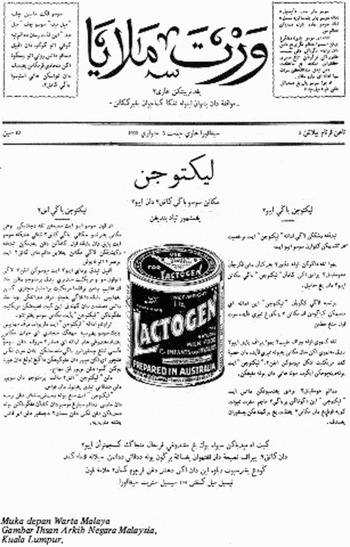
Front page of Warta Malaya, published in Singapore, carrying an advertisement for Lactogen milk (Zulkipli Mahmud, Warta Malaya: Penyambung Lidah Bangsa Melayu 1930–41 [Kuala Lumpur: United Selangor Press, 1979])

Other kinds of periodicals were equally popular; arguably the most widely read and influential of these during this period was Majalah Guru (The Teacher's Magazine), which published 206 issues over a 17-year period, an impressive record that other publications, newpapers and magazines alike, would have envied. Majalah Guru was immensely popular and well supported by the Malay reading community. It had an active membership that often contributed articles to the magazine. Most importantly, Majalah Guru, like other publications of the day, provided insights into the views of ordinary men and women who staffed the hundreds of vernacular schools spread across the Malay Peninsula. It would be careless to suggest that all teachers had access to Majalah Guru or even contributed to the discourse, but there is certainly enough evidence to show that this magazine had a tremendous reach and cut across a vast cross section of the Malay bangsa. The magazine was well supported by the various teachers' organisations that were part of Majalah Guru management team, but also beyond these states. For instance, in Johor the magazine was popular with schools and state offices and was also popular among local women, particularly in Muar and Batu Pahat. However, the popularity of Majalah Guru was not confined to just the Malay reading public. An article published in Majlis suggested that Majalah Guru was the leading magazine on the Malay Peninsula, so that even Chinese businessmen saw it as one of the best publications in which to advertise their wares. It was so popular that it attracted advertisements from Sumatran and Javanese book agents.Footnote 30
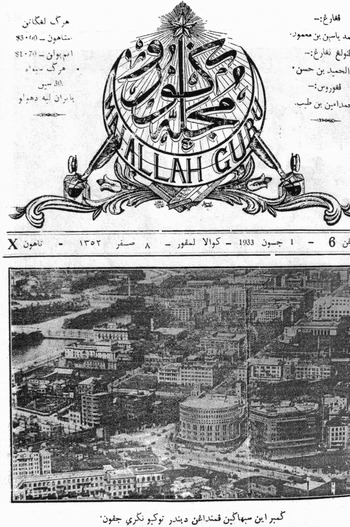
Front cover of the Teacher's Magazine (Majalah Guru), published in Seremban (Majalah Guru, 1 June 1933, p. 1)

Viewspapers: The changing nature of the Malay press
By the 1930s, Malay newspapers had been radically enhanced with opinion pieces and commentaries taking centre stage. Early newspapers like the first Malay-language paper, Jawi Peranakan (a term meaning ‘Indian Muslim’, ‘Indian Malay’, or ‘Malay with an Indian father’), which first began publishing in 1876, were focused more on news than opinion.Footnote 31 It was a modest start, but the demand for a Malay-language press grew in the first two decades of the twentieth century, giving rise to more prolific newspapers like Utusan Melayu and Lembaga Melayu. As the Malay newspaper industry matured, there was also a marked change in content. Zainal Abidin Ahmad (Za'ba), a prolific writer and scholar of Malay literature during that period, noted that these early papers were more focused on news, both local and foreign, and ‘were more given to correspondence and discussion on the niceties of Malay language and on various question of Malay customs and religion’.Footnote 32 However, the appearance of the daily Warta Malaya on 1 January 1930 was to change this orientation with its focus on opinion and commentary. Onn Ja'afar, Warta Malaya's founding editor, realised that he could not compete with the better resourced English-language newspapers to disseminate the latest news; he therefore chose to focus on publishing a wide range of opinion pieces and commentaries about Malay life, inviting and soliciting views and responses from the reading public.Footnote 33 It was a successful strategy which differentiated Warta Malaya from other newspapers, both English and Malay. The shift to publishing commentary and opinion pieces turned Warta Malaya into one of the most successful and influential newspapers of that decade; other publications followed its lead in creating a previously non-existent public space for Malay views, comments and discussions.
The Malay press began to evolve into a site for discussing and debating the circumstances of Malay life in the 1930s, but it is also important to recognise that these newspapers were structured very differently to give more space to public contributions. By the 1930s, Malay editors and journalists became more acutely aware of the challenges presented by the bangsa asing. The Malay press evolved from its role of translating English articles to one that provided a forum for debate and self-improvement. Although the press had a history dating back to Jawi Peranakan in 1876, it was only in 1929 that the editorial became a ‘permanent and prominent feature’ in the first Malay daily, Lembaga Melayu. Earlier newspapers like the first run of the ubiquitous Utusan Melayu (1907–21) carried lead articles rather than editorials, which were neither a very distinctive nor a regular feature of newspapers prior to 1930.Footnote 34 It was not until that year that editorials became a regular – and indeed recognised – set feature of Malay newspapers.
By the 1930s, opinions, commentaries, leading articles and editorials rather than news articles made up the bulk of column space in Malay publications, making them more ‘viewspapers’ than newspapers. The major papers tended to focus on opinion pieces rather than news reporting for practical reasons. For example, the periodicals of the 1930s were characterised by a relatively small staff, often comprising the editor and a few journalists. Even one of the largest Malay papers, Warta Malaya, had very few permanent staff and employed many casual stringers. The Warta Malaya team when it first started publication was staffed by the editor, Onn Ja'afar, who was assisted by two assistant editors (Ismail Abdul Kadir and Hashim), while Yusof Ishak held the post of manager.Footnote 35
Majalah Guru was no different and relied solely on the free labour of teachers. Its first editor (1924–32) was a teacher, Muhammad Datuk Muda, who was based in Seremban, Negri Sembilan. Other teachers assisted him by serving as sub-editors although they were physically located in Selangor and Malacca.Footnote 36 The editor worked to put the magazine together in Seremban while the various sub-editors were pressed into providing content from their respective states. They would edit these reports for mistakes and then send them on to Muhammad Datuk Muda in Seremban for publication. If these sub-editors could not find material from other sources, they were often required to write articles for the journal themselves.Footnote 37 There was also difficulty finding editors and journalists that had the necessary language skills because only the larger newspapers were able attract, hire and keep on staff journalists who were proficient in both Malay and English.Footnote 38 The news that came through the wire services or in the form of government notices or reports from criminal courts or legislative councils were in English and needed to be translated before they could be published in the Malay press.
This growth in the Malay press and the attendant rise in the participation in this media was carried and sustained by Malays who were relatively unaffected by the economic downturn. More recent scholarship on the economic history of the Depression in Southeast Asia argues that the Depression was not uniformly devastating for all communities.Footnote 39 Some, depending on their trade and their particular circumstances, were less affected than others, and this was equally the case in Malaya. Fixed-income Malay civil servants and farmers involved in mixed subsistence farming seemed to manage the slump better than other Malays whose livelihoods depended solely upon rubber. A. Samad Ismail, a Malay journalist and political activist in the post-war years, recounted that his family was relatively unscathed, as his father continued to draw a fixed salary as a schoolmaster in Singapore.Footnote 40 Similarly, some smaller Malay villages were relatively unaffected by the unemployment and economic upheaval of the 1930s. Muhammad Yusoff Haji Ahmad, a senior Malay civil servant who was a schoolboy in Negri Sembilan during the Depression, said that his own village was relatively unaffected although he saw abject conditions in the towns.Footnote 41 Malays involved in rubber planting and tin mining, however, were not as fortunate. Mujeini Amat has studied the plight of farm labourers in Seri Gading, Johor during this period, showing that this group of workers suffered more because work such as tapping rubber trees quickly evaporated.Footnote 42
It is clear that many Malays experienced the hardships of the Depression first-hand, but there were other more fortunate individuals who stood on the sidelines as sympathetic observers. It was this group of Malays more than any other who actively participated in the print media. They had time and resources, and with the Depression these writers gained both motivation and focus for their writing. The Depression was crucial in motivating this community of writers. As teachers, civil servants and paid employees working in various industries watched the unfolding of this economic tragedy, many were moved to look deeper into the reasons for what they saw as Malay backwardness. This translated into increased and fervent public discussion in the vernacular press of the time about the plight and the problems of Malays.
Malay editors and journalists are a well-studied group in Malaysian historiography. For example, Roff has detailed their contribution to nationalism, Milner has studied them in terms of political consciousness, and, more recently, Deborah Johnson has evaluated their contribution to the intellectual climate of Malaysia.Footnote 43 Editors and journalists were opinion leaders within the Malay community, and indeed in the print media. In reading these newspapers, there is a sense that these writers believed that they knew what was the right direction or the correct action to take and that it was their role to pass on this knowledge through their writings in the press. They saw themselves as engaged in a constructive process of rebuilding the Malay community.
The journalists and the people who published newspapers were motivated by a genuine concern for Malays. They saw their mission as redeeming Malays from their backwardness. The intellectual Za'ba, another prolific contributor to newspapers, recalled that Malay journalists exhorted their bangsa (race) to ‘bestir themselves and to take their due share in the activities of modern life’.Footnote 44 For Za'ba and many others, it was plain to see that Malays were lagging behind the foreign races, and this rankled all the more because it was their homeland. Muhammad Yusuf Ahmad, who was the driving force behind the success of Majalah Guru, wrote in a letter to Za'ba that he would start up a newspaper on his own called ‘Wake up Malays!’ if he had the financial resources.Footnote 45 Writers felt, as we saw earlier in the article, that they had a responsibility (kewajipan) to impart knowledge to their fellow Malays.
As opinion leaders, these editors and journalists set the tone for what was to be published in newspapers. It might help to understand how a diverse set of writers seemed to share a common concern. That these individuals were constantly interacting, having conversations, visiting each other, and reading and responding to each others' work probably helped shape, clarify or even sharpen their thinking about many of the problems facing their community — issues that were the grist of Malay newspaper commentary. Editors and journalists sought each other out, and this collegiality probably stemmed from their involvement in the same field. When on travels, editors visited other editors and journalists, spending hours talking about the business of newspapers and probably the issues canvassed in their papers.Footnote 46 However, it might be well worth considering that this collegiality was also the product of their belief that they were engaged in a common enterprise. Those involved with Malay newspapers were often found attending and participating in the same events. For instance, they were active participants, alongside Malay civil servants, at public debates at the Sultan Sulaiman Club for senior Malay officials. They often congregated at the club to attend debates on the theme of Malay progress that they wrote about in their newspapers.
Perhaps a measure of how emotionally invested these editors and journalists were in their common enterprise can be found in the way they reacted to each other's writings. Sometimes, the newspapers and other periodicals earned each other's approval. Pengasuh, a journal in Kelantan, told its readers in September 1929 that Majalah Guru was a magazine for the people and should be subscribed to by Malays, calling it ‘one of our beloved companions.’Footnote 47 At other times, when they felt that a fellow traveller was putting out the wrong message, they earned each other's wrath. In an angry rant, Muhammad Yusuf Ahmad of Majalah Guru, for example, criticised newspapers like Saudara, Dewasa, Bulan Melayu and Lidah Benar for publishing articles of little substance and devoid of the message of progress. He likened it to selling coconuts that had a thick external husk but with a really small inner shell with very little filling.Footnote 48
The community of writers who wrote in the Malay press extended beyond journalists, editors and paid staffwriters. It was the norm for newspapers and periodicals to rely on contributors who wrote for free and sent in articles of interest from various parts of the Peninsula.Footnote 49 There was little to distinguish the long letter from the article; and writers preferred to use pseudonyms, an ‘exceedingly common’ practice, to protect themselves from possible recrimination from officials and superiors.Footnote 50 Individual writers often used different pseudonyms for different subjects that they were writing about. For example, Za'ba wrote under three pseudonyms: ‘Zai Penjelmaan’ (Zai the Incarnate) for literary matters, ‘Patriot’ for comments on Malay society; and Za'ba for language and letters.Footnote 51 Ahmad Boestamam, a prolific writer and later Malay politician, recounted in his memoirs that correspondents were not only unpaid but went to some expense to publish their articles, in particular having to pay their own postage. He said that even if an article was published, the correspondent did not receive a free copy.Footnote 52 This was a wide pool of correspondents united by their common background as literate individuals and more often than not educated in Malay schools. It is hard to say precisely who they were because many of them preferred the anonymity of pseudonyms when writing to the Malay press. However, from some of the articles we can see that teachers were frequent contributors as well as students of all ages, policemen, penghulu (village headmen) and other civil servants.
Milner notes that ‘newspapers could bring a new directness and reciprocity to the relationship between author and audience…the new journalists went so far as to ask their readers to reply’. He cites the early example of Jawi Peranakan being overwhelmed by the ‘sheer volume of correspondence which their publication inspired’. He goes on to point out that through this regular correspondence, editors/writers and their readers ‘established…an interpersonal relationship’ and created a ‘new rhetorical situation’ whereby ‘reader and writer communed across the written page.’Footnote 53 Similarly, in the 1930s, Malay newspapers attracted and courted replies to their views. It would not be misplaced to argue that the editors wanted to involve the Malay reading and writing public in the process of refining concepts or ideologies elucidated by the newspapers. Many papers privileged Surat Kiriman, Letters to the Editor, above other articles. In Warta Malaya, there were countless instances in which letters from the public were the first substantive articles of the paper.
Surat Kiriman served a variety of functions and they were a tremendous resource for at least literate Malays of every stratum of society. This was a site for discussion in the community. It was an educational tool — schoolchildren wrote in with quizzes (teka-teki). It was an instrument of communication, the equivalent of an open letter where Malays wrote descriptions about life in their village (kampung). It was a place to voice complaints, a site for passing on information, advice, teachings and guidance to the larger Malay community. Malays probably regarded it as attractive to contribute to this lively public space because it gave the individual the ability to operate in a space larger than his social position might have allowed in traditional society.
The invitation to readers to participate showed that letter writers were as active participants as the other categories of authors. Moreover, the Surat Kiriman was an active way of engaging the community in dealing with their common set of problems. These columns provided the Malay reading community an opportunity to affirm their ideas or to engage in a debate about the validity of the advice put out in the press, becoming a basis for fine-tuning newspaper-sponsored advice, and could compel an editor to respond or prompt some level of coverage. For instance, Onn Ja'afar, the editor of Warta Malaya, wrote an editorial responding to unpublished letters accusing bangsa asing teachers of treating bangsa Melayu students unfairly in English schools.Footnote 54
In enlarging the community of writers to the press to include letter writers, Warta Malaya, in particular, demanded new standards for its letter writers. Within its first two weeks of publication, on 13 January 1930, Warta Malaya insisted that any persons sending in Surat Kiriman must submit their real names and addresses, even if they chose to publish their letter under a pseudonym. This was quite a departure from the usual practice of allowing anonymity. Warta Malaya was making clear that people needed to take responsibility for their views, and that participation in this public sphere required the courage of their convictions and the willingness to identify themselves for further debate. The editors required that the contributions be constructive and warned against using the Surat Kiriman as a forum for personal grievances.Footnote 55 The Surat Kiriman was a site for social action and discussion as well as debate over community concerns.
Reading and listening: Re-evaluating the bourgeois public sphere
The Malay public sphere should not merely be seen as the exclusive domain of a rising middle class who read newspapers and whose participation sustained and financed the print media, as Milner has argued.Footnote 56 Such a Habermasian notion of a purely bourgeois public sphere underestimates the wider participation of other groups in the making of public opinion.Footnote 57 Disenfranchised communities and other minority groups not necessarily associated with the majority, middle-class elite groupings have also been influential in shaping the public discourse. For instance, Nancy Fraser criticises the concept of a single public sphere for failing to reflect the reality of public participation. She argues that it includes marginal groups who also participate in the process as ‘subaltern counterpublics’.Footnote 58 Such terminology brings back into focus the contributions of women and the working classes in the public sphere.
Similarly, the Malay press should be seen as larger than just the community of literate, middle class/bourgeois writers and readers. It included ‘listeners’, many of whom would have been illiterate in the formal sense of the word.Footnote 59 A lack of formal literacy should not be considered as limiting the scope of their participation. Literate members of the community could represent themselves in writing and form the most evident and active participants in the Malay press. However, these literate members were not the only ones who shared patterns of reasoning, causal beliefs and convictions about the solutions to problems facing the community. There was a larger community of readers and listeners who actively discussed these issues and whose arguments and sentiments inevitably made their way into the press.
Colonial Malaya like India, to use Christopher A. Bayly's concept, was a ‘literacy aware’ community. Bayly has shown that although certain sections of the population did not have comprehensive reading and writing skills, they nonetheless had limited literacy skills but also an ‘awareness of the uses of literacy’.Footnote 60 The point that Bayly is making is that formal literacy was by no means an indicator of how educated or knowledgeable a population was. Bayly recounts his bemusement in present-day India at what he calls the ‘paradox of low literacy and knowledge’ when ‘apparently uneducated people would come up to one in the bazaar to discourse on the demerits of Baroness Thatcher or Mr Gorbachev’.Footnote 61 This was similarly true for Malaya of the 1930s. Only 48.3 per cent of all adult Malay males in both the rural and urban areas could read and write by 1931.Footnote 62 Although a significant achievement, this was still low in comparison to their European and East Asian counterparts. However, listening to some learned man reading newspapers was commonplace in Malaya. For instance, Majalah Guru noted that newspapers and periodicals were shared among the reading population. Schools received free copies of Majalah Guru; by 1931, the periodical was distributed to upwards of 470 schools, staffed by 1,700 teachers and attended by a total of 76,000 students. More than half of all Malay schoolteachers in the Malay states read it.Footnote 63
Circulation figures, often used as an indication of the newspaper and periodical reading population, are not a helpful indicator in the case of British Malaya. Roff, for instance, noted that sales and circulation figures were an ‘insufficient index of the penetration of printed matter in peasant societies undergoing modernisation’. Although circulation figures for most of the major newspapers and magazines were relatively low, each edition of these publications was ‘read anything from a dozen to a hundred times’.Footnote 64 Scholars of Malaya have generally agreed that changes in the form of the texts from hikayats (traditional texts) to newspapers did not immediately change the way in which the Malay public consumed them.Footnote 65 Many still participated in this activity by having the newspapers read to them. Za'ba described it best in 1941:
There is no doubt that Malay newspapers and magazines are exerting a strong influence in shaping public opinion among their Malay readers, in spreading general knowledge and shaking off the apathy of Malays towards progress. To say nothing of the towns where these papers are always available at every Malay bookshop and some of them at the various Malay clubs, and read by the motor car drivers, one notices that even the peasant folks of the kampungs are also taking a keen interest in what was said in the suratkhabar (newspaper) about other parts of Malaya and the world. Often, in the evening, one sees at the wayside Chinese shop some lettered man, perhaps an old guru (teacher) of the local school or perhaps the local penghulu (village head), reading one or other of these papers, and a little crowd of elderly people less literate than he eagerly listening, questioning and commenting around him.Footnote 66
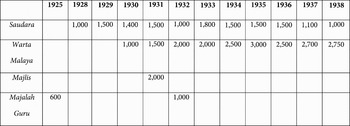
Circulation figures by year (Sources: The figures for Saudara and Warta Malaya are from Roff, Bibliography, p. 22. The figure for Majlis is from Proudfoot, ‘Pre war Malay periodicals’, p. 11. Majalah Guru figures are from Ali bin Ahmad, Majalah Guru, p. 87)

There was an active ‘listenership’ for newspapers, drawing in Malays who were not literate. They were not just silent imbibers of the content and advice of newspapers but participants in the process offering opinion and asking questions. Given the prevailing content of newspapers, they were participating in the discussions about the future of the Malay bangsa. In this regard, the ‘new rhetorical situation’ should not be limited to only readers who could ‘commune across the page’ with editors and writers; it should also include listeners who sat among readers probing and questioning, possibly inspiring others to ask questions and offer comments through the Surat Kiriman. It is not difficult to imagine the robust discussions that took place in these small groups.
Conclusion
By the 1930s, the Malay public sphere was no longer solely the domain of the Malay middle or bourgeois class. It involved a wider range of Malays, both the literate and those who were literacy-aware. Both Roff and Milner have argued persuasively that the elite and the intelligentsia played a leading role in the Malay press. Roff sees the press as a crucial dimension in the growth of Malay nationalism, while Milner argues that the discourses in the press were part and parcel of the discursive tension in an emerging bourgeois public sphere in Malaya. Undoubtedly, this group of literate Malays played a key role in the Malay press. However, in extending our lens by looking at the structure of newspapers that placed greater emphasis on commentary, views, opinions, letters and contributions from a wider range of participants, we are able to see the dynamic interaction between writers, readers and listeners in creating a new rhetorical situation in Malaya. New forms of public-opinion-making like the editorial, increased participation in the media through letters of the editor and contributors' articles, public readings of newspapers, and the extension of newspapers into classrooms meant that a broader cross-section of Malays were able to access debates and discussions on issues of the day.
The emergence of a vibrant Malay newspaper scene provided a medium for the airing of Malay sentiment and tensions about the challenges they faced in the 1930s. Newspapers became a pulpit for members of the community – not merely elites – to create a new economic discourse about the need for Malays to become more competitive in order to wrest back the economy from Chinese entrepreneurs. The changing circumstances of life in Malaya gave rise to inter-communal tensions — particularly between Malays, who saw themselves as the legitimate owners of the country, and the bangsa asing, who were fast becoming a permanent community. There was a growing Malay unease with demographic changes brought about by the non-Malay immigrant giving up the status of sojourner in favour of becoming a permanent settler. Malays were becoming a minority group in their own land, and these latent tensions found an outlet in the political challenges to Malay authority in the late 1920s and early 1930s.
However, it was the onset of the Great Depression that created a rising ‘consciousness’ (kesedaran) of the weakened Malay position, especially when compared to the achievements of other ethnic groups like the Chinese and Indians. The impact of the Depression kept economic issues on the front burner of Malay commentary and opinion in newspapers, coinciding as it did with the political challenges of the period. It was the Depression that brought a much sharper dimension to the anxieties surfacing in the Malay press, and it increased the level of discussion about economic weakness, which was perceived as having negative consequences for Malay political power and for the future of Malays as a people.
Economics more than politics was the central focus of the discussions within the pages of newspapers in the 1930s. Although later left-wing radicals like Ibrahim Yaacob would decry economics and politics as a false dichotomy, participants in the discourse of newspapers were far more motivated by the economic situation because of the passage of the Depression. The downturn added a much sharper dimension to Malay anxieties about their ability to control their own economic destiny. Perhaps by analysing this new economic discourse, we may be able to see the basic morphology of a future Malay economic nationalism rooted not in elite politics but a larger ideological belief in the Malay public sphere about economic rights.